

1.61 Design Workshop Wraps a 600-Square-Meter Café in Vietnam in Sculptural Burgundy Drama
Reden Café & Bistro pairs a helical staircase, mosaic floors, and deep red interiors to rethink Vietnamese hospitality space.


Red is a risky move in hospitality interiors. Lean too hard and you get a nightclub. Pull back too far and the gesture reads as timid. At Reden Café & Bistro in Vietnam, 1.61 Design Workshop under lead architect Ha Pham commits fully: 600 square meters of dining, lounge, and bar space drenched in burgundy, maroon, and crimson, offset by mosaic tile, blue service walls, and transparent acrylic furniture that keeps the palette from collapsing into a single note.
What makes this project genuinely interesting is not the color itself but the structural choreography that organizes it. A helical staircase in painted steel anchors a double-height volume, rounded columns punctuate the dining floor like stage props, and arched window mullions frame the garden beyond with a softness that counterbalances the intensity of everything inside. The café is not decorated red; it is architecturally conceived as red, and the distinction matters.
The Staircase as Protagonist
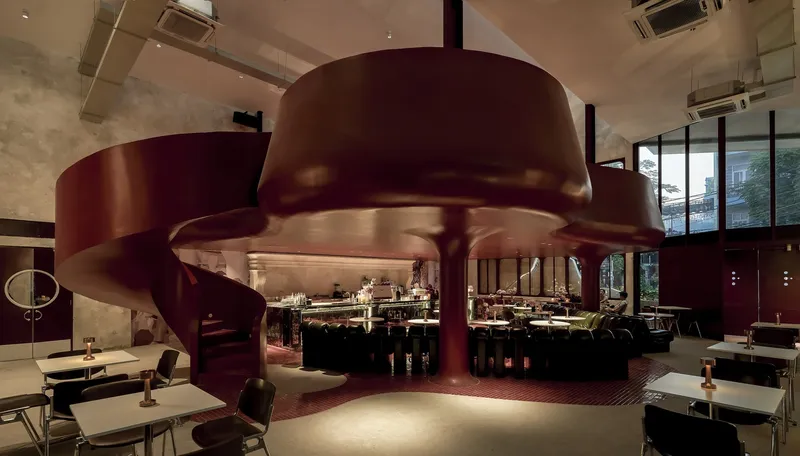
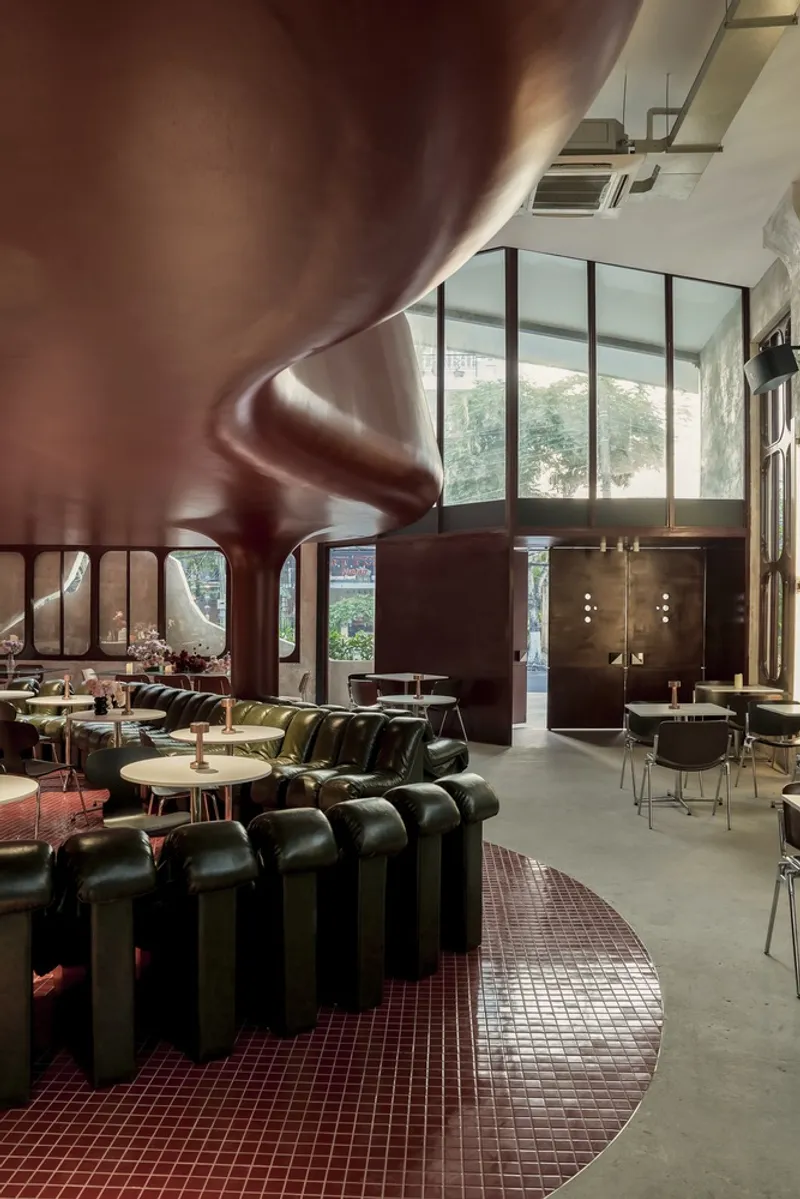
The sculptural helical staircase is the single most commanding element here. Fabricated from burgundy-painted metal, it spirals down from an upper mezzanine into the main dining room, functioning as both circulation and a visual anchor for the double-height volume. Its tight radius and continuous ribbon form give the piece a kinetic quality, as if the stair is still unwinding.
Seen from below, surrounded by tufted seating and mosaic tile flooring, the stair transforms an otherwise conventional two-level plan into something closer to theater. Guests sitting beneath it are framed by its curves, which is a deliberate effect. The staircase does not merely connect floors; it generates the spatial event that the rest of the interior revolves around.
Banquettes, Columns, and the Perimeter Game
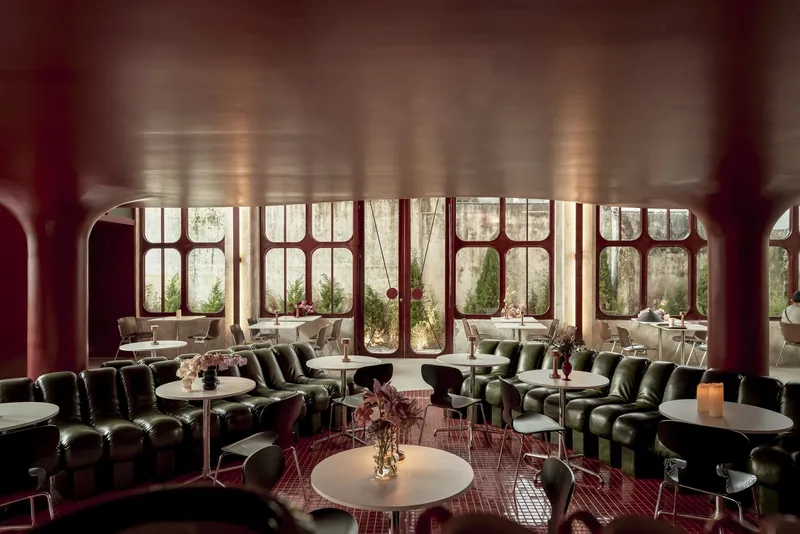
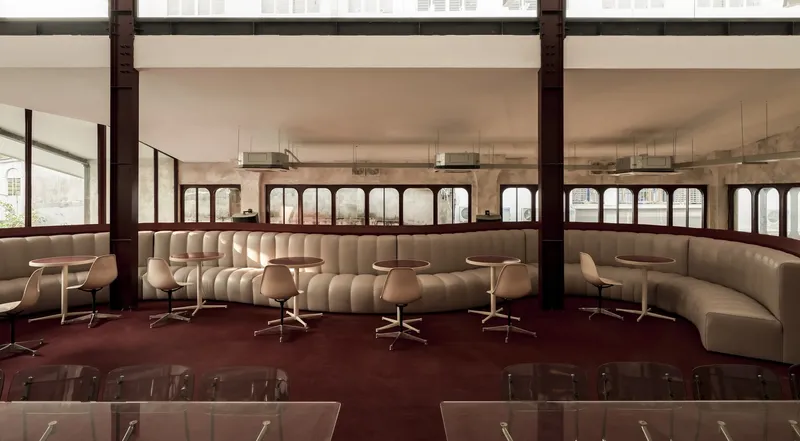
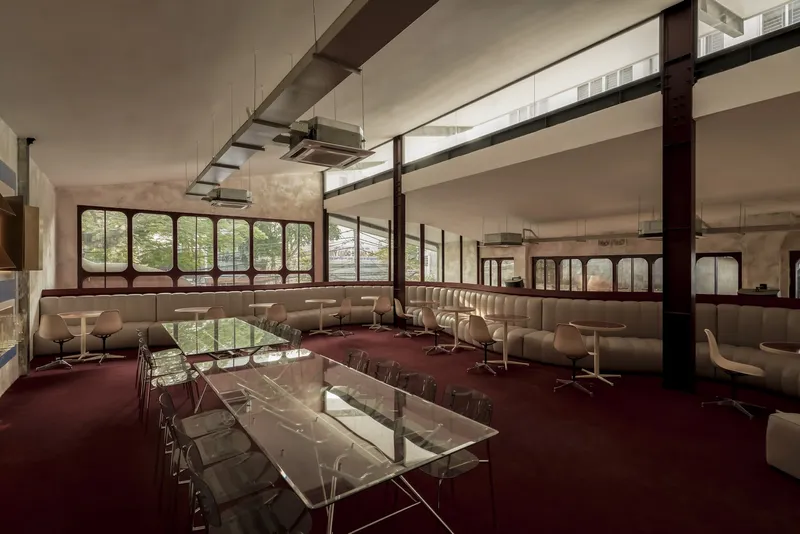
Along the perimeter, continuous curved banquettes in tufted upholstery run beneath arched windows, wrapping around rounded steel columns that read as both structural necessity and decorative rhythm. The columns are slender enough not to block sightlines toward the garden but substantial enough to segment the long banquette into semi-private zones without walls.
The central communal table introduces a completely different material register: transparent acrylic chairs on a burgundy carpet, flanked by the same curved banquettes. The transparency is a smart tactical choice. In a space this saturated, opaque seating would have thickened the visual density past the point of comfort. The acrylic creates breathing room, letting the floor and walls carry the color load.
A Ceiling That Sculpts the Room
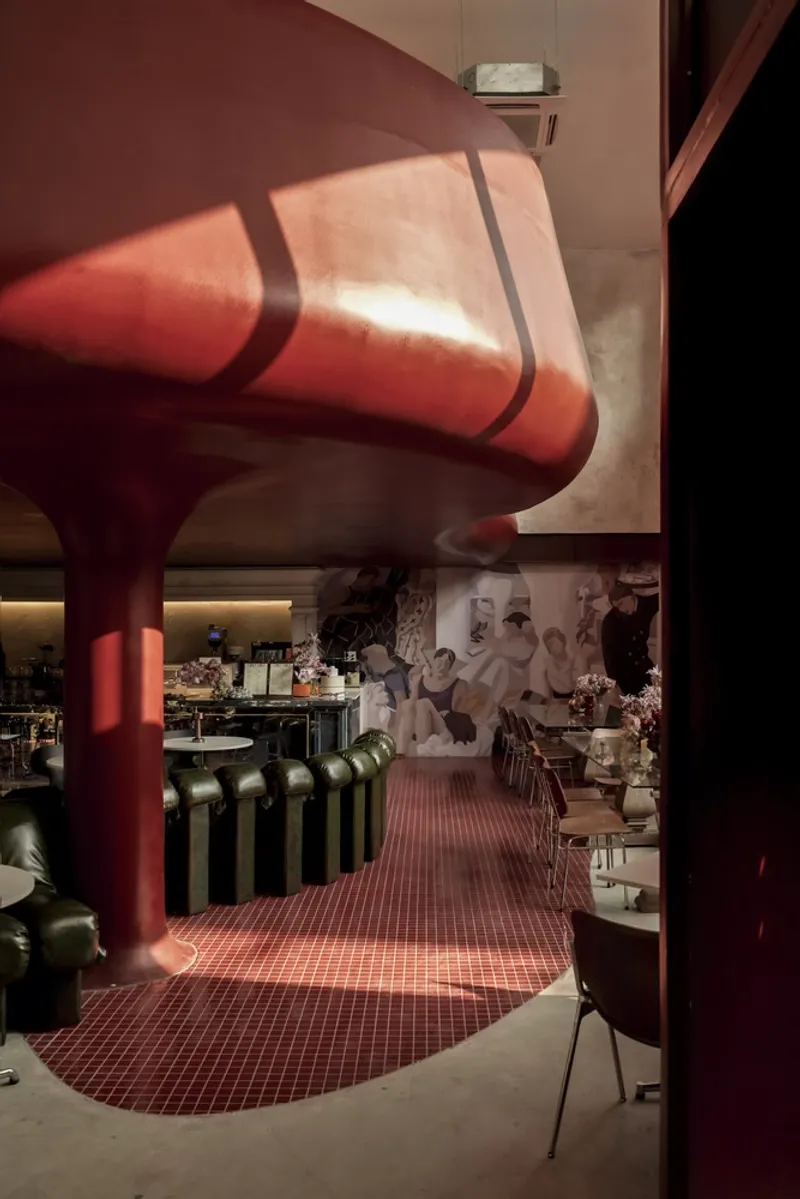
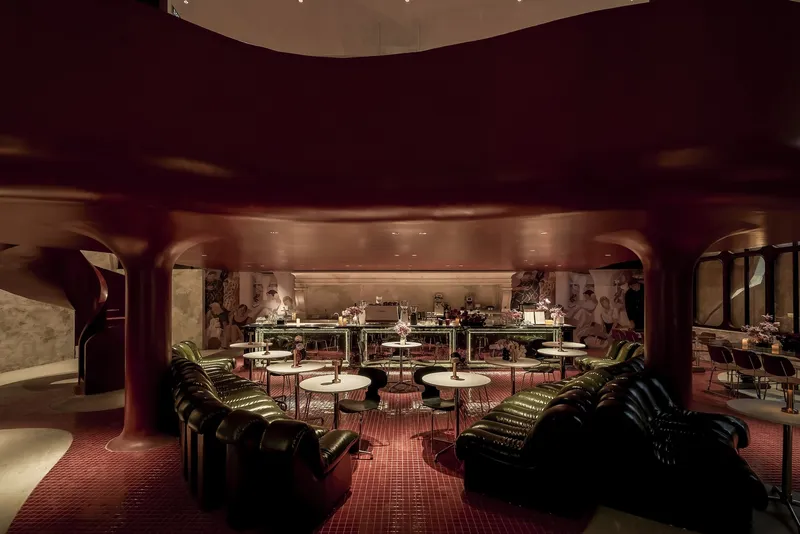
In the lower-ceilinged lounge zones, red tubular columns support a curved soffit that presses down gently over tiled dining areas and tufted seating. The effect is deliberately intimate, almost grotto-like, compressing the vertical dimension to create a sense of enclosure that the double-height staircase zone releases. It is classic section manipulation: compress and expand, compress and expand.
Warm pendant lights hang at low heights in these compressed zones, reinforcing the intimacy. The curved ceiling is not just decorative; it controls the acoustic envelope as well, containing conversation in the lounge areas while allowing the taller volumes to absorb ambient noise. The result is a café that does not feel uniformly loud, an underappreciated quality in Vietnamese hospitality spaces that tend toward open, reverberant plans.
Blue as Counterpoint
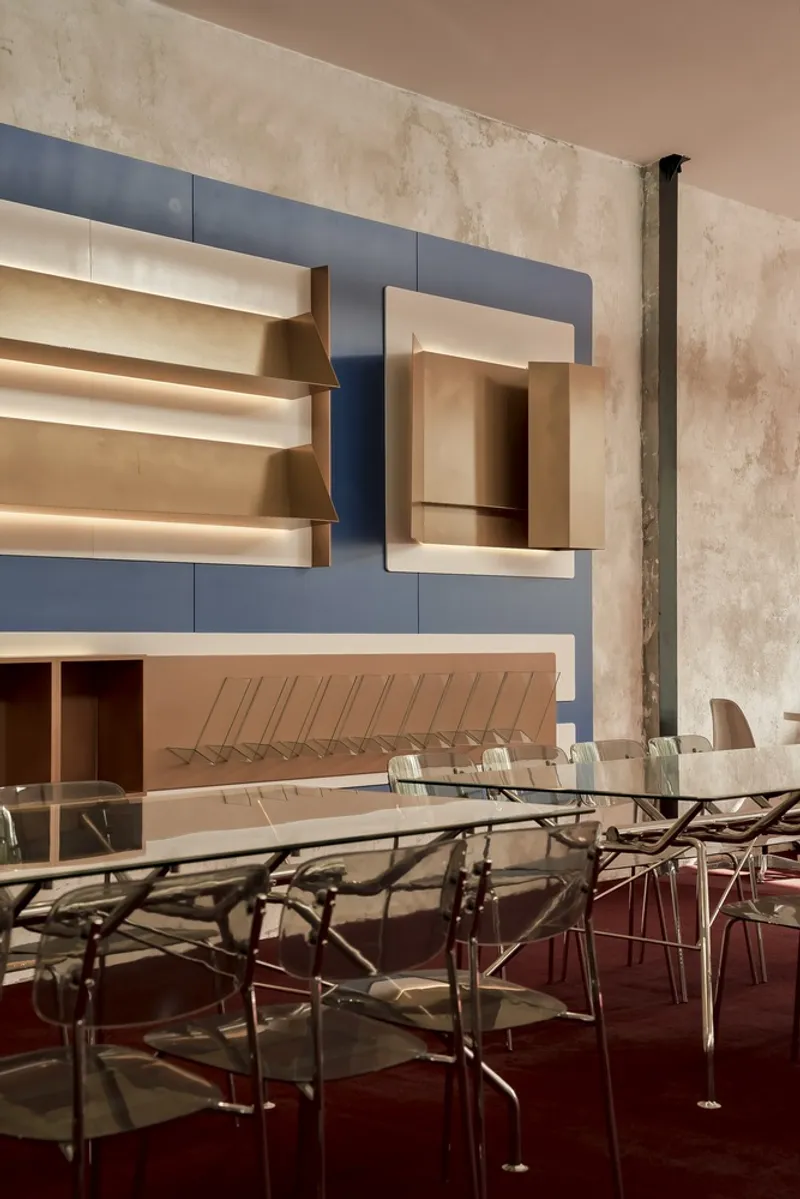
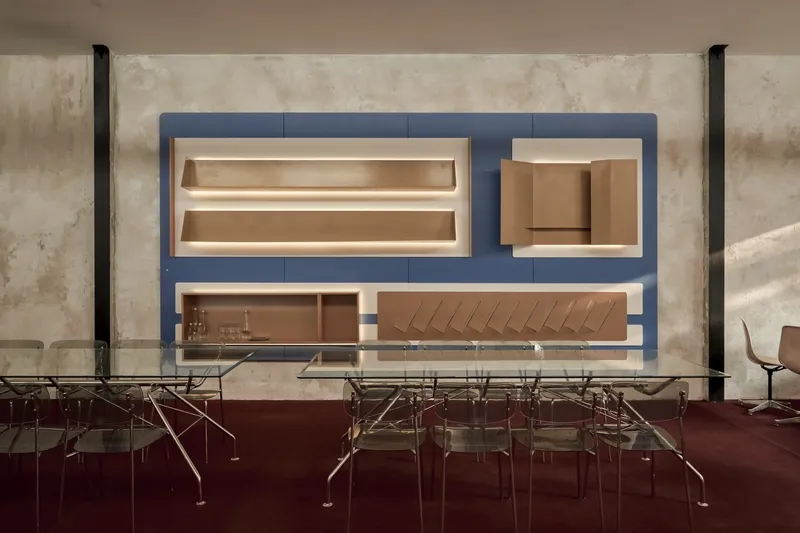
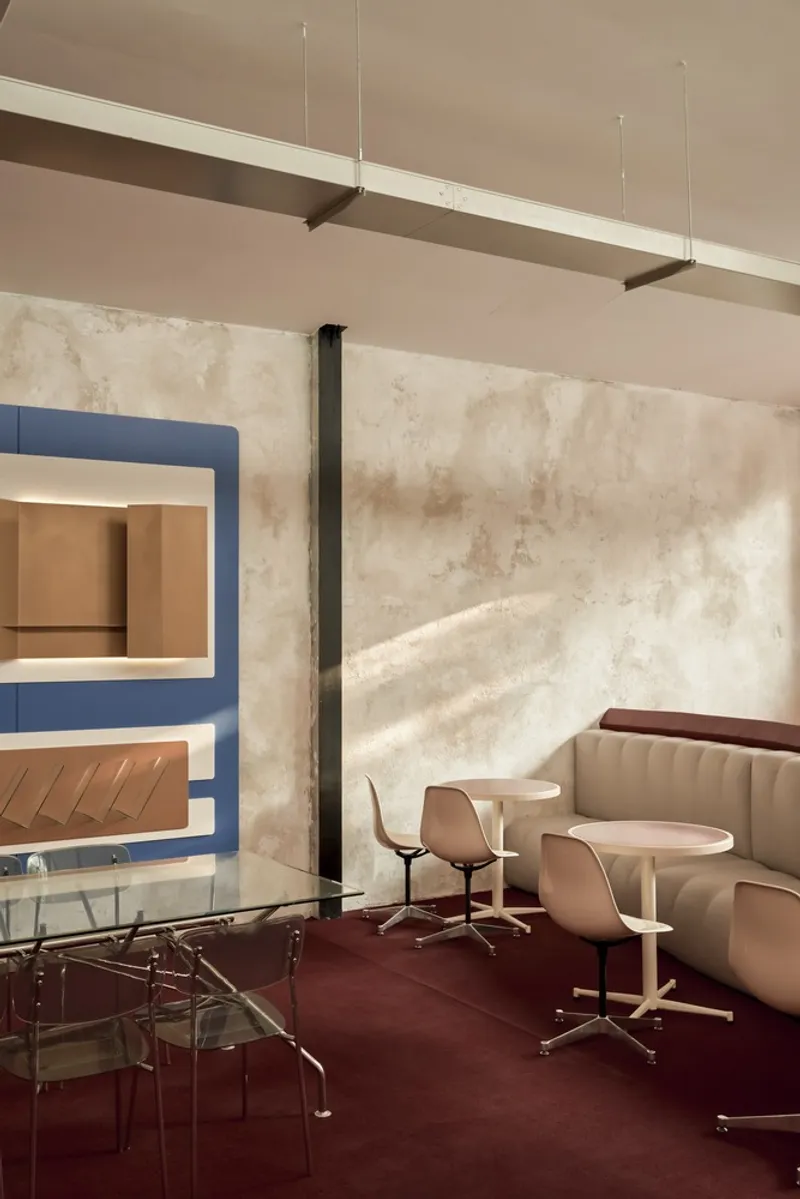
If the entire interior were red, the project would exhaust you within minutes. The blue-paneled service wall and bar counter operate as a chromatic pressure valve. Recessed niches display bottles against illuminated blue shelving, and a framed bar alcove near a textured plaster wall introduces an entirely different mood: cooler, more composed, closer to a cocktail bar than a café.
The juxtaposition is bold but carefully measured. Blue occupies the service and functional zones, essentially the back-of-house face that guests interact with when ordering. Red dominates the social and lounge territories. This color zoning creates an intuitive wayfinding logic: you move from red (sit, relax) to blue (order, engage), and the shift registers subconsciously before you are even aware of it.
Garden Interface and the Arched Frame
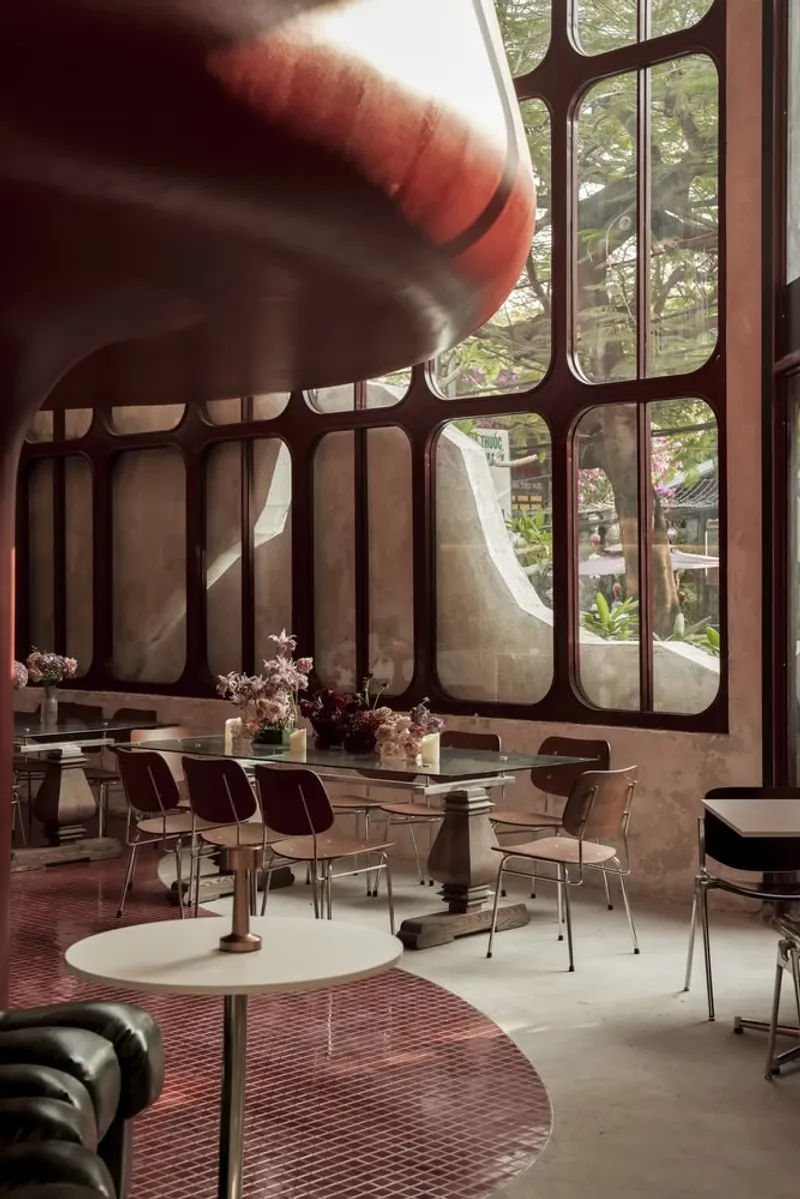
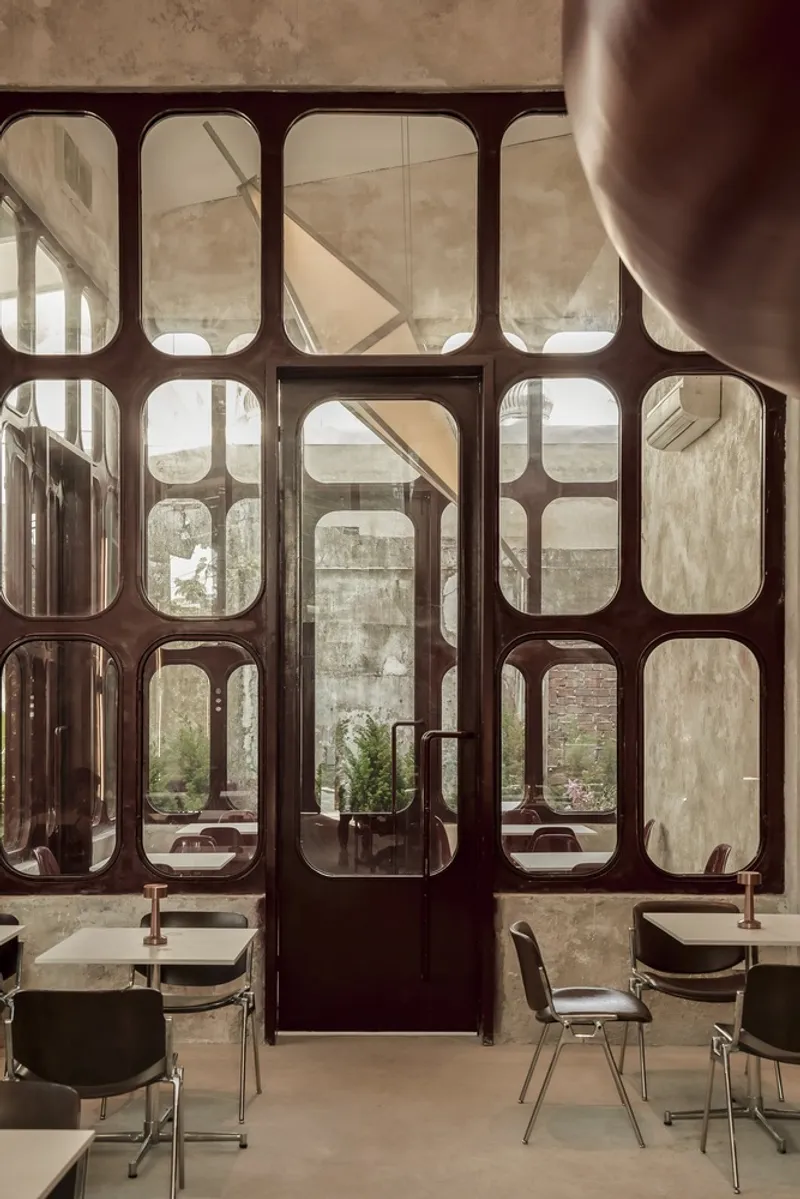
The large arched windows do more than admit natural light. Their rounded mullions frame the lush garden beyond as a series of green vignettes that serve as chromatic relief against the red interior. The glazed doors opening to a courtyard with weathered walls extend this dialogue between the curated interior and a more casual, textured exterior.
An inflatable sculptural element visible above the dining area near these windows adds a playful, almost surreal note. It signals that the architects are not treating the red palette with deadly seriousness; there is wit in this project, a willingness to introduce the unexpected. The garden views, the sculpture, and the weathered courtyard walls collectively prevent the interior from becoming hermetically sealed in its own aesthetic intensity.
Overhead: Mosaic and Modular Seating
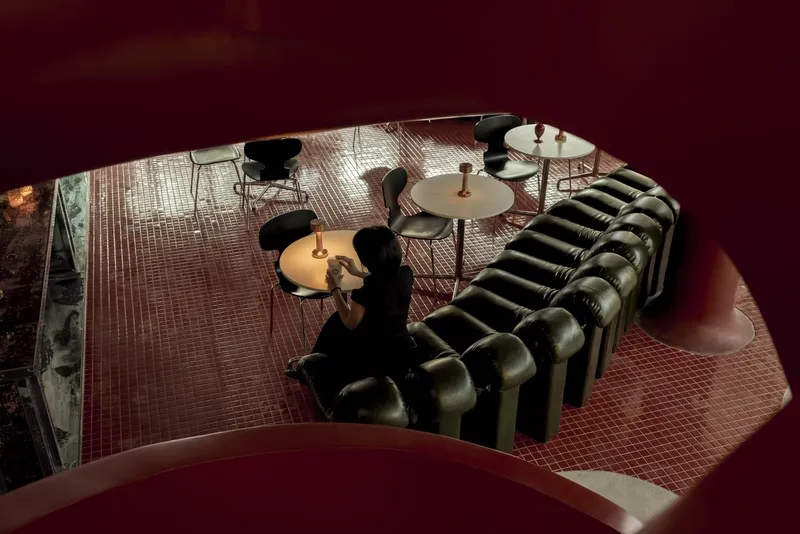
Seen from above, the mosaic tile flooring reveals a careful pattern logic that is mostly invisible at eye level. Round tables and modular seating create loose clusters rather than rigid rows, encouraging the kind of spontaneous social configuration that makes a café feel alive rather than staged. The tiling anchors each zone with geometric consistency while the furniture floats freely above it.
This overhead view also exposes the plan's real intelligence: circulation paths are generous, avoiding the cramped aisles that plague many 600-square-meter hospitality spaces trying to maximize covers. Ha Pham and the team clearly prioritized spatial generosity over seat count, which is a decision that pays dividends in atmosphere and repeat visits.
Why This Project Matters
Reden Café & Bistro matters because it treats color as architecture, not decoration. The red is not applied to a neutral shell; it is embedded in the structural columns, the staircase, the ceiling soffits, and the floor tiles. This totality of commitment gives the project a coherence that most themed hospitality interiors never achieve. When color is structural rather than cosmetic, it survives trends.
More broadly, the project signals that Vietnamese café culture, already one of the most architecturally inventive hospitality scenes in Southeast Asia, continues to push its own boundaries. 1.61 Design Workshop has delivered a space that is photogenic without being shallow, dramatic without being exhausting, and deeply specific to its context without relying on cliché. In an era of beige minimalism, this is a welcome provocation.
Reden Café & Bistro by 1.61 Design Workshop, lead architect Ha Pham. Located in Vietnam. 600 m². Completed 2024. Photography by Phú Đào.
About the Studio
Share Your Own Work on uni.xyz
If projects like this are the kind of work you want to make, uni.xyz is a place to publish your own, find collaborators, and enter design competitions.


Popular Articles
Popular articles from the community


The Amber Palace Opera: A Geological Fiction Surfaces on Tallinn's Baltic Waterfront
Pierre Brillard reimagines a Baltic legend as a public landscape, opera house, and waterfront promenade rooted in Tallinn's coastal identity.

Cloaked Colonization: A Mobile Underwater Habitat That Moves Like a Fish
Micah Abaya's shortlisted EHC Pacific entry reimagines ocean settlement as a dispersed network of self-sustaining architectural organisms.

Manzana Morphosis: Stretching Barcelona's Grid into a Living Landscape for 2050
A radical reworking of the Eixample manzana turns density into a tool for generous public space, vertical ecology, and environmental performance.

Singing Woman: Contemporary Architecture Inspired by Estonia’s Voice and the Sea
Singing Woman turns Estonia’s song culture into flowing opera house architecture, blending public life, landscape, sea, and national memory.

Similar Reads
You might also enjoy these articles

FAMM Arquitectura Organizes Ten Villas Around Courtyards and Jungle in Nosara, Costa Rica
El Molino pairs two elongated volumes with deep overhangs and timber louvers to build a compact coastal community five minutes from the beach.
Oscar Niemeyer's Ibirapuera Park Pavilions Define São Paulo's Cultural Identity in Concrete and Curve
A constellation of modernist volumes set within São Paulo's most important urban park, conceived for the city's 400th anniversary in 1954.
Sanjay Puri Architects Wraps a Jaipur Office Tower in Capsule-Shaped Green Buffers
A nine-level climate-responsive workplace near Jaipur Airport uses stacked planter terraces and aluminium screens to fight 40°C heat.
RHO Converts a Berlin Spree-Side Industrial Courtyard into Enkime's 1,000 m² Agency Headquarters
A social media agency's new home in Charlottenburg trades glossy branding for concrete waffle ceilings, glazed tile, and sheer curtains.

Explore Cafe and Restaurant Design Competitions
Discover active competitions in this discipline

Challenge to design luxury tourism on rails

Challenge to reimagine the Iron Throne

Photograph architecture without architects

VR headsets Storefront design competition
Comments (0)
Please login or sign up to add comments
No comments yet. Be the first to comment!