
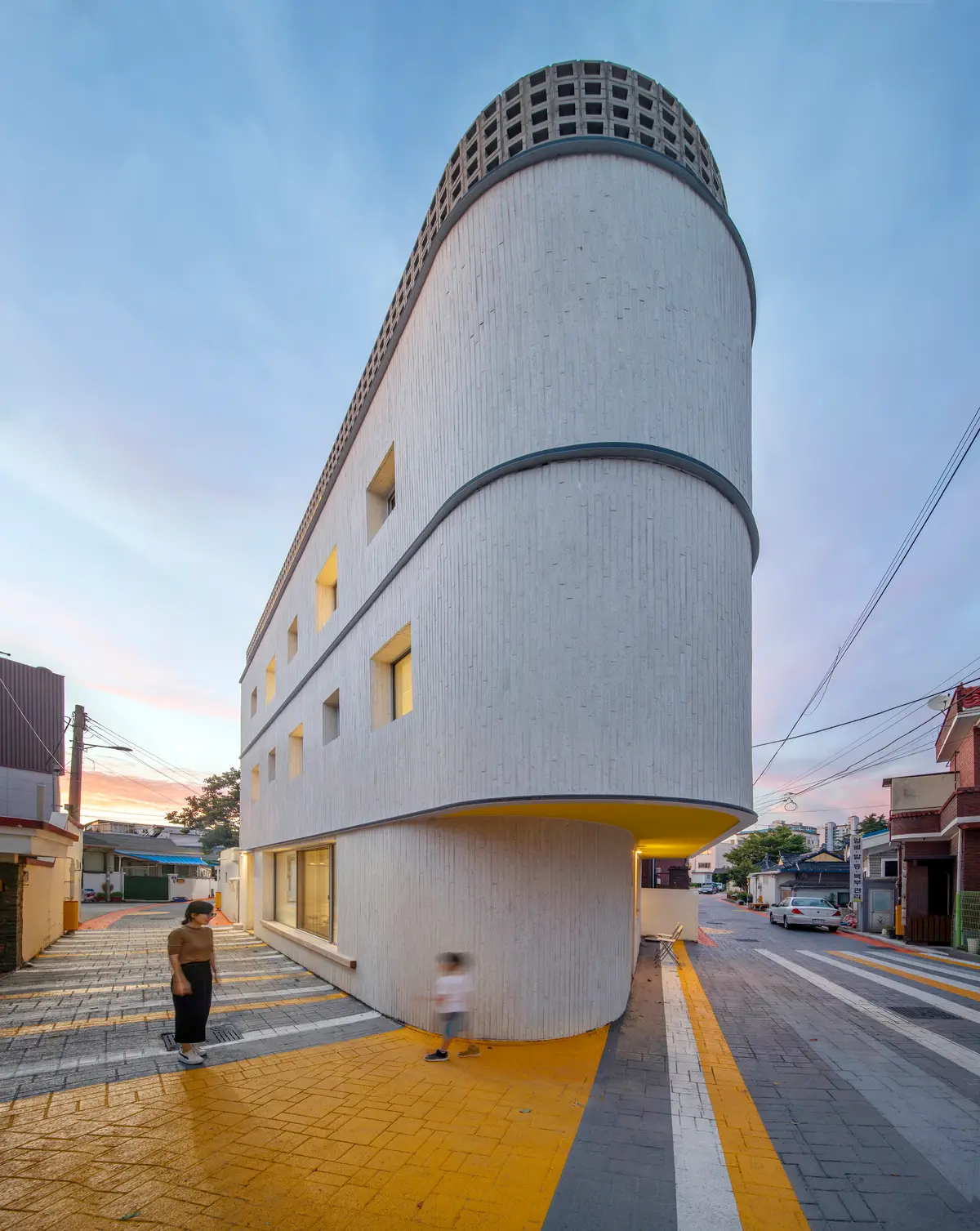
YOAP Architects Round a Corner in Yeongcheon with a Cylindrical Community Hub
A 197-square-meter brick and ribbed-clad tower turns a forgotten alley corner in South Korea into a public garden with a low threshold.


Community centers in small Korean cities tend to be anonymous boxes, funded by municipal budgets and forgotten the moment the ribbon is cut. The Wansantrak Community Center in Yeongcheon, designed by YOAP architects, refuses that fate. Built on a tiny 137-square-meter triangular site at the corner of an old alley in Wansandong, the building wraps itself into a compact cylindrical tower that reads less like institutional infrastructure and more like a small lighthouse marking the intersection of two neighborhood paths.
What makes this project genuinely interesting is the way it treats the boundary between building and street as the real design problem. The project began with a kick-off meeting where residents voiced their wishes for the site, which had previously been nothing more than a passageway. Rather than filling that site with floor area and calling it done, architects Jeong Sang Kyong, Ryoo In Keun, and Kim Doran extended their design outward: the alley itself was redesigned alongside the building, with yellow-striped paving, a generous soffit overhang, and a crosswalk that pulls pedestrians directly toward the entrance. The result is a public room that starts on the pavement.
A Cylinder on a Corner
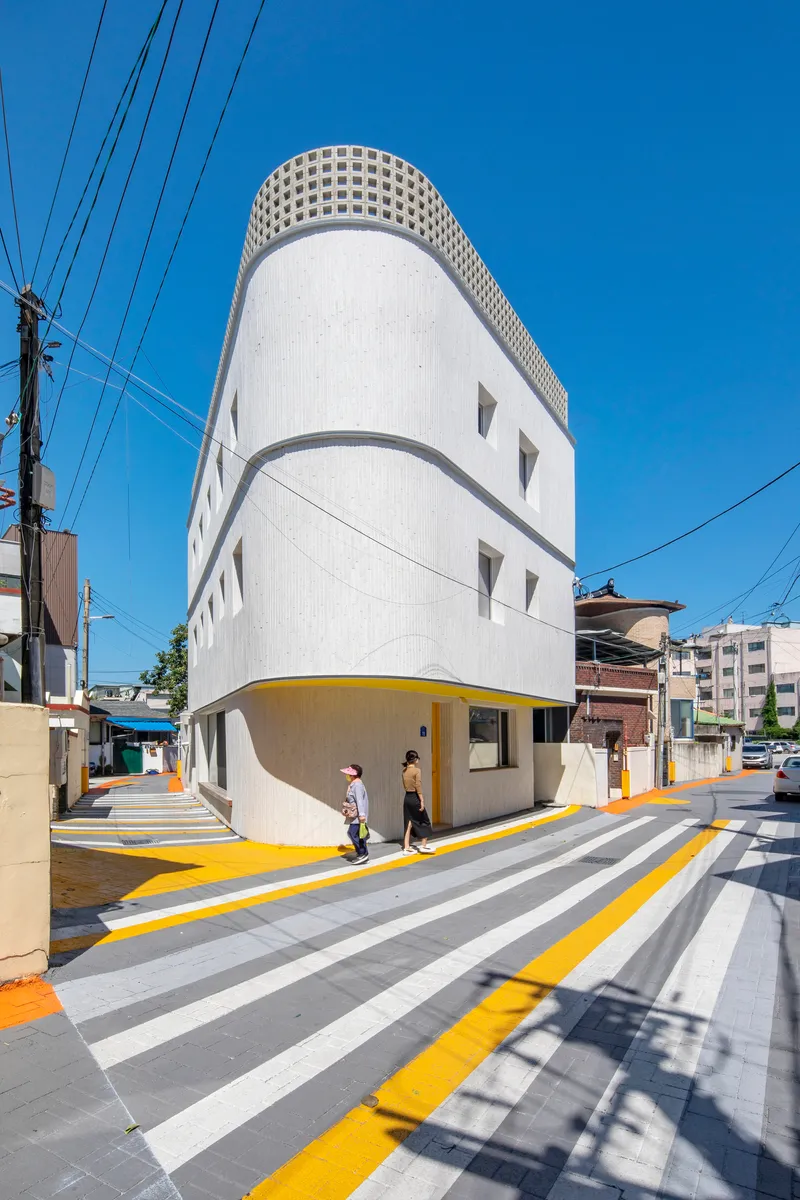
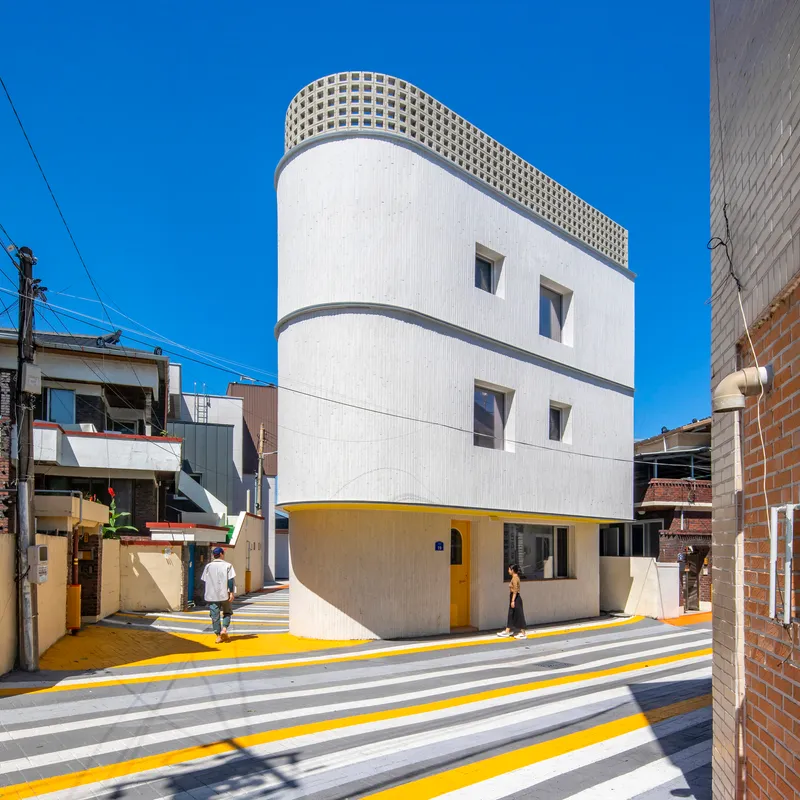

The building's rounded form is a direct response to its triangular footprint. Rather than carving a box into an awkward lot, YOAP let the geometry of the site generate a soft curve that wraps the corner and eliminates dead angles at street level. The vertical ribbed cladding in white accentuates the tower's height, making it visible from several blocks away, while a perforated lattice parapet crowns the rooftop and gives the profile a civic presence that belies its modest size.
Brick, the primary structural material, is largely concealed on the exterior by the ribbed skin but exposed inside as a legible reminder of the construction. The latticed crown does double duty: it screens rooftop activities from neighboring sightlines while allowing light and breeze to pass through, turning the top of the building into a usable terrace rather than dead mechanical space.
Yellow as Invitation
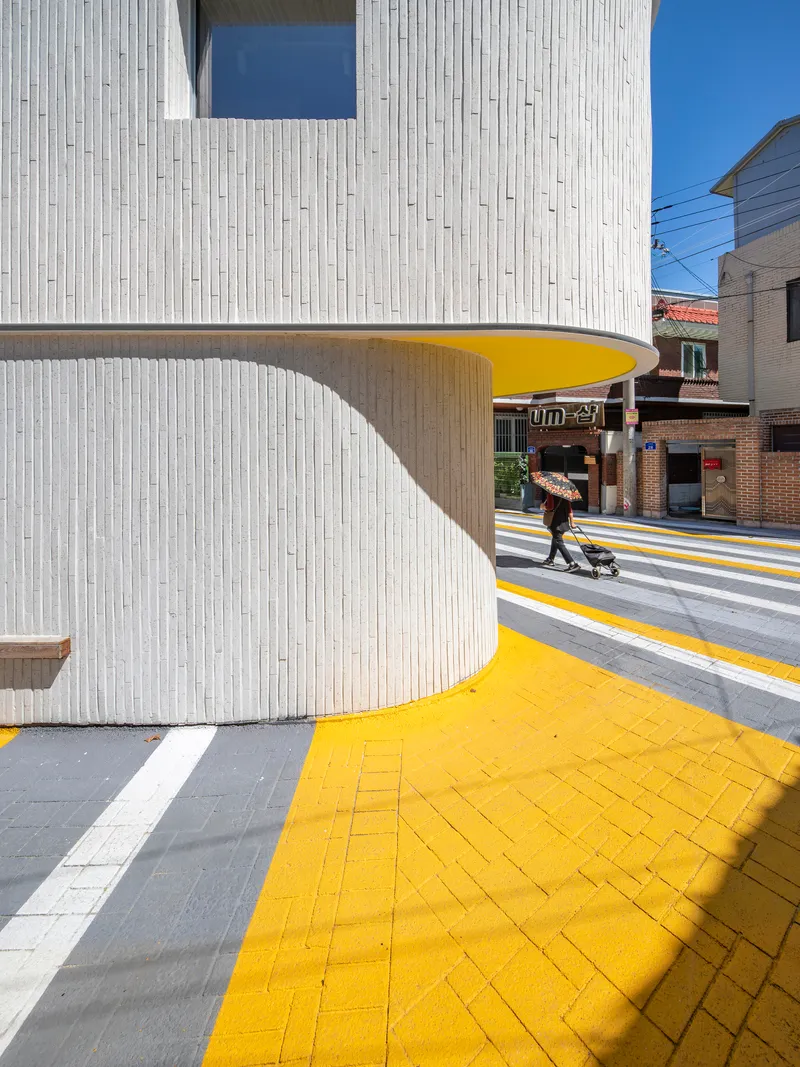
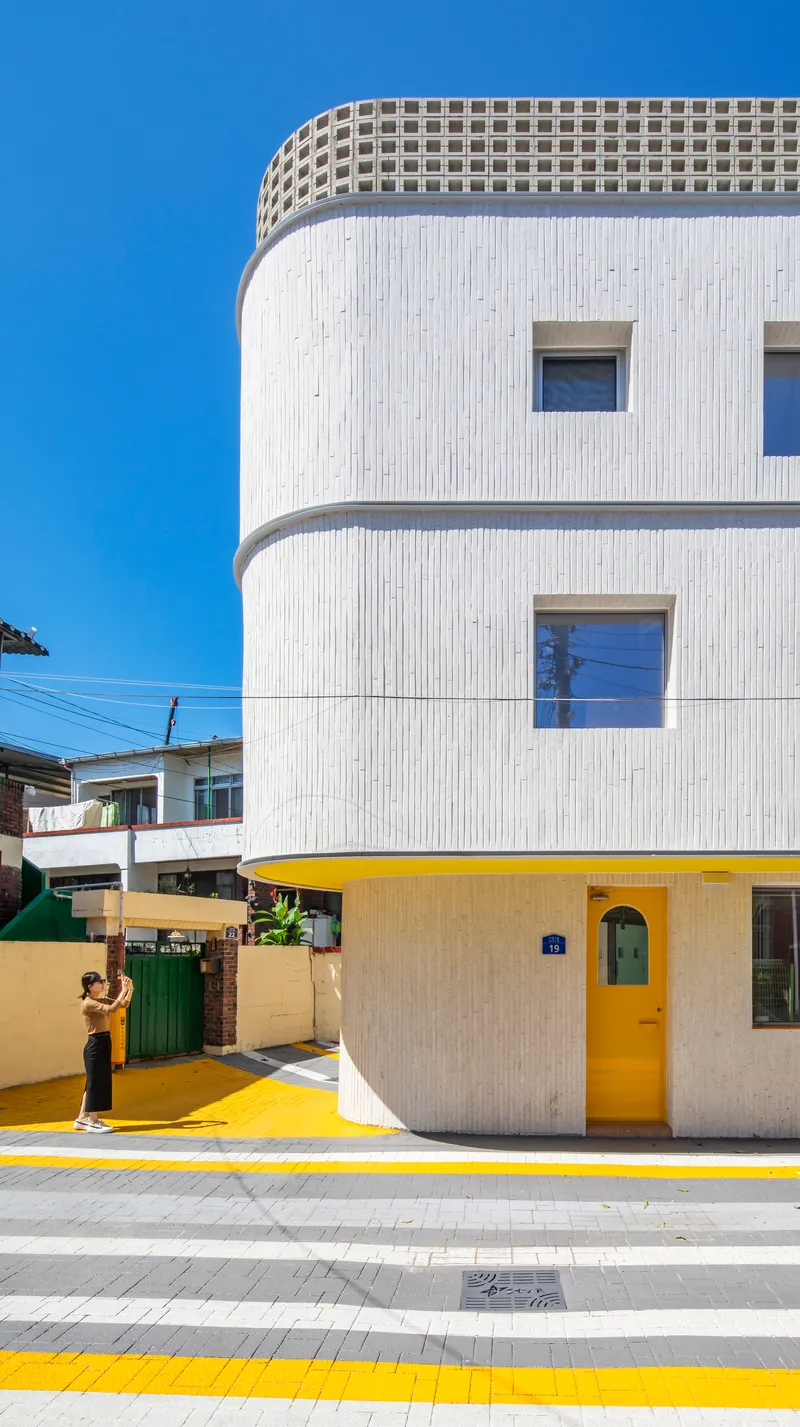

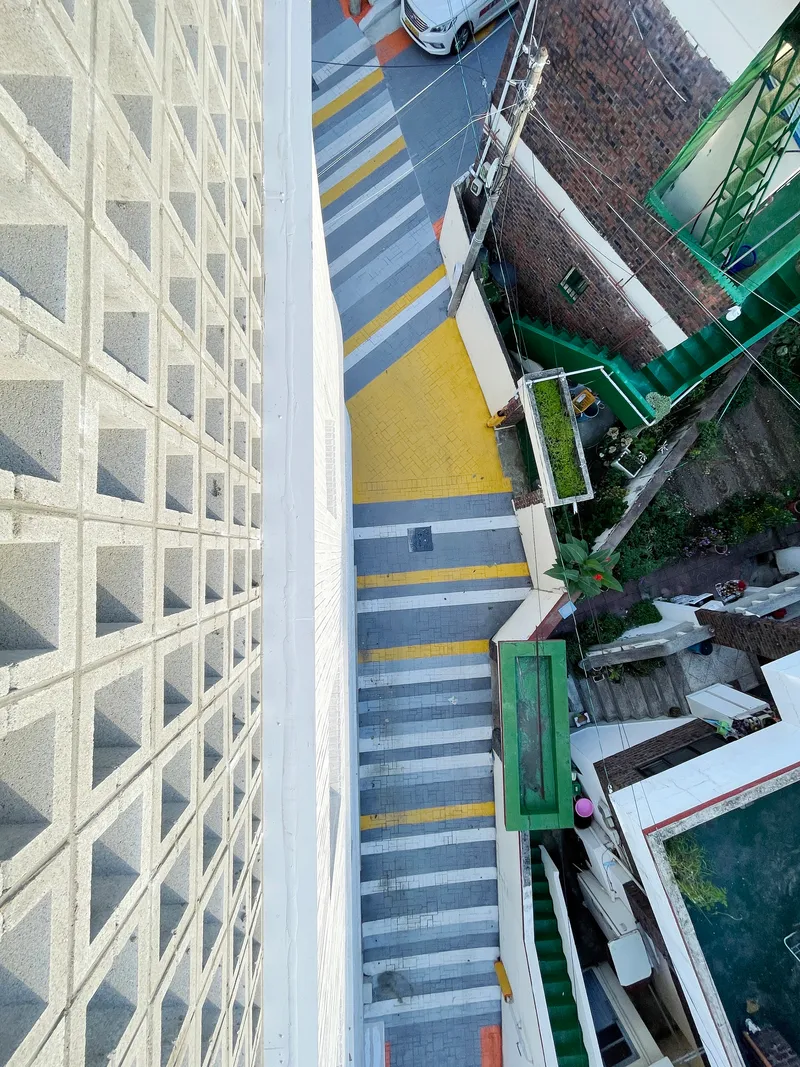
The most immediate gesture is the bright yellow that runs from the underside of the soffit down to the ground plane and out across the crosswalk. It is not decoration. It is wayfinding, a visual carpet that says "walk here, come in." The color appears at the threshold between public sidewalk and building interior, dissolving the line between the two. Linear patterns on the paving recreate the texture of the old alley, layering memory onto the new surface.
At dusk the yellow paving and soffit catch the last ambient light and the warm glow from within, creating a lantern effect at ground level. The architects understood that a community building's most important audience is the person who hasn't decided to enter yet. The yellow carpet gives that person a reason to pause.
The Street as Co-Design


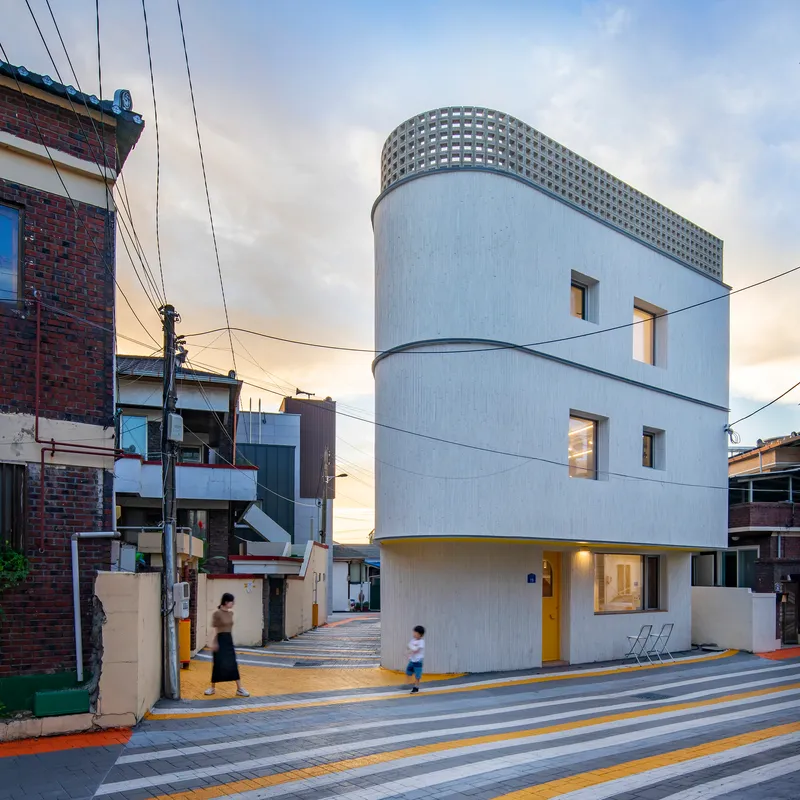
YOAP's public space proposal extends well beyond the building's property line. The striped crosswalk, the repaved alley, and the canopy overhang together form a single composition that treats the street as part of the program. Seen from above, the relationship is clear: the curved facade, the radial stripe pattern, and the pedestrian paths all emanate from the same center point at the corner.
In a neighborhood defined by overhead wires, narrow lanes, and ad hoc rooftop additions, this coordinated ground plane is a quiet act of civic generosity. It costs relatively little compared to the building itself, but it transforms the experience of approaching the site. The alley that was once just a passageway now has a destination.
Ground Floor: Open and Legible
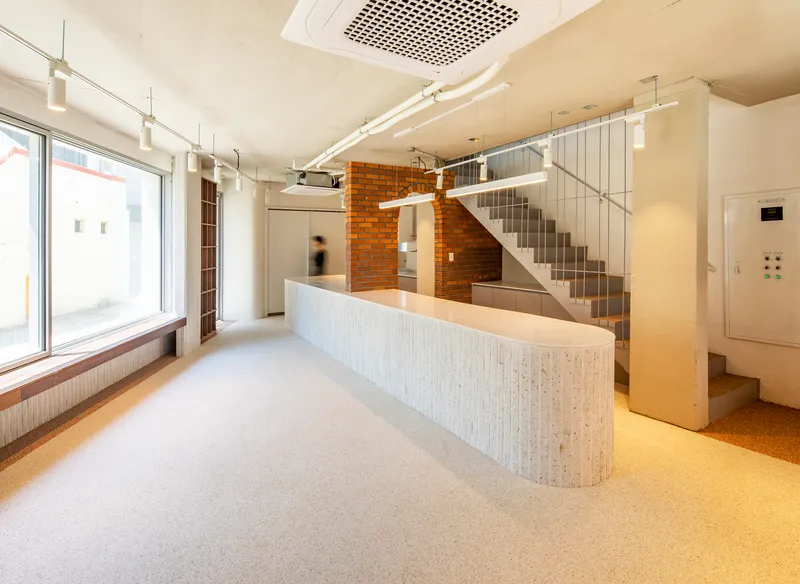
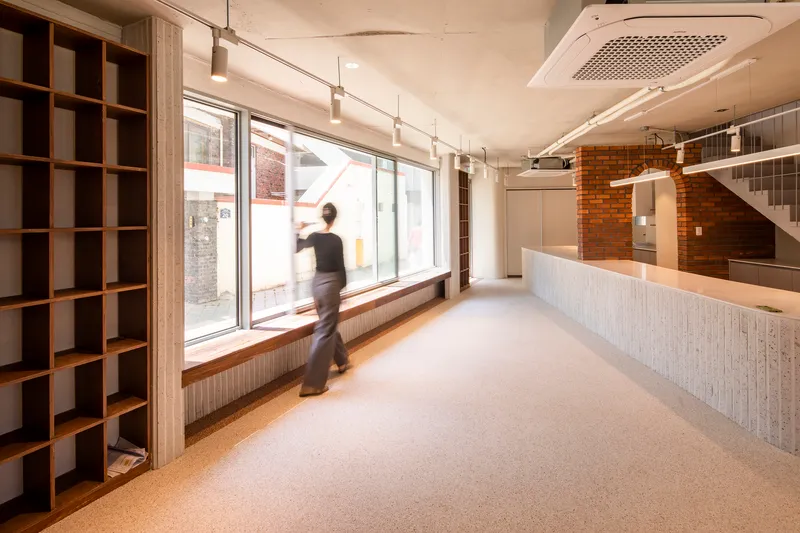
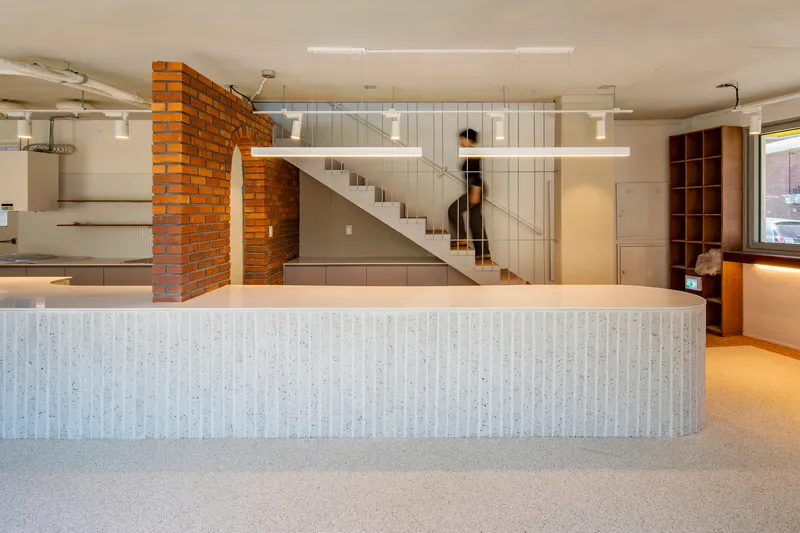
Inside, the ground level is a single open hall anchored by a curving white-tiled reception counter and a raw exposed brick wall. The brick is honest, unfinished, and slightly rough, a deliberate contrast to the smooth white cladding outside. A glass-enclosed staircase rises along the curved wall, its transparency keeping the ground floor visually connected to the levels above. The effect is that you can read the entire vertical circulation from the moment you step inside.
Track lighting and fluorescent strips keep the space evenly lit without resorting to dropped ceilings. The exposed plywood ceiling structure overhead is functional rather than decorative, reinforcing the sense that this is a working room for a neighborhood, not a showroom.
Climbing the Tower

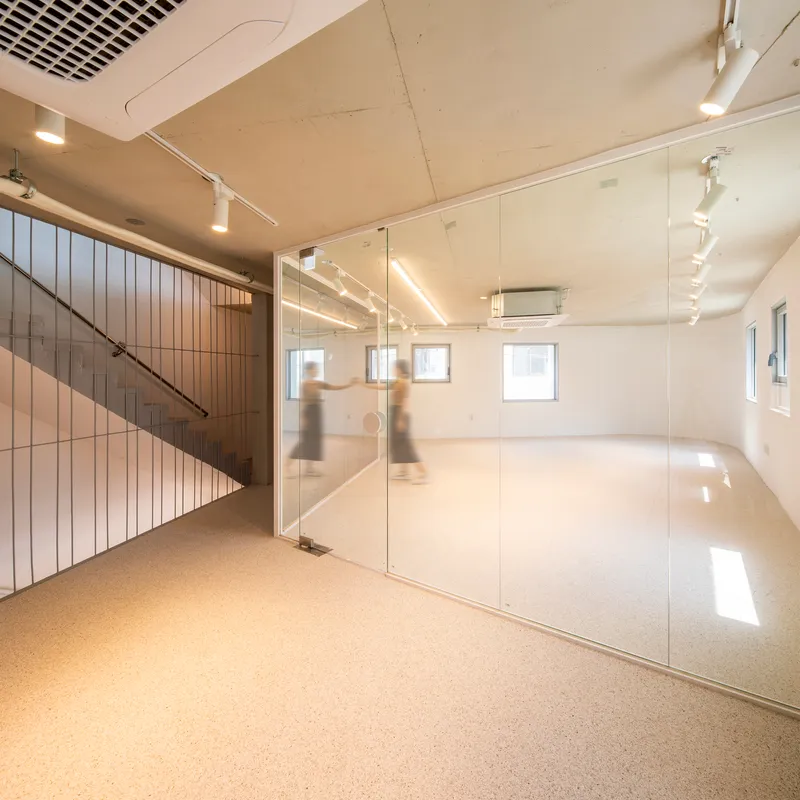

The concrete staircase with cork treads and a slender metal handrail winds upward along the inside of the curved wall. Cork is a smart choice here: it absorbs sound in what is essentially a vertical tube, and it softens the footfall in a building that will see constant use by residents of all ages. The stairs are generous enough to allow two people to pass, which matters more than it sounds in a 197-square-meter building where the staircase is the primary social corridor.
On the upper floors, an orange brick partition wall and glass dividers break the open plan into flexible zones. Sunlight enters through carefully placed square windows, and the interiors remain warm without feeling cramped. The palette stays restrained: white walls, exposed brick, terrazzo, plywood.
Framed Views and the Rooftop
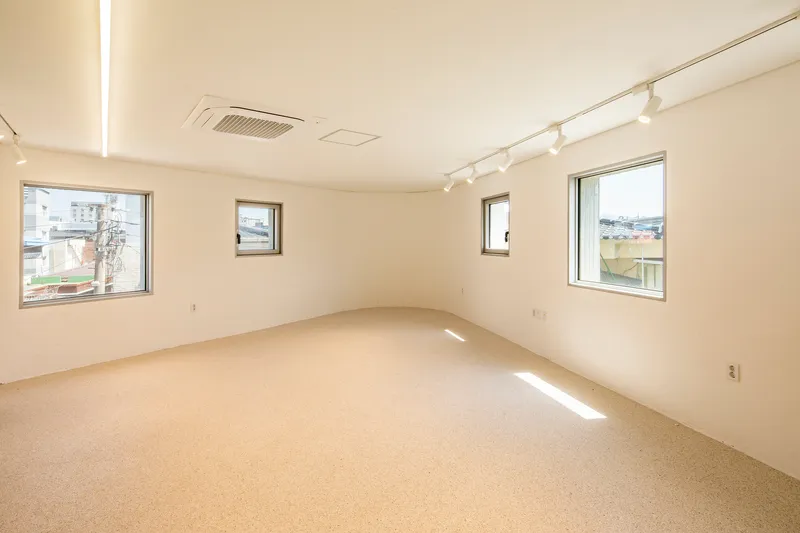

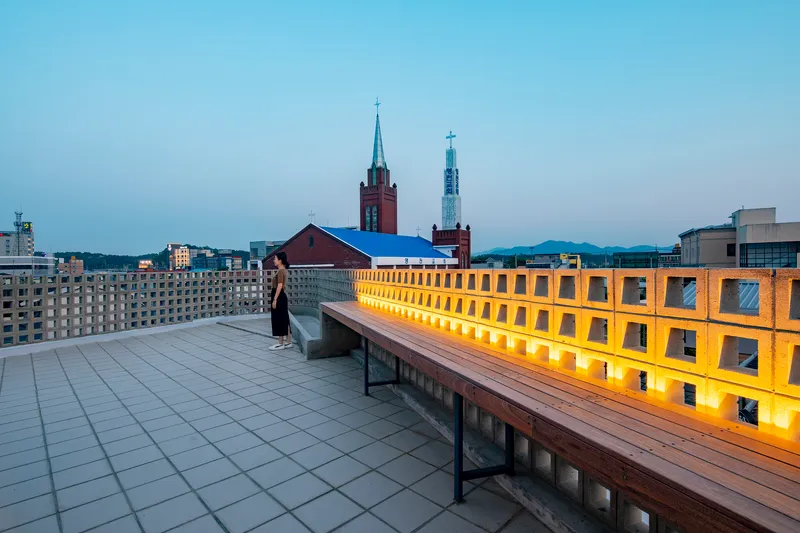
Square punched windows on the upper floors frame precise views of the surrounding rooftops, turning the neighborhood itself into the artwork on the walls. From the terrazzo-floored room on one of the upper levels, three windows offer three different slices of Yeongcheon's domestic landscape: tile roofs, satellite dishes, distant hills. It is a deliberate acknowledgment that the building belongs to this place, not above it.
The rooftop terrace takes that idea further. A timber bench sits against the backlit perforated parapet, facing the spires of a nearby church. At twilight the screen glows from within, and the terrace becomes the best seat in the neighborhood. For a community center this small, giving residents a sky-level gathering space is an outsized gift.
Dusk and the Lantern Effect


At night, the vertical window slots glow and the perforated parapet becomes a luminous band crowning the cylinder. The building transforms from a solid white object into a signal, visible from multiple streets. The rooftop terrace, lit from below, reads as a floating room above the neighborhood. It is a simple trick, slot windows plus interior lighting, but the cylindrical form amplifies the effect because light escapes in every direction.
The ribbed facade that appeared opaque during the day now reveals its translucent qualities near the glass block edges, adding texture to the night reading. For a building whose entire mission is to say "come in," this nocturnal presence matters. A community center that goes dark at sunset sends the wrong message.
Plans and Drawings
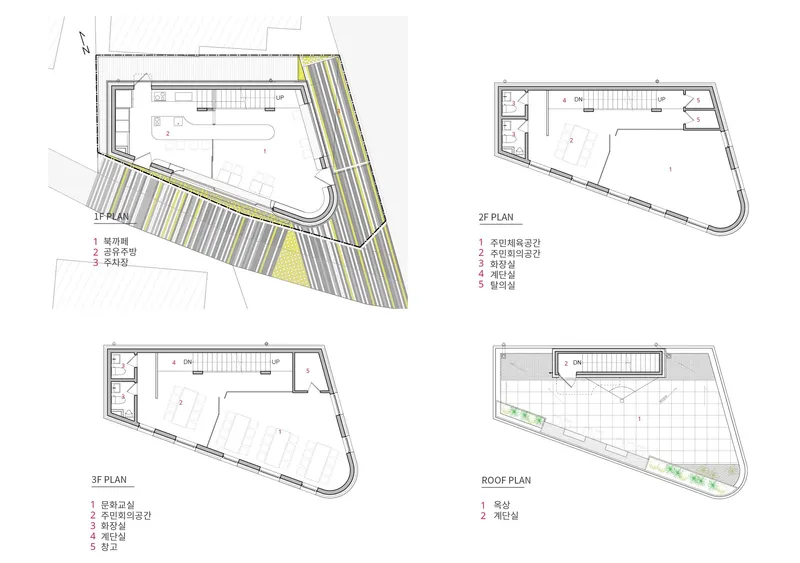

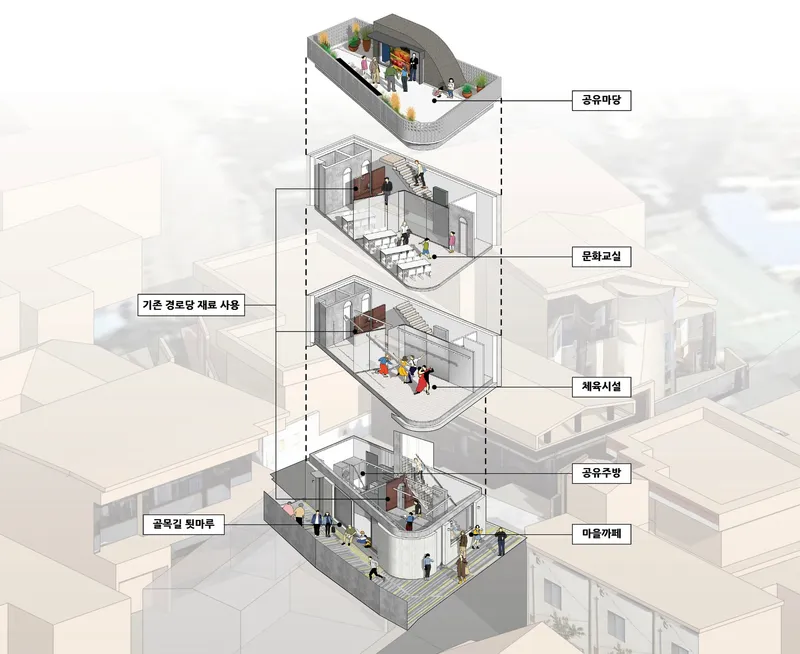

The floor plans confirm the triangular site geometry and show how YOAP packed program into its 137 square meters of ground coverage. Angled parking at grade frees the street edge for pedestrian activity. The section reveals cascading floor plates connected by a single diagonal stair, with generous floor-to-ceiling heights for a building of this scale. The exploded axonometric lays bare the stacking logic: five levels of program in a compact vertical footprint, each slightly different in plan to respond to the tapering lot and window placement.
The massing diagram sequence is particularly instructive. It walks through the design decisions step by step, from initial setback to fenestration to the street interface strategy, showing how each move was calibrated to both the neighbors and the pedestrian experience. The building's form is not arbitrary; it is the product of a constrained site and a generous ambition.
Why This Project Matters
The Wansantrak Community Center demonstrates that civic architecture does not require a civic budget or a civic scale. At 197 square meters on a leftover triangular plot, YOAP produced a building that reorganizes an entire corner of its neighborhood. The real design is not the tower; it is the relationship between the tower and the ground, the way the crosswalk pulls you in, the way the yellow soffit shelters you before you even touch the door. That sequence, from street to threshold to interior to rooftop, is handled with the kind of precision usually reserved for projects ten times this size.
The phrase "low threshold" gets thrown around loosely in community architecture, but here it is literal: the ground plane is continuous, the entrance is open, and the color coding is unmistakable. YOAP did not invent a new typology. They simply took the idea of a public garden seriously, planted it in a forgotten alley corner, and built a tower that makes sure everyone in the neighborhood knows it is there. That is enough. In fact, for Wansandong, it is everything.
Wansantrak Community Center, designed by YOAP architects (Jeong Sang Kyong, Ryoo In Keun, Kim Doran). Yeongcheon, Gyeongsangbuk-do, South Korea. 197 m². Completed 2022. Photography by Ryoo, In Keun.
About the Studio
Share Your Own Work on uni.xyz
If projects like this are the kind of work you want to make, uni.xyz is a place to publish your own, find collaborators, and enter design competitions.


Popular Articles
Popular articles from the community


LT2A and OPEN Architectes Thread a Brick and Glass High School Through a Wooded Belgian Campus
In Braine-l'Alleud, a 3,000 m² wing for Collège Cardinal Mercier pairs pale brick with a glazed colonnade, deferring to a small chapel and a dense wood.

Jaramillo Van Sluys Arquitectura and Urbanismo Turn a Demolished Registry Lot in Quito into an Orchard Plaza
In Quito's Centro Histórico, a 2,800 m² plaza exposes the San Agustín convent wall and redraws its lost Augustinian orchard in volcanic stone.

GROUP A Strips a 1969 Rotterdam Harbor Headquarters to Its Frame and Wraps It in Timber Louvers
In Rotterdam's M4H harbor district, Ferro Offices reuses a 1969 frame, adds one timber storey and reaches BREEAM-NL Outstanding.

longwave studio Reorganizes a 112 m² Tainan Apartment Around the Daily Routines of a Family and Two Cats
In Tainan, Taiwan, birch plywood, rust-red furniture and a freestanding plaster wall link arrival, storage, work and family life in one apartment.

Similar Reads
You might also enjoy these articles


LAVA Architecten Gives Vocational Education a Sawtooth-Roofed Face on a Mechelen School Campus
In Mechelen, Belgium, a 2,053 m² STEM school on a 6×6 m grid turns workshops and classrooms into rooms that can be rearranged as teaching changes.

KEMA Studio Turns a Derelict Marvila Attic into a 60 m² Lighthouse Apartment Above Lisbon
In Lisbon's Marvila district, a rebuilt roof, four skylights and two plywood volumes turn an unlivable attic into a bright home facing the Tagus.

Pixel Gardens: One Repeated Module Stacked Into a Terraced Social Housing Tower for Famagusta
Salem Bader's shortlisted housing tower builds a vertical neighbourhood from one repeated module, offsetting units to carve terraces, light and air.

Bao Huynh Watercolor Atelier: A Serene Art Retreat in Hội An
Bao Huynh Watercolor Atelier in Hội An blends multifunctional art spaces, sustainable design, local materials, and family-friendly living in a serene environment.

Explore Community Center Competitions
Discover active competitions in this discipline

Challenge to design locus for the upliftment of human rights

Challenge to reimagine the Iron Throne

Photograph architecture without architects

Illustrate the lost glory of Angkor Wat - Render Challenge
Comments (0)
Please login or sign up to add comments
No comments yet. Be the first to comment!