

Taller MACAA Weaves Adobe Lodging into the Sacred Valley at 3,100 Meters Above Sea Level
Dormis Donata bridges permanent and temporary inhabitation through earthen construction in the agricultural highlands of Taray, Peru.


At 3,100 meters above sea level, where the agricultural terraces of the Sacred Valley of the Incas fold into steep mountainsides, Taller MACAA has completed Dormis Donata: a 135 square meter rural lodging that sits at the hinge point of KUSKA, a broader complex that negotiates between domestic permanence and temporary stay. The project, led by architect Rafael Ortiz Santos, treats the act of sleeping in a landscape as something worth designing around with real precision, not just a bedroom dropped into scenic terrain.
What makes Dormis Donata worth studying is the way it refuses to separate building from ground. Adobe walls rise directly from fields of yellow wildflowers. Clay tile roofs echo the ridged topography above. Colored glass, reed ceilings, and timber structure give every interior a tonal warmth that feels grown rather than applied. The building operates as an axis connecting KUSKA's private home to its communal quincho, and the architecture reads exactly that way: threshold, not terminus.
Built from the Ground It Sits On
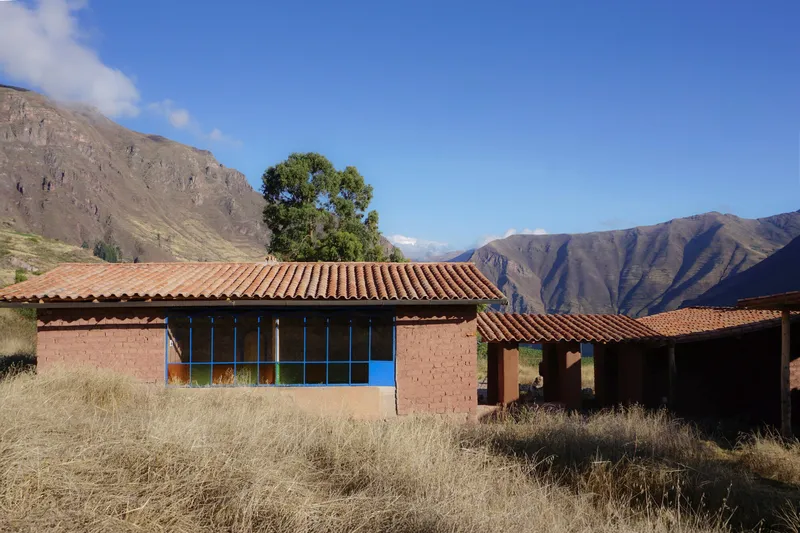
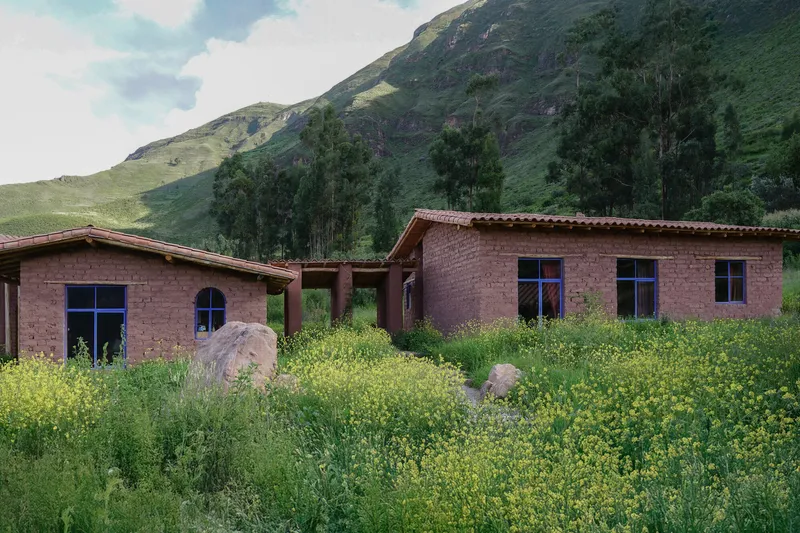

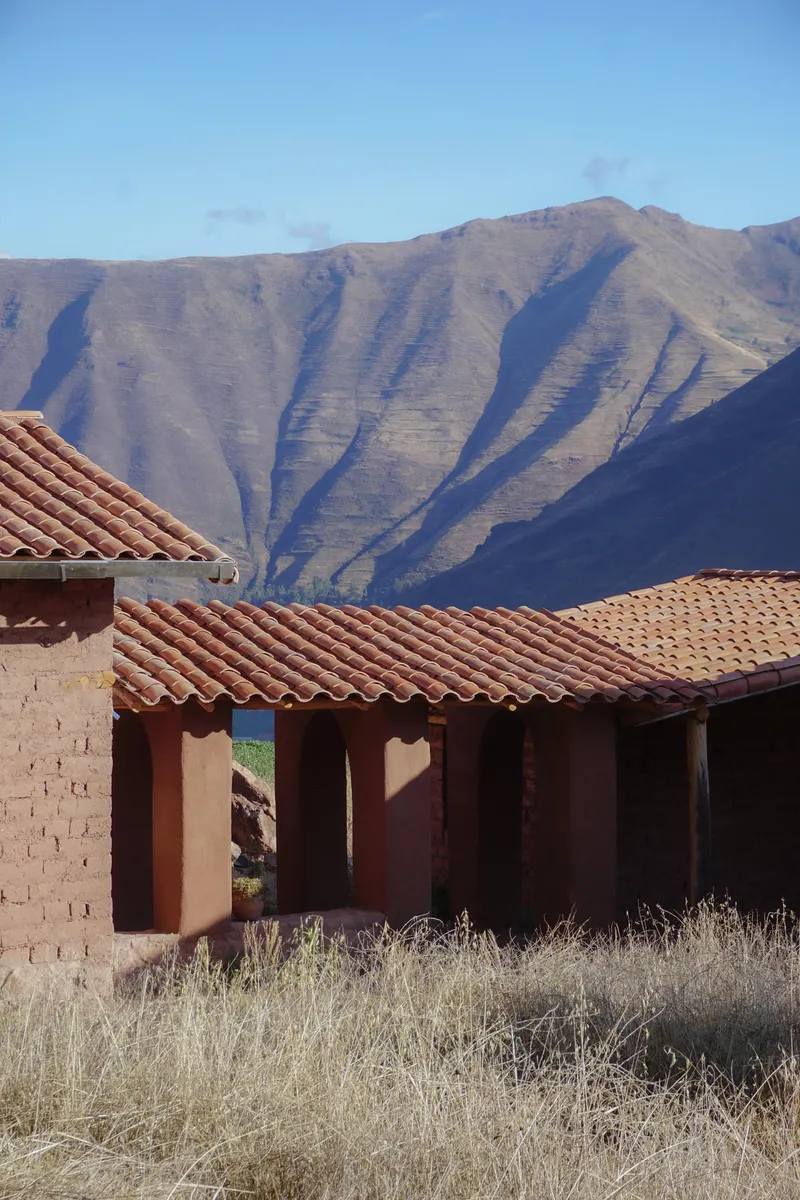
The buildings emerge from the landscape with a material logic that is both practical and legible. Adobe brick walls, unclad and unapologetic, register every mark of their making. Clay tile roofs follow gabled profiles that could belong to any century of Andean construction. Blue painted doors and window frames are the only overt gesture of color on the exterior, and they read less as decoration than as navigation: signals of entry and inhabitation in a field of earth tones.
Set in meadows of yellow wildflowers, the structures avoid the trap of self-conscious rusticity. They are not "inspired by" the landscape; they are continuous with it. The dry grassland, the ridged mountain behind, and the adobe wall share a palette so closely that the boundary between site and building dissolves in late afternoon light.
The Arched Corridor as Connective Tissue


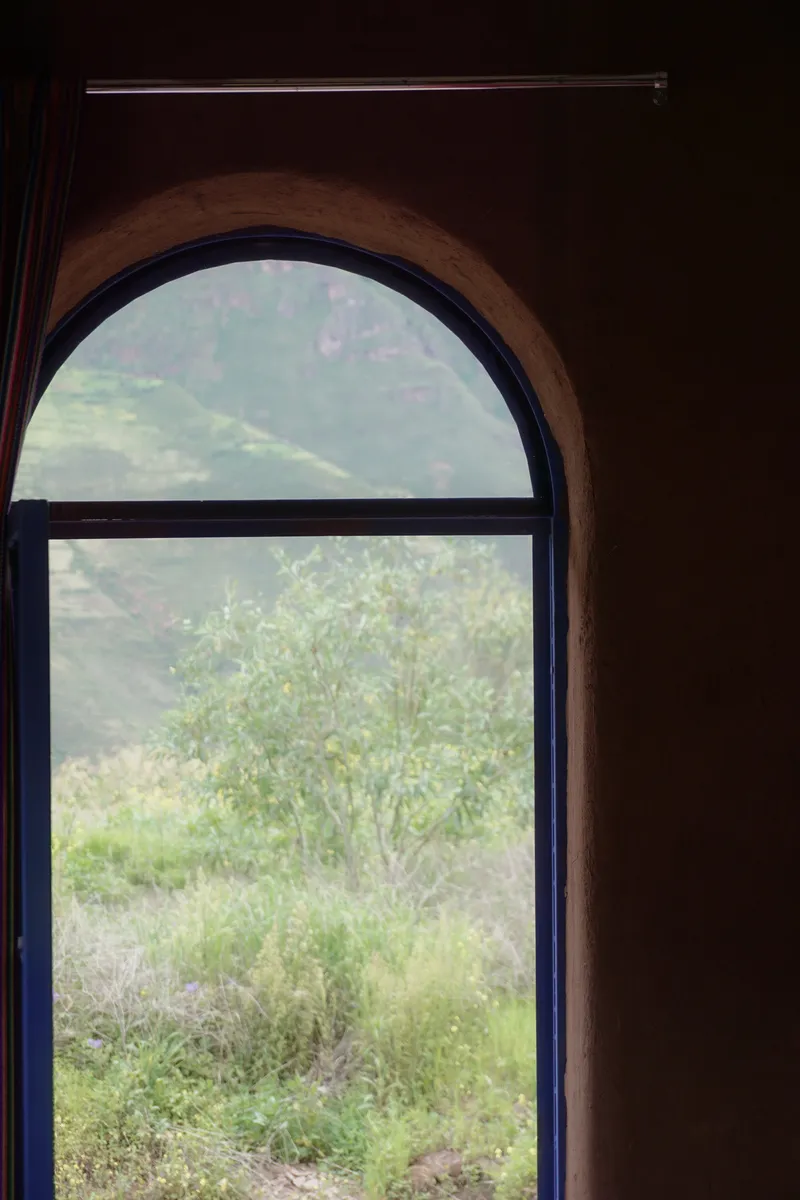
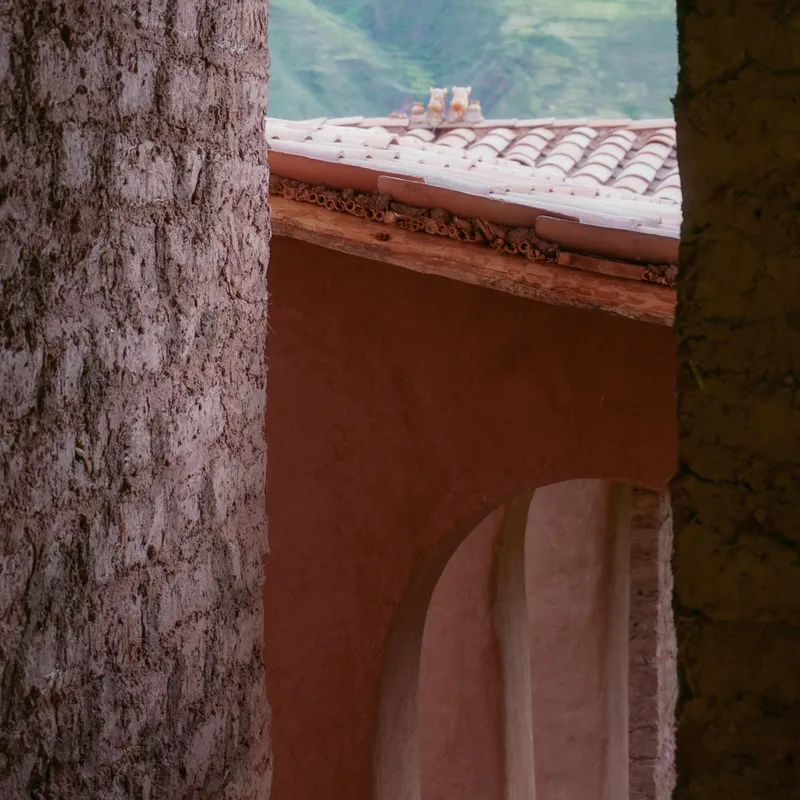
The most striking spatial move is the sequence of rounded arches that defines the interior corridor. Plastered in a warm earthen finish, these arches compress and release the visitor's view, framing stained glass doors, bedrooms, and the open landscape in alternation. It is a processional device, not merely a hallway, and it transforms what could be a simple linear plan into a series of curated thresholds.
Each arched opening frames a different condition. One reveals a bedroom with exposed timber beams and a clear sightline to the mountains. Another opens onto an overgrown courtyard. The effect is cinematic: you move through the building as through a series of vignettes, each calibrated to a particular quality of light and enclosure. The arch is not decorative here. It is the project's primary spatial argument.
Colored Glass and Embedded Bottles

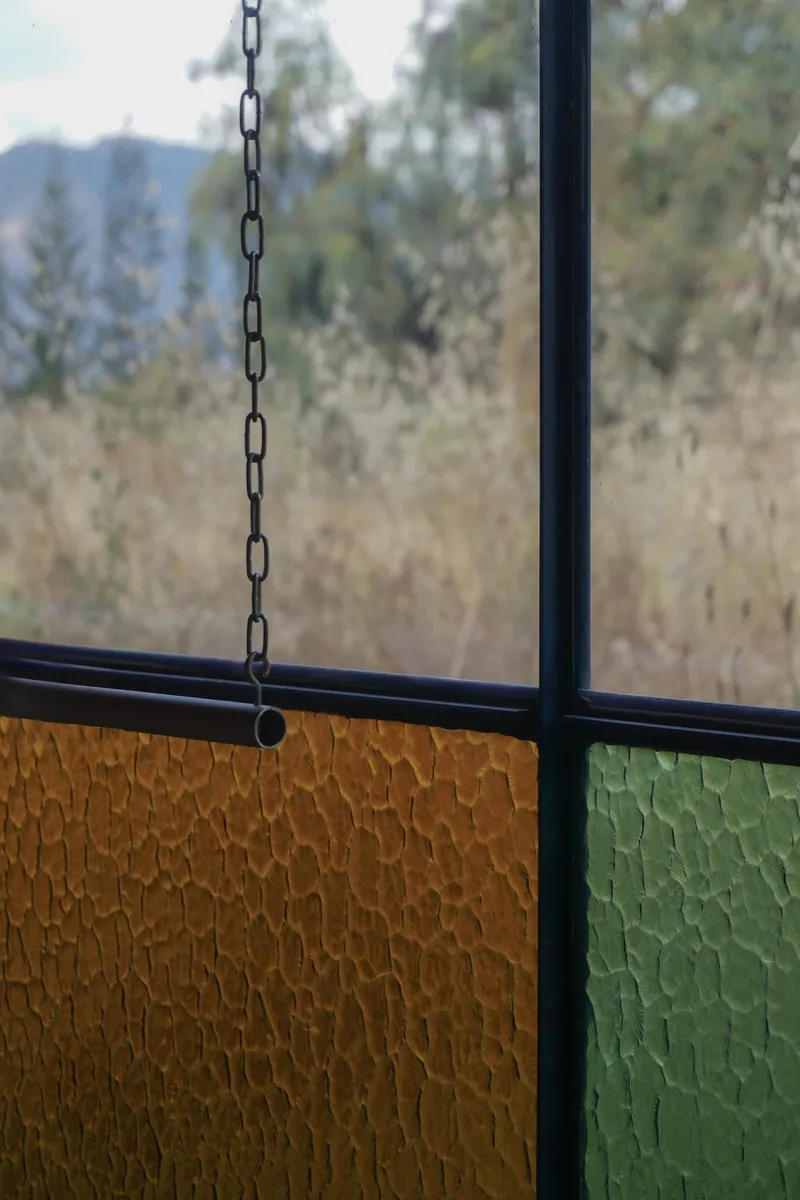
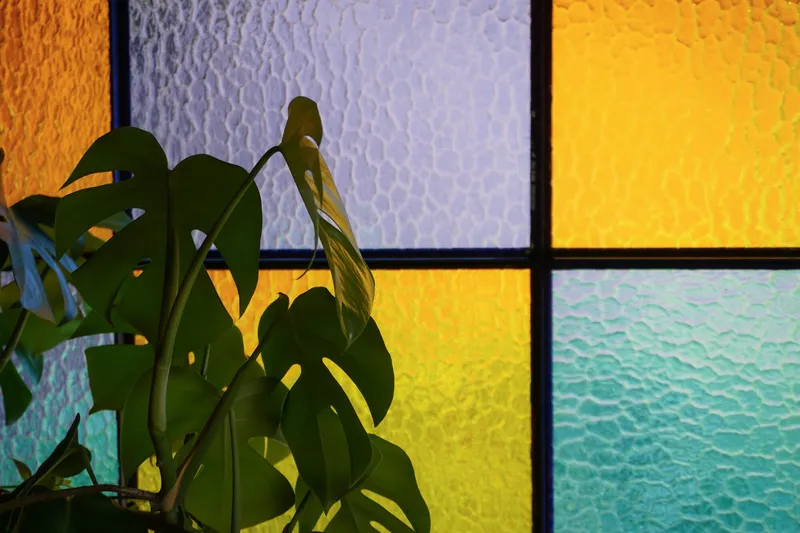
The windows at Dormis Donata are not just openings; they are instruments. Multi-colored glass panels in orange, yellow, blue, and green filter Andean sunlight into something almost liturgical. In one window, a grid of glass bottles is embedded directly into the earthen sill, transforming a structural detail into a light fixture. A suspended metal chain catches the glow. These are not expensive moves. They are clever ones.
The colored glass does double duty. It provides privacy in rooms that face communal paths while still admitting generous light. And it shifts the interior atmosphere from one room to the next, so that the sleeping quarters feel tonally distinct from the bathrooms and circulation spaces. At altitude, where sunlight arrives with unusual intensity, this kind of modulation matters more than surface decoration ever could.
Rooms for Rest at Altitude
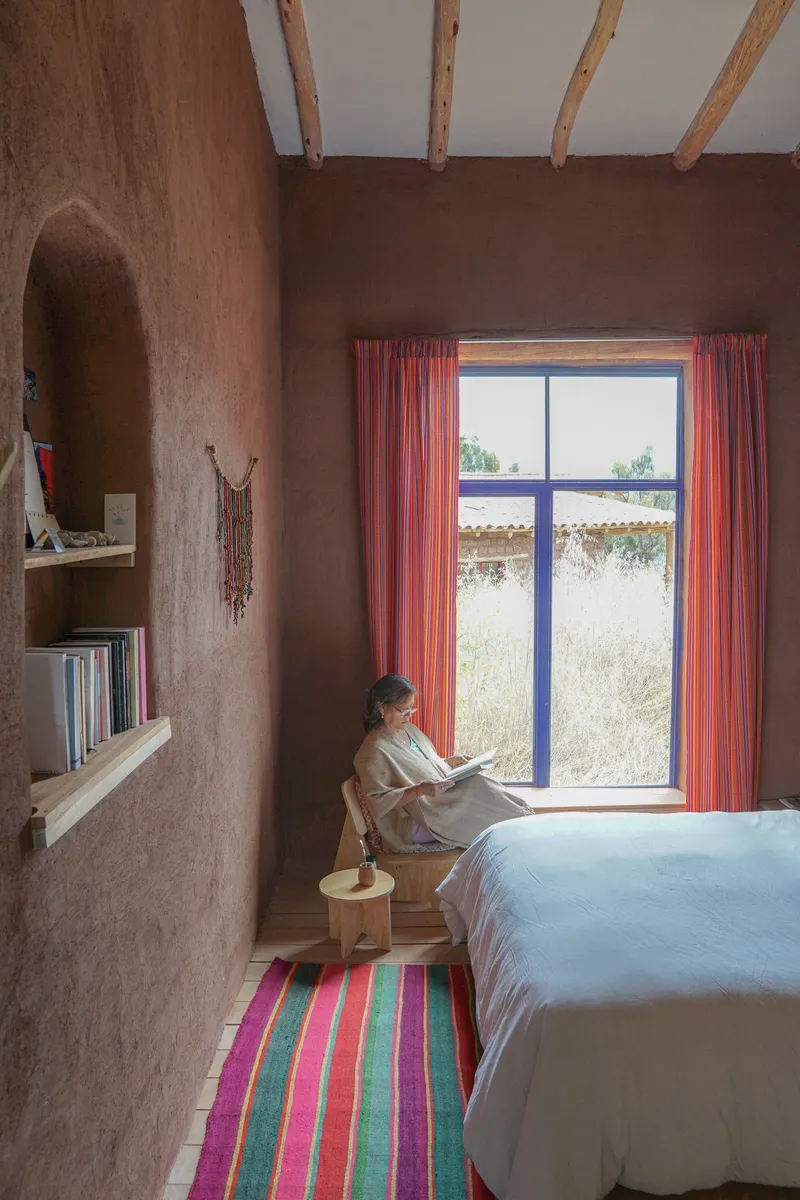


The sleeping rooms are compact and considered. Twin ladder bunks with striped textile rugs sit beneath exposed timber ceiling beams in one configuration. In another, a bedroom nook positions a reader beside a window framed with striped textile curtains, the mountain landscape held at arm's length. Reed ceilings overhead give a textural softness that acoustically and visually dampens the rooms.
There is no pretense of luxury here, and that is the point. The project is lodging in the most elemental sense: a warm, dry, beautiful place to sleep in a landscape where nights are cold and the sky is enormous. The textiles, the timber, and the earthen walls create an envelope that feels protective without being sealed off. Windows are placed to let the landscape in on the building's terms.
Bathing with the Valley in View


The bathrooms may be the most unexpected spaces in the project. One features a round mirror beneath a reed ceiling that opens directly to a mountain view, turning the act of washing your face into a confrontation with geography. Another shows a bathtub framed by an arched doorway and colored glass window, with bamboo ceiling overhead. An outdoor shower enclosure uses corrugated metal walls and potted plants on stone paving, offering an unadorned openness to the sky.
These are not spa gestures. They are spatial decisions that acknowledge the particular pleasure of water and warmth at 3,100 meters, where the air is thin and the temperature drops sharply after sunset. The architecture makes bathing a moment of landscape awareness, not retreat from it.
Roofscape and Mountain Dialogue


Seen from above and at distance, the clustered red tile roofs of Dormis Donata register as an extension of the terraced agricultural fields that surround them. The aerial view reveals how deliberately the volumes have been placed: not in a single bar or courtyard, but scattered and angled to follow the slope, creating gaps for trees and paths. Eucalyptus and wildflowers occupy the spaces between structures, blurring the edge between built and cultivated ground.
The roofscape itself carries the project's strongest formal relationship to the mountains. Clay tiles, pitched profiles, and angular volumes echo the ridged slopes behind. At dusk, with the last light catching the tiles and the eucalyptus silhouetted against the peaks, the complex reads as a small village rather than a single building. That reading is deliberate: Dormis Donata is designed to belong to a settlement, not to stand apart from one.
Thresholds and In-Between Spaces


Much of the project's intelligence lies in the spaces that are neither fully inside nor fully outside. A timber pergola entry framed by hillside vegetation marks the transition from path to building. An earthen doorway with a timber lintel and reed ceiling opens onto an overgrown courtyard. A glazed facade with blue and colored panels sits beneath a clay tile roof, its transparency offering a controlled reveal of the mountainside beyond.
These thresholds are where the project's role as a connector becomes most palpable. Dormis Donata links the private domain of the home to the communal life of the quincho, and its architecture is organized around passages, porticos, and framed views that keep visitors moving through rather than settling in one place. It is an architecture of transition, appropriate for a building type, lodging, that is itself fundamentally transient.
Plans and Drawings
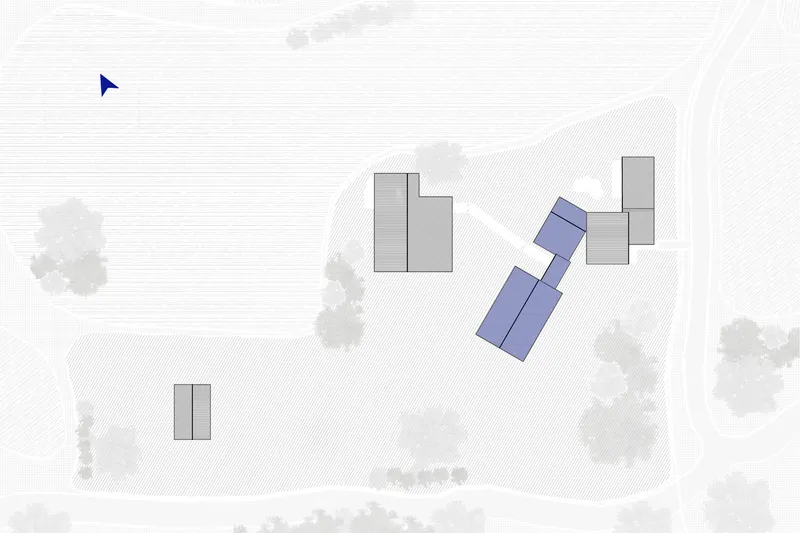

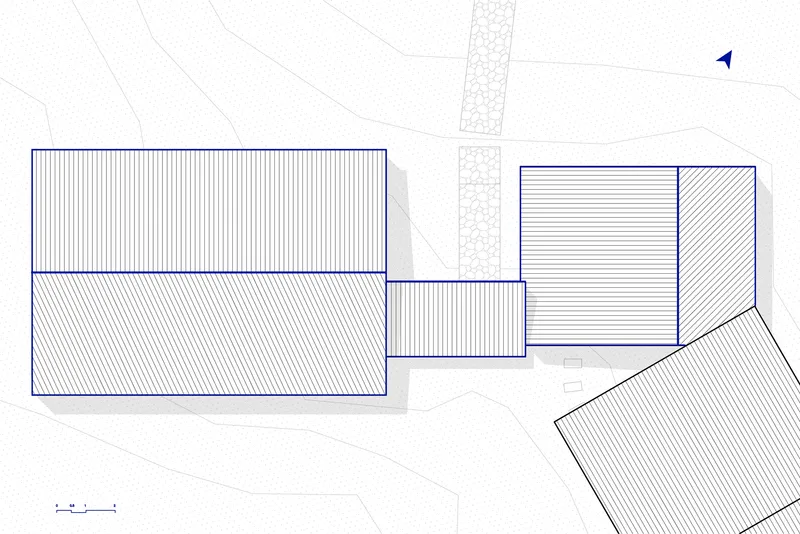


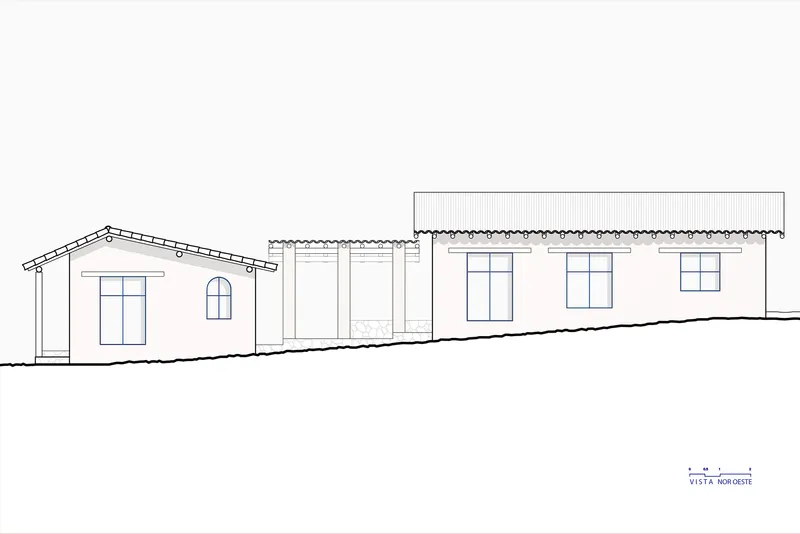


The site plan reveals the dispersed strategy: multiple building volumes scattered across sloping terrain with trees interspersed, a settlement pattern rather than a single footprint. The floor plan shows interconnected pavilions with thick walls and central courtyards, confirming the processional experience of moving through the building. Sections expose the relationship between gabled volumes and rectilinear forms connected by arched openings, while a glass curtain wall with diagonal bracing above a brick base negotiates a stepped terrain condition on one edge.
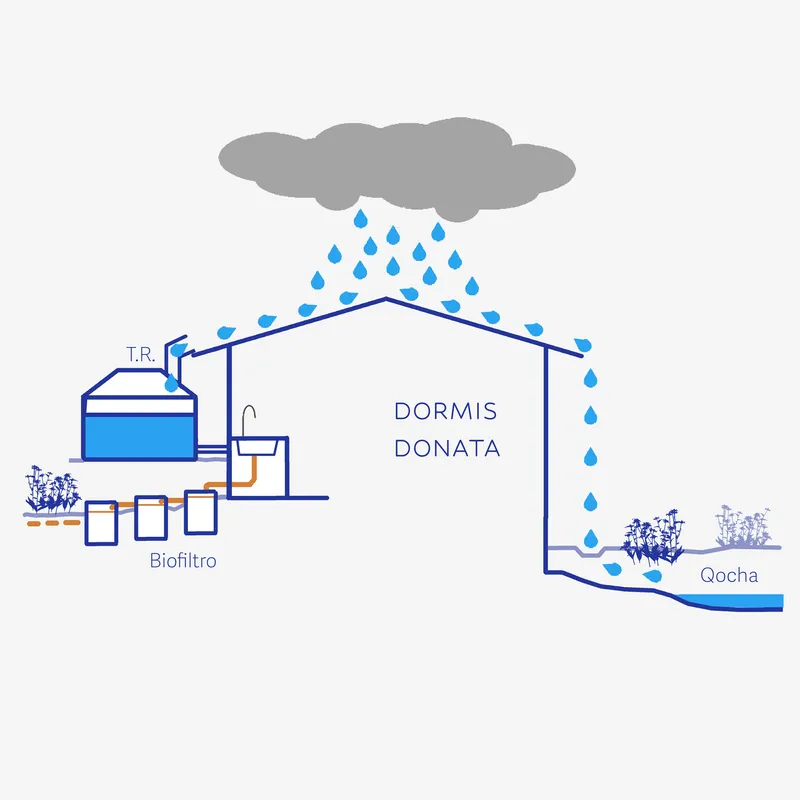
One drawing stands out for its environmental ambition: a diagram showing a rainwater collection system that routes water from the roof through a biofilter and storage tank to a pond. At altitude in the Andes, where rainfall is seasonal and water management has been an architectural concern for centuries, this is not innovation. It is continuity with a landscape tradition. The axonometric and isometric drawings, meanwhile, reveal the careful interior detailing: arched doors, window placement, bed platforms, and terrazzo floors all designed with the same material attention visible in the photographs.
Why This Project Matters
Dormis Donata matters because it demonstrates that rural lodging in a spectacular landscape does not require spectacular architecture. The project's materials are local. Its formal language is inherited. Its spatial ambitions, the arched corridors, the colored glass, the threshold sequences, are achieved through craft rather than technology. In an era when rural tourism projects often import urban aesthetics wholesale, this building insists on working with what is already present: adobe, timber, tile, and the rhythms of a terrain shaped by centuries of agriculture.
More importantly, the project takes seriously the idea that a building can be connective tissue rather than a destination. Dormis Donata is not the main event of the KUSKA complex. It is the passage between events, the axis that gives the settlement its legibility. Taller MACAA has designed a building that knows its place, literally and architecturally, in a landscape where humility before geography is not a stylistic choice but a condition of survival.
Dormis Donata (Rural Housing and Lodging) by Taller MACAA (Misión de Arquitectura, Construcción y Arte en los Andes), led by Rafael Ortiz Santos. Taray, Peru. 135 m². Completed 2025. Photography by Rafael Ortiz Santos.
About the Studio
Taller MACAA (Misión de Arquitectura
Construcción y Arte en los Andes)
Share Your Own Work on uni.xyz
If projects like this are the kind of work you want to make, uni.xyz is a place to publish your own, find collaborators, and enter design competitions.


Popular Articles
Popular articles from the community


Extended Shell: Retrofitting Kolkata's Balconies as Living Urban Thresholds
A modular retrofit system recovers the social and environmental intelligence of Kolkata's historic verandas for contemporary Park Street residents.

Opera on the Sea: Driftwood Logic Shapes a Timber Opera House on Estonia's Coast
Trevor Orgill's opera house translates the entangled drift of floating timber into a civic building where wood, water, and music converge.
Tsunami Convergenics: Turning Catastrophic Ocean Forces into Underwater Housing Infrastructure
A speculative underwater settlement off the coast of Onagawa, Japan, treats tsunamis and typhoons as energy sources rather than threats.

Temporary Home for Dogs: A Reversed Zoo Rethinks Animal Shelter Architecture
In Bucharest, a sinuous corridor and freed landscape flip the logic of containment, designing a shelter that works to make itself unnecessary.

Similar Reads
You might also enjoy these articles

Pixel Gardens: One Repeated Module Stacked Into a Terraced Social Housing Tower for Famagusta
Salem Bader's shortlisted housing tower builds a vertical neighbourhood from one repeated module, offsetting units to carve terraces, light and air.

Bao Huynh Watercolor Atelier: A Serene Art Retreat in Hội An
Bao Huynh Watercolor Atelier in Hội An blends multifunctional art spaces, sustainable design, local materials, and family-friendly living in a serene environment.

Atelier Macri Concept Store Interior Design by CASE-REAL
Atelier Macri store features a "ko" counter, walnut wood details, cork displays, blending retail, gallery, and seamless customer experiences.

Manuel Vargas Izquierdo Stadium and High-Performance Sports Center: Architectural Excellence in Jalpa de Méndez
The Manuel Vargas Izquierdo Stadium blends sustainable design, inclusive sports facilities, and cultural-inspired architecture, revitalizing Jalpa de Méndez’s public spaces.

Comments (0)
Please login or sign up to add comments
No comments yet. Be the first to comment!