
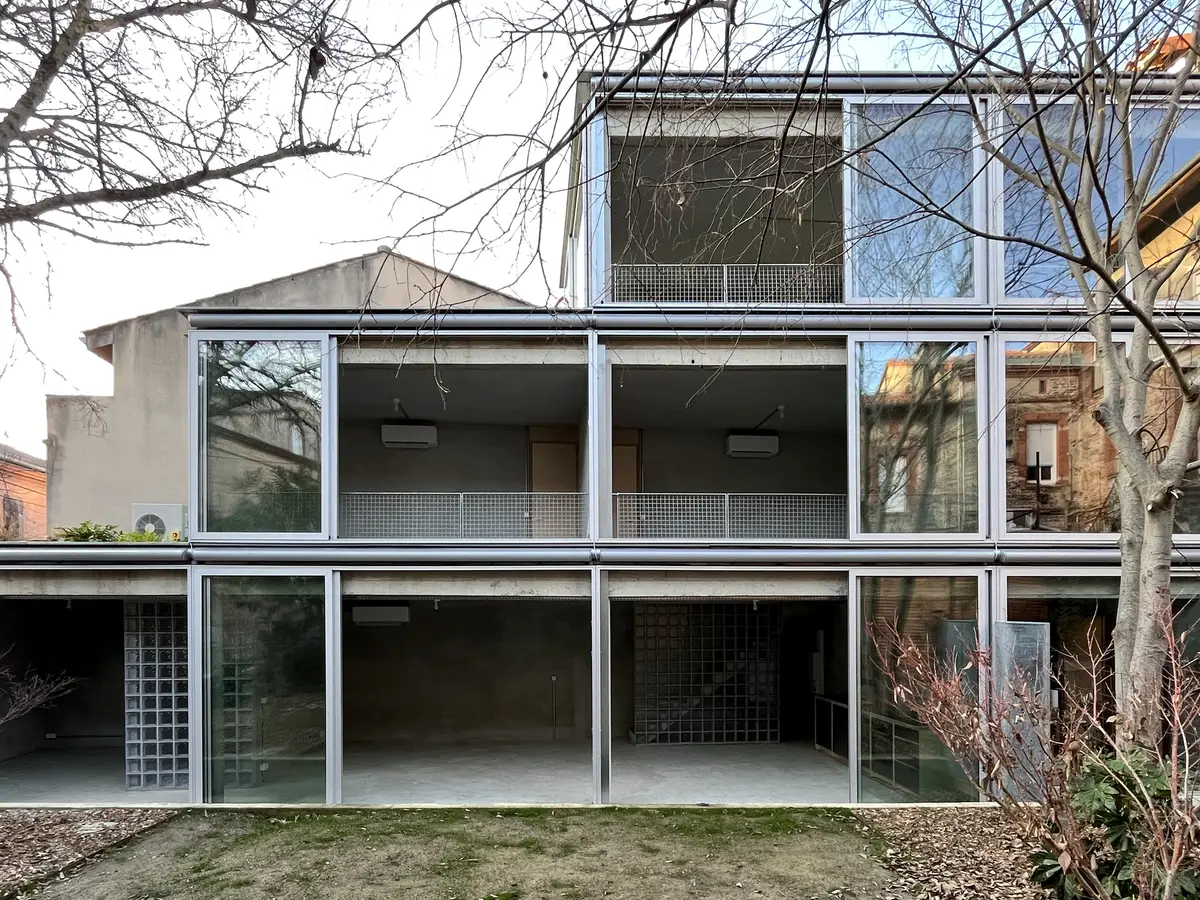
BAST Slots a Four-Story Glass House into a Narrow Gap Between Toulouse Townhouses
In the dense Bonnefoy district, a stepped infill building merges home and office while preserving a majestic hackberry tree.


Urban infill projects tend to announce themselves as clever. They squeeze into leftover lots, and the architecture often performs a kind of smugness about it: look how thin I am, look how much I fit. The L33 Narrow House by BAST in Toulouse does something more restrained. It occupies the width of a pair of demolished garages between two brick townhouses in the Bonnefoy district and uses that constraint not as a stunt but as a starting point for a genuinely considered building that steps down from street to garden, houses both a residence and an office, and treats an existing hackberry tree as an immovable fact rather than an obstacle.
What makes this project worth studying is not the narrowness itself but the cascading section. The building rises to four levels along the street to match the cornice line of its neighbors, then drops one story at a time as it moves toward the rear garden and the opposite street. The result is a profile that negotiates between urban density and a preserved landscape, offering every level a relationship to the outdoors that a conventional extrusion of the lot would never achieve.
Filling the Gap
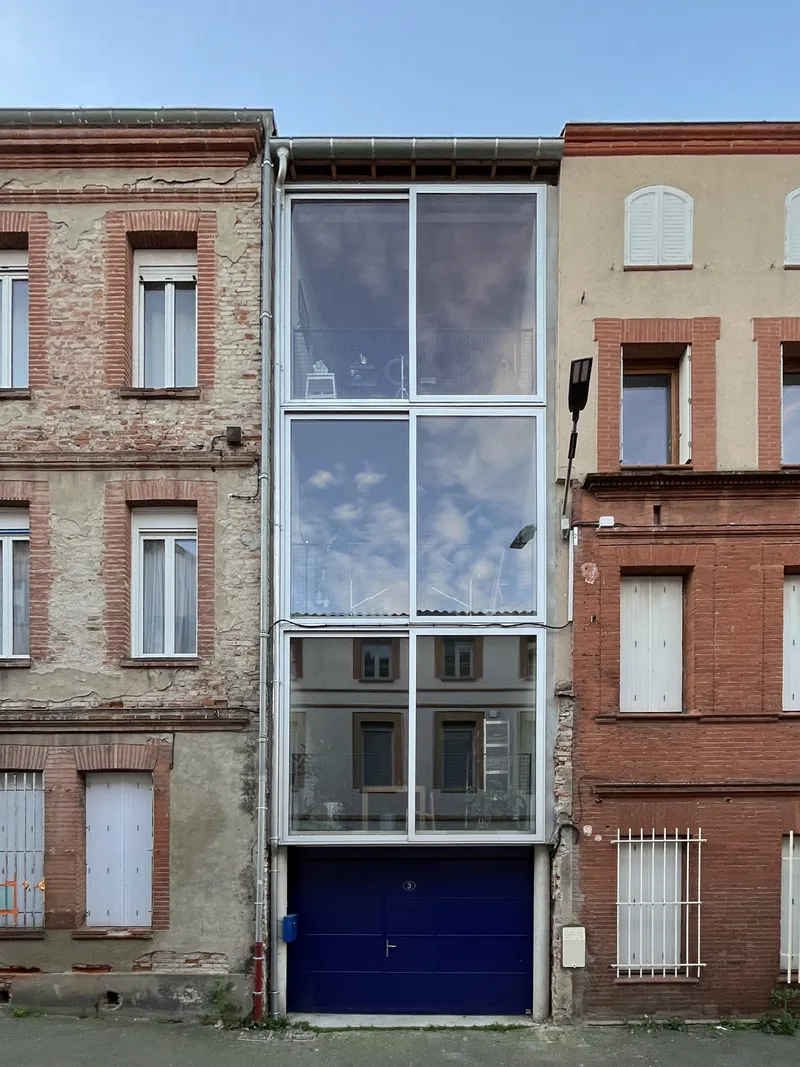
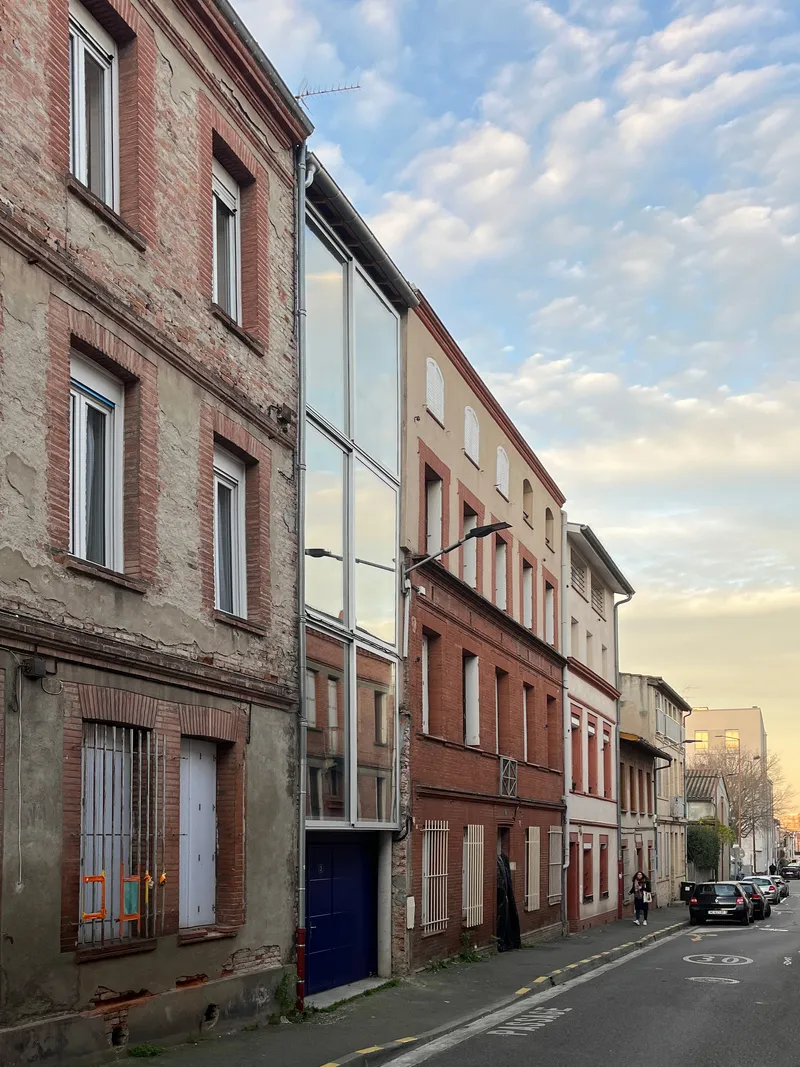
From the street, the L33 reads as a thin vertical slice of glass and white steel framing inserted between the warm brick masses of its neighbors. The contrast is deliberate but not aggressive. The facade's proportions echo the rhythm of windows on the adjacent townhouses while making no attempt to mimic their materiality. A blue garage door at ground level adds a pragmatic, almost playful note to an otherwise precise composition.
At dusk, the building becomes a lantern. The transparency that defines its street presence inverts the typical relationship between infill architecture and its context: rather than receding into the gap, it illuminates it. BAST has clearly thought about this building as a piece of urban scenography, one that changes character with the time of day and the season.
The Cascade Toward the Garden
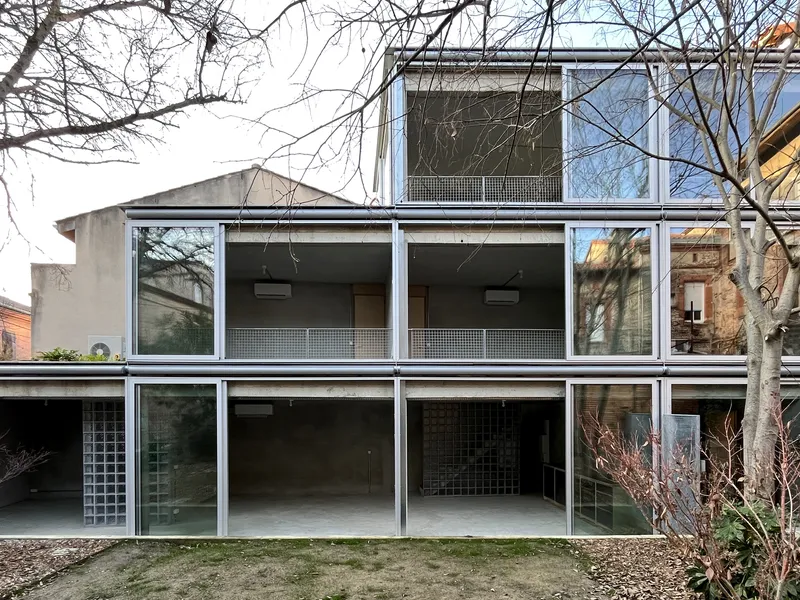
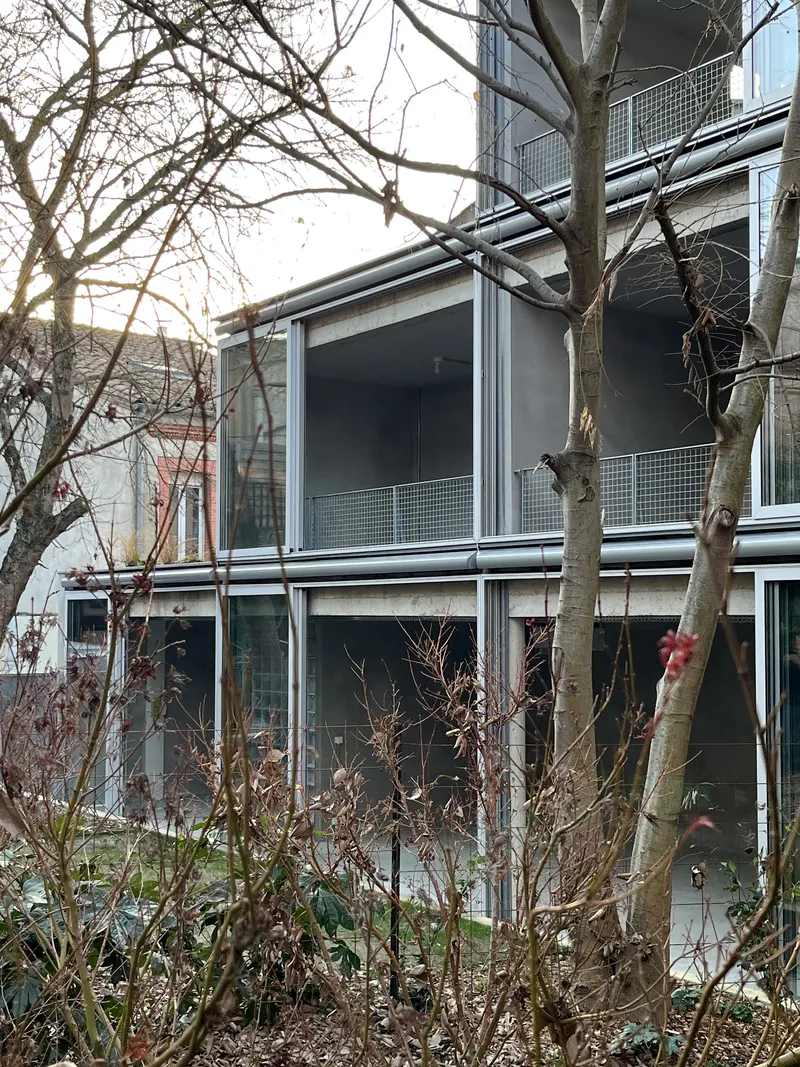
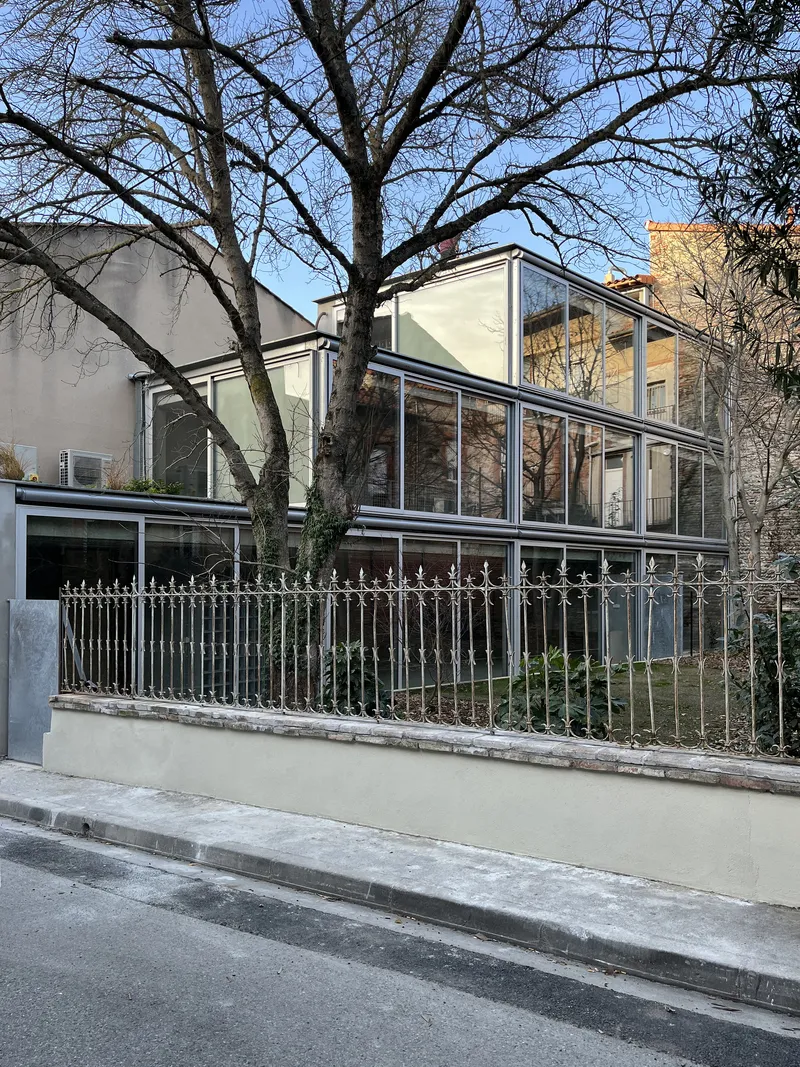
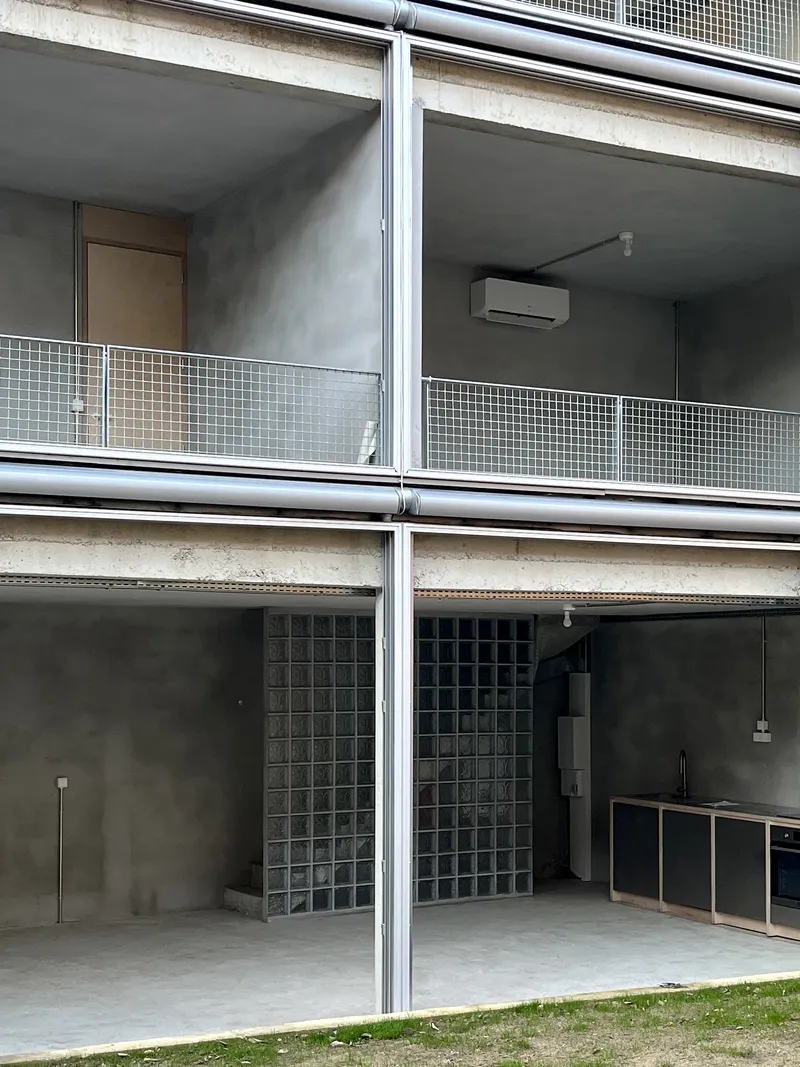
The rear facade reveals the building's sectional strategy. From the garden side, L33 presents a stepped profile, each level receding to create terraces and balconies that face southeast toward dense vegetation. The stacking of glazed bays, horizontal metal frames, and perforated panels gives the garden elevation a layered depth that the street side, constrained by alignment rules, cannot match.
BAST describes the project as being conceived in the spirit of a "preserved forest," and the rear views support that reading. The building footprint was kept to the width of the former garages specifically to avoid disturbing the root zone of a large hackberry tree on Massé Street. When the tree's canopy fills in during summer, the architecture and landscape will merge into something far more ambiguous than what the bare winter branches currently allow.
Concrete, Glass Block, and Light
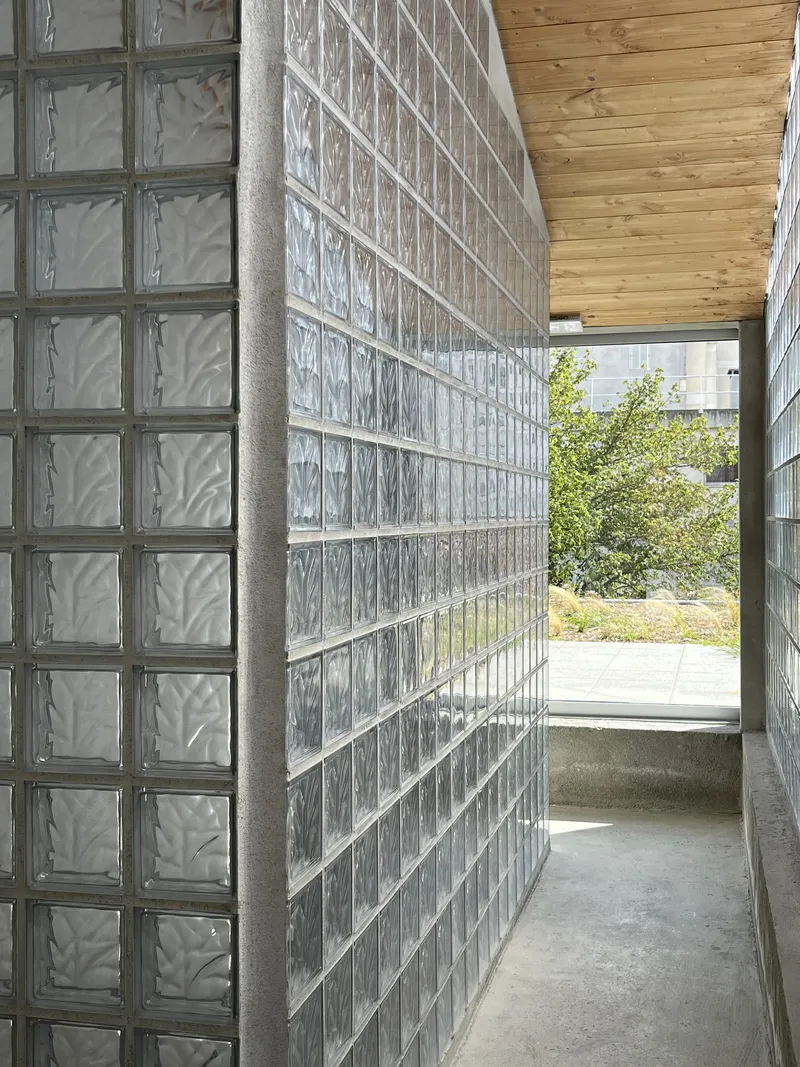
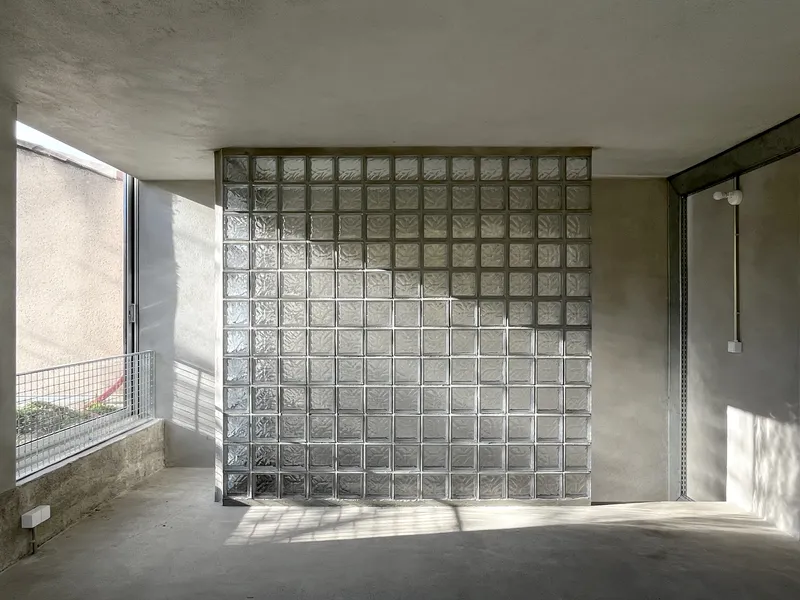
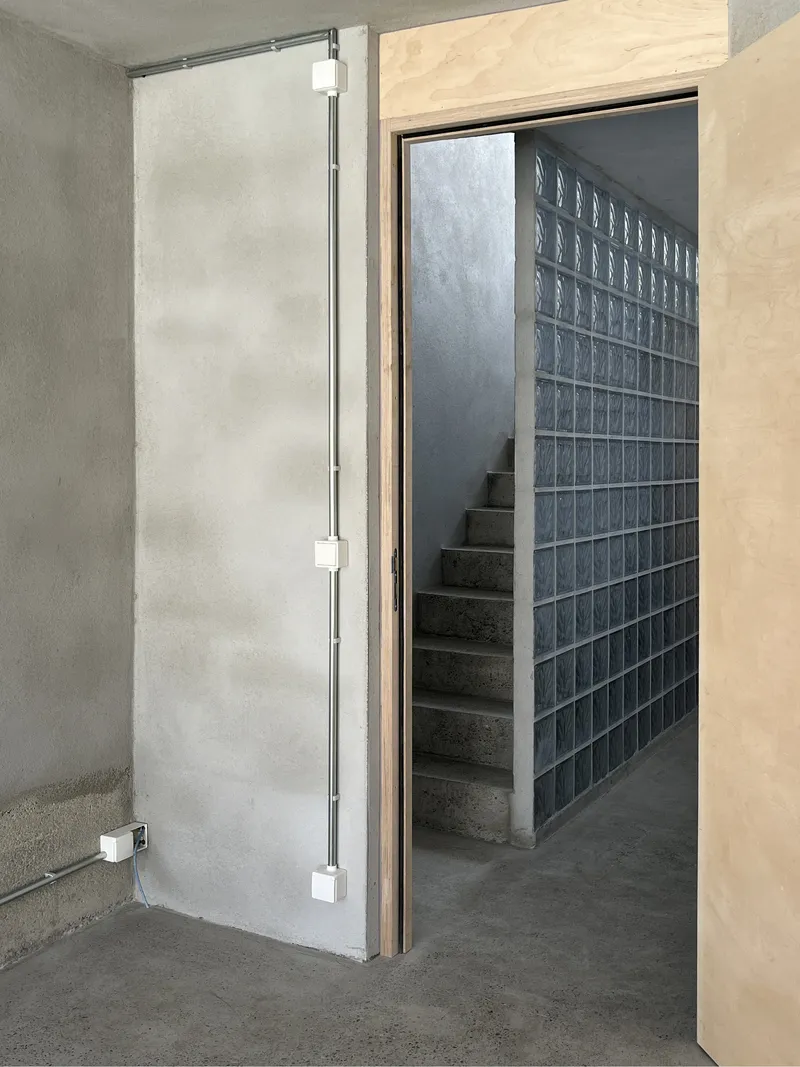
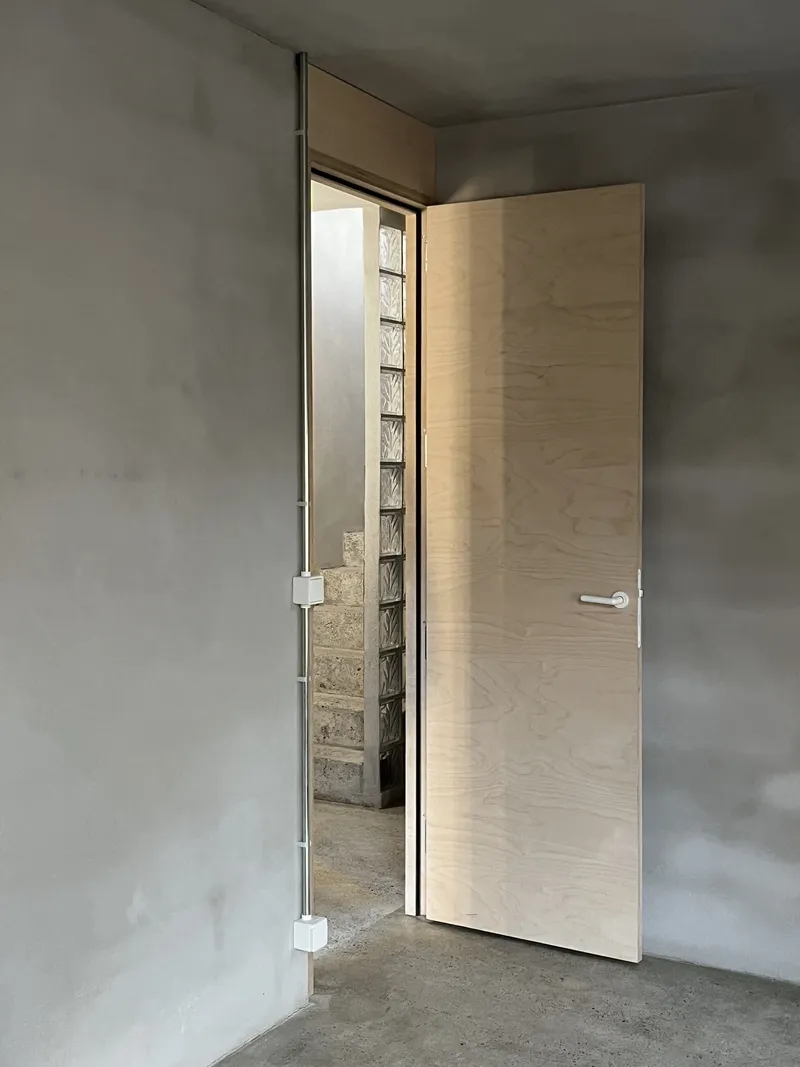
Inside, the material palette is pared back to concrete, glass block, and light timber. Glass block partitions recur throughout the building, serving as both spatial dividers and light diffusers. In the corridor passage, translucent glass block walls on both sides create a luminous, almost aqueous quality beneath a timber ceiling. The blocks catch and scatter sunlight in ways that shift hour by hour.
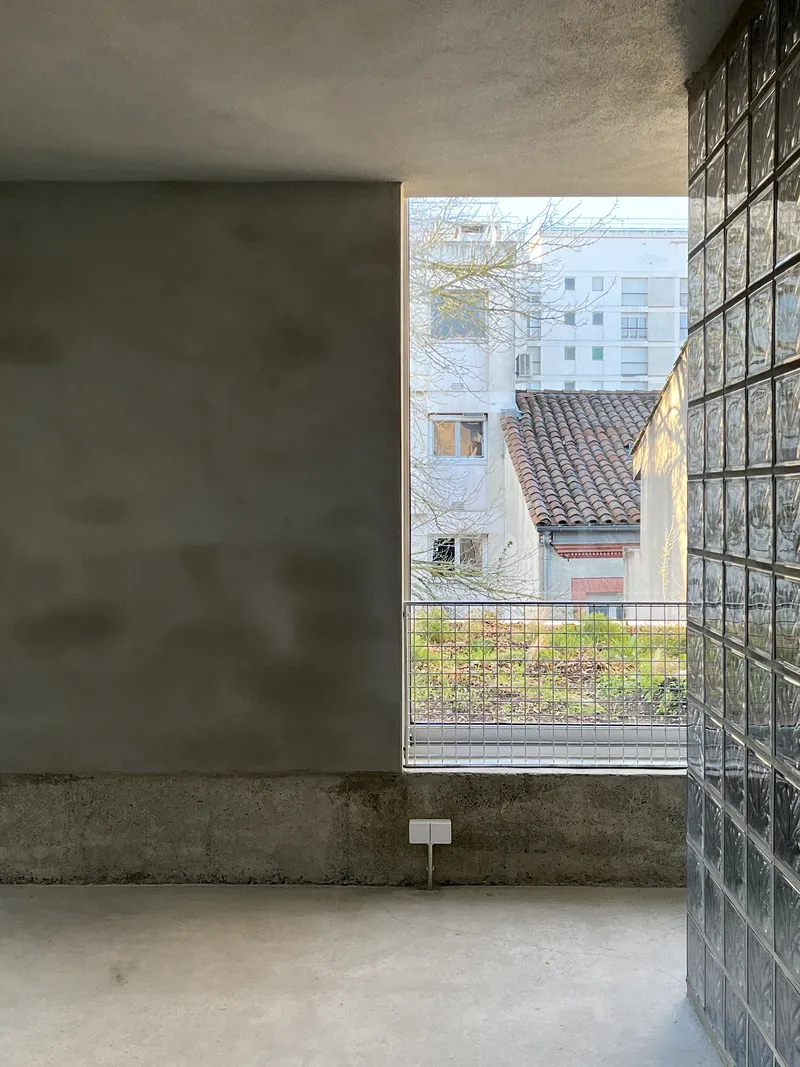
The freestanding glass block wall in one interior room is a particularly strong move. Rather than running wall to wall, it stands as an independent element receiving sharp lateral light from an adjacent window. It works simultaneously as a screen, a lamp, and a piece of furniture. This kind of material intelligence, where a single element does multiple jobs without looking busy, is the hallmark of a confident design.
Living Between Walls
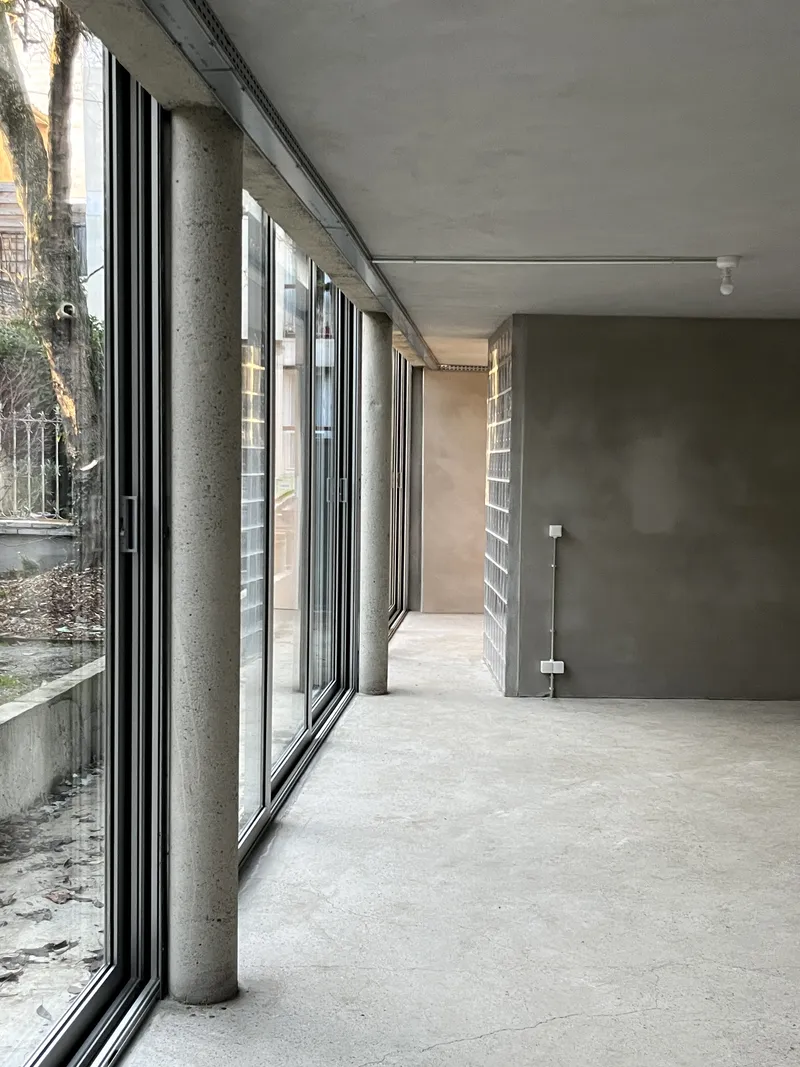
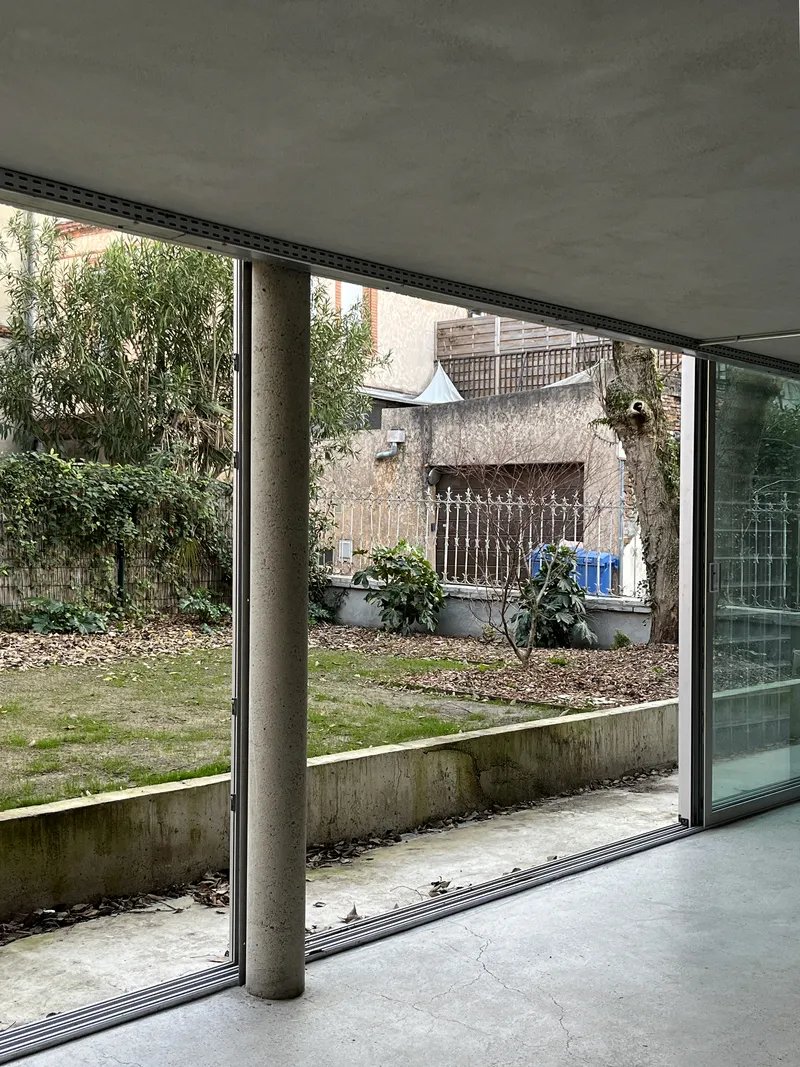
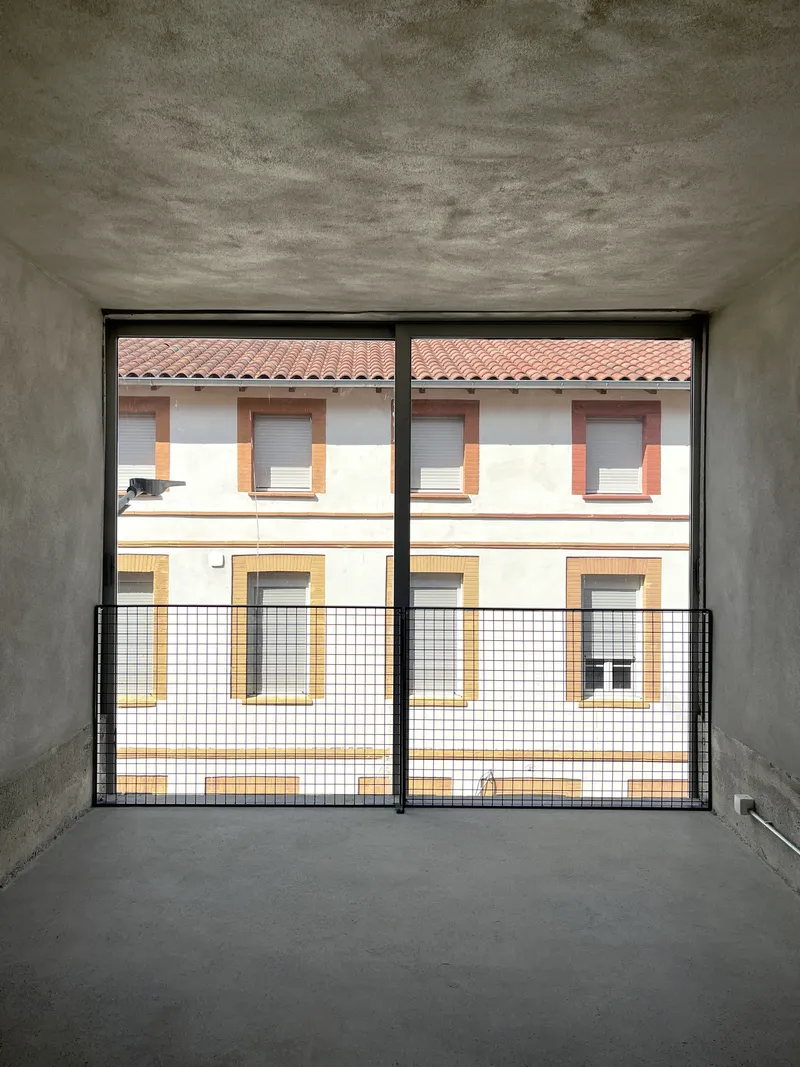
The ground-level spaces are defined by floor-to-ceiling glass on the garden side and raw concrete on the party walls. A single concrete column in one view stands as the only structural interruption between the interior and a courtyard thick with planting. The polished cement floors amplify daylight and give the rooms a coolness that suits Toulouse's hot summers.
Because the building serves as both home and office, every room has to negotiate between privacy and openness. BAST solves this not through heavy partitioning but through orientation: both programs face northeast toward the street and southeast toward the garden, meaning they share light conditions and views without necessarily sharing walls. The dual program is legible in the plans but largely invisible in the experience of the spaces.
Terraces, Rooftops, and the View Out
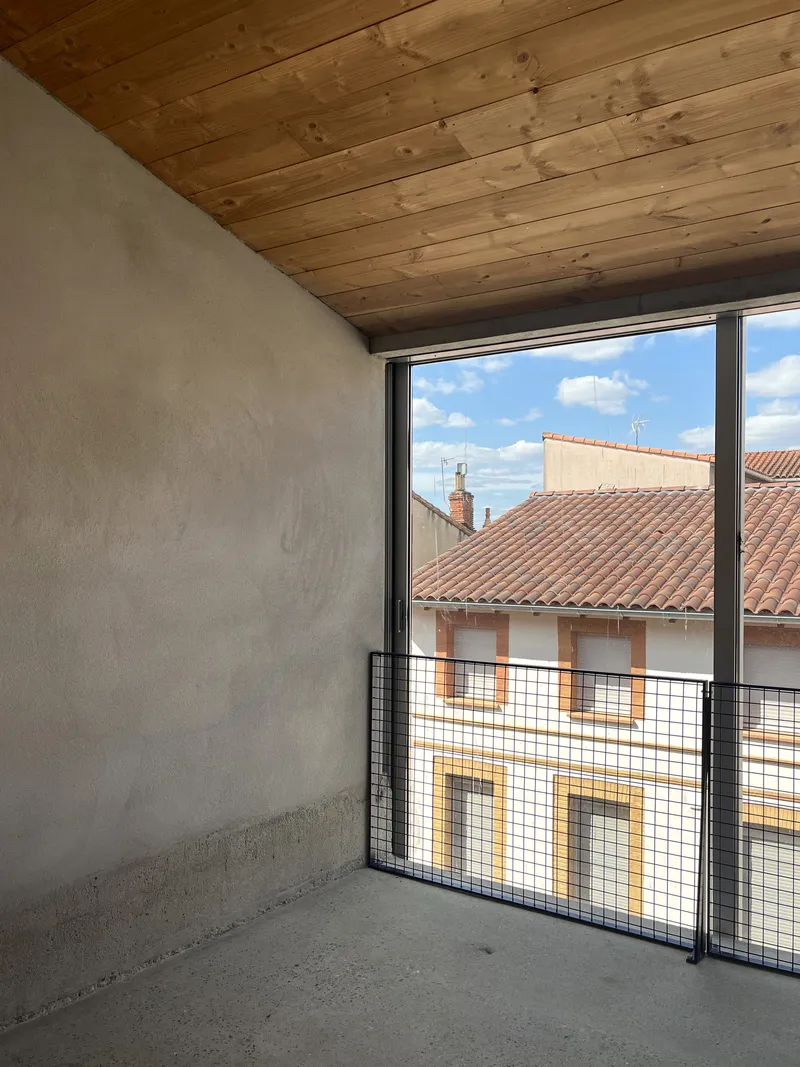
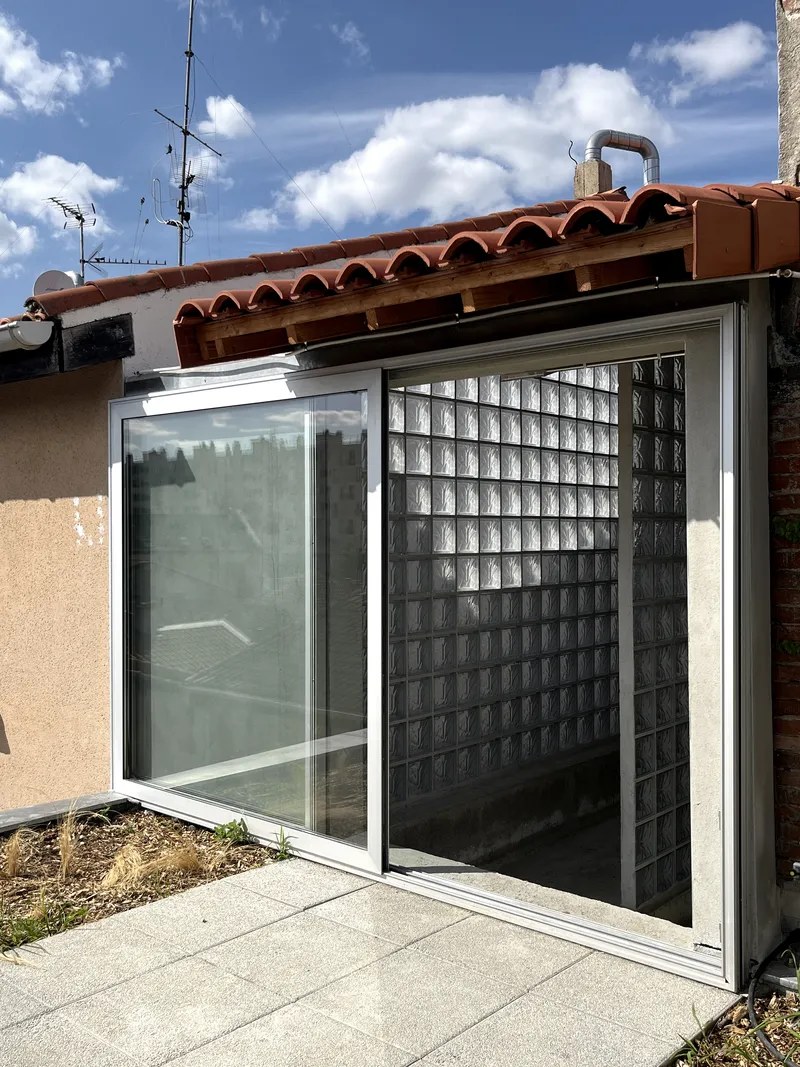
The cascading section generates terraces at every step, and these outdoor spaces are some of the project's strongest moments. The corner balcony with its timber plank ceiling and wire mesh railing frames a panorama of terracotta rooftops that is quintessentially Toulousain. The rooftop terrace, bounded by a curved glass block wall and sliding doors, feels almost Mediterranean in its relationship between enclosure and sky.
These terraces are not decorative. In a building this narrow, they serve as essential extensions of the interior, multiplying usable area without adding footprint. The stacked balconies visible from the garden side, with their glass block walls and metal railings, give the building a vertical garden quality that deepens the landscape strategy.
Domestic Details
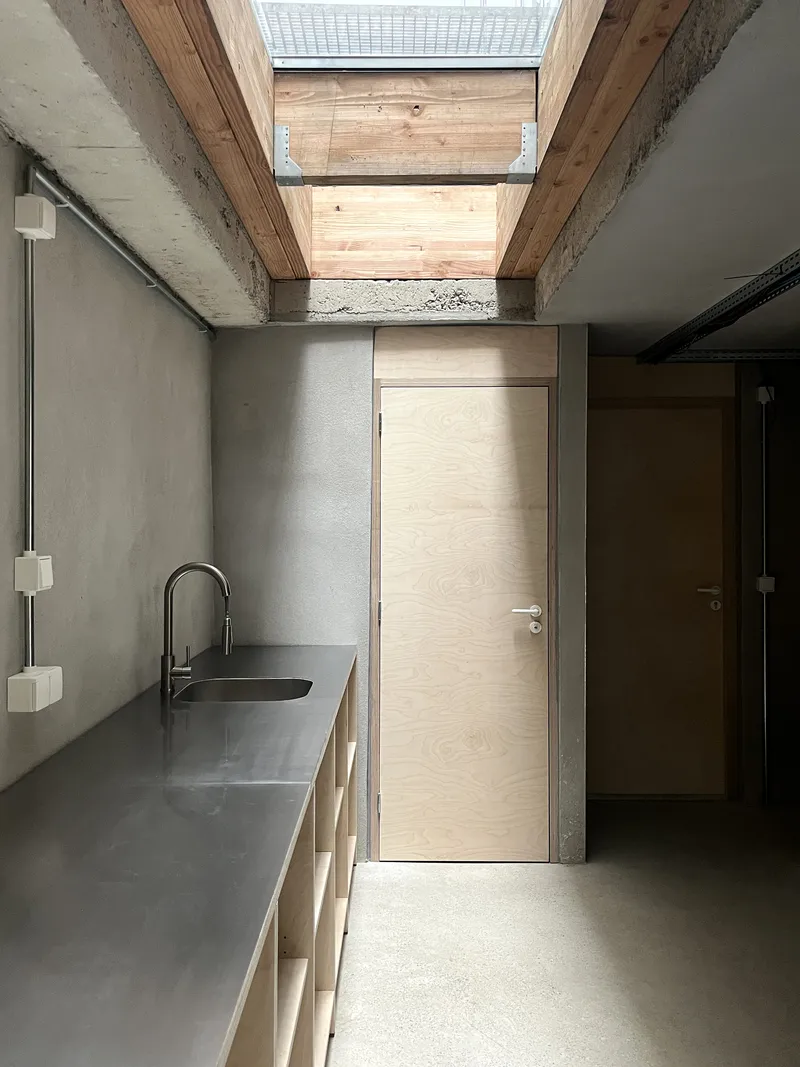
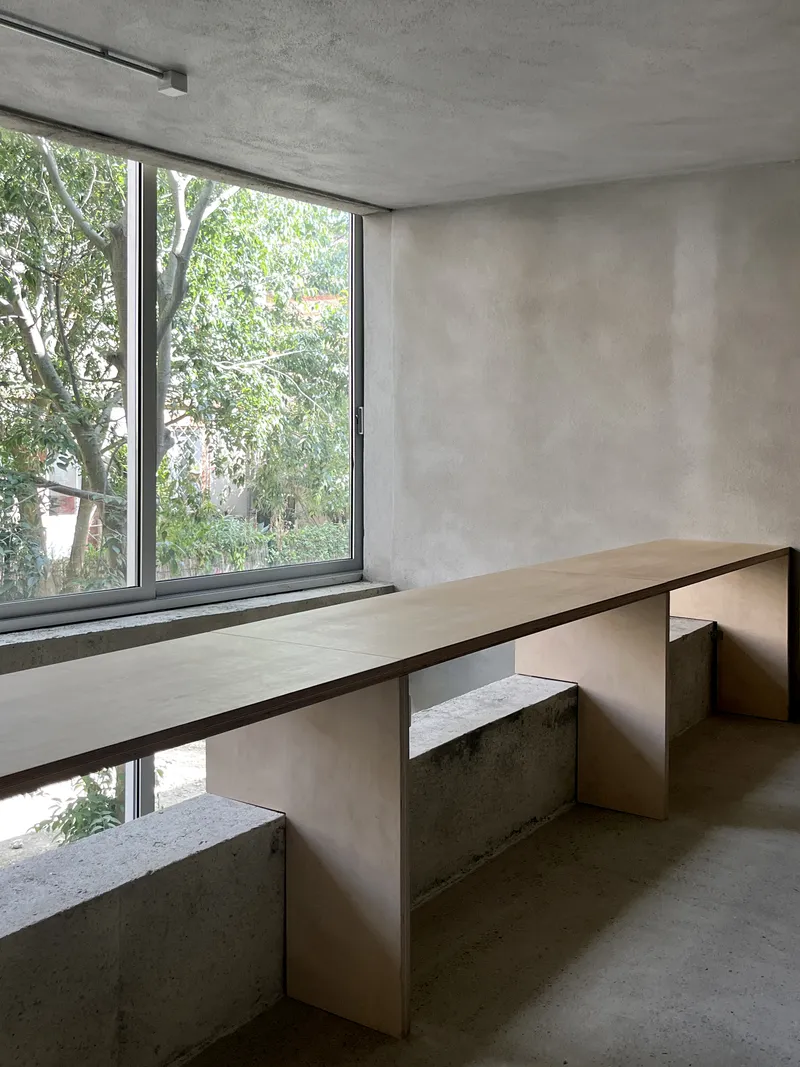
The kitchen corridor, lit by a rectangular skylight, is a study in controlled compression. Concrete walls and timber finishes hold the space tight, but the overhead light prevents it from feeling oppressive. Elsewhere, a built-in plywood desk and concrete bench beside a tree-framed window suggest a building designed for sustained, attentive occupation rather than photogenic display.
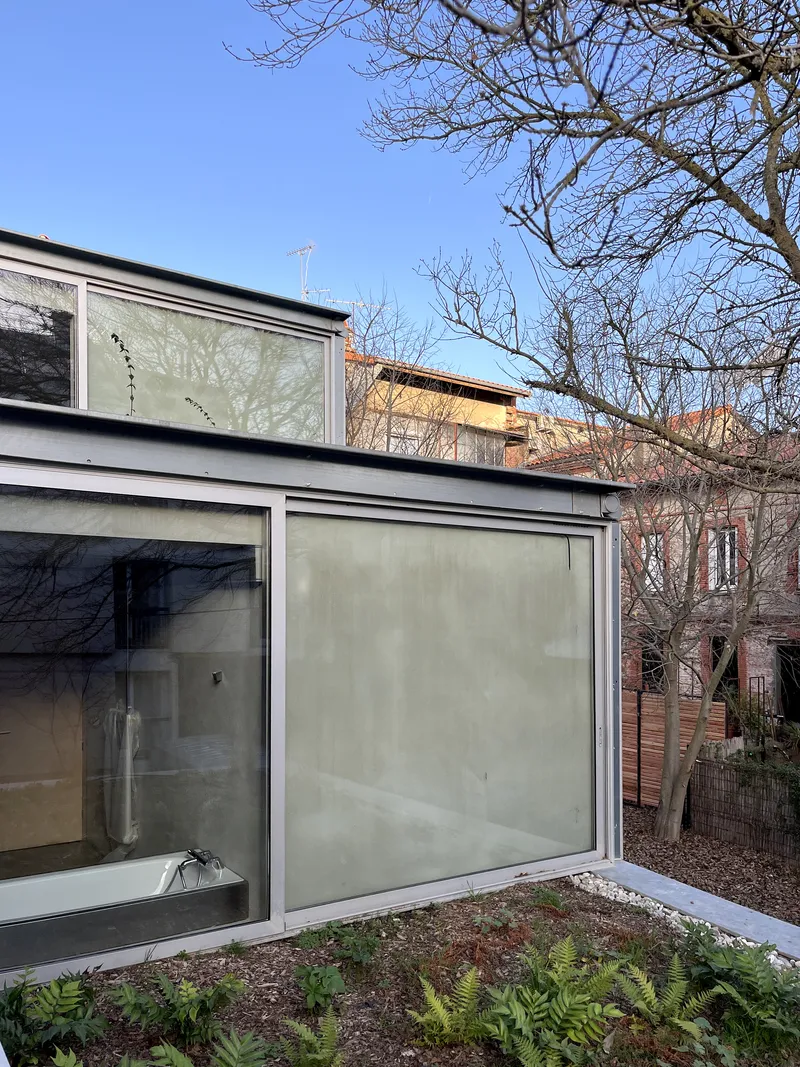
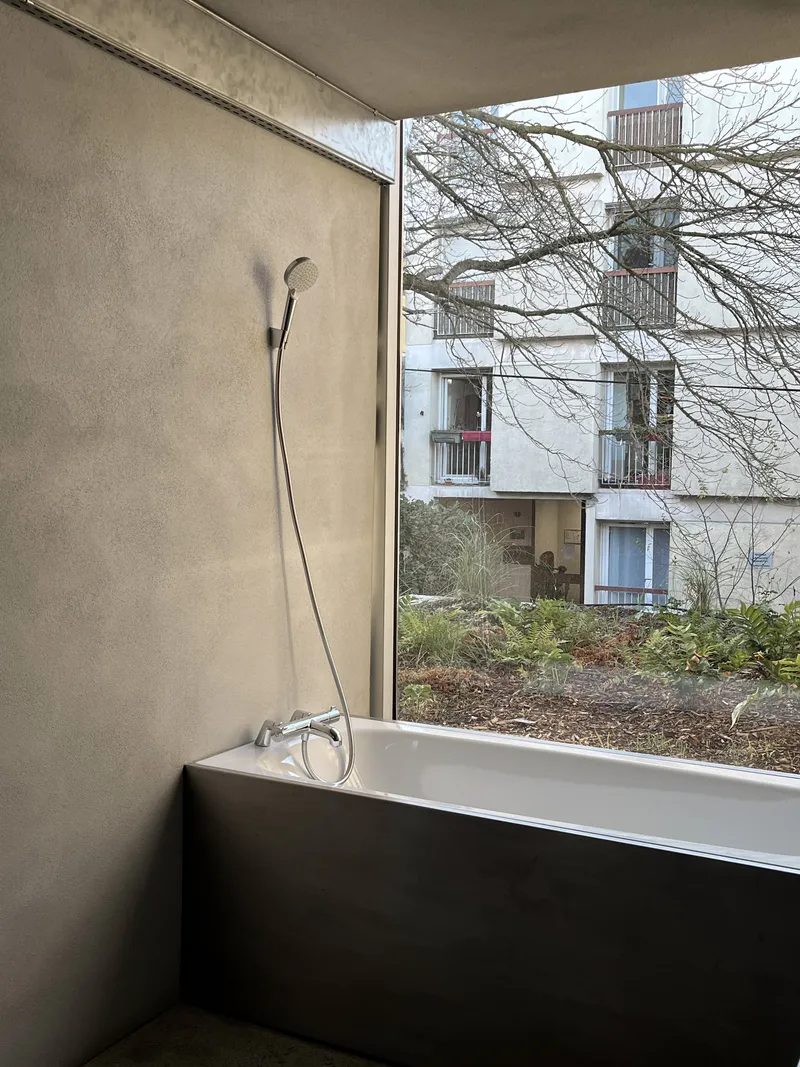
The bathtub beneath a corner window overlooking bare trees and an adjacent apartment facade is the kind of detail that divides opinion. It is either a luxurious indulgence or a practical acknowledgment that in a narrow house, you put the tub where the view is. Either way, it captures something essential about L33: the willingness to let the constraints of the site dictate unexpected spatial pleasures.
Thresholds and Transparency
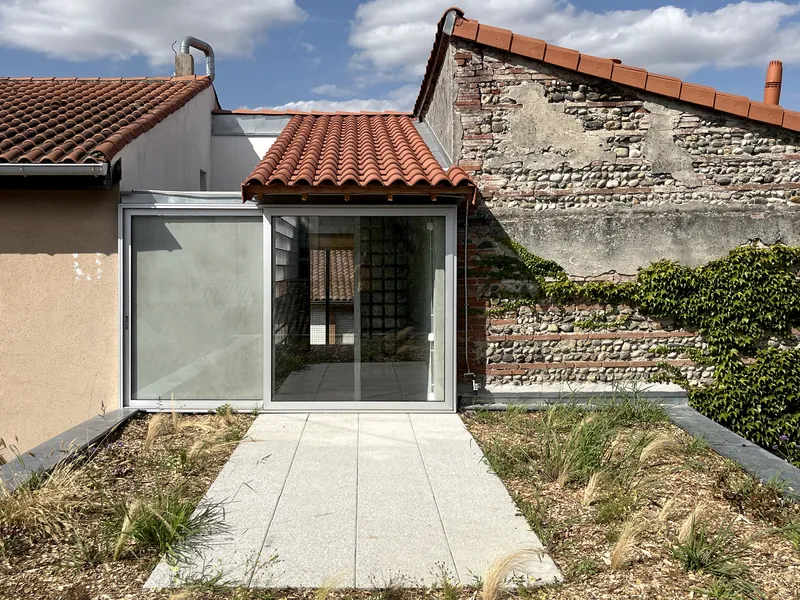
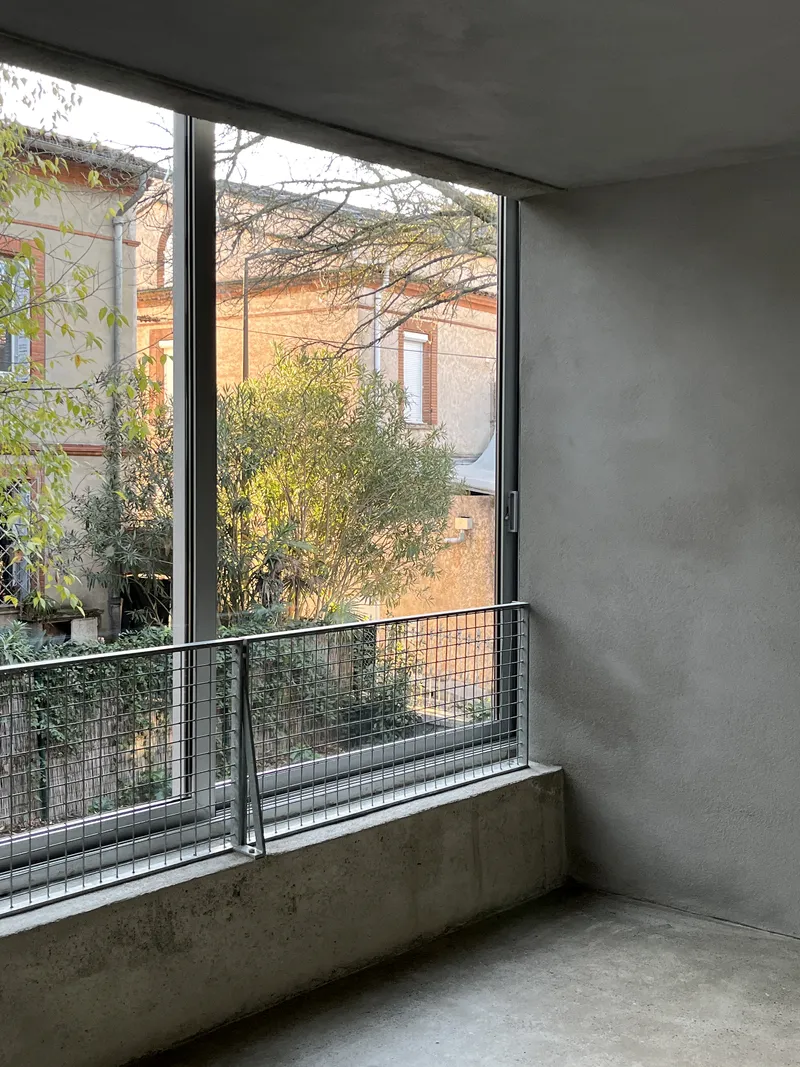
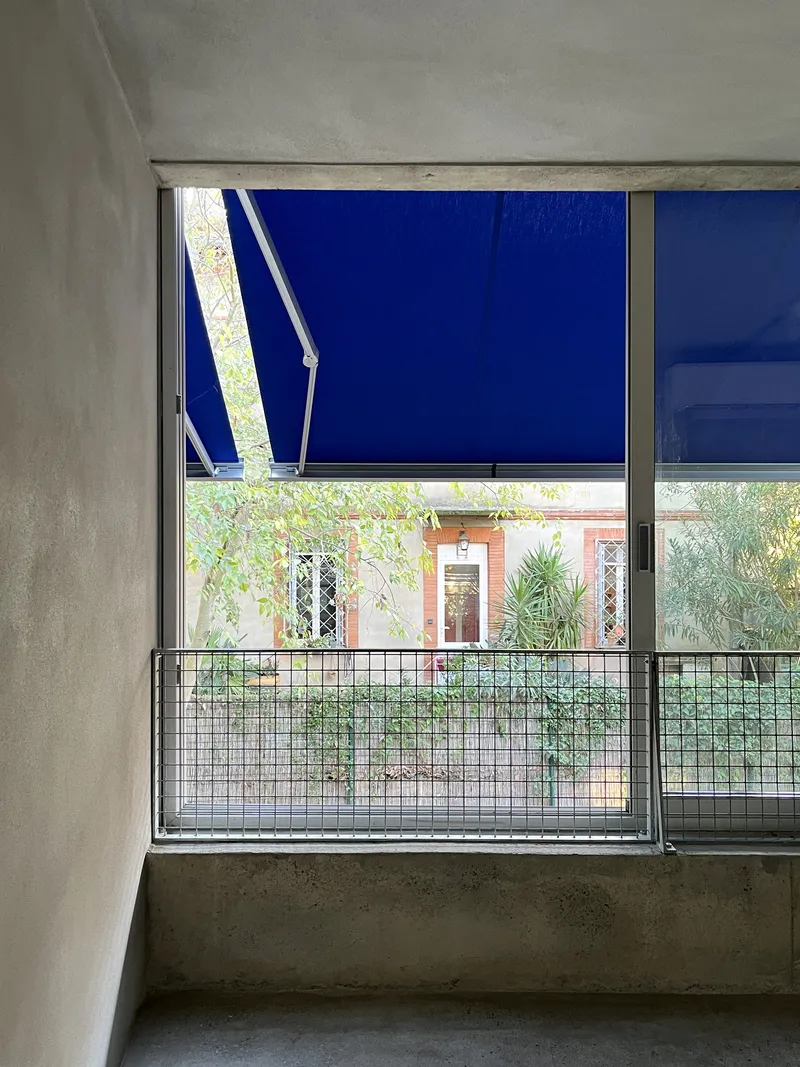
The glass extension meeting the existing brick party wall and gravel courtyard planting illustrates how carefully BAST has managed the seam between new and old. Terracotta roof tiles from a neighbor overhang the junction, and the gravel bed acts as a buffer zone between the building's glass skin and the planted garden. The retractable blue awning on an upper level introduces a note of informality, a reminder that this is a house, not a gallery.
Throughout the building, the threshold between inside and outside is treated as a gradient rather than a boundary. Floor-to-ceiling windows with metal railings open directly to courtyard planting. Sliding glass doors dissolve the roof terrace wall. Even the glass block partitions, which technically face interior corridors, behave like exterior walls in the way they admit and modulate light.
Plans and Drawings
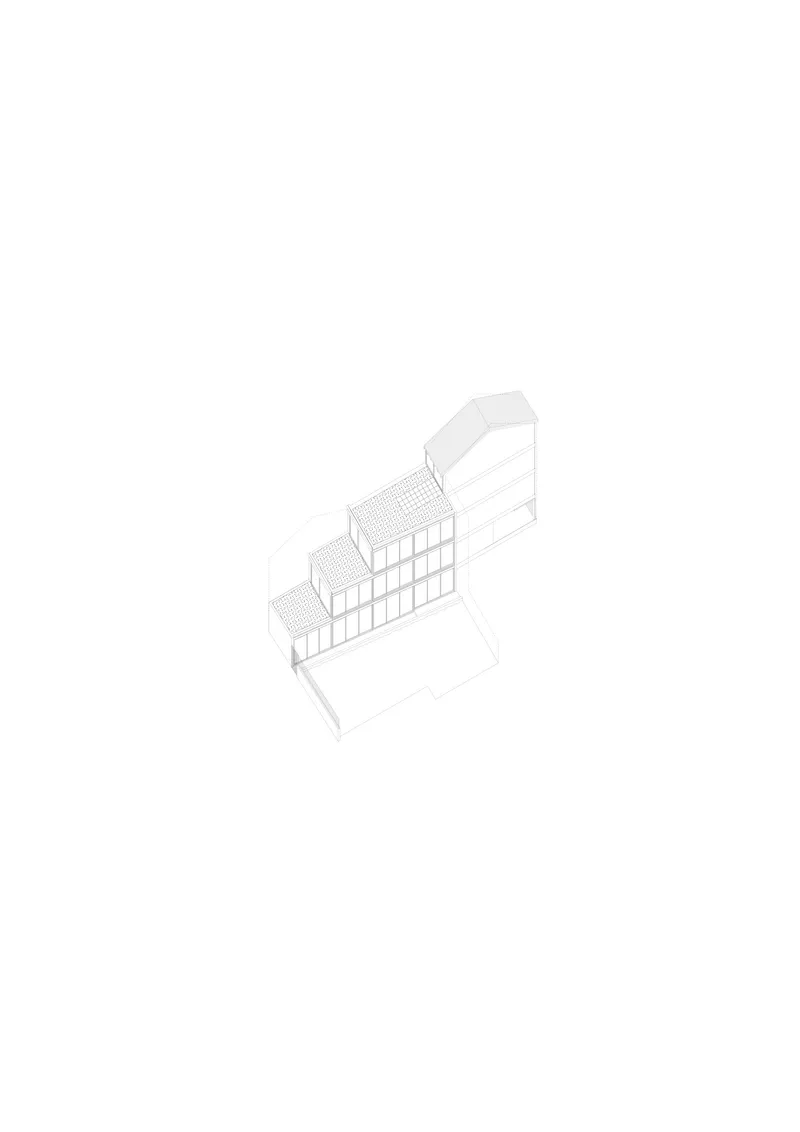
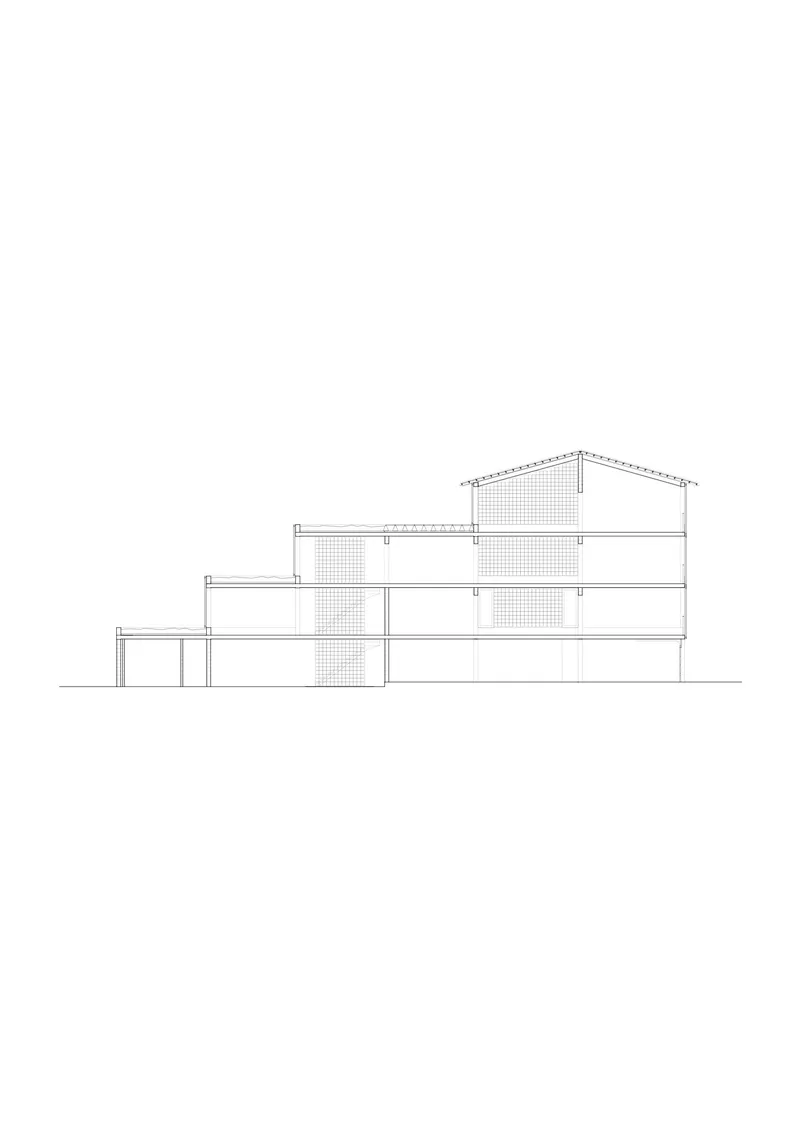
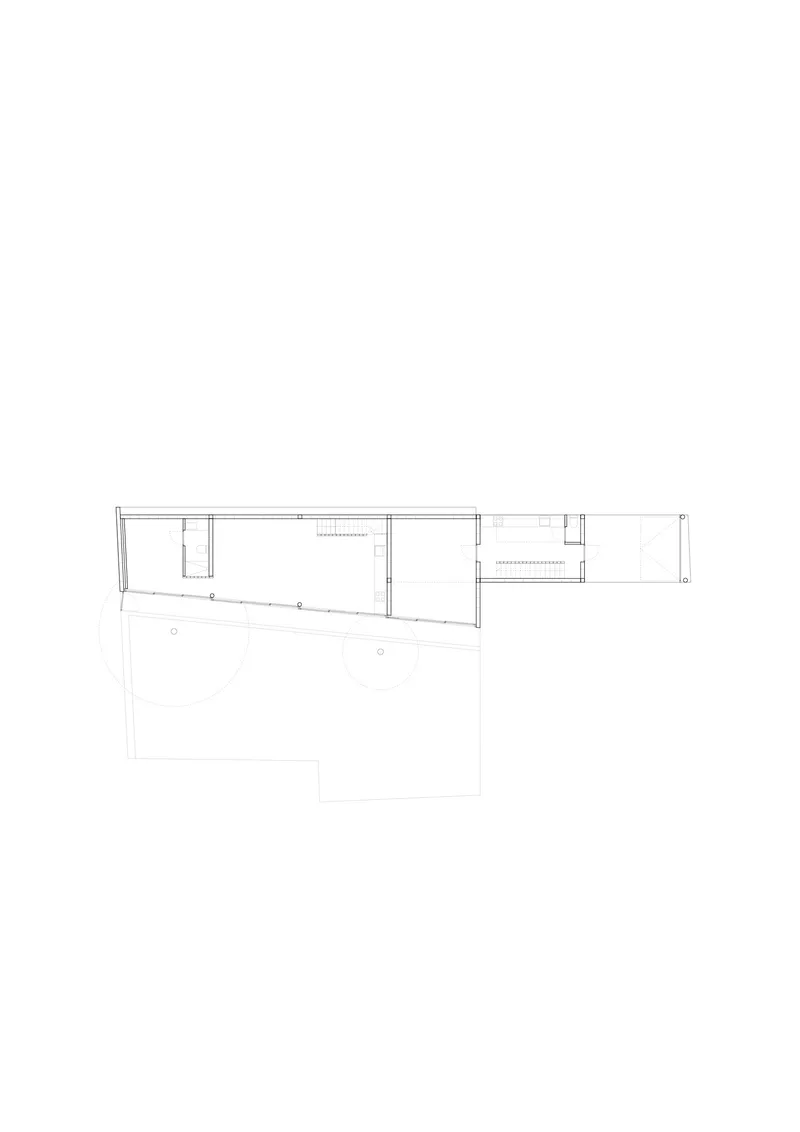
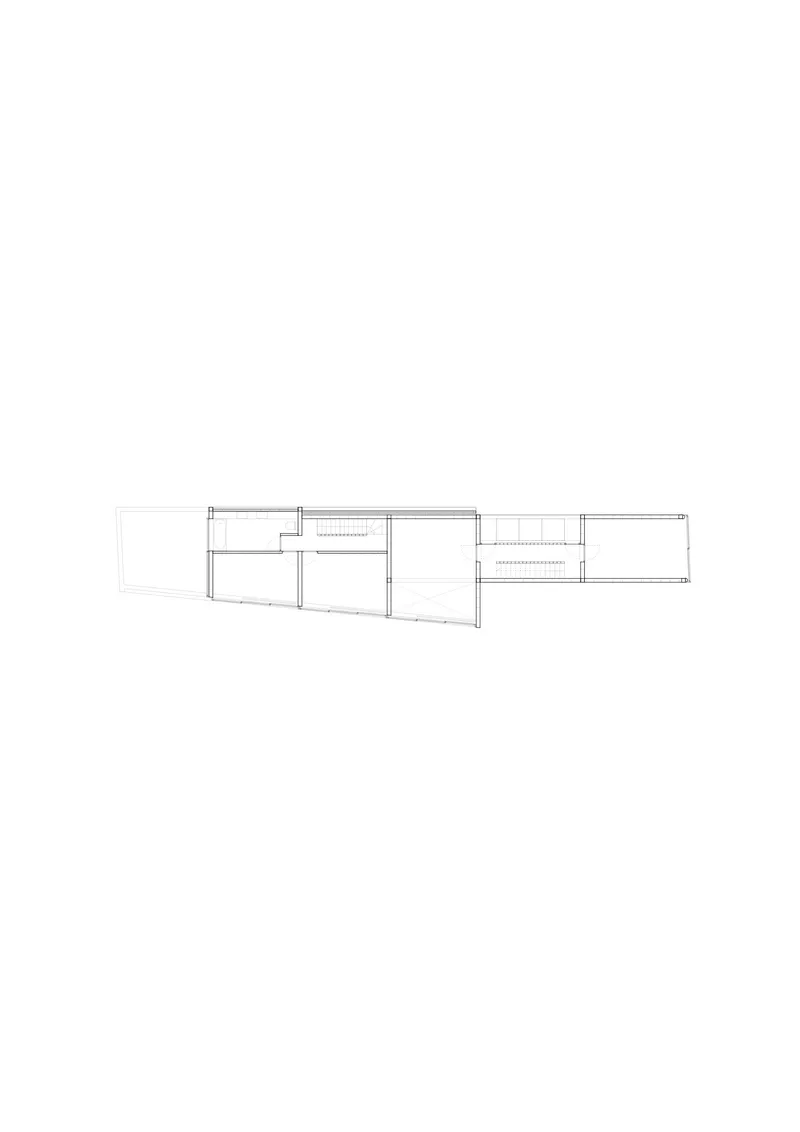
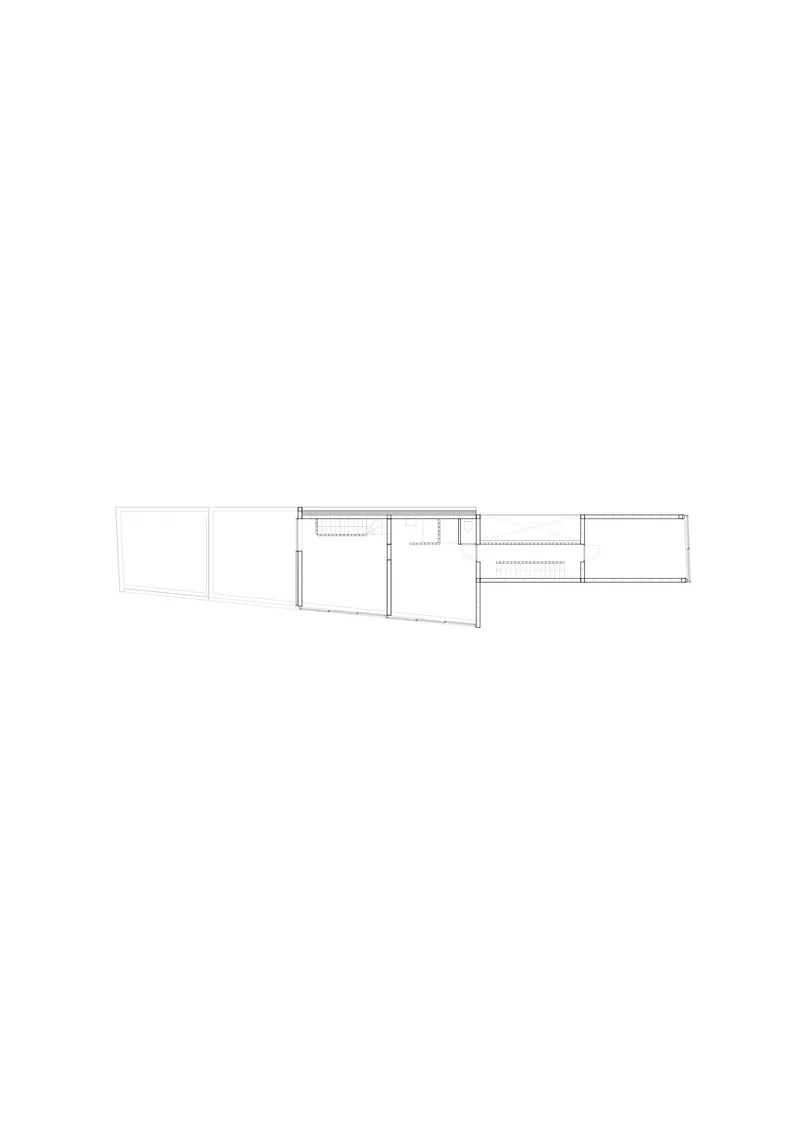
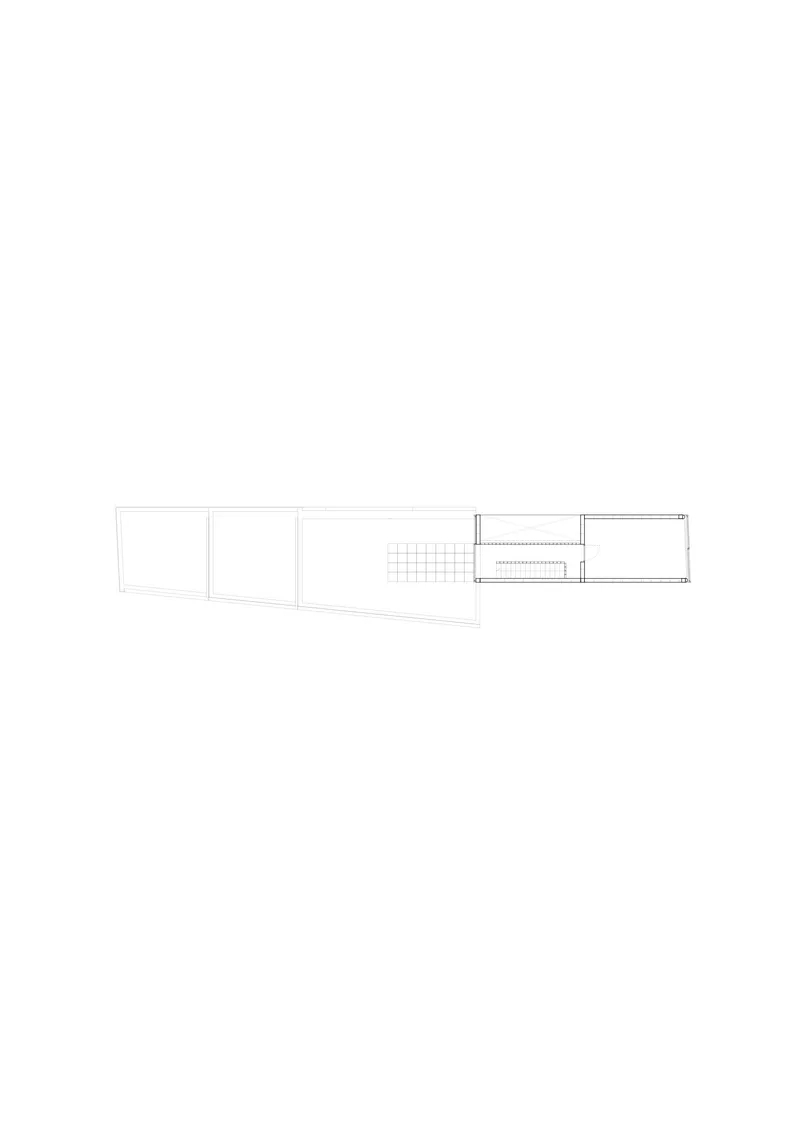
The axonometric drawing makes the stepping strategy legible in a way photographs cannot. Four vaulted roof profiles descend in sequence from the street side to the garden, each step creating a terrace for the level above. The section drawing confirms the slope: the building is not simply extruded from its footprint but sculpted in response to the topography and the neighboring rooflines. The floor plans reveal an angular geometry that accommodates the irregular lot shape, with central service cores freeing the perimeter for daylight.
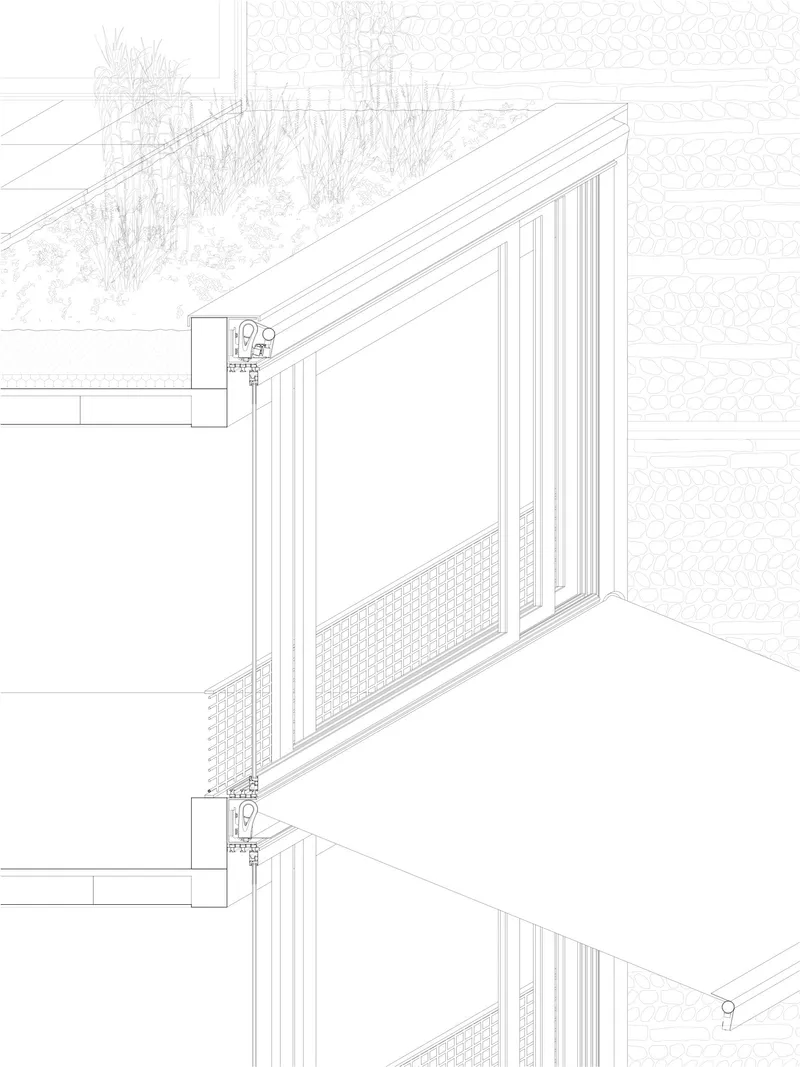
The detail axonometric of the sliding glass door assembly is worth a close look. It shows how the mullion system connects two floor levels, suggesting that transparency is achieved not by minimizing structure but by integrating it into the glazing rhythm. The grid pattern on the ground-floor plan indicates the extent of outdoor paving, mapping the exact territory the building claims versus what it leaves to planting.
Why This Project Matters
Narrow-house projects are a genre unto themselves, and the risk is always that the architecture becomes a demonstration of cleverness at the expense of livability. L33 avoids this trap because its narrowness is secondary to its sectional ambition. The cascading profile, the preserved tree, the dual program, and the material discipline all point to a design process that treated the site's constraints as design generators rather than problems to solve. BAST has produced a building that fits its gap without merely filling it.
For architects working in established European urban fabric, this project offers a useful model. It demonstrates that density and landscape are not opposed, that transparency and privacy can coexist in a narrow volume, and that an infill building can be a good neighbor without being a wallflower. When the hackberry tree leafs out, L33 will become a different building entirely, and that seasonal mutability may be its most intelligent quality.
L33 Narrow House by BAST. Located in Toulouse, France. 370 m². Completed in 2025. Structural engineering by I.STRUCTURE bureau d'études structure; thermal engineering by QPE bureau d'étude thermique.
About the Studio
Share Your Own Work on uni.xyz
If projects like this are the kind of work you want to make, uni.xyz is a place to publish your own, find collaborators, and enter design competitions.


Popular Articles
Popular articles from the community


The Ocean Hive: Sustainable Architecture for a Self-Sufficient Civilization at Sea
The Ocean Hive imagines sustainable architecture at sea, where modular habitats, algae, wave power and ocean waste sustain a growing colony.

Lunar Spiral: Space Architecture Shaped by the Mathematics of the Universe
Lunar Spiral reimagines space architecture through Fibonacci geometry, lunar regolith, levitating habitats, and self-sustaining Moon living.

Conexión: Biophilic Design Reimagines High-Rise Living in Hong Kong
Conexión reimagines high-rise living in Hong Kong through biophilic design, green facades, shared spaces, daylight, water and nature within.

Co-Life: Senior Housing Design That Reconnects Older Adults With the City
Co-Life reimagines senior housing design through healing gardens, shared streets, workshops, and a sustainable community across generations.

Similar Reads
You might also enjoy these articles

Bao Huynh Watercolor Atelier: A Serene Art Retreat in Hội An
Bao Huynh Watercolor Atelier in Hội An blends multifunctional art spaces, sustainable design, local materials, and family-friendly living in a serene environment.

Atelier Macri Concept Store Interior Design by CASE-REAL
Atelier Macri store features a "ko" counter, walnut wood details, cork displays, blending retail, gallery, and seamless customer experiences.

Manuel Vargas Izquierdo Stadium and High-Performance Sports Center: Architectural Excellence in Jalpa de Méndez
The Manuel Vargas Izquierdo Stadium blends sustainable design, inclusive sports facilities, and cultural-inspired architecture, revitalizing Jalpa de Méndez’s public spaces.
KAKR Buluh Awar Hall: Revitalizing Community and Ecology Through Bamboo Architecture
Community built bamboo hall revitalizes Buluh Awar village, empowering youth, restoring ecology, celebrating vernacular craftsmanship through sustainable architecture and culture.

Explore Residential Building Competitions
Discover active competitions in this discipline

Challenge to design mud housing for contemporary communities

Challenge to reimagine the Iron Throne

Photograph architecture without architects

Illustrate the lost glory of Angkor Wat - Render Challenge
Comments (0)
Please login or sign up to add comments
No comments yet. Be the first to comment!