
Driss Kettani Carves a Private World from Concrete Boxes on a Tight Casablanca Plot
Villa Polo stacks perforated concrete volumes around courtyards and a rooftop pool to shield a family home from the dense urban fabric.


In Casablanca's tightly packed residential neighborhoods, privacy is not a luxury; it is a structural premise. Driss Kettani treats the 250-square-meter plot of Villa Polo not as a limitation but as the generator of its entire architectural logic: a sequence of interlocking concrete boxes that step back, rotate, and perforate to create an interior world for a family of four that owes nothing to the street outside.
What makes this 370 m² house worth studying is the discipline with which it handles a basic paradox. The plot faces north, so the street side receives little direct sun. Kettani responds by closing the building toward the road with monolithic board-formed concrete walls, then opening it progressively toward the south-facing garden and pool at the rear. The result is a house that feels both fortified and generous, opaque from the sidewalk yet flooded with light inside.
A Facade That Speaks in Perforations
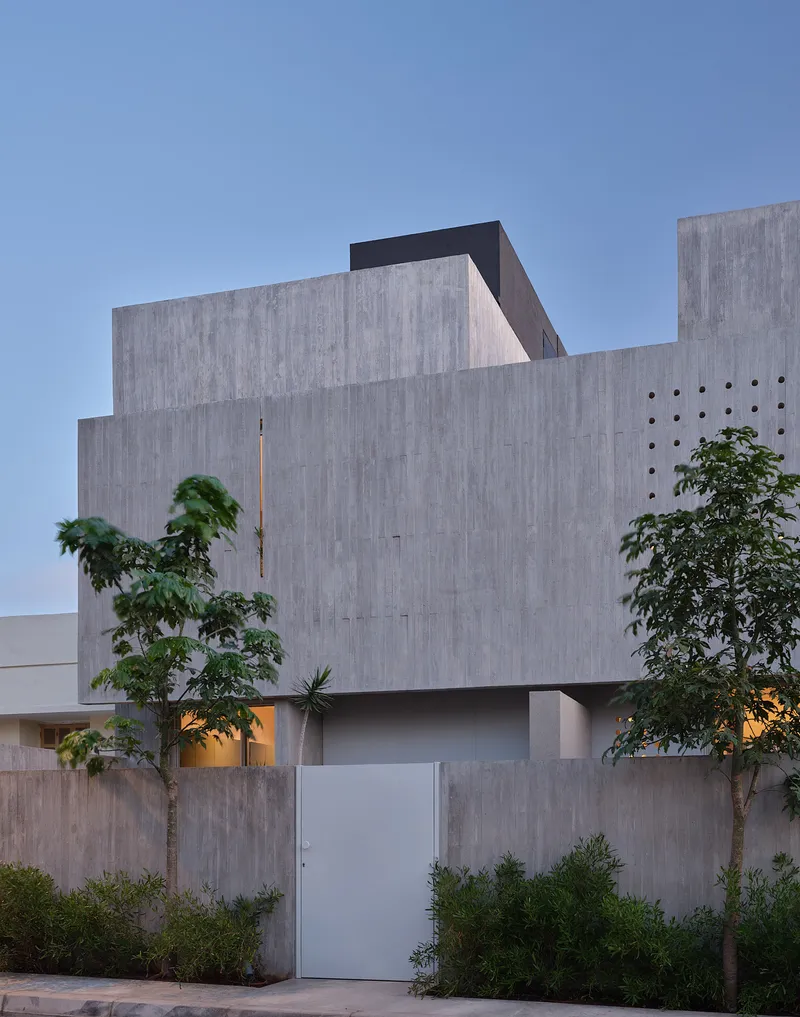
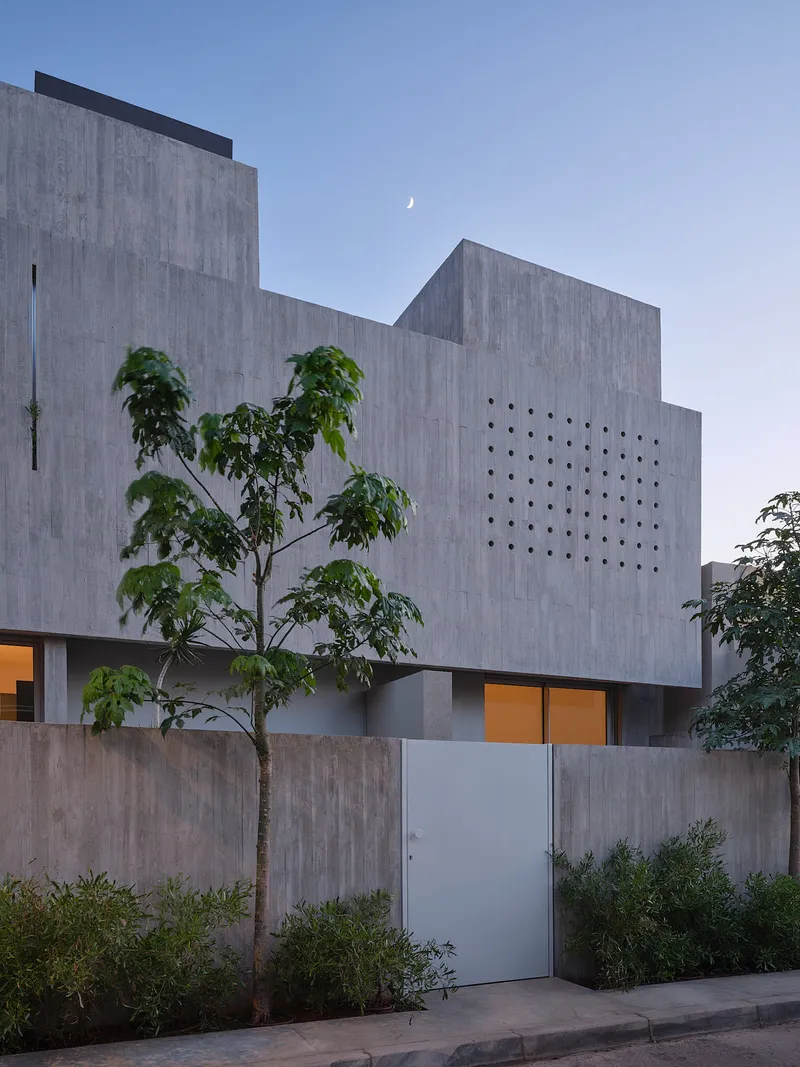
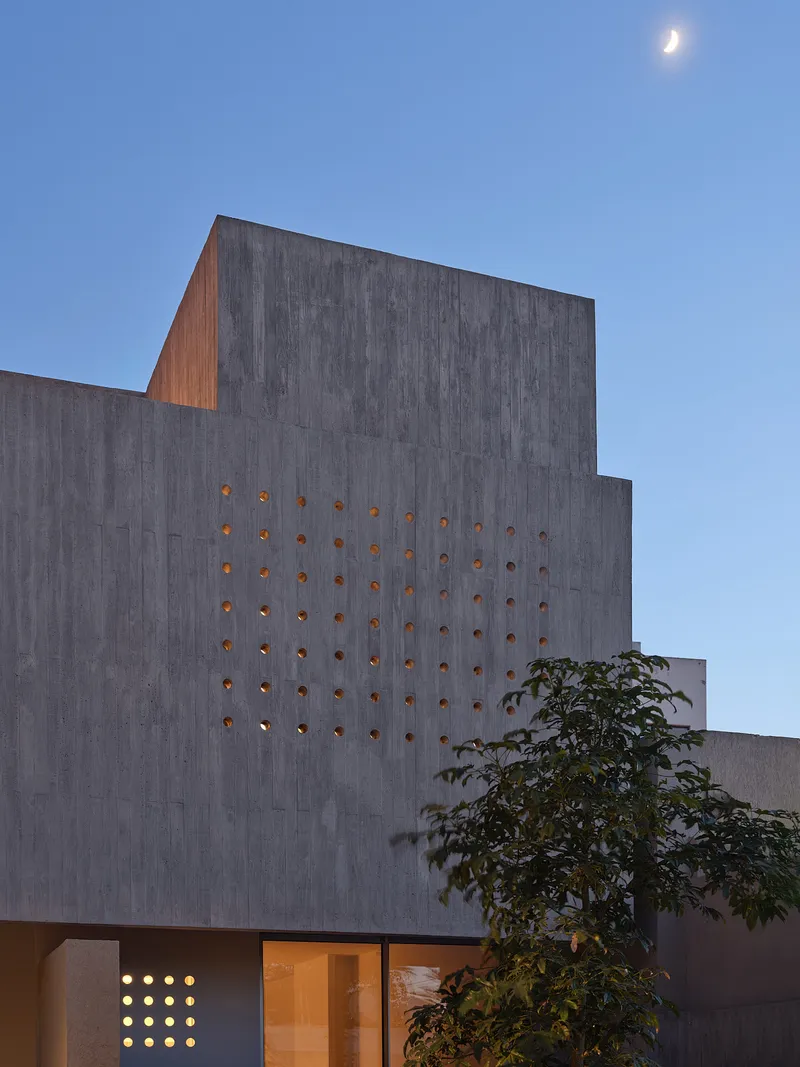
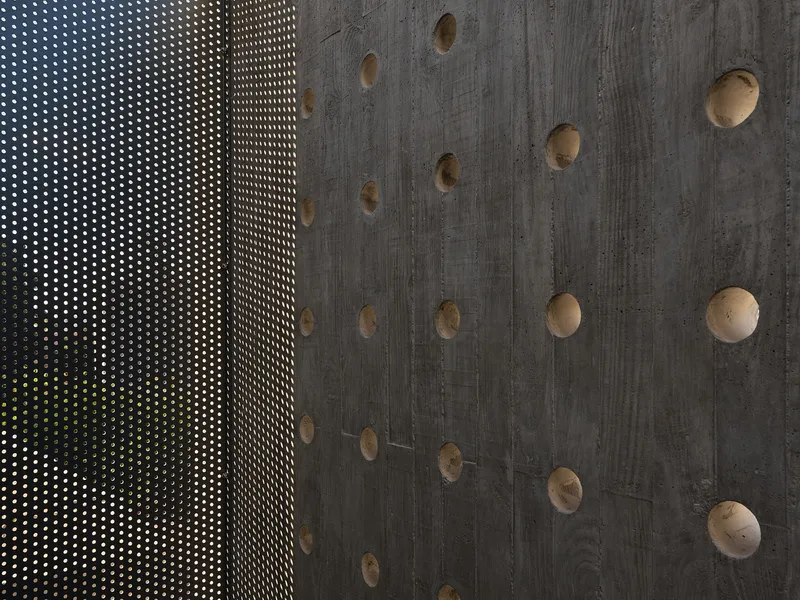
The street elevation is the building's most public performance, and Kettani keeps it deliberately restrained. Stacked concrete volumes step upward and back, their surfaces textured by the grain of rough formwork and punctuated by a grid of circular perforations. At twilight, these openings glow from within, giving the facade a lantern-like quality without sacrificing any of the family's seclusion.
The perforated panels do real climatic work, admitting filtered light and cross-ventilation into service zones and corridors while blocking direct sightlines from the narrow street. A sliver of warm light running along the base of one volume and the recessed entry behind glass sliding doors are the only concessions to openness on this side. Everything else is shielded.
Concrete as Skin and Structure

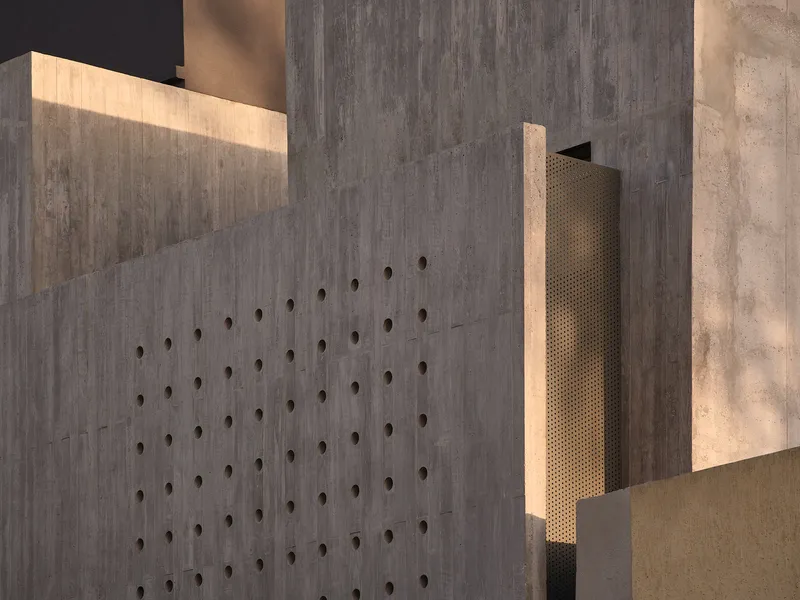
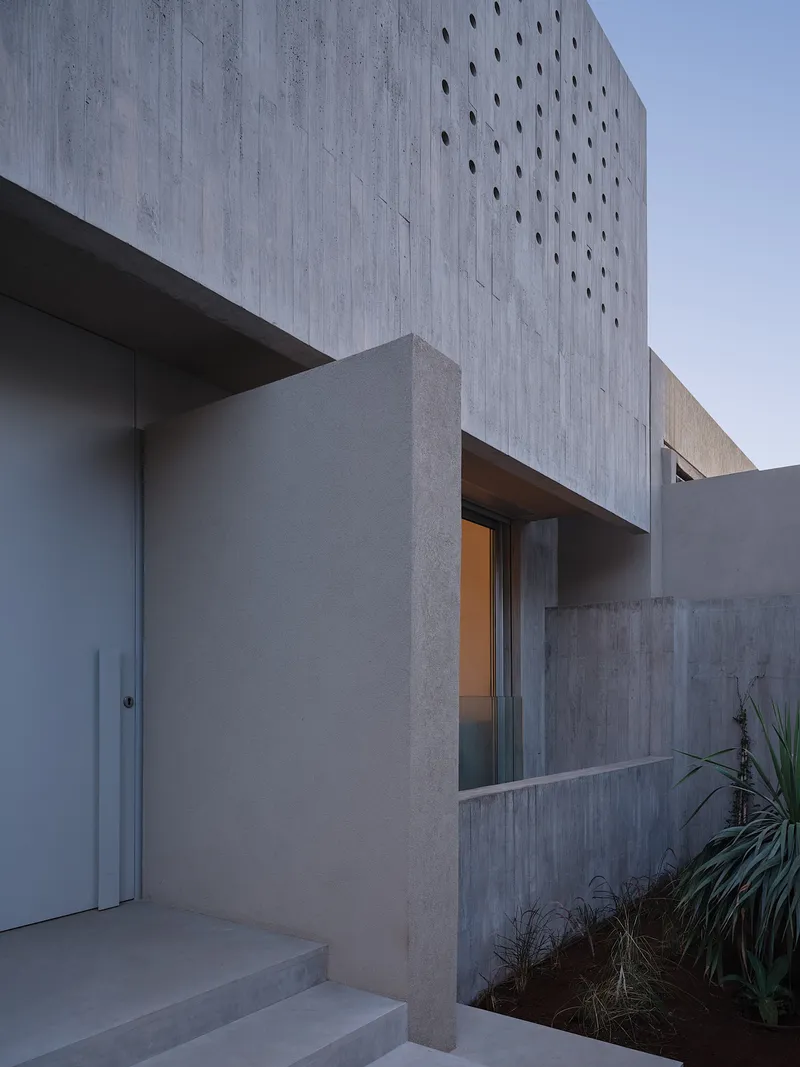
Board-formed concrete is the dominant material throughout, and Kettani lets it carry an unusual amount of expressive weight. The tie holes left by formwork rods become a rhythmic texture across every wall surface, and the circular perforations in the upper panels echo that geometry at a larger scale. These are not decorative choices; they are consequences of how the house was built, and they give the building a coherent material identity from basement to rooftop.
The layered massing reads clearly at the corners, where one concrete plane slides past another with a deliberate gap between them. Perforated metal screens and vent openings tuck into these gaps, allowing the facade to breathe without breaking its monolithic profile. Green foliage from planted beds at the base softens the base condition and signals that something different is happening behind the walls.
The Courtyard as Vertical Spine
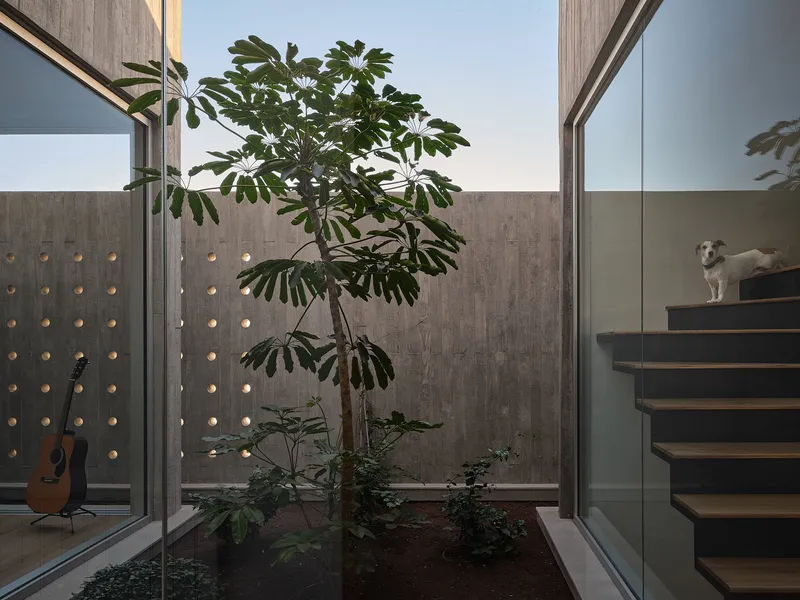
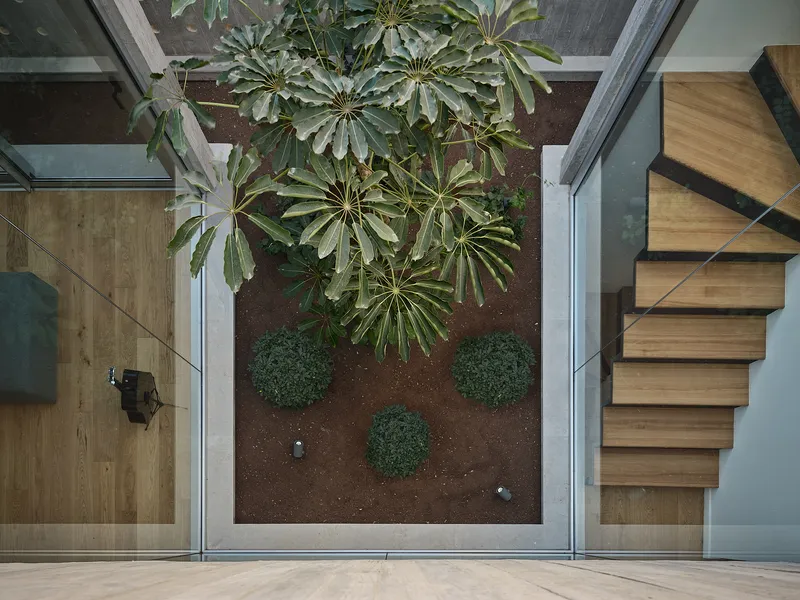
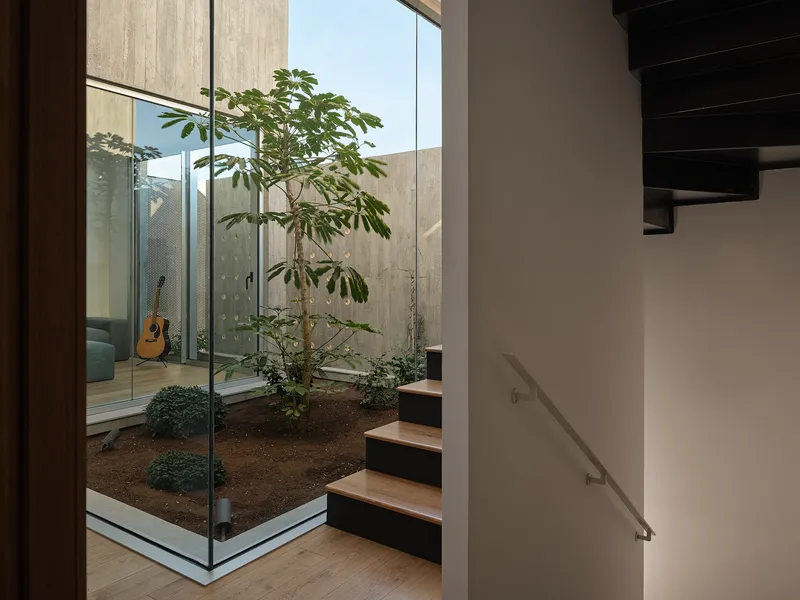
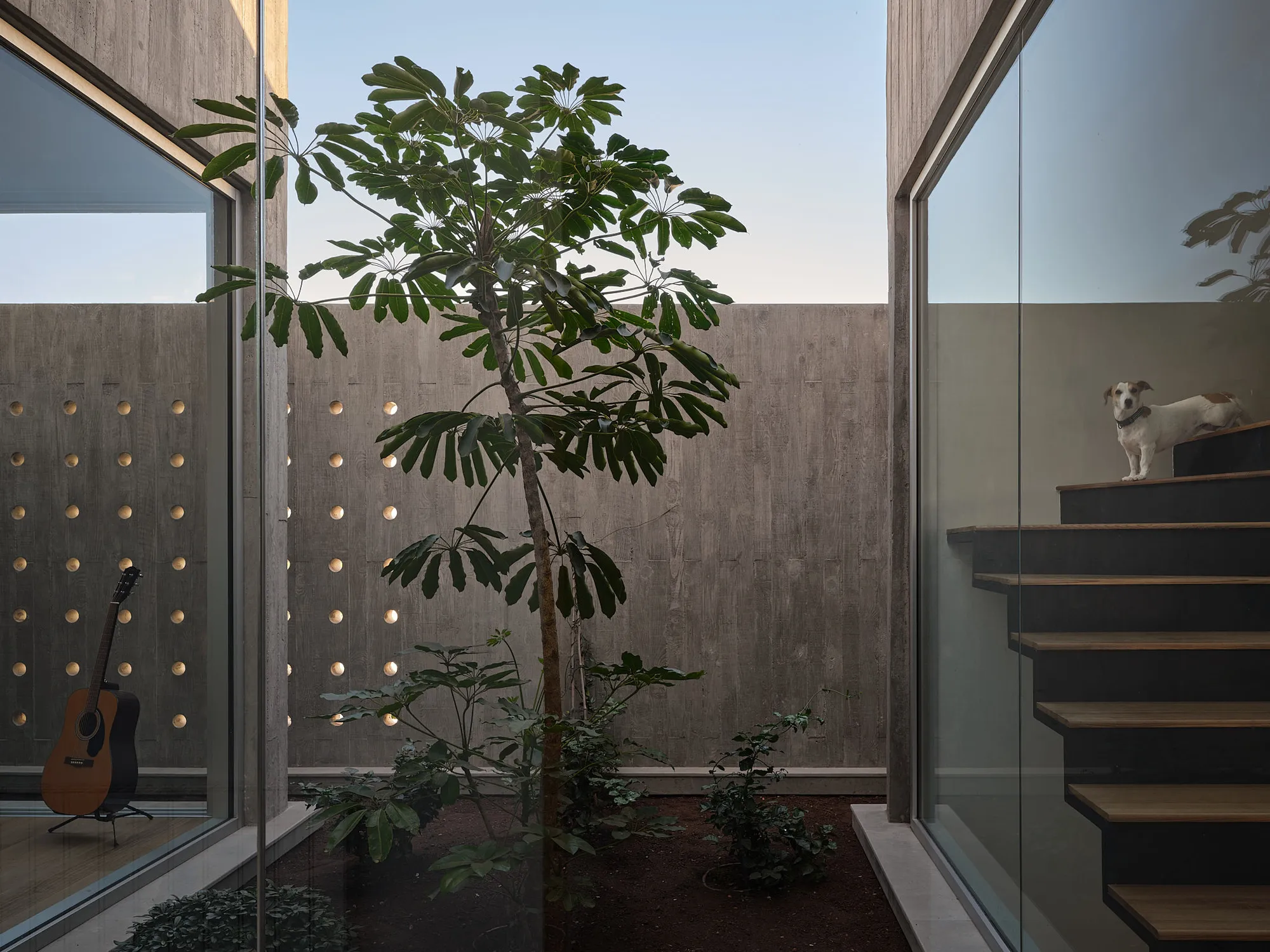
The internal courtyard is the spatial heart of Villa Polo. Visible from every floor, it houses a single tree planted in a soil bed, wrapped on two sides by glass and on the others by the timber and steel staircase that stitches the three levels together. Light drops straight down into this void, reaching the basement and making the deepest part of the house feel connected to the sky.
From above, the courtyard reads as a carved-out rectangle in the building's mass. From inside, it operates as both a light well and a visual anchor: wherever you stand in the house, the tree and the changing quality of light through the courtyard orient you. The circular perforations in the courtyard walls filter additional sun, projecting small discs of light that track slowly across the concrete throughout the day.
Living Spaces Open to the South
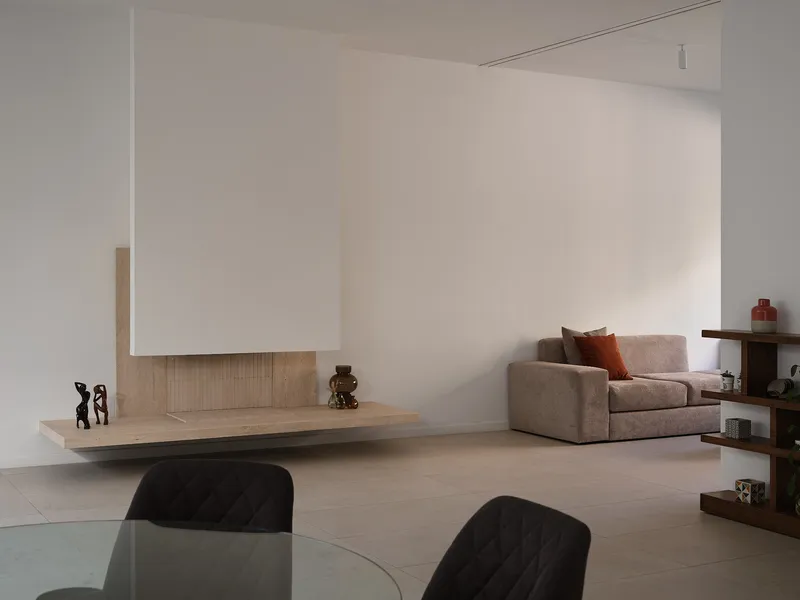

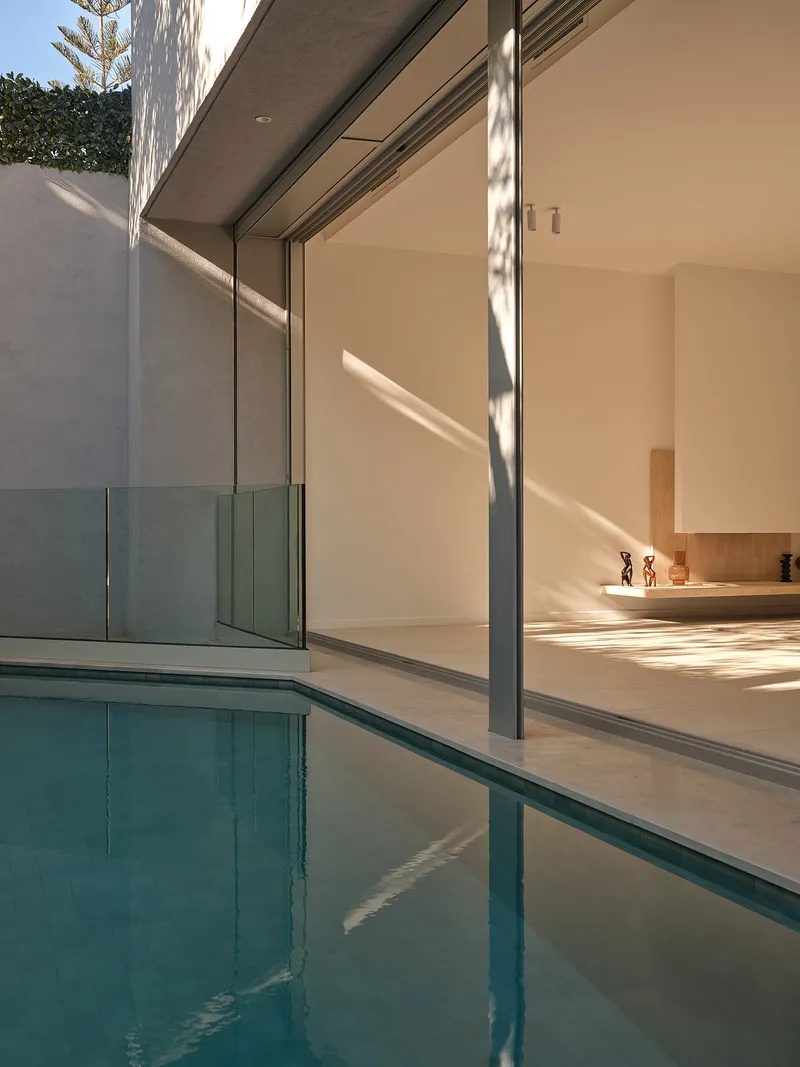
The ground floor is organized as a wide open interior that flows from the entry through office and kitchen zones to a living and dining area facing the south garden. A floating travertine hearth and white plastered fireplace hood anchor the living space without subdividing it, and pale timber flooring carries through the entire sequence, reinforcing the sense of a single continuous room.
At the rear, floor-to-ceiling glass doors slide open to the pool deck, collapsing the boundary between inside and outside. The swimming pool terminates at a diagonal, creating a triangular crevice that accommodates a small garden at the basement level below. It is a clever geometric move: the angled pool edge introduces a slant into an otherwise orthogonal plan, and the garden beneath it brings daylight and greenery down to the yoga room and storage spaces in the basement.
Warmth Inside the Shell
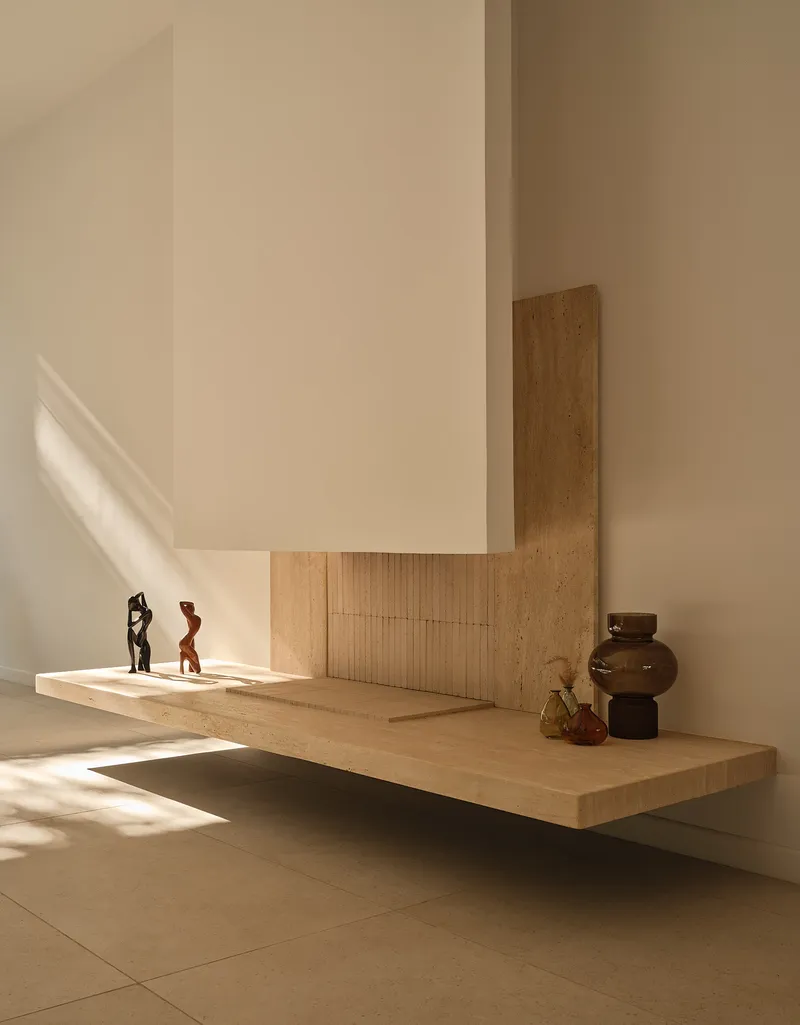
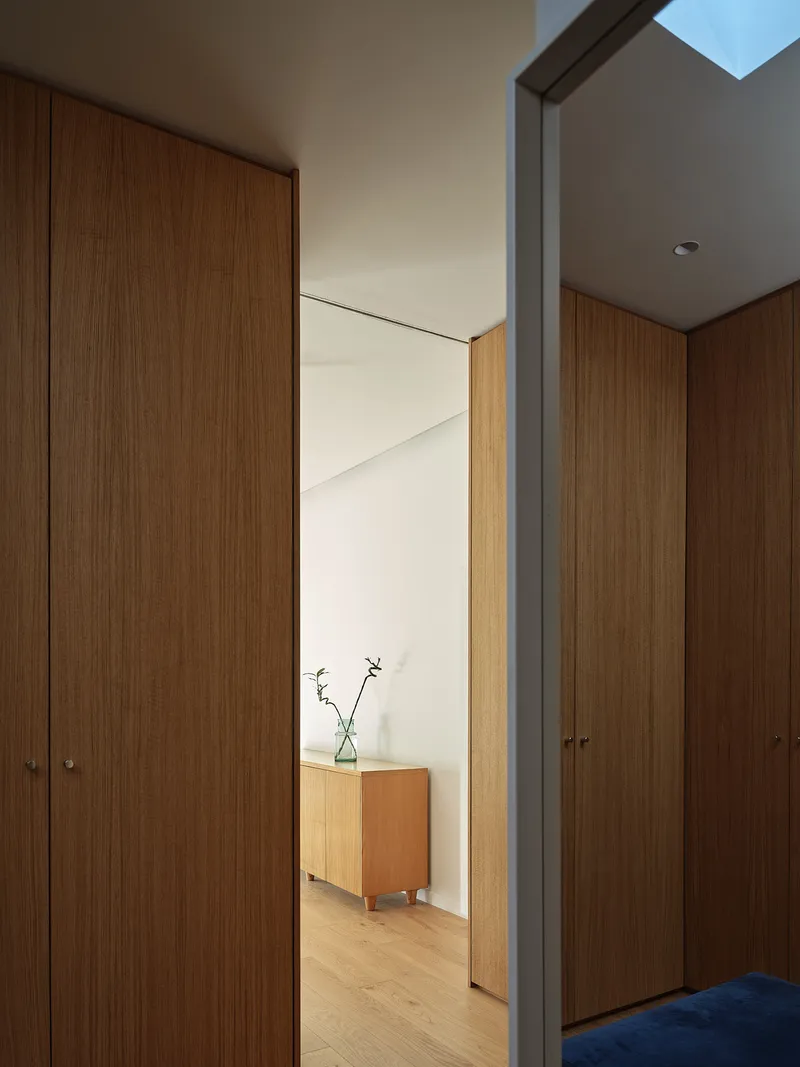
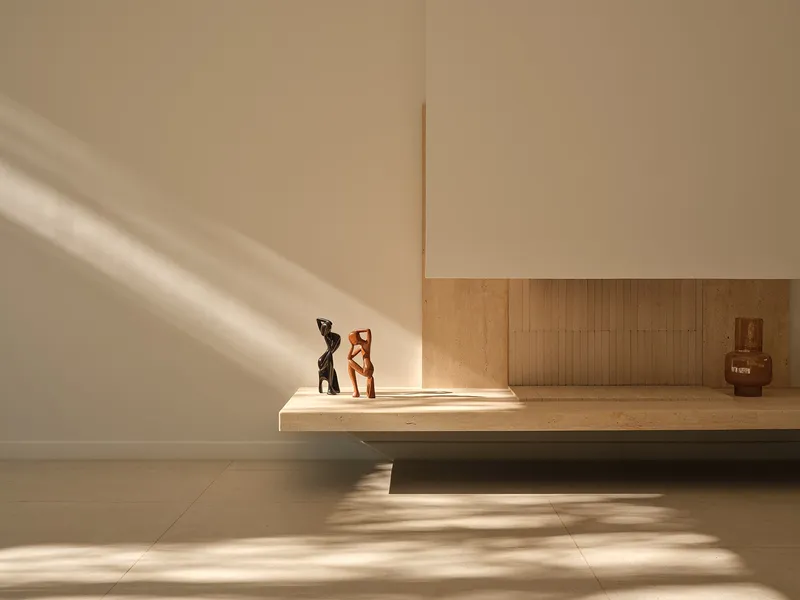
If the exterior is all raw concrete and restraint, the interiors swing toward warmth. Oak flooring, timber-clad corridors, floating shelves, and low benches introduce a domestic softness that counterbalances the muscular structure. Angular afternoon sunlight plays across pale walls and floor tiles, catching sculptural objects on display shelves and making the geometry of the house itself feel like part of the furniture.
Steel beams are left exposed at key thresholds, framing views through hallways and into the courtyard beyond. The material palette is deliberately limited: concrete, oak, white plaster, steel. Within that narrow range, Kettani creates variety through proportion and light rather than through the introduction of new surfaces.
Private Rooms and Planted Edges
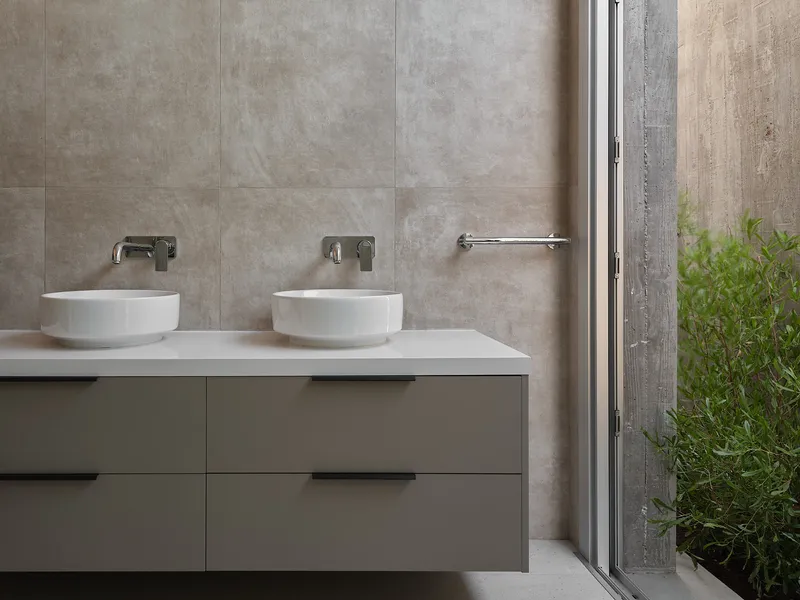
The upper floor houses bedrooms for the couple and their two children, along with a family room and a patio arranged around the central stair. Bathrooms open onto planted pockets through glazed doors, so even the most private rooms maintain a connection to greenery. A double vessel sink on a floating vanity sits beside one such opening, catching soft natural light from the courtyard.
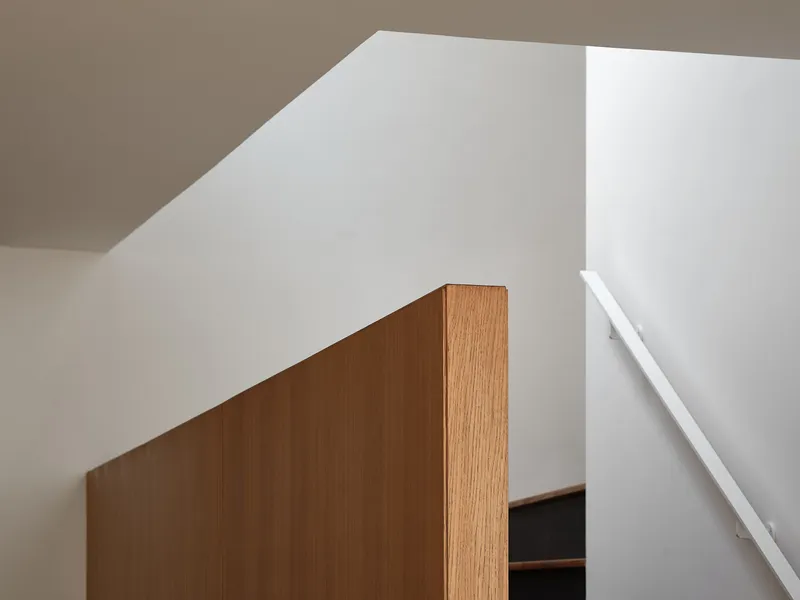
The detail of oak-clad cabinet edges meeting white walls and ceilings is characteristic of the whole project: precise, quiet, and resolved without fuss. Perforated metal screens at the building's edges filter views to the street while admitting ventilation, maintaining the boundary between the family's domain and the neighborhood beyond.
Plans and Drawings
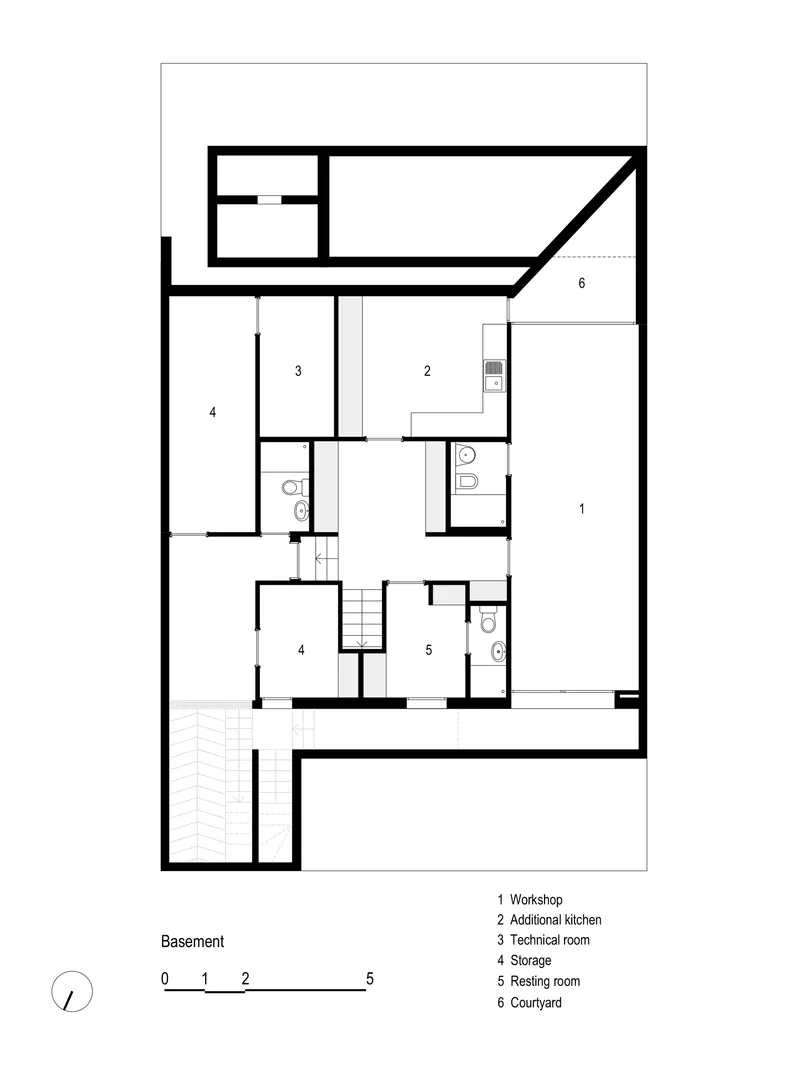
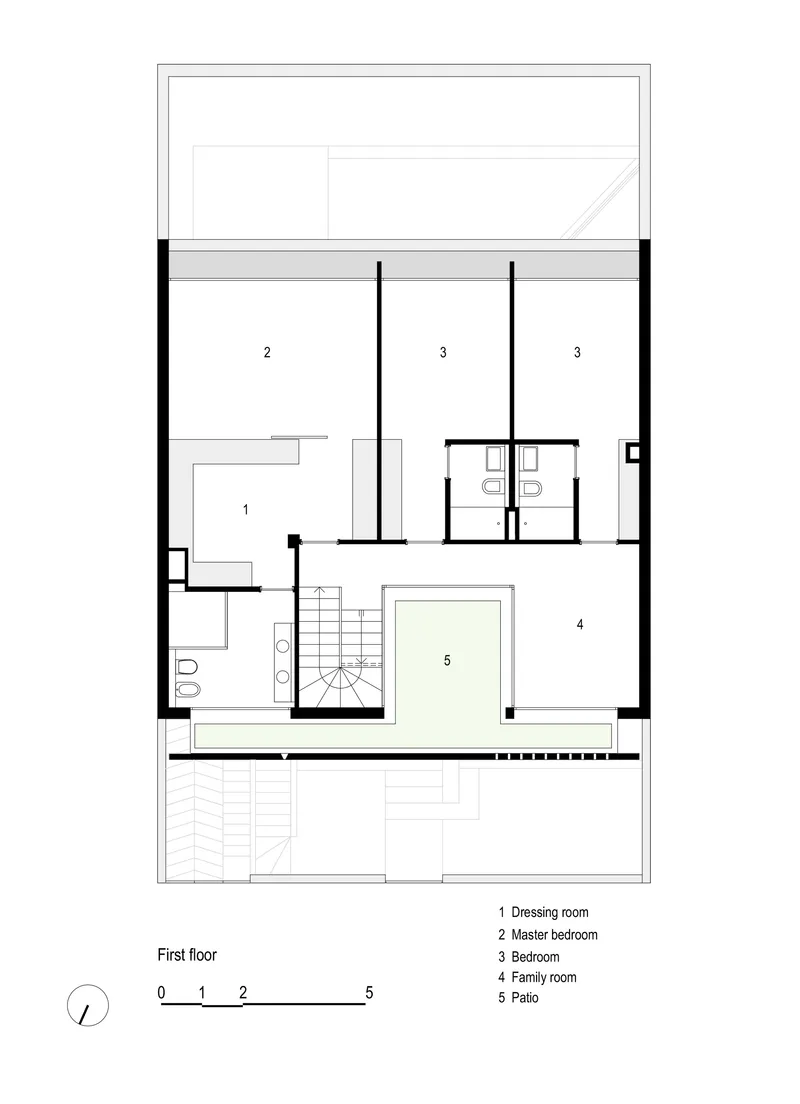
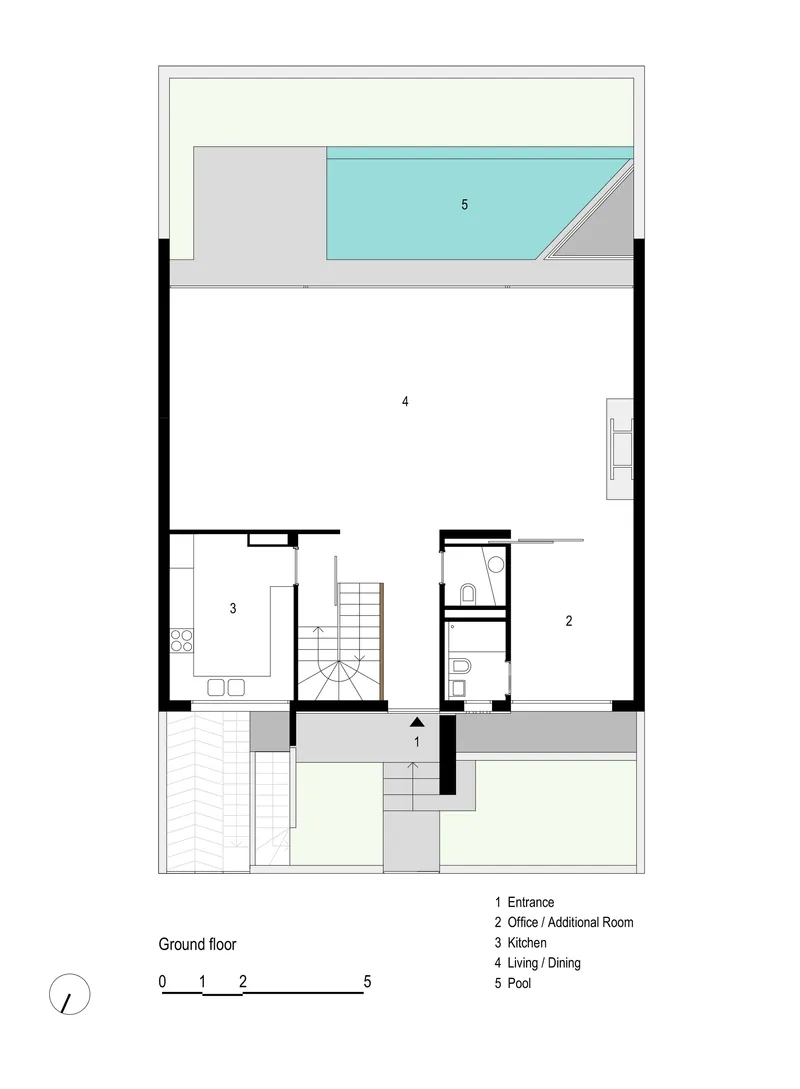
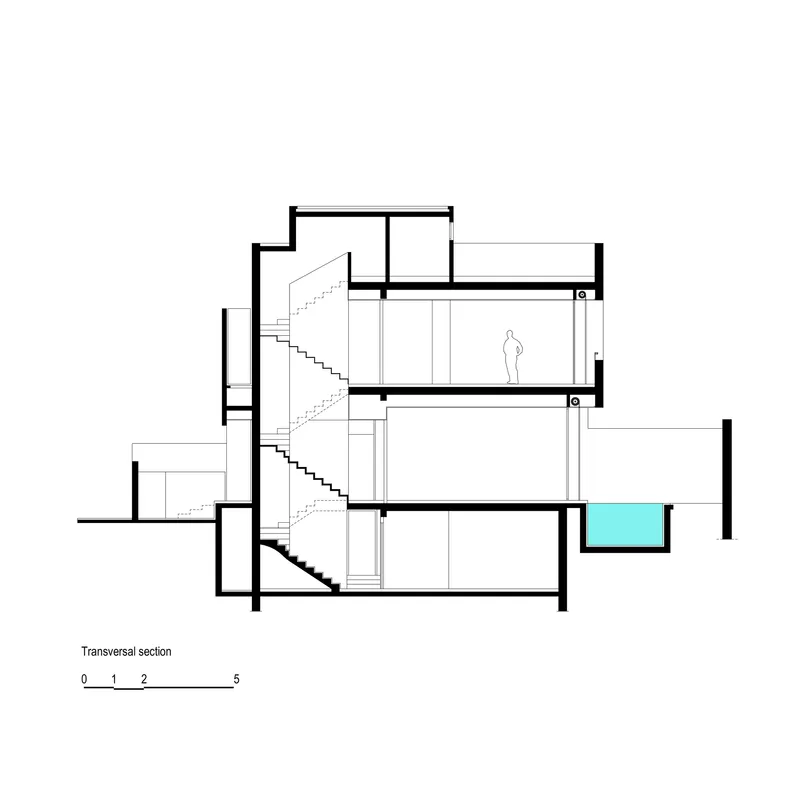
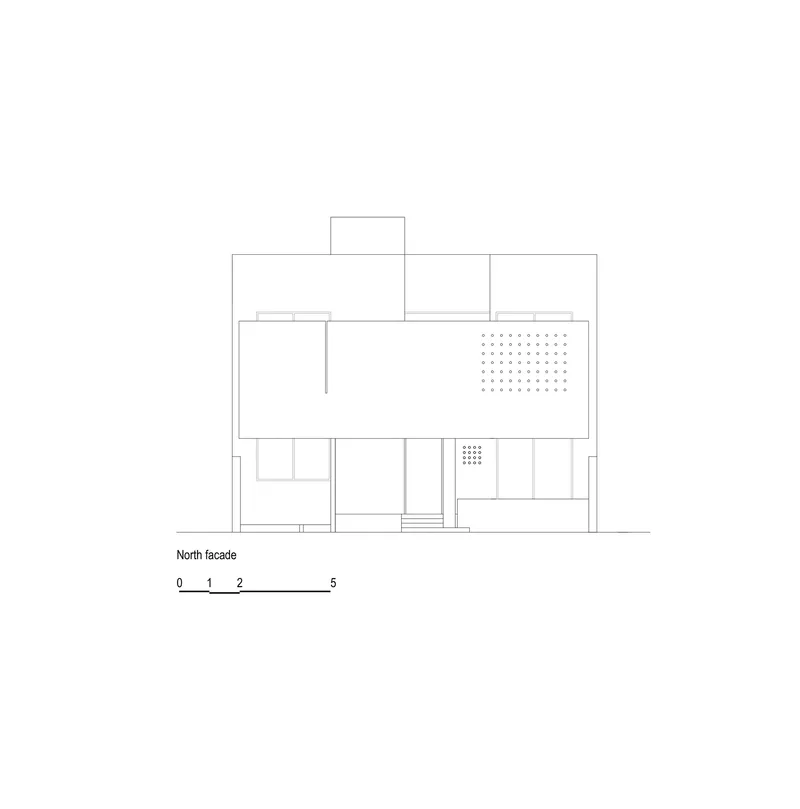
The floor plans reveal how tightly the program is packed into the narrow plot. The basement holds a workshop, kitchen, technical room, and storage, all organized around the courtyard and the diagonal pool edge above. The ground floor is the most open, with the living, dining, office, and kitchen areas flowing into one another. The first floor compresses the private program, with three bedrooms and a family room arranged around the central stair and a patio that serves as a secondary outdoor room.
The transversal section is the most revealing drawing. It shows the full three-story stack with the rooftop pool highlighted in blue, the central staircase descending all the way to the basement, and the courtyard acting as a continuous vertical void. The north elevation drawing confirms the stepped massing strategy and the grid of perforations on the upper volume, which from the street reads as a graphic pattern but from inside serves as a filter for light and air.
Why This Project Matters
Villa Polo is not trying to reinvent the Casablanca townhouse. It is trying to solve it well. The constraints are familiar to any architect working in dense North African cities: a narrow plot, party walls on both sides, a street orientation that fights against passive solar strategy, and a client who wants openness without exposure. Kettani's response is systematic rather than spectacular, and that is what makes it instructive. Every move, from the perforated screen to the diagonal pool edge to the courtyard void, addresses a specific problem with a specific spatial consequence.
The project also demonstrates that board-formed concrete can do more than signal austerity. Here it is warm, textured, and full of incident. The tie holes, the perforations, the gaps between planes: these are the ornament of a building that has no applied ornament at all. For studios working on tight urban sites with limited material budgets, Villa Polo is a useful case study in how constraint can produce architecture that feels generous without ever wasting a square meter.
Villa Polo by Driss Kettani, Casablanca, Morocco. 370 m², completed 2024. Photography by Doublespace Photography.
About the Studio
Share Your Own Work on uni.xyz
If projects like this are the kind of work you want to make, uni.xyz is a place to publish your own, find collaborators, and enter design competitions.



Popular Articles
Popular articles from the community


AL-JANNAH: Sustainable Architecture and Permaculture for Afghan Widows
AL-JANNAH uses sustainable architecture and permaculture to create resilient oasis of housing, learning, work and renewal for Afghan widows.

The Ocean Hive: Sustainable Architecture for a Self-Sufficient Civilization at Sea
The Ocean Hive imagines sustainable architecture at sea, where modular habitats, algae, wave power and ocean waste sustain a growing colony.

Conexión: Biophilic Design Reimagines High-Rise Living in Hong Kong
Conexión reimagines high-rise living in Hong Kong through biophilic design, green facades, shared spaces, daylight, water and nature within.

Co-Life: Senior Housing Design That Reconnects Older Adults With the City
Co-Life reimagines senior housing design through healing gardens, shared streets, workshops, and a sustainable community across generations.


Similar Reads
You might also enjoy these articles

Bao Huynh Watercolor Atelier: A Serene Art Retreat in Hội An
Bao Huynh Watercolor Atelier in Hội An blends multifunctional art spaces, sustainable design, local materials, and family-friendly living in a serene environment.

Atelier Macri Concept Store Interior Design by CASE-REAL
Atelier Macri store features a "ko" counter, walnut wood details, cork displays, blending retail, gallery, and seamless customer experiences.

Manuel Vargas Izquierdo Stadium and High-Performance Sports Center: Architectural Excellence in Jalpa de Méndez
The Manuel Vargas Izquierdo Stadium blends sustainable design, inclusive sports facilities, and cultural-inspired architecture, revitalizing Jalpa de Méndez’s public spaces.

KAKR Buluh Awar Hall: Revitalizing Community and Ecology Through Bamboo Architecture
Community built bamboo hall revitalizes Buluh Awar village, empowering youth, restoring ecology, celebrating vernacular craftsmanship through sustainable architecture and culture.


Explore Villa Competitions
Discover active competitions in this discipline


Challenge to design mud housing for contemporary communities


Challenge to reimagine the Iron Throne


Photograph architecture without architects


Illustrate the lost glory of Angkor Wat - Render Challenge
Comments (0)
Please login or sign up to add comments
No comments yet. Be the first to comment!