
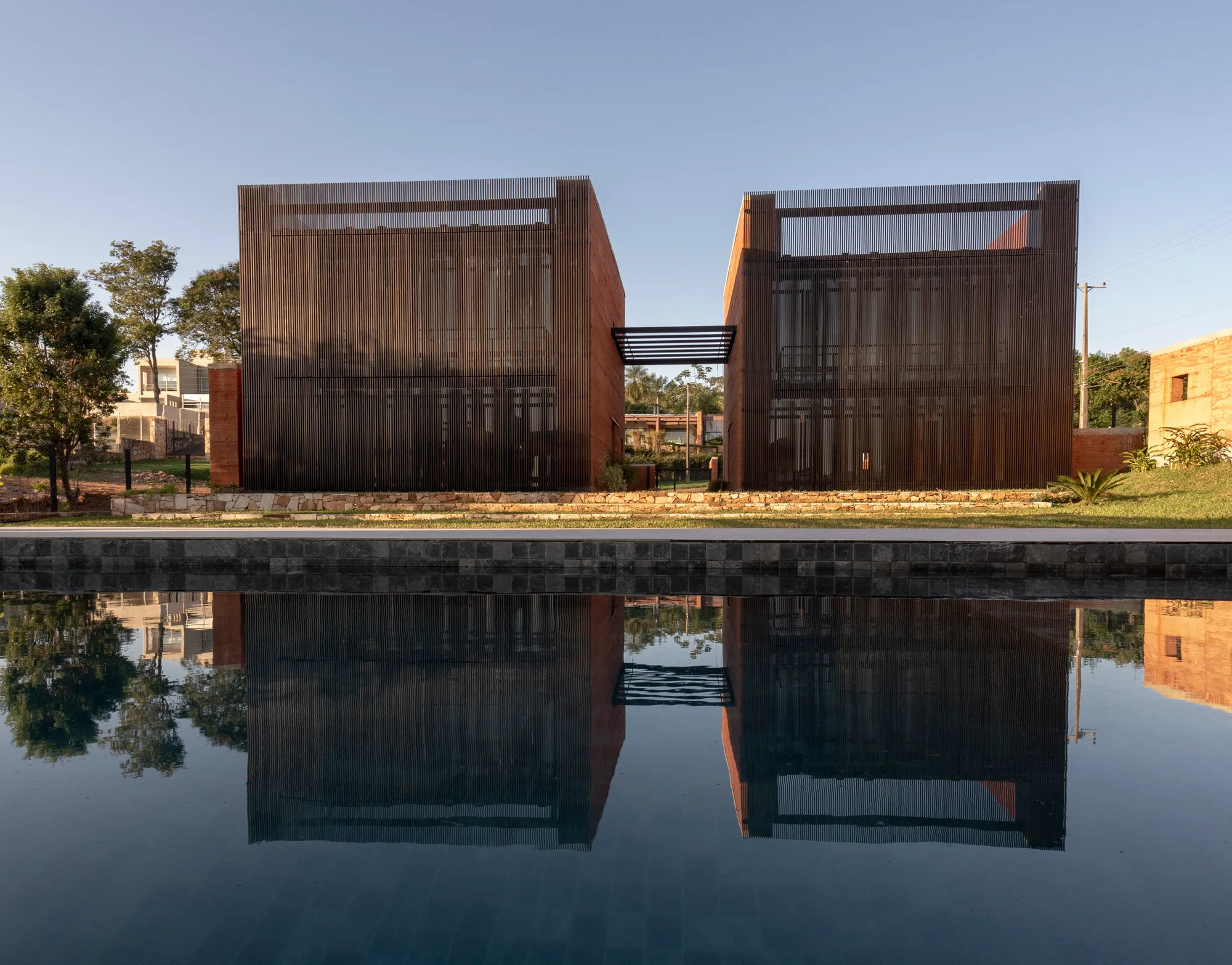
BAUEN Builds Two Rammed Earth Volumes in Paraguay Inspired by the Ovenbird's Nest
In San Bernardino, a house of compacted earth channels the instinct of a constructive bird to shelter life from the Paraguayan summer.


The hornero, or ovenbird, builds its mud nest with an instinct so singular that it has become a symbol across South America: architecture as pure necessity, shaped by the material at hand and oriented to protect what matters most. BAUEN, the Asunción-based practice led by Aldo Cristaldo Kegler and José Cáceres, takes the bird literally and figuratively in this 467 square meter residence in San Bernardino, Paraguay. Two rammed earth volumes rise from the terrain like a pair of clay ovens, connected by steel bridges and mediated by courtyards, pools, and planted passages that dissolve the boundary between enclosure and landscape.
What makes the project compelling is not the metaphor alone but the commitment to its logic. Rammed earth is not decoration here; it is the structural wall, the thermal mass, and the primary aesthetic. The house is oriented to the southwest, reducing solar gain during the long Paraguayan summer and cutting the need for mechanical cooling and artificial light for most of the day. The result is a building that performs quietly, relying on mass and orientation rather than technology, and that looks like the ground it was pulled from.
Two Volumes, One Ground
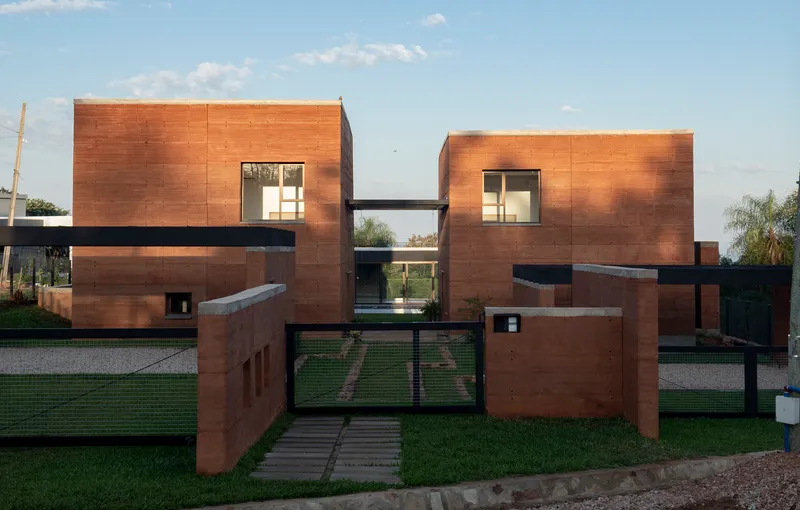


Approached from the street, the house reads as a pair of solid, banded masses separated by a narrow gap. The rammed earth walls, rising to two storeys, carry the horizontal stratification of their construction: each layer of compacted soil is legible, giving the facade a geological quality rather than a decorative one. A metal bridge stitches the volumes together at the upper level, its slender steel profile contrasting sharply with the heft of the earth below.
The pairing is deliberate. Two residential units flank a central courtyard, each with its own internal logic but sharing external ground. The composition avoids symmetry without abandoning order; the volumes step and shift in plan, responding to the slope and creating pockets of outdoor space that feel discovered rather than designed.
Rammed Earth as Structure and Surface


Close up, the walls reward attention. The horizontal layers of compacted earth vary subtly in color and texture, recording the moisture content and composition of each pour. Formwork tie holes punctuate the surface in a regular grid, a residue of process that BAUEN leaves exposed. There is nothing coy about this: the building shows exactly how it was made.
Punched window openings are cut cleanly into the mass, framed with concrete sills that provide weather protection without fussiness. The effect is monastic in the best sense: thick walls, deep reveals, and framed views of sky and garden that change character with the light. Rammed earth's thermal inertia keeps interiors cool during the day and releases stored warmth at night, a passive strategy perfectly suited to San Bernardino's summer climate.
Courtyards and the Space Between
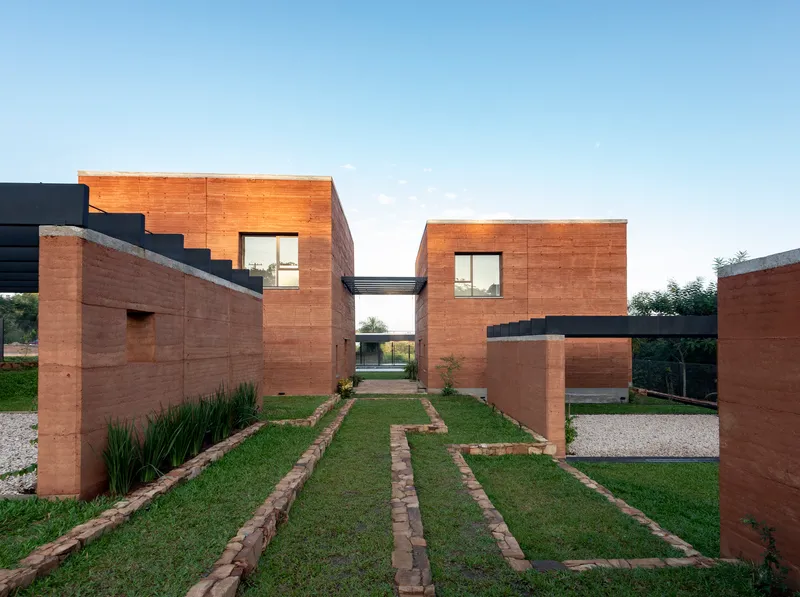
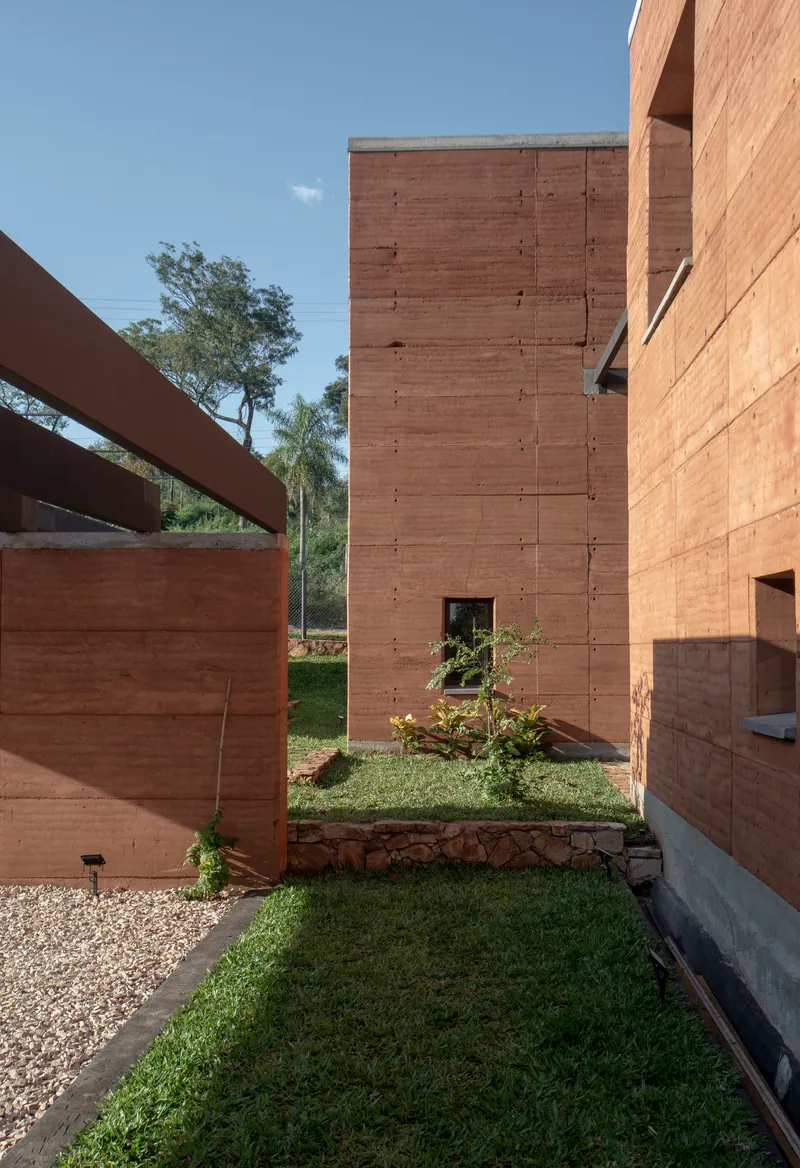

The gap between the two volumes is not leftover space; it is the heart of the project. Gravel paths, grass strips, and young trees create a narrow garden passage that channels movement and breeze. Overhead steel beams cast diagonal shadows across the ground, marking time as effectively as any sundial. Figures appear and disappear through the interstitial space, and the compression between the tall earth walls makes the release into the wider courtyard genuinely dramatic.
The front courtyard anchors arrival, with planted grass strips and gravel organizing a threshold between public road and private interior. A skybridge overhead signals the connection between volumes without blocking the sky, preserving the sense that you are always partly outdoors.
Corrugated Metal and the Reflecting Pool


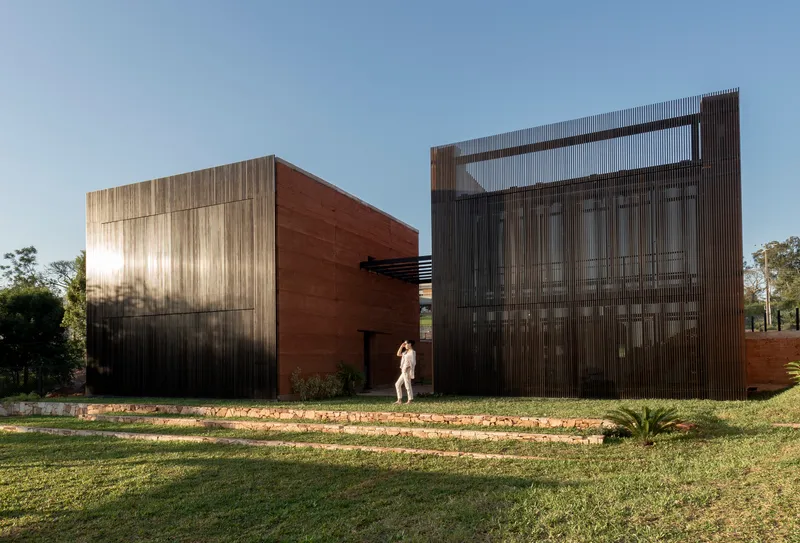
At the rear of the site, the material palette shifts. Black corrugated metal wraps secondary pavilions that sit alongside the rammed earth masses, their industrial texture a deliberate counterpoint. A reflecting pool stretches between these elements, doubling the facades in still water and introducing a horizontal calm that balances the verticality of the walls. At dusk the effect is striking: the corrugated screens become silhouettes, the earth glows warm, and the pool holds both.
The pool is not incidental. It functions as a cooling body, reflecting light into adjacent spaces and extending the visual depth of the courtyard. A glass-walled pavilion with a steel frame bridges between the volumes here, its transparency a deliberate void within the solidity of earth and metal.
The Glass Pavilion and the Horizon


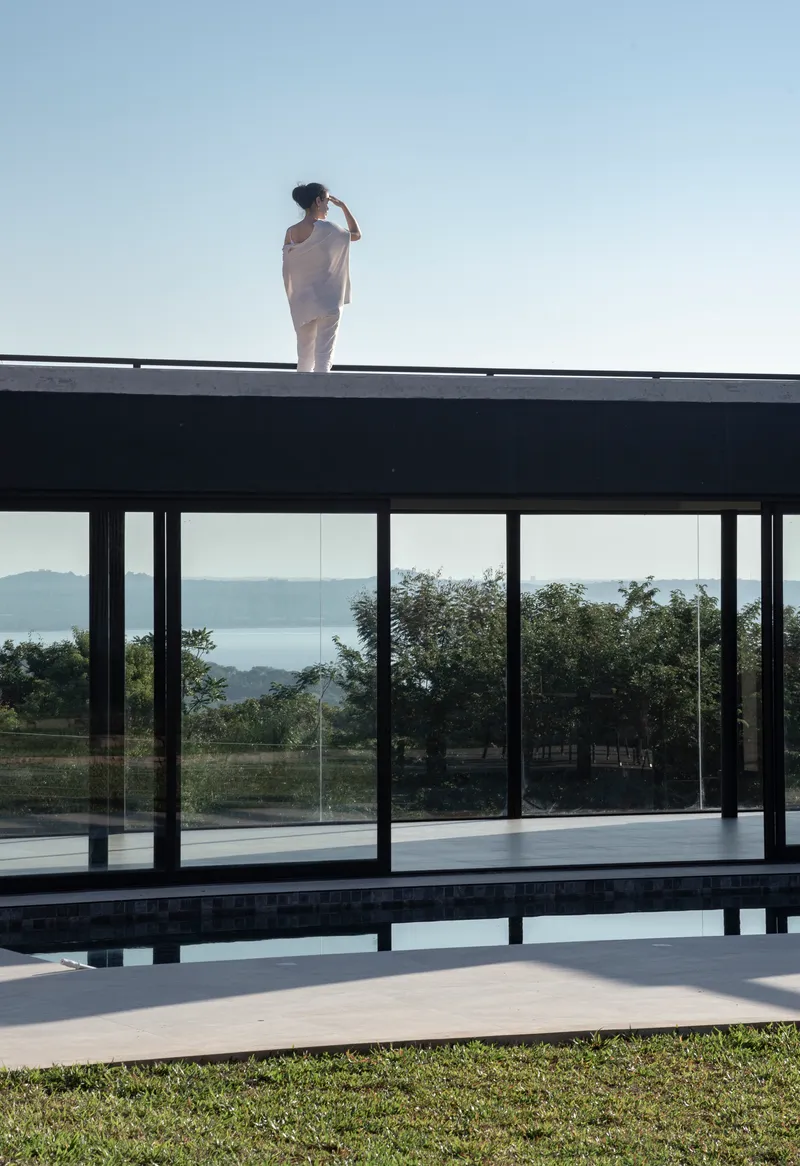
The glass pavilion connecting the two volumes at ground level is the project's most open gesture. Steel columns and a flat roof frame panoramic views across a sloped lawn toward distant hills. At sunset, the pavilion becomes a lantern, glowing against the heavy earth masses on either side. A pool terrace extends from the pavilion, and the flat roof above doubles as a lookout, offering long views over the San Bernardino landscape.
This moment of transparency is essential to the house's logic. Without it, the rammed earth volumes would risk feeling fortress-like. The glass link reintroduces lightness and prospect, reminding inhabitants that the walls exist to frame views, not to exclude them.
Interior Warmth


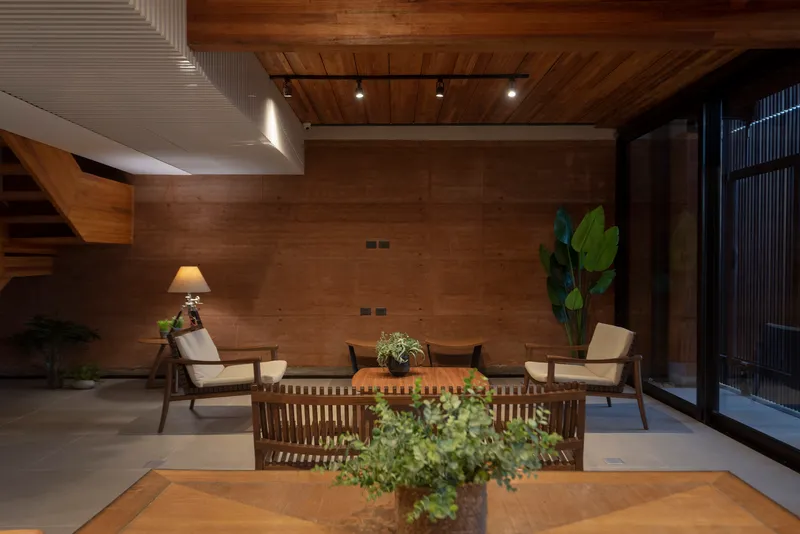
Inside, the rammed earth walls continue uninterrupted, their texture softened by timber ceilings that introduce warmth and scale. The living spaces are open plan, with the earth walls defining major zones while glazed courtyard openings pull daylight deep into the floor plate. A corrugated metal air duct runs exposed through the living and dining area, an honest detail that refuses to hide the mechanics of comfort.
At night, the interior courtyards become intimate rooms. Potted plants, upholstered seating, and low lighting transform the rammed earth surfaces into something softer, almost domestic. The thick walls absorb sound as effectively as heat, creating a stillness that contrasts with the open sky above.
Details and Inhabitants


A window frames nothing but blue sky and cloud. A cat sits on a concrete sill, perfectly at ease. Two birds perch on the roofline of a rammed earth volume. These small moments reveal a house that has already been claimed by its inhabitants, human and otherwise. The ovenbird metaphor is not forced: like the bird's nest, the house is a constructed environment that invites habitation beyond its intended species.
The concrete copings and sills are minimal, doing their protective work without calling attention to themselves. Every detail serves the larger argument that architecture should be direct, material, and open to the life that settles within it.
Plans and Drawings


The section drawing reveals how the two-storey volume connects to a single-storey linear wing, stepping with the terrain and keeping the roofline low despite the program's density. The ground floor plan confirms the bilateral organization: two residential units flank a central courtyard with pool, each unit mirrored but not identical. Upper floors contain bedrooms and bathrooms arranged for privacy, while the basement clusters service rooms at one corner beneath the taller volume.
The aerial view and roof plan show the extent of flat green roofs, timber pergolas, and skylights that are invisible from the street. These planted surfaces reduce heat gain and manage stormwater, extending the passive strategy from wall to roof. The drawings make clear what the photographs suggest: that the house is more complex and more carefully tuned than its elemental appearance lets on.
Why This Project Matters
Rammed earth construction is experiencing a revival across Latin America and beyond, but too often it appears as a veneer, a thin skin over conventional structure deployed for its aesthetic warmth. The Ovenbird House takes the material seriously as both structure and climate strategy, trusting compacted soil to carry loads, regulate temperature, and define space without supplementary systems. In a summer city like San Bernardino, where cooling demand dominates energy budgets, this is not a romantic gesture; it is a pragmatic one.
BAUEN's insistence on process legibility, from formwork holes to exposed ductwork, positions the house within a broader argument about honesty in construction. The ovenbird builds because it must, using what is available, shaping material into shelter with nothing wasted. The architects have absorbed that lesson without sentimentality: two volumes of compacted earth, oriented to the wind and the sun, connected by steel and glass, inhabited by people and cats and birds. That is enough.
Ovenbird House, designed by BAUEN (Aldo Cristaldo Kegler, José Cáceres), San Bernardino, Paraguay. 467 m², completed 2022. Photography by Darío Mereles and Daniel Ojeda.
About the Studio
Share Your Own Work on uni.xyz
If projects like this are the kind of work you want to make, uni.xyz is a place to publish your own, find collaborators, and enter design competitions.




Popular Articles
Popular articles from the community

EW PARK: Sustainable Architecture Reimagines the Future of Urban Parking
EW PARK reimagines city parking as a modular wooden tower combining automation, solar energy, electric mobility, and adaptable urban design.

Co-Life: Senior Housing Design That Reconnects Older Adults With the City
Co-Life reimagines senior housing design through healing gardens, shared streets, workshops, and a sustainable community across generations.

Riyadh For All: Intergenerational Urban Design for Active Aging in Rabat
Riyadh For All reimagines urban design in Rabat with intergenerational co-living, adaptive courtyards, and Moroccan cultural exchange today.

The Ocean Hive: Sustainable Architecture for a Self-Sufficient Civilization at Sea
The Ocean Hive imagines sustainable architecture at sea, where modular habitats, algae, wave power and ocean waste sustain a growing colony.


Similar Reads
You might also enjoy these articles

Bao Huynh Watercolor Atelier: A Serene Art Retreat in Hội An
Bao Huynh Watercolor Atelier in Hội An blends multifunctional art spaces, sustainable design, local materials, and family-friendly living in a serene environment.

Atelier Macri Concept Store Interior Design by CASE-REAL
Atelier Macri store features a "ko" counter, walnut wood details, cork displays, blending retail, gallery, and seamless customer experiences.

Manuel Vargas Izquierdo Stadium and High-Performance Sports Center: Architectural Excellence in Jalpa de Méndez
The Manuel Vargas Izquierdo Stadium blends sustainable design, inclusive sports facilities, and cultural-inspired architecture, revitalizing Jalpa de Méndez’s public spaces.

KAKR Buluh Awar Hall: Revitalizing Community and Ecology Through Bamboo Architecture
Community built bamboo hall revitalizes Buluh Awar village, empowering youth, restoring ecology, celebrating vernacular craftsmanship through sustainable architecture and culture.




Comments (0)
Please login or sign up to add comments
No comments yet. Be the first to comment!