
Kanisavaran Office Turns a Central Courtyard into a Light Engine on the Plains of Damavand
Shahrzad Villa in Tehran's Seyedabad plains uses a classical courtyard typology to orchestrate natural light, ventilation, and mountain views.


Iranian domestic architecture has spent centuries perfecting the courtyard as a climate device and social anchor. Kanisavaran Office, led by Mohammad Kanisavaran, takes that lineage seriously with Shahrzad Villa, a 470 square meter residence on a generous 1,650 square meter east-west plot in Seyedabad, Damavand. From the outside, the building reads as a single protective volume, its white rendered walls and classical proportions almost austere. Step inside, and the geometry cracks open around a planted central courtyard that pulls daylight, air, and views deep into every room.
What makes the project genuinely interesting is the tension it holds between symmetry and fluidity. The first floor leans toward a classical, near-symmetrical facade, yet the plan composition on both levels slides and shifts to create layered spatial sequences. The courtyard is not merely decorative. It is the organizational spine of the house, governing circulation, cross-ventilation, and the way sunrise and sunset enter through floor-to-ceiling glazing at the building's four corners. Designed between 2022 and 2025, the villa oscillates between openness and enclosure in a way that feels genuinely calibrated rather than stylistically imposed.
A White Volume on an Open Plain
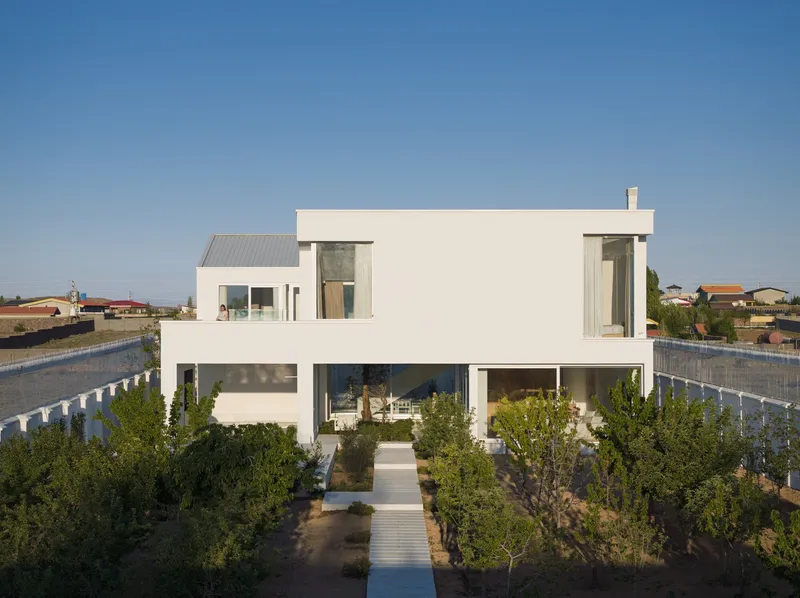
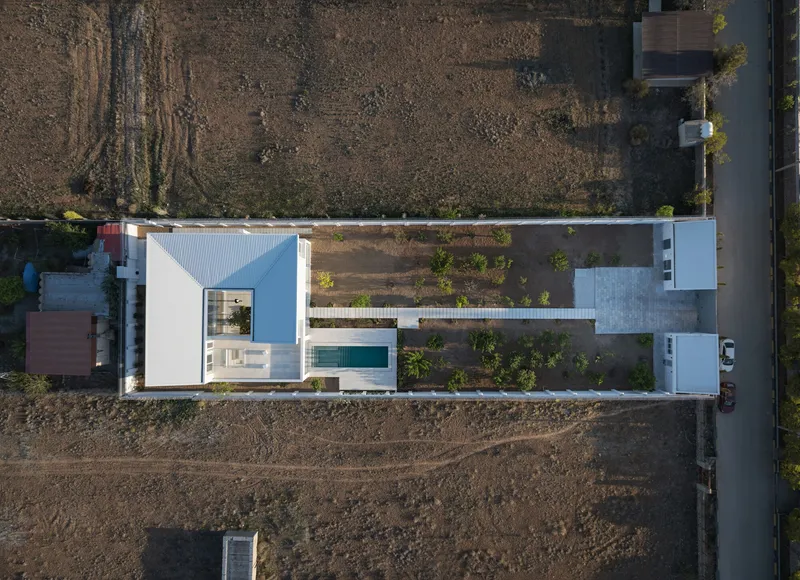
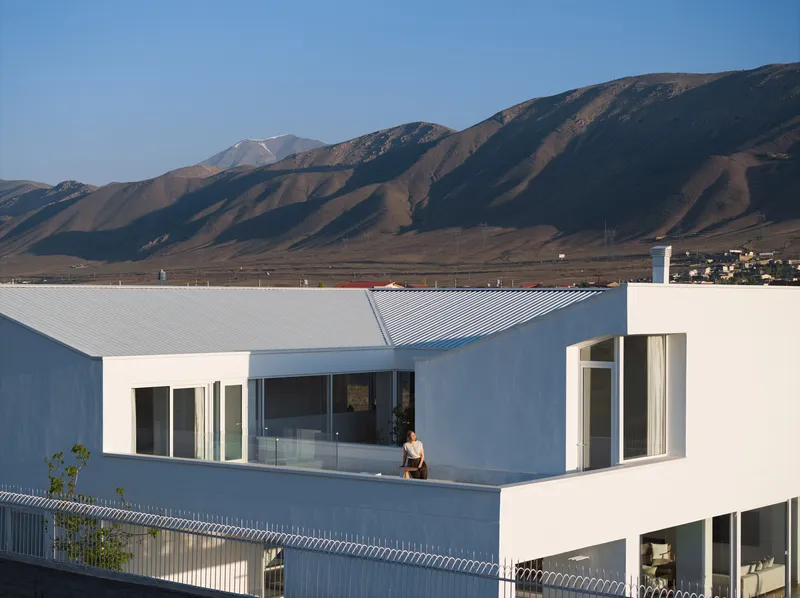
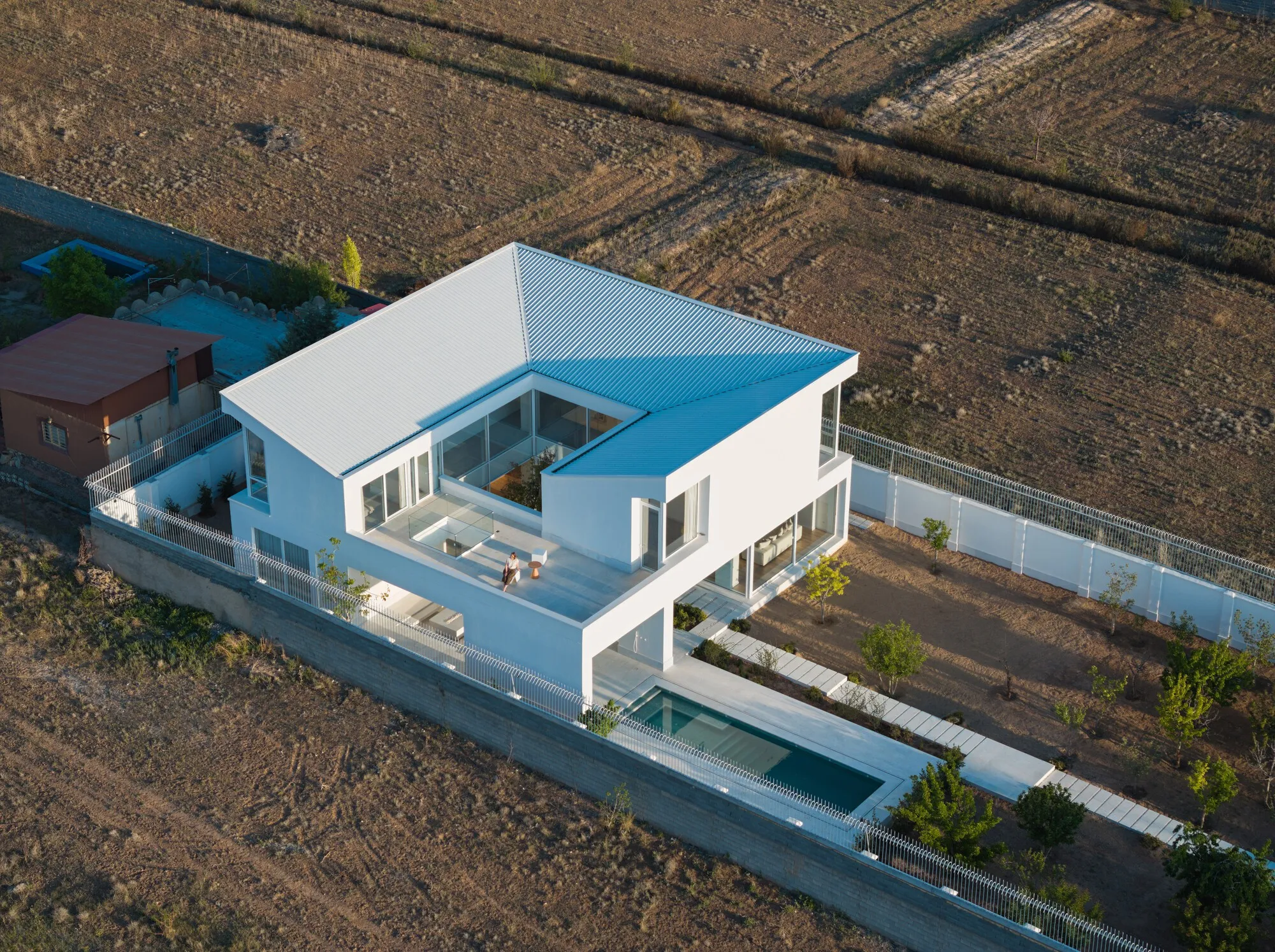
Seen from a distance, particularly in the aerial dusk shots, Shahrzad Villa sits like a chalk block dropped onto agricultural fields with Mount Damavand's foothills beyond. The white cement plaster finish is unbroken and decisive, giving the two-story structure a monolithic quality that contrasts sharply with the soft terrain around it. Olive trees in the front garden and terraced planting beds around the pool soften the approach, but the architectural posture is intentionally protective.
The rooftop terrace reveals a corrugated metal roof plane sloping gently over the interior volumes, an industrial counterpoint to the rendered walls below. Standing up there, you face the mountains with nothing between you and the horizon. The choice to use Neyriz stone for paving at grade and wood for key interior moments creates a material palette that is restrained but warm, letting the architecture do its work through proportion rather than surface.
The Courtyard as Organizing Core
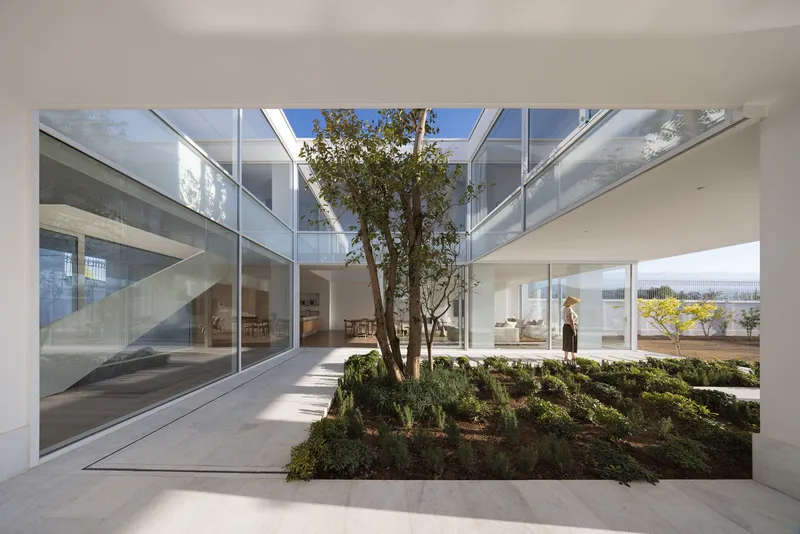
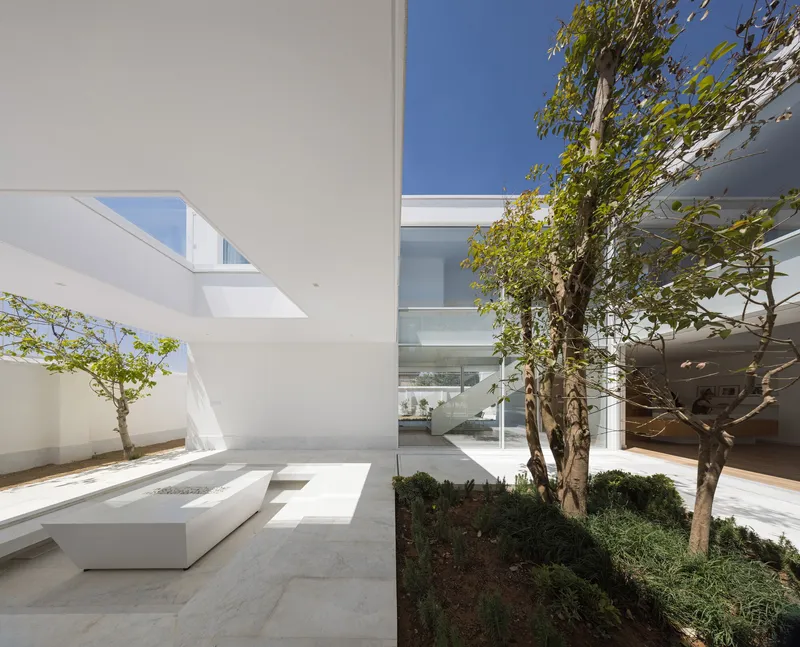
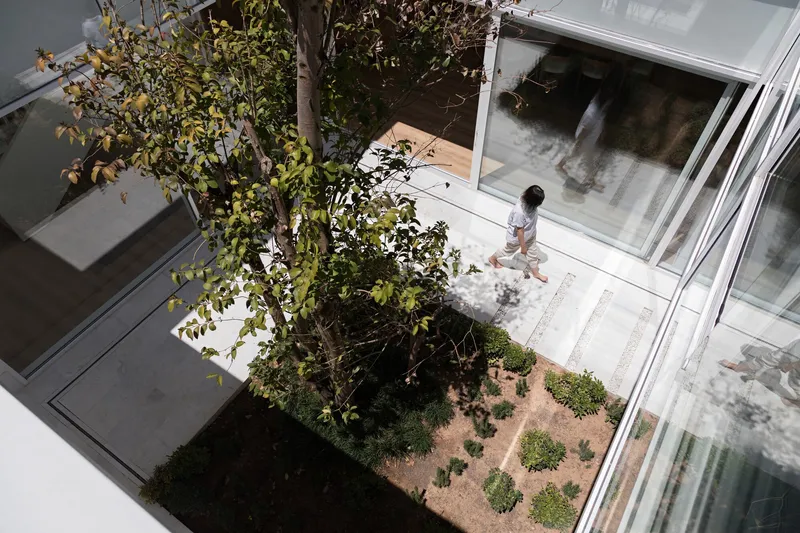
The central courtyard is the single most important move in the project. A square-shaped volume sits at the center of the site, and the courtyard punches through it vertically, pulling a multi-stem tree up through two stories of white walls. From above, the overhead view makes the logic clear: glass-walled rooms on both sides face into this green core, collapsing the distance between domestic life and planted ground.
Limestone paving in angular patterns and raised white planters give the courtyard floor a graphic quality that reads well against the organic tree canopy above. The greenery is not ornamental: it contributes to passive ventilation and microclimate regulation, keeping air moving through the house across seasons. Kanisavaran treats the courtyard as a spatial engine rather than a leftover void, and the building's character depends entirely on that commitment.
Glazing That Frames Time
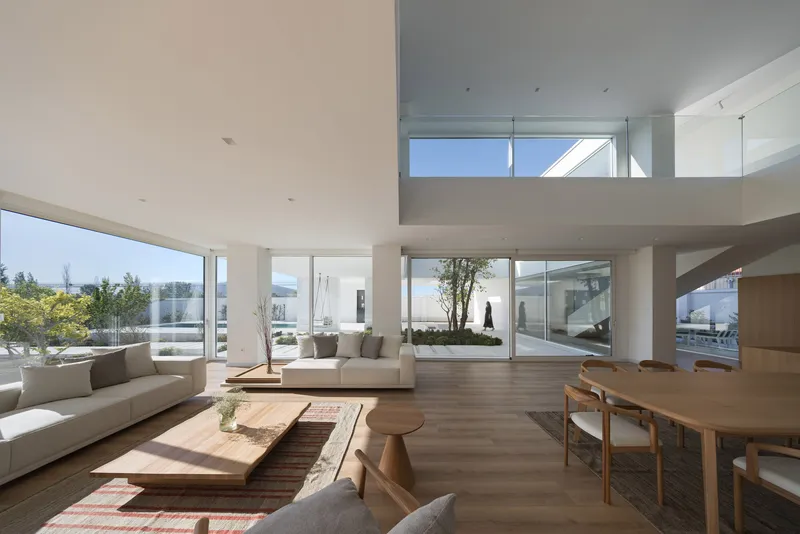
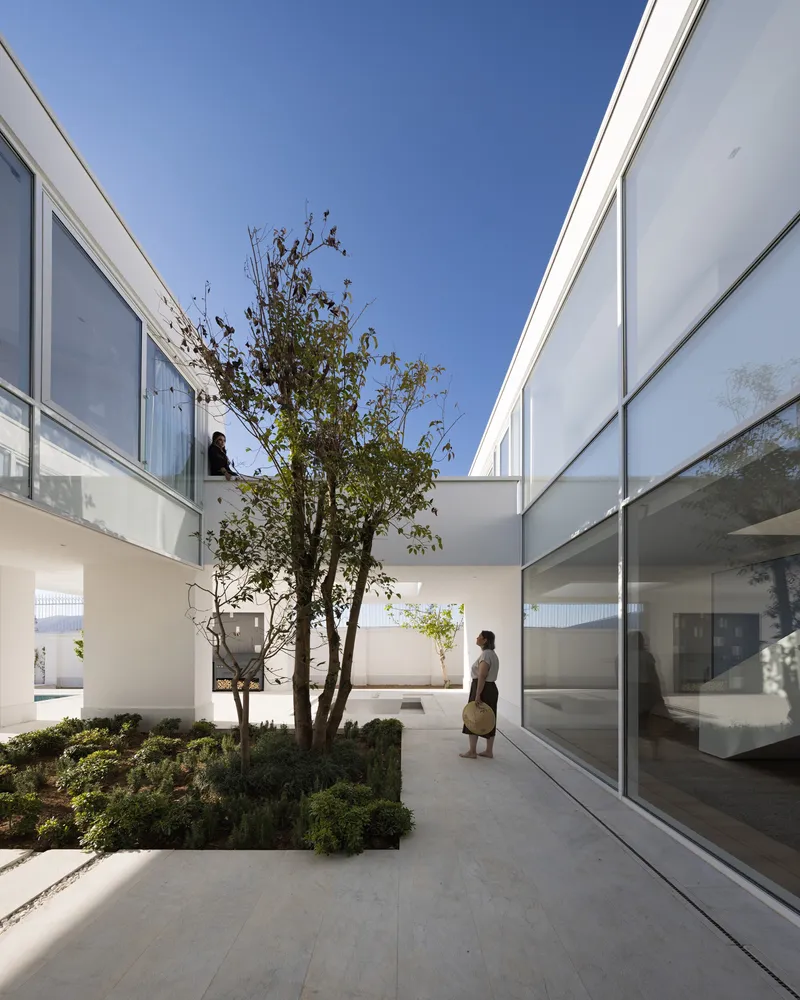
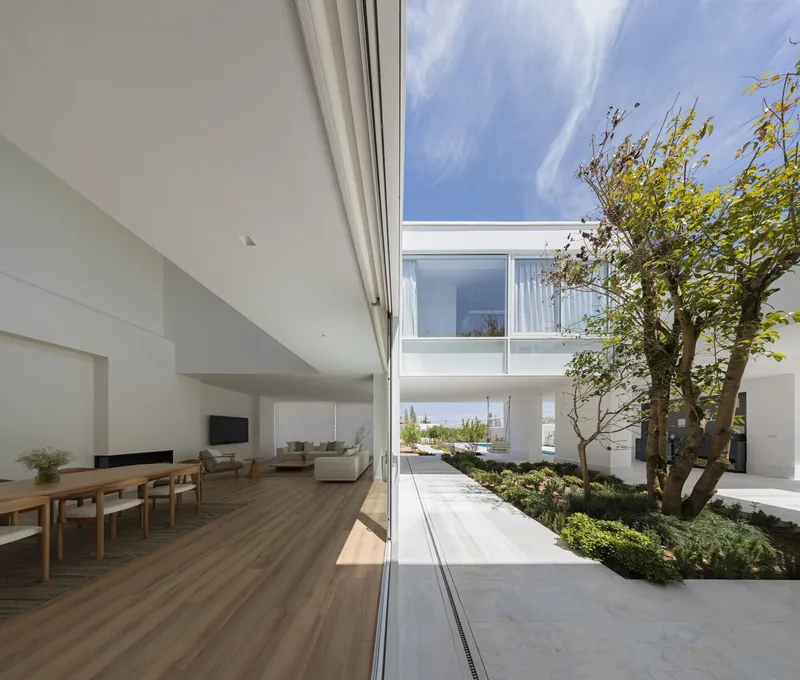
Floor-to-ceiling windows at the four corners of the building are positioned to channel sunrise and sunset light through the interiors across every season. The double-height living space, visible in the ground-floor shot looking into the courtyard, is drenched in direct sunlight that travels the full depth of the room. A person walking through the glazed courtyard passageway becomes a silhouette against the tree and sky, a deliberate framing that turns everyday movement into something cinematic.
The orientation of fixed and operable windows is aligned with Damavand's prevailing winds. The result is natural ventilation that works without mechanical assistance for much of the year, channeling breezes through the courtyard gap while protecting against the region's stronger gusts. Scenic views toward the plains are captured in the same gesture, so the environmental strategy and the experiential quality of the house are one and the same thing.
Vertical Connections and Split Levels
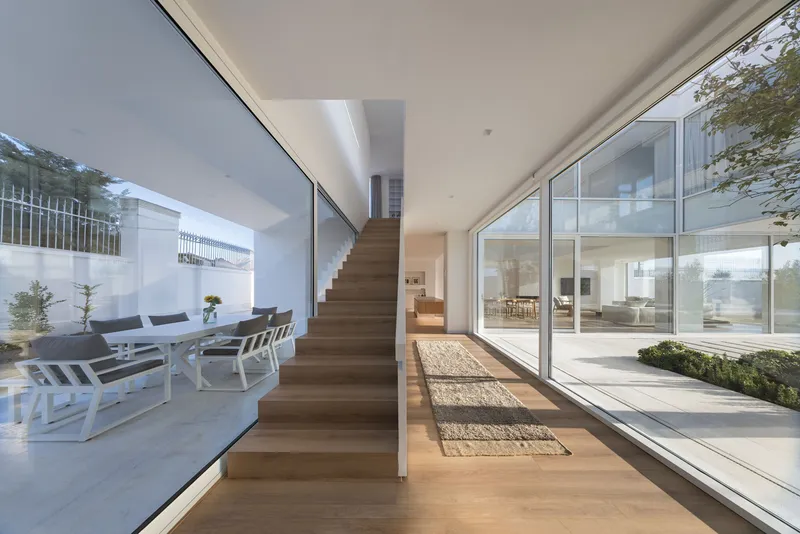
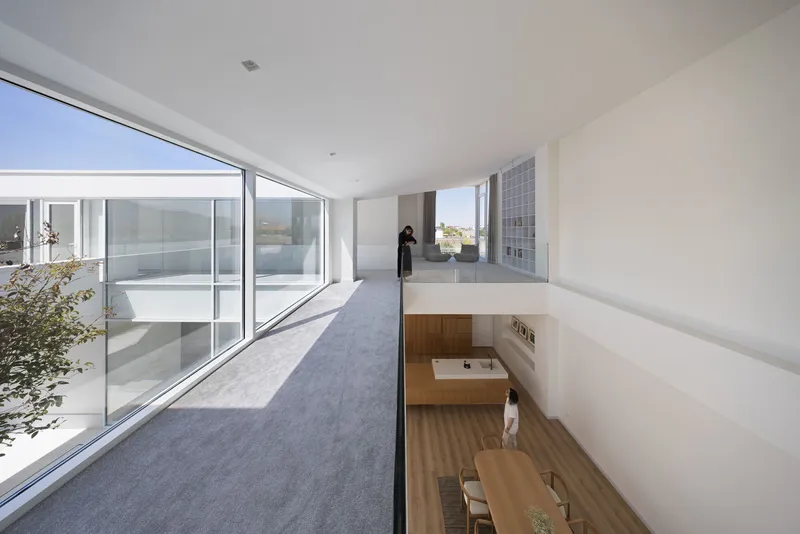
A timber staircase rises beside a tall glass wall overlooking the courtyard, its warm wood tones contrasting with the white plaster surfaces that dominate the rest of the house. The stair connects the ground floor's layered living spaces to the first floor's more enclosed bedrooms and corridors. From the upper-level walkway, a glass guardrail lets you look down into the dining area and out through the courtyard garden simultaneously, collapsing two scales of domestic space into a single view.
The split-level organization, visible in the section drawings, means that the ground floor is more porous and open while the first floor wraps the courtyard with a tighter perimeter. The house offers different degrees of privacy and exposure depending on where you stand, a gradient from the rooftop's full panorama to the ground-level terrace's sheltered overhang, where a suspended swing seat occupies a limestone-paved gap between garden and building.
Thresholds and Outdoor Rooms
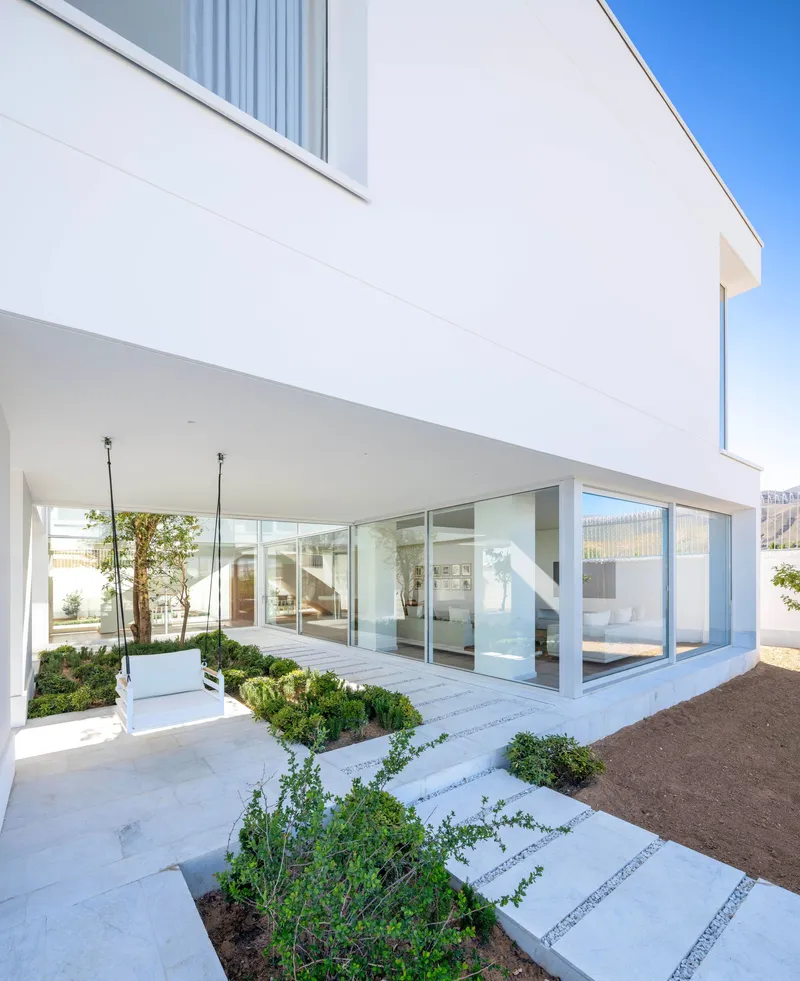
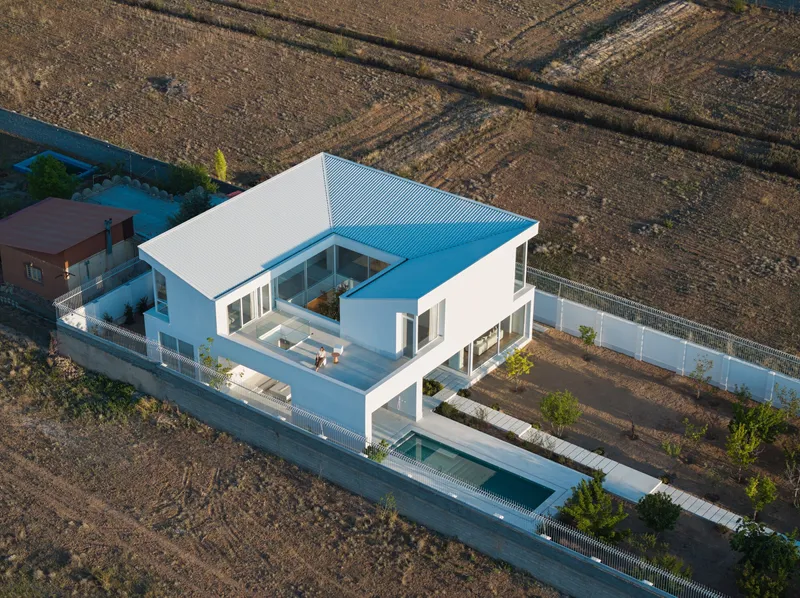
The deep overhang above the ground-level terrace creates a threshold space that is neither fully inside nor out. Planted gaps in the limestone paving blur the boundary further, allowing vegetation to break through the hard surface. At dusk, the aerial view shows how the central courtyard glows against the surrounding darkness of the agricultural plain, making the interior garden visible as a lantern of sorts within the landscape.
These in-between zones are critical to the way the house actually works day to day. In a climate that swings between intense summer heat and cold winter winds, having calibrated outdoor rooms at multiple elevations gives the occupants choices. The pool terrace, the courtyard floor, the upper corridors, the rooftop: each operates at a different exposure and microclimate, and the architecture connects them without flattening their differences.
Plans and Drawings
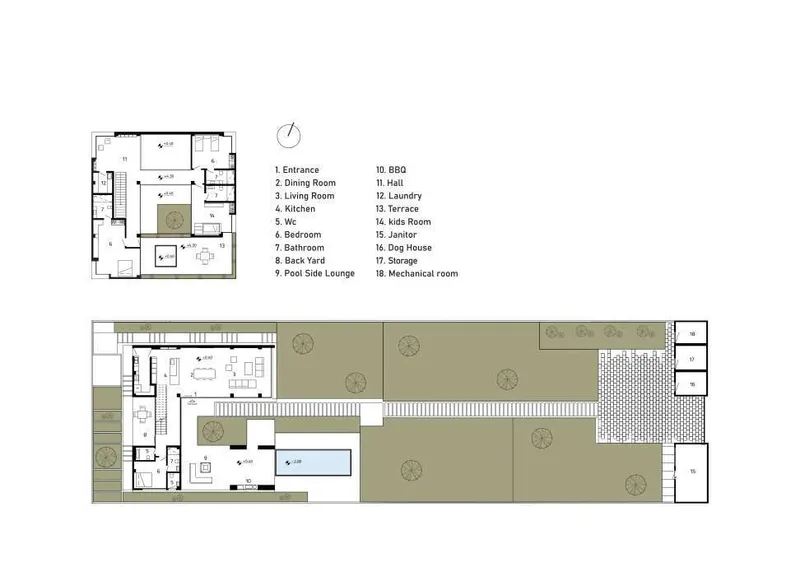
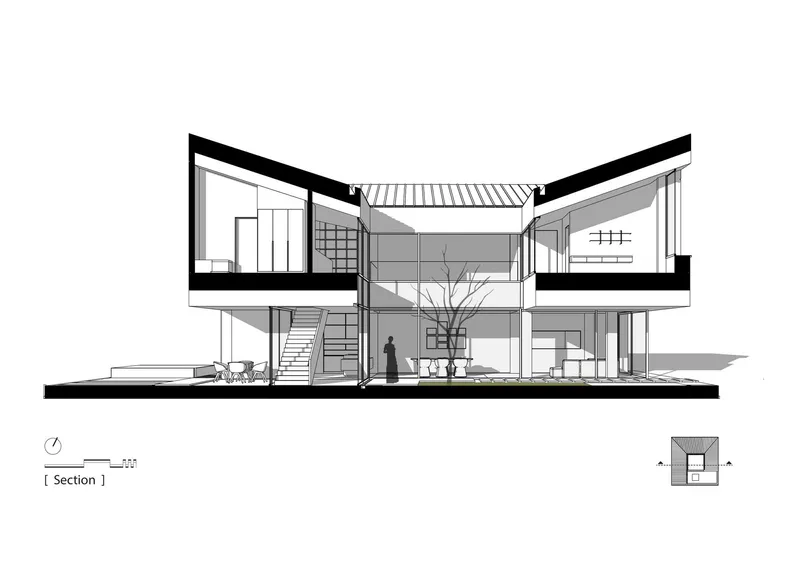
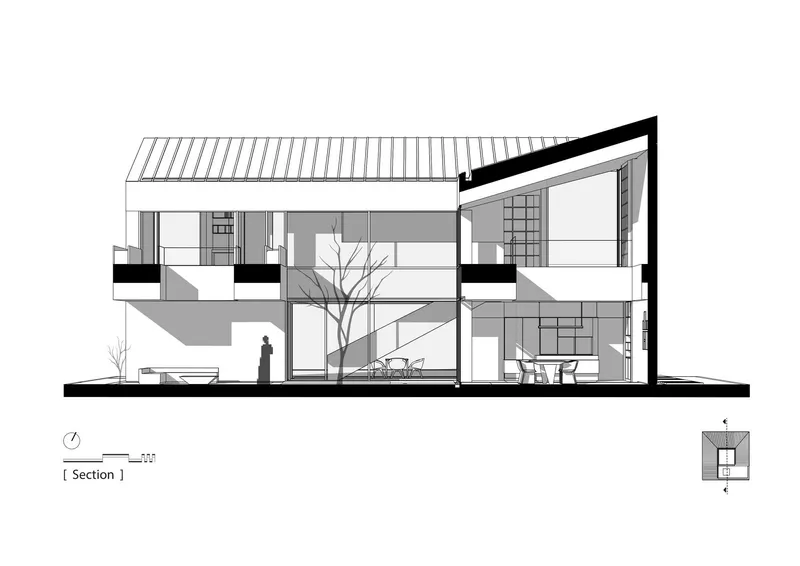
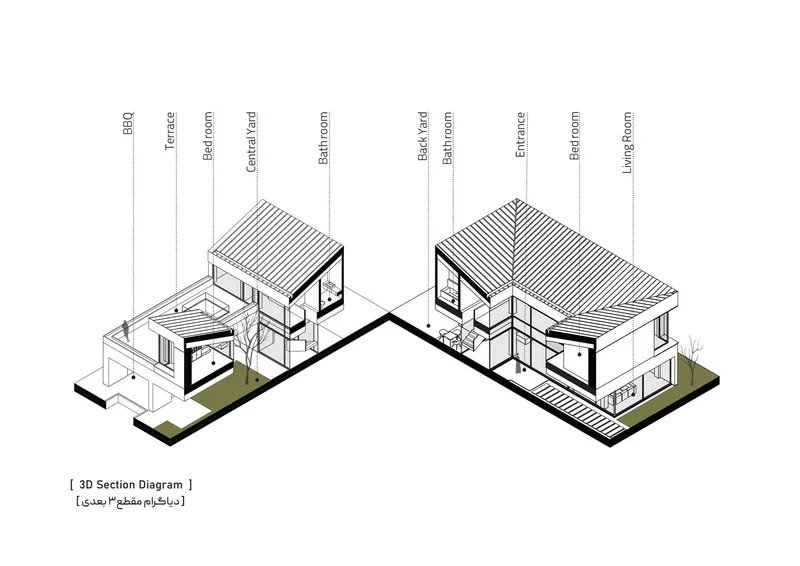
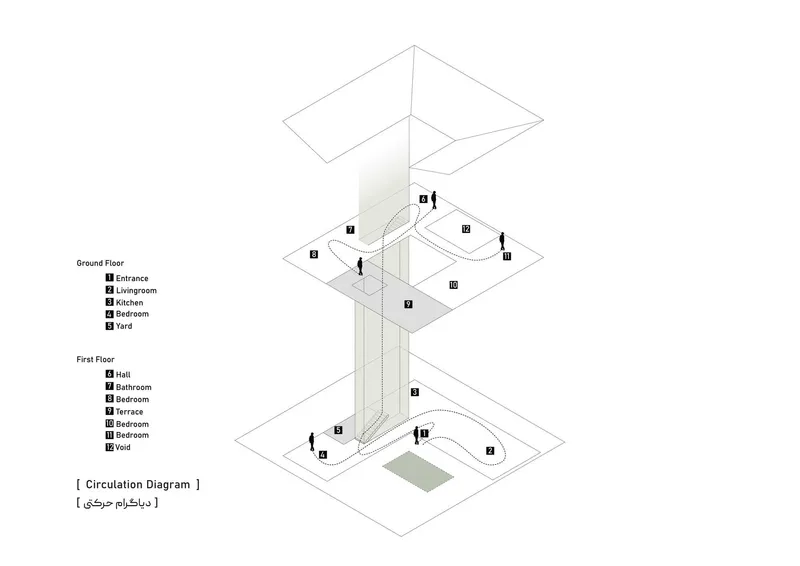
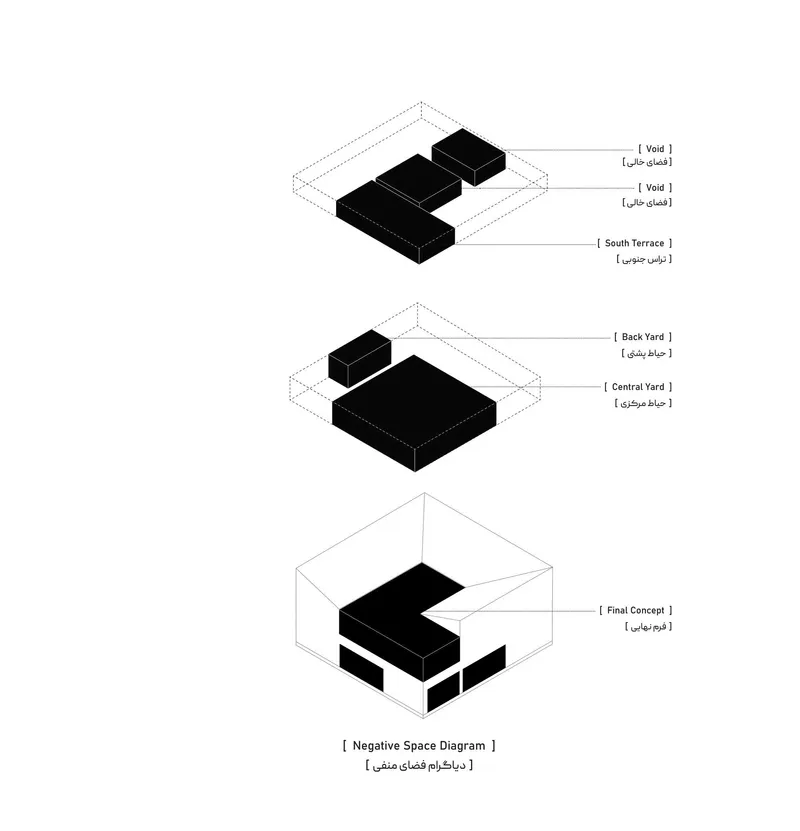
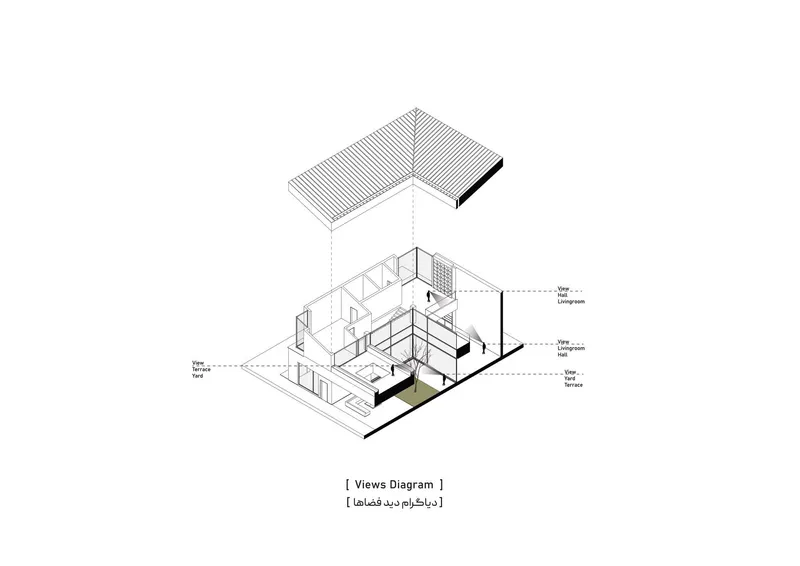
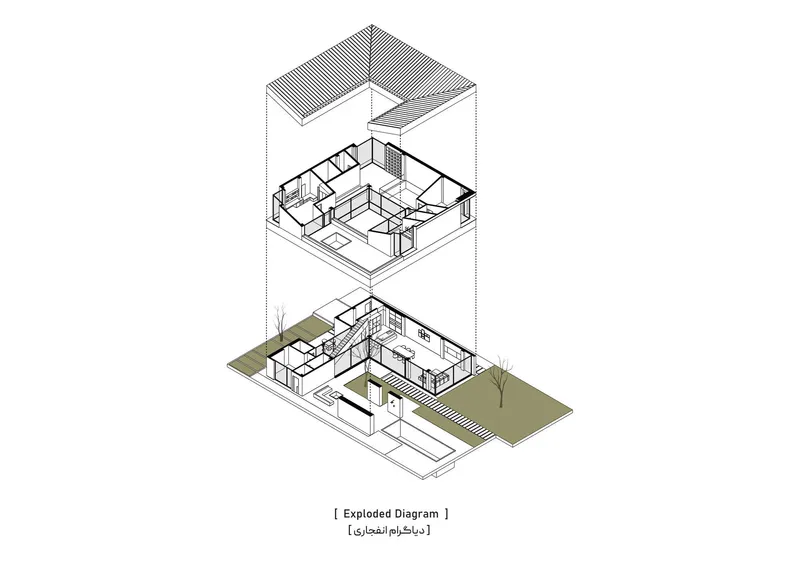
The floor plans confirm the courtyard's centrality: rooms on both levels wrap around it in a pinwheel pattern, with the staircase bridging the two floors at one corner. The section drawings are particularly revealing, showing how the double-height courtyard void and the sloped corrugated roof create a vertical landscape inside the building. The tree at the center reaches nearly to the roof line, making it an active participant in the architecture rather than a decorative accent.
The exploded axonometric diagrams break the project into legible moves: massing studies show how three volumes were tested before arriving at the final configuration of two sloped roof planes flanking the central void. Circulation diagrams illustrate how movement between floors passes through or alongside the courtyard at every transition, reinforcing its role as the gravitational center. Sight lines are mapped to demonstrate how the corner glazing captures specific landscape features, turning the passive design strategy into a deliberate visual program.
Why This Project Matters
Shahrzad Villa matters because it demonstrates that the Iranian courtyard house is not an artifact to be preserved under glass but a living typology still capable of generating contemporary architecture. Kanisavaran Office does not mimic tradition; it abstracts its principles, using the courtyard as a genuine climate device and spatial organizer rather than a nostalgic reference. The result is a house where passive ventilation, daylighting, and privacy are designed as a single integrated system, not bolted on as separate sustainability features.
On a broader level, the project asks a question worth paying attention to: what happens when you place a rigorous courtyard house on an open plain where it has no urban fabric to negotiate? The answer here is that the building creates its own interiority, turning inward to its planted core while selectively opening outward toward mountains and sky. It is a convincing argument that courtyard logic works not because of density but because of climate, light, and the human desire for enclosed gardens. That makes it relevant well beyond Damavand.
Shahrzad Villa by Kanisavaran Office, led by Mohammad Kanisavaran. Located in Seyedabad, Damavand, Tehran, Iran. 470 m², completed 2025. Photography by Mohammad Hassan Ettefagh.
About the Studio
Share Your Own Work on uni.xyz
If projects like this are the kind of work you want to make, uni.xyz is a place to publish your own, find collaborators, and enter design competitions.




Popular Articles
Popular articles from the community


The Earth Pod: 3D Printed Homes for Resilient Refugee Communities
The Earth Pod reimagines refugee housing through 3D printed homes made from clay, combining resilience, self-sufficiency, and rapid shelter.

Hill & Cross Opera: Sculptural Opera House Architecture Shaped by Tallinn’s Landscape and Identity
Hill & Cross Opera reimagines opera house architecture in Tallinn through its sculptural hill, civic plaza, glass wave and a luminous cross.

Co-life: Sustainable Architecture for Age-Friendly Community Living
Co-life reimagines sustainable architecture for seniors through courtyards, rammed earth, shared gardens, and spaces designed for belonging.

Play: Fragments of Their World
Familiar architecture becomes modular playground design, creating safe spaces where displaced children can learn, connect, imagine and play.


Similar Reads
You might also enjoy these articles

Bao Huynh Watercolor Atelier: A Serene Art Retreat in Hội An
Bao Huynh Watercolor Atelier in Hội An blends multifunctional art spaces, sustainable design, local materials, and family-friendly living in a serene environment.

Atelier Macri Concept Store Interior Design by CASE-REAL
Atelier Macri store features a "ko" counter, walnut wood details, cork displays, blending retail, gallery, and seamless customer experiences.

Manuel Vargas Izquierdo Stadium and High-Performance Sports Center: Architectural Excellence in Jalpa de Méndez
The Manuel Vargas Izquierdo Stadium blends sustainable design, inclusive sports facilities, and cultural-inspired architecture, revitalizing Jalpa de Méndez’s public spaces.

KAKR Buluh Awar Hall: Revitalizing Community and Ecology Through Bamboo Architecture
Community built bamboo hall revitalizes Buluh Awar village, empowering youth, restoring ecology, celebrating vernacular craftsmanship through sustainable architecture and culture.

Comments (0)
Please login or sign up to add comments
No comments yet. Be the first to comment!