

BLDUS Turns a 250-Square-Foot Screened Porch into a Pine Forest Temple in East Hampton
A gabled cedar pavilion mimics the rhythm of surrounding pines, anchoring a 1990s wooded home to its hollow in Long Island.


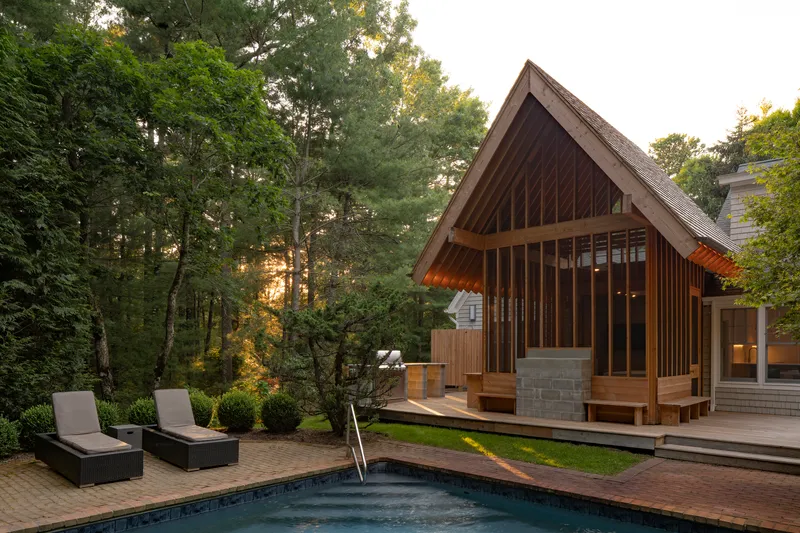
A screened porch doesn't normally warrant architectural attention. At 250 square feet, the rear addition to a 1990s wooded home in East Hampton could have been a forgettable contractor-grade enclosure. Instead, BLDUS built something closer to a votary hall: a 20-foot-tall gabled volume clad entirely in vertical cedar 2x4 studs, topped with a heavy roof of 2x12 Douglas fir rafters and cedar shingles. The pavilion doesn't attach to the house so much as hover beside it, floating free of the existing roofline while rhyming with the main gable. It is, at root, a room made of sticks standing among sticks.
The real subject here is dimensional lumber pushed past its default role. Mainstream stick-built construction treats 2x4s as dumb infill hidden behind drywall. BLDUS makes them the entire facade, the entire spatial experience. Tightly spaced studs become screen walls that filter light and frame views the way a pine canopy does. The surrounding trees, tall and straight, are mirrored in the vertical grain of the structure. It is a quiet, clever conflation of forest and building, and it works because the proportions are right and the material palette stays disciplined.
A Gable That Stands Alone
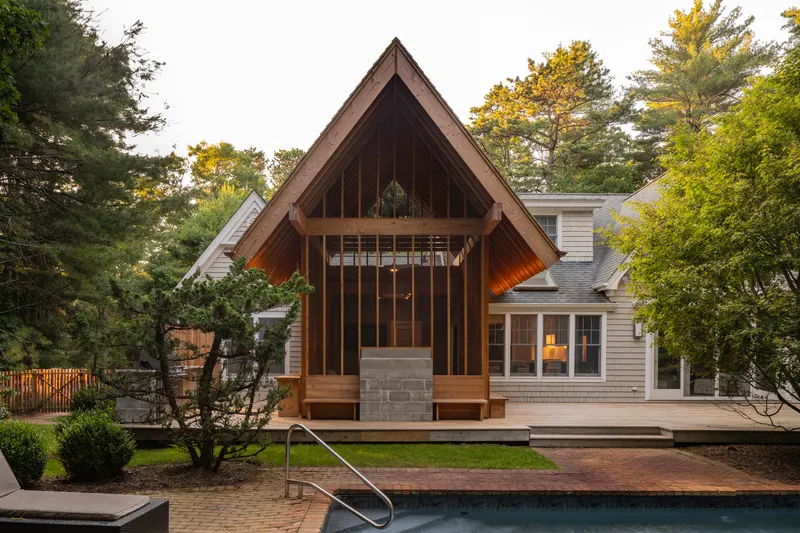
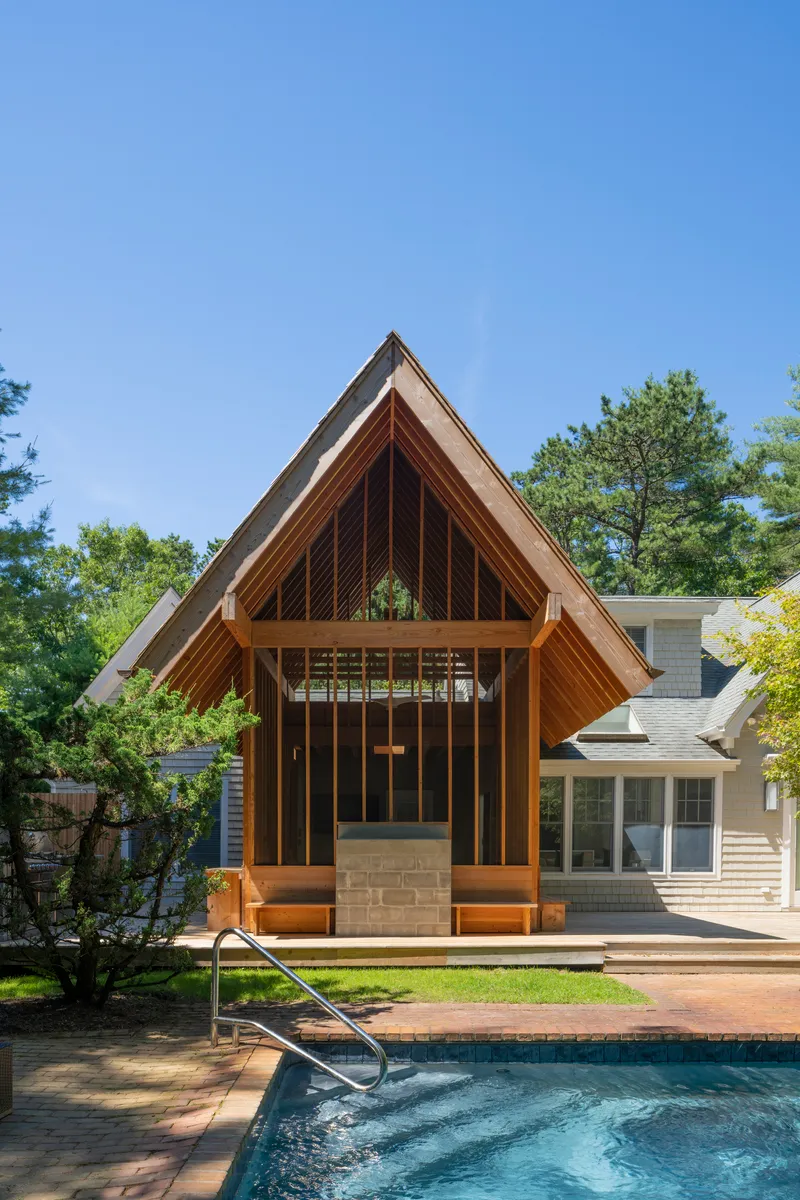
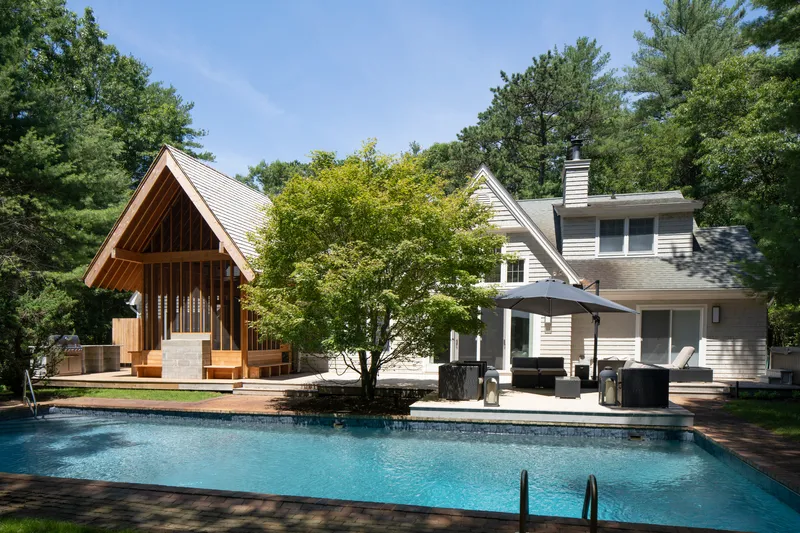
The screened porch reads as an independent object even though it connects to the kitchen and breakfast nook of the existing house. Its steep gable rises well above the adjacent roofline, establishing its own proportional logic. This separation is deliberate: it lets the pavilion claim identity as a garden structure, a pool house, and a dining room simultaneously, without diluting any one role.
Seen from the pool terrace, the white clapboard residence recedes behind the cedar pavilion like a backdrop. The relationship reverses the typical hierarchy. The addition, not the house, becomes the public face of the property toward the garden.
Cedar Studs as Screen and Structure
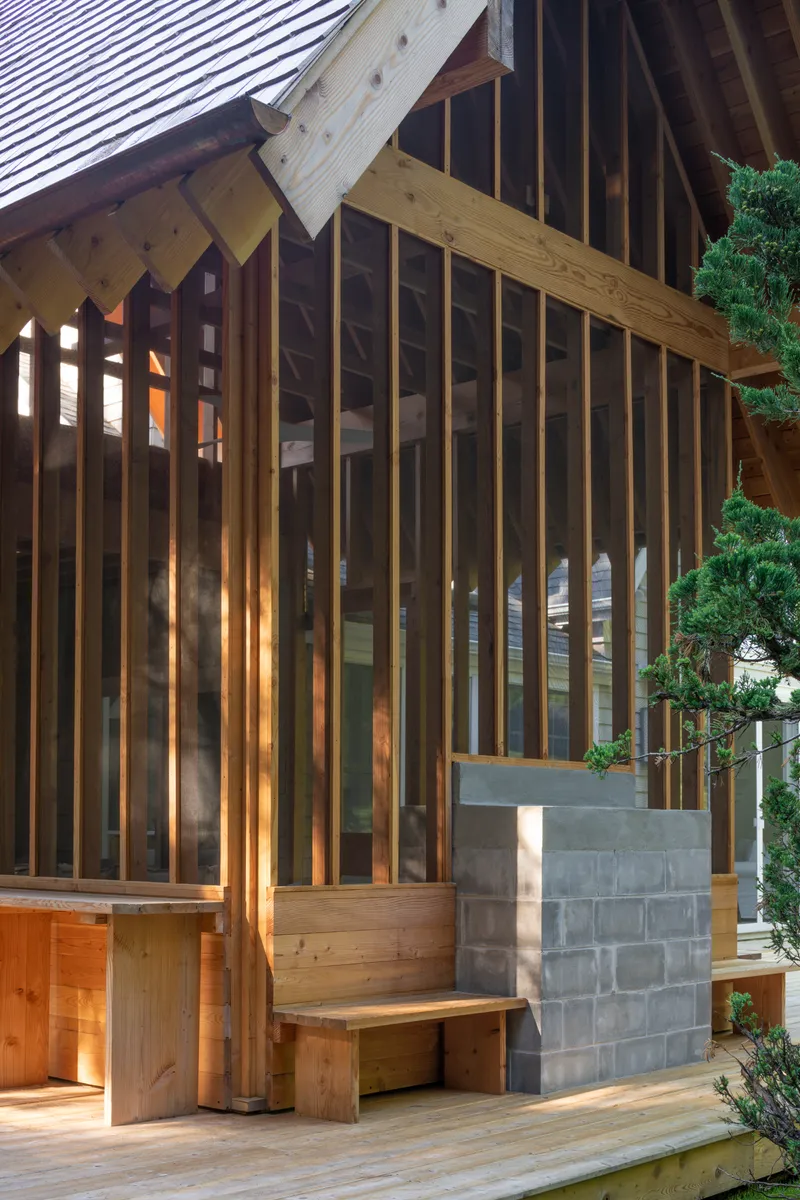
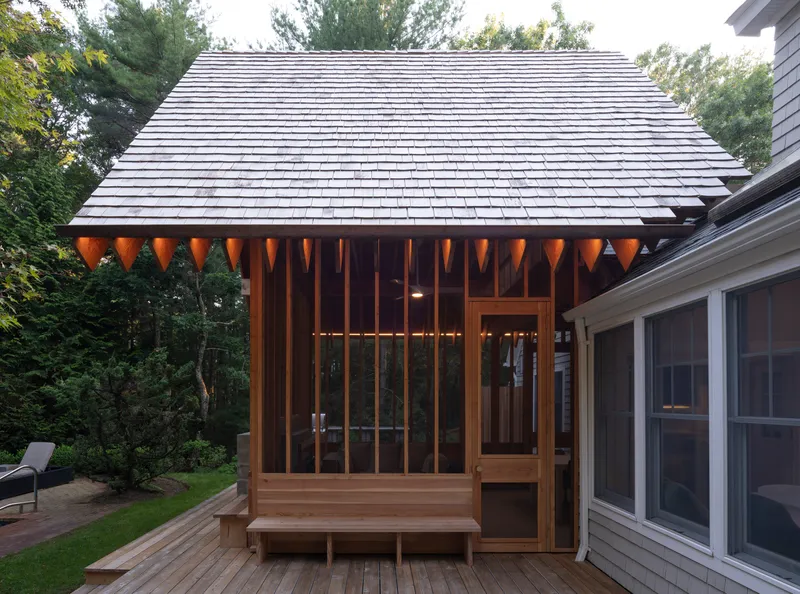
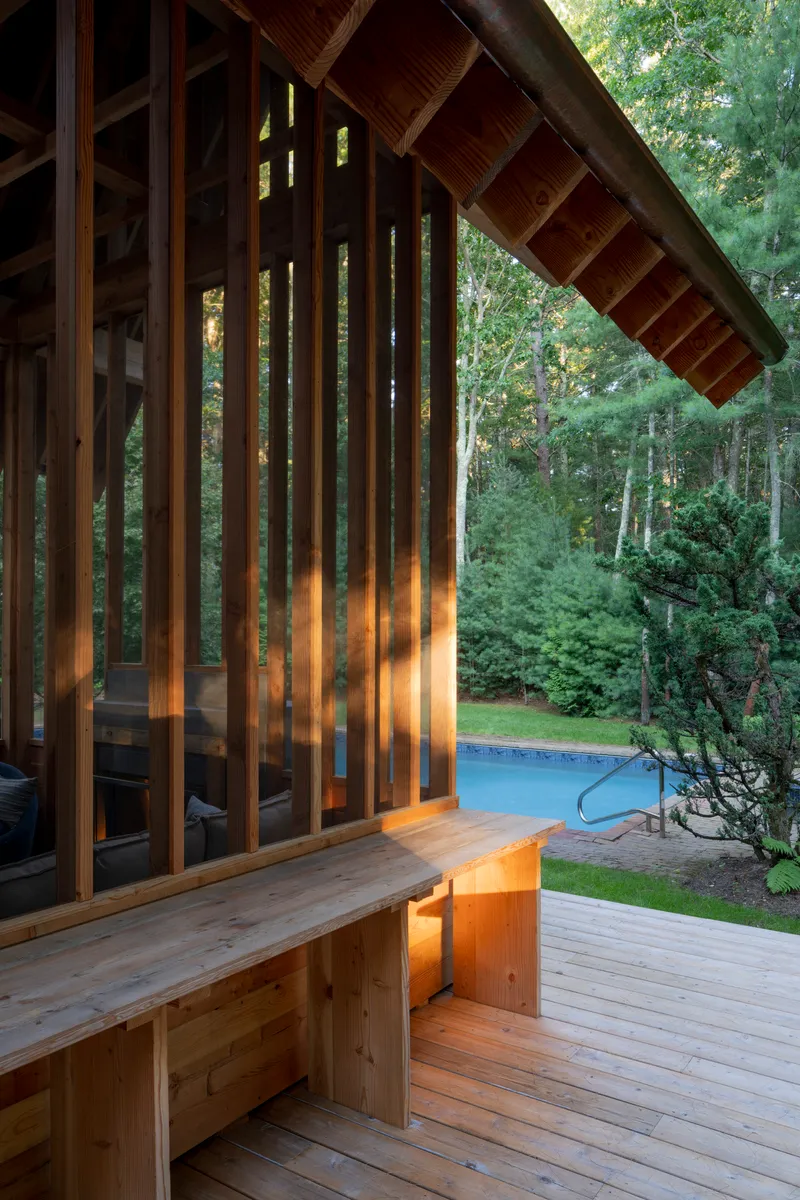
The facade is both structure and ornament, with no secondary cladding system. Clear cedar 2x4s, spaced at a tight rhythm, carry the loads and define the enclosure. A concrete block base gives the assembly a plinth, grounding the lightweight timber above. At dusk the eaves light up, washing warm tones across the wood grain and turning the walls into lantern screens.
The detail is deceptively simple. Each stud runs floor to eave without interruption, reinforcing the vertical datum that echoes the surrounding pine trunks. The pattern creates a moiré effect as you move around the pool: views of the interior appear and disappear, keeping the porch semi-private without closing it off.
Interior: Hearth, Bench, Forest
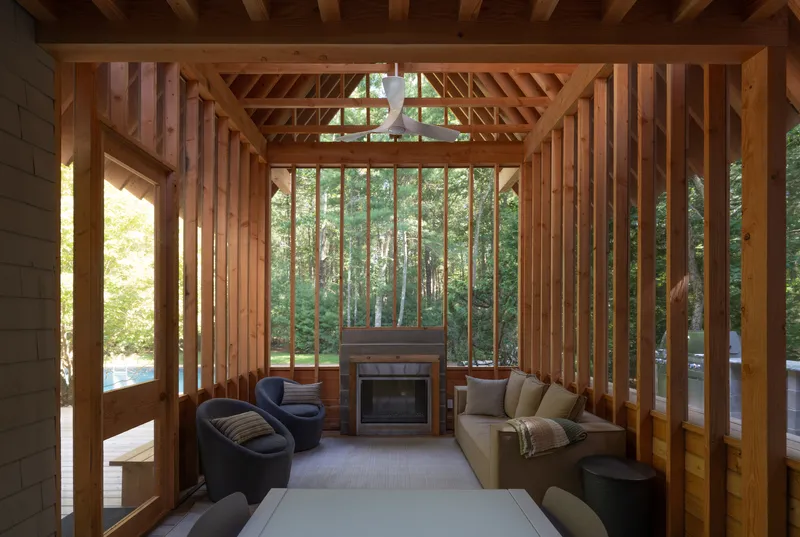
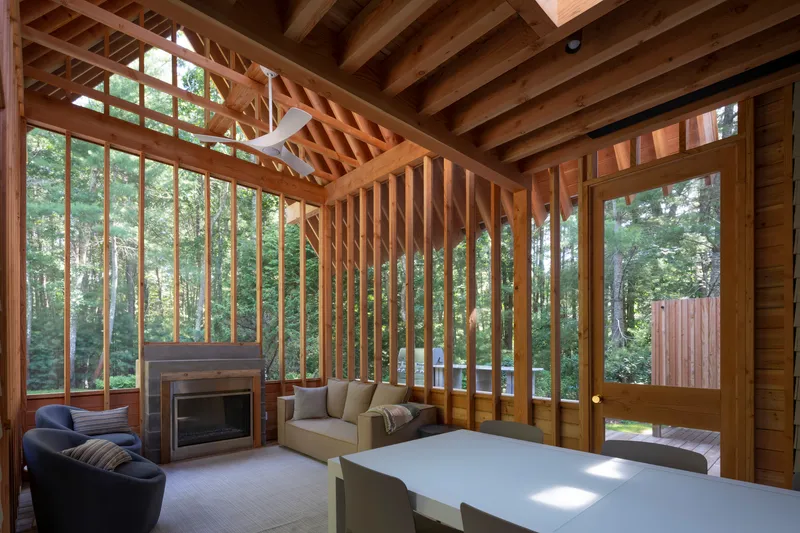
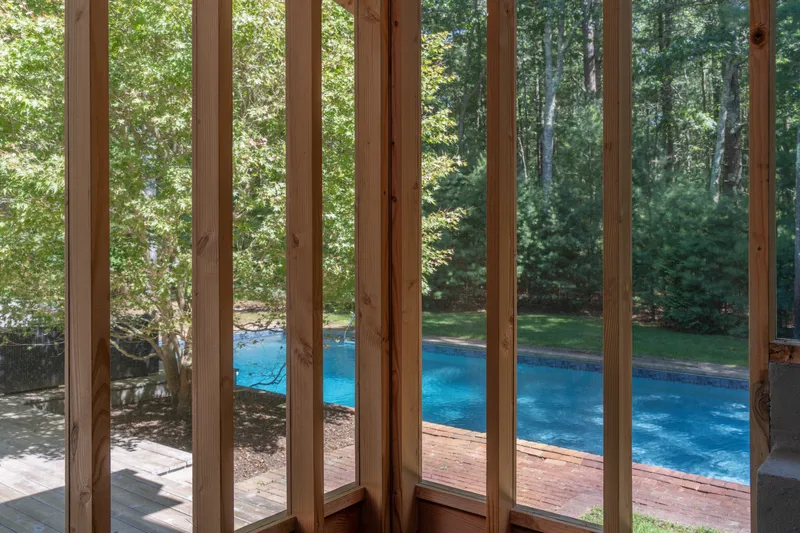
Inside, the volume reveals its full height. Exposed 2x12 Douglas fir rafters radiate from the ridge, giving the ceiling the cadence of a hull turned upside down. A ventless hearth anchors the far end, providing a focal point that pulls you through the space. Built-in benches and a food prep counter tuck beneath extended eaves, keeping the center of the room clear.
The best moment is the view out through the slats toward the pool and the woods beyond. The vertical members slice the landscape into strips of blue water and green canopy, compressing the panorama into a series of framed vignettes. It is the architectural equivalent of looking through a stand of trees, and it works precisely because the spacing is calibrated to the scale of the surrounding forest.
Roof and Rafter Logic
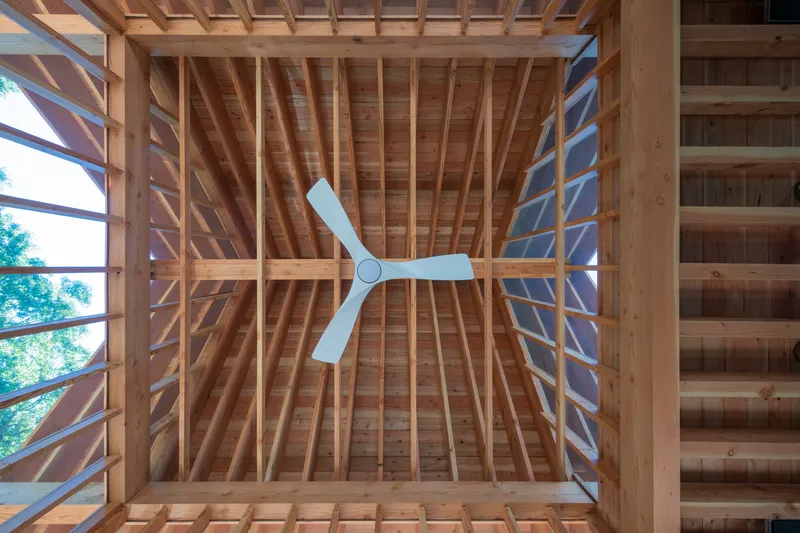
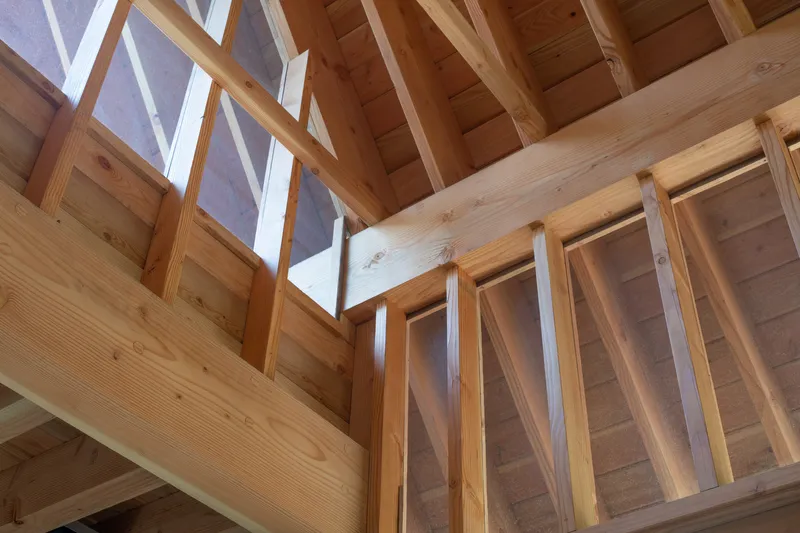
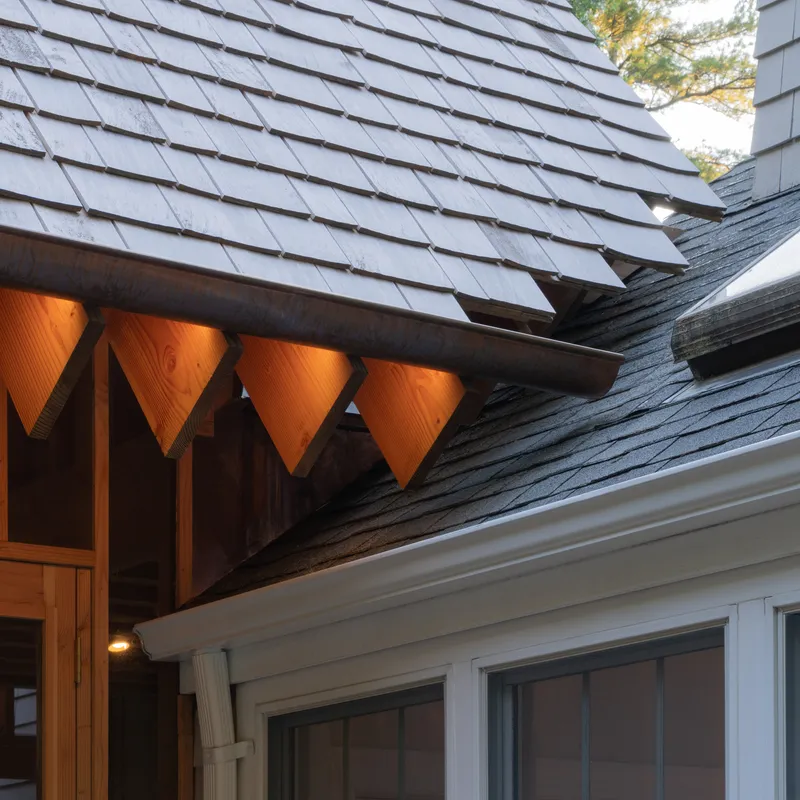
The roof is heavy by design. Cedar shingles, the default material in East Hampton for generations, sit atop a steep pitch supported by massive rafters. Clerestory windows at the ridge wash the interior with daylight and ventilate the volume passively. Triangular soffit openings at the junction of old and new roofs allow hot air to escape, turning the gable into a thermal chimney.
Where the new roof meets the existing slate shingle roofline, a careful triangular joint resolves the geometry without awkward flashing gymnastics. It is a small detail that reveals the level of care in the construction: every junction is considered, not improvised.
The Front Entry and Kitchen Renovation
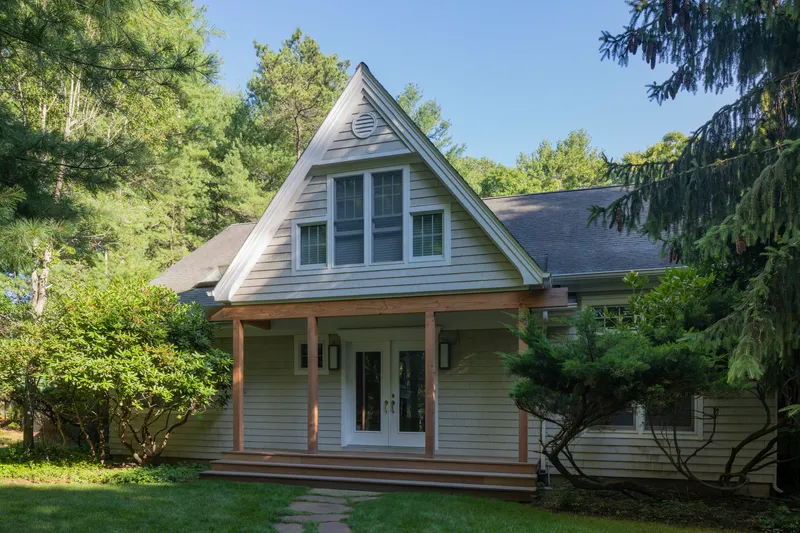
Swampy Hollow is a project of two entrances. At the front, 6x6 wood columns and a 6x12 beam reframe the arrival sequence with a temple-front porch, giving the house a formality it previously lacked. The gable vent and the proportions of the columns reference a vernacular New England porch tradition without quoting it literally.
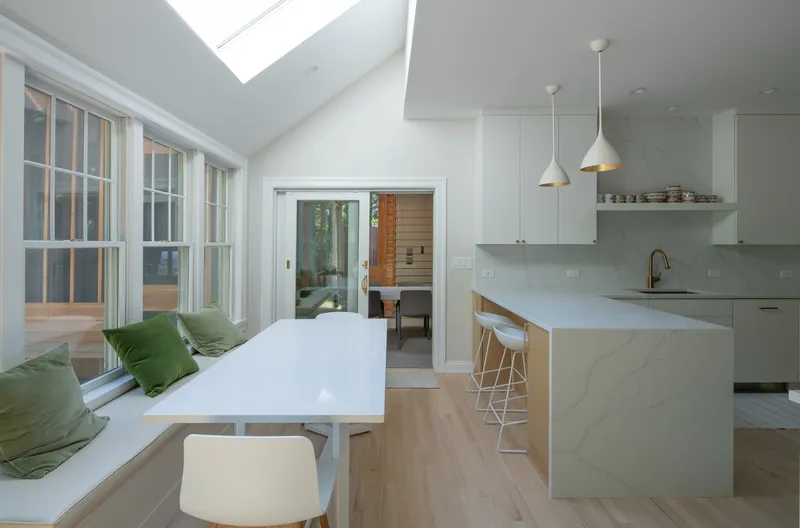
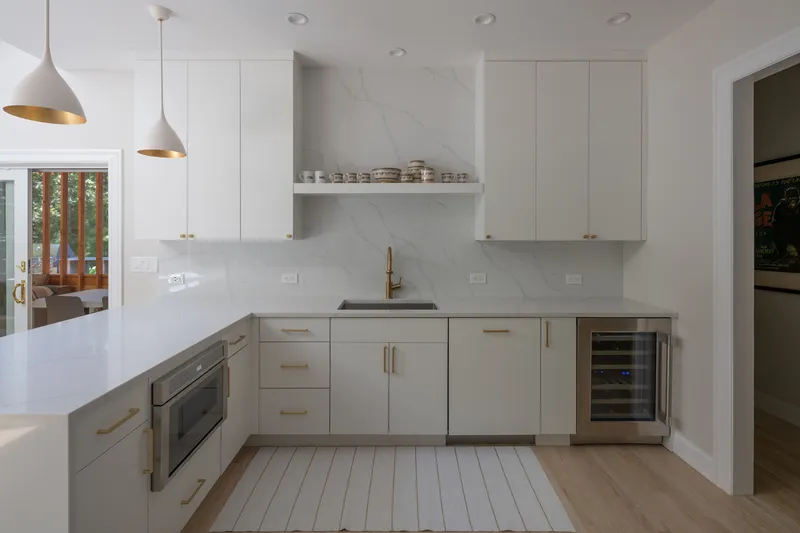
Inside, the kitchen is bright and restrained: white cabinetry, marble backsplash, brass hardware, and light wood flooring. A window seat floods the breakfast nook with daylight. The renovation connects the kitchen directly to the screened porch, establishing a seamless flow from cooking to outdoor dining.
Night and the Pool Edge
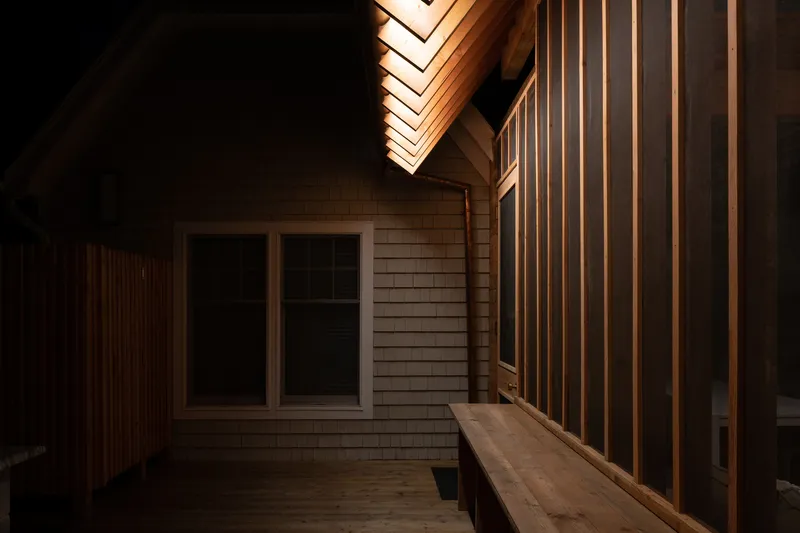
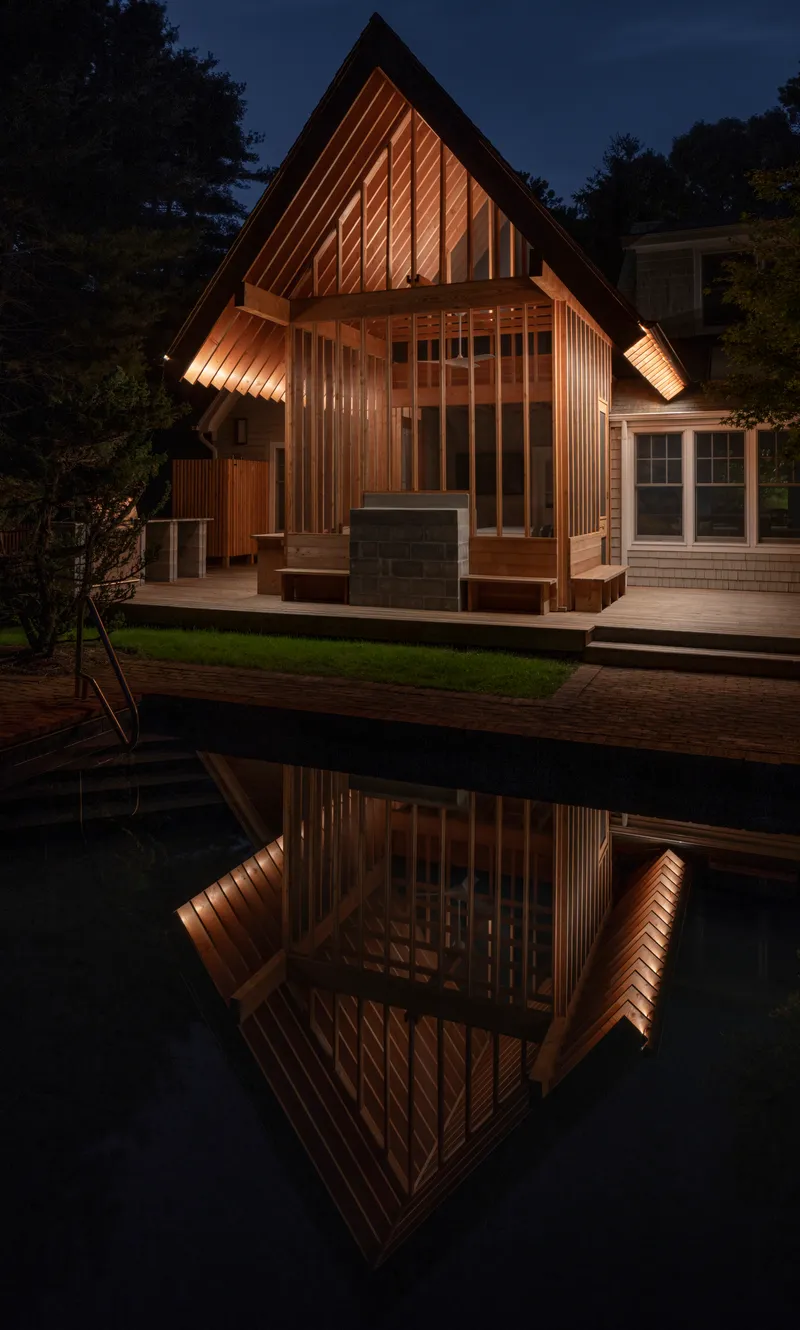
The pavilion performs differently after dark. Uplighting beneath the eaves transforms the cedar screen into a warm, glowing lantern. The concrete block base disappears into shadow, and the timber volume appears to levitate above the pool deck. Reflected in still water, the gable doubles itself, creating a symmetry that the daytime composition intentionally avoids.
These night views are the project's strongest images because they reveal a quality that photographs of raw lumber rarely achieve: atmosphere. The grain of the cedar catches light unevenly, producing a soft, textured luminosity that no composite panel could replicate.
Concrete, Bench, Threshold
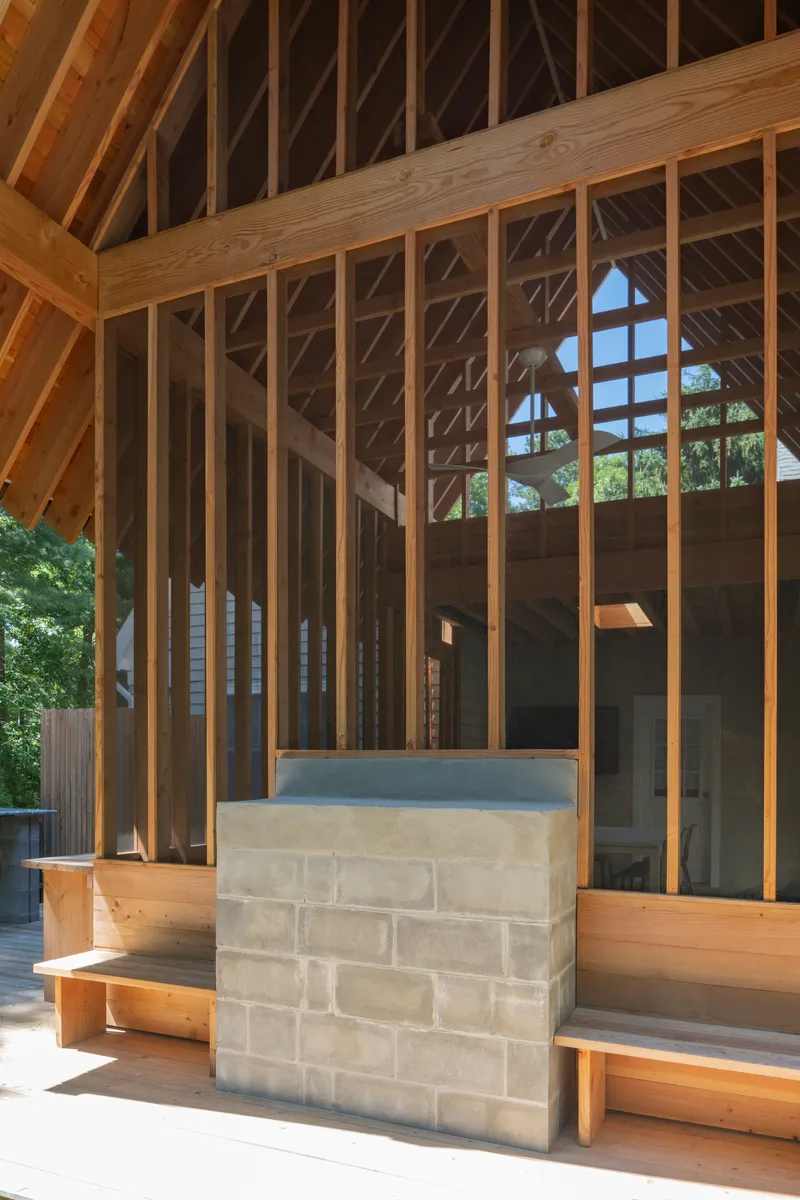
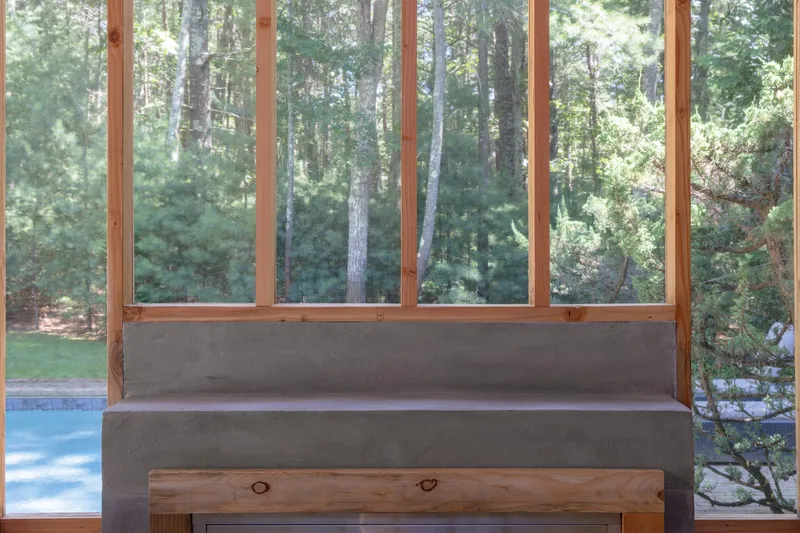
A concrete block bench wraps beneath the timber frame, defining the edge between inside and outside without a wall. It is a generous detail: a place to sit that is neither fully in the porch nor fully on the deck. The bench doubles as a ledge for drinks and plates, eliminating the need for separate furniture.
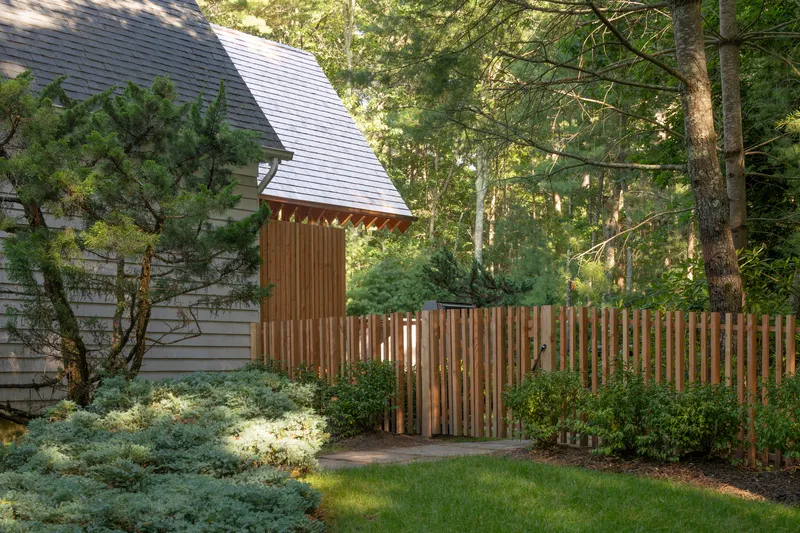
On the garden side, a cedar slat fence extends the material language of the pavilion into the landscape, enclosing planted beds along a gravel path. The fence is lower and more loosely spaced than the porch walls, stepping down the intensity of the screen motif as it moves away from the building.
Plans and Drawings
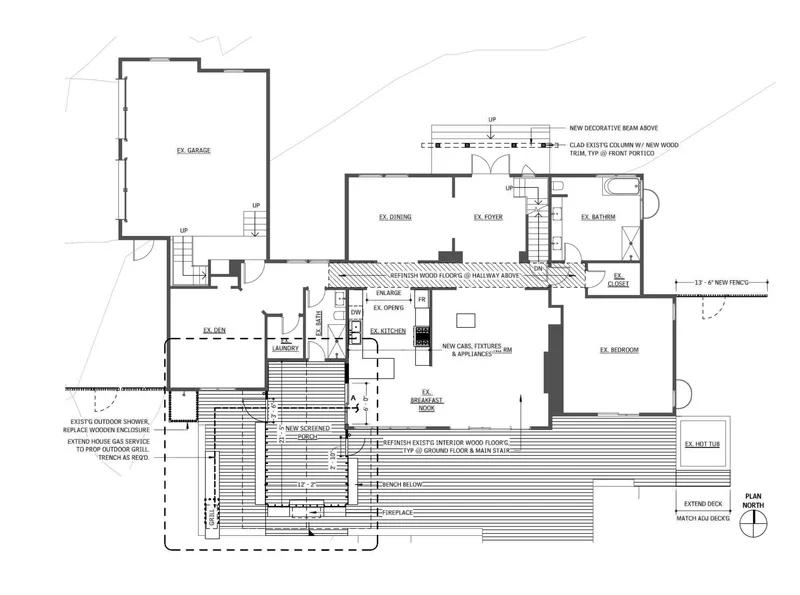
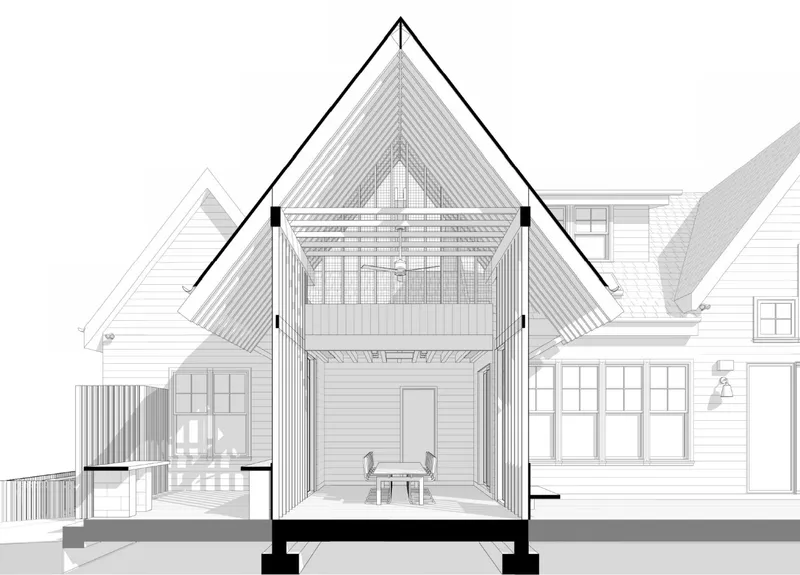
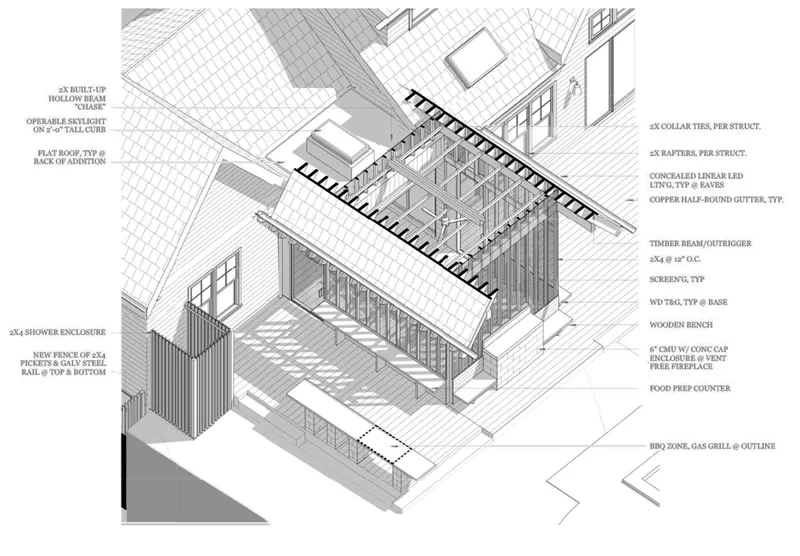
The floor plan shows how the 250-square-foot addition plugs into the gap between the garage and the dining room, turning a residual zone into the social core of the house. The section confirms the dramatic height of the gabled volume and reveals the clerestory slot at the ridge. An axonometric drawing annotates the timber framing system, making explicit what the photographs only imply: every piece of lumber is load-bearing, spatial, and visible. There is no hidden structure here.
Why This Project Matters
Swampy Hollow is a case study in doing more with less. BLDUS did not import exotic materials or invent a novel structural system. They took off-the-shelf dimensional lumber, the same stuff framing every house on Long Island, and gave it spatial ambition. The screened porch is 250 square feet. It feels like a chapel. That gap between size and experience is the project's real achievement.
It also offers a useful corrective to the prevailing narrative that sustainable design requires proprietary technology. Here, passive ventilation, local cedar shingles, and an open-air program accomplish comfort without mechanical systems. The lesson is old but worth repeating: craft, proportion, and site awareness can do the heavy lifting when the architect pays attention to what is already there.
Swampy Hollow by BLDUS, East Hampton, New York, United States. 250 sq ft addition. Completed 2021. Photography by Michael Vahrenwald.
About the Studio
Share Your Own Work on uni.xyz
If projects like this are the kind of work you want to make, uni.xyz is a place to publish your own, find collaborators, and enter design competitions.


Popular Articles
Popular articles from the community


ETEH Reworks the Shared Spaces of São Domingos School in Brazil Around Timber, Color and Hanging Plants
At São Domingos School in Brazil, 436 m² of hall, refectory and library are recast with timber joinery, a yellow and blue code and trailing greenery.

Cube Design Draws an Ecological Corridor Between Two Shenzhen Hills with the Nankai Building
Beside Shenzhen's container docks, the Nankai Building pairs stacked balconies with a climbing green screen to connect two hillsides across its height.


Manzana Morphosis: Stretching Barcelona's Grid into a Living Landscape for 2050
A radical reworking of the Eixample manzana turns density into a tool for generous public space, vertical ecology, and environmental performance.

The Amber Palace Opera: A Geological Fiction Surfaces on Tallinn's Baltic Waterfront
Pierre Brillard reimagines a Baltic legend as a public landscape, opera house, and waterfront promenade rooted in Tallinn's coastal identity.

Similar Reads
You might also enjoy these articles

LAVA Architecten Gives Vocational Education a Sawtooth-Roofed Face on a Mechelen School Campus
In Mechelen, Belgium, a 2,053 m² STEM school on a 6×6 m grid turns workshops and classrooms into rooms that can be rearranged as teaching changes.

KEMA Studio Turns a Derelict Marvila Attic into a 60 m² Lighthouse Apartment Above Lisbon
In Lisbon's Marvila district, a rebuilt roof, four skylights and two plywood volumes turn an unlivable attic into a bright home facing the Tagus.

Pixel Gardens: One Repeated Module Stacked Into a Terraced Social Housing Tower for Famagusta
Salem Bader's shortlisted housing tower builds a vertical neighbourhood from one repeated module, offsetting units to carve terraces, light and air.

Bao Huynh Watercolor Atelier: A Serene Art Retreat in Hội An
Bao Huynh Watercolor Atelier in Hội An blends multifunctional art spaces, sustainable design, local materials, and family-friendly living in a serene environment.

Explore Ai Generated Competitions
Discover active competitions in this discipline

Challenge to design a barrier free sports center

Challenge to design an outdoor ice-rink and park

Challenge to design a portable theatre

Challenge to design a portable music platform
Comments (0)
Please login or sign up to add comments
No comments yet. Be the first to comment!