
Constanti Architects Builds a Fortress of Privacy in Nicosia with House 345
A concrete and timber residence in Cyprus reinterprets the traditional introverted courtyard house for a new urban landscape.


Most residential architecture in Mediterranean cities negotiates the same tension: how to live openly in a climate that rewards it while keeping the street at arm's length. In Nicosia, that negotiation has centuries of precedent. The traditional Cypriot house turns its back to the road and pours its life inward, organizing rooms around a courtyard that belongs entirely to the household. House 345, designed by Constanti Architects and completed in 2022, takes that premise and rebuilds it with bare planked concrete, perforated metal screens, and a sequence of thresholds that make arrival feel like an act of decompression rather than simple entry.
What makes this 369 square meter house worth studying is not the introversion itself but the precision with which it is staged. Lead architect Constantinos Constanti organized the plan around what he calls imaginary zones, spatial divisions enforced through both physical walls and perceptual cues. The street facade is nearly opaque, a large uncoated concrete wall with selective openings that offer controlled entrances rather than views. Behind it, the house progressively opens up until the rear elevation dissolves into glazing, a pool terrace, and a planted garden. The gradient from closed to open is the project's real subject.
The Opaque Street Wall
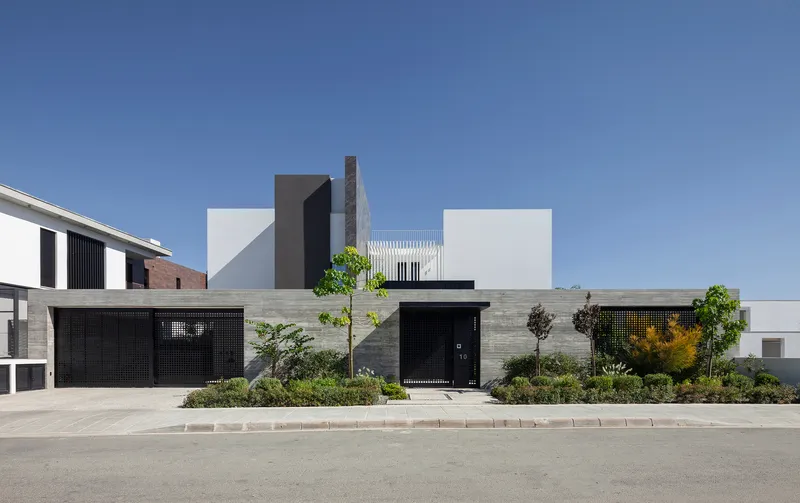
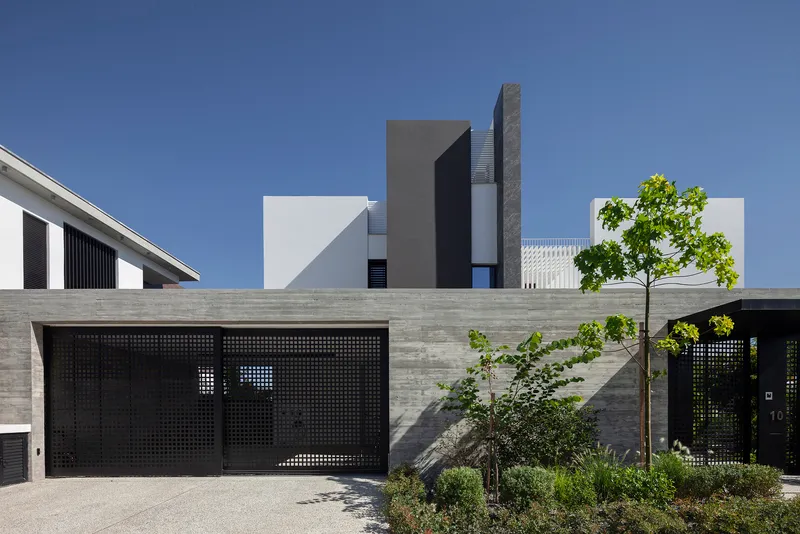
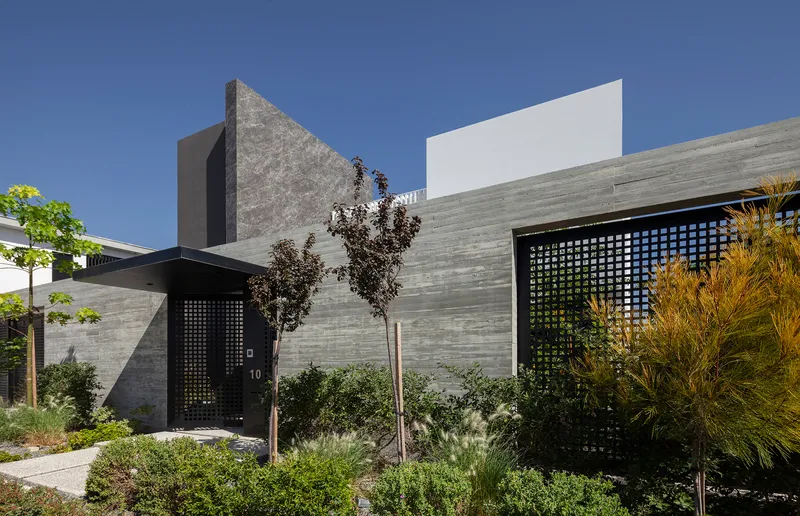
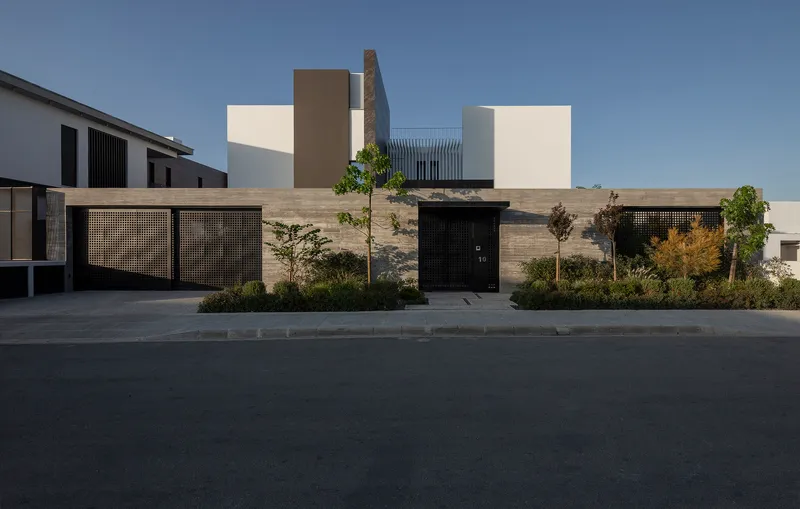
From the street, House 345 presents itself as a composition of stacked volumes in white and grey, grounded by a horizontal stone wall and punctuated by perforated metal garage screens. There is almost nothing here that invites the eye inside. The facade reads as a series of material textures rather than a collection of windows: horizontal timber cladding, rough stone, punched metal. Planted trees and low shrubs soften the boundary without undermining its assertiveness.
The strategy is deliberate and culturally literate. In the traditional Cypriot house, the street-facing wall was essentially impenetrable, communicating status through material quality rather than transparency. Constanti updates the idea without sentimentality. The concrete is left fair-faced and planked, the metal screens are industrial in tone, and the overall composition avoids any folklorism. It simply refuses to perform for the public realm.
Threshold as Architecture
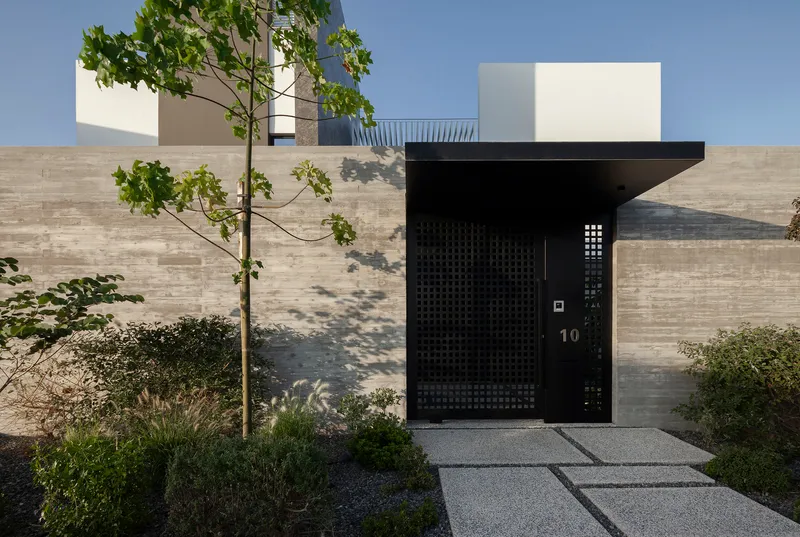
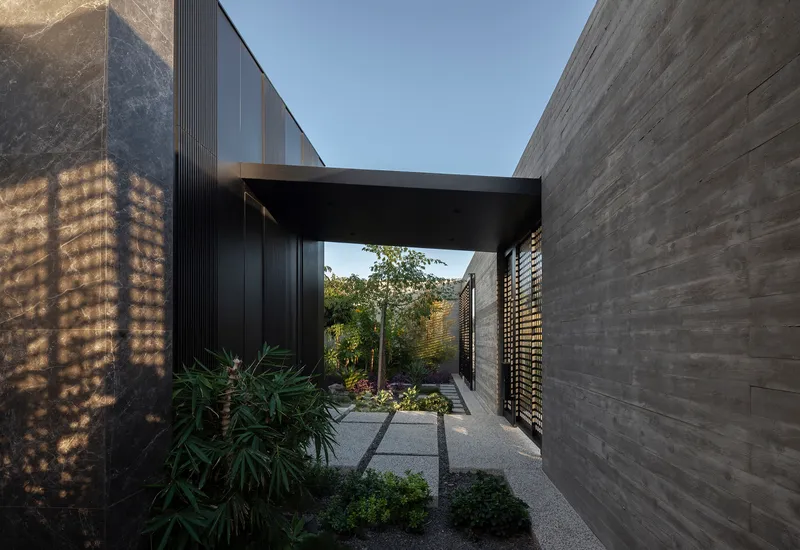
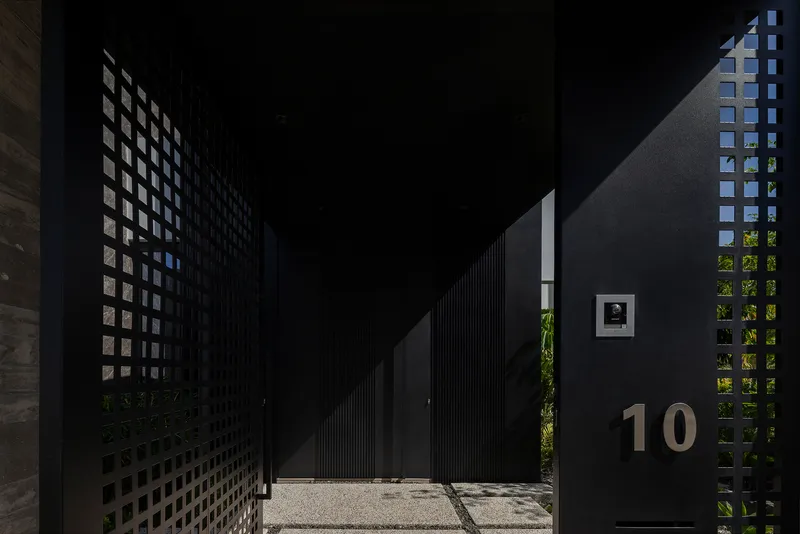
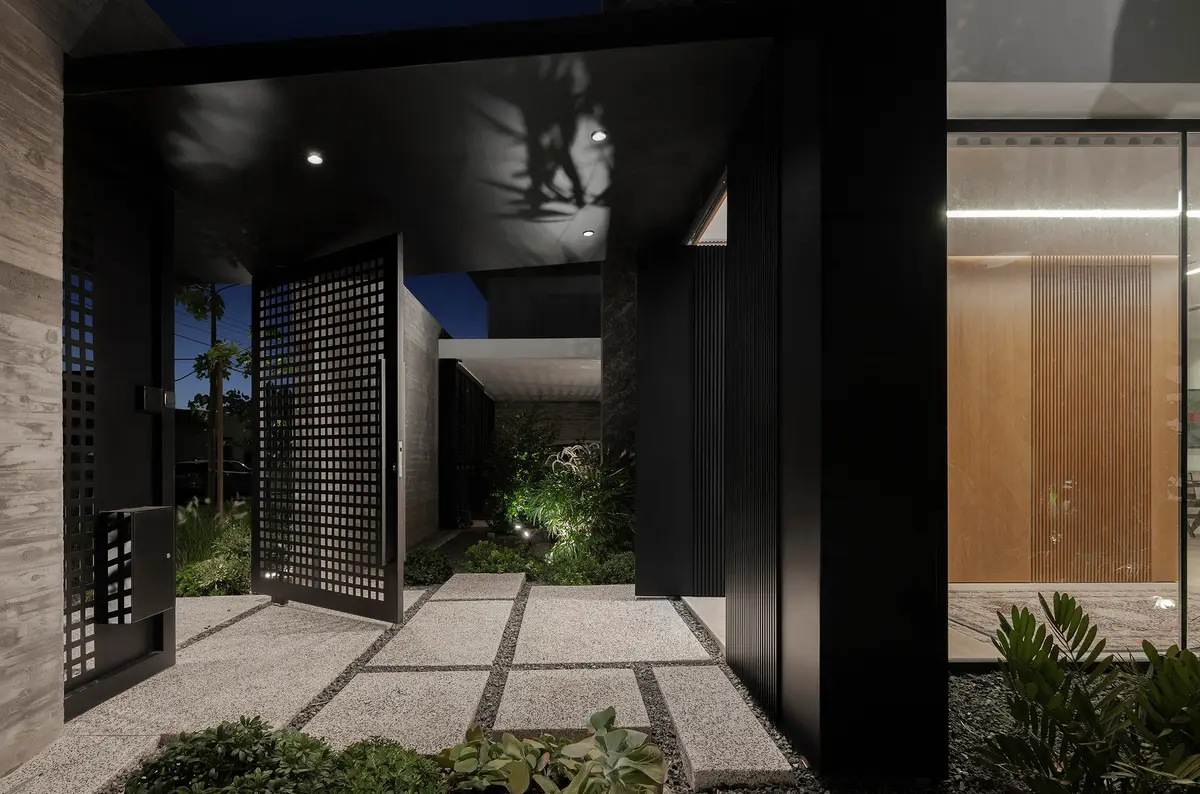
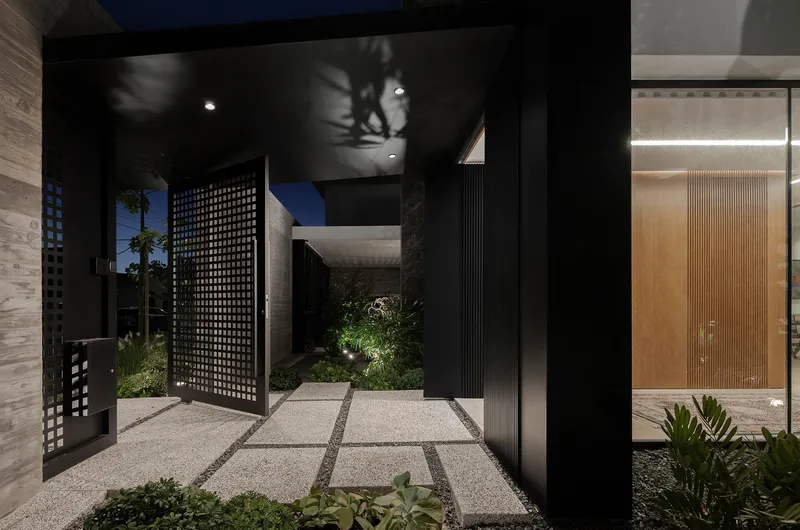
The entry sequence is the most carefully choreographed part of the project. A black perforated metal door set within the stone wall opens to a covered passage defined by a perforated stone screen, planted beds, and a black steel beam overhead. The lattice filters sunlight into dappled patterns on the gravel path, turning circulation into an event. You are not simply walking to the front door; you are being slowly separated from the street.
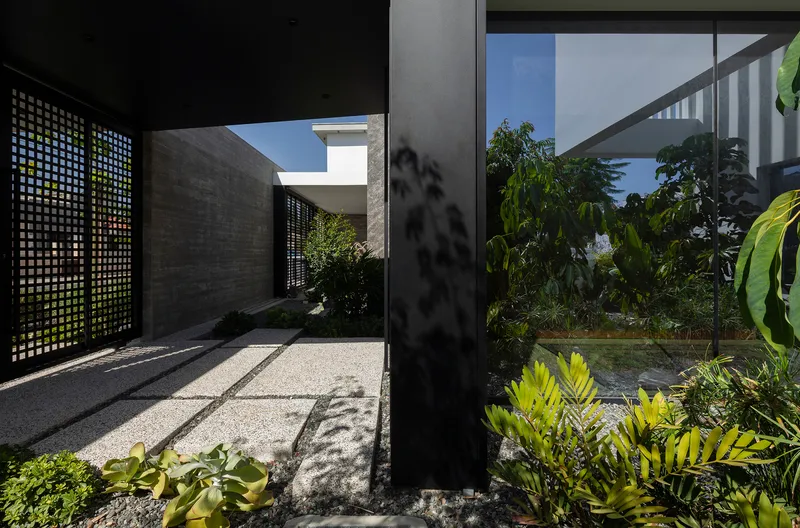
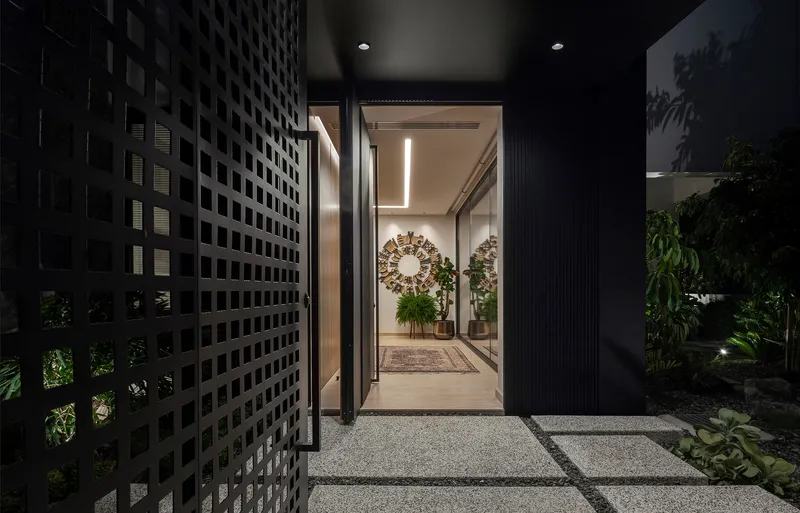
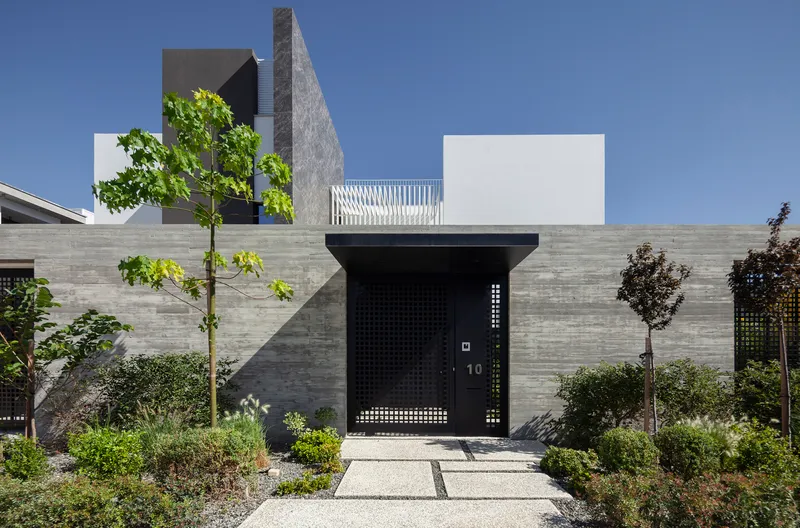
At night, the screens glow with warm light from behind, and the planted beds become illuminated borders that guide movement. During the day, tropical planting along the walkway reinforces the sense of enclosure. The pivot lattice door, visible in the dusk views, acts as a second gate within the sequence, compressing the transition before the house finally reveals itself. Few single-family houses invest this much design energy in the act of arriving.
The Inner Courtyard Reinvented
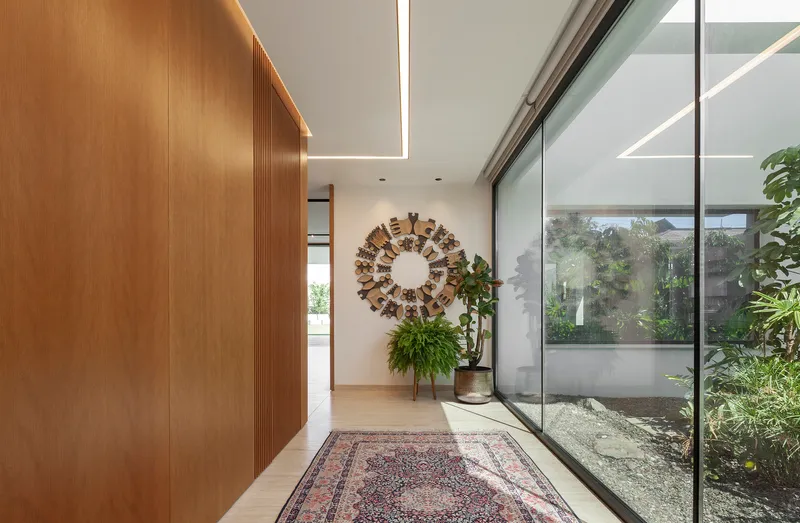
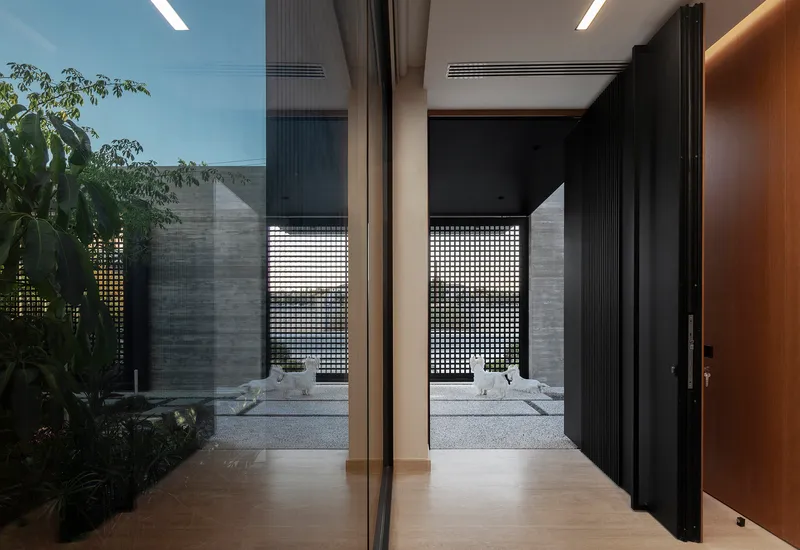
Once past the entry thresholds, the internal planted courtyard becomes the spatial anchor of the house. Visible through glass walls from the entry hall and through sliding doors from the living spaces, this void brings light and greenery into the plan without any exposure to the exterior. The timber wall paneling of the hall frames views into the courtyard as if it were a controlled landscape painting, and the perforated screen wall at the far side maintains the layered filtering that defines the project.
The courtyard is not ornamental. It is the mechanism that makes the introversion work. Without it, the closed street facade would produce dark, airless rooms. With it, the house breathes inward, pulling daylight through the section and allowing cross-ventilation without relying on street-facing openings. It is a functional reinterpretation of a regional tradition, not a nostalgic quotation.
Living Spaces That Open Rearward
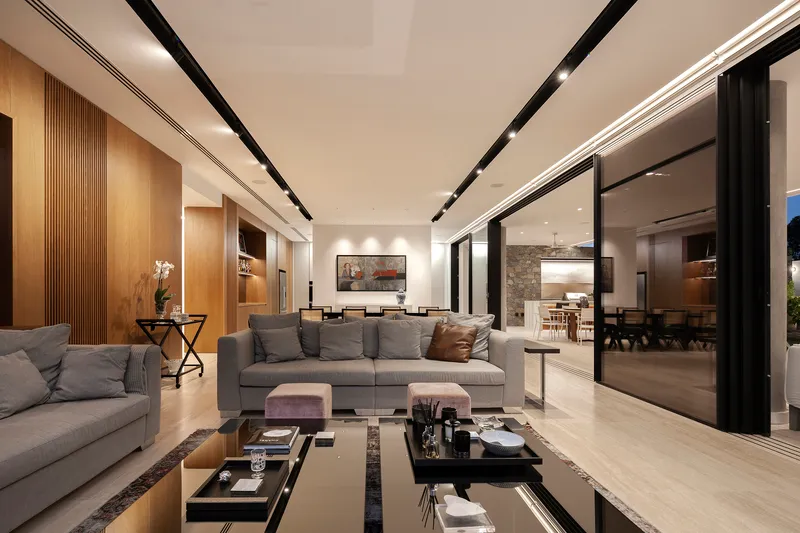
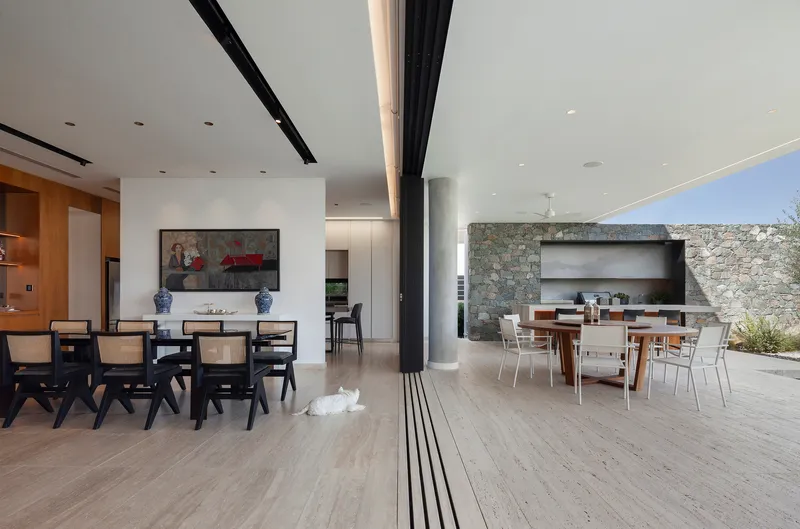
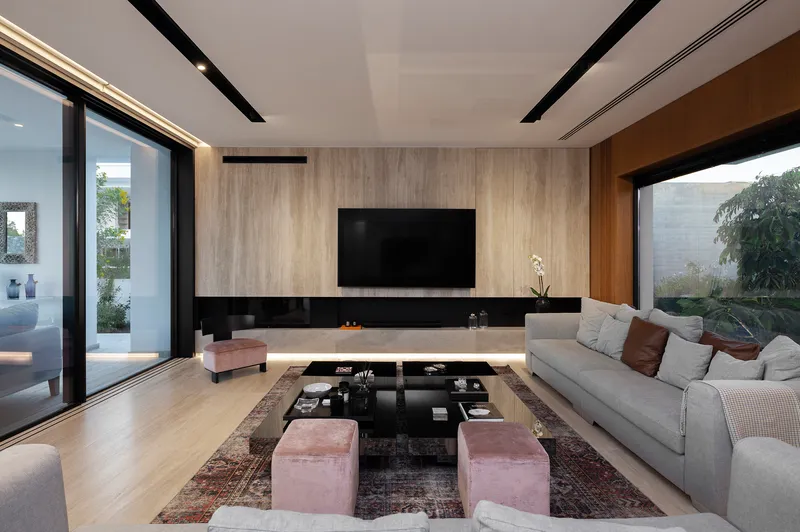
The ground floor living area is organized as a single open-plan volume that unifies the living room and dining room, with the kitchen separated by a natural boundary rather than a full partition. Floor-to-ceiling sliding glass doors on the rear elevation collapse the distinction between inside and outside, opening the entire social zone to the back courtyard, pool terrace, and garden. Recessed ceiling lighting tracks run continuously, reinforcing the linearity of the space.
At dusk, the corner glazing in the living room frames the garden as an extension of the interior, with the floating media console and wood-clad wall grounding the composition in warm materiality. The travertino flooring runs continuously from inside to the covered terrace, eliminating any threshold between the two conditions. Where the front of the house is about barriers and filtration, the rear is about erasure.
Material and Detail
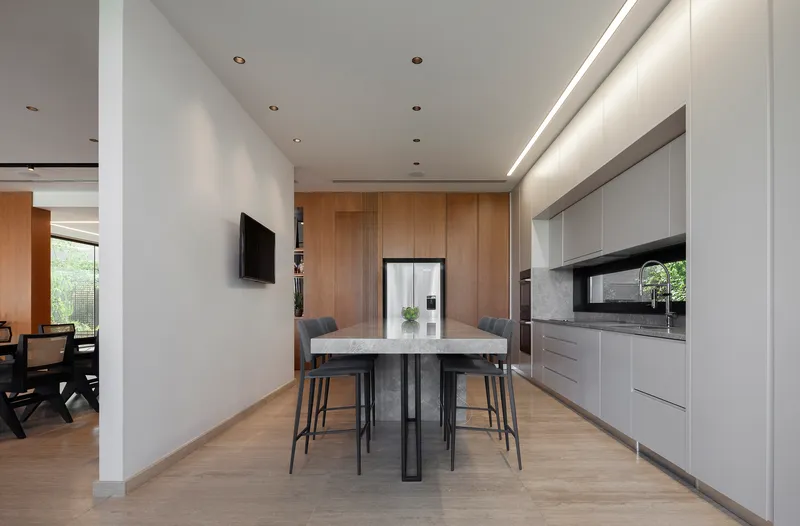
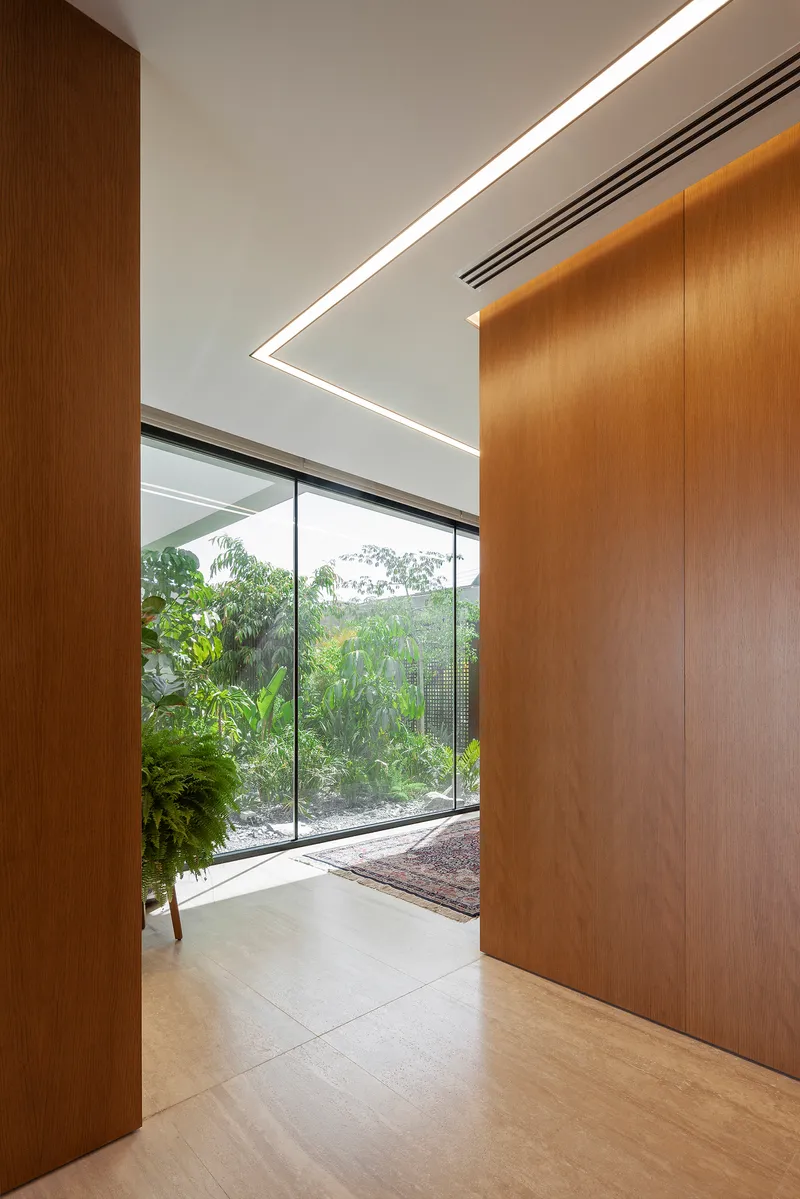
The interior palette is restrained: timber cabinetry, marble countertops, recessed cove ceilings in the kitchen, and black marble vanities in the bathrooms. Nothing competes for attention. The wood-paneled corridor with its angled ceiling light fixture and glazed opening onto the garden courtyard demonstrates how even circulation spaces are treated as opportunities for controlled views and material expression.
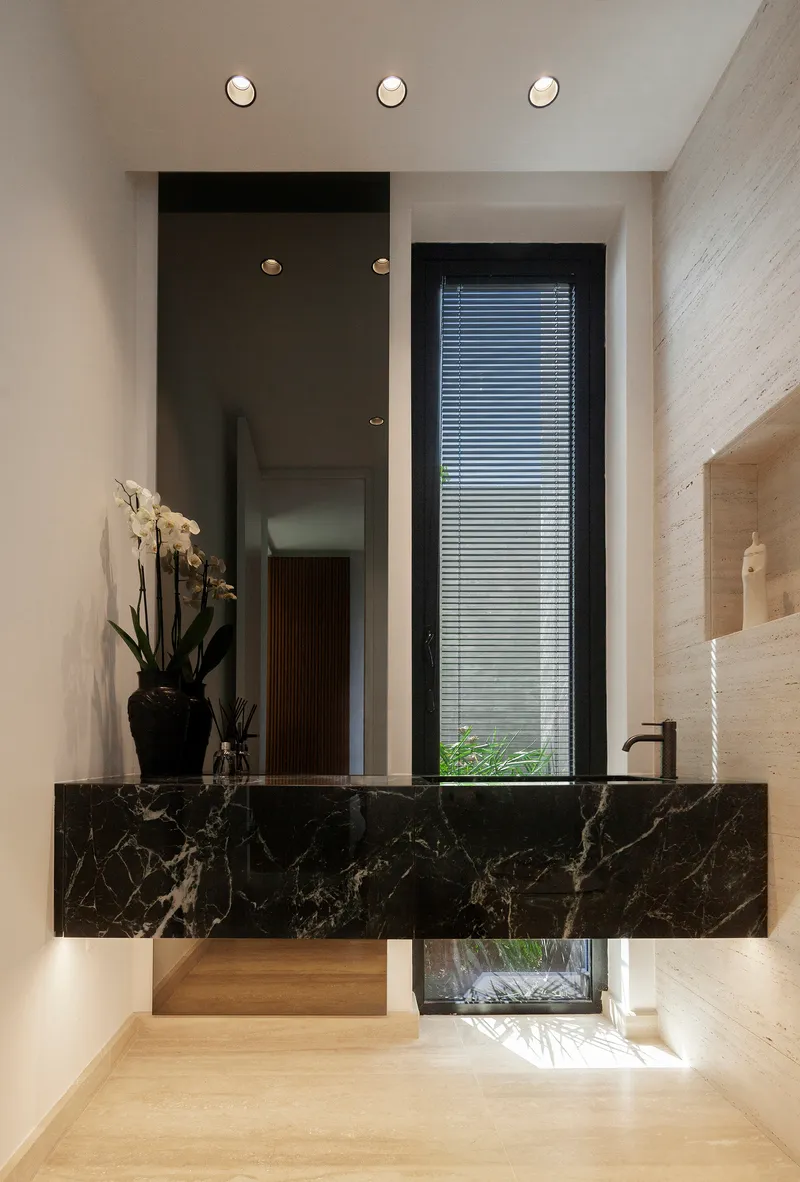
The black marble floating vanity and narrow vertical window in the bathroom are characteristic of the project's approach to detail. Every element serves the broader strategy of introversion: the window is too narrow to compromise privacy, but sufficient to bring a sliver of light into an otherwise enclosed room. The frameless mirror amplifies the effect. Nothing is decorative; everything is working.
The Garden Facade and Pool Terrace
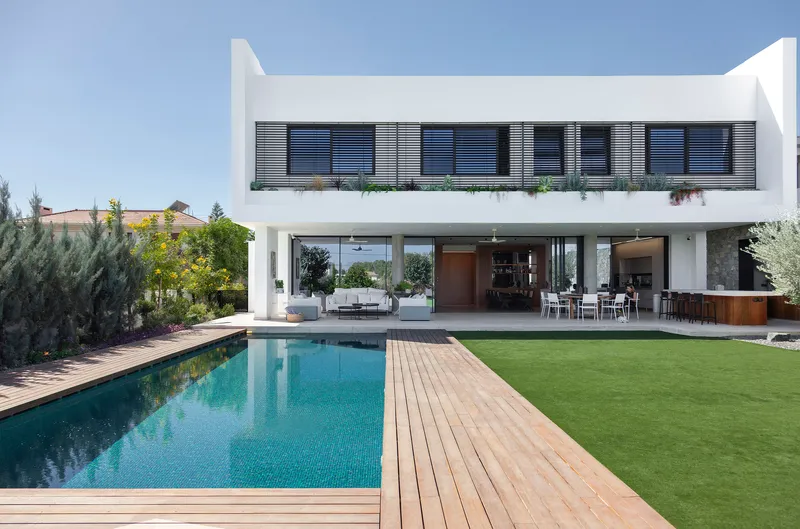
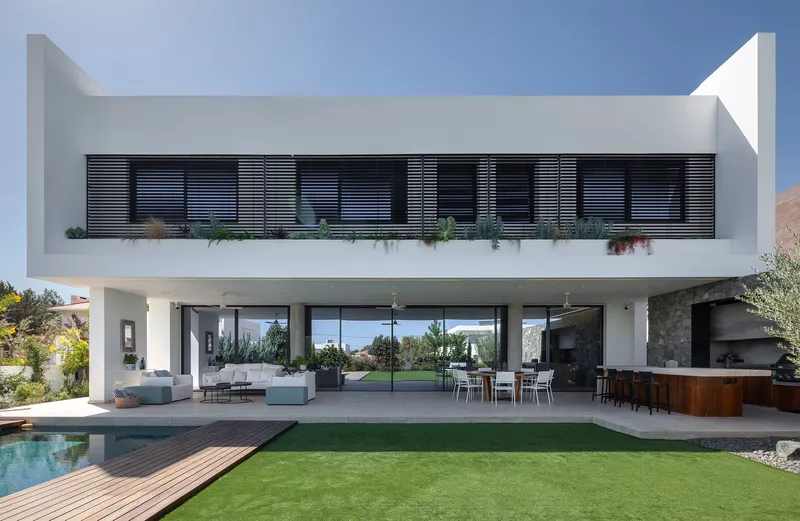
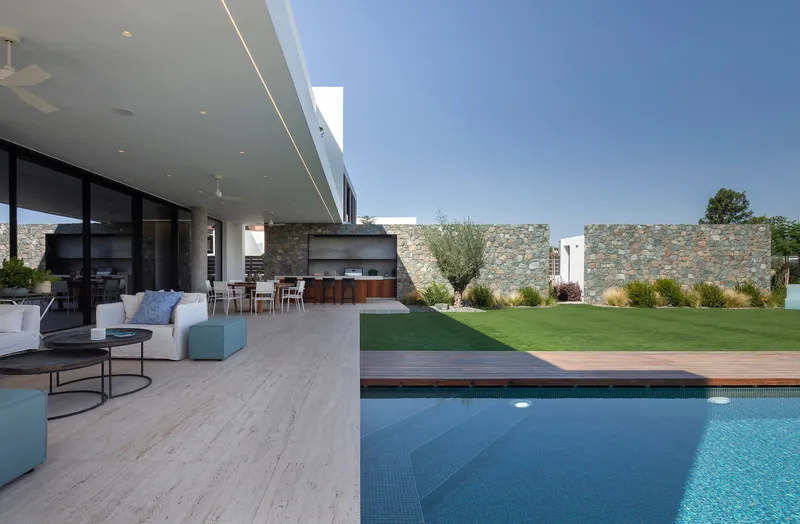
The rear elevation is the antithesis of the street facade. Horizontal louvers on the upper balcony provide solar control while maintaining openness, and the ground floor terrace extends seamlessly to the pool and lawn. The stone boundary wall at the garden's edge establishes a final perimeter, but the visual field within is generous and planted. A rubble masonry backdrop behind the outdoor bar counter introduces a rougher texture that contrasts with the polished travertine of the terrace.
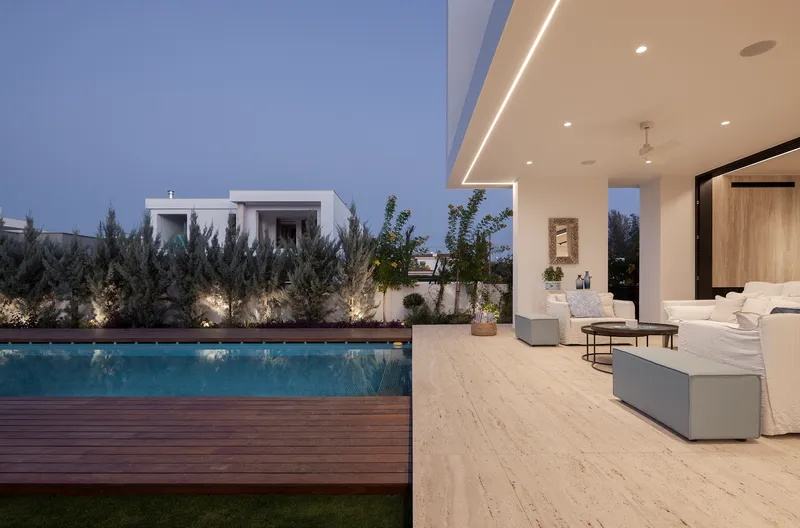
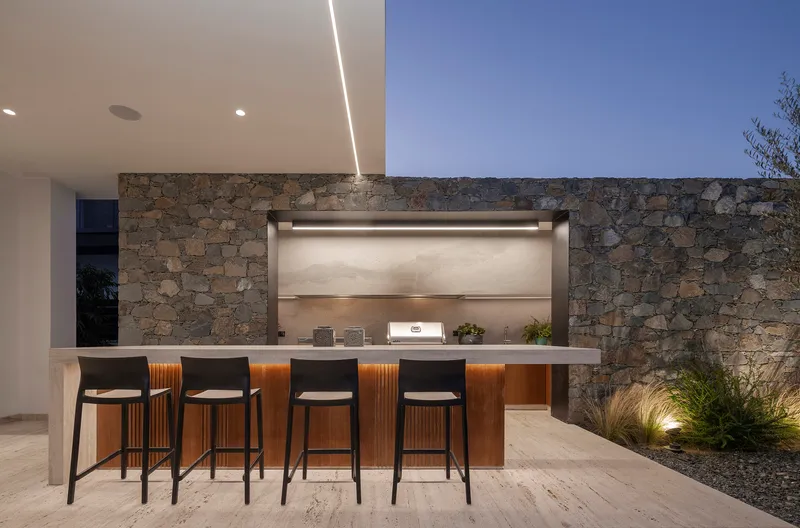
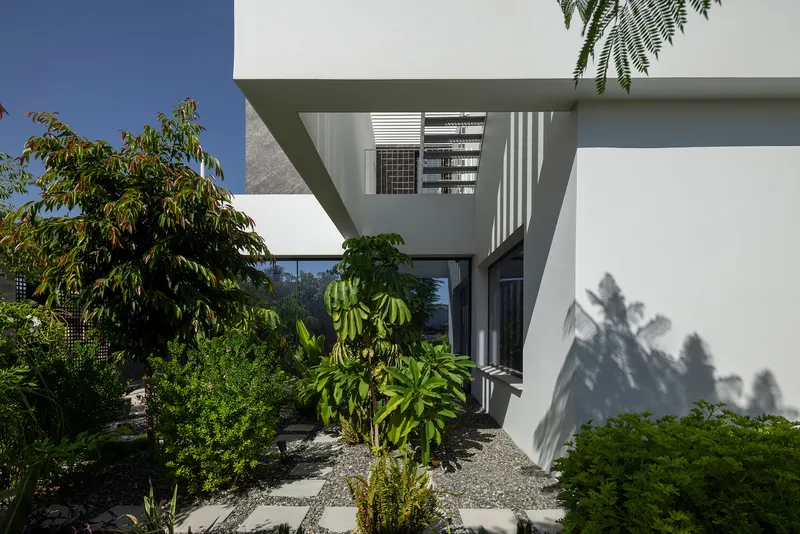
The cantilevered upper volume hovering over the landscaped courtyard with planted trees and gravel is one of the project's strongest formal moves. It creates a deep shadow zone at ground level and signals the transition from the compressed entry side to the expansive garden side. The covered terrace at dusk, with the timber pool deck glowing under artificial light and the planted garden forming a soft boundary, reveals just how much outdoor living the plan accommodates behind its fortress wall.
Upper Level and Light
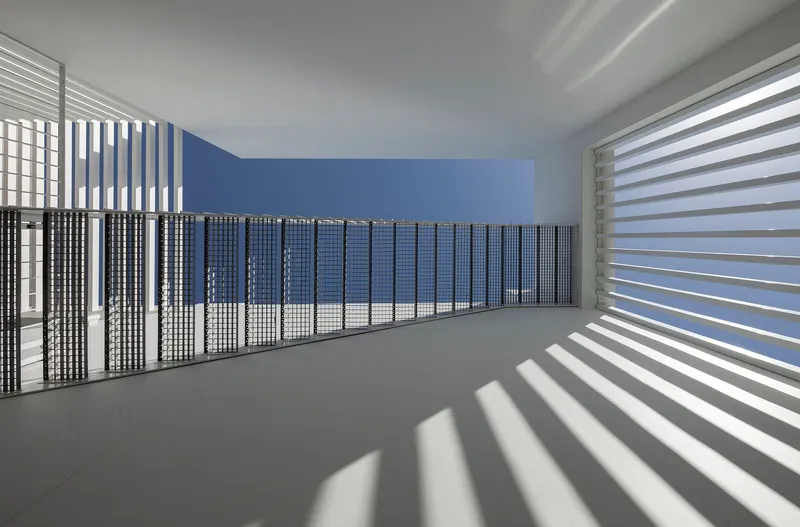
The upper level corridor captures the house's play with filtered light at its most photogenic. Horizontal louvers cast striped shadows across white floors and a blue accent wall, turning a simple hallway into a kinetic surface that shifts throughout the day. The louvers that read as privacy devices from the exterior become instruments of light modulation from within, performing a double duty that is central to the project's logic.
Plans and Drawings
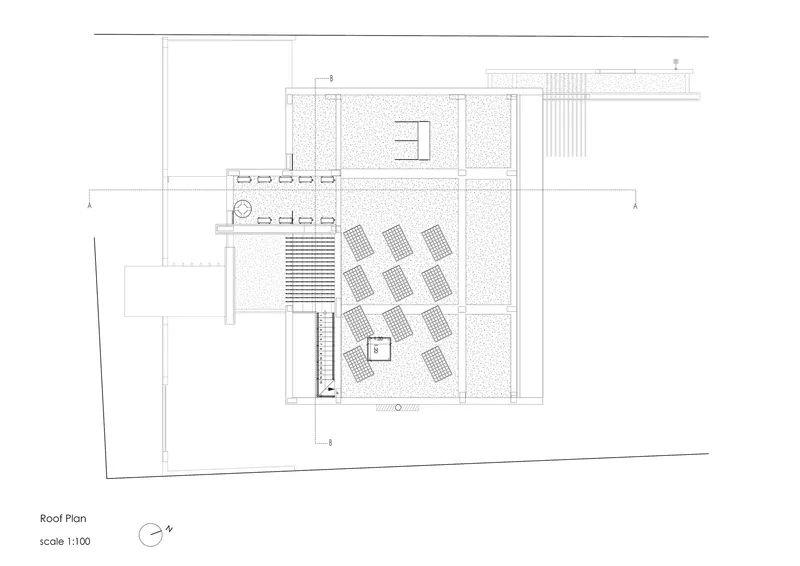
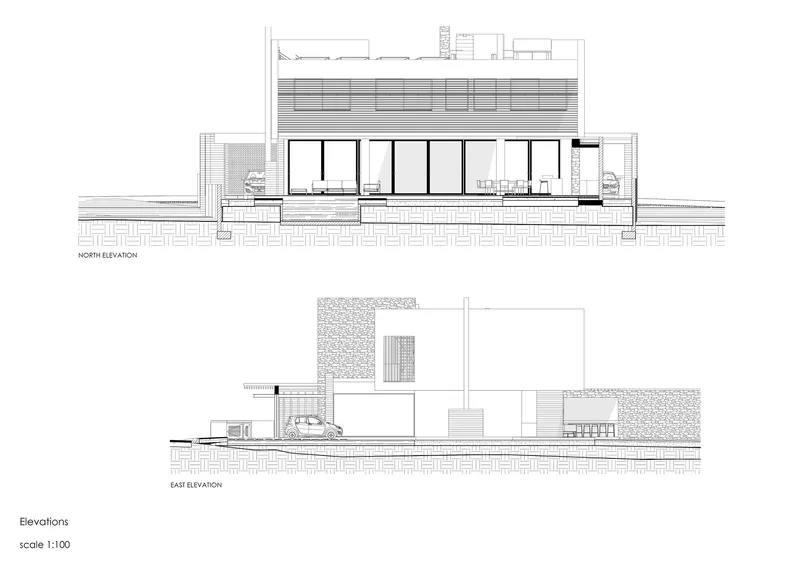
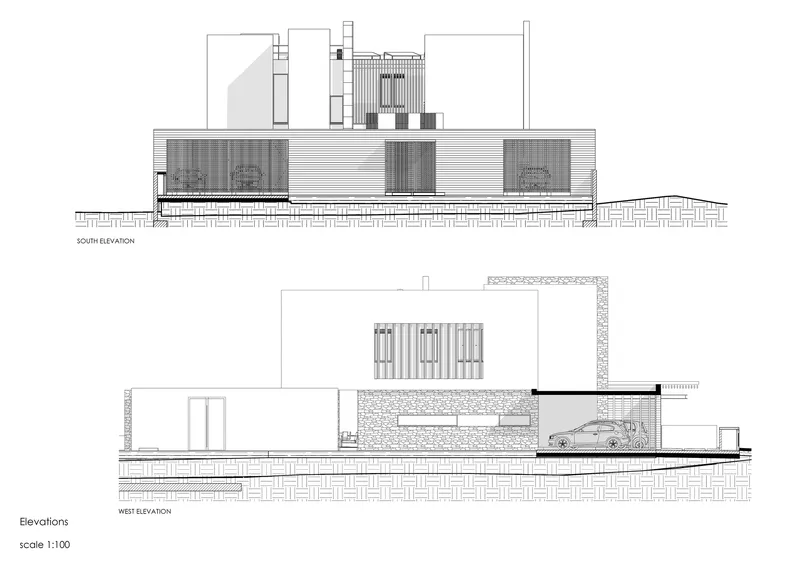
The roof plan reveals a generous rooftop terrace with loungers and perimeter screening, adding a third outdoor living zone to the courtyard and pool terrace below. The north and east elevations show the horizontal louver systems in full, clarifying how the upper floor manages views and solar gain simultaneously. The south and west elevations illustrate the perforated screens and the recessed garage bay, confirming that the street facade is essentially a single material surface with minimal penetration.
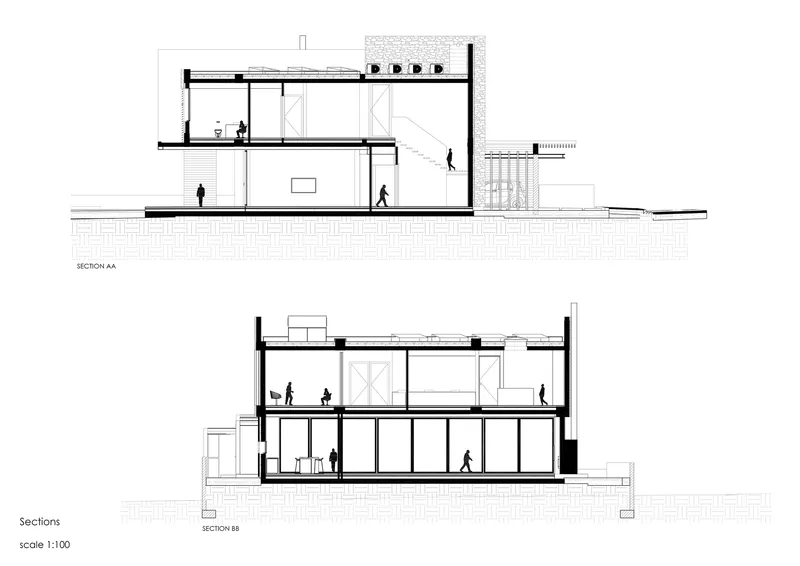
The section drawings are the most revealing documents in the set. They expose the two-story interior volumes, the central courtyard void that pulls light into the plan, and the relationship between the compressed street edge and the open garden elevation. Figures placed throughout indicate scale and use, showing how the imaginary zones translate into actual lived experience. The courtyard void is clearly the project's spatial engine, mediating between the introverted front and the extroverted rear.
Why This Project Matters
House 345 matters because it demonstrates that privacy is not a problem to solve but a spatial condition to design. In an era when residential architecture often defaults to transparency as a sign of sophistication, this project argues the opposite: that opacity, filtration, and layered thresholds can produce richer spatial experiences than a glass box ever will. The gradient from closed to open, from the impenetrable street wall to the dissolved garden facade, gives the house a narrative quality that unfolds as you move through it.
It also represents a model for how regional building traditions can inform contemporary work without resorting to pastiche. The introverted courtyard house is not a Cypriot invention, but it is deeply embedded in Cypriot domestic culture, and Constanti Architects have extracted its spatial logic rather than its visual language. The result is a house that could only make full sense in its climate and culture but speaks a material language that is thoroughly contemporary. That balance is harder to achieve than it looks, and it is what elevates House 345 above the generic privacy-obsessed villa.
House 345 by Constanti Architects (lead architect: Constantinos Constanti). Nicosia, Cyprus. 369 m². Completed 2022. Photography by CreativePhotoRoom – Maria Efthymiou.
About the Studio
Share Your Own Work on uni.xyz
If projects like this are the kind of work you want to make, uni.xyz is a place to publish your own, find collaborators, and enter design competitions.


Popular Articles
Popular articles from the community


The Ocean Hive: Sustainable Architecture for a Self-Sufficient Civilization at Sea
The Ocean Hive imagines sustainable architecture at sea, where modular habitats, algae, wave power and ocean waste sustain a growing colony.

Hill & Cross Opera: Sculptural Opera House Architecture Shaped by Tallinn’s Landscape and Identity
Hill & Cross Opera reimagines opera house architecture in Tallinn through its sculptural hill, civic plaza, glass wave and a luminous cross.

ALGAL REALM: A Bio-Integrated Lunar Habitat Design for Life Beyond Earth
ALGAL REALM reimagines lunar habitat design with algae-powered life support, 3D-printed regolith, and vertical living for a lunar future.

Lunar Spiral: Space Architecture Shaped by the Mathematics of the Universe
Lunar Spiral reimagines space architecture through Fibonacci geometry, lunar regolith, levitating habitats, and self-sustaining Moon living.

Similar Reads
You might also enjoy these articles

Bao Huynh Watercolor Atelier: A Serene Art Retreat in Hội An
Bao Huynh Watercolor Atelier in Hội An blends multifunctional art spaces, sustainable design, local materials, and family-friendly living in a serene environment.

Atelier Macri Concept Store Interior Design by CASE-REAL
Atelier Macri store features a "ko" counter, walnut wood details, cork displays, blending retail, gallery, and seamless customer experiences.

Manuel Vargas Izquierdo Stadium and High-Performance Sports Center: Architectural Excellence in Jalpa de Méndez
The Manuel Vargas Izquierdo Stadium blends sustainable design, inclusive sports facilities, and cultural-inspired architecture, revitalizing Jalpa de Méndez’s public spaces.

KAKR Buluh Awar Hall: Revitalizing Community and Ecology Through Bamboo Architecture
Community built bamboo hall revitalizes Buluh Awar village, empowering youth, restoring ecology, celebrating vernacular craftsmanship through sustainable architecture and culture.


Comments (0)
Please login or sign up to add comments
No comments yet. Be the first to comment!