
Johnston Architects Reimagines the Methow Valley Hay Barn as a Small-Town Library in Winthrop
A 7,300-square-foot timber library channels the region's agrarian vernacular to serve a rural Washington community of 400 year-round residents.


The town of Winthrop, Washington, has a population of 400. It sits in the Methow Valley, a landscape of open meadows, river corridors, and mountain peaks that swells to 30,000 people during ski and summer seasons. For decades, the community relied on two libraries each smaller than 2,000 square feet. The new Winthrop Library, completed in 2022 by Johnston Architects, consolidates those efforts into a single 7,300-square-foot building that looks less like a civic institution and more like the hay barns that have defined this valley for over a century.
What makes the project genuinely interesting is the constraint it worked under. Winthrop enforces a Westernization Architectural Code that requires new buildings to reference structures from 150 years ago. Rather than producing the kind of theme-park pastiche that mandate often invites, Johnston Architects looked past the saloons and boardwalks to the region's dignified utilitarian farm buildings: open-air barns with wide sheltering roofs, porous walls designed to let air circulate and prevent rot, and visible structural logic. The library is that typology, translated with precision into a modern public building that can also serve as a clean-air refuge during wildfire season.
A Barn on the Meadow


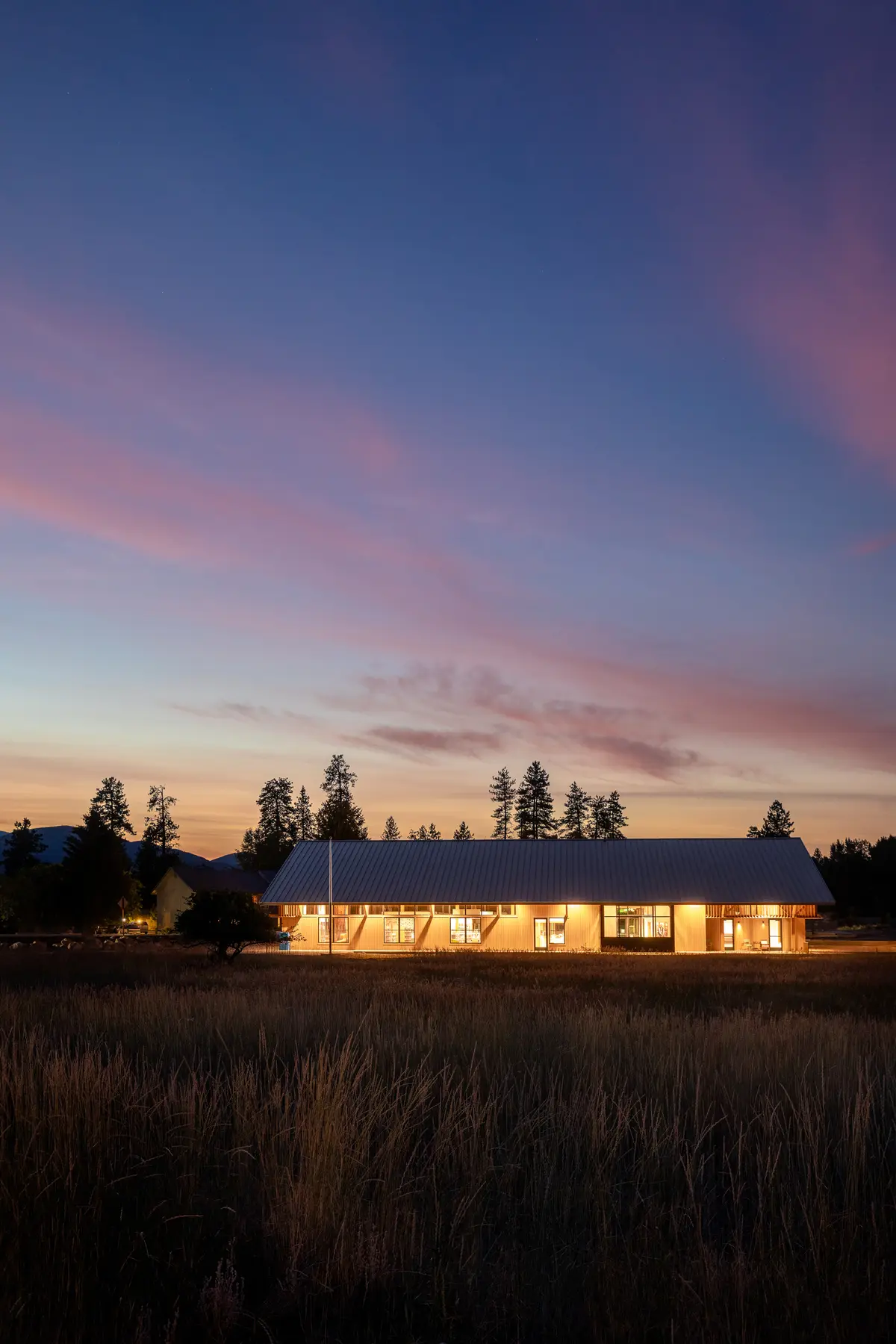
Approached across an open meadow at dusk, the library reads as a lantern: a simple gabled volume wrapped in larch cladding, its glazed walls glowing against the pink and blue sky of the Methow Valley. The form is deliberately unassuming. No cantilevered gesture, no parametric flourish. The building's rectangular footprint is organized along two axes, with the long axis pointing toward Gardner Mountain and the entrance facing the Methow River. It is oriented to the landscape rather than to the road, which is a quiet but meaningful decision for a building meant to connect a community to its place.
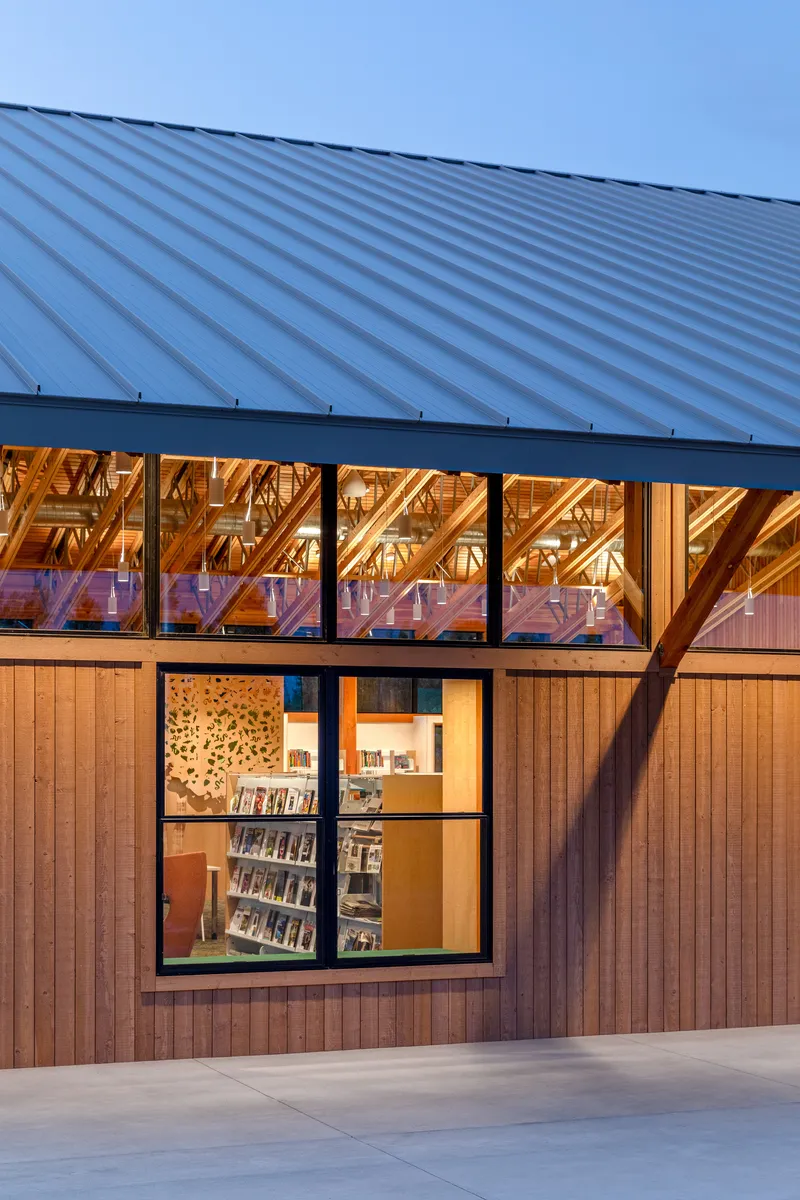
The vertical wood cladding and standing seam metal roof recall the agricultural buildings scattered across the valley. But the proportions are slightly more generous, the overhangs broader, the glazing more extensive. The corner view reveals diagonal timber bracing through the glass, making the structure legible from outside. It is a barn that invites you to look in.
Exposed Structure as Spatial Identity
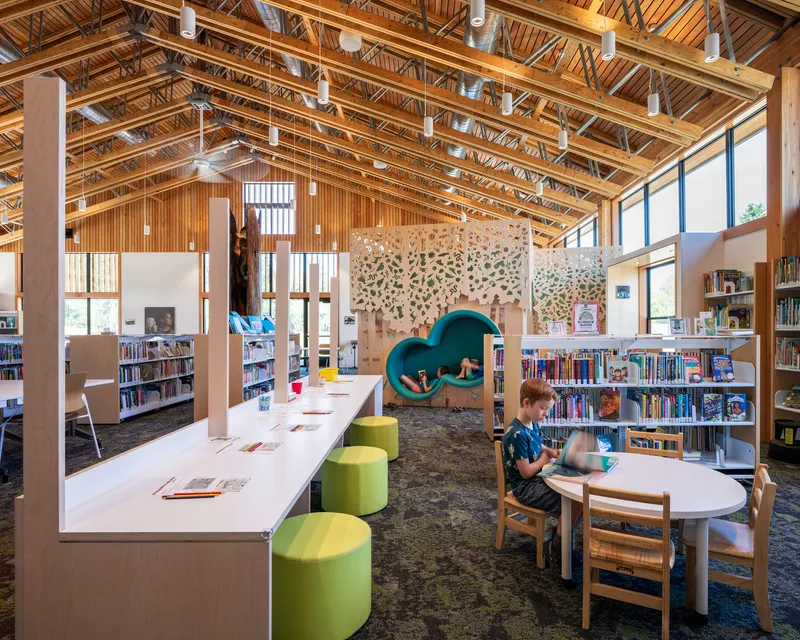
Inside, the building is essentially one large open room with high ceilings, and the structure does all the spatial work. Glulam columns rise to support prefabricated open-web wood and steel trusses that are fully exposed, giving the interior the airy, legible framework of a traditional hay barn. The trusses were prefabricated to reduce costs and shorten the construction schedule, a pragmatic decision that also produces a clean, rhythmic ceiling plane.
Clerestory windows run along the ridge, pulling daylight deep into the space and reinforcing the barn analogy. Historically, those barns were designed to be light-filled and porous to stave off rot. Here, the porosity is reinterpreted through carefully calibrated window openings, slatted wooden scrim, and overhangs that the architects developed through daylighting and energy studies to control heat gain and glare during the valley's arid summers.
Gathering Around the Hearth and the Tree


Two anchoring elements give the open plan its emotional center. A large preserved tree trunk stands in the entry hall, framed by the gabled timber ceiling and flanked by glass doors. It functions as a sculptural landmark, a wayfinding device, and a reminder that the building sits within a forested landscape. A child reads at its base in one image, which tells you everything about how the object is received.
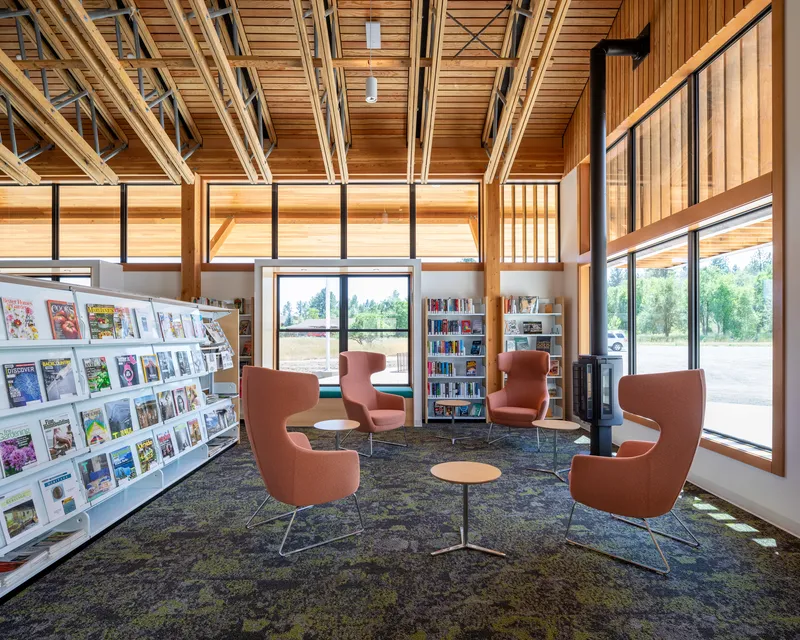
At the far end of the space, a fireplace with large windows frames the valley landscape beyond. Between these two poles, the reading areas unfold: terracotta upholstered chairs around low tables, study desks, and lounge seating arranged beneath the maple-toned ceiling. The interior palette draws from the Methow Valley itself, with tones of green, blue, and rust that echo the shifting seasonal landscape. It is warm without being precious.
Window Seats and the Perimeter


Twelve window seats line the perimeter between book stacks, tucked into the glazed wall. They are perhaps the most considered detail in the building. In a library designed for a rural community that swells with seasonal visitors, these seats offer something that a study table cannot: a private, body-scaled moment within a communal room. Children sprawl across them with books. The connection between reading and landscape becomes literal.
The sliding barn doors at the entrance, with their circular wood grain panels, reinforce the agrarian vocabulary while providing a generous, accessible threshold. When open, they dissolve the boundary between inside and out, extending the library's civic presence onto the site.
The Meeting Room and Maker Spaces


A separate 1,000-square-foot public meeting room operates as an acoustically distinct volume within the building. Vertical wood slats line the ceiling, and clerestory windows above white walls keep the room daylit without visual distraction. It is a clean, flexible box that can host community meetings, classes, or events independent of library hours.
Elsewhere, an open doorway between the children's area and a makerspace shows the building's commitment to programming beyond books. The exposed timber roof framing overhead remains continuous, stitching these varied zones into a single spatial experience. Wood baffles lining walls and ceilings throughout the building do double duty as acoustic absorption, diffusing ambient noise so that these different activities can coexist within the open plan.
Climate Performance as Community Resilience
The library was designed to LEED Silver standards, but the more compelling performance story is about resilience. The building shell is insulated and sealed beyond code requirements. An advanced split HVAC system with energy recovery ventilator and MERV filters allows the library to function as a clean-air community refuge during wildfire season, an increasingly critical need in the rural West. Low-flow plumbing, LED lighting with smart controls, and extensive daylighting round out the energy strategy. A rooftop solar array and demonstration gardens are planned for the site.
The Kebony sunshades on the exterior are worth noting. Made from sustainably manufactured modified wood, they modulate solar gain while aging gracefully in the valley's harsh climate. The material choice reflects a broader commitment throughout the project to recycled and low-VOC materials, executed with a construction team assembled by a local family firm from past employees. The building was built by the community it serves.
Plans and Drawings

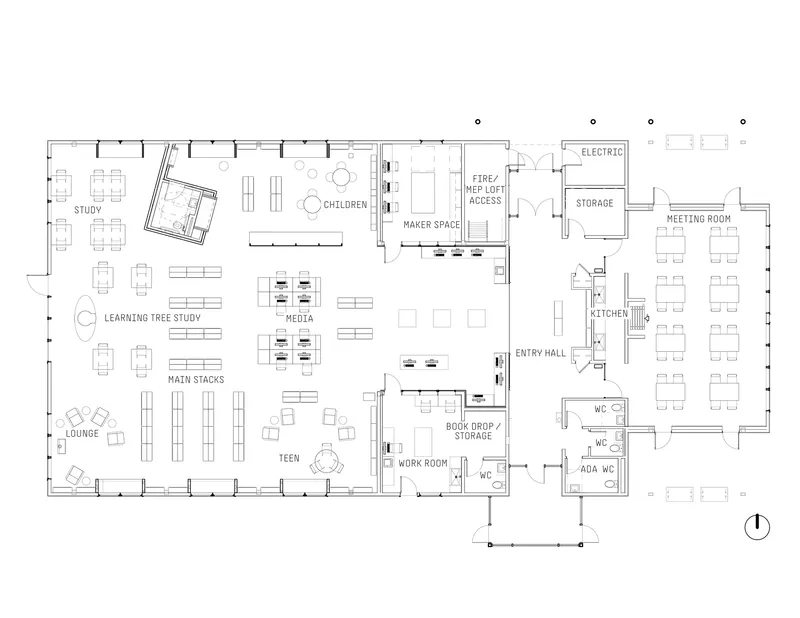
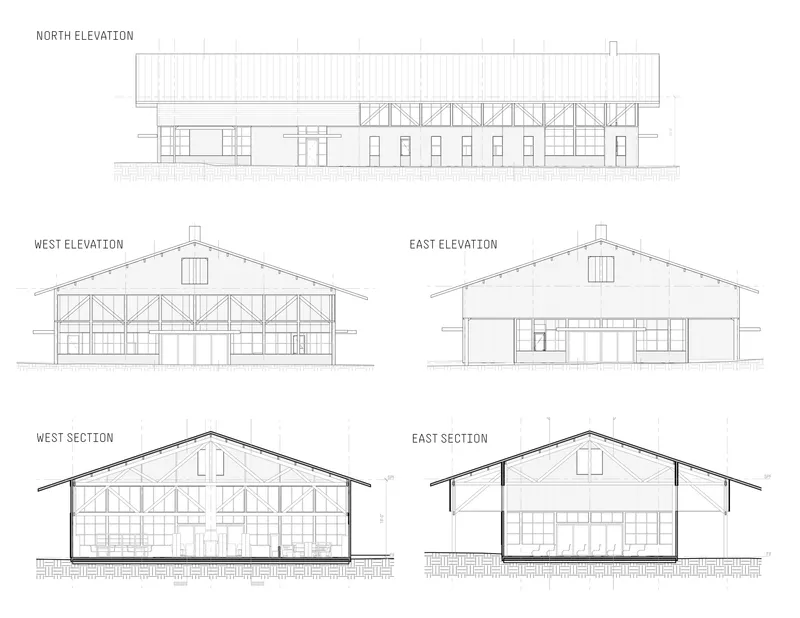
The site plan reveals the library's position on its 1.8-acre parcel, with an amphitheater-shaped landscape element, generous green lawn, and parking organized to keep vehicles at the periphery. The floor plan confirms the open single-room strategy: study areas, maker space, kitchen, and meeting rooms are arranged as zones within a continuous volume rather than as cellular rooms. The elevation and section drawings make the structural logic explicit. The gabled roof, clerestory band, and exposed trusses are the entire architectural idea, drawn with economy and executed with care.
Why This Project Matters
Rural communities rarely get architecture that takes them seriously. Small-town libraries are often either prefab boxes dropped on a slab or nostalgic exercises in false fronts. The Winthrop Library refuses both options. It takes a local vernacular, the hay barn, and treats it as a structural and spatial proposition worth investigating rather than a surface to cosplay. The result is a building that satisfies a restrictive design code while producing something genuinely contemporary, a neat trick that required looking harder at the code's source material than the code's authors probably intended.
More importantly, the building understands what a library means in a town of 400. It is not just a repository for 20,000 materials. It is a clean-air shelter, a meeting hall, a maker space, a place to sit by a fire and look at a mountain. Johnston Architects has built a piece of civic infrastructure that earns its presence in the landscape by being as honest and purposeful as the barns it descends from.
Winthrop Library by Johnston Architects. Winthrop, Washington, United States. 7,300 square feet. Completed 2022. Photography by Benjamin Drummond.
About the Studio
Share Your Own Work on uni.xyz
If projects like this are the kind of work you want to make, uni.xyz is a place to publish your own, find collaborators, and enter design competitions.


Popular Articles
Popular articles from the community


graciastudio Turns a Viewless Tijuana Lot Inward Around a Courtyard of Concrete, Timber and Trees
In Tijuana, Jorge Gracia's GA2 House stacks a timber-clad private floor over exposed concrete and replaces a missing view with a planted interior patio.


Aquadapt: An Underwater Habitat That Rewrites Its Rooms by the Hour
Curved modules ring the seabed while one shell shifts from breakfast room to cinema, farm and football pitch as residents' needs change.

FCC Arquitectura Expands a Portuguese Granite House with a Board-Marked Concrete Wing
In Portugal, JV House pairs a cleaned-up whitewashed and granite dwelling with a timber-shuttered concrete extension, courtyards and a garden pool.

Singing Woman: An Opera House That Performs Before the Curtain Rises
Ovidiu Cristian Pavel's conceptual opera house translates Estonia's choral identity into a sculpted waterfront landmark facing the Baltic Sea.

Similar Reads
You might also enjoy these articles

LAVA Architecten Gives Vocational Education a Sawtooth-Roofed Face on a Mechelen School Campus
In Mechelen, Belgium, a 2,053 m² STEM school on a 6×6 m grid turns workshops and classrooms into rooms that can be rearranged as teaching changes.

KEMA Studio Turns a Derelict Marvila Attic into a 60 m² Lighthouse Apartment Above Lisbon
In Lisbon's Marvila district, a rebuilt roof, four skylights and two plywood volumes turn an unlivable attic into a bright home facing the Tagus.

Pixel Gardens: One Repeated Module Stacked Into a Terraced Social Housing Tower for Famagusta
Salem Bader's shortlisted housing tower builds a vertical neighbourhood from one repeated module, offsetting units to carve terraces, light and air.

Bao Huynh Watercolor Atelier: A Serene Art Retreat in Hội An
Bao Huynh Watercolor Atelier in Hội An blends multifunctional art spaces, sustainable design, local materials, and family-friendly living in a serene environment.


Comments (0)
Please login or sign up to add comments
No comments yet. Be the first to comment!