

LAVA Architecten Gives Vocational Education a Sawtooth-Roofed Face on a Mechelen School Campus
In Mechelen, Belgium, a 2,053 m² STEM school on a 6×6 m grid turns workshops and classrooms into rooms that can be rearranged as teaching changes.


Vocational schools rarely get the architecture they deserve. Workshops end up in back sheds, technical courses sit behind the academic wing, and the message to students is clear enough. For the STEM School Mechelen, LAVA Architecten reversed that hierarchy. Commissioned by the Province of Antwerp to rethink an entire campus on the Antwerpsesteenweg, the Belgian studio wrote the master plan and then designed its first new piece: a 2,053 m² building for technical and vocational STEM courses, completed in 2020.
What interests us is not the flexibility rhetoric, which every school brief now carries, but how literally LAVA built it in. A strict 6×6 m structural grid governs everything, classrooms can face either way and merge in pairs, and the ground floor opens into a column-free studio. Wrap that in a sawtooth roofline, set it next to a listed 1934 school by J. Lauwers, and you get a building that works hard as infrastructure while also giving technical education something it rarely has: a public face.
A New Neighbour for a Listed School
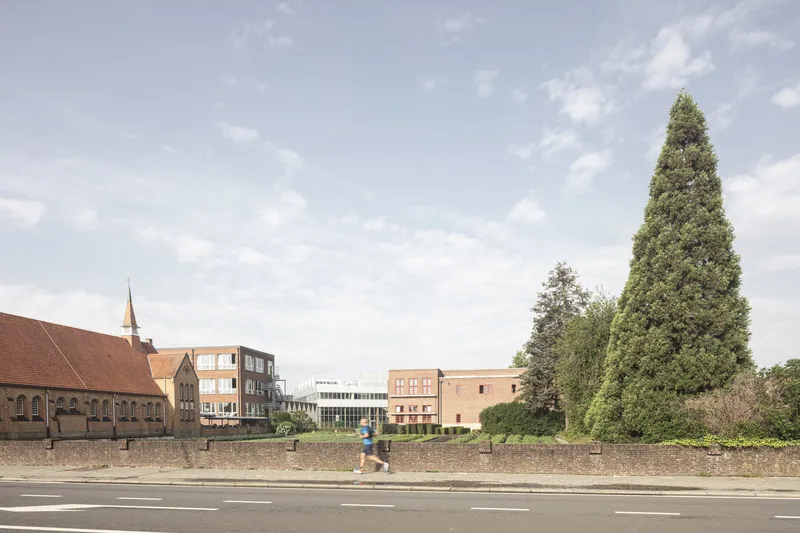
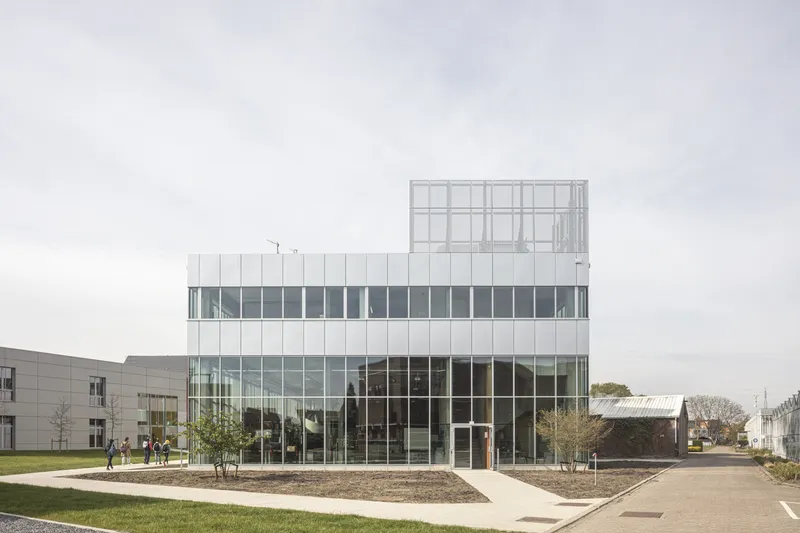
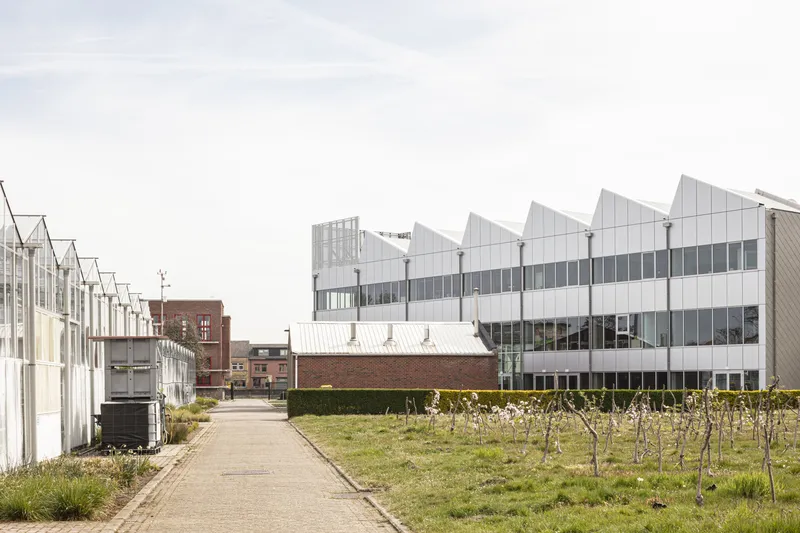
The campus already had a strong anchor in the recently restored brick school of 1934. LAVA did not try to mimic it. The new block reads as a pale, panelled object of glass and aluminium-zinc cladding, deliberately distinct from the masonry around it. The contrast works because the scale stays modest: three storeys at most, with a rooftop mesh enclosure rather than another floor of program.
The greenhouse, brick shed and young fruit trees around the building suggest a campus that teaches outdoors as much as in. The new volume sits among these pieces without dominating them, which matters for a master plan intended to grow in phases.
The Sawtooth as Signage
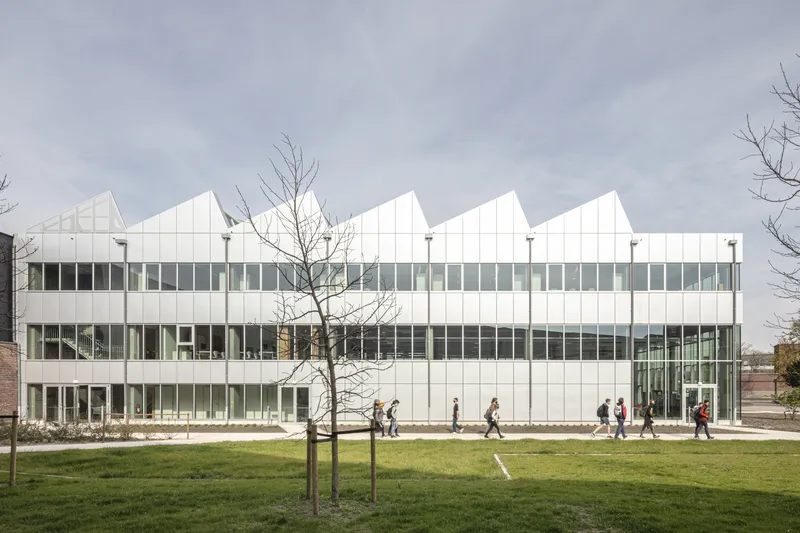
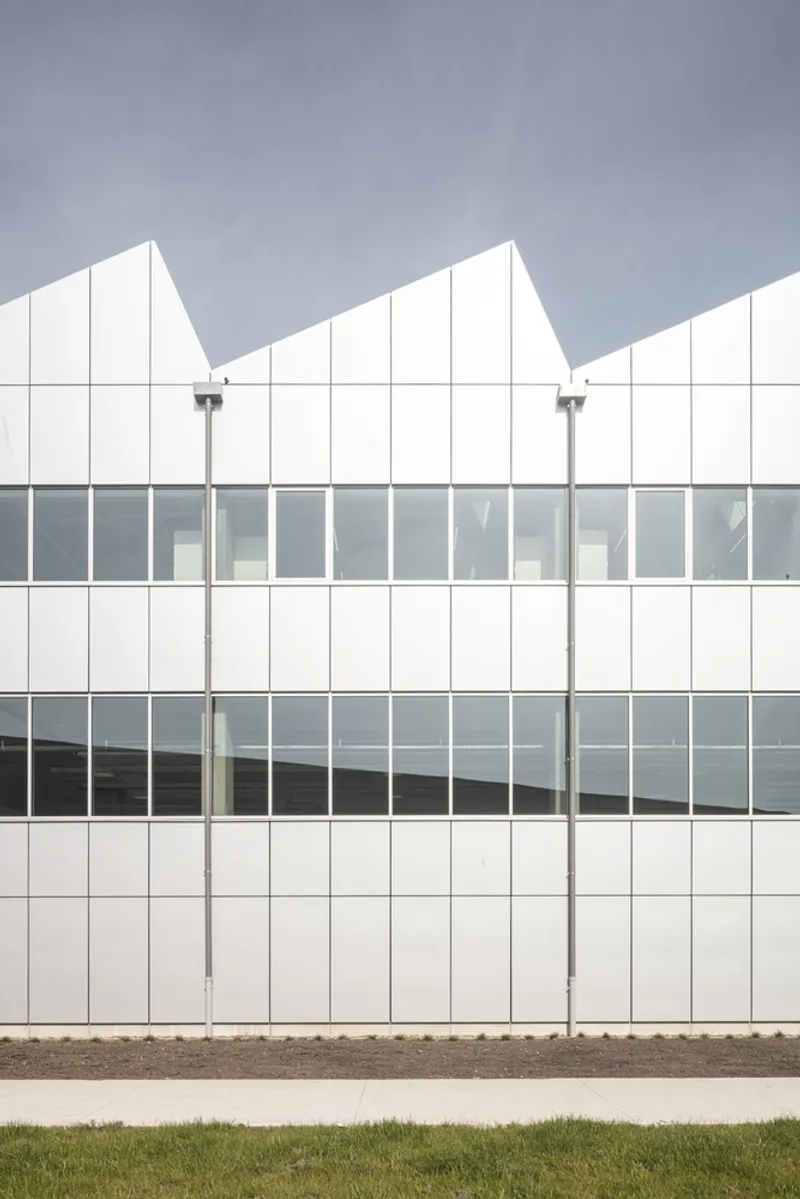
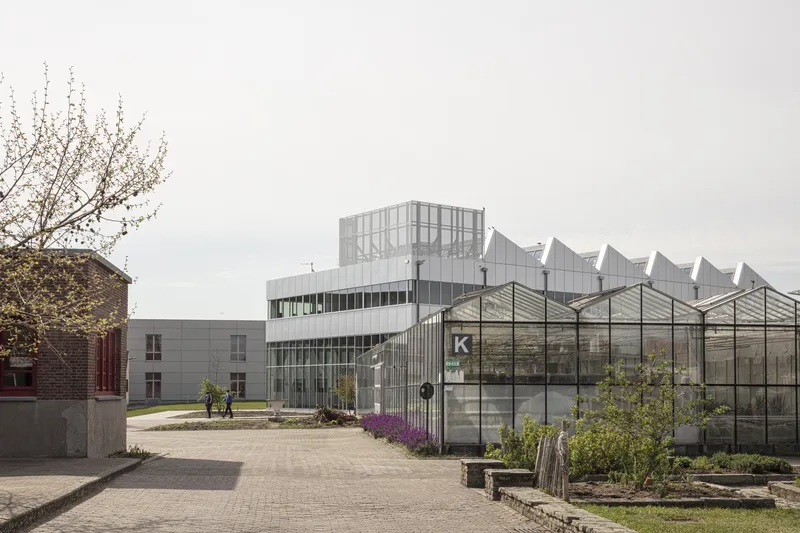
The five sawtooth gables are the project's most legible move, and a smart one. The profile borrows directly from the industrial workshop, the building type where many of these students will eventually work. From the Antwerpsesteenweg, the roofline reads as a landmark; up close, the ribbon windows and glazed bands give the long facade a steady rhythm without fuss.
We like that the gesture is earned. The sawtooth is not decoration applied to a box; it shapes the top-floor rooms beneath it and brings daylight deep into the plan. In flat grey Belgian light, the downpipes and the plain cladding keep the image honest and a little utilitarian, which suits the program.
Workshops Built to Be Seen
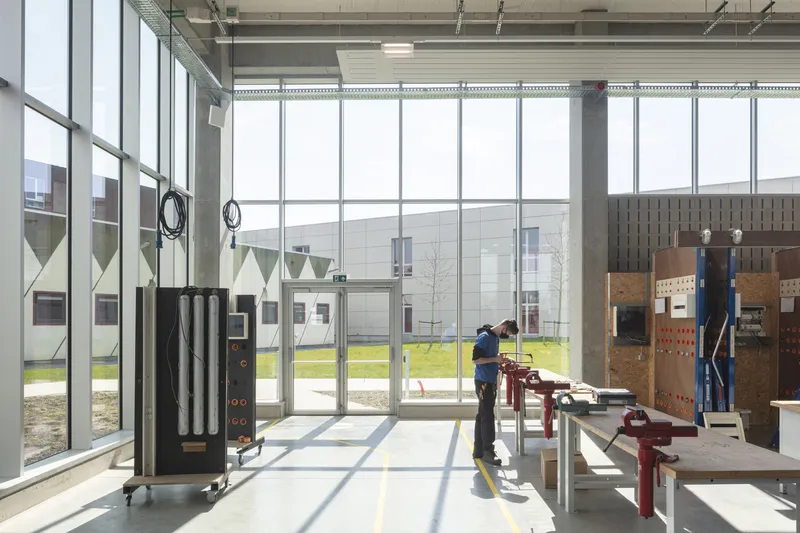
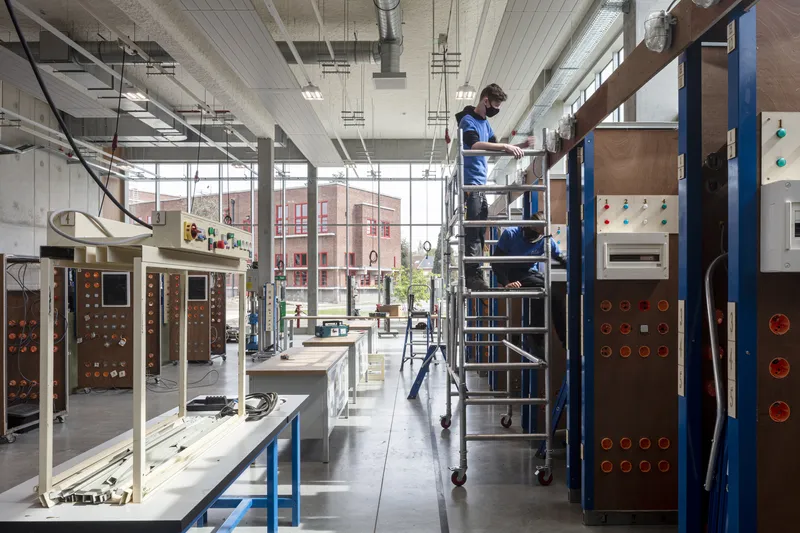
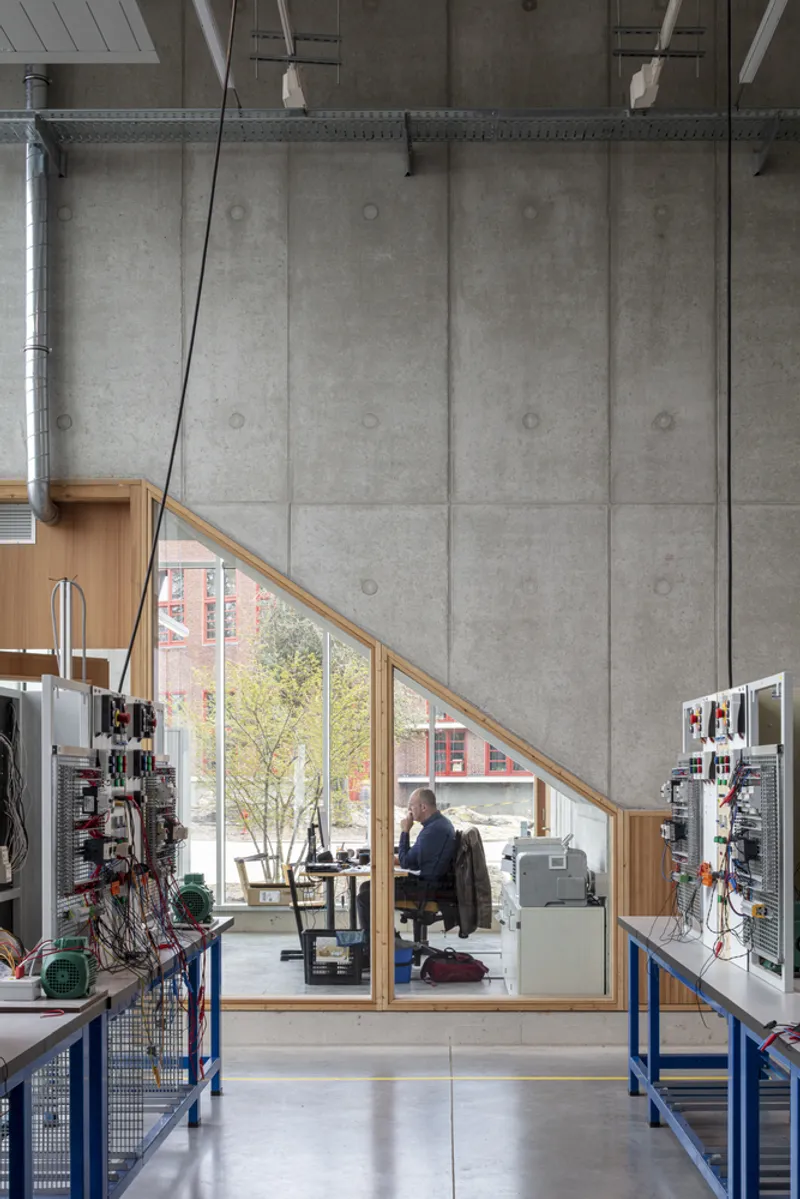
The workshops carry the brief's central acoustic problem. Bench vices, wiring boards and scaffold towers generate noise, so LAVA alternates loud rooms with quieter classrooms and practice spaces. The clever part is that soundproofing never becomes a reason to close rooms off. Glazed walls and framed openings keep sightlines running between spaces, so a teacher in one room can see activity in the next.
The stepped timber window set into a concrete wall is a good example: a small office overlooks the electrical training benches, and the opening becomes a piece of furniture as much as a window. Visibility here is pedagogical, letting students watch skills being practised around them.
A Grid That Lets Rooms Change Their Minds
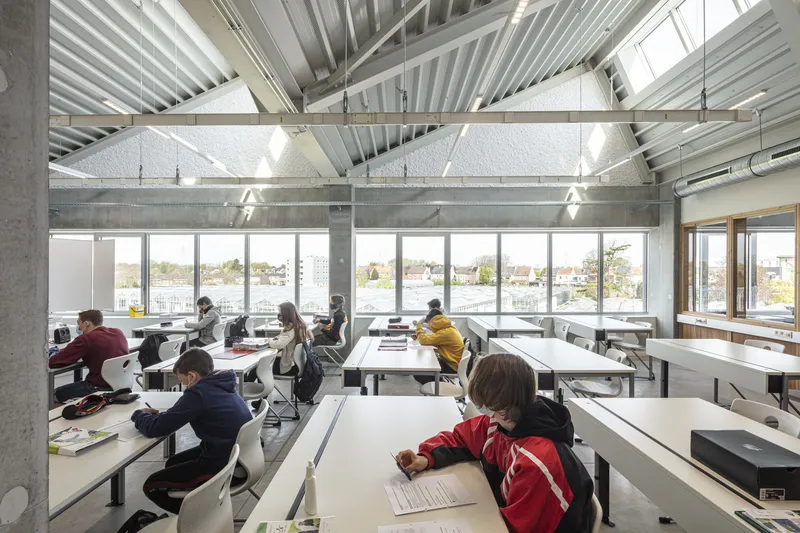
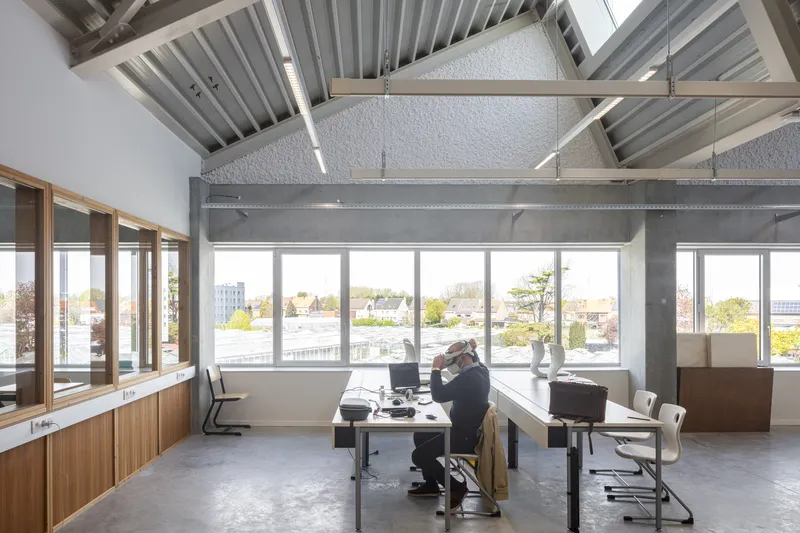
The 6×6 m module is what makes the flexibility real rather than aspirational. Because the bays are square, classrooms can be oriented in either direction, and two can be joined into one large room when a project needs it. Inside each space, zones for individual work, small groups and whole-class teaching sit together, so the room adapts to the lesson rather than the reverse.
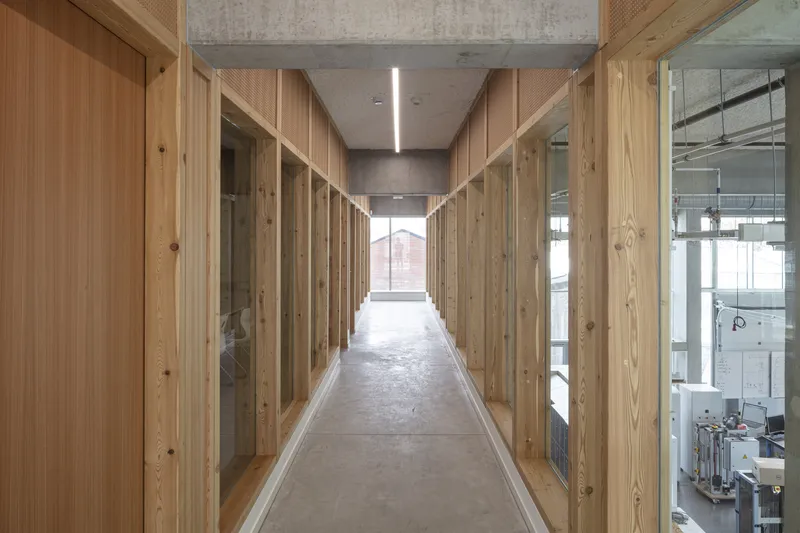
Upstairs, exposed steel trusses and sloping ceilings follow the sawtooth, with skylights and tall windows pulling in daylight. The narrow corridor lined with timber posts and lab windows is the one place where the grid feels tight, though the bright window at its end keeps it from becoming a tunnel.
Shared Rooms, Rough Surfaces
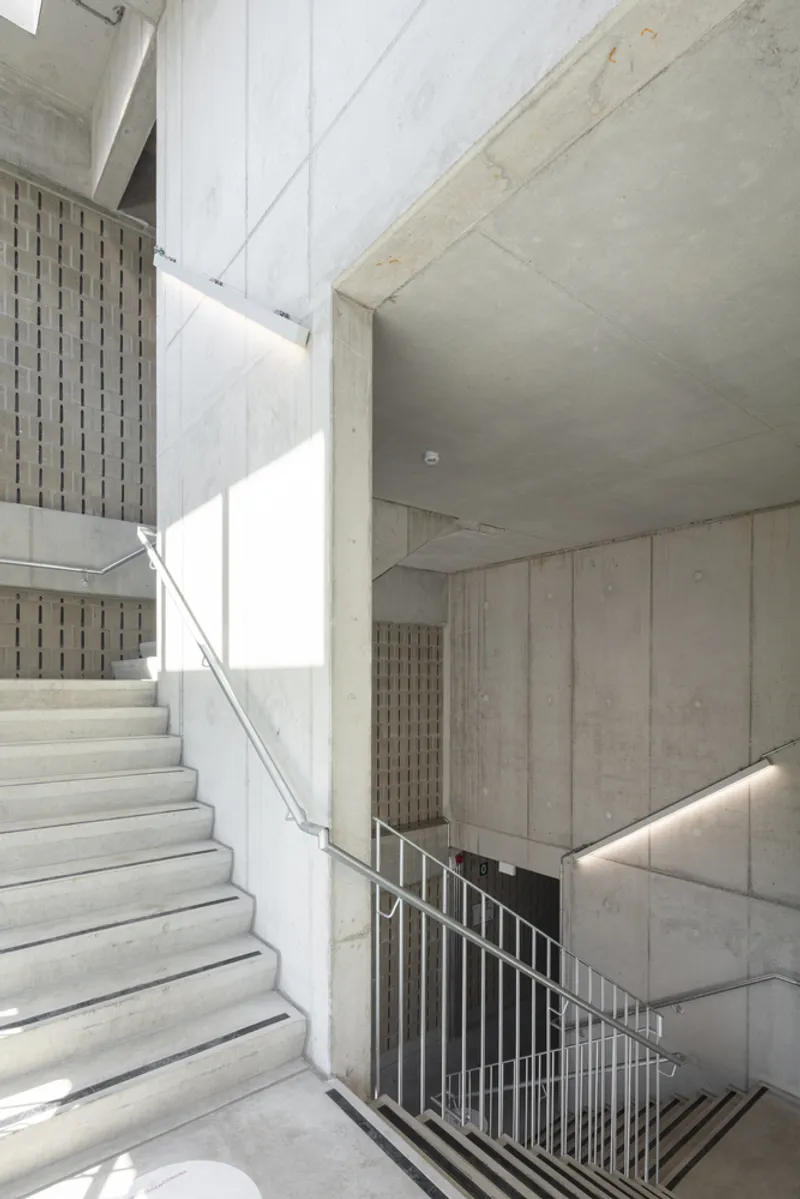
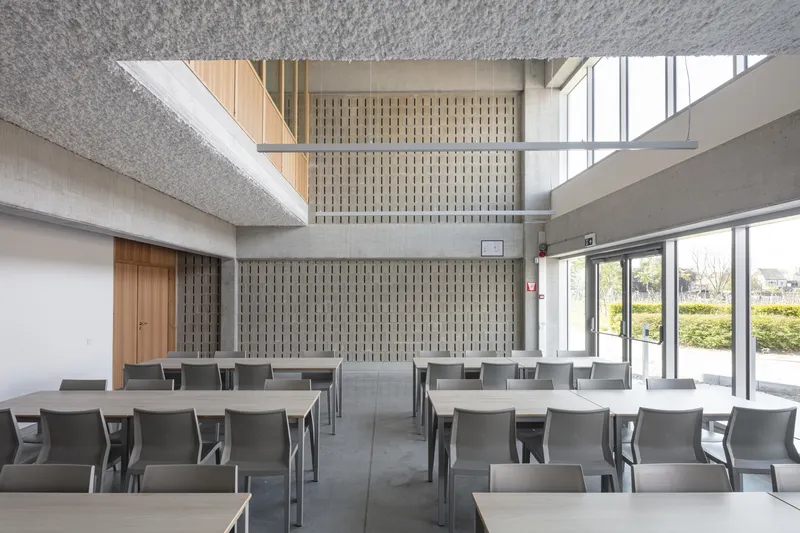
The palette in the common spaces is frank: board-marked concrete, steel handrails, perforated concrete walls and textured acoustic ceilings in the dining hall. The specifications list acoustic spray plaster and cotton insulation, choices that quietly absorb the noise of a school full of teenagers and machines.
The stairwell, with sunlight raking across its rough walls, shows that this restrained material approach can still produce atmosphere. Nothing here is precious, and in a school where students handle tools daily, that robustness is a design virtue.
Why This Project Matters
The building meets Belgium's BEN nearly-energy-neutral standard and draws its remaining energy from green sources, which is now the baseline for public schools rather than a headline. The larger lesson lies elsewhere. LAVA treats flexibility as a structural decision made at the level of the grid, not a promise left to movable partitions and furniture catalogues. That is the difference between a school that claims to be future-ready and one that can actually absorb change.
Equally important is the social argument. By putting vocational education in the most visible building on the campus, beside a listed heritage school and facing a main road, the Province and its architects make a statement about the value of technical work. The sawtooth roof tells passers-by what happens inside, and it tells students their training deserves good architecture.
STEM School Mechelen by LAVA Architecten, Mechelen, Belgium. Area: 2,053 m². Completed: 2020. Photography by Tim Van de Velde.
About the Studio
Share Your Own Work on uni.xyz
If projects like this are the kind of work you want to make, uni.xyz is a place to publish your own, find collaborators, and enter design competitions.


Popular Articles
Popular articles from the community

Opera by the Sea Estonia: Three Shells Dissolving Architecture into Tallinn's Coastline
A winning opera house proposal replaces monumental form with interconnected shells that blur the boundary between building, park and Baltic Sea.
Faces of the Soviet Avant-Garde: Turning Moscow's Street Names into an Open-Air Museum
A network of sculptural installations across a Moscow residential district transforms forgotten architect names into spatial encounters with cultural memor
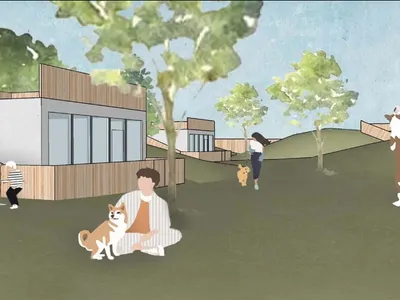
Temporary Home for Dogs: A Reversed Zoo Rethinks Animal Shelter Architecture
In Bucharest, a sinuous corridor and freed landscape flip the logic of containment, designing a shelter that works to make itself unnecessary.

Tsunami Convergenics: Turning Catastrophic Ocean Forces into Underwater Housing Infrastructure
A speculative underwater settlement off the coast of Onagawa, Japan, treats tsunamis and typhoons as energy sources rather than threats.

Similar Reads
You might also enjoy these articles

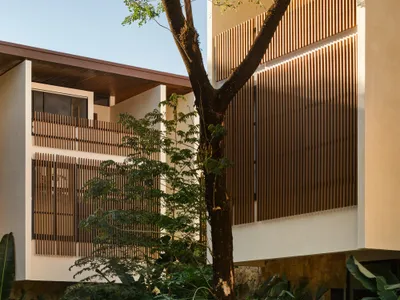
FAMM Arquitectura Organizes Ten Villas Around Courtyards and Jungle in Nosara, Costa Rica
El Molino pairs two elongated volumes with deep overhangs and timber louvers to build a compact coastal community five minutes from the beach.
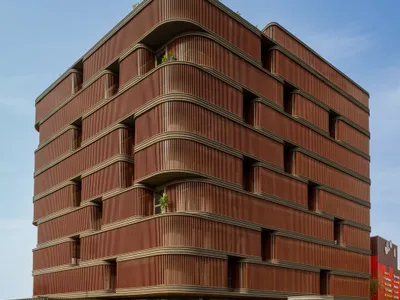
Sanjay Puri Architects Wraps a Jaipur Office Tower in Capsule-Shaped Green Buffers
A nine-level climate-responsive workplace near Jaipur Airport uses stacked planter terraces and aluminium screens to fight 40°C heat.
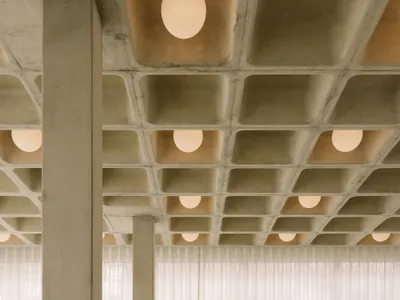
RHO Converts a Berlin Spree-Side Industrial Courtyard into Enkime's 1,000 m² Agency Headquarters
A social media agency's new home in Charlottenburg trades glossy branding for concrete waffle ceilings, glazed tile, and sheer curtains.
Vari Architects Wraps a Lakeside Pavilion in Timber and Corrugated Metal for an Italian Restaurant in Chongqing
A waterfront pavilion in Yihe Park becomes a family-oriented Italian kitchen where Cassia timber columns echo the surrounding cedars.

Explore Architecture Competitions
Discover active competitions in this discipline

Challenge to design public laboratory

Challenge to reimagine the Iron Throne

Photograph architecture without architects

Illustrate the lost glory of Angkor Wat - Render Challenge
Comments (0)
Please login or sign up to add comments
No comments yet. Be the first to comment!