
Kookmin University and one-aftr Build a 12 m² Pavilion of Gaps in Seoul
Pavilion TEUM reinterprets the traditional Korean Daecheong as a compact wooden room of triangular voids in a Seoul plaza.


The Korean word teum means gap, and in the hands of Kookmin University and one-aftr, that linguistic kernel becomes a full spatial argument. Pavilion TEUM is a 12 square meter timber structure sited in a tree-lined Seoul plaza, and it functions less as a shelter than as a thesis on what happens when you punch deliberate voids into an enclosure. Each of its four walls performs a different act of opening: a south-facing window catches light, a north wall frames a table for conversation with passersby, an east alcove invites floor-seated reading, and a west wall lets visitors physically step into the gap between ceiling and structure. The result is a room that never lets you forget the city outside it.
The project takes aim at what the designers call the "popcorn brain," the overstimulated modern mind that craves ever stronger sensory hits. Their antidote is not silence but calibrated exposure. TEUM borrows from the Daecheong, the traditional Korean living room that served as a threshold between domestic life and the shifting weather, seasons, and sounds of the outdoors. Here, that threshold is compressed into a tiny volume where every surface negotiates between inside and out. A central bench that rotates 360 degrees ensures no single orientation dominates. You are always being gently redirected.
A Compact Object on a Public Stage
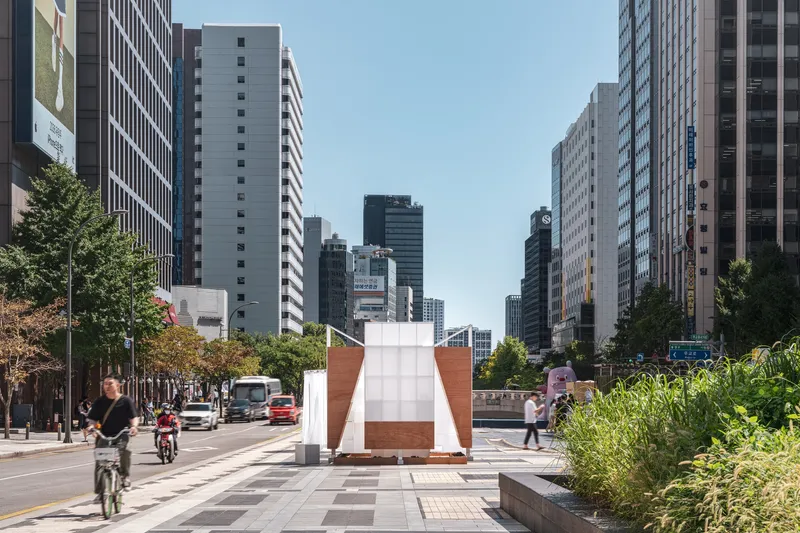
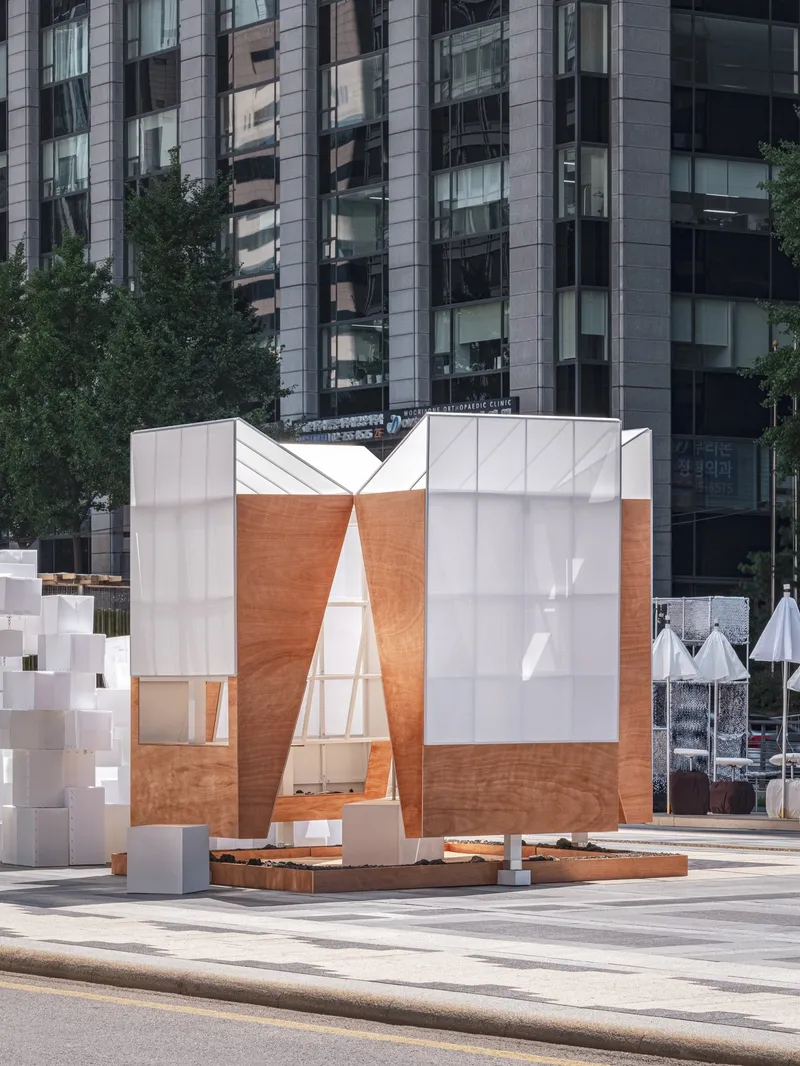
Placed on a Seoul plaza flanked by residential towers and bike lanes, the pavilion reads as a precise white and timber box that is simultaneously transparent and opaque. Its translucent polycarbonate cladding diffuses daylight while the triangular apertures cut into the plywood walls frame very specific views of the surrounding neighborhood. Cyclists pass without breaking stride, pedestrians slow down and lean in. The pavilion's scale is just small enough to feel approachable and just strange enough to demand a second look.
The decision to work at 12 square meters is not incidental. At that footprint, every design gesture carries disproportionate weight. There is no dead space, no filler wall. The structure earns its presence not through volume but through the intensity of its detailing and the intelligence of its openings.
Triangular Apertures as Spatial Arguments
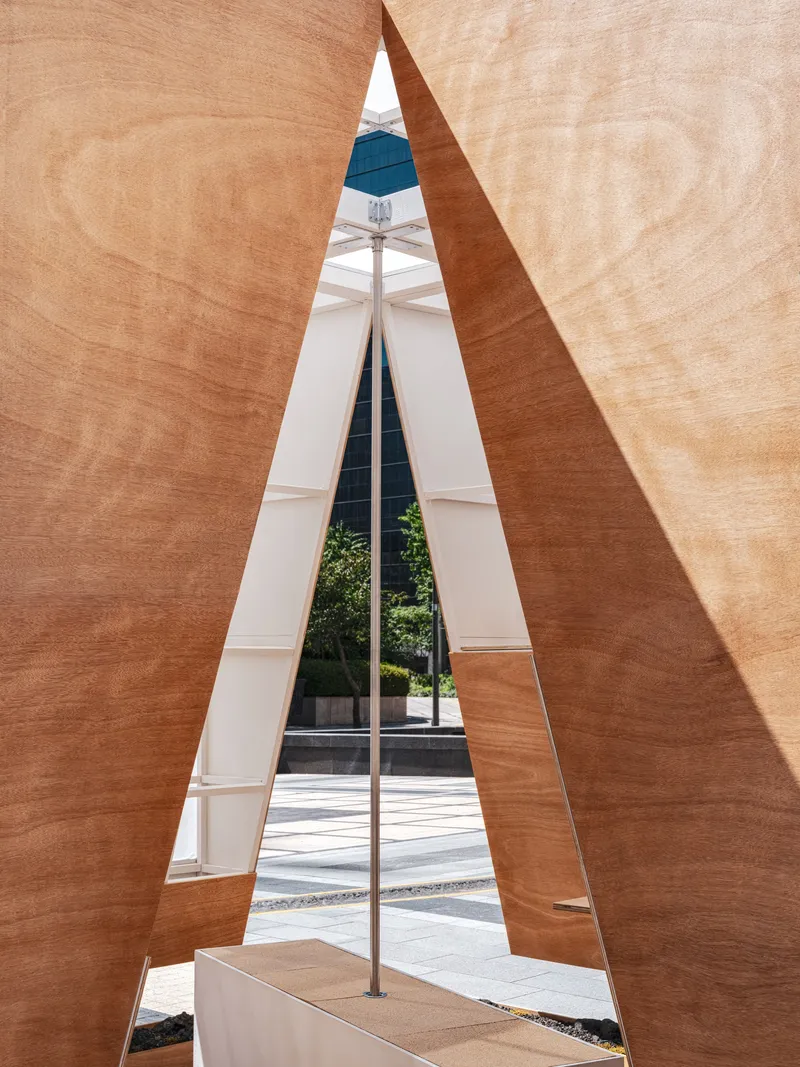
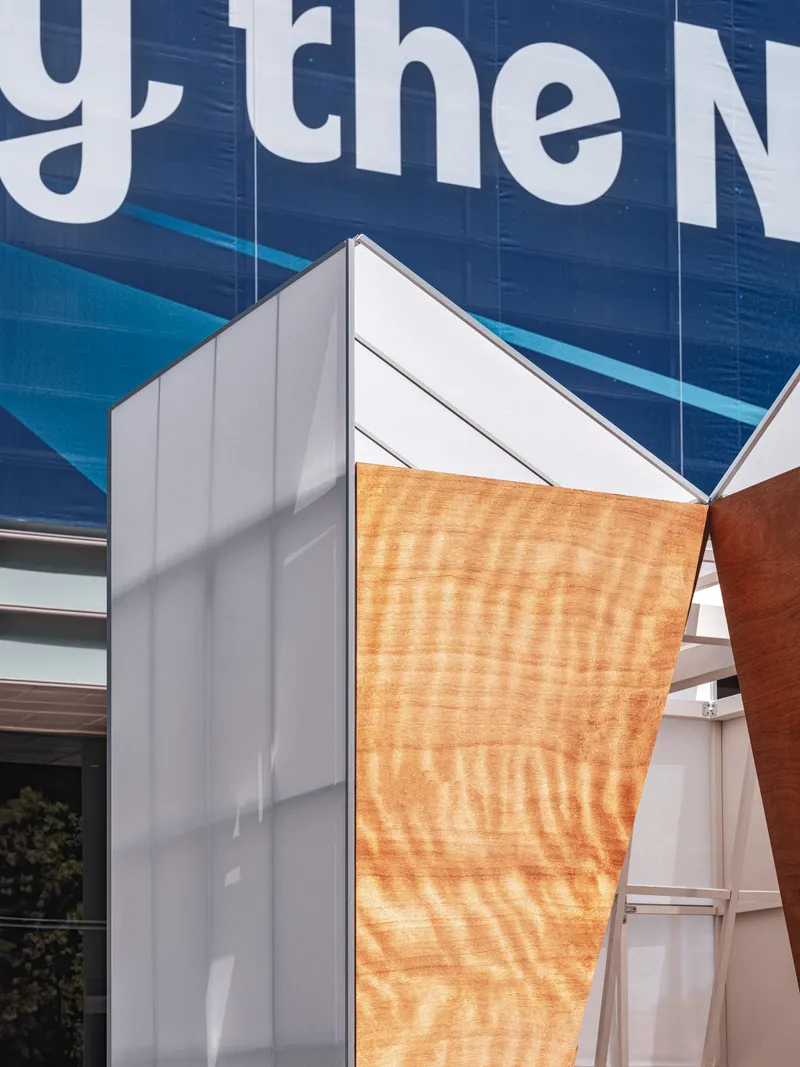
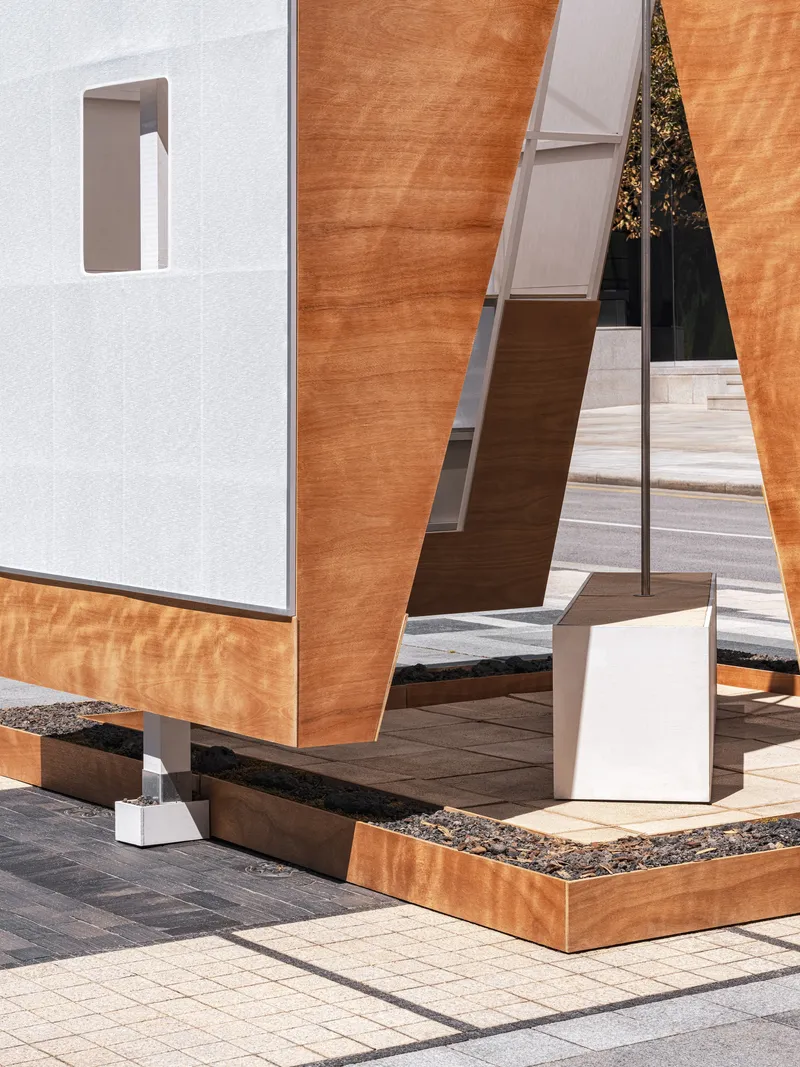
The most distinctive formal move is the triangular voids created by angled plywood panels that converge toward the ground or ceiling, producing narrow slits that frame the street beyond. These are not decorative cutouts. They control sightlines, regulate airflow, and force the visitor into a specific bodily relationship with the wall. You have to crouch, lean, or tilt your head. The gap demands participation.
Materially, the meeting of laminated timber and white polycarbonate is handled with restraint. The plywood panels sit on slender white metal posts above a black aggregate base, lifting the warm wood off the ground and lending the whole assembly a slightly hovering quality. Up close, the grain of the timber and the texture of the gravel create a tactile richness that photographs only partially convey.
Interior: Four Walls, Four Programs
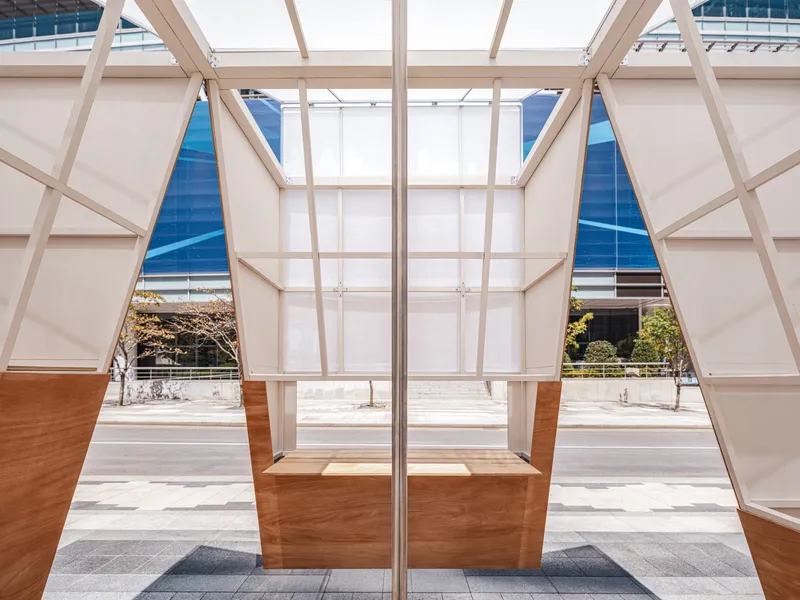
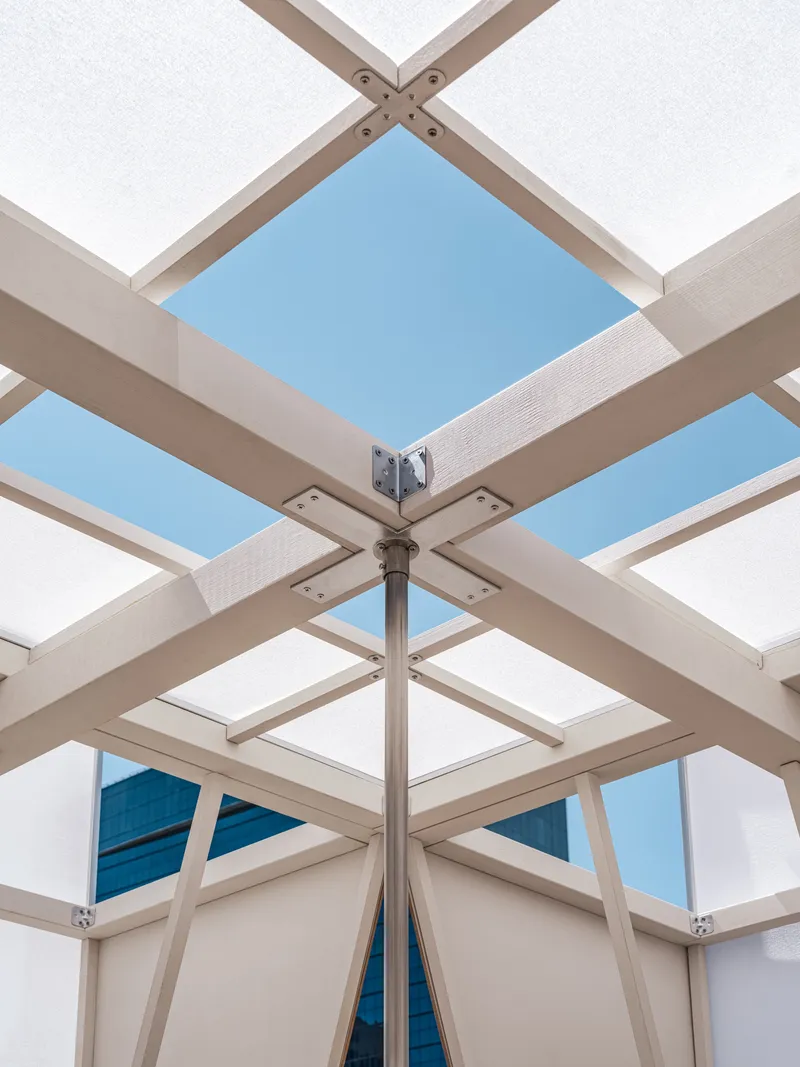
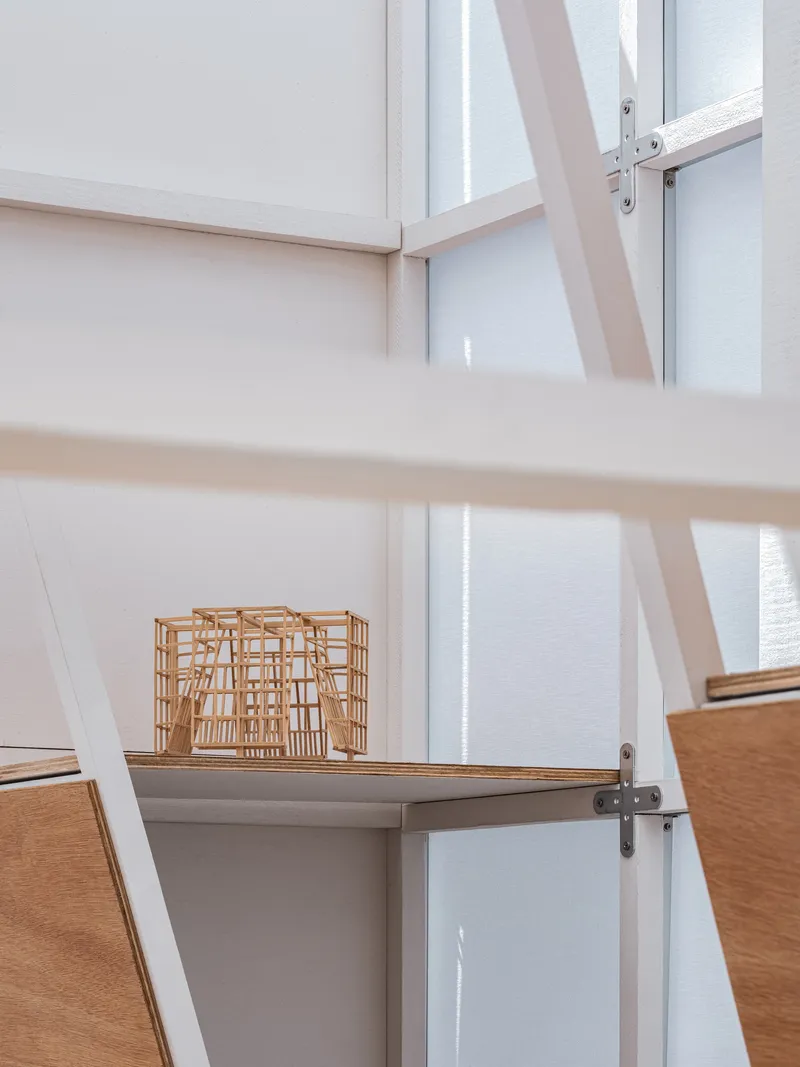
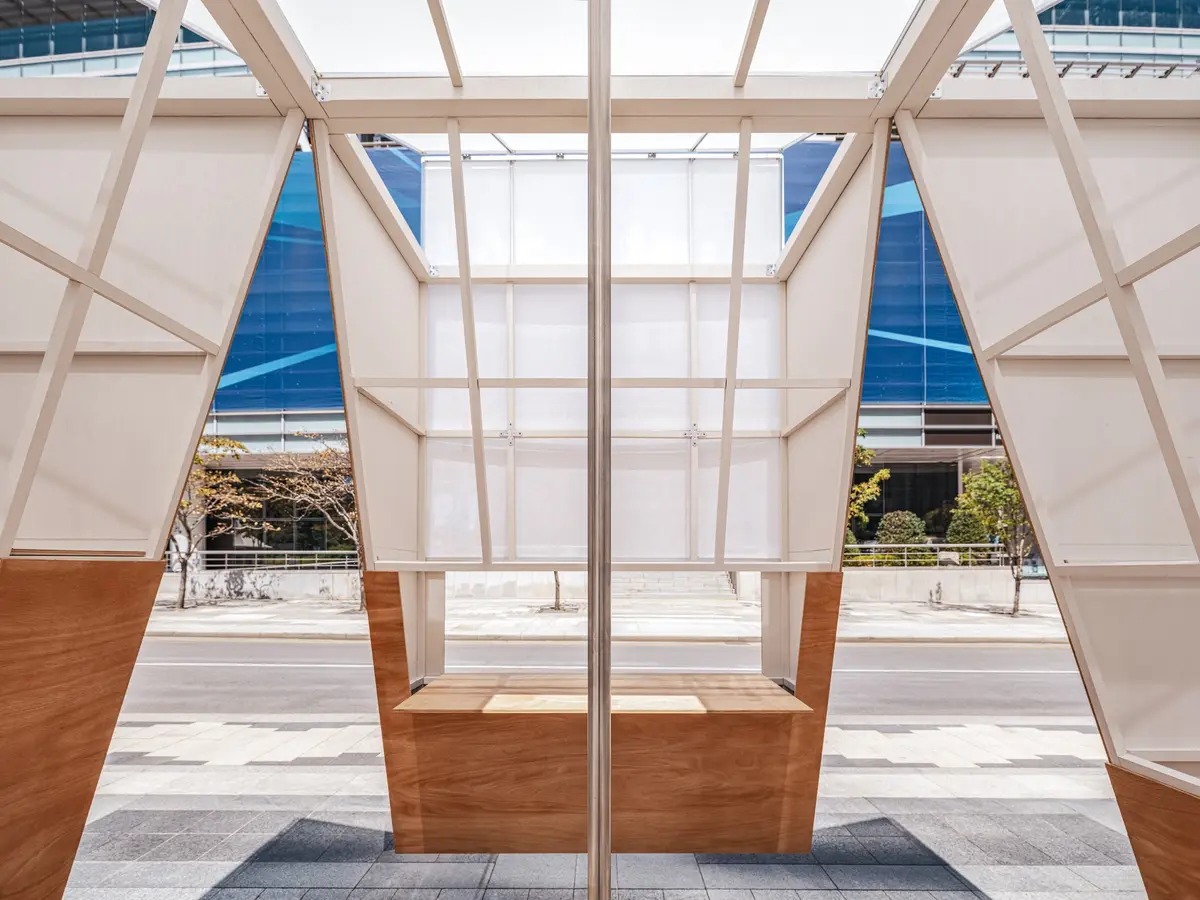
Step inside and the pavilion reveals its organizational conceit: each cardinal wall hosts a distinct activity. The twin benches visible through the timber frame structure anchor the interior, while triangular apertures to the street keep you oriented. Overhead, a central steel column gathers timber beams and translucent roof panels into a butterfly configuration that channels light downward along the column's axis. The structural logic is legible and economical, with Prof. Changsoon Rha's engineering allowing the slender steel rod and wood frame to do the work without visual excess.
A display shelf with a small architectural model, bathed in soft daylight from the polycarbonate panels, suggests that the pavilion also serves an exhibitory function. It is both the exhibit and the gallery, a demonstration of its own principles. The rotating central bench collapses the hierarchy of orientation: no wall is primary, no view is privileged. You spin and the room changes around you.
Details and Craft
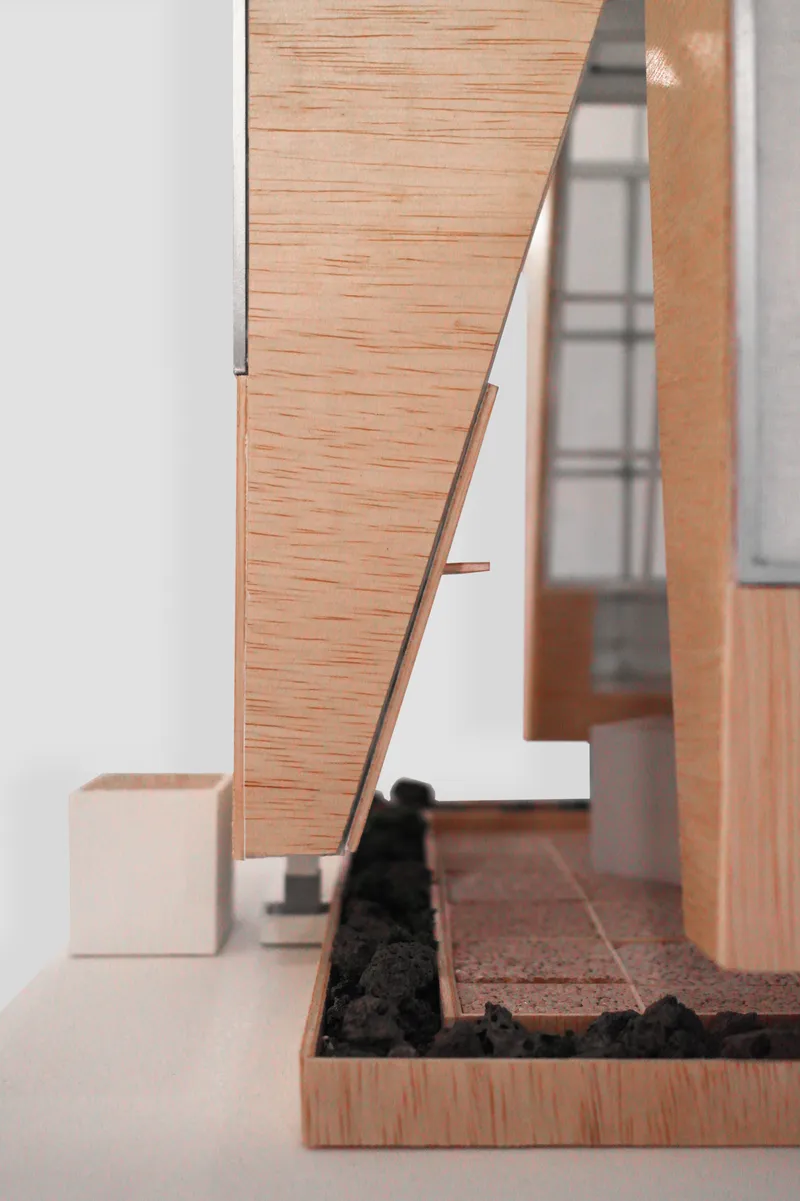
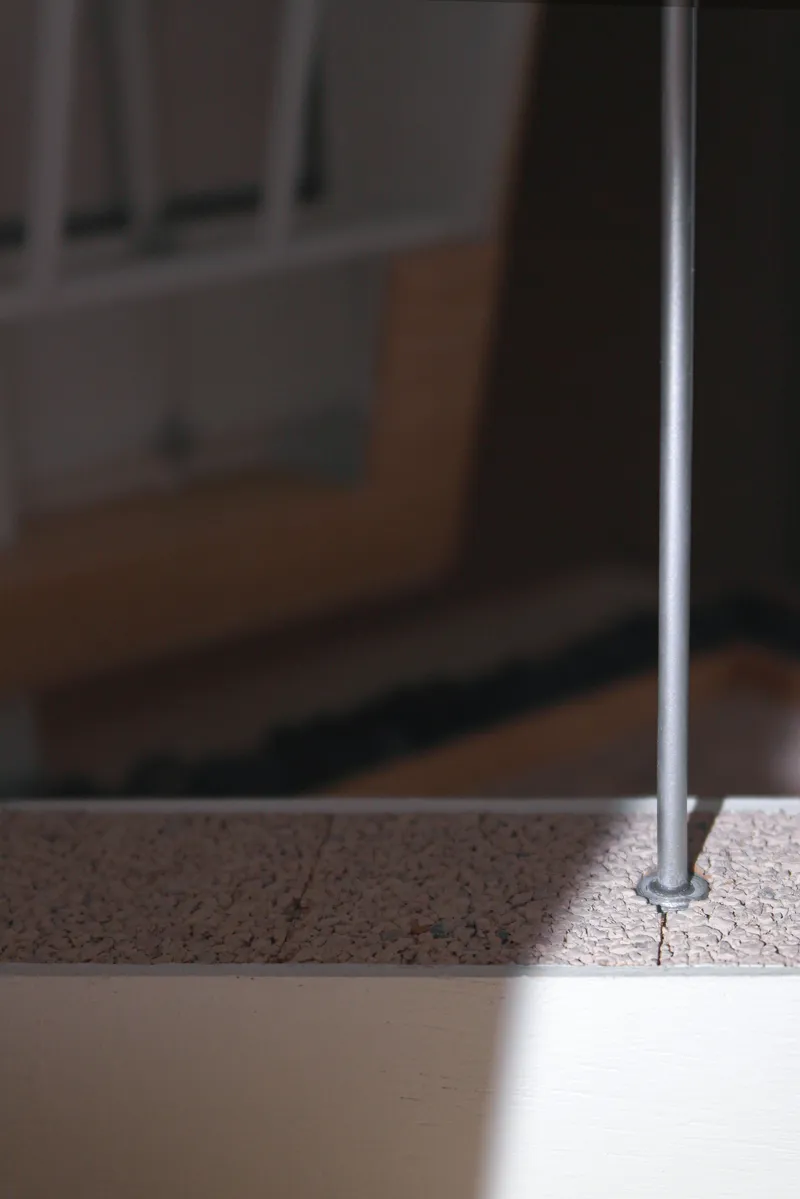
The close-up views reveal a project that was built with care by a large student-led design team. The angled timber facade panel of the study model mirrors the full-scale construction faithfully, sitting on its own black gravel plinth as a miniature rehearsal of the real thing. At floor level, the slender steel rod anchored into a speckled terrazzo surface shows where structure meets finish with surgical precision. These are not the details of a throwaway installation. They belong to a building that takes its own smallness seriously.
Plans and Drawings
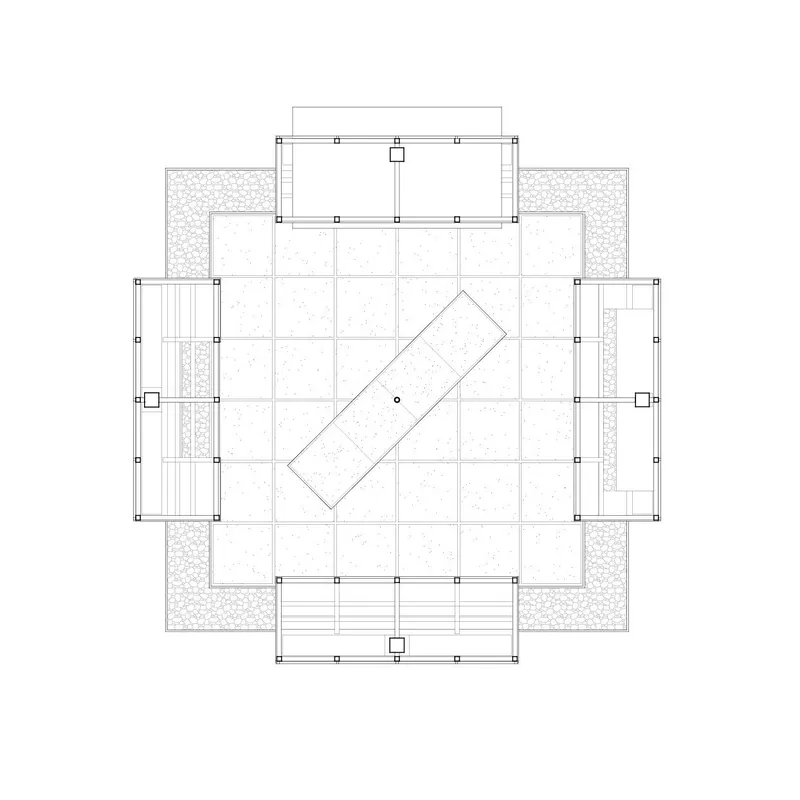
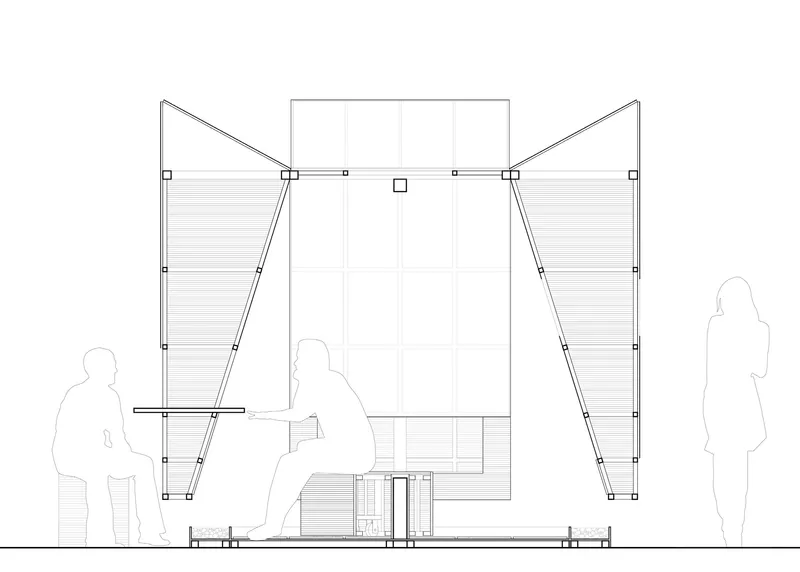
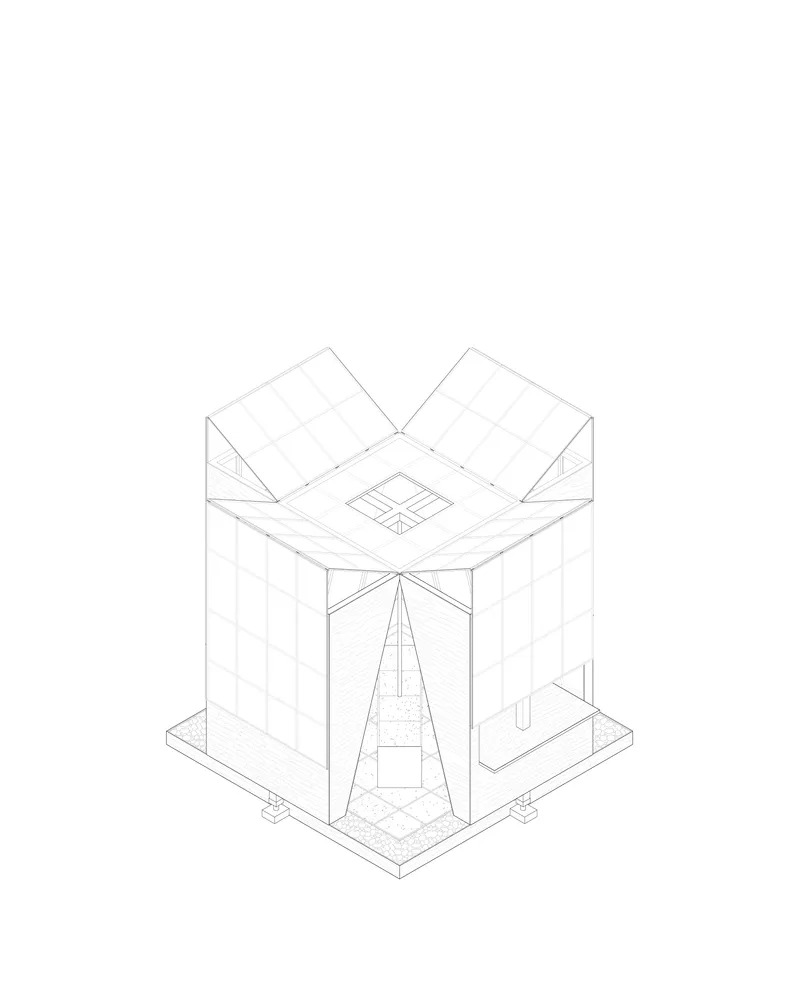
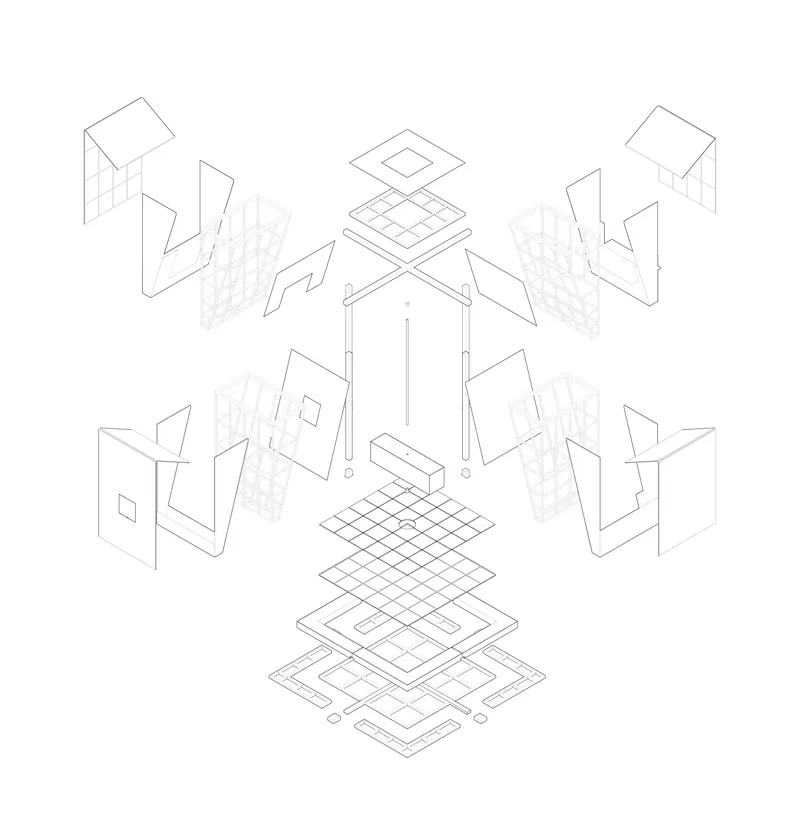
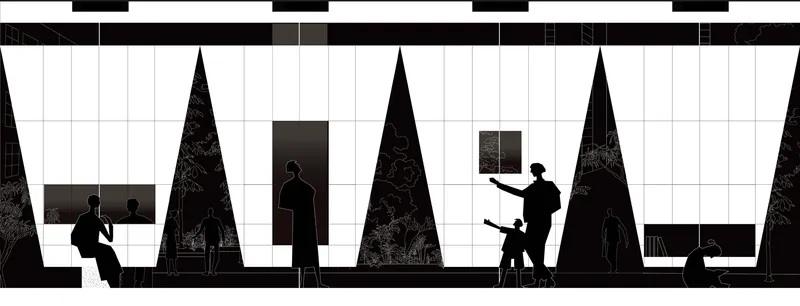
The drawings lay bare a spatial organization that is richer than its compact footprint suggests. The floor plan shows a central tilted rectangle, the rotating bench, surrounded by gridded zones and gravel margins that mediate between the pavilion and its plaza. The sections reveal tall triangular voids that extend nearly the full height of the interior, confirming that the apertures are not shallow punches but deep spatial cuts through the envelope. An exploded axonometric peels the building apart into its constituent layers: butterfly roof planes, angled wall panels, floor grids, and structural armature. Everything is additive and reversible, as a pavilion should be.
The axonometric of the assembled volume shows the butterfly roof with its central skylight hovering above entrance steps, making the rainwater logic and the light strategy simultaneously clear. For a 12 m² project, the drawing set is unusually complete, which suggests the design team understood that their argument lives as much in representation as in built form.
Why This Project Matters
Pavilion TEUM matters because it treats a tiny brief with the intellectual seriousness of a much larger commission. The concept of the gap, drawn from the Daecheong, is not nostalgic pastiche. It is a genuine spatial strategy for reconnecting enclosed bodies with the sensory world outside. In a city as dense and stimulated as Seoul, the proposition that architecture can recalibrate attention rather than simply compete for it feels both urgent and rare.
It also matters as a model of academic practice. A team of thirteen designers and a structural engineer, working between a university and a practice, produced a built object that holds up under close scrutiny. The collaboration between Kookmin University and one-aftr demonstrates that the design studio and the construction site need not be separate worlds. When they overlap, the gap between learning and making closes, and something precise, considered, and genuinely useful appears on a Seoul sidewalk.
Pavilion TEUM, designed by Kookmin University and one-aftr. Seoul, South Korea. 12 m². Completed 2024.
About the Studio
Share Your Own Work on uni.xyz
If projects like this are the kind of work you want to make, uni.xyz is a place to publish your own, find collaborators, and enter design competitions.


Popular Articles
Popular articles from the community

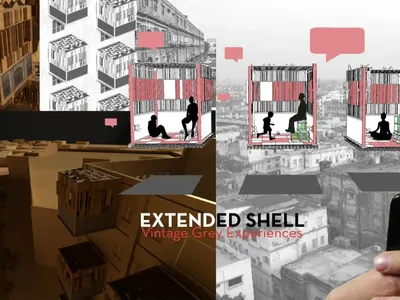
Extended Shell: Retrofitting Kolkata's Balconies as Living Urban Thresholds
A modular retrofit system recovers the social and environmental intelligence of Kolkata's historic verandas for contemporary Park Street residents.

The Amber Palace Opera: A Geological Fiction Surfaces on Tallinn's Baltic Waterfront
Pierre Brillard reimagines a Baltic legend as a public landscape, opera house, and waterfront promenade rooted in Tallinn's coastal identity.
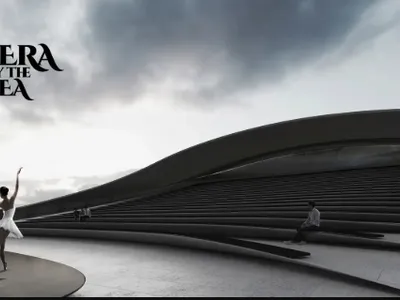
Opera by the Sea Estonia: Three Shells Dissolving Architecture into Tallinn's Coastline
A winning opera house proposal replaces monumental form with interconnected shells that blur the boundary between building, park and Baltic Sea.

Singing Woman: An Opera House That Performs Before the Curtain Rises
Ovidiu Cristian Pavel's conceptual opera house translates Estonia's choral identity into a sculpted waterfront landmark facing the Baltic Sea.

Similar Reads
You might also enjoy these articles

Pixel Gardens: One Repeated Module Stacked Into a Terraced Social Housing Tower for Famagusta
Salem Bader's shortlisted housing tower builds a vertical neighbourhood from one repeated module, offsetting units to carve terraces, light and air.

Bao Huynh Watercolor Atelier: A Serene Art Retreat in Hội An
Bao Huynh Watercolor Atelier in Hội An blends multifunctional art spaces, sustainable design, local materials, and family-friendly living in a serene environment.

Atelier Macri Concept Store Interior Design by CASE-REAL
Atelier Macri store features a "ko" counter, walnut wood details, cork displays, blending retail, gallery, and seamless customer experiences.

Manuel Vargas Izquierdo Stadium and High-Performance Sports Center: Architectural Excellence in Jalpa de Méndez
The Manuel Vargas Izquierdo Stadium blends sustainable design, inclusive sports facilities, and cultural-inspired architecture, revitalizing Jalpa de Méndez’s public spaces.

Explore Pavilion Competitions
Discover active competitions in this discipline

Challenge to design a portable theatre

Challenge to design a portable music platform

Challenge to design public laboratory

Challenge to design an open learning module for the elderly
Comments (0)
Please login or sign up to add comments
No comments yet. Be the first to comment!