
Takeshi Hosaka Architects Suspends a Concrete Cross Above a Yokohama Cemetery
A 28-square-meter burial renovation in Yokohama lifts the symbol of resurrection into the sky so mourners see it against heaven.


A grave is architecture at its most compressed. Every square meter carries weight that is not structural but existential: the living stand above, the dead rest below, and something in between has to mediate. At a cemetery on the outskirts of Yokohama, Takeshi Hosaka Architects took on the renovation of a church-owned burial plot, just 30 square meters of sloped ground surrounded by traditional Japanese headstones. The result is a 28-square-meter platform that suspends a reinforced concrete cross overhead, deliberately positioned so that the sky, not the earth, becomes the backdrop for the symbol of resurrection.
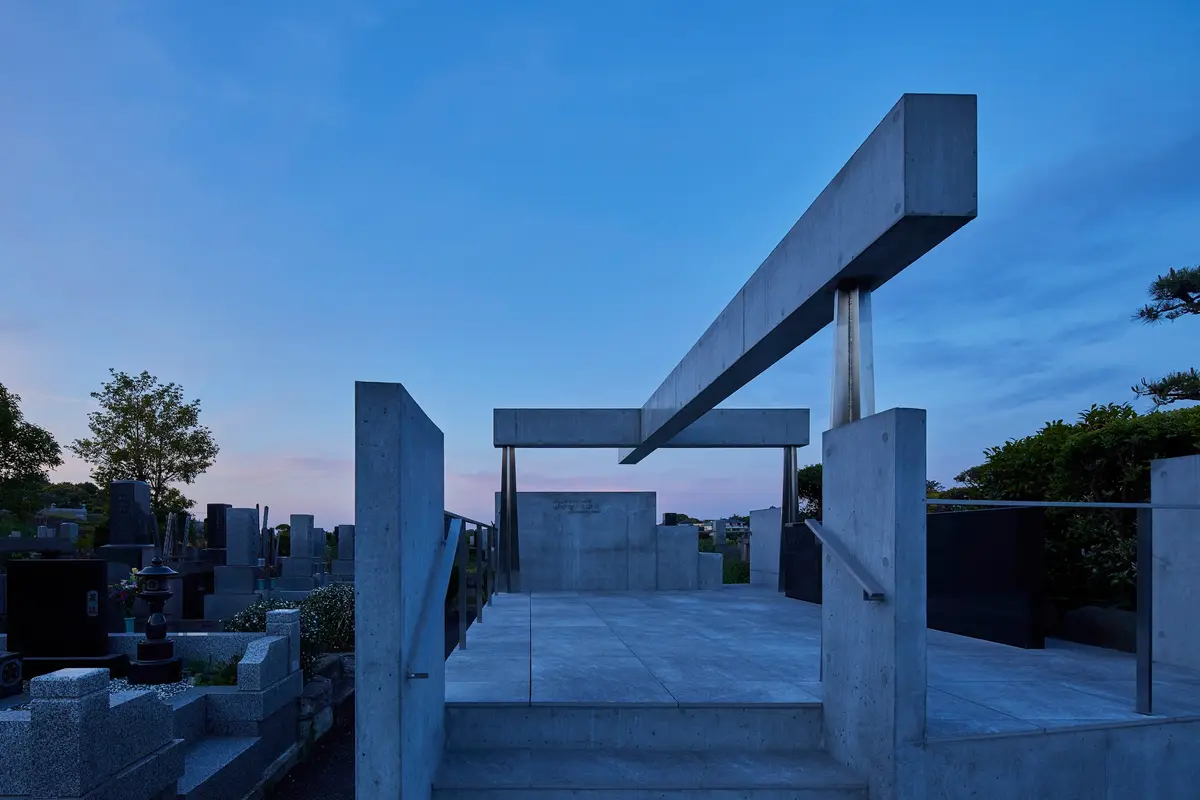
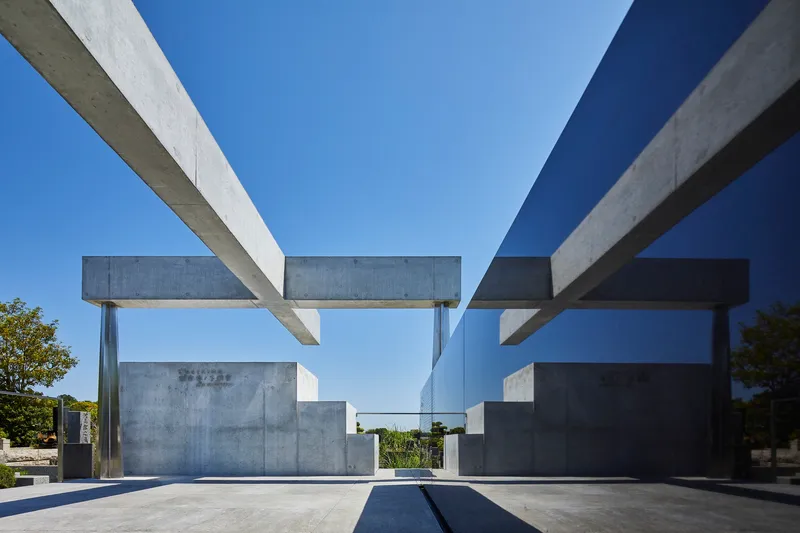
What makes this project unusual is its insistence on optical theology. The horizontal cross floats at a height of roughly 2.5 meters above the platform, supported by three cross-shaped pillars that transmit their load into an existing underground burial chamber. From the eye level of a standing mourner, the cross is almost unrecognizable as such. It reads as abstract geometry against open sky. Only when you shift your viewpoint, or when the sun and moon position themselves behind the beams, does the form resolve. The architecture does not announce faith; it makes you discover it.
A Platform Between Two Worlds
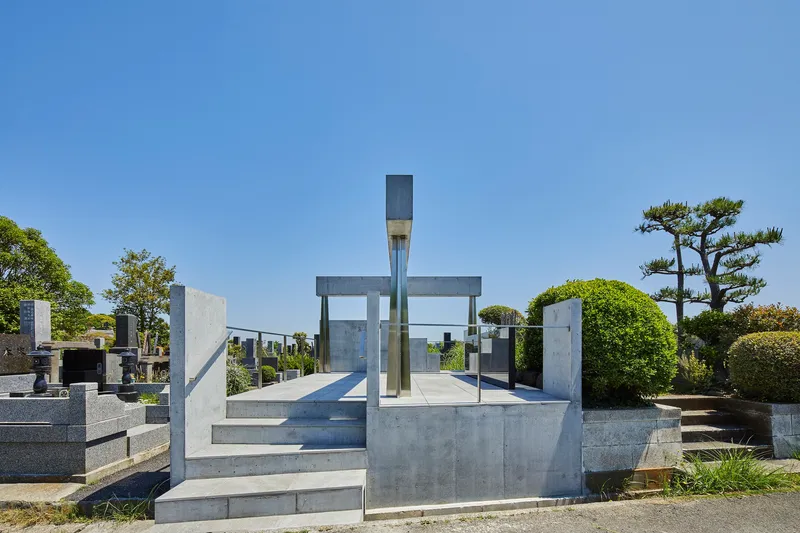
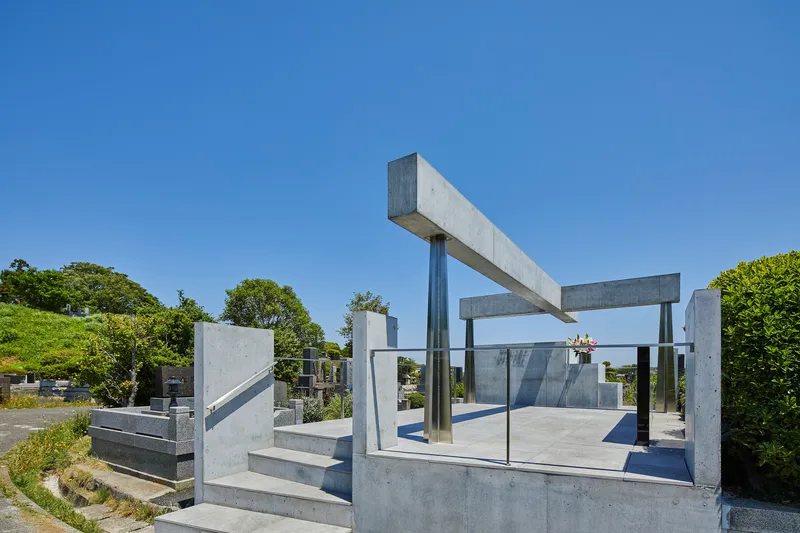
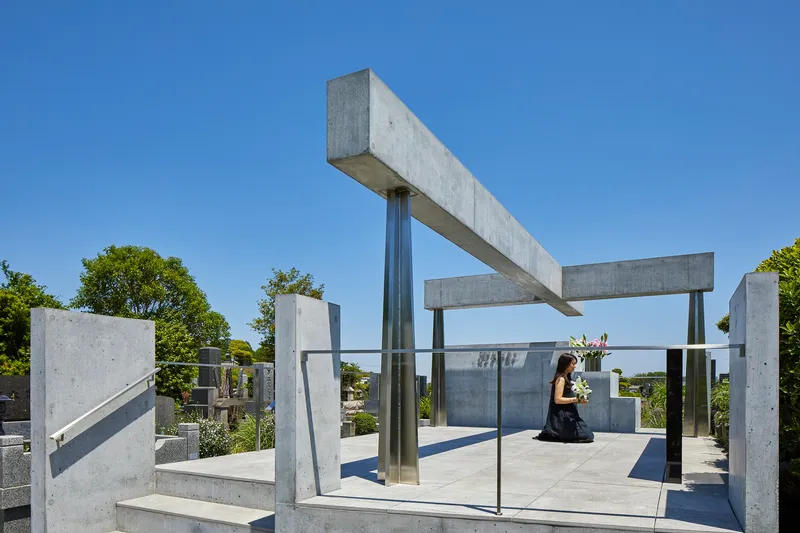
The project's two-level organization is blunt in its symbolism and precise in its construction. The platform sits 650 millimeters above ground level, a flat reinforced concrete plane wide enough to accommodate a funeral ceremony. Below it lies the pre-existing shared burial chamber, waterproofed and refinished as part of the renovation, accessible only to authorized workers. The living perform rites on a surface that is literally a ceiling for the dead.
Hosaka's decision to keep the ground plane open and uncluttered is critical. Traditional Japanese cemetery plots are dense with vertical markers, engraved stone, and planted borders. Here, the platform is almost aggressively horizontal. A person kneeling on the concrete occupies a space that feels closer to a stage than a gravesite. The three cross-shaped steel and concrete pillars punctuate the surface without crowding it, and a glass balustrade along one edge keeps the precinct defined without walling it off from the surrounding graves.
The Cross You Cannot See
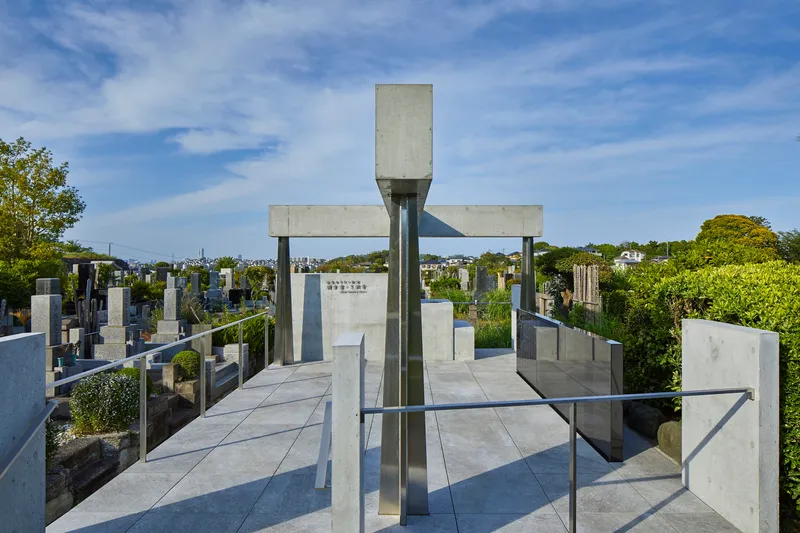
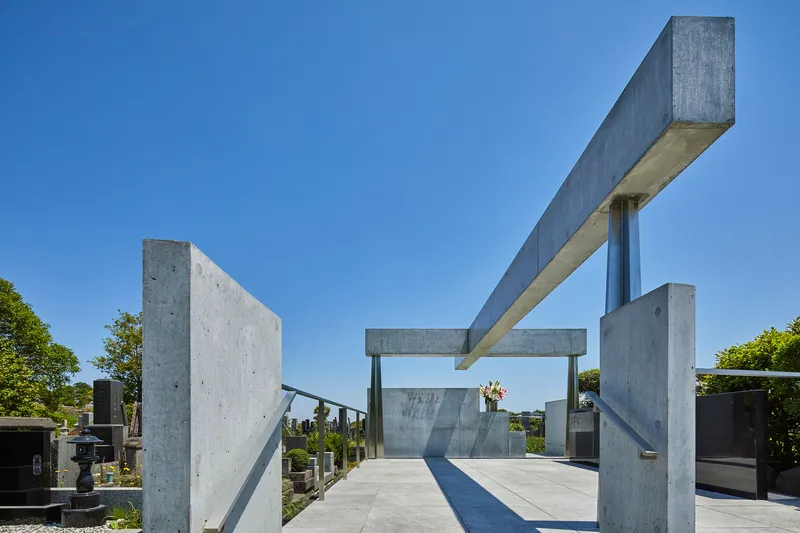
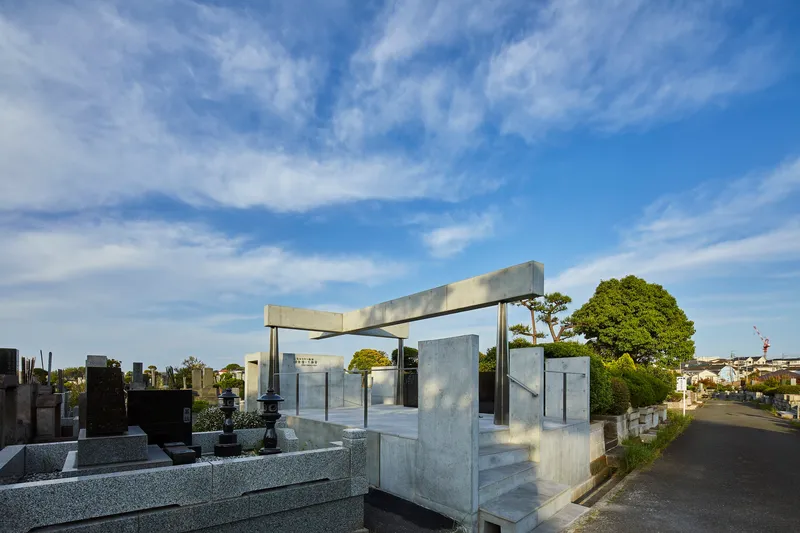
The floating cross is the project's intellectual center. Its bottom edge sits 1,850 millimeters above the platform, and the entire structure tops out at 3,000 millimeters. These dimensions are calibrated so that a standing adult looks through and past the cross rather than up at it. From ground level, the horizontal beam and its perpendicular arm dissolve into overlapping planes of concrete. The cross only reads as a cross from above, from a distance, or in silhouette against the sky.
This is a deliberate provocation. The most charged symbol in Christian architecture is rendered nearly invisible to the very people gathered beneath it. Hosaka has described the concept as wanting mourners to "feel the glow of the resurrection behind the cross," and the geometry delivers exactly that. At certain hours of the day and during full moon nights, the cross casts defined shadows on the platform, momentarily making the absent symbol present. The architecture operates on a delay: you understand it only after the light has moved.
Structural Minimalism on Borrowed Ground
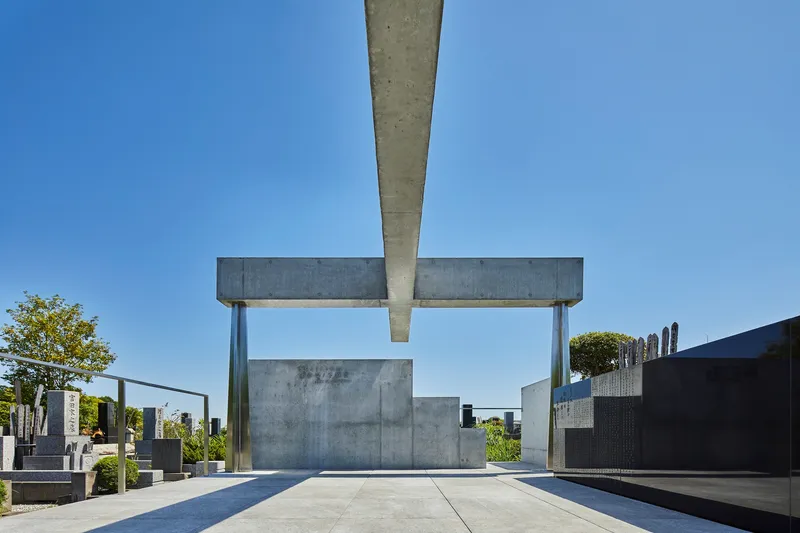
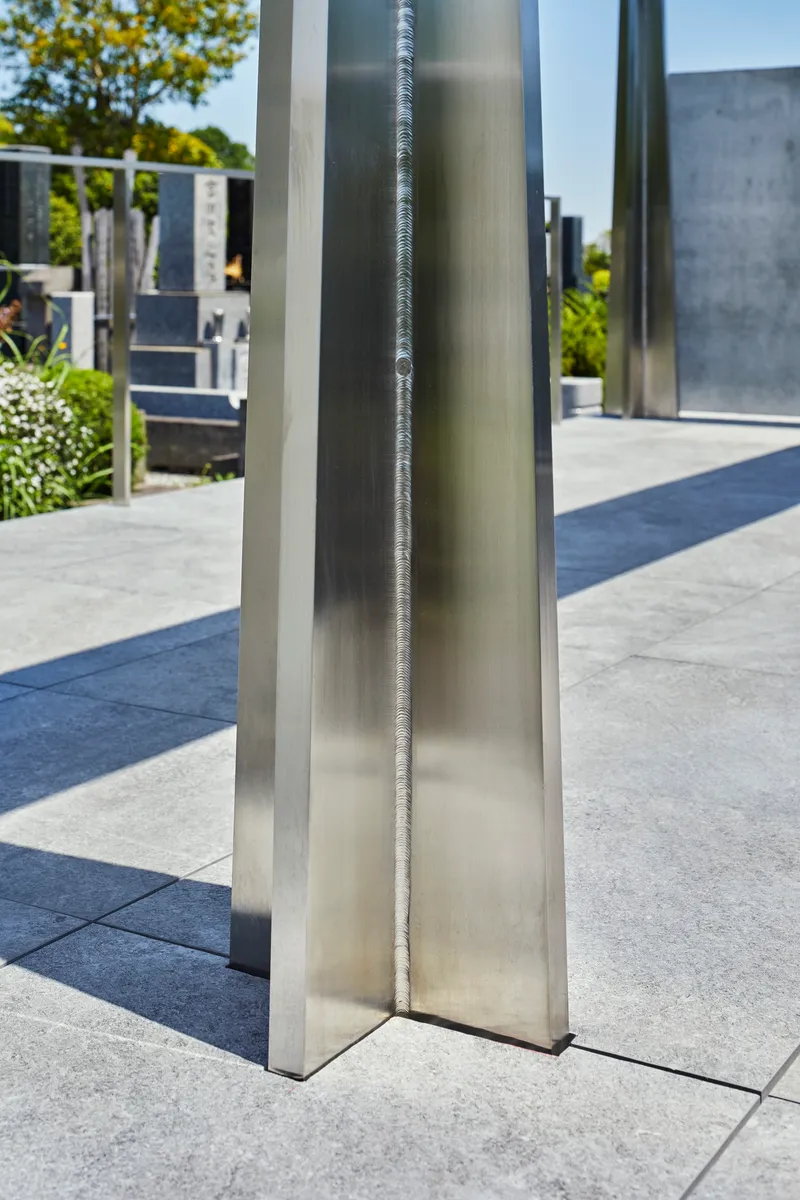
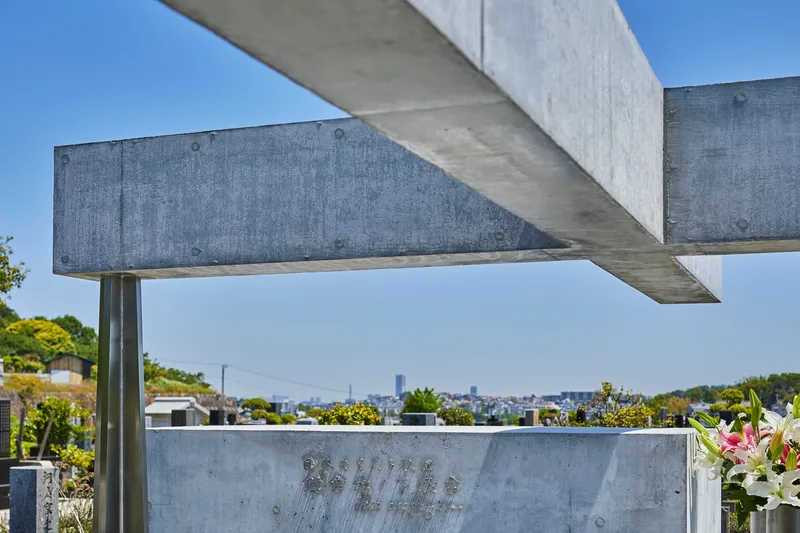
Structural engineer Kenji Nawa of Nawakenji-M devised a system where three cross-shaped pillars carry the cantilevered concrete beams, transmitting their load directly into the walls of the existing underground chamber. This means the new structure is parasitic in the best sense: it relies on what was already buried to hold up what is newly visible. The engineering is honest about the fact that this is a renovation, not a tabula rasa.
Detail shots reveal polished stainless steel columns with exposed welded seams and the rough texture of formwork ties on the underside of the beams. There is no attempt to hide the process of making. The concrete is left with its casting marks. The steel shows its joints. In a space dedicated to the transition between life and death, the rawness of the materials feels appropriate. Nothing here pretends to be eternal, even though it shelters a place meant for exactly that purpose.
Cemetery Context and the Urban Horizon
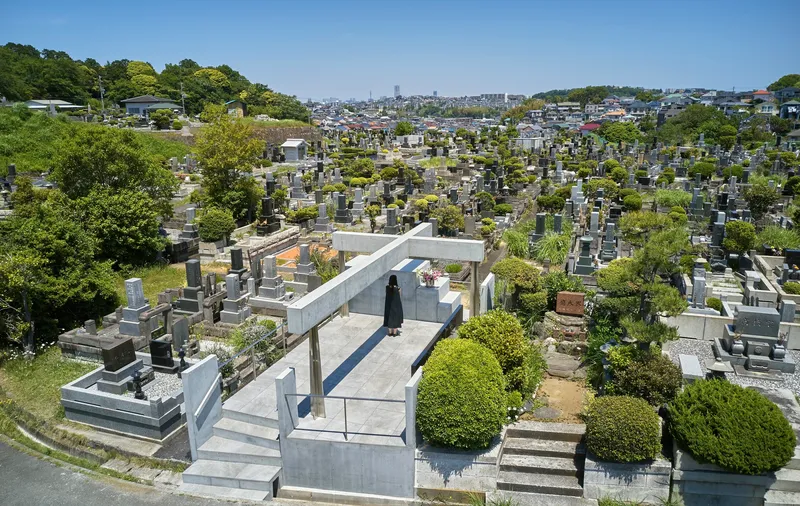
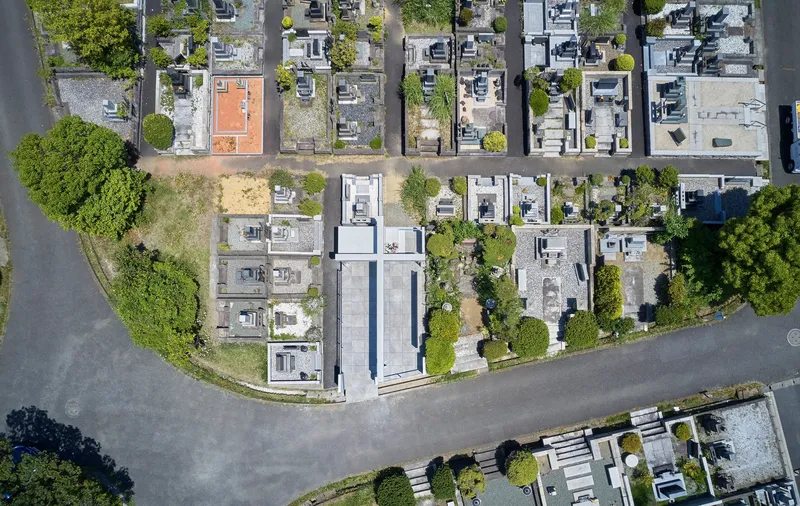
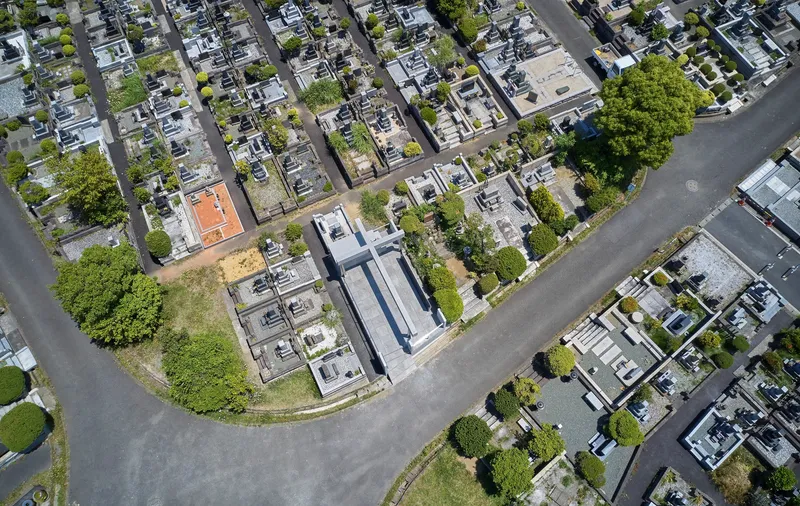
From above, the grave plot reads as a clean geometric incision in an otherwise organic field of headstones, trees, and curved paths. The aerial views are revealing: the cruciform plan is legible only from a drone's altitude, reinforcing the idea that the cross is meant for a viewpoint beyond the human. The site sits at a slightly elevated position on the cemetery's hillside, and from the platform, one can see the tall silhouettes of Yokohama's downtown skyscrapers on the horizon.
That juxtaposition of sacred miniature and secular skyline is not incidental. Hosaka places the mourner at the threshold between two scales of human ambition: the compressed intimacy of a 30-square-meter burial plot and the sprawling commercial city just beyond the trees. The cemetery's mature plantings create a soft boundary between these worlds, but they do not close it. You are always aware that the city is right there, pressing in.
Light, Shadow, and the Passage of Hours
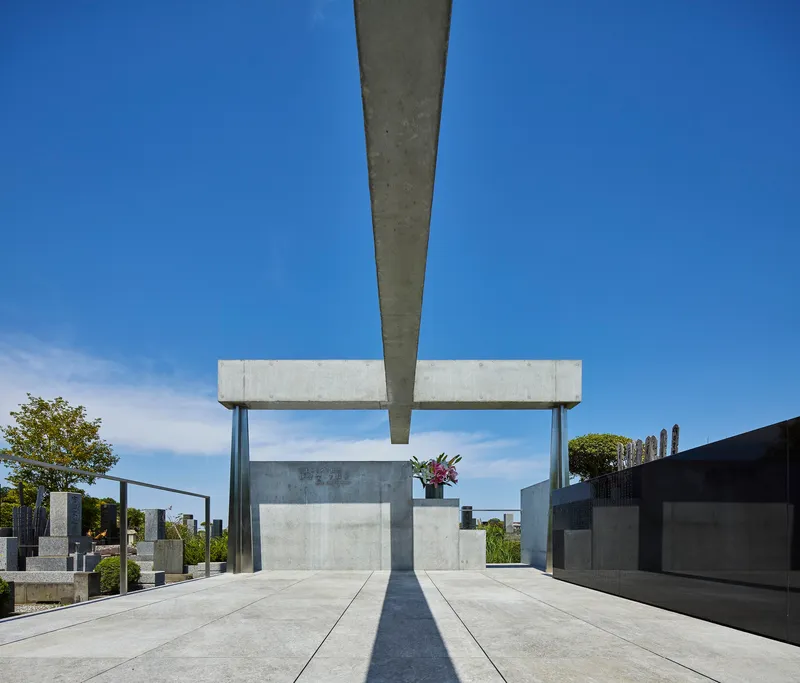
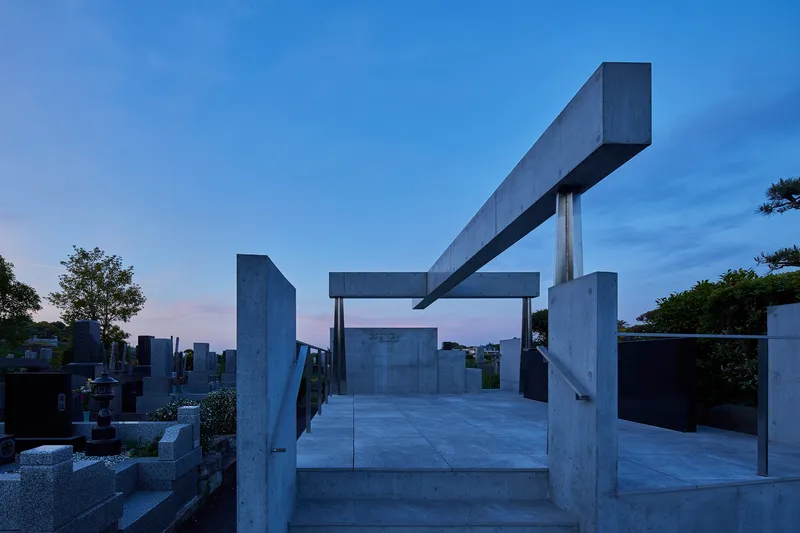
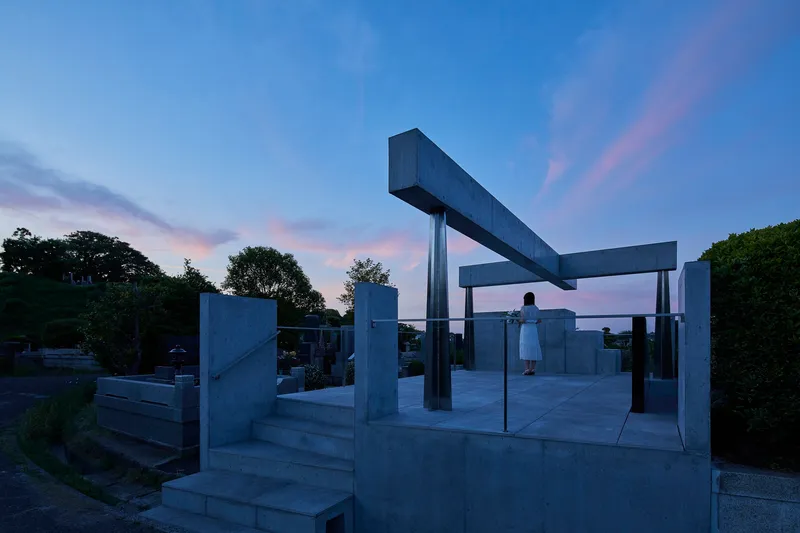
Photographed across the full cycle of a day, the structure is almost a different building at each hour. At midday, the beams cast sharp, ruled shadows across the platform, turning the concrete into a sundial. At dusk, the pink sky fills the gap between beam and ground, and the cross becomes a dark silhouette against a wash of color. The twilight image of a figure standing beneath the beams is the project's most evocative moment: a human body framed by concrete and sky, occupying the exact threshold between the visible and the symbolic.
Hosaka's use of natural light is passive design at its most poetic. No artificial illumination is visible in any image. The architecture depends entirely on the sun and moon to activate its central idea. This is a risky strategy, because it means the building's meaning is weather-dependent and time-dependent. But risk is the right posture for a project about mortality. Nothing here is permanent, not even the symbol.
The Chamber Below
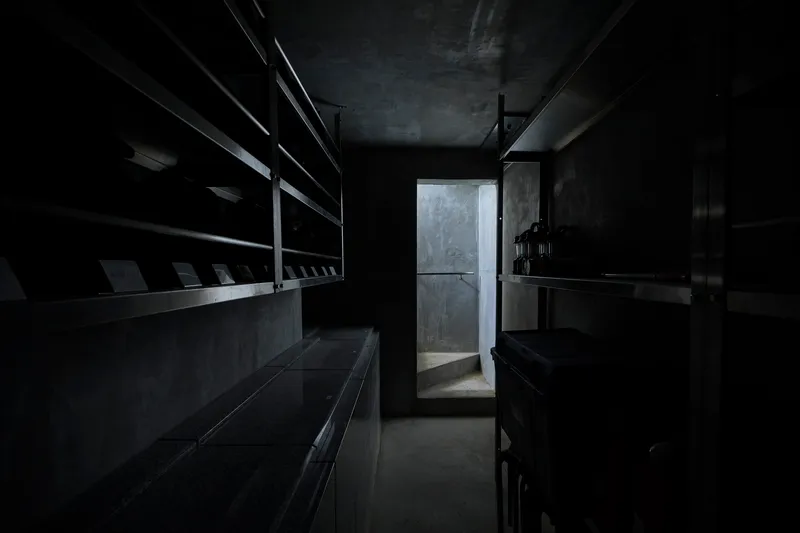
A single image reveals the underground burial chamber: a narrow corridor with steel shelving along both walls, backlit by diffused light from a doorway. It is austere and functional, a storage space for remains rather than a place of ceremony. The contrast with the open-air platform above could not be sharper. Above, the living gather under sky and cross. Below, the dead are shelved in darkness.
The renovation's practical scope included stripping the old structure, waterproofing the underground chamber, and renewing all finishes before constructing the new platform on top. It is a project where the invisible labor of preservation, the sealing of a subterranean space against water infiltration, is just as important as the visible gesture of the floating cross. Architecture that deals with burial always carries this duality: what is seen above is only possible because of what is secured below.
Plans and Drawings
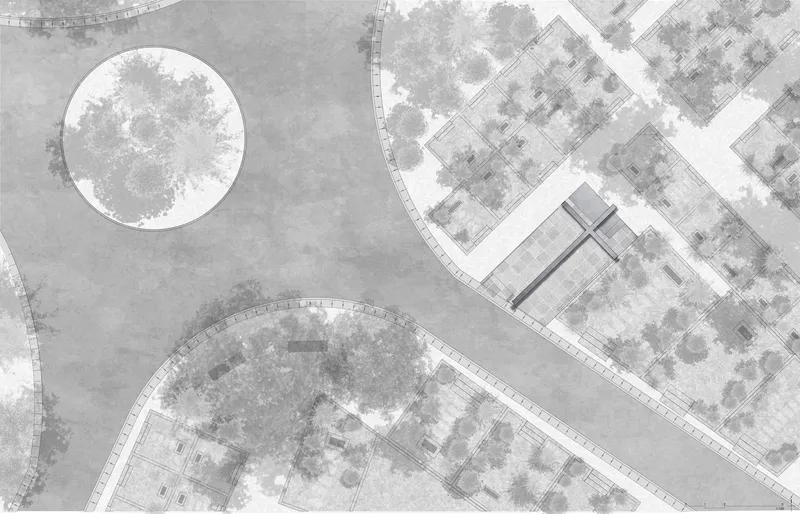
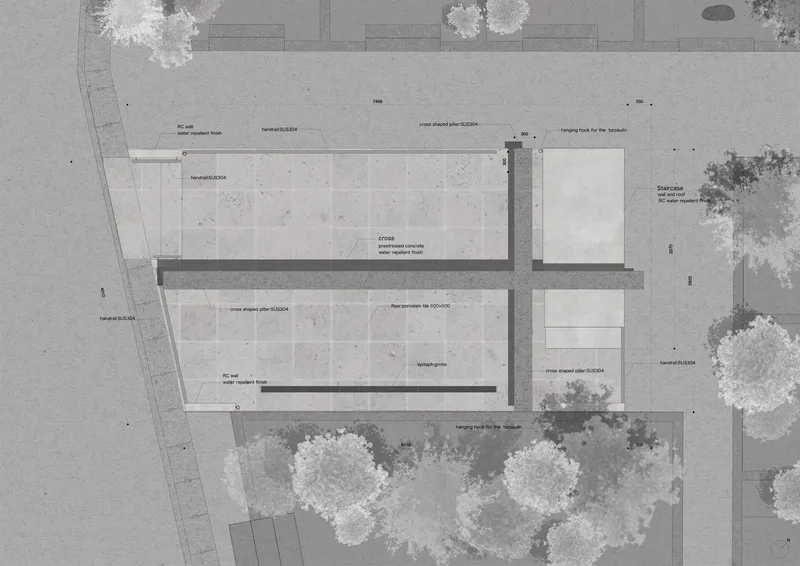
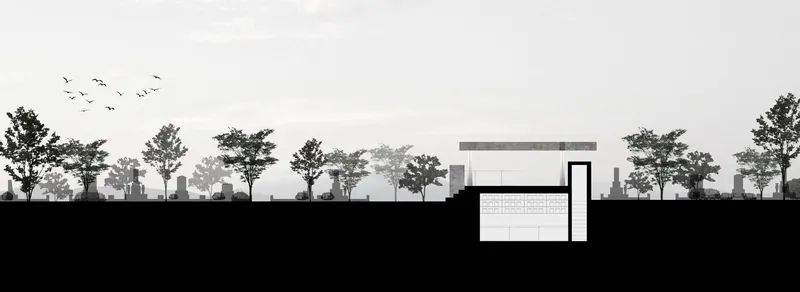
The site plan shows the grave's position at a junction of curved cemetery roads, nestled among circular planted areas and tree canopies. The roof plan, with its material annotations, reveals the two rectangular volumes and a courtyard with trees that define the plot. Most telling is the section drawing, which makes explicit what the photographs only suggest: a partially buried volume sits beneath the platform, and the cross-shaped pillars bridge the gap between old underground structure and new elevated frame. Birds drawn in flight above the tree line are a small, almost sentimental touch, but they underscore the project's vertical aspiration. Everything here points upward.
Why This Project Matters
At 28 square meters, this is one of the smallest projects we have published, and one of the most conceptually dense. Takeshi Hosaka has taken a building type that is usually invisible to architectural discourse, the church-owned grave, and turned it into a thesis on perception, symbol, and light. The cross that cannot be seen from eye level, the platform that doubles as a ceiling for the dead, the structure that depends on a pre-existing buried chamber for its stability: every element operates on at least two registers. This is architecture that rewards patience and shifting perspective.
It also asks a real question about the role of religious symbols in contemporary architecture. Rather than displaying the cross as a billboard, Hosaka hides it in plain sight, trusting the sun and moon to reveal it on their own schedule. In an era when sacred architecture often defaults to literalism or spectacle, this grave proposes a third way: abstraction as devotion. The building does not tell you what to feel. It sets up the conditions under which feeling might arrive.
The Grave of Kamakura Yukinoshita Church, designed by Takeshi Hosaka Architects with structural engineering by Kenji Nawa / Nawakenji-M. Located in Yokohama, Japan. 28 m². Completed in 2020. Photography by Koji Fujii / TOREAL.
About the Studio
Share Your Own Work on uni.xyz
If projects like this are the kind of work you want to make, uni.xyz is a place to publish your own, find collaborators, and enter design competitions.


Popular Articles
Popular articles from the community


ETEH Reworks the Shared Spaces of São Domingos School in Brazil Around Timber, Color and Hanging Plants
At São Domingos School in Brazil, 436 m² of hall, refectory and library are recast with timber joinery, a yellow and blue code and trailing greenery.


The Amber Palace Opera: A Geological Fiction Surfaces on Tallinn's Baltic Waterfront
Pierre Brillard reimagines a Baltic legend as a public landscape, opera house, and waterfront promenade rooted in Tallinn's coastal identity.

Aquadapt: An Underwater Habitat That Rewrites Its Rooms by the Hour
Curved modules ring the seabed while one shell shifts from breakfast room to cinema, farm and football pitch as residents' needs change.

FCC Arquitectura Expands a Portuguese Granite House with a Board-Marked Concrete Wing
In Portugal, JV House pairs a cleaned-up whitewashed and granite dwelling with a timber-shuttered concrete extension, courtyards and a garden pool.

Similar Reads
You might also enjoy these articles

LAVA Architecten Gives Vocational Education a Sawtooth-Roofed Face on a Mechelen School Campus
In Mechelen, Belgium, a 2,053 m² STEM school on a 6×6 m grid turns workshops and classrooms into rooms that can be rearranged as teaching changes.

KEMA Studio Turns a Derelict Marvila Attic into a 60 m² Lighthouse Apartment Above Lisbon
In Lisbon's Marvila district, a rebuilt roof, four skylights and two plywood volumes turn an unlivable attic into a bright home facing the Tagus.

Pixel Gardens: One Repeated Module Stacked Into a Terraced Social Housing Tower for Famagusta
Salem Bader's shortlisted housing tower builds a vertical neighbourhood from one repeated module, offsetting units to carve terraces, light and air.

Bao Huynh Watercolor Atelier: A Serene Art Retreat in Hội An
Bao Huynh Watercolor Atelier in Hội An blends multifunctional art spaces, sustainable design, local materials, and family-friendly living in a serene environment.

Explore Graveyard Competitions
Discover active competitions in this discipline

Design Challenge - Contemporary interpretation of a religious complex

Challenge to reimagine the Iron Throne

Photograph architecture without architects

Illustrate the lost glory of Angkor Wat - Render Challenge
Comments (0)
Please login or sign up to add comments
No comments yet. Be the first to comment!