
20 Most Popular Office Building Projects of 2025
From biophilic workspaces in India to net-positive energy offices in New Delhi, 20 office building projects that defined architecture in 2025.


The office building had to argue for its own relevance in 2025. With hybrid work entrenched and corporate footprints shrinking across most major cities, the projects that drew the most attention this year shared a common conviction: that the workplace is worth designing carefully, not because employees are obligated to be there, but because the building should justify the trip.
These 20 projects answer that question in different registers. Some treat the office as a biophilic refuge, others as a corporate landmark, others as a flexible coworking platform. A few rescue postwar buildings that most developers would have replaced. One imagines a tower for 2050 where AI choreographs the daily working life. Each of them has a clear position on what a workplace is for.
We have ranked them by reader engagement on uni.xyz: visits, saves, and conversation from our community of 260,000+ architects and designers. The list spans nineteen built projects across Asia, Europe, Africa, and the Americas, alongside one conceptual proposal that closes the article on a question.
Biophilic and Sustainable Headquarters
The most-engaged office projects of the year share one preoccupation: making the workplace feel less like a workplace. Timber, planting, and rooftop gardens carry the architectural weight in this section.
1. Haruna Innovation Center by Naomi Sato Architects, Gunma

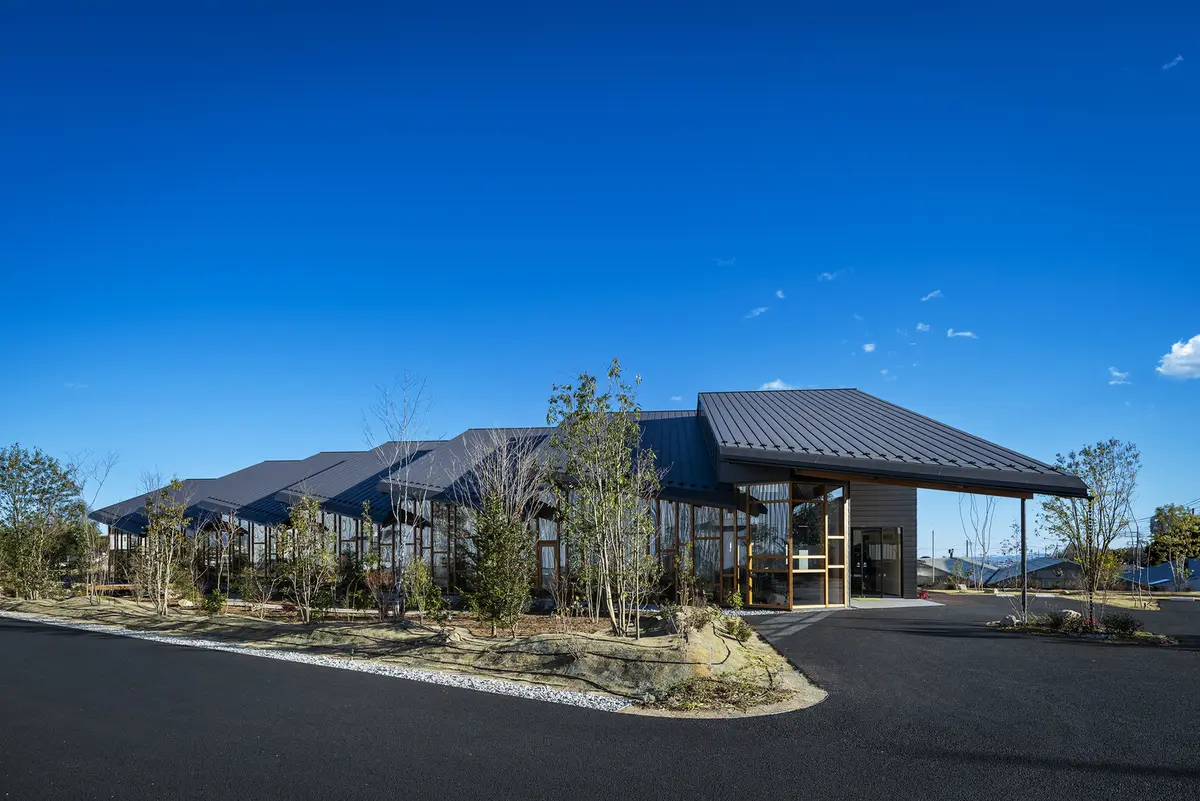
The most-read office project on uni.xyz in 2025. Naomi Sato Architects folds seven gabled roofs into a beverage innovation center in Gunma Prefecture, where the rhythm of the surrounding forest and mountains becomes the spatial logic of the workplace itself. The fireproof timber structure does not borrow from local vernacular; it extends it.
What makes Haruna remarkable is its refusal to treat the office as an isolated typology. The roofs slope to the same angles as the ridgelines beyond the site, and the warmth of the timber argues that a beverage company's innovation should feel as grounded as its products. It is corporate architecture without the corporate posture.
Studio: Naomi Sato Architects
2. Whispering Curve by Ace Associates, Gujarat
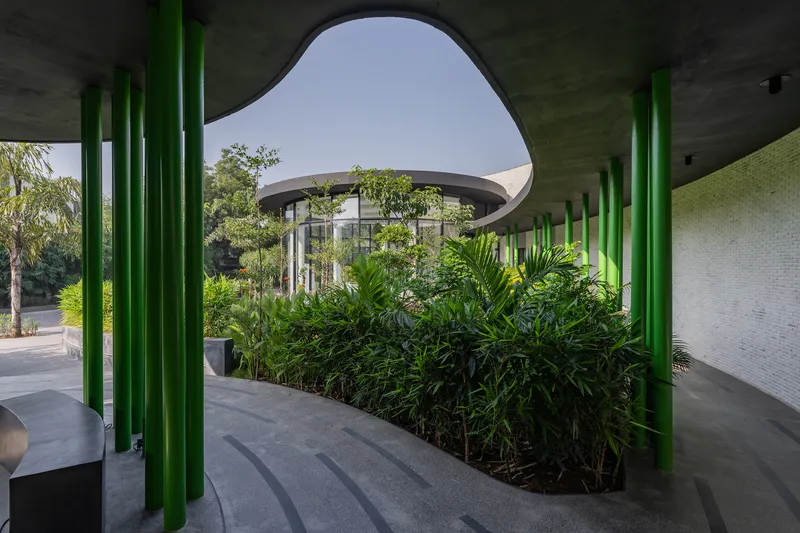
Ace Associates wraps a 3,900-square-foot workspace in green columns and sweeping curves, set inside Asia's largest biogas campus in Anand. The architecture dissolves the office wall by wall, replacing them with living mass that filters air and softens light without sacrificing the precision a contemporary workplace requires.
Biophilic design has become marketing shorthand, but Whispering Curve takes the term seriously. The plant columns are not decorative; they are structural and atmospheric at once. The result is an office where every working hour feels closer to a forest clearing than a fluorescent grid.
Studio: Ace Associates
3. Atal Akshaya Urja Bhavan: India's First Net-Positive Energy Office, New Delhi

Edifice Consultants designed India's first net-positive energy office building for the Indian Renewable Energy Development Agency in New Delhi. The headquarters generates more energy than it consumes through a fully integrated solar array, passive cooling, and a climate-responsive envelope tuned to the punishing Delhi summer.
What makes Atal Akshaya Urja Bhavan exceptional is the alignment between client and building. A government renewable energy agency commissioned a headquarters that demonstrates its own mandate, and the architecture takes that responsibility seriously. The result is one of the most credible sustainability statements in Indian commercial architecture today.
Studio: Edifice Consultants Pvt. Ltd.
4. Plant Basingstoke: Restoring Peter Foggo's Hanging Gardens
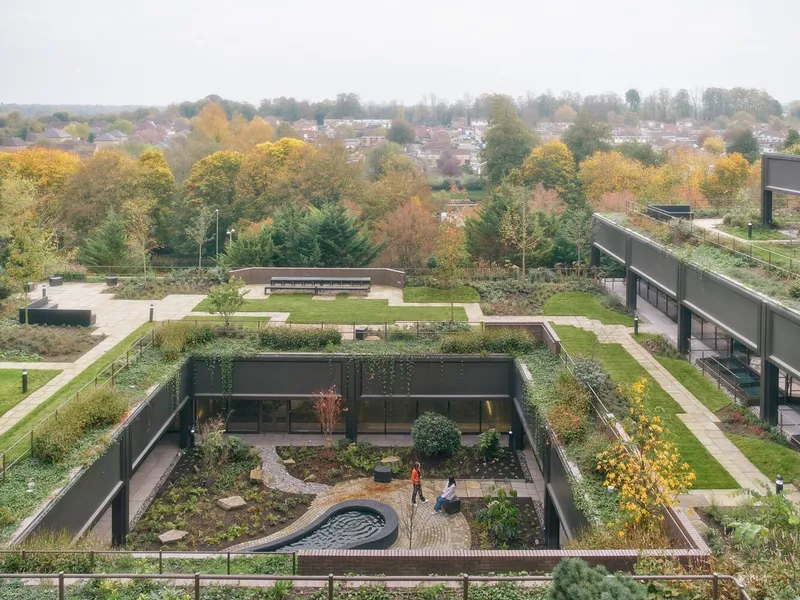
Four studios collaborated to restore Peter Foggo's terraced 1970s office building and James Russell's rooftop hanging gardens, then push the whole assembly toward BREEAM Outstanding. The project is part preservation, part performance retrofit, and entirely about proving that postwar workplace architecture is worth saving.
Plant Basingstoke pushes back against the demolition-and-rebuild instinct that dominates office portfolios. Foggo's original was an unusual building. The restoration honors it while modernizing the systems, the gardens, and the public ground floor. It is a model for what can happen when developers treat embodied carbon as a brief, not an inconvenience.
Corporate Landmarks and Campuses
Five projects in this section treat corporate architecture as civic architecture. They are large, visible, and unapologetic about the buildings they need to be. The best ones earn their scale through programmatic generosity.
5. XPENG Headquarters by weico Architects, Guangzhou
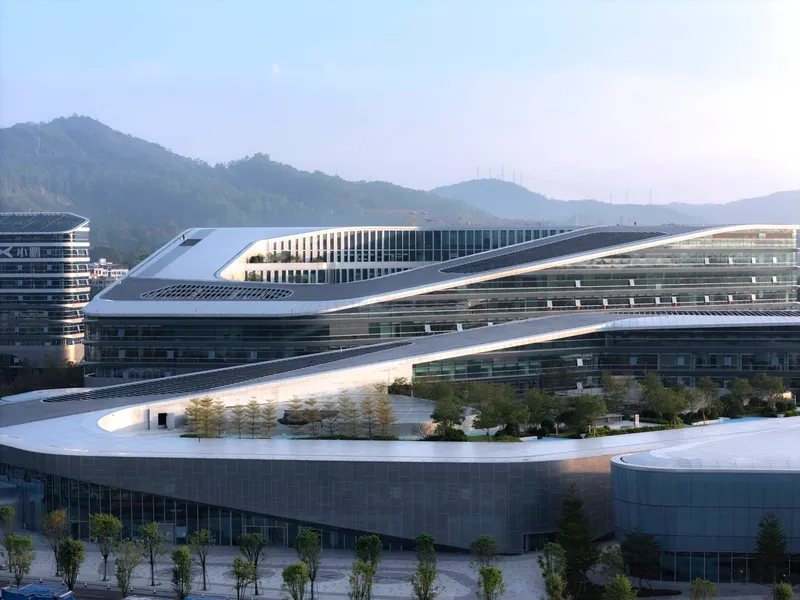
XPENG's new headquarters in Guangzhou treats the corporate campus as a research engine. weico Architects designed for an EV company that builds autonomous vehicles, robotics, and AI hardware under one roof, and the architecture had to host all three without choosing between them. The building reads as much like a lab as an office.
The proposal's success is in its programmatic generosity. Heavy R&D facilities usually live in industrial parks far from civic life. XPENG embeds them in a publicly engaged campus, treating engineering as something worth showing rather than hiding. The architecture argues that future-tech companies should look like part of their cities.
Studio: weico Architects
6. AIRSIDE by Snøhetta, Hong Kong
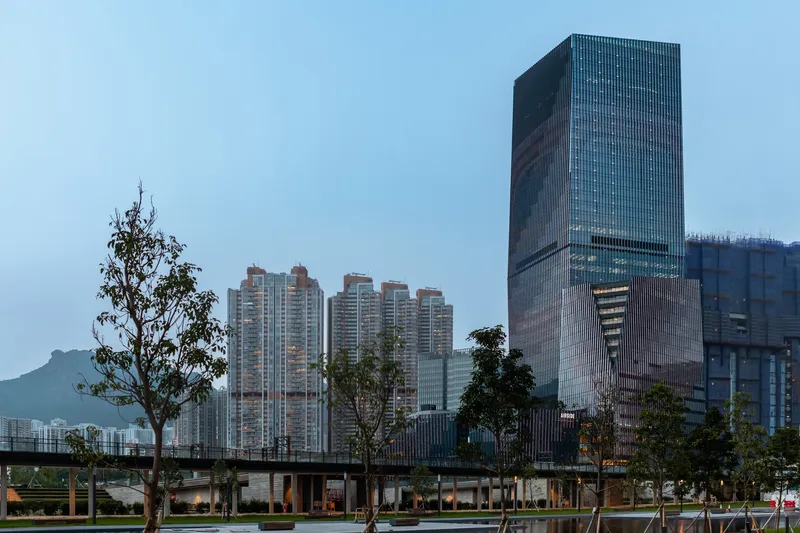
Snøhetta drapes the former Kai Tak Airport site in a textile-inspired tower that holds 177,670 square meters of office, retail, and public space. The project's scale is enormous; its restraint is more remarkable. The folded textile facade reads as a single material gesture across a building that could have fragmented into a dozen visual systems.
AIRSIDE works because it accepts the responsibility a building of this size carries. Kai Tak is one of the most consequential redevelopment sites in Asia, and Snøhetta's tower anchors the new district without overpowering it. The building does monumental work in a quietly disciplined register.
Studio: Snøhetta
7. Da Nang Hi-Tech Park Headquarters by HUNI Architectes
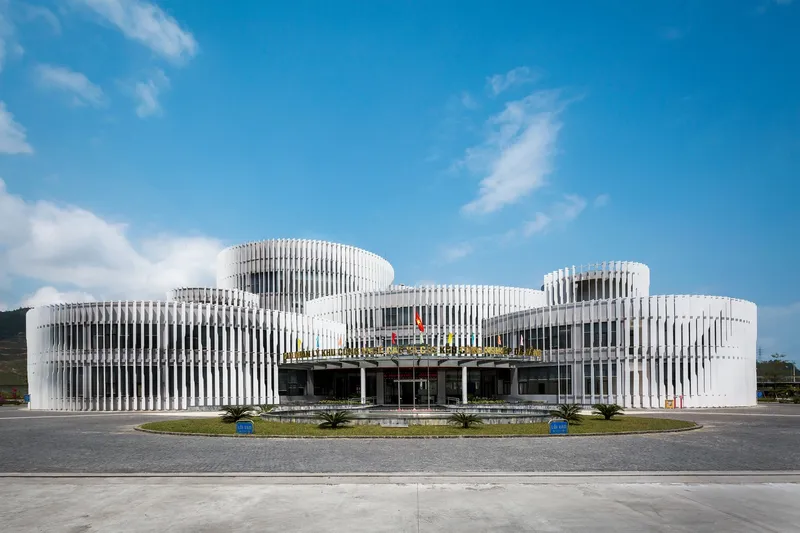
HUNI Architectes wraps Vietnam's Da Nang Hi-Tech Park in parametric sun blades simulated against the local climate. The gear-inspired form is not symbolic decoration; it is a functional response to a tropical sun that punishes glass facades on every side.
What gives the project its weight is the integration of climate simulation into the formal language. The blades are individually angled for solar exposure, and the result is a facade that looks computed because it is. It is one of the clearest examples on this list of climate-as-aesthetic working without compromise.
Studio: HUNI Architectes
8. Orange Village by Koffi & Diabaté Architectes, Abidjan
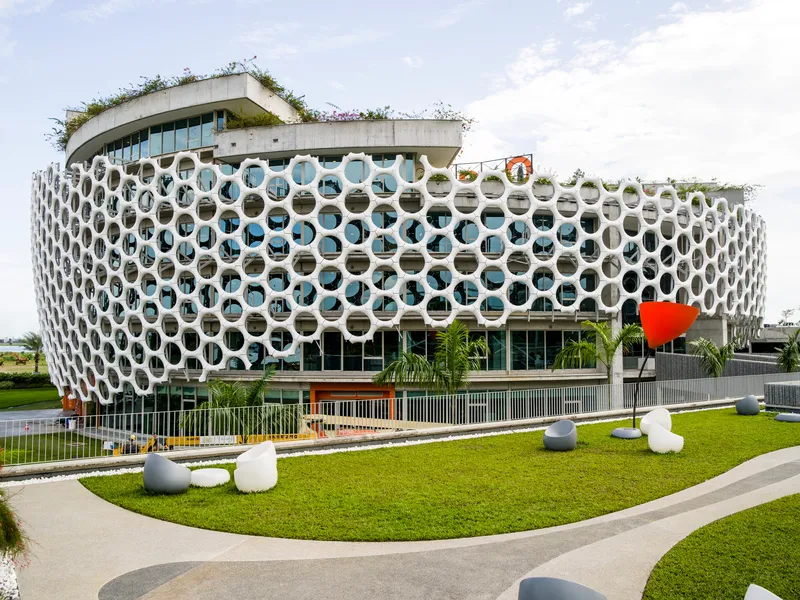
Orange Village proposes a sustainable corporate campus in Abidjan that treats West African urbanism with the same architectural seriousness usually reserved for European business parks. Koffi & Diabaté blend futuristic form with green space and collaborative working programs.
The project is significant in part for what it represents about where corporate architecture is being built. Abidjan, Lagos, Nairobi, and Dakar are becoming destinations for tech and telecom headquarters, and Orange Village shows what happens when those projects are designed by architects rooted in the region rather than imported from elsewhere.
Studio: Koffi & Diabaté Architectes
9. The Screen Office by ARK-architecture, Tunis
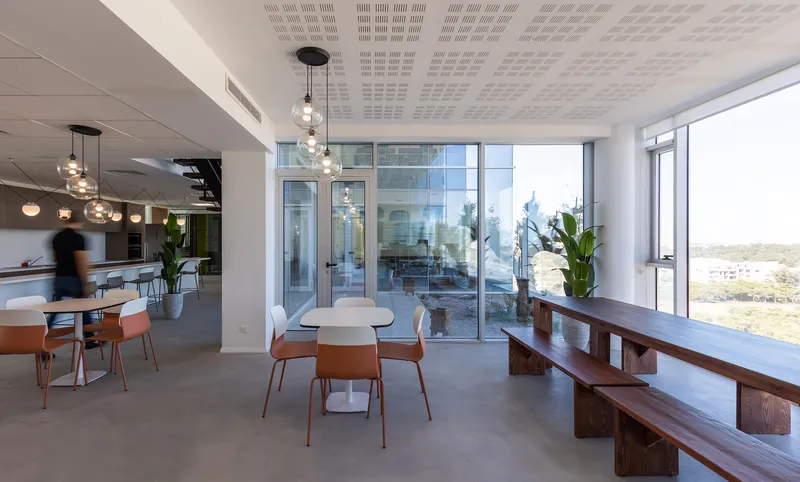
ARK-architecture and AUDA built a 23,000-square-meter office tower in Tunis with a perforated screen facade and a bright yellow entrance volume. The screen is the building's structural identity and its climate strategy simultaneously, filtering Mediterranean sun while creating a recognizable urban presence.
The yellow entrance is the kind of move most corporate offices have been trained to avoid. The Screen Office uses it the right way: a single color, applied with discipline, at the threshold where a building most needs to communicate. It signals welcome in a city that rewards architectural confidence.
Studio: ARK-architecture
Adaptive Reuse Workspaces
Three projects in this section build their workplaces inside older buildings, treating the existing structure as a brief rather than an obstacle. Each one is a small argument against the demolition-and-rebuild instinct that dominates office portfolios.
10. Machinery Hall Renovation by KO and OK, Leipzig
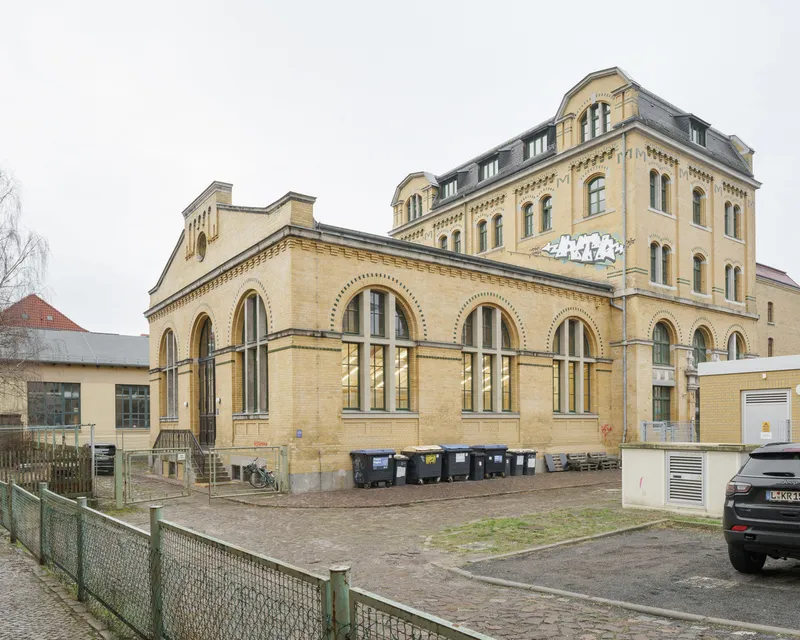
A historic Leipzig machinery hall transformed into workshops and offices while preserving the industrial character that gave the building its presence in the first place. KO and OK kept the trusses, the windows, the rhythm of the bays, and let new functions slot into the architecture rather than replace it.
Adaptive reuse this disciplined is rare. The temptation with industrial conversions is to over-design, to insert glass mezzanines and curated lighting until the old shell becomes background. Machinery Hall avoids that trap. The new offices feel borrowed from the building, not imposed on it.
11. Xưởng Xép: A Modernist Apartment Becomes a Studio, Ho Chi Minh City

Xưởng Xép turned a Ho Chi Minh City modernist apartment into its own studio, layering green MDF, raw steel, and teak over original tile floors and sanded concrete walls. The renovation reads as an argument: that good adaptive reuse is about adding visible new material rather than erasing what was there.
The studio's working life is now legible in its architecture. You can see what came from the 1970s apartment and what came from the renovation. That clarity is unusual and valuable. Most office renovations work hard to look seamless. Xưởng Xép works hard to look honest.
12. Nothing Design Co. Headquarters by Range Design, Chicago
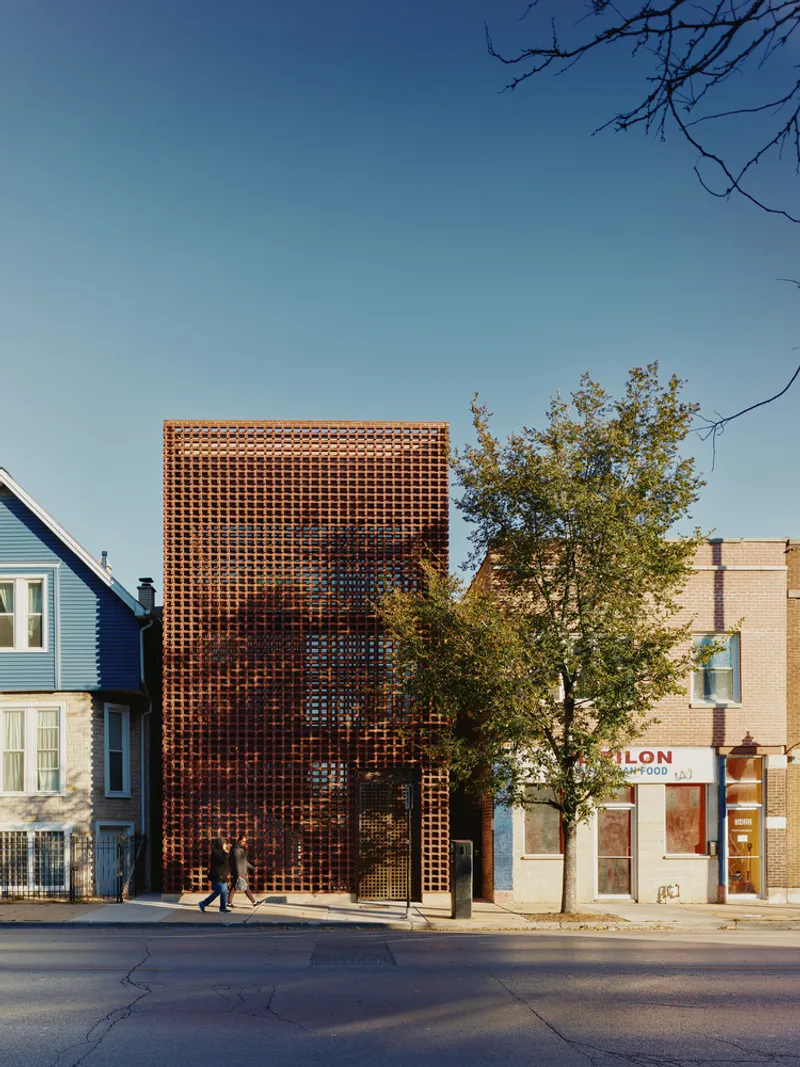
Range Design wraps a former dentist's office in Chicago's Logan Square in a porous brick screen that channels the city's masonry DNA. The interior becomes a double-height furniture showroom and design studio, and the new facade gives the building back the civic presence its previous program denied it.
What makes the project rewarding is its respect for context. Chicago is a brick city. Range Design did not import a vocabulary from elsewhere; they read the neighborhood carefully and added something that belongs. The result is a workspace that strengthens its block rather than disrupting it.
Studio: Range Design & Architecture
Coworking and Modular Offices
Four projects in this section grapple with flexibility as a design problem. Coworking spaces, modular systems, and reconfigurable offices need different kinds of discipline. The best ones avoid the generic and commit to material specificity.
13. LABO by CUDO: A Neo-Renaissance Coworking Space, Wrocław
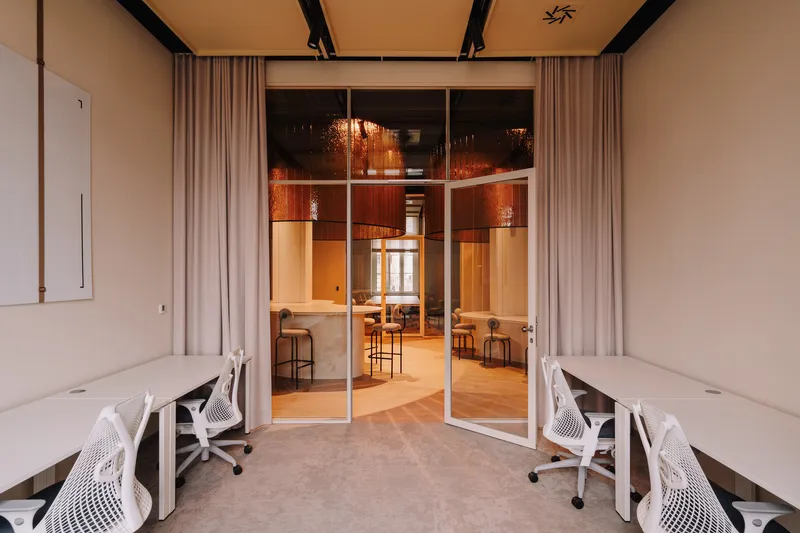
CUDO turned a 320-square-meter neo-Renaissance building on Wrocław's Oder River into the city's first high-end coworking space. The architecture had to negotiate between heritage protection and the contemporary expectations of independent workers, and CUDO threaded that needle with care.
Coworking interiors usually default to industrial-loft signals because they read as creative. LABO refuses that vocabulary. The heritage envelope provides the character; the new interiors are restrained because they have to be. The result is a coworking space that feels like a serious place to work, not a curated stage.
Studio: CUDO
14. S NINE Co-working by PMA madhushala, Pune

PMA madhushala designed a sustainable, modular coworking space in Pune that blends red sandstone, greenery, and local craftsmanship into a climate-responsive interior. S NINE is the rare coworking project that uses regional material vocabulary as a design strategy rather than a finishing touch.
The architecture reads as confident because every element belongs together. The sandstone is structural and tactile, the greenery is functional and atmospheric, and the modular partitions allow the space to evolve without losing identity. It is coworking design as urban architecture rather than interior styling.
Studio: PMA madhushala
15. Lume Haus by Studio Prakruthi: A Modular Office
Studio Prakruthi proposes a modular, sustainable office that combines flexibility with bespoke interior detailing. Lume Haus is interesting precisely because it refuses the modular-versus-customized binary that dominates office design conversations. The kit of parts is modular, the finishes are not.
The proposition matters for clients commissioning new workspaces. Modular construction is faster and more sustainable, but it often produces interiors that look generic. Lume Haus offers a path forward: standardize the structural and mechanical systems, customize what the eye actually touches.
Studio: Studio Prakruthi
16. Carbonera Office by Carlana Mezzalira Pentimalli, Treviso
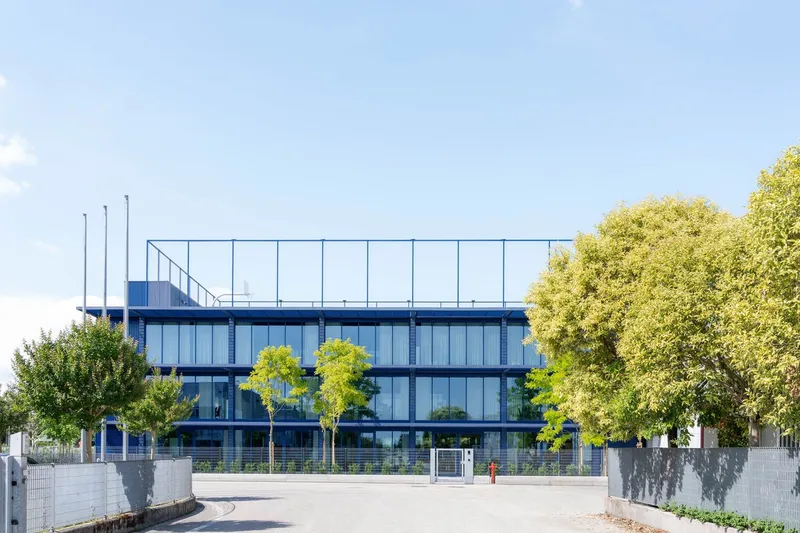
Carlana Mezzalira Pentimalli built a four-storey headquarters near Treviso that treats every wall, desk, and rooftop as something its occupants can rearrange at will. The flexibility is structural, not gestural. The building is engineered to be moved through, around, and into without permission slips.
What sets Carbonera apart is the discipline behind its openness. Most flexible offices simply minimize partitions and call it freedom. This one builds in actual reconfiguration: the floors, the systems, the relationship between work and outdoor terrace. It is an office that takes employee agency seriously as an architectural problem.
Studio: Carlana Mezzalira Pentimalli
Creative Studios and Campus Hubs
Three projects in this section blur the line between office and creative studio, between workplace and learning environment. They reflect a discipline coming to terms with the fact that work no longer happens in one kind of room.
17. KUBRICK Office by InOrder Studio, Taichung
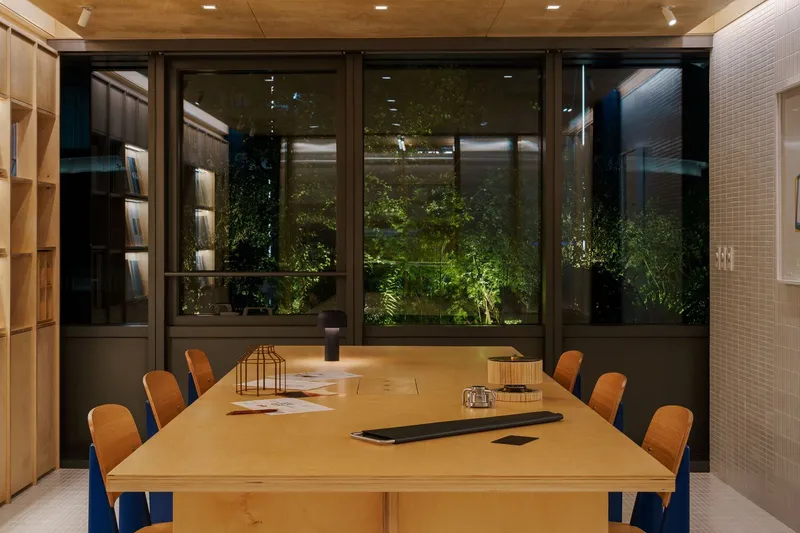
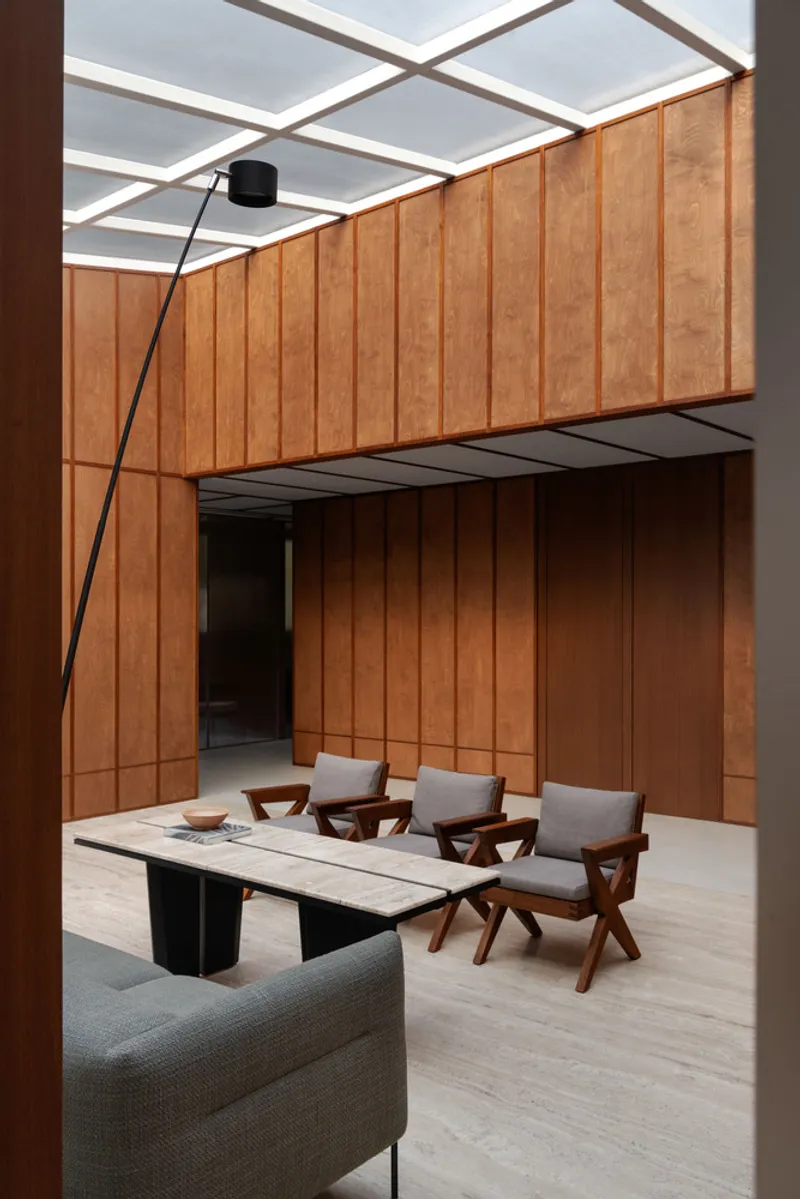
InOrder Studio wraps a Taichung office in birch plywood for a ceiling-to-floor warmth that turns 190 square meters into one of the most material-distinctive workspaces on this list. The architecture treats wood not as accent but as the spatial system itself.
KUBRICK's restraint is its strength. Most small offices try to do too much with their interiors and end up busy. This one commits to a single material story and lets the program (workstations, meeting rooms, kitchen) settle into it. The result feels like a single sculpted volume rather than an assembled set of rooms.
Studio: InOrder Studio
18. FNC Entertainment Seongsu Office by EDIT TABLE, Seoul
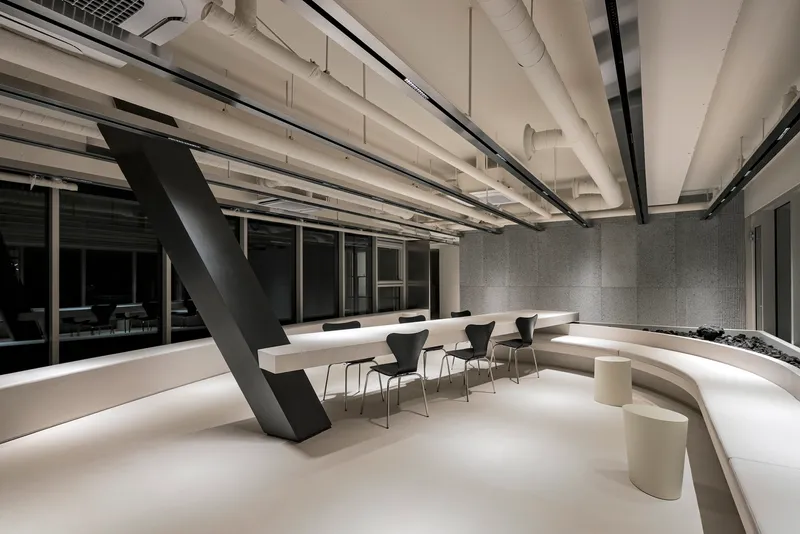
EDIT TABLE designed FNC Entertainment's Seongsu office in Seoul as a dynamic flow of linear architecture and volumetric forms, reflecting an entertainment company whose creative output runs from K-pop to film production. The architecture had to perform across that range.
The strongest interior detail is the studio's willingness to let lines and volumes negotiate openly. Most entertainment-industry offices commit hard to a single visual language. FNC Seongsu is more honest. It admits that creative companies hold contradictions, and the architecture provides space for both halves of the equation.
Studio: EDIT TABLE
19. J Office by RVMN: Biophilic Office Design
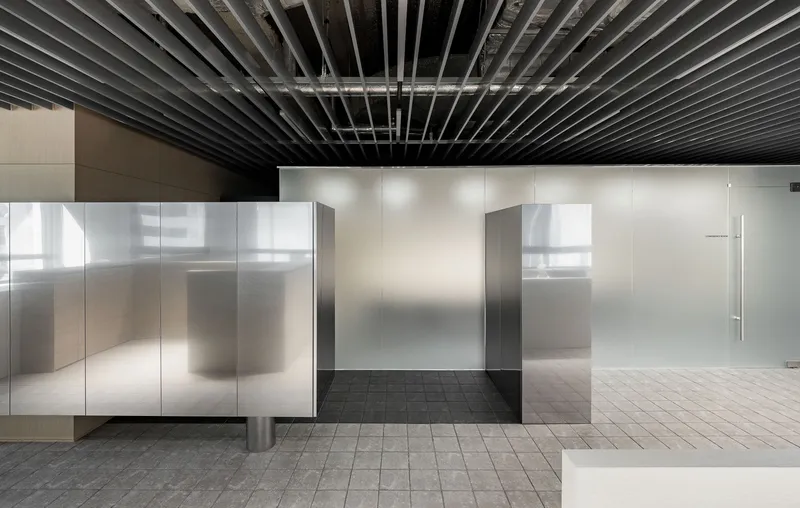
RVMN designed J Office as a biophilic workspace that treats productivity and well-being as the same design problem. Plants, natural light, and material warmth are not decorative accents but the architectural strategy. Every workstation negotiates a relationship with the greenery threaded through the office.
What makes J Office stand out among biophilic office proposals is the discipline behind it. Most biophilic interiors stop at potted plants and a green wall. RVMN built the entire spatial sequence around how light, planting, and circulation reinforce each other, producing an office where the design intent reads clearly without overstating itself.
Studio: RVMN
The Conceptual Future
One conceptual proposal closes the list, asking what the next generation of office towers should look like when computation, not the spreadsheet, organizes the floor plate.
20. 2050 Skyscraper: A Tower Where No Two Floors Match
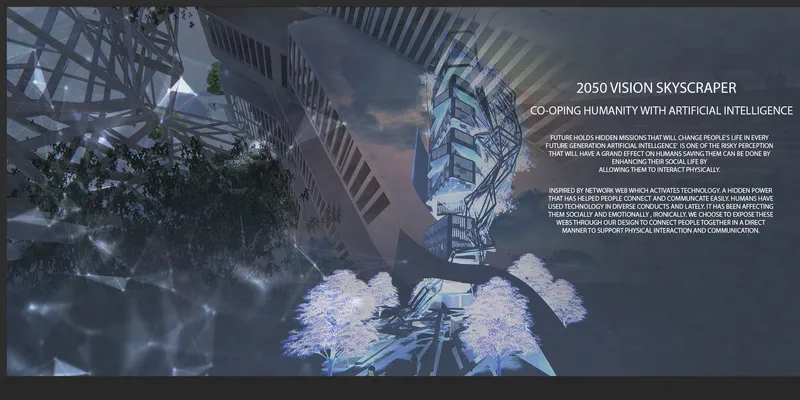
Rabah's 2050 Skyscraper imagines a workplace tower where every floor is unique, no two volumes align, and AI mediates how people and spaces find each other. The proposal pushes against the orthogonal logic that has organized office towers for a century, asking what happens when computation, not the spreadsheet, dictates the floor plate.
The project is the most speculative on this list, and the most necessary. Towers are still designed for an organization of work that the next decade is unlikely to keep. 2050 Skyscraper rejects that inertia. It imagines the office as a social condition that AI helps choreograph, and the architecture follows.
Designer: Rabah
What Office Architecture Told Us in 2025
Looking across these 20 projects, two patterns dominate. The first is the rejection of the generic. The most-engaged office projects of the year were the ones that committed hard to a specific material, climate, or program: timber in Gunma, sandstone in Pune, a textile facade in Hong Kong, a porous brick screen in Chicago. Generic glass-and-steel did not rank.
The second pattern is the willingness to take the workplace seriously as a civic question. The most popular projects on this list are not designed for the employees alone. They open to streets, host public ground floors, integrate with surrounding neighborhoods, and treat the corporate address as a contribution to the city. That shift in expectation may be the most important thing the office discipline learned this year.
All 20 projects are featured in full on uni.xyz, with detailed photographs, plans, and architectural descriptions. Explore them, save the ones that inspire you, and consider how your own workplace projects might contribute to this evolving conversation about what offices should be when they no longer have to be where work happens by default.
This article features projects published on uni.xyz in 2025, ranked by reader engagement. Last updated: May 2026.


Popular Articles
Popular articles from the community


longwave studio Reorganizes a 112 m² Tainan Apartment Around the Daily Routines of a Family and Two Cats
In Tainan, Taiwan, birch plywood, rust-red furniture and a freestanding plaster wall link arrival, storage, work and family life in one apartment.

Architekt Andreas Gruber Scatters 23 Dark Timber Chalets Across a South Tyrolean Forest Edge
In Molini di Tures, Amonti Chalets breaks a resort into a hamlet of gabled timber houses, with parking, storage and services pushed into the slope.

Cube Design Draws an Ecological Corridor Between Two Shenzhen Hills with the Nankai Building
Beside Shenzhen's container docks, the Nankai Building pairs stacked balconies with a climbing green screen to connect two hillsides across its height.

David Macias Steps a Doorless Stone and Plaster House Down a Tropical Colombian Hillside
In the humid hills of Colombia, Threshold House replaces the front door with an open void and terraces its 850 m² down the slope instead of fighting it.

Similar Reads
You might also enjoy these articles

Gil Mello Arquitetura Tilts a Single Roof Toward the Waterfalls on a Plateau Above Aiuruoca, Brazil
In Aiuruoca, Minas Gerais, a 200 m² house of local labor and reclaimed poles pairs a low valley veranda with a tall mountain one.

U.GA Architects Wraps an Oval Rooftop Pool in Curved Board-Formed Concrete on Busan's Jeollidan-gil
In Busan's Jeonpo-dong, a 454 m² mixed-use block stacks a neighborhood facility, guest rooms and an oval rooftop pool inside spiraling concrete walls.

Felipe Hess Arquitetos Turns a Blind Stone Wall to the Street and Opens a Brazilian House onto a Courtyard and Canal
A canal-front house in Brazil hides behind painted stone and planting, then opens to an olive-tree courtyard, a reed-ceilinged porch and a curving pool.
David Macias Steps a Doorless Stone and Plaster House Down a Tropical Colombian Hillside
In the humid hills of Colombia, Threshold House replaces the front door with an open void and terraces its 850 m² down the slope instead of fighting it.

Explore Office Building Competitions
Discover active competitions in this discipline

Challenge to reimagine the Iron Throne

Photograph architecture without architects

Illustrate the lost glory of Angkor Wat - Render Challenge

Design challenge to reuse E-waste
Comments (0)
Please login or sign up to add comments
No comments yet. Be the first to comment!