
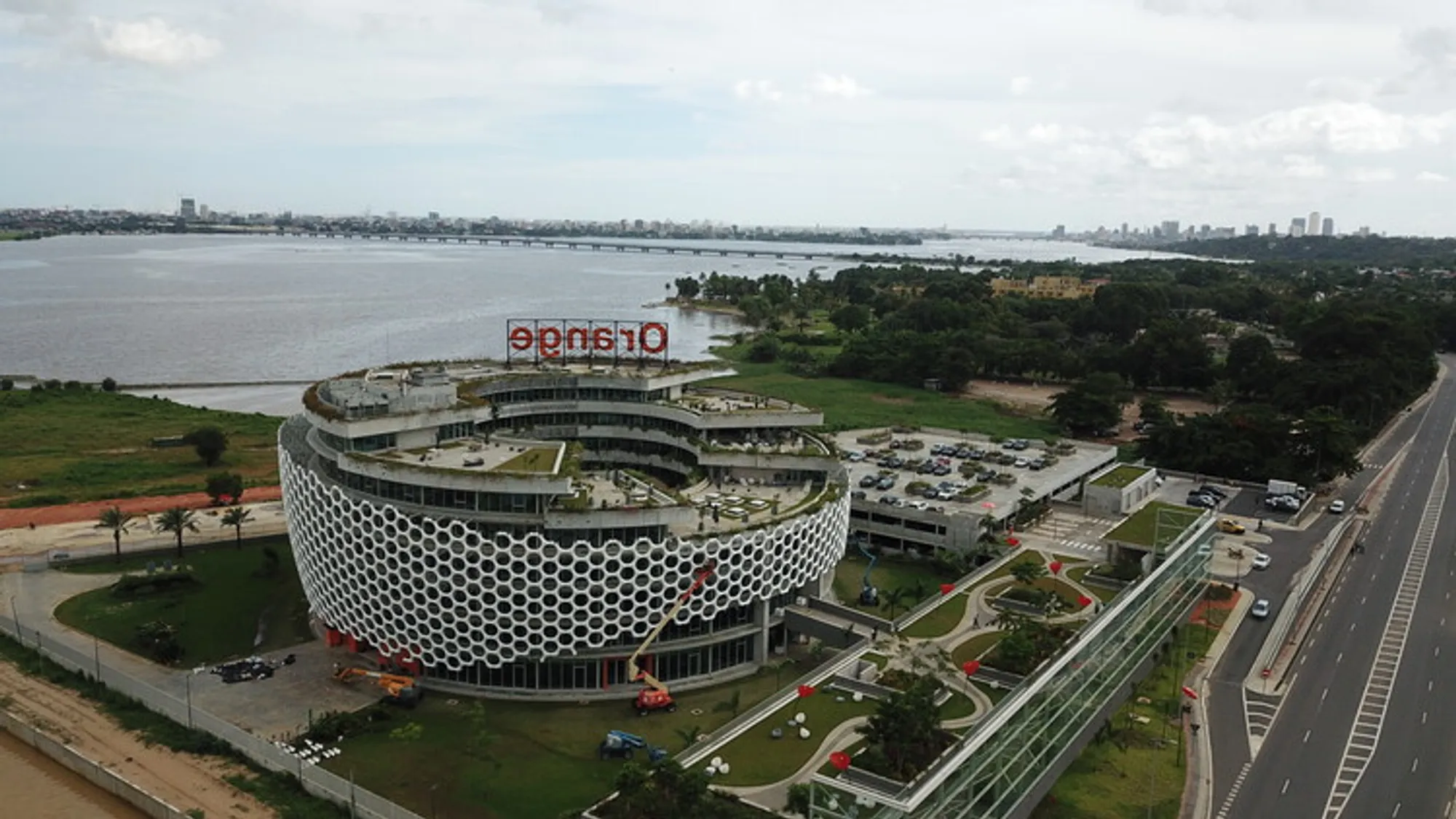
Koffi & Diabaté Wrap Orange's Abidjan Headquarters in a 4,000-Piece Double Skin
A seven-story circular campus on the Ébrié Lagoon filters tropical sun through a golf-ball-inspired perforated envelope.


Corporate headquarters in tropical climates tend to solve the sun problem by retreating behind tinted glass and cranking the air conditioning. Koffi & Diabaté Architectes took a fundamentally different approach for Orange Côte d'Ivoire's new campus in the Riviera Golf district of Abidjan: they wrapped the entire building in a 43,000 m² perforated exoskeleton made of 4,000 unique double-curved precast elements, turning the facade itself into the primary cooling strategy. The result is a building that looks nothing like the curtain-wall office towers that line African capitals, and performs nothing like them either.
Completed in 2022 after five years of construction, Orange Village is a 68-meter-diameter circular structure that rises from three stories at its main entrance to five stories along the edge of the Ébrié Lagoon. The golf-ball silhouette is a deliberate nod to the Riviera Golf Course next door, but the real interest lies deeper: in the interplay between raw exposed concrete and advanced parametric fabrication, between West African cultural symbolism and global digital infrastructure, between a corporate campus and an emerging piece of public urbanism.
The Envelope as Architecture
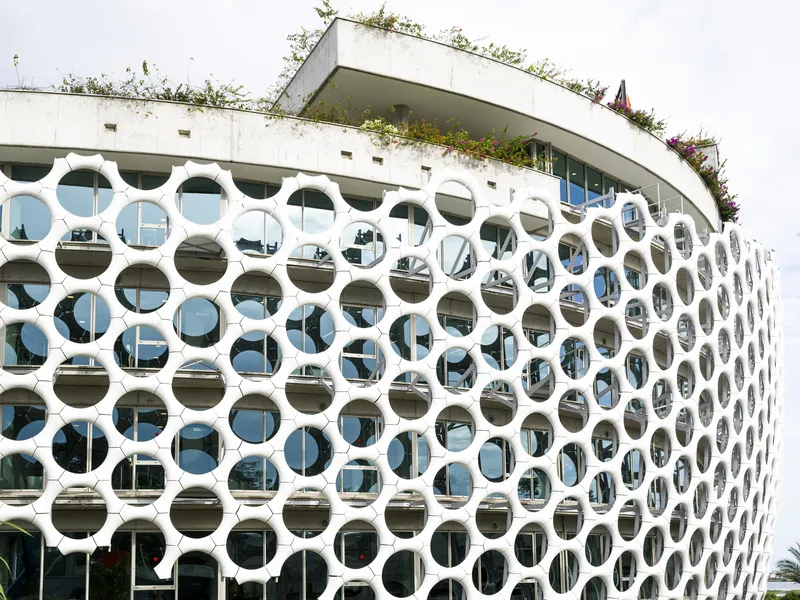
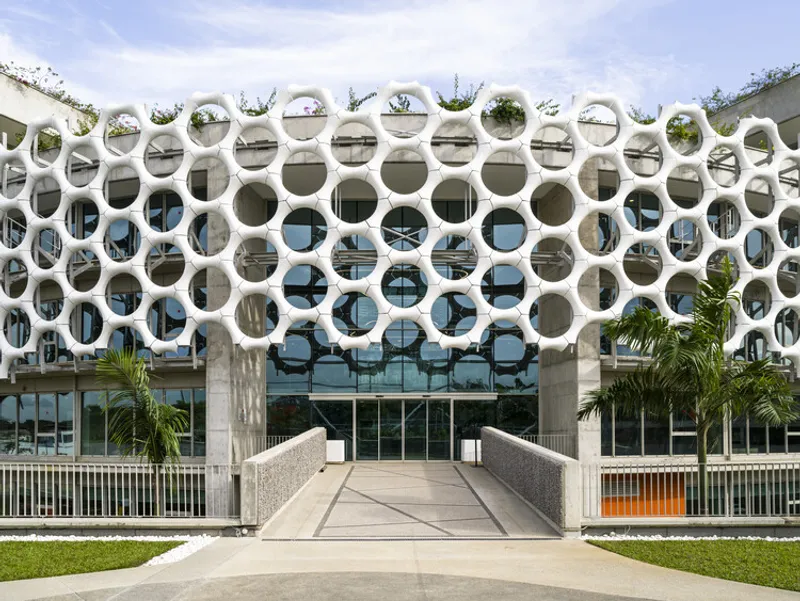
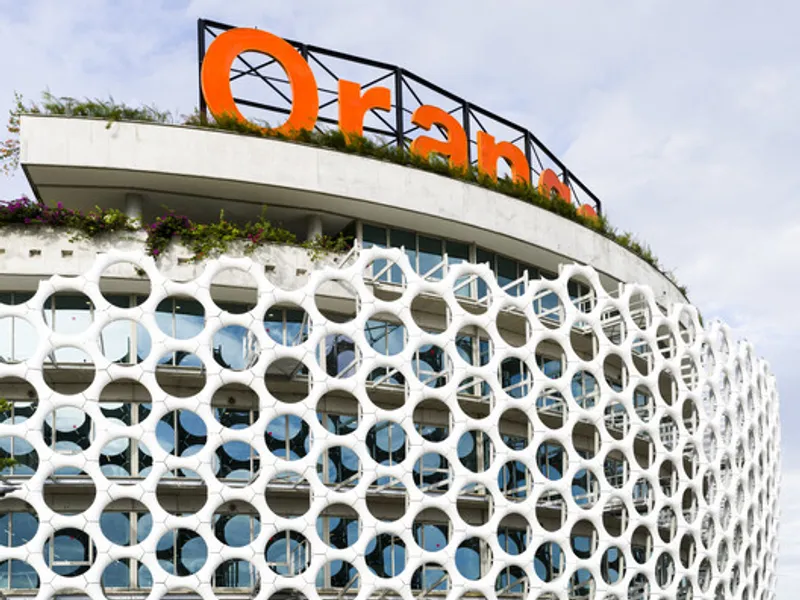
Every serious building in the tropics must negotiate with the sun, but few do so with such sculptural commitment. The double skin here is not a bolt-on brise-soleil; it is the building's defining architectural gesture, a continuous curved screen that stands proud of the glazed curtain wall behind it. The 4,000 interlocking pieces were modeled in Dassault Systèmes' 3D software and fabricated by Moroccan contractor Jet Contractors, making the envelope a genuinely pan-African engineering effort delivered through BIM.
From the ground, the perforated circles read as an abstract textile pattern. From the lagoon, the building registers as a single white volume punctuated by shadow. The screen reduces direct solar gain across roughly 40,000 m² of facade area, limiting heat transfer enough to cut cooling loads substantially. It is passive design at a corporate scale, and it does not look like a sacrifice.
The Central Atrium and Garden Core
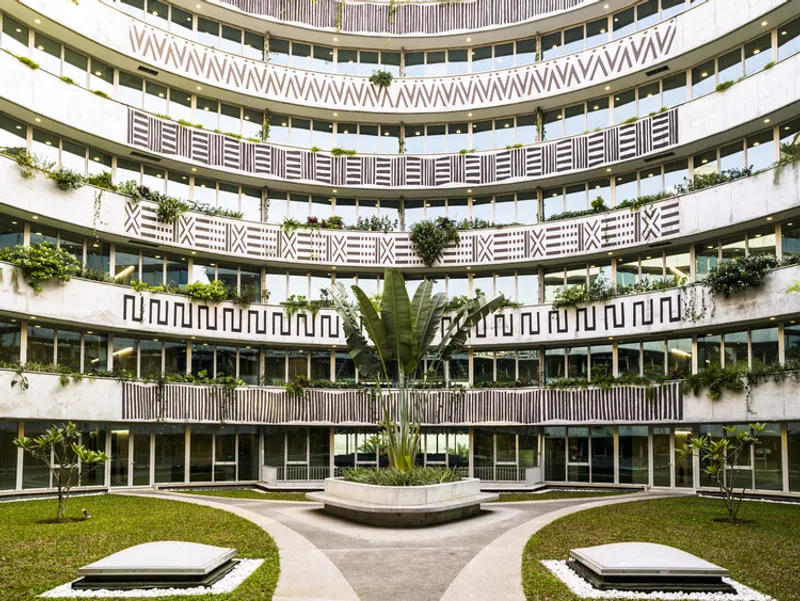
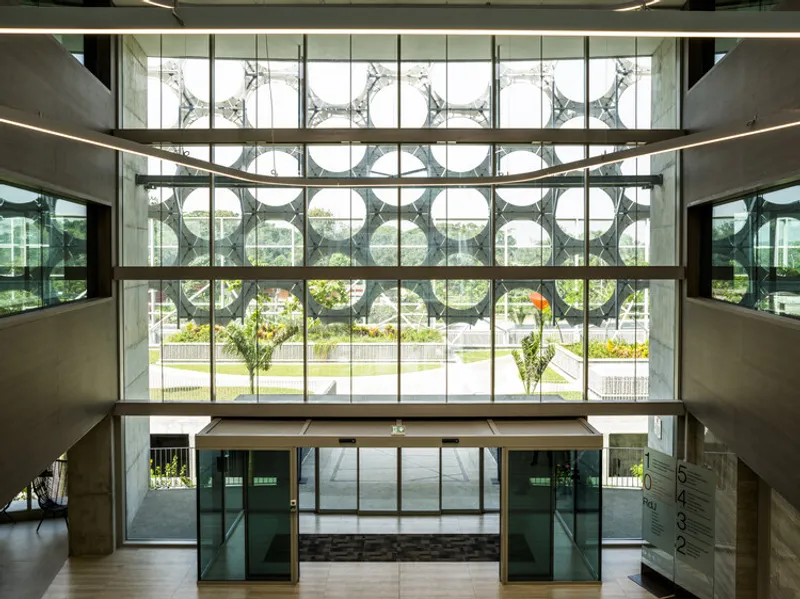
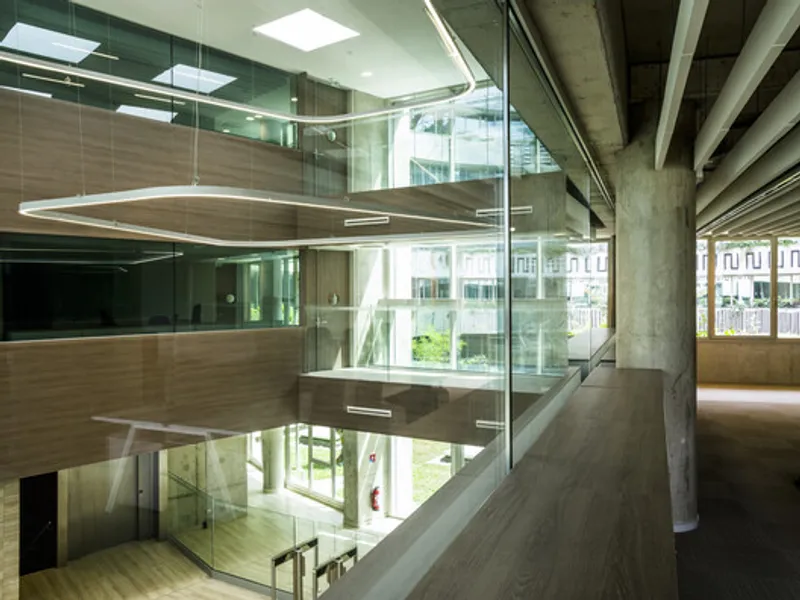
Cut open the circular plan and you find the building's social engine: a multi-level atrium ringed by planted terraces that wraps around a landscaped central courtyard. Triple-height glazing floods the interior with diffused light, while the courtyard itself provides a green focus visible from nearly every workspace in the building. Cylindrical concrete columns march through the atrium, their raw finish contrasting with timber flooring and wood-paneled walls that warm the palette.
The concentric geometry means that circulation is continuous rather than corridor-based. People move around the ring and encounter each other repeatedly, an organizational strategy the architects describe as fostering informal exchange and innovation. Nearly 10,000 m² of the 18,181 m² site is planted, and greenery extends up through balconies, roof terraces, and planted fences, so the boundary between interior and landscape stays deliberately porous.
Program Stacked by Openness
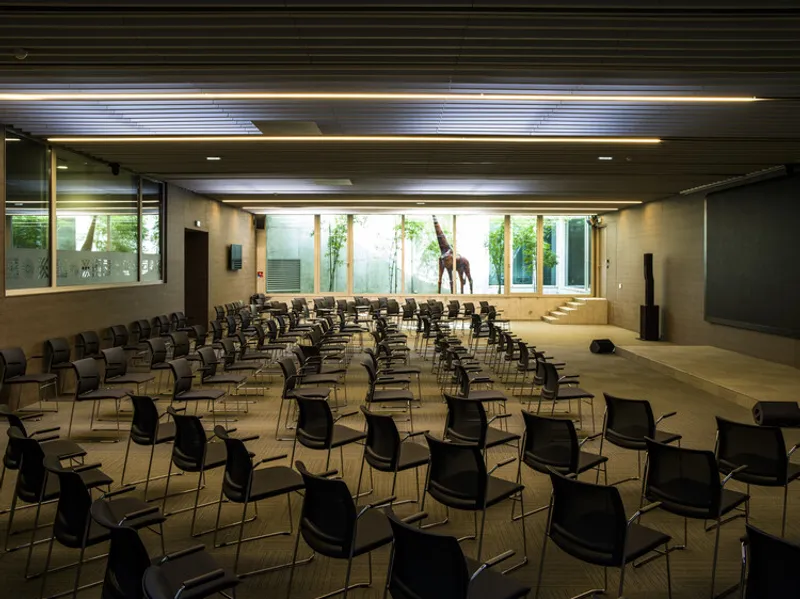
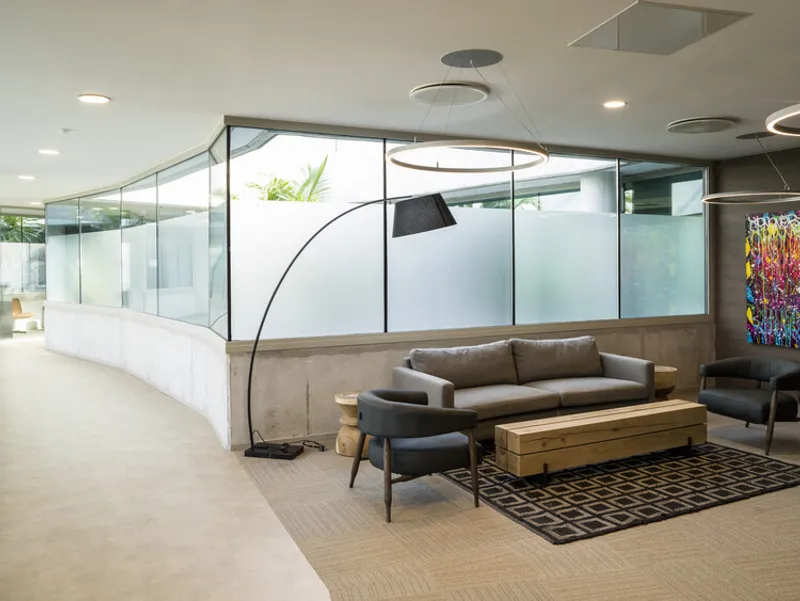
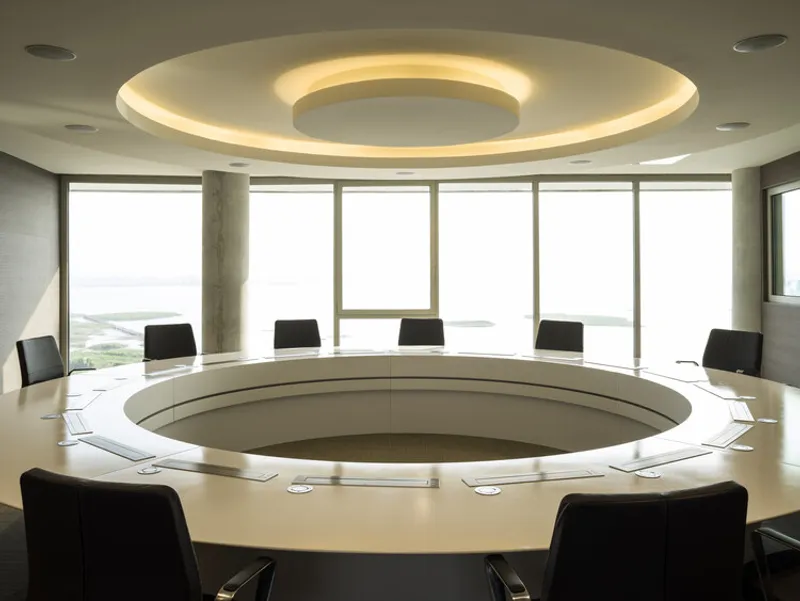
The ground and garden levels are the most public zones: a conference center, training rooms, a restaurant, and a gym cluster around the courtyard, establishing the campus as a social hub rather than a sealed office block. This base layer is where Orange Village acts most like a piece of the neighborhood, and it is the first step in a larger masterplan that will eventually include an urban park and public green space along the lagoon.
Office floors above mix individual offices, flexible co-working areas, small meeting rooms, cubicles, and isolation booths. The variety is important: rather than defaulting to either open-plan or cellular, the design offers genuine choice. The top floor reserves lagoon-facing offices for senior management, decorated with locally sourced artworks selected for the VIP lounges. Interior graphics draw on Bogolan motifs, and each of the seven levels carries identity symbols referencing different regions and cultural groups of Côte d'Ivoire.
Materiality: Concrete, Timber, Honesty
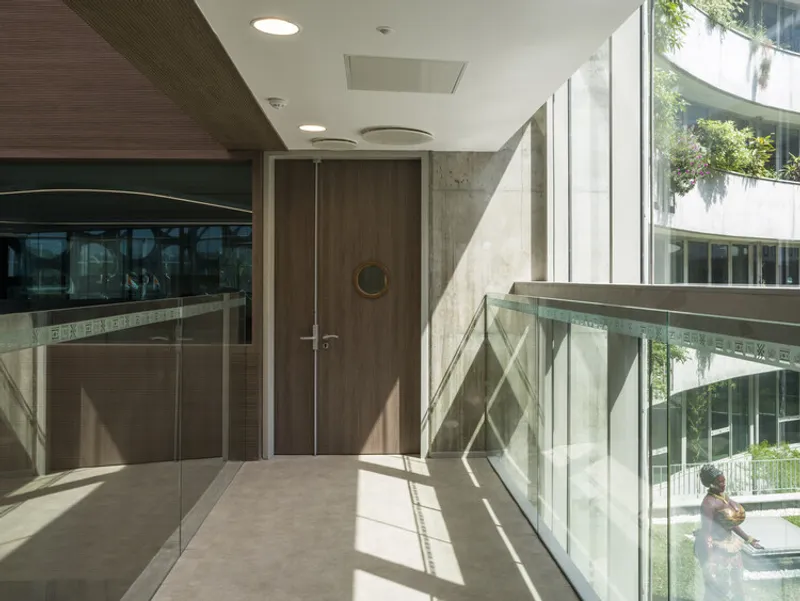
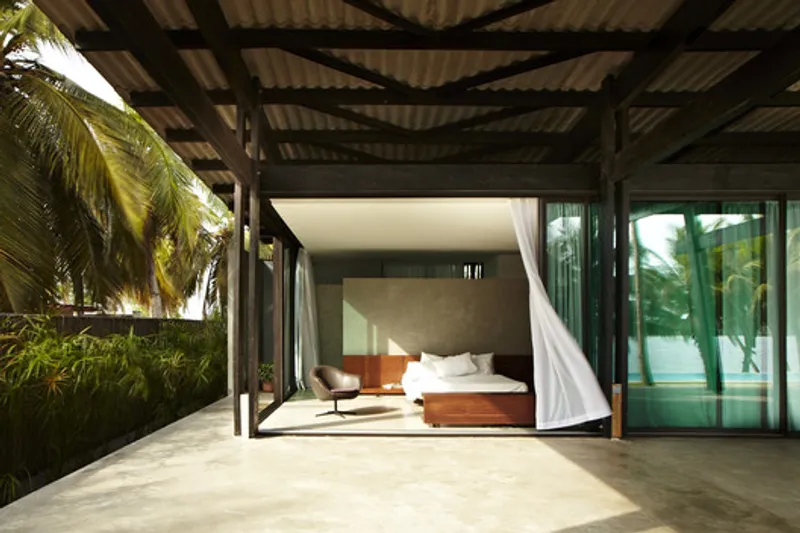
Koffi & Diabaté chose to leave the concrete structure exposed wherever possible, a decision that gives the interiors an assertive weight. Bridge connections between upper levels reveal board-marked concrete walls bathed in raking sunlight, while the covered outdoor terrace at rooftop level pairs corrugated metal, timber beams, and palm canopy in a register closer to vernacular pavilion architecture than corporate polish.
The architects describe the duality as oscillating between raw material expression and advanced technological performance. That tension is legible in every transition: from the rough concrete columns of the atrium to the precision-fabricated double skin outside, from the hand-selected local artworks to the BIM-delivered digital model that coordinated construction. It is a building comfortable with contradiction, and stronger for it.
Urban and Landscape Strategy
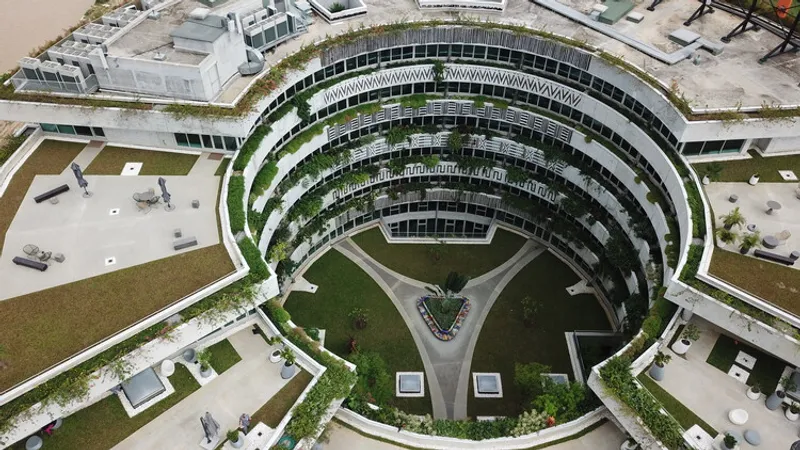
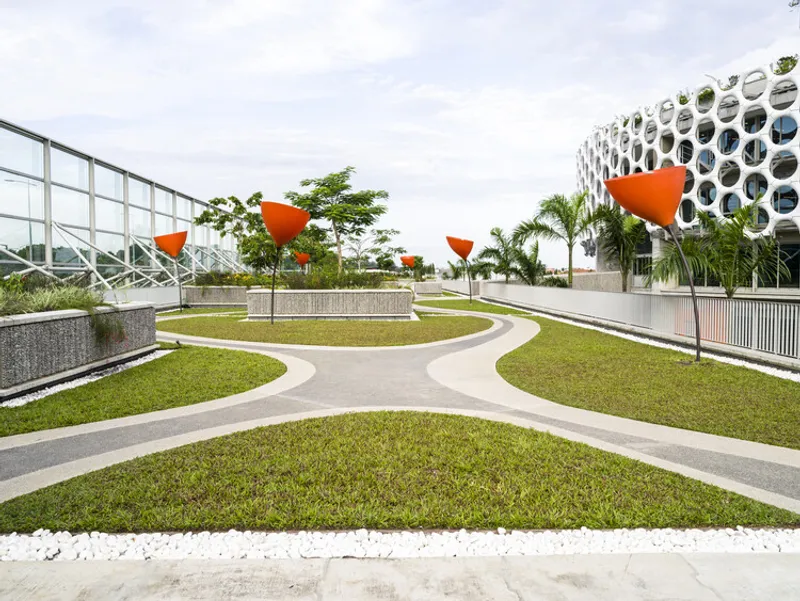
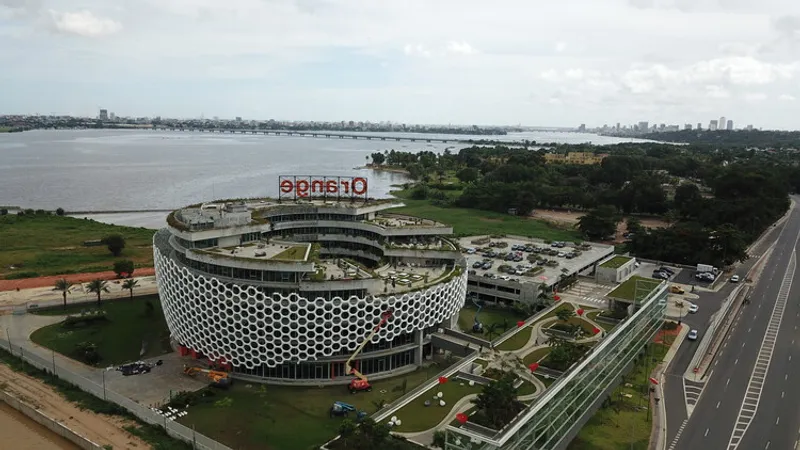
Seen from above, the building's circular footprint sits within a broader landscape of terraced lawns, curved pathways, orange-accented shade structures, and mature palms. The graduated massing, three stories at the street, five at the waterfront, complies with local height regulations while creating a topographic transition from the neighborhood to the lagoon edge. The Riviera Golf district is affluent and institutional, ringed by embassies, corporations, and international schools, so the stakes for contextual integration are high.
Orange Village is conceived as a structuring element within that neighborhood's evolving masterplan, not a standalone corporate fortress. Green roofs, planted fences, and the eventual public park extending from the site all signal an ambition to contribute shared landscape infrastructure to the city. Whether that ambition survives contact with Abidjan's rapid growth remains to be seen, but the intentions are built into the ground.
Plans and Drawings
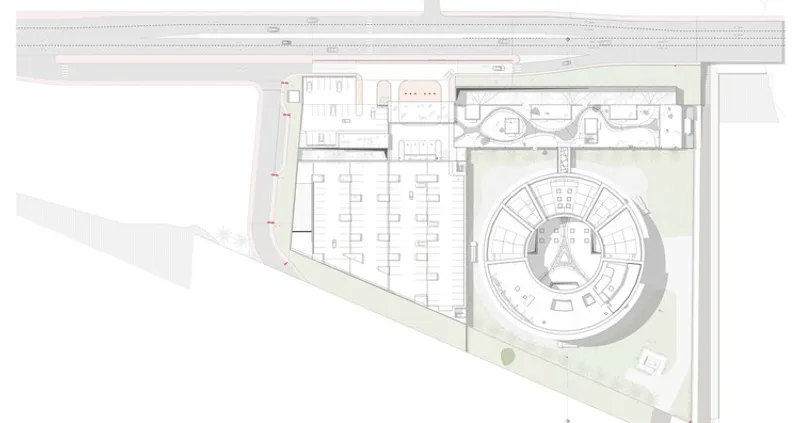
The floor plan confirms what the photographs suggest: the circular auditorium, rectangular gallery wings, and landscaped courtyard zones are organized along a clear concentric logic that radiates from the green core. Circulation wraps continuously, with programmatic zones differentiated by their relationship to the courtyard and the lagoon rather than by rigid partitioning. The parking area, at over 10,000 m², is kept largely below grade and at the periphery, preserving the planted surface that dominates the site.
Why This Project Matters
Orange Village matters because it demonstrates that climate-responsive corporate architecture in sub-Saharan Africa does not need to import its forms wholesale from temperate latitudes. The double-skin envelope is a genuinely engineered response to Abidjan's tropical heat, fabricated through a pan-African supply chain using advanced parametric tools. That combination of local climate knowledge, continental collaboration, and global technology is a model worth studying, especially as multinational firms continue to build headquarters across the continent.
It also matters as proof that an African architecture firm can deliver a building of this technical complexity and ambition on its home ground. Koffi & Diabaté have been practicing for decades, and Orange Village represents a kind of culmination: a project where material honesty, cultural identity, passive environmental strategy, and digital fabrication all converge in a single, legible form. The golf-ball metaphor may be playful, but the engineering, the landscape thinking, and the programmatic generosity underneath it are entirely serious.
Orange Village, designed by Koffi & Diabaté Architectes, Abidjan, Côte d'Ivoire. Site area: 18,181 m². Office space: 14,440 m². Completed 2022. Photography by François-Xavier Gbré.
About the Studio
Share Your Own Work on uni.xyz
If projects like this are the kind of work you want to make, uni.xyz is a place to publish your own, find collaborators, and enter design competitions.



Popular Articles
Popular articles from the community


Co-Life: Senior Housing Design That Reconnects Older Adults With the City
Co-Life reimagines senior housing design through healing gardens, shared streets, workshops, and a sustainable community across generations.

The Ocean Hive: Sustainable Architecture for a Self-Sufficient Civilization at Sea
The Ocean Hive imagines sustainable architecture at sea, where modular habitats, algae, wave power and ocean waste sustain a growing colony.

Co-life: Sustainable Architecture for Age-Friendly Community Living
Co-life reimagines sustainable architecture for seniors through courtyards, rammed earth, shared gardens, and spaces designed for belonging.

The Earth Pod: 3D Printed Homes for Resilient Refugee Communities
The Earth Pod reimagines refugee housing through 3D printed homes made from clay, combining resilience, self-sufficiency, and rapid shelter.

Similar Reads
You might also enjoy these articles


Hodi-Mandai Geram
Project Function: Preservation and revitalization of the Intangible heritage and socio-spatial identity of the Hodi by Housing, Cultural Memory Center, Sacred Grove, landscape, local tourism economy


Olio Towers: A Mid-Rise for Performers That Fuses Housing, Rehearsal, and Stage
Located blocks from Houston's Theater District, this modular tower stacks living units around a central performance atrium.

Oasis: Modular Green Housing Carved into Dhaka's Urban Fabric
A shortlisted Plugin Housing entry reclaims unauthorized settlements in Dhaka with stepped concrete volumes, green roofs, and ventilation-driven design.

Black Hole: A Floating Megastructure for the Post-Physical Era
Emiliano Mazzarotto envisions a spherical, self-scaling arena where e-sports, digital hotels, and holographic stadiums replace traditional public space.
Explore Office Building Competitions
Discover active competitions in this discipline



Challenge to reimagine the Iron Throne


Photograph architecture without architects


Illustrate the lost glory of Angkor Wat - Render Challenge


Design challenge to reuse E-waste
Comments (0)
Please login or sign up to add comments
No comments yet. Be the first to comment!