
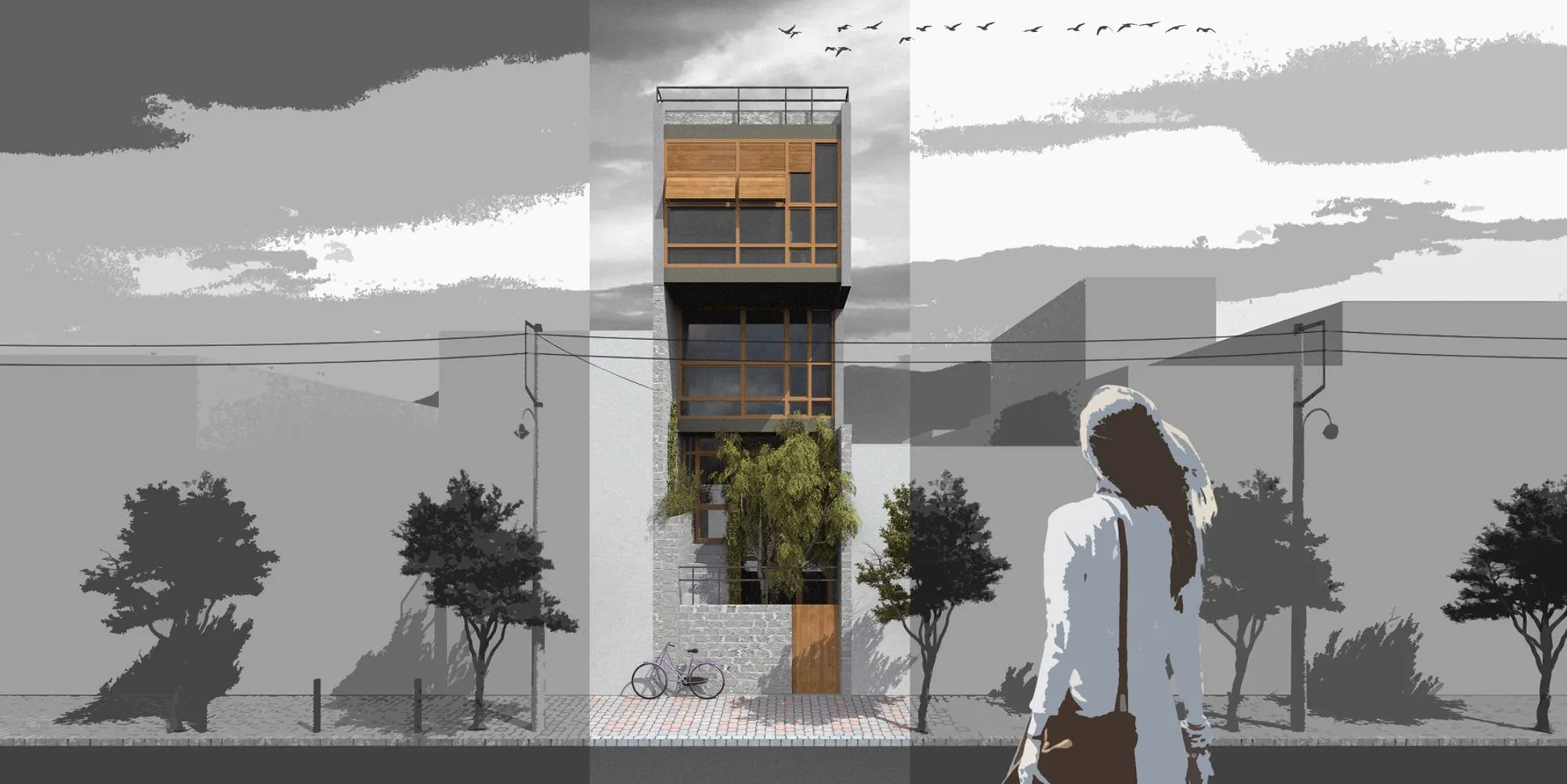
Compact & Sustainable Living in Piraeus: A Four-Level Family Home Built Around Light and Air
A narrow townhouse in one of Greece's densest port cities uses a central atrium and passive strategies to house three generations under one roof.


In Piraeus, where tightly packed buildings crowd out green space and the Mediterranean sun pounds concrete surfaces for most of the year, the question of how to house an extended family comfortably is also a question of how to breathe. This project answers it with a central atrium that pulls daylight into the core of a narrow four-level townhouse while driving cross-ventilation through every floor, turning the building's compactness from a liability into a thermal strategy.
Designed by Vaia Vakouli, this shortlisted entry for the Nano Nest 2020 competition tackles a specific domestic scenario: a modern Greek family of six, including two parents, two teenage sons, and two grandparents who live independently in a ground-floor studio. That arrangement, rooted in Greek cultural tradition, demands a building that can simultaneously foster intergenerational closeness and protect individual privacy. The result is a slim, vertically organized house that slots into the existing urban fabric of one of Greece's most densely populated port cities.
A Narrow Volume in Dense Urban Fabric
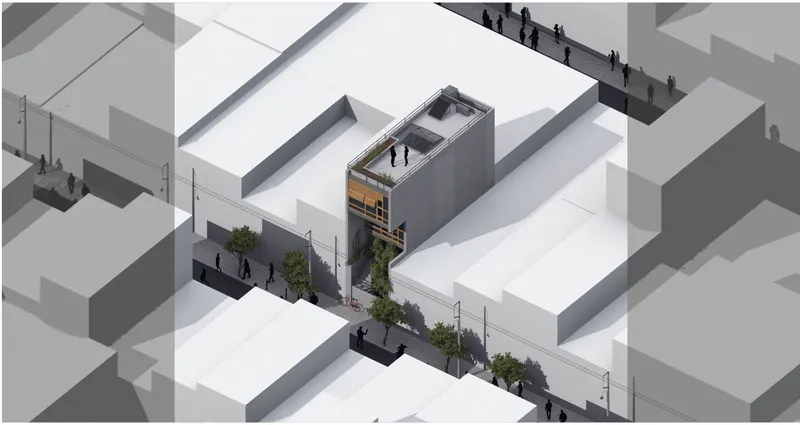
The axonometric drawing reveals how the building negotiates its tight site. Surrounded by the anonymous white massing typical of Piraeus, the townhouse reads as a precise insertion rather than an imposition. Its planted street level and rooftop terrace inject greenery into a neighborhood that has very little. The building's footprint is deliberately restrained, responding to the limited available land while stacking four functional levels vertically. Each level serves a distinct programmatic role, from the grandparents' accessible studio at ground level to the family living spaces and private bedrooms above.
Steel, Timber, and the Staircase as Spatial Engine
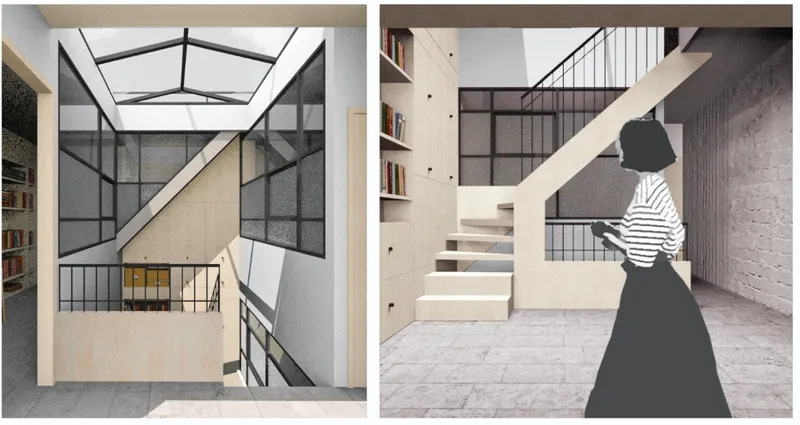
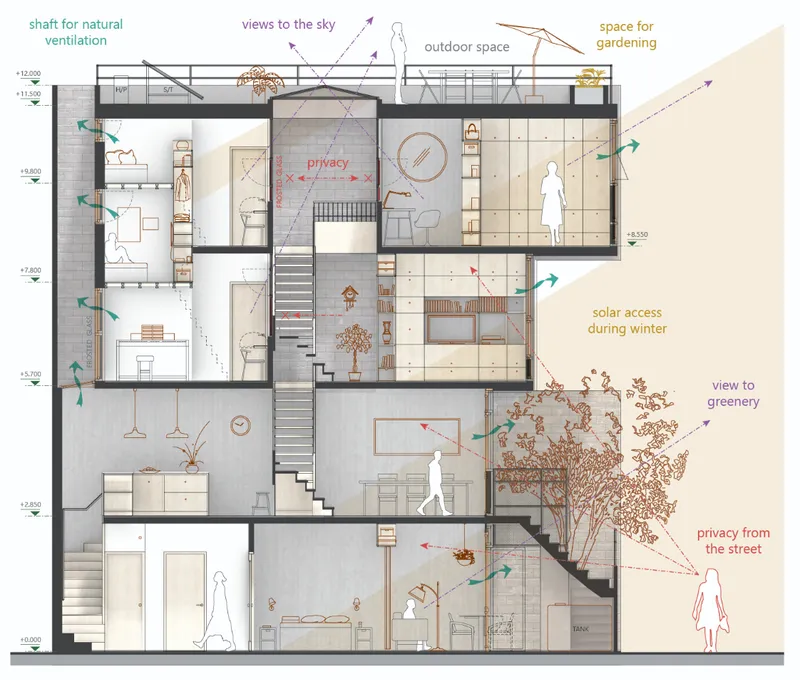
The section perspective exposes the interior staircase as the building's circulatory spine. Steel-framed glazing frames views between levels while pale timber treads soften the ascent. More than a vertical connection, the stair engages directly with the central atrium, meaning that moving through the house also means moving through its primary source of natural light. The effect is an interior that feels substantially more open than its narrow plan would suggest.
The annotated section drawing makes the strategy legible: interior courtyards punctuate the stacked floors, enabling daylight penetration and natural ventilation pathways that reduce reliance on mechanical cooling. Shared and private zones are carefully layered so that communal areas occupy the middle levels while bedrooms are pushed to the upper floors, buffered from street noise and oriented toward prevailing breezes.
Passive Systems Working Within the Section

The environmental systems diagram annotates the building's passive and active sustainability measures. Solar thermal panels on the roof provide hot water, while an air-source heat pump handles climate control with high efficiency. Rainwater collected from the roof terrace is redirected to irrigate planting during Greece's arid summers. The building envelope is insulated and fitted with thermally broken window frames, and large movable shutters on the facade allow occupants to regulate solar gain manually. Thermal mass from in-situ reinforced concrete, chosen partly for its seismic resilience, absorbs heat during the day and releases it at night. Airflow diagrams through the split-level rooms show how the atrium acts as a stack-effect chimney, exhausting warm air upward and drawing cooler air in from below.
A Street Face of Timber, Steel, and Planted Forecourt

At street level, the narrow facade balances transparency with enclosure. Steel-frame glazing and timber elements compose a warm, textured front that stands out against the prevailing concrete context without being aggressive. Recessed balconies add depth and shadow to the elevation while creating sheltered outdoor spaces on the upper levels. A planted forecourt softens the threshold between public street and private home, contributing a small but meaningful patch of green to the neighborhood. The material palette, which includes natural limestone, wood, and exposed board-formed concrete, is locally sourced and selected for low environmental impact, grounding the project in its specific Mediterranean context.
Why This Project Matters
Vakouli's design demonstrates that compact urban housing does not have to sacrifice environmental performance or domestic generosity. By organizing three generations around a central void that delivers light and air, the project turns a standard density problem into an architectural opportunity. The grandparents' independent studio, the modular storage solutions, and the optional partitions throughout the house all point to a building designed for longevity and adaptation, not just first-day aesthetics.
For cities like Piraeus, where population density is high and green space is scarce, this kind of thinking matters. The project proves that a single narrow plot can accommodate solar energy harvesting, rainwater collection, passive ventilation, seismic safety, and a full multigenerational domestic program without sprawling outward. It is a quiet argument for doing more with less, made persuasive by the clarity of its section and the intelligence of its environmental systems.
View the Full Project
About the Designers
Designer: Vaia Vakouli
Enter a Design Competition on uni.xyz
uni.xyz runs architecture and design competitions year-round that reward proposals with spatial conviction and real site intelligence.
Project credits: Compact & Sustainable living in Piraeus by Vaia Vakouli Nano Nest 2020 (uni.xyz).




Popular Articles
Popular articles from the community


The Earth Pod: 3D Printed Homes for Resilient Refugee Communities
The Earth Pod reimagines refugee housing through 3D printed homes made from clay, combining resilience, self-sufficiency, and rapid shelter.

Co-Life: Senior Housing Design That Reconnects Older Adults With the City
Co-Life reimagines senior housing design through healing gardens, shared streets, workshops, and a sustainable community across generations.

The Ocean Hive: Sustainable Architecture for a Self-Sufficient Civilization at Sea
The Ocean Hive imagines sustainable architecture at sea, where modular habitats, algae, wave power and ocean waste sustain a growing colony.
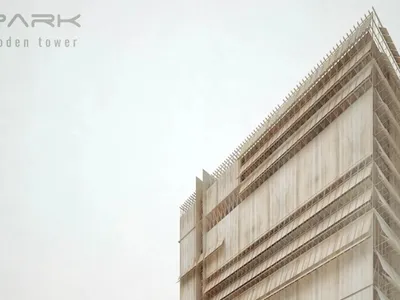
EW PARK: Sustainable Architecture Reimagines the Future of Urban Parking
EW PARK reimagines city parking as a modular wooden tower combining automation, solar energy, electric mobility, and adaptable urban design.
Similar Reads
You might also enjoy these articles

Day and Night Park: A Time-Based Urban Newsstand in Beijing
A temporary urban newsstand in Beijing blending travel, light, and reading through poetic colors, compact form, and community-focused design.

Modernist Patio Renovation in El Masnou, Barcelona by Oliver Segura Arquitectura + Cebrià Arquitectura
Modernist patio renovation blending tradition and innovation with a movable pool, leveled floors, and Catalan materials in El Masnou.

Alto Residencial Coop: Cooperative Housing Development in Santiago de Compostela by Carbajo Barrios Arquitectos
A linear cooperative housing complex blending white volumes and perforated metal façades, enhancing community living, natural light, privacy, and urban integration.

Vil Genis School by BPA ARCHITECTURE – Massy, France
Vil Genis School in Massy, France, features sustainable design, south-facing classrooms, community integration, accessible spaces, and modern educational architecture.

Explore Nano Nest Competitions
Discover active competitions in this discipline


Challenge to design mud housing for contemporary communities


Challenge to reimagine the Iron Throne


Photograph architecture without architects


Illustrate the lost glory of Angkor Wat - Render Challenge
Comments (0)
Please login or sign up to add comments
No comments yet. Be the first to comment!