
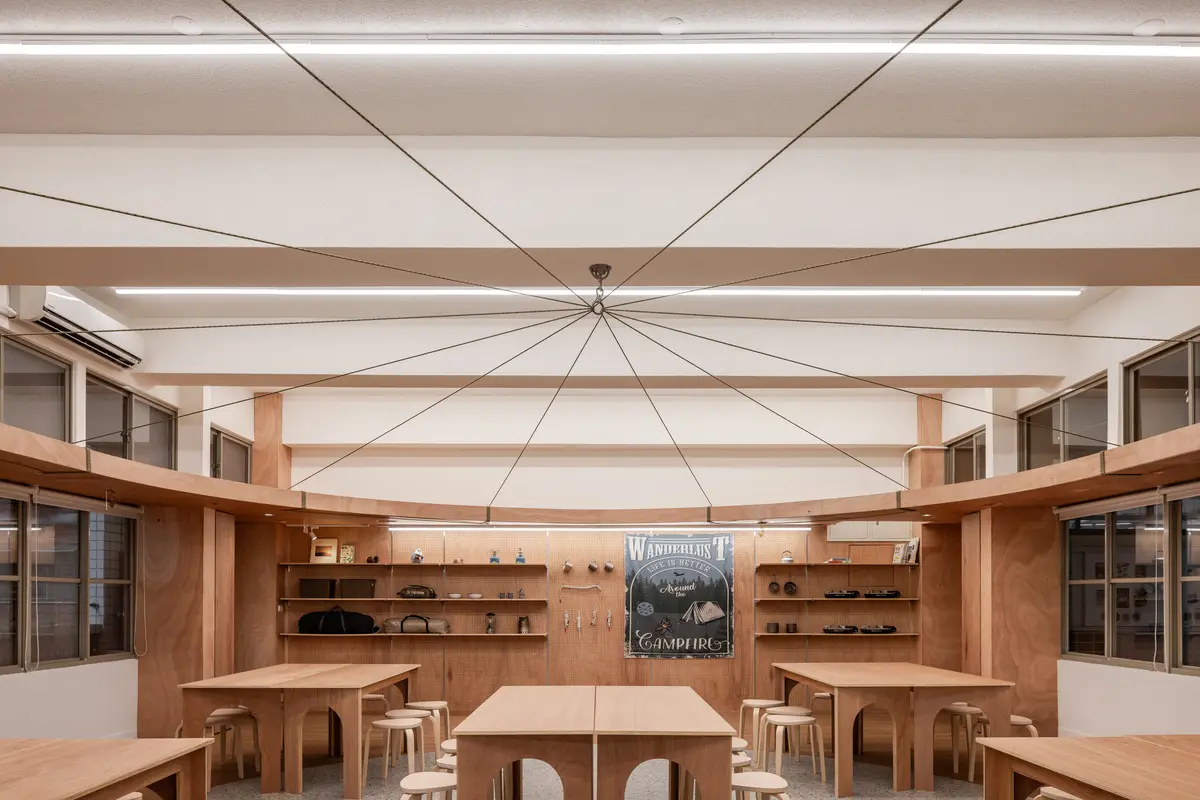
317studio Turns an 87 m² Classroom into a Forest Clearing for Scouts in New Taipei City
A rope canopy, student-made specimens, and campfire geometry replace rows of desks in this Scouting classroom in Xizhi District.


Most school renovation projects promise to "rethink learning" and then deliver the same room with nicer furniture. 317studio's 2025 intervention at Qingshan Elementary and Junior High School in Xizhi District, New Taipei City, is a rare exception. Within just 87 square meters, the Taipei-based practice has replaced a rigid, front-facing classroom with a space organized around a single, ancient idea: the campfire circle. The result is a Scout classroom that doesn't just teach outdoor skills but physically embodies them, from the radial rope canopy overhead to the student-crafted botanical specimens embedded in the walls.
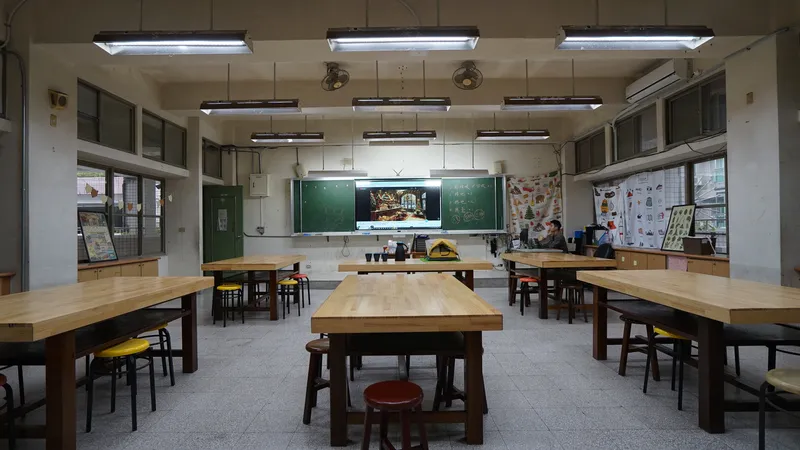
The project responds to a practical problem. Xizhi receives frequent rainfall, which regularly forces Scouting programs, tent drills, knot workshops, and team exercises, indoors. The existing classroom couldn't handle any of it: storage was minimal, furniture was fixed, and the layout assumed one teacher talking at thirty seated students. 317studio's redesign treats the room as a miniature clearing in a forest, with functional elements pushed to the perimeter like trees at the edge of a grove, leaving the center open for gathering, reconfiguration, and collective participation.
The Campfire at the Center

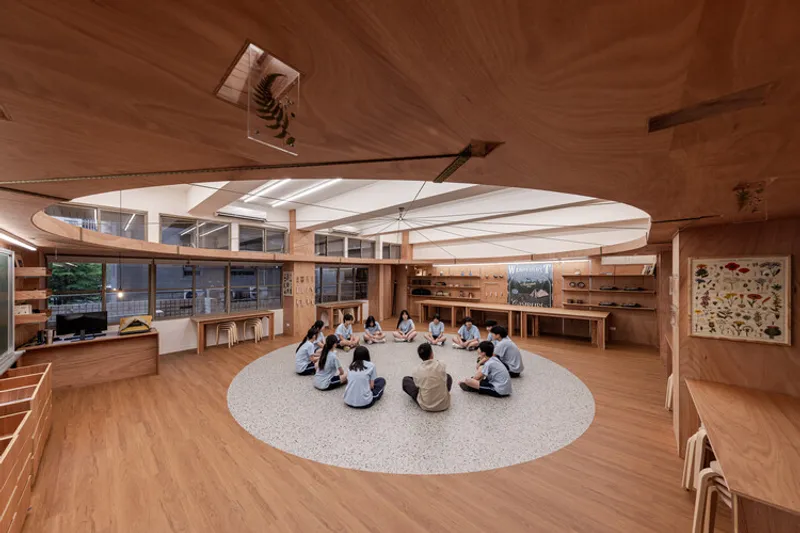
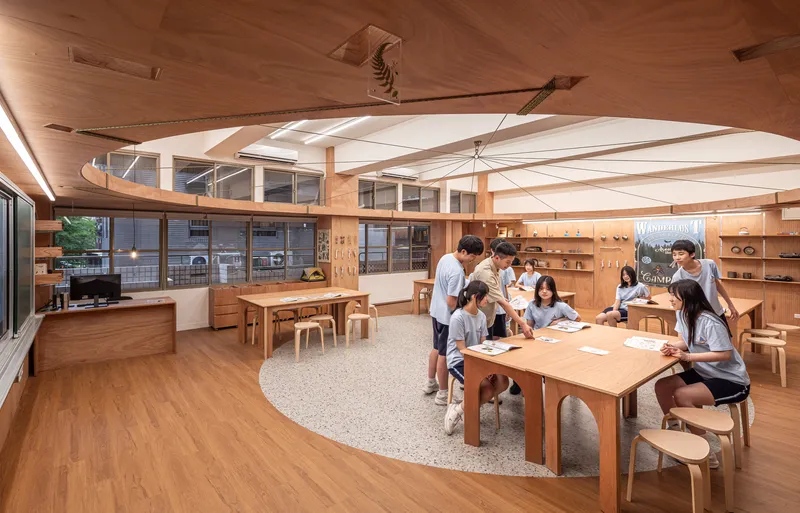
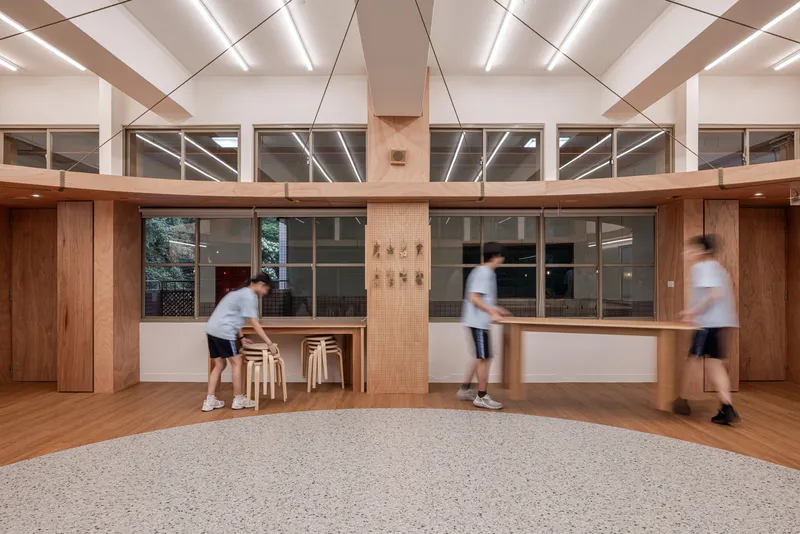
The plan is frankly circular. A central clearing occupies the core of the room, free of fixed furniture, so students can gather in the round. Movable tables and stools orbit this zone without ever locking it down. It is a spatial argument against the lecture format: teaching here is circular rather than linear, and every participant faces every other participant. That geometry is not decoration. It reinforces the Scouting values of equality, attentiveness, and group awareness that the school has championed for years.
What makes the layout work in practice is restraint. At 87 square meters, the room has no space for grand gestures. Instead, 317studio concentrated storage, work surfaces, and service zones along the perimeter walls, compressing utility into a tight band so the center stays generous. Students can shift from a circle discussion to a tent-pitching drill to a club meeting simply by rearranging the furniture, a flexibility the old room never offered.
Rope as Architecture


The most immediately visible move is the continuous rope system woven through the wooden ceiling framework. Cables radiate from a central fixture and fan outward to the perimeter, creating a tent-like canopy that hovers above the gathering zone. It is simultaneously structural framing, spatial marker, and Scouting metaphor. Knot-tying, tension, interdependence: these are core skills for any Scout troop, and here they have been scaled up to the size of a room.
The installation does more than symbolize. It guides movement by visually defining the center, pulling attention inward and away from the perimeter walls. Students working beneath it understand, without being told, where the heart of the room is. Architecture is doing the teaching before the instructor opens their mouth.
Timber, Pegboard, and the Forest Palette
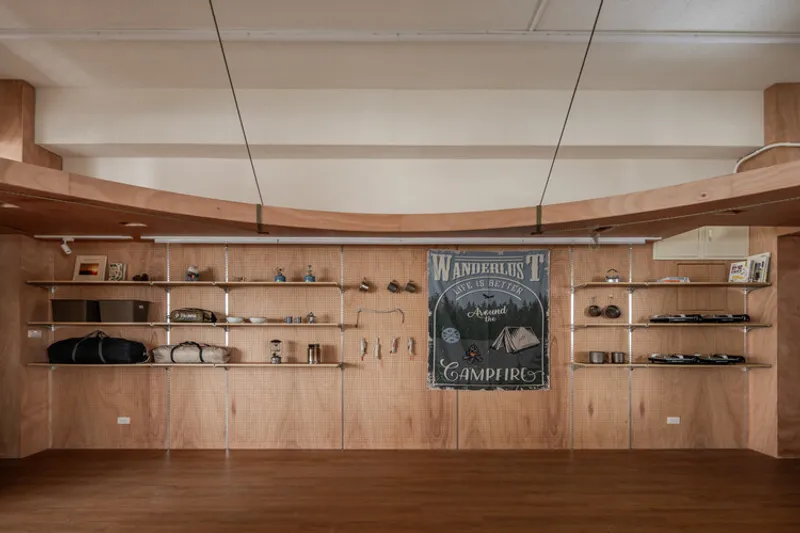
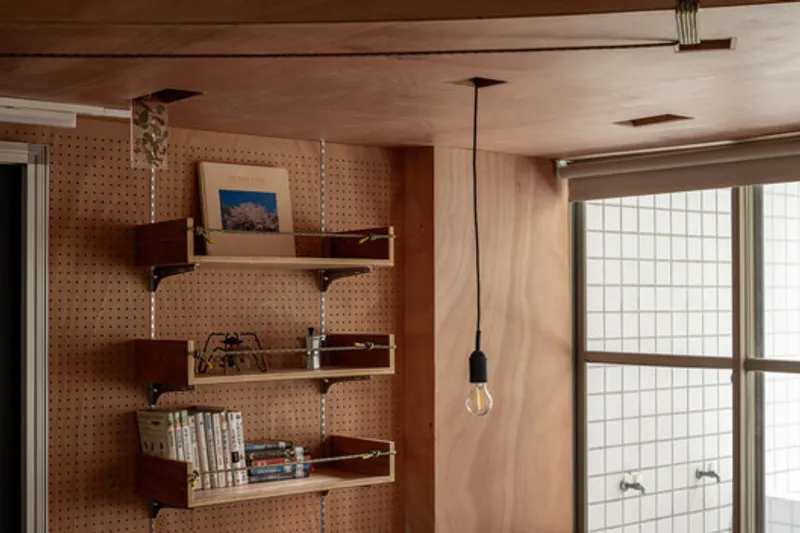
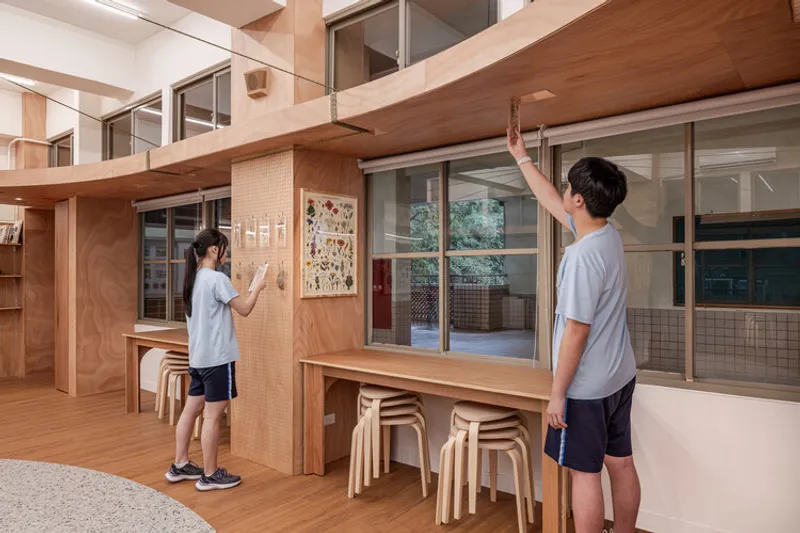
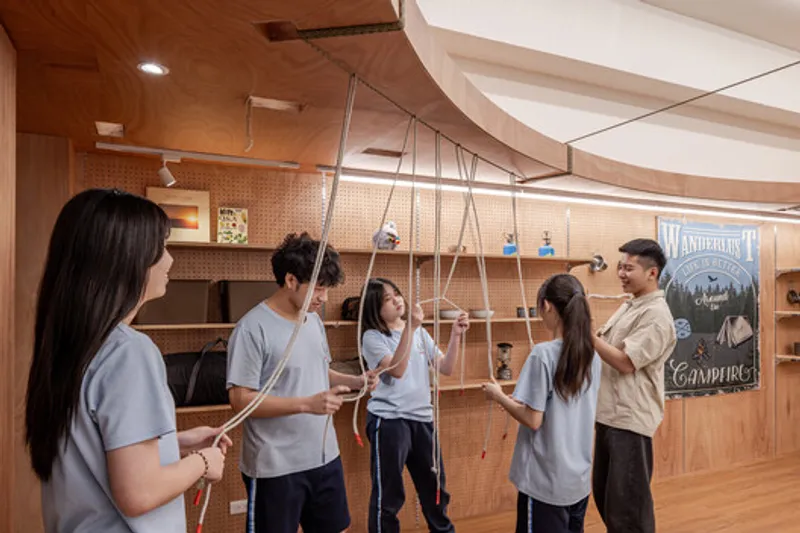
Wood dominates every surface: ceiling beams, plywood wall panels, shelving, furniture. Against the warm timber, 317studio introduced pegboard walls that serve as flexible tool storage, display surfaces, and organizational infrastructure. Camping gear, ropes, botanical charts, and teaching materials hang from pegs that students can rearrange at will. It is a simple, low-tech system that puts children in control of their environment, a pedagogical statement as much as a storage solution.
The terrazzo floor grounds the warmth overhead with a cooler, more durable surface that can withstand the abuse of tent poles, muddy boots, and dragged furniture. The contrast is deliberate: the ceiling belongs to the forest canopy, the floor to the clearing underfoot.
Students as Makers
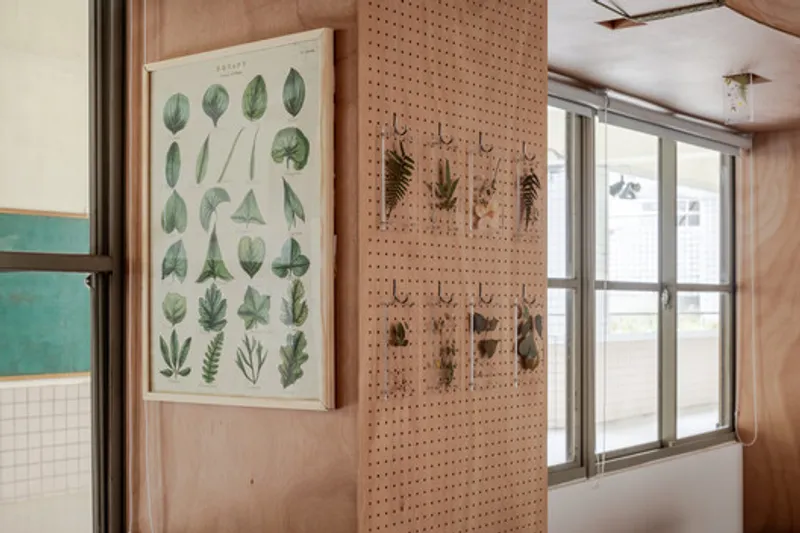

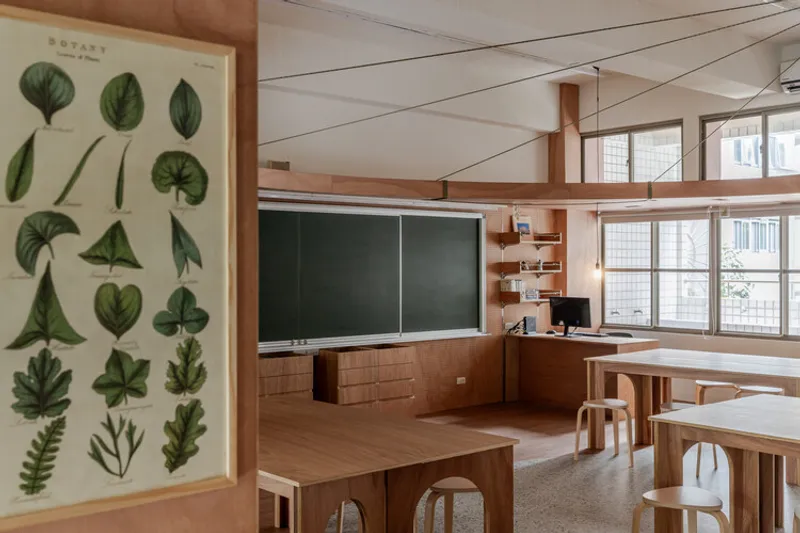
Acrylic plant specimens are embedded in walls and ceiling panels throughout the classroom, and they were handcrafted by students as part of the design process. This is a significant decision. By giving children direct authorship over permanent elements of the room, 317studio turned the renovation itself into a learning exercise, one that builds emotional attachment, responsibility, and pride in a shared space. The specimens double as nature study references, connecting indoor education to the ecology of the surrounding Xizhi hills.
Light and Atmosphere Under the Canopy
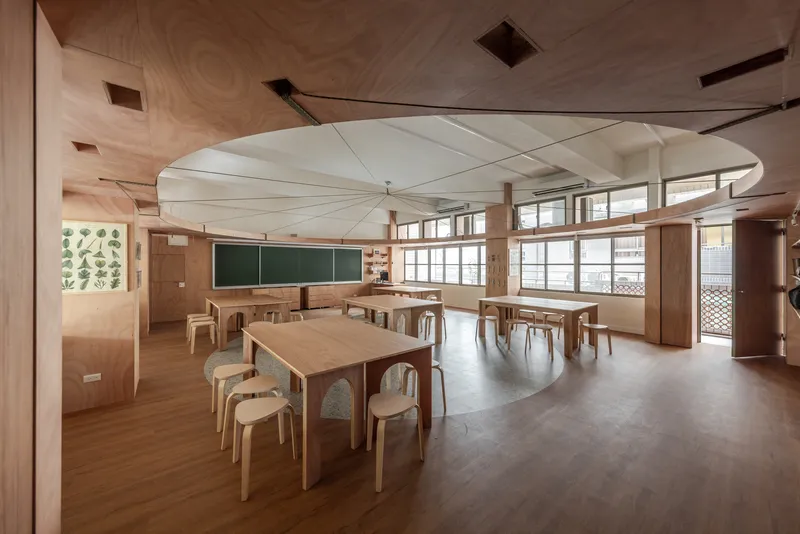
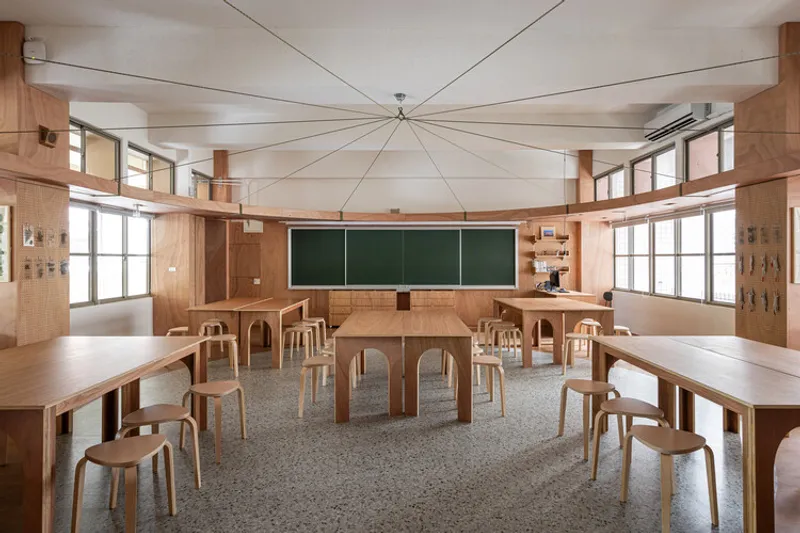
Clerestory windows and wraparound glazing admit daylight from multiple directions, softening the enclosure and sustaining the illusion of an outdoor setting. Afternoon sun rakes across timber surfaces and picks out the tension lines of the rope canopy. Supplementary lighting, designed by Yu-Chin Lighting Co., is warm and restrained, mimicking the quality of natural light rather than overpowering it. The effect is a room that feels sheltered without feeling sealed, exactly the sensation of sitting in a forest clearing.
Thresholds and Shared Zones
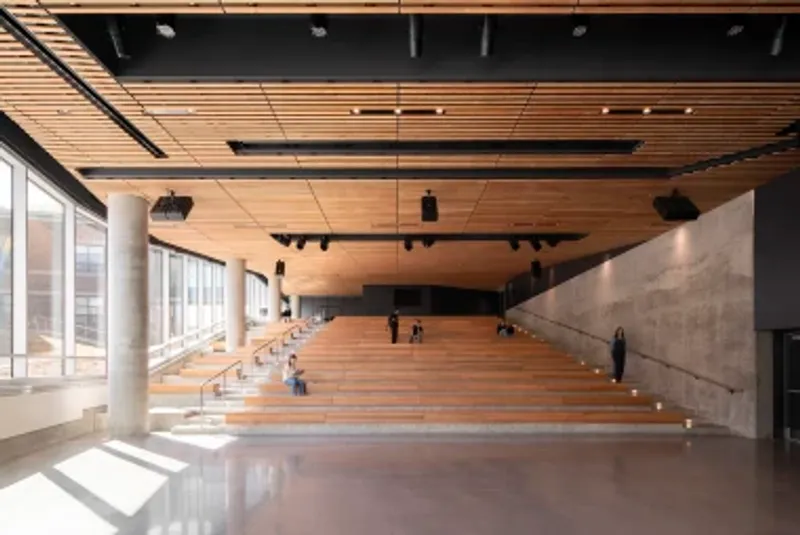
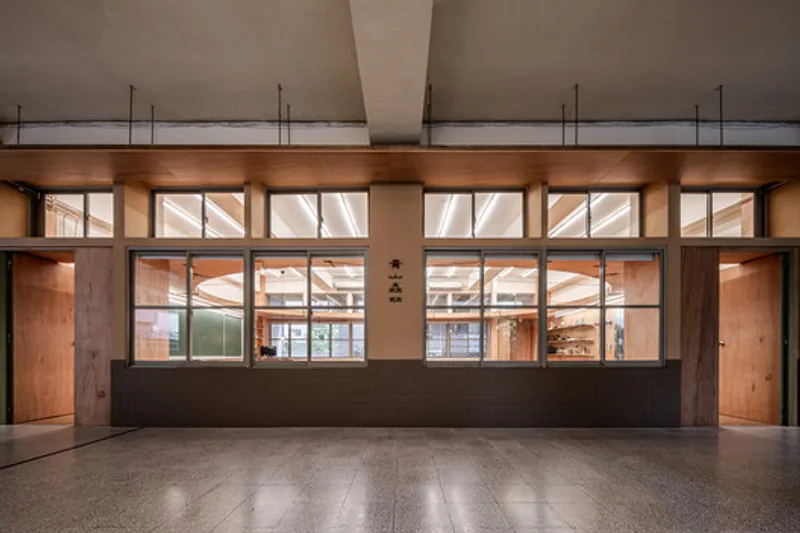
Beyond the main classroom, 317studio gave careful attention to the thresholds that connect it to the rest of the school. A wide timber staircase doubles as informal seating, its slatted ceiling catching natural light and signaling the transition from corridor to learning environment. A glazed partition at the entry frames the reception desk beneath a concrete soffit, creating a moment of visual pause before one enters the timber world inside. These edges matter: they tell students they are crossing into a different kind of space, one where the rules of engagement shift.
A double-height common area with a central counter and diagonal ceiling grid extends the collaborative ethos beyond the Scout classroom itself, suggesting that 317studio's ambitions for the school run deeper than a single room.
Indoor Scouting in Action

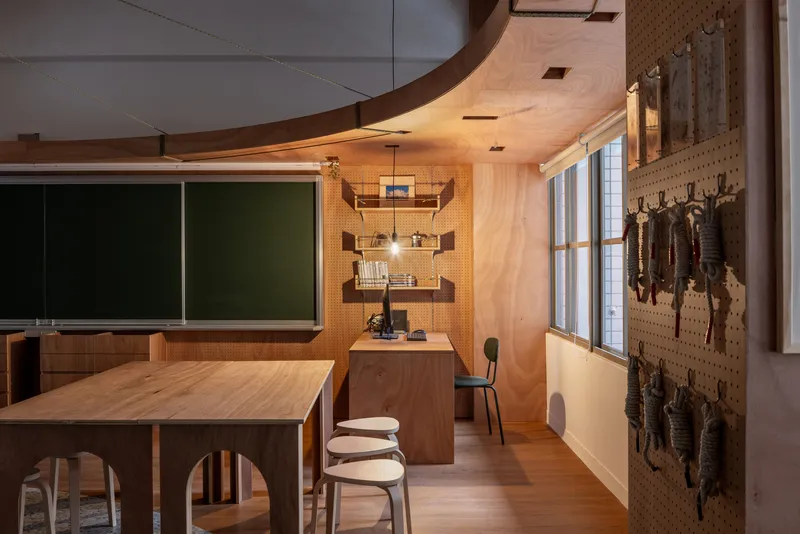

The acid test for any flexible classroom is whether it actually gets used flexibly. Images of students assembling a colorful tent on the terrazzo floor, beneath the plywood ceiling and a generous skylight, provide the answer. The room accommodates activities that would have been impossible in the old layout: full-scale tent drills, workshop sessions with tools on pegboard walls, even suspended rope swings for knot practice. Integrated drawer units and open shelving keep gear accessible without creating clutter, so transitions between setups take minutes rather than class periods.
Plans and Drawings
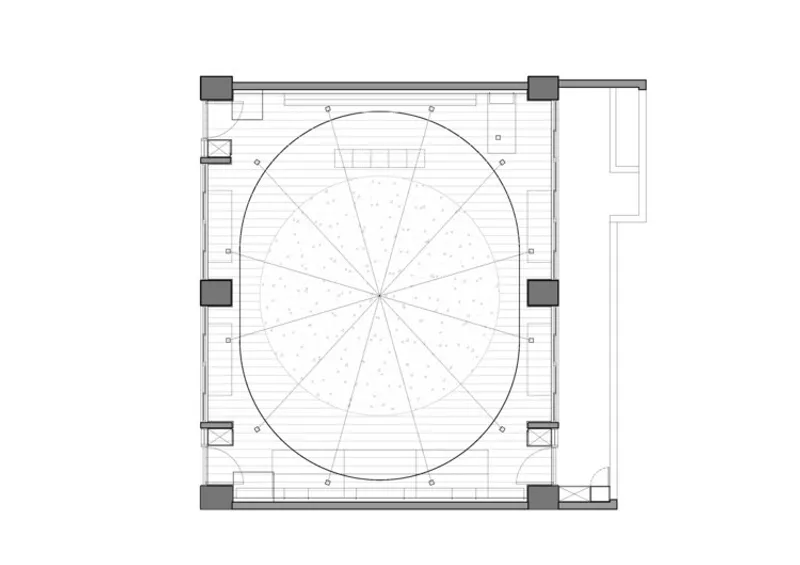
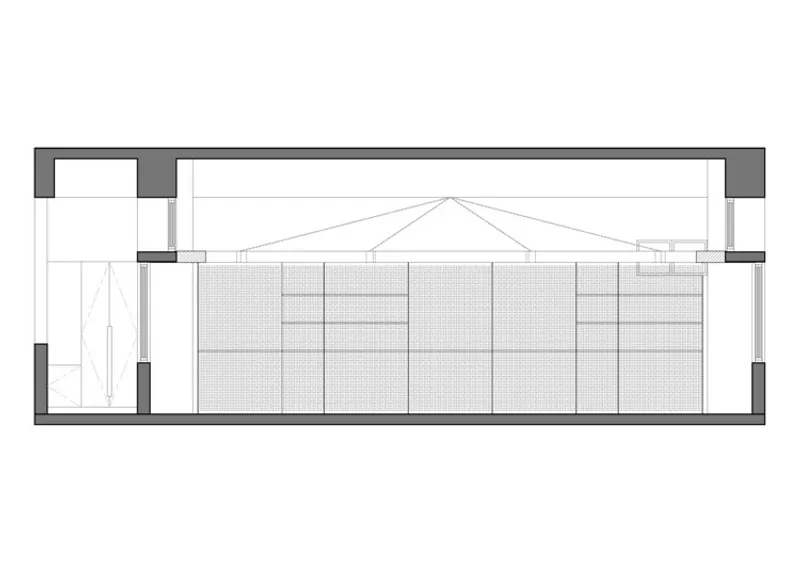
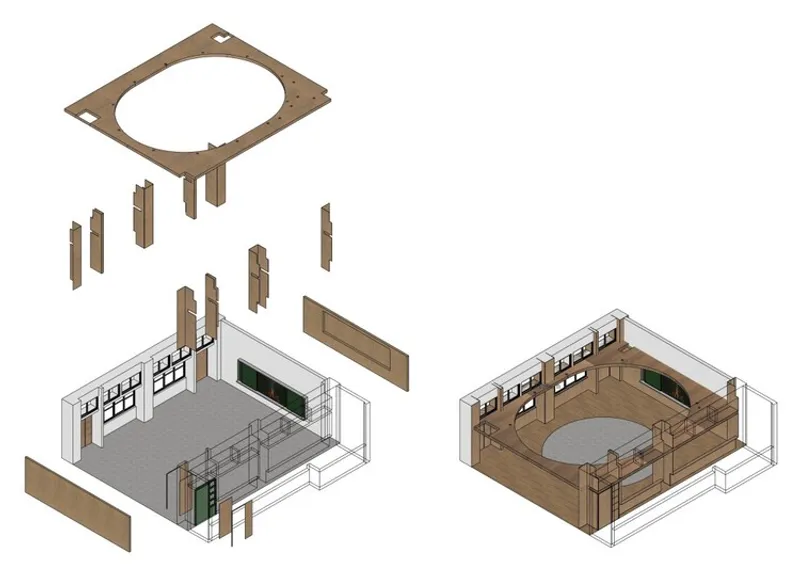
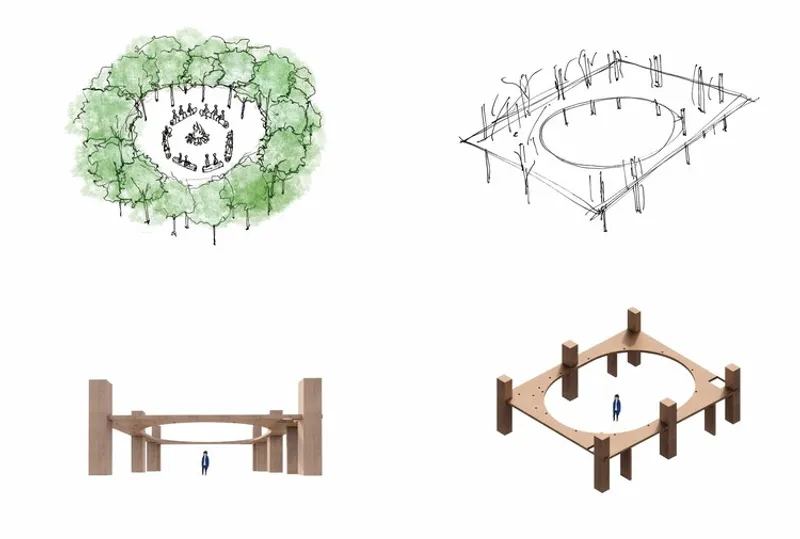
The floor plan reveals the clarity of the circular organization: radiating segments fan out from a central void, while service zones form a tight ring along the perimeter. The section drawing exposes the cable-supported roof structure and its relationship to a perforated panel wall and the adjacent stairwell. An exploded axonometric breaks the timber components apart, showing how the curved roof opening admits light and frames two distinct classroom configurations. Sketch studies of plan, elevation, and axonometric views confirm that the circular geometry was present from the earliest design stages, not an afterthought.
Why This Project Matters
Educational design in East Asia still defaults to the rectangular classroom with fixed desks. 317studio's project is a compact but forceful rebuttal. By organizing 87 square meters around a campfire metaphor and building the room's identity from actual Scouting skills (rope work, specimen collection, tent assembly), the studio demonstrates that a learning space can teach before anyone stands up to speak. The participatory fabrication process, students making the acrylic specimens that become part of the architecture, raises the bar further: it proves that even young learners can be co-authors of their built environment.
The Qingshan Forest Classroom also offers a pragmatic lesson for schools in rainy climates everywhere. Outdoor education programs shouldn't collapse the moment it starts raining. When the architecture itself carries the values, rituals, and spatial logic of outdoor learning, the weather becomes irrelevant. That is a small room doing very large work.
Qingshan Forest Junior High School Classroom by 317studio. Xizhi District, New Taipei City, Taiwan. 87 m². 2025. Lead team: Po Chang Lin, Tsai Yun Kao. Design team: Kai Hung Yang, Shin Cheng Lai. Engineering: Xing-Yi Design & Construction Co., Ltd. Electrical engineering: Di-Sheng Plumbing & Electrical Engineering. Lighting engineering: Yu-Chin Lighting Co., Ltd. Photography by YuChen Chao Photography.
About the Studio
Share Your Own Work on uni.xyz
If projects like this are the kind of work you want to make, uni.xyz is a place to publish your own, find collaborators, and enter design competitions.


Popular Articles
Popular articles from the community


The Amber Palace Opera: A Geological Fiction Surfaces on Tallinn's Baltic Waterfront
Pierre Brillard reimagines a Baltic legend as a public landscape, opera house, and waterfront promenade rooted in Tallinn's coastal identity.


ETEH Reworks the Shared Spaces of São Domingos School in Brazil Around Timber, Color and Hanging Plants
At São Domingos School in Brazil, 436 m² of hall, refectory and library are recast with timber joinery, a yellow and blue code and trailing greenery.

Opera on the Sea: Driftwood Logic Shapes a Timber Opera House on Estonia's Coast
Trevor Orgill's opera house translates the entangled drift of floating timber into a civic building where wood, water, and music converge.

Singing Woman: An Opera House That Performs Before the Curtain Rises
Ovidiu Cristian Pavel's conceptual opera house translates Estonia's choral identity into a sculpted waterfront landmark facing the Baltic Sea.

Similar Reads
You might also enjoy these articles


Hodi-Mandai Geram
Project Function: Preservation and revitalization of the Intangible heritage and socio-spatial identity of the Hodi by Housing, Cultural Memory Center, Sacred Grove, landscape, local tourism economy


Olio Towers: A Mid-Rise for Performers That Fuses Housing, Rehearsal, and Stage
Located blocks from Houston's Theater District, this modular tower stacks living units around a central performance atrium.

Oasis: Modular Green Housing Carved into Dhaka's Urban Fabric
A shortlisted Plugin Housing entry reclaims unauthorized settlements in Dhaka with stepped concrete volumes, green roofs, and ventilation-driven design.

Black Hole: A Floating Megastructure for the Post-Physical Era
Emiliano Mazzarotto envisions a spherical, self-scaling arena where e-sports, digital hotels, and holographic stadiums replace traditional public space.

Explore Learning Spaces Competitions
Discover active competitions in this discipline

Challenge to design public laboratory

Challenge to reimagine the Iron Throne

Photograph architecture without architects

Illustrate the lost glory of Angkor Wat - Render Challenge
Comments (0)
Please login or sign up to add comments
No comments yet. Be the first to comment!