
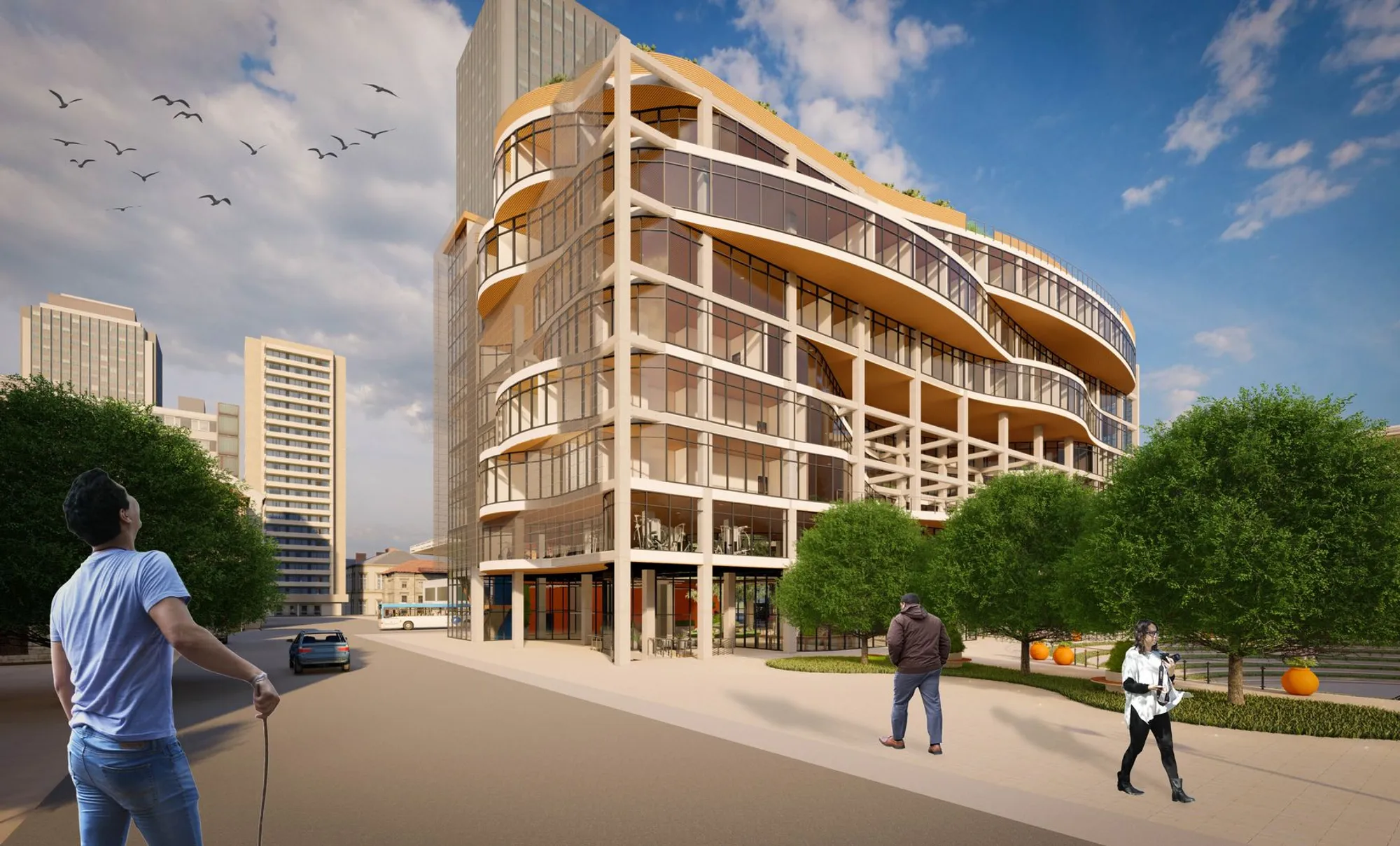
Olio Towers: A Mid-Rise for Performers That Fuses Housing, Rehearsal, and Stage
Located blocks from Houston's Theater District, this modular tower stacks living units around a central performance atrium.


What happens when you design a residential building around the daily rhythms of performers? You get a circular atrium where dancers rehearse at ground level, tiered balconies where residents watch from their front doors, and a rooftop terrace where the audience and the community become the same thing. Olio Towers takes the idea of mixed-use housing and pushes it toward something more specific and more compelling: a building that treats artistic production not as an amenity but as the organizing principle of the architecture itself.
Designed by Maryssa Morrison, Olio Towers was a shortlisted entry in the Plugin Housing Challenge 2020. Sited just a few blocks from Houston's Downtown Theater District, the mid-rise tower proposes a creative live-work ecosystem for thespians, artists, and theater enthusiasts, integrating residential units, rehearsal facilities, and a fully equipped performance venue under a single roof. The project leans on modular, prefabricated construction and adaptive reuse strategies to keep its environmental footprint low while delivering a rich spatial experience.
A Central Atrium Built for Performance, Not Just Circulation
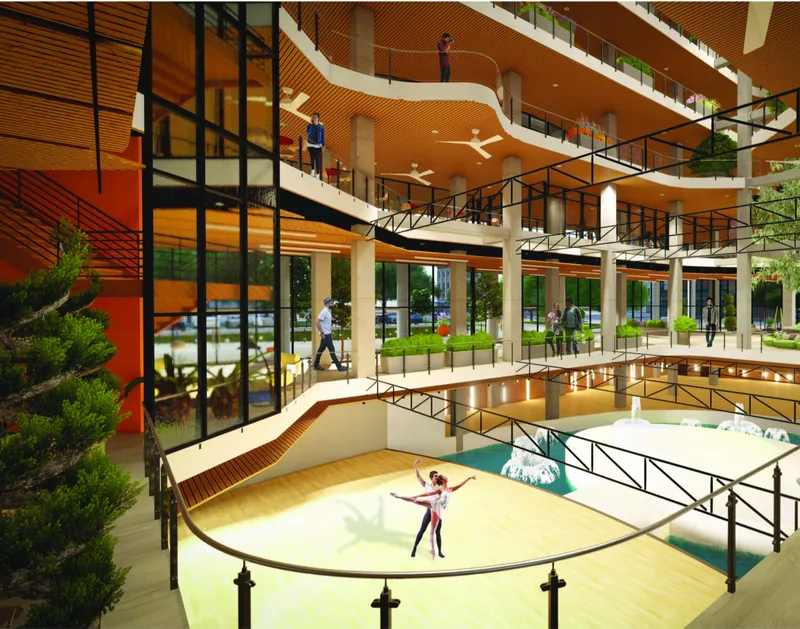
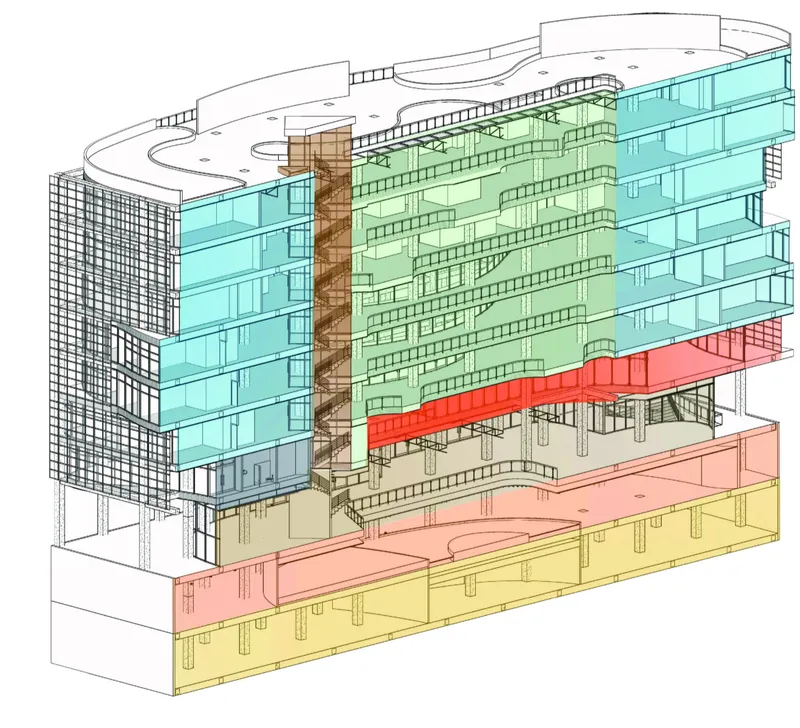
The interior atrium is the heart of the building, and it reads immediately as a theater in the round. Tiered balconies rise on all sides, framed by warm timber slatted ceilings that soften the acoustics and lend a domestic warmth to what is essentially a public performance space. Two dancers occupy the circular stage at ground level, illustrating the intended daily use: this is not a lobby with occasional programming, it is a venue that residents orbit. The axonometric drawing makes the organizational logic explicit. Color-coded floor plates stack around a central circulation core, with each zone assigned a distinct programmatic role. The core does double duty, acting as both vertical access and the spatial anchor that holds the performance atrium open through the full height of the building.
Rooftop and Section: Layered Community Spaces from Ground to Sky
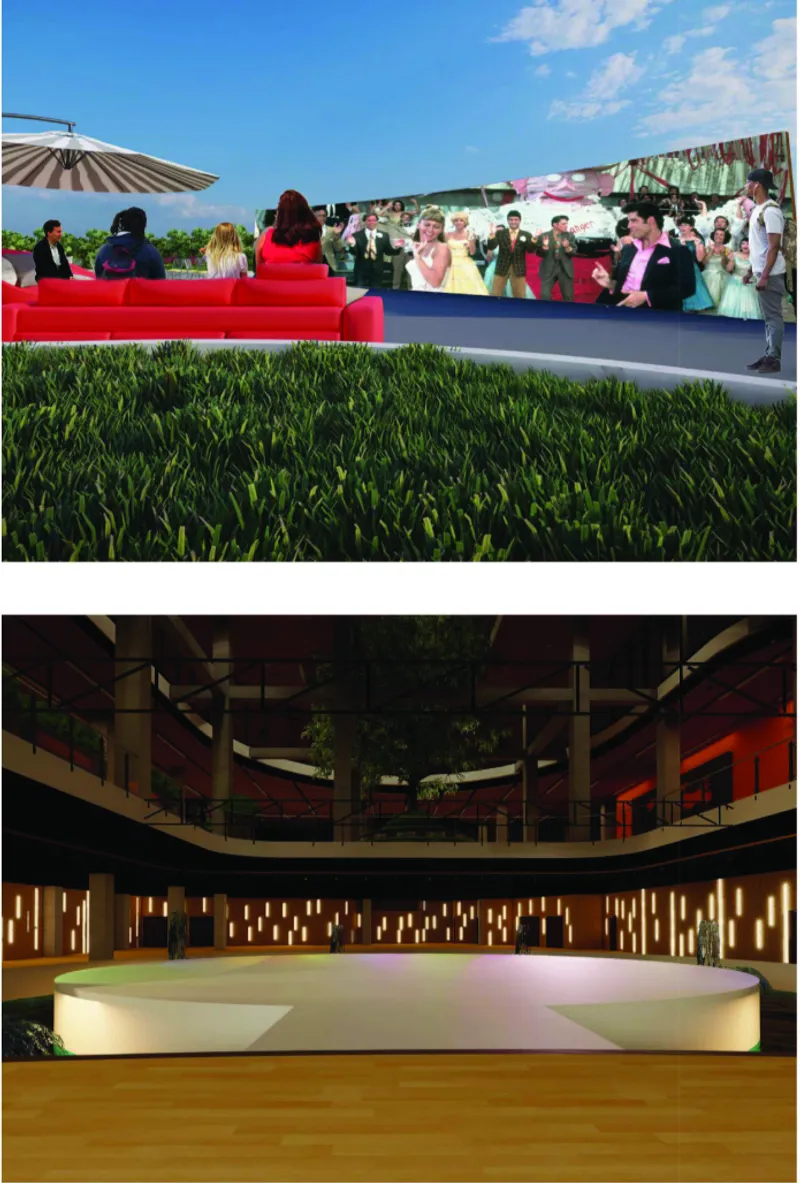
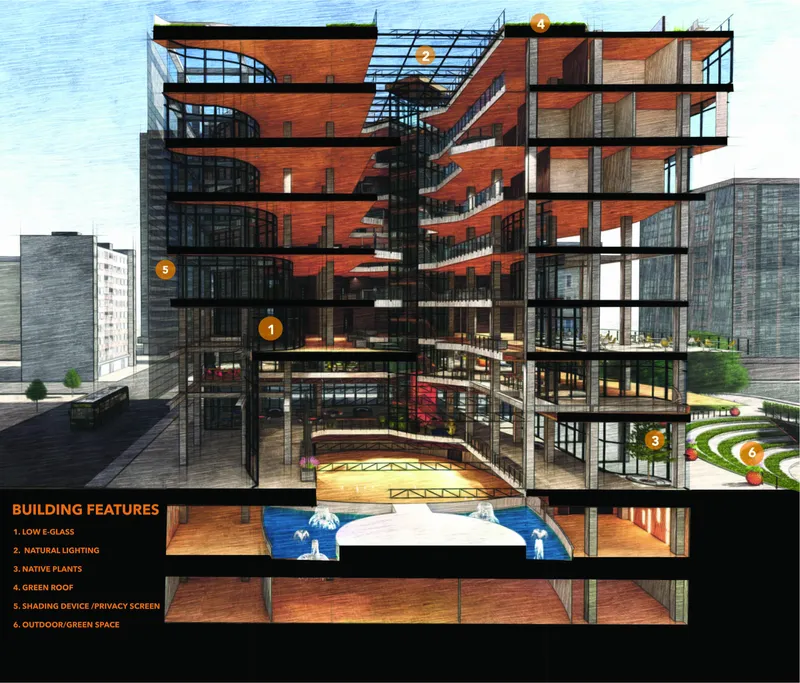
The rooftop terrace is designed as a gathering surface rather than a decorative cap. Red seating clusters sit on artificial turf beneath open sky, and the rendering shows it packed with people, suggesting that the roof functions as an extension of the performance program below. Native plantings at the edges contribute to the building's green roof strategy, supporting environmental awareness and stormwater management without sacrificing usable social space.
The sectional rendering peels the building open and reveals a more complex interior than the exterior suggests. Open floors are bridged by walkways that connect residential wings across the central void. Planted terraces punctuate the section at irregular intervals, and an interior pool appears at a lower level, adding recreational depth to the program. The section confirms that Morrison treats every floor as a potential threshold between private living and collective activity, with no dead zones between the two.
Compact Units with Material Precision
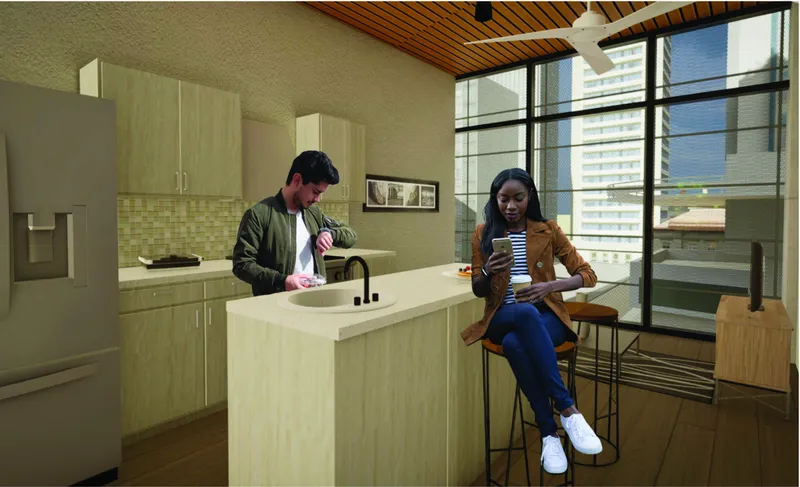
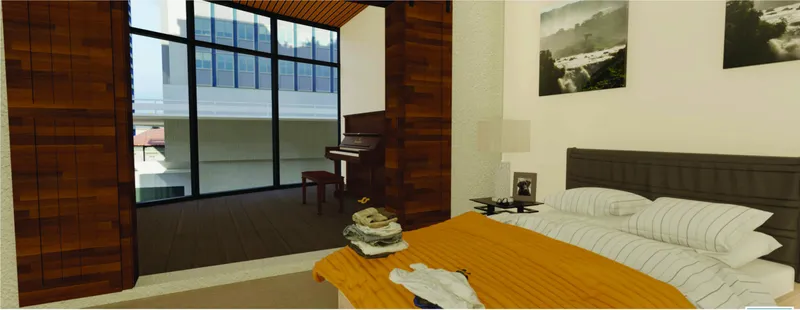
Inside the residential units, the approach is restrained and efficient. The kitchen features light wood cabinetry and a clean white countertop within a compact footprint, sized for the realities of urban living rather than suburban aspiration. Modern insulation, energy-efficient lighting, and low-emission glass are specified throughout, keeping operating costs and carbon output down. The bedroom takes a different tonal register: dark timber wall panels create a quieter, more insular atmosphere, while large glazed doors open the room to daylight and views. A small piano near the window is a telling detail, reinforcing that these units are designed for people who practice their craft at home, not just at the venue downstairs.
Modular Construction as a Sustainability Strategy
Morrison's use of prefabricated, modular construction is not merely a cost-saving measure. It is an environmental argument. Factory-built units reduce on-site waste, shorten construction timelines, and allow for tighter quality control on insulation and material sourcing. Combined with sustainable materials, energy-efficient appliances, and the building's green roof system, the modular strategy positions Olio Towers as a project that takes embodied carbon as seriously as operational energy. For a competition focused on plugin housing, this approach is well-calibrated: the units can be assembled, replaced, or reconfigured without demolishing the structural frame.
Why This Project Matters
Most mixed-use housing proposals treat program as a checklist: retail on the ground floor, apartments above, maybe a gym. Olio Towers rejects that formula by centering its entire spatial organization on a specific community and its specific needs. The result is a building where the architecture does real work, creating sightlines from homes to stages, bridging private rooms with collective rehearsal spaces, and making the act of performance visible at every level of the section.
Morrison's shortlisted entry in the Plugin Housing Challenge 2020 demonstrates that housing for creative communities does not have to be generic loft space with high ceilings and a marketing campaign. It can be structurally intentional, environmentally accountable, and spatially generous in ways that serve the people who actually live and work inside. For Houston's Theater District, a building like Olio Towers would not just add units to the housing stock; it would add infrastructure for the arts.
View the Full Project
About the Designers
Designer: Maryssa Morrison
Enter a Design Competition on uni.xyz
uni.xyz runs architecture and design competitions year-round that reward proposals with spatial conviction and real site intelligence.
Project credits: Olio Towers by Maryssa Morrison Plugin Housing Challenge 2020 (uni.xyz).




Popular Articles
Popular articles from the community


The Ocean Hive: Sustainable Architecture for a Self-Sufficient Civilization at Sea
The Ocean Hive imagines sustainable architecture at sea, where modular habitats, algae, wave power and ocean waste sustain a growing colony.

Co-life: Sustainable Architecture for Age-Friendly Community Living
Co-life reimagines sustainable architecture for seniors through courtyards, rammed earth, shared gardens, and spaces designed for belonging.

Co-Life: Senior Housing Design That Reconnects Older Adults With the City
Co-Life reimagines senior housing design through healing gardens, shared streets, workshops, and a sustainable community across generations.

The Earth Pod: 3D Printed Homes for Resilient Refugee Communities
The Earth Pod reimagines refugee housing through 3D printed homes made from clay, combining resilience, self-sufficiency, and rapid shelter.


Similar Reads
You might also enjoy these articles

Day and Night Park: A Time-Based Urban Newsstand in Beijing
A temporary urban newsstand in Beijing blending travel, light, and reading through poetic colors, compact form, and community-focused design.

Modernist Patio Renovation in El Masnou, Barcelona by Oliver Segura Arquitectura + Cebrià Arquitectura
Modernist patio renovation blending tradition and innovation with a movable pool, leveled floors, and Catalan materials in El Masnou.

Alto Residencial Coop: Cooperative Housing Development in Santiago de Compostela by Carbajo Barrios Arquitectos
A linear cooperative housing complex blending white volumes and perforated metal façades, enhancing community living, natural light, privacy, and urban integration.

Vil Genis School by BPA ARCHITECTURE – Massy, France
Vil Genis School in Massy, France, features sustainable design, south-facing classrooms, community integration, accessible spaces, and modern educational architecture.


Comments (0)
Please login or sign up to add comments
No comments yet. Be the first to comment!