

1+1>2 Architects Build a School from 900 Blocks of Hmong Stone on Vietnam's Rocky Plateau
On a barren valley in Ha Giang province, a community quarried its own stone to raise a kindergarten and primary school rooted in Hmong identity.


When the Hmong community of Tham Luong in Du Gia commune, Ha Giang province, asked for a modern lowland-style school with brick staircases and yellow painted walls, 1+1>2 Architects pushed back. The result, completed in 2023 with sponsorship from the Midas Foundation, is a kindergarten and primary school built from 900 blocks of locally quarried stone, assembled by hand with diesel-powered drills because the site had no electricity. It is a building that does not imitate the lowlands. It argues, wall by wall, for the value of Hmong material culture on a rugged plateau where that culture has been treated as temporary.
The Hmong community here migrated to Tay lands after losing homes and farmland to landslides. That history of displacement produced a psychology the architects describe as "living on borrowed land," where every structure is considered provisional. The old school was dilapidated, damp, and dark. By persuading villagers to quarry and build with local stone rather than imported brick, 1+1>2 reframed the act of construction as a claim to permanence. The school is not just a place to teach children. It is evidence that a displaced community can build something worth staying for.
Walls That Weave Like Brocade
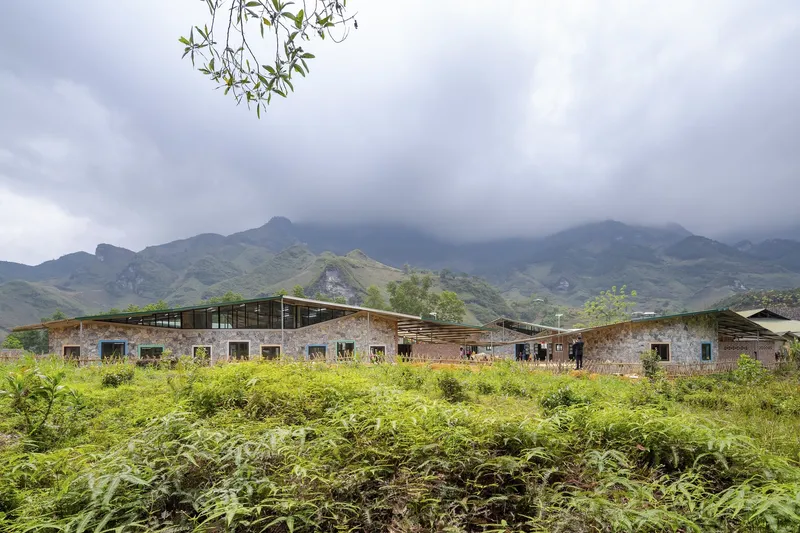
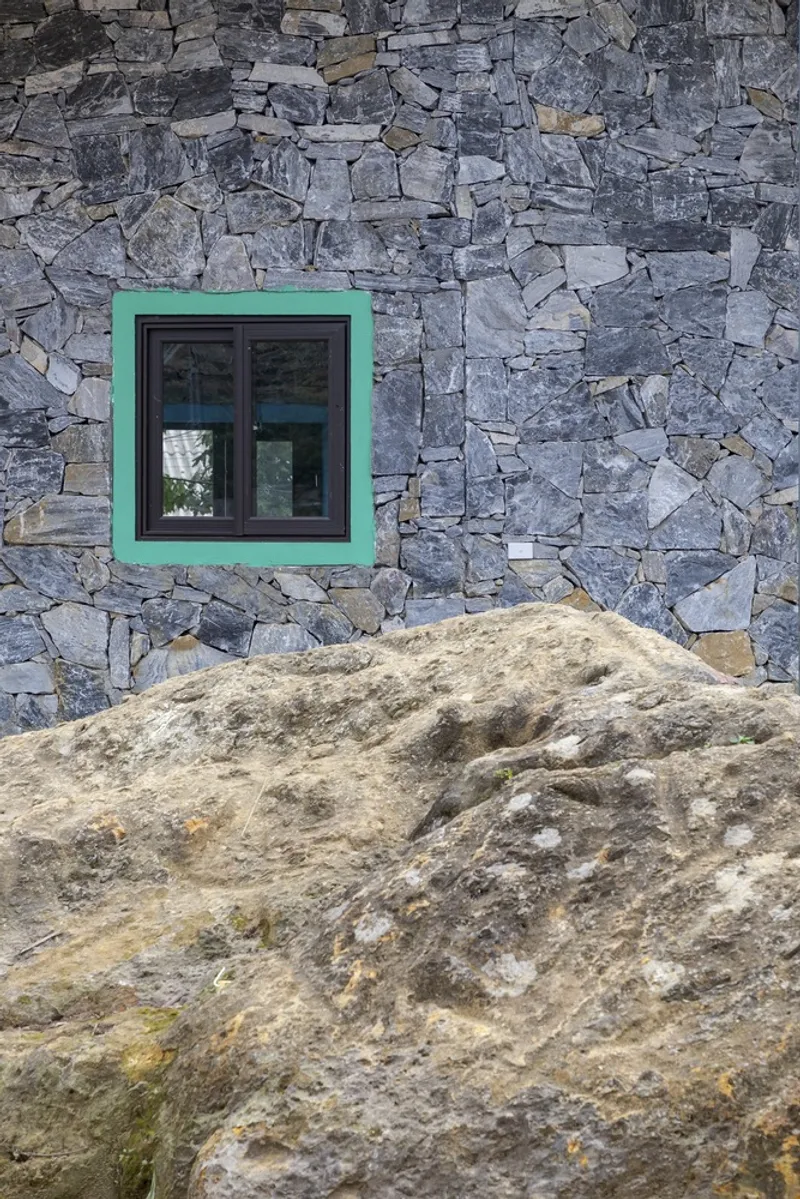
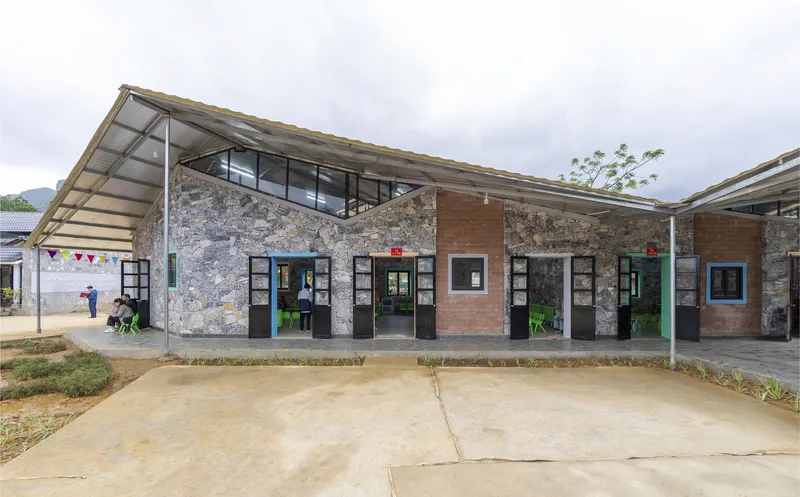
The most striking feature of the school is its stone masonry. Walls run 40 to 50 centimeters thick, composed of irregularly cut stone blocks interspersed with pebbles and adobe bricks in a pattern that references traditional Hmong brocade weaving. The technique is both decorative and structural: these are load-bearing walls that double as windbreaks, keeping classrooms warm in winter and cool in summer without mechanical systems. Up close, the surfaces read as geological collage, with rough grey stone meeting weathered boulders that were already on the site.
The facades combine this heavy masonry with a lighter register above. Timber-framed clerestory windows sit on top of the stone walls, capped by green and white metal roofs with cantilevered overhangs. The contrast is deliberate: the base belongs to the ground, solid and mineral, while the roof floats above it, catching the mountain light. Colored window frames punctuate the stone at ground level, giving each classroom its own marker without disrupting the material unity of the whole.
A Courtyard Built Around Boulders
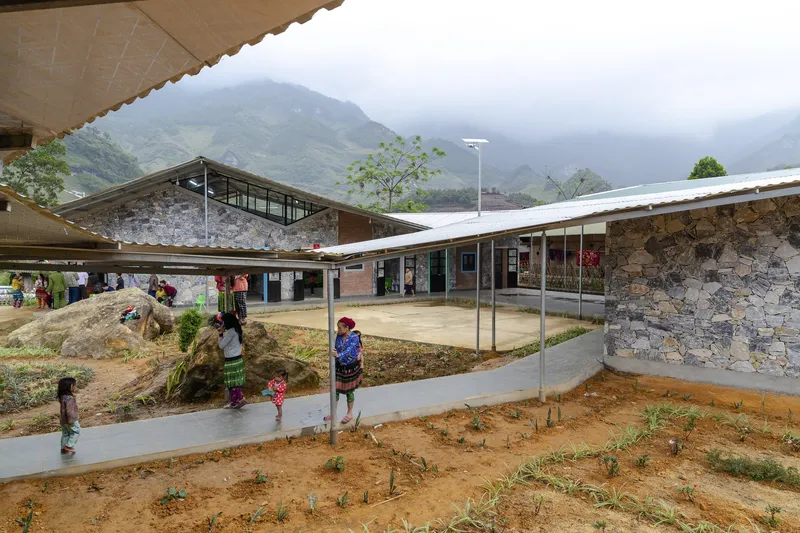
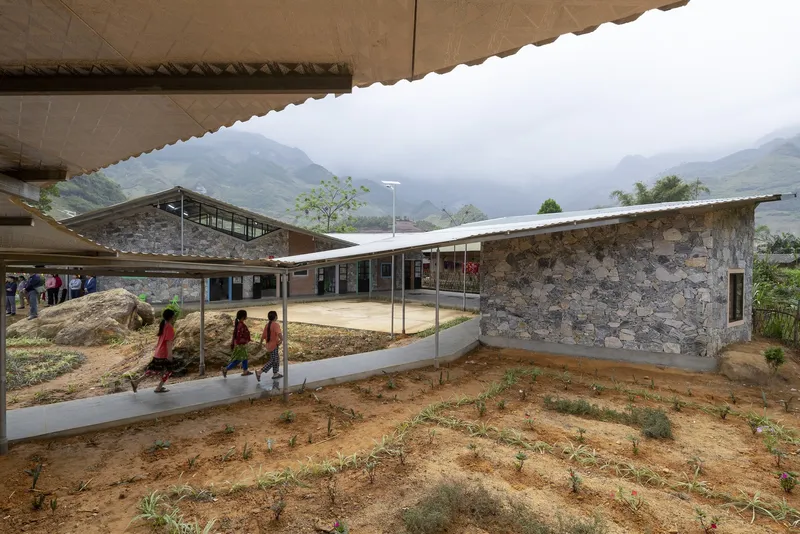

Three building volumes are connected by two zigzag corridors that embrace a small central courtyard. Rather than clearing the site of its existing boulders, 1+1>2 incorporated them into the playground. Curved concrete paths weave around rock outcrops where children can climb, sit, and play. For Hmong kids who grew up scrambling over the karst landscape, these boulders are not obstacles. They are familiar terrain brought inside the school's protective enclosure.
The courtyard performs a dual role. During school hours it is a play and learning space. Outside those hours it functions as a cultural meeting ground for the broader community, linking the school to an adjacent cultural house. Covered walkways with corrugated roof canopies and planted beds create sheltered circulation along the edges, so movement between buildings stays dry during monsoon season. The planted beds soften the stone with green, reinforcing the sense that the architecture grew out of the valley floor rather than being dropped onto it.
Classrooms of Stone and Light
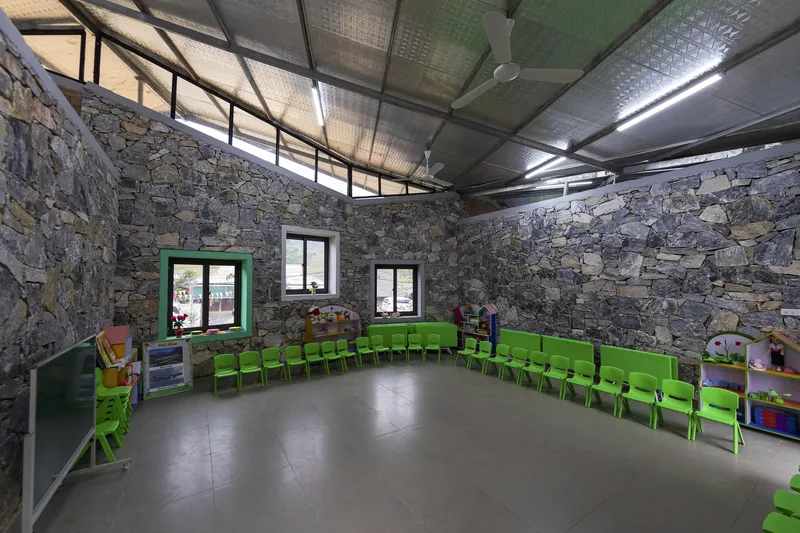
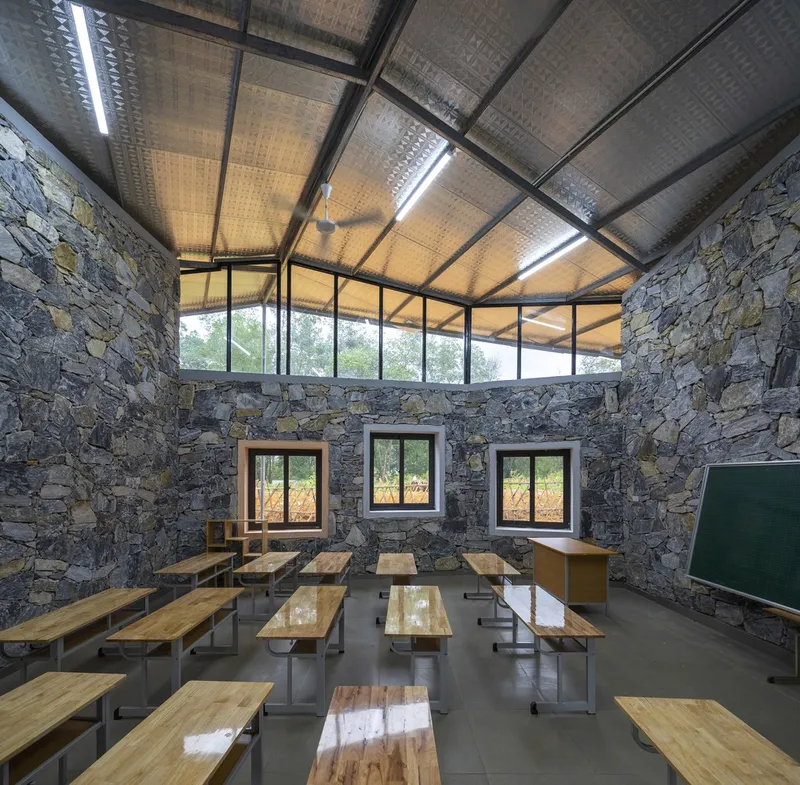
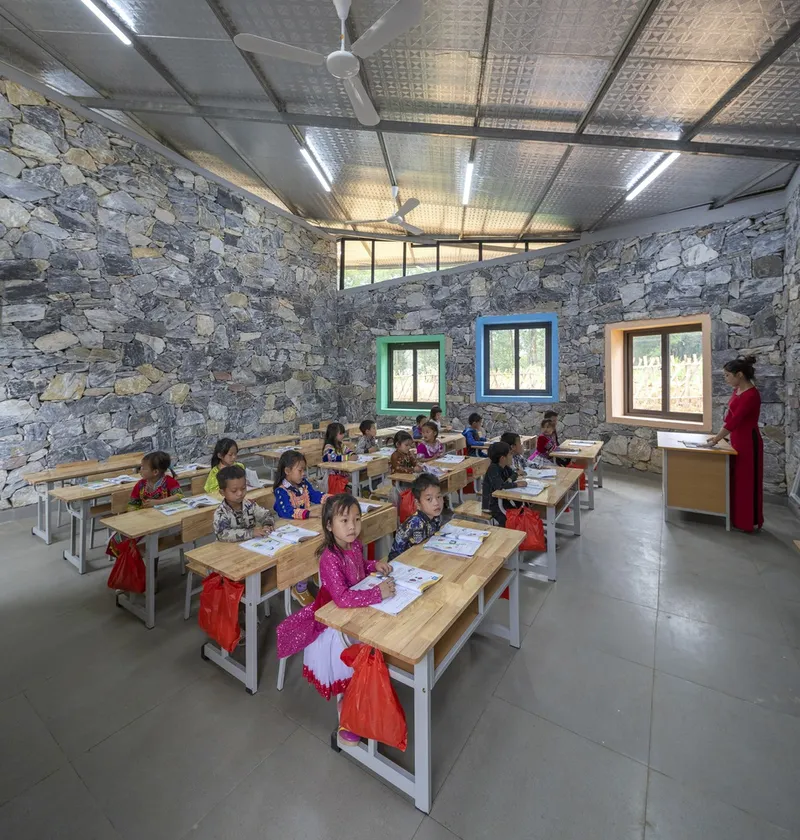
Inside the classrooms, the exposed stone walls are the dominant presence. Corrugated metal ceilings with exposed steel beams keep things honest: no suspended ceilings, no plasterboard concealment. In several rooms, translucent corrugated panels replace opaque metal at the clerestory level, flooding the space with diffused light from above. The old school was notoriously dark. These clerestories solve that problem without large glazed openings that would compromise the thermal mass of the walls.
Furniture is simple. Green plastic chairs and timber desks are arranged in rows, reflecting the reality of the school's budget and supply chain. But the rooms do not feel austere. The texture of the stone walls gives every surface visual depth, and the interplay between warm timber framing and cool grey masonry creates an interior palette far richer than painted concrete could achieve. One classroom features three differently colored window frames, a small gesture that transforms a functional opening into a framed view of the mountains beyond.
Stone and Color at the Window
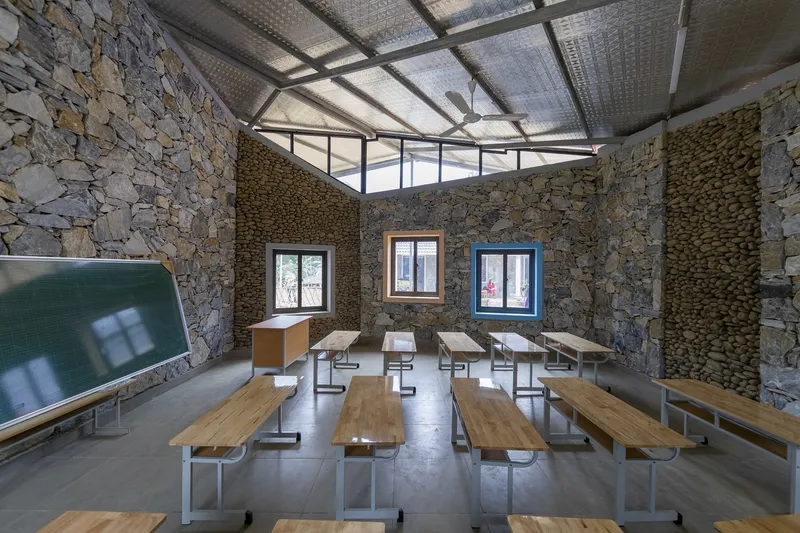
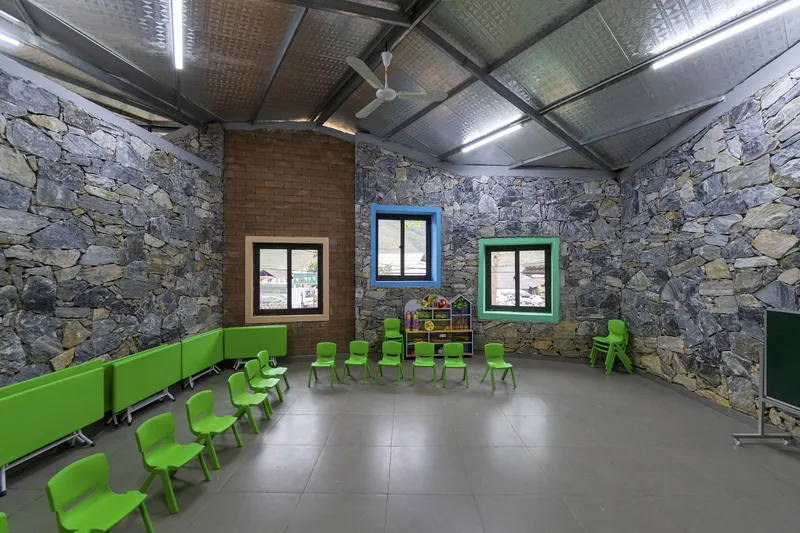
The detail where colored window frames meet rough stone is where the school's identity crystallizes. Bold greens, blues, and reds recall the vivid palette of Hmong textiles, set against a wall surface that is entirely geological. It is a collision of the handmade and the elemental that works precisely because neither element pretends to be something else. The windows are frankly industrial, steel-framed and functional. The walls are frankly archaic, hand-laid and irregular. Together they produce something that belongs to this specific community in this specific place.
Roofscape in the Valley
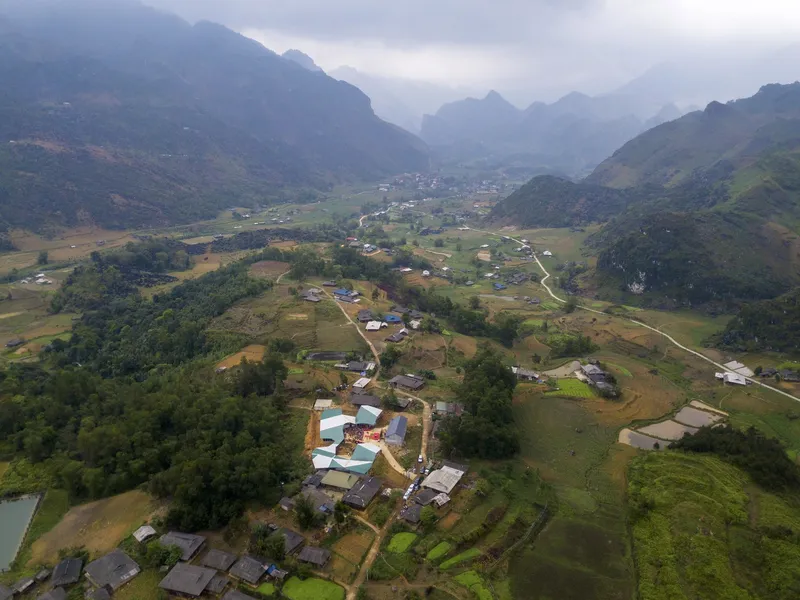
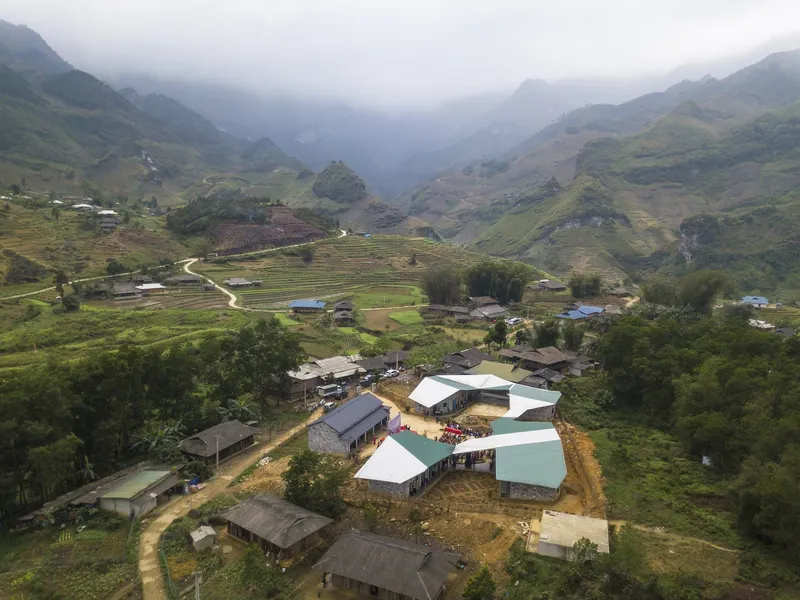
From above, the school reads as a cluster of green and white metal roofs scattered across the valley floor, echoing the rhythm of the surrounding terraced fields and forested hills. The architects describe the roof spans, walls, and clerestory windows as harmonizing with the "rhythm of the mountains," and the aerial views bear this out. The buildings do not impose a single axis or formal geometry on the site. Instead, their zigzag plan follows the contours of the terrain and the placement of existing boulders, producing an informal silhouette that disappears into the misty landscape on overcast mornings.
The choice of metal roofing is pragmatic. In a region prone to extreme weather, stone walls provide thermal mass and structural resilience while lightweight metal spans reduce the load on those walls and simplify construction. The green paint, far from being arbitrary, ties the roofs to the surrounding tree canopy when seen from the mountain roads above. It is a simple decision with outsized effect.
Why This Project Matters
Tham Luong Kindergarten and Primary School is a case study in what happens when architects refuse to give clients what they initially ask for and instead offer something better rooted in the clients' own heritage. The Hmong community requested a lowland imitation. 1+1>2 delivered a building made of local stone, patterned after local textile traditions, shaped around local boulders, and built by local hands. That process, in which villagers quarried, transported, and assembled the stone themselves, transferred construction skills that will outlast the school itself.
More broadly, the project challenges the assumption that modernity and indigenous identity are opposites. The steel-framed clerestory windows and corrugated metal roofs are contemporary solutions. The 40-centimeter-thick stone walls and brocade-pattern masonry are ancestral ones. The school does not choose between them. It demonstrates that a community displaced by landslides, building on land they consider borrowed, can produce architecture of real permanence. That is a political statement made in stone, and it is more convincing than any manifesto.
Tham Luong Kindergarten & Primary School by 1+1>2 Architects (Hoang Thuc Hao, Do Minh Duc). Du Gia commune, Yen Minh district, Ha Giang province, Vietnam. Completed 2023. Photography by Trieu Chien.
About the Studio
Share Your Own Work on uni.xyz
If projects like this are the kind of work you want to make, uni.xyz is a place to publish your own, find collaborators, and enter design competitions.




Popular Articles
Popular articles from the community


Co-Life: Senior Housing Design That Reconnects Older Adults With the City
Co-Life reimagines senior housing design through healing gardens, shared streets, workshops, and a sustainable community across generations.
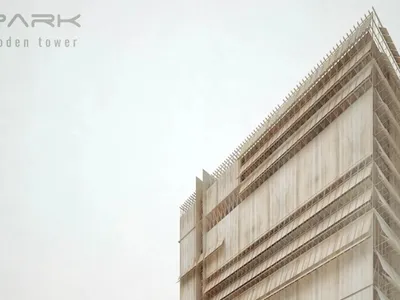
EW PARK: Sustainable Architecture Reimagines the Future of Urban Parking
EW PARK reimagines city parking as a modular wooden tower combining automation, solar energy, electric mobility, and adaptable urban design.

AL-JANNAH: Sustainable Architecture and Permaculture for Afghan Widows
AL-JANNAH uses sustainable architecture and permaculture to create resilient oasis of housing, learning, work and renewal for Afghan widows.

Co-life: Sustainable Architecture for Age-Friendly Community Living
Co-life reimagines sustainable architecture for seniors through courtyards, rammed earth, shared gardens, and spaces designed for belonging.
Similar Reads
You might also enjoy these articles


Hodi-Mandai Geram
Project Function: Preservation and revitalization of the Intangible heritage and socio-spatial identity of the Hodi by Housing, Cultural Memory Center, Sacred Grove, landscape, local tourism economy


Olio Towers: A Mid-Rise for Performers That Fuses Housing, Rehearsal, and Stage
Located blocks from Houston's Theater District, this modular tower stacks living units around a central performance atrium.

Oasis: Modular Green Housing Carved into Dhaka's Urban Fabric
A shortlisted Plugin Housing entry reclaims unauthorized settlements in Dhaka with stepped concrete volumes, green roofs, and ventilation-driven design.

Black Hole: A Floating Megastructure for the Post-Physical Era
Emiliano Mazzarotto envisions a spherical, self-scaling arena where e-sports, digital hotels, and holographic stadiums replace traditional public space.


Explore Educational Building Competitions
Discover active competitions in this discipline



Challenge to design public laboratory


Challenge to reimagine the Iron Throne


Photograph architecture without architects


Illustrate the lost glory of Angkor Wat - Render Challenge
Comments (0)
Please login or sign up to add comments
No comments yet. Be the first to comment!