

Prokop Hartl Turns a 1930s Prague Corner Apartment into a Lesson in Structural Honesty
A 115 m² renovation on the Vltava River celebrates exposed concrete, restored parquet, and a mirrored column as its centerpiece.


Most apartment renovations in prewar buildings fall into one of two camps: gut everything and start fresh, or preserve the bones at the cost of livability. Prokop Hartl's Corner Apartment in Prague manages to sidestep that binary entirely. Set in a late-1930s building with commanding views over the Vltava River, this 115 m² renovation for a young family strips back decades of surface treatments to reveal a concrete beam structure that would normally be hidden behind plasterboard, then builds a new domestic program around it as though the skeleton had always been the point.
What makes the project genuinely interesting is its refusal to treat structural exposure as an aesthetic gesture alone. The converging concrete beams and the massive corner column are not ornamental; they organize circulation, define thresholds, and dictate where oak veneer wardrobes begin and end. Hartl has effectively turned the building's engineering diagram into a floor plan, then furnished it with a restrained material palette of oak, poured polyurethane, terrazzo, glass block, and dark-stained timber that references the building's functionalist origins without mimicking them.
The Column as Protagonist

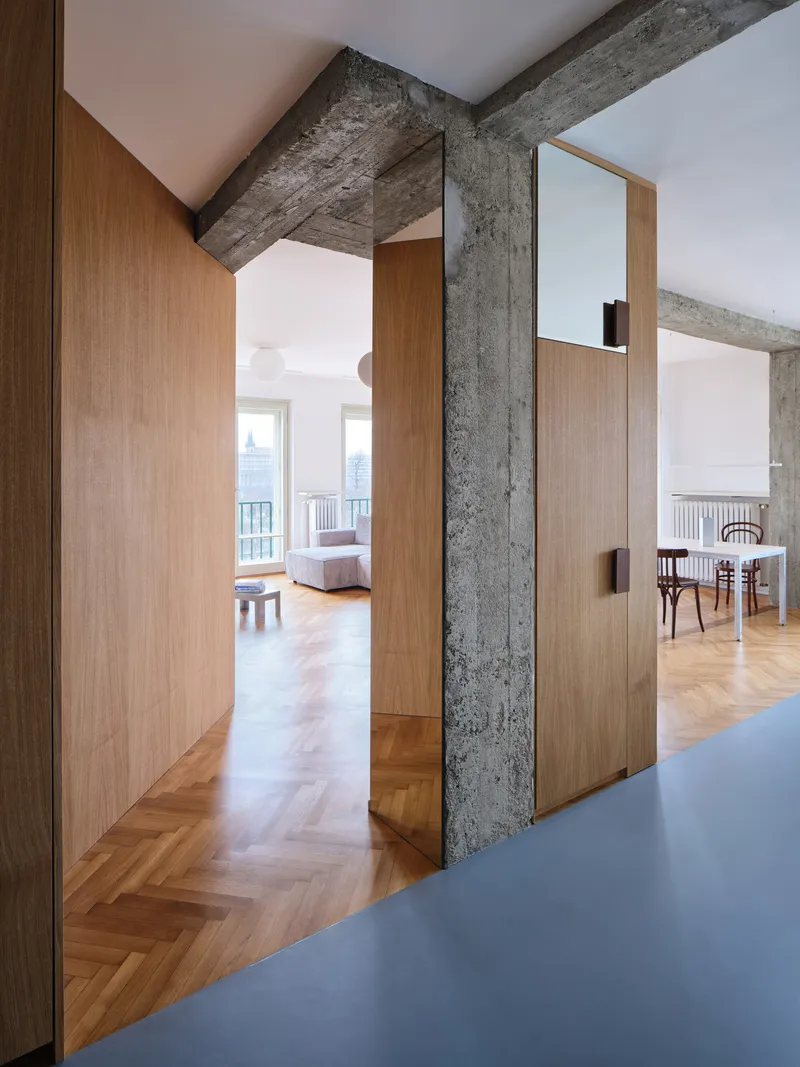

At the structural pivot of the apartment sits a concrete column that could have been boxed in and forgotten. Instead, Hartl wrapped it in mirrors and oak veneer, transforming it into a spatial device that reflects the living area back onto itself and fragments the views of the river beyond. It is the kind of move that sounds gimmicky in description but reads as inevitable in person: the column was always the center of gravity, and the mirrored treatment simply makes that fact legible.
The exposed beams radiating from this column reinforce its importance. They converge overhead like a diagram of structural forces, and the herringbone oak parquet beneath (restored, not replaced) provides a warm counterpoint. A freestanding white partition hovers nearby, holding artwork by Lukáš Koubek and further calibrating the scale of the open living area that resulted from removing a wall between two original rooms.
A Kitchen Pulled Into the Center
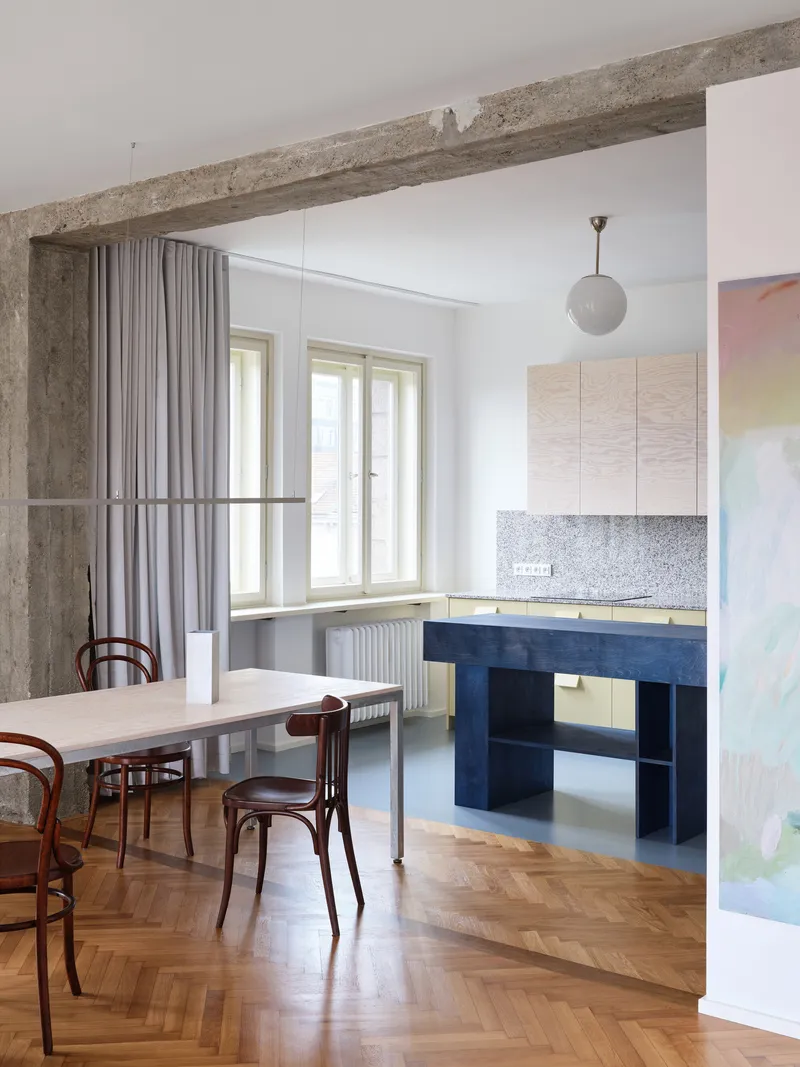
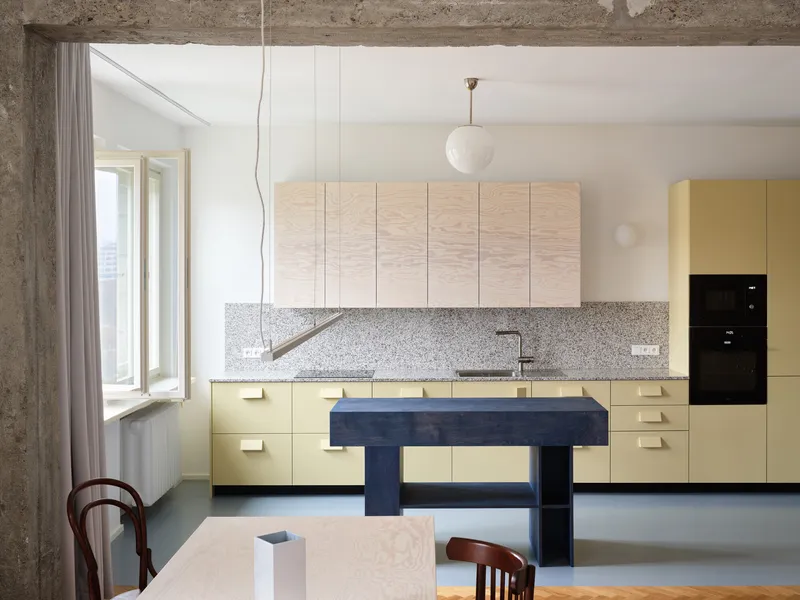

The original apartment relegated the kitchen to a rear service area, a remnant of 1930s domestic hierarchies that assigned cooking to a maid's quarters. Hartl relocated it into the main living space, anchoring it with a blue-stained island that doubles as dining counter and social fulcrum. The color is unexpected but precise: dark enough to read as a piece of furniture rather than cabinetry, saturated enough to hold its own against the raw concrete above.
Pale yellow cabinets and a terrazzo backsplash complete the kitchen composition. The material choices avoid the all-white minimalism that dominates contemporary European kitchen design, opting instead for a palette that feels specific to this apartment and this building. Oversized handles on the island add a tactile detail that signals the involvement of bespoke fabrication, here executed by the Czech carpentry firm Zlatý řez.
Living at Dusk Over the Vltava


The corner position of this apartment is not incidental to its name. It is the entire proposition. Floor-to-ceiling windows on two sides capture the river and the city in a panorama that shifts mood as the day progresses. At dusk, the herringbone floor catches warm light from globe pendants while the blue kitchen bench becomes a silhouette against the fading sky. Hartl designed the open living area precisely to frame this transition, treating the interior atmosphere as something that unfolds in time rather than remaining static.
Glass Block and the Private Wing
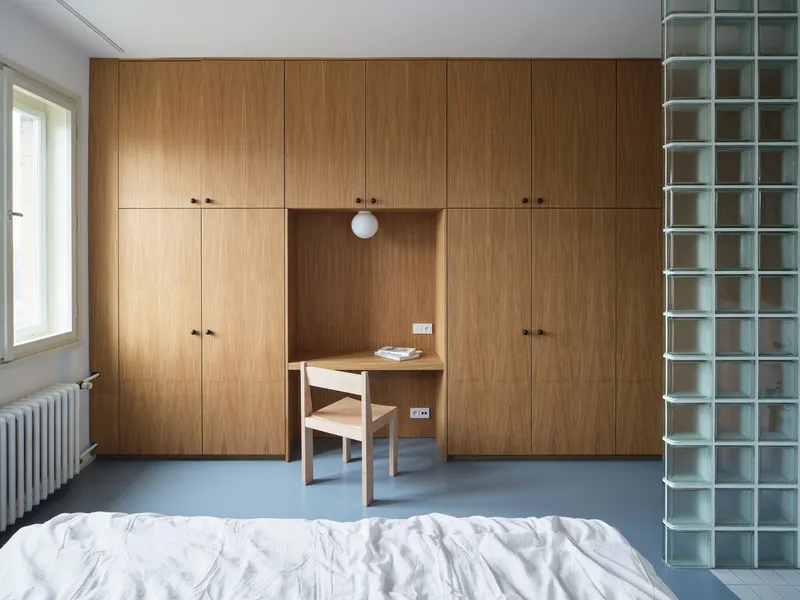


The rear service wing has been repurposed as the parental zone, containing the main bedroom and a walk-in shower separated by glass block partitions. Glass block is one of those materials that oscillates between cliché and revelation depending on how it is deployed. Here, executed by Alfaglass, it performs a specific double duty: screening the bathroom from the sleeping area while transmitting enough light that neither space feels enclosed. The translucency creates a gradient of privacy rather than a hard boundary.
An integrated desk nook carved into the oak wardrobe wall gives the bedroom a secondary function as a quiet workspace. The globe pendant above it, seen in both daylight and dusk photographs, underscores how carefully Hartl considered the lighting conditions in every corner of the plan. Even the smallest alcoves are designed to function across the full arc of a day.
Thresholds and Storage as Architecture
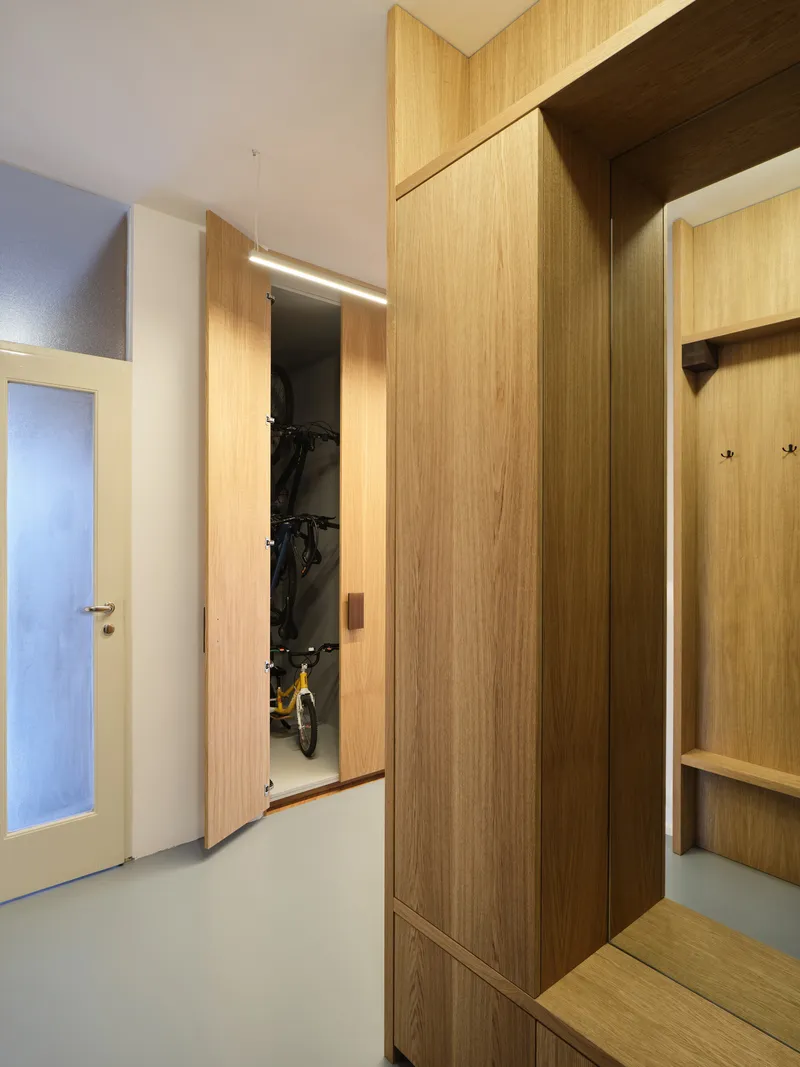


The hallway is where the project's spatial logic becomes most explicit. Built-in oak wardrobes are positioned precisely on the transition line between the new poured polyurethane flooring and the restored oak parquet, marking the boundary between served and service spaces. One of these wardrobes conceals a bicycle closet with integrated LED lighting, a practical concession to young family life in Prague that is handled with the same material rigor as the rest of the apartment.
Exposed concrete beams run the length of the corridor ceiling, and the change in floor material underfoot makes the threshold palpable before you consciously register it. Original doors have been restored and fitted with new glass transoms above, a detail that allows natural light to penetrate deep into the plan and connects the functionalist heritage of the building to the new interventions.
Concrete Meets Craft
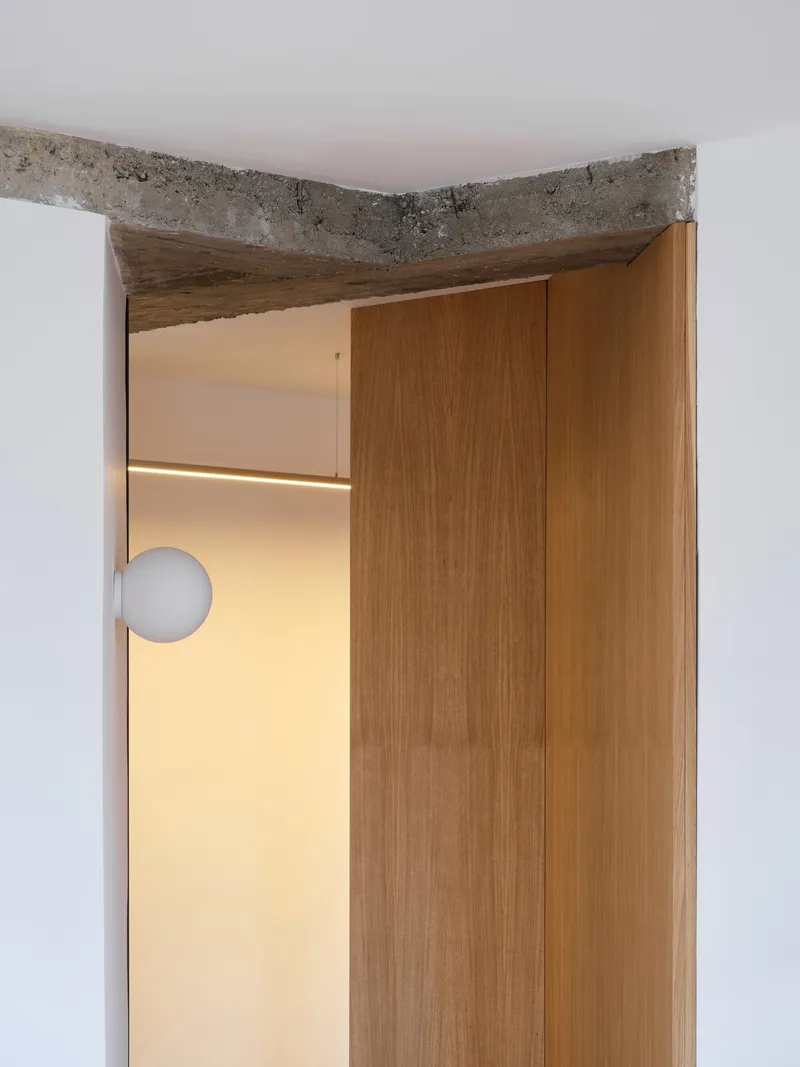
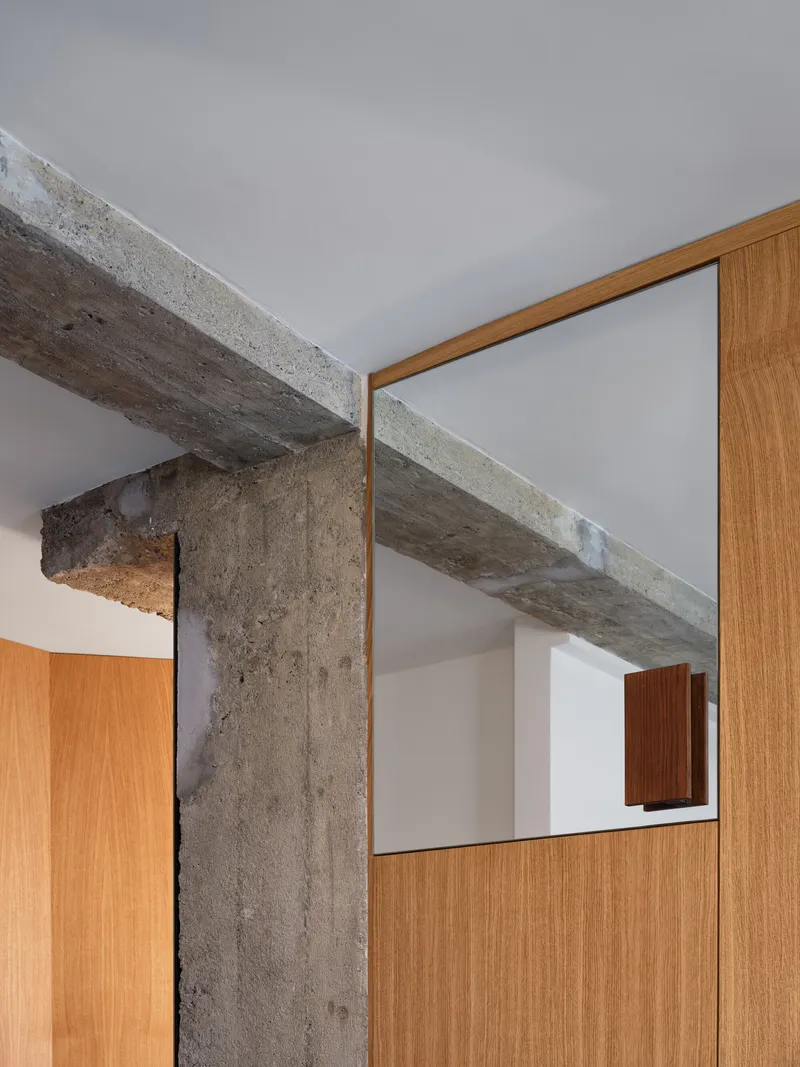
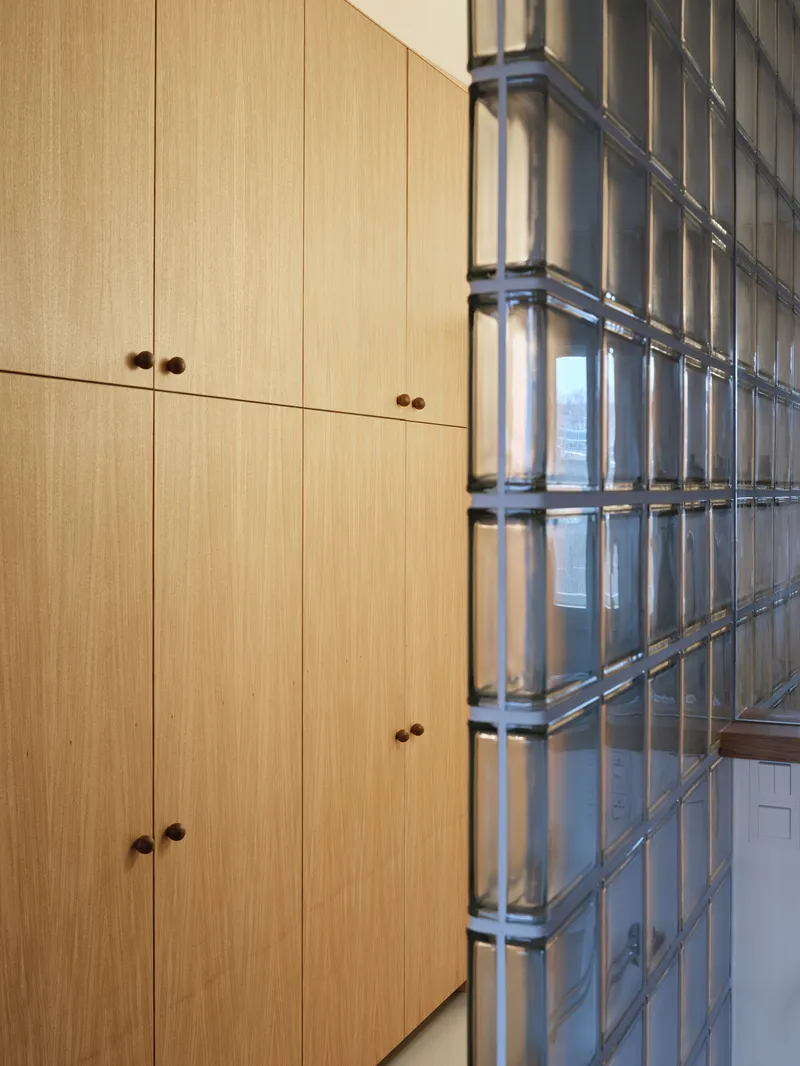
The detail photographs reveal how much of the project's success lies in the junctions. Where concrete beams meet oak-framed glazed partitions, where glass block meets steel framing, where the raw lintel above a doorway yields to a timber surround: these are the moments that separate a thoughtful renovation from a surface-level refresh. The stonework by Bruno Paul and the carpentry by Zlatý řez are legible in these details as genuine craft rather than spec-sheet finishes.
Hartl treats the building's original structure as a found condition to be negotiated with, not plastered over. The result is an apartment where you are always aware of the forces holding it up, and where the new domestic program reads as a precise insertion into that existing logic.
Bathroom as Spatial Sequence

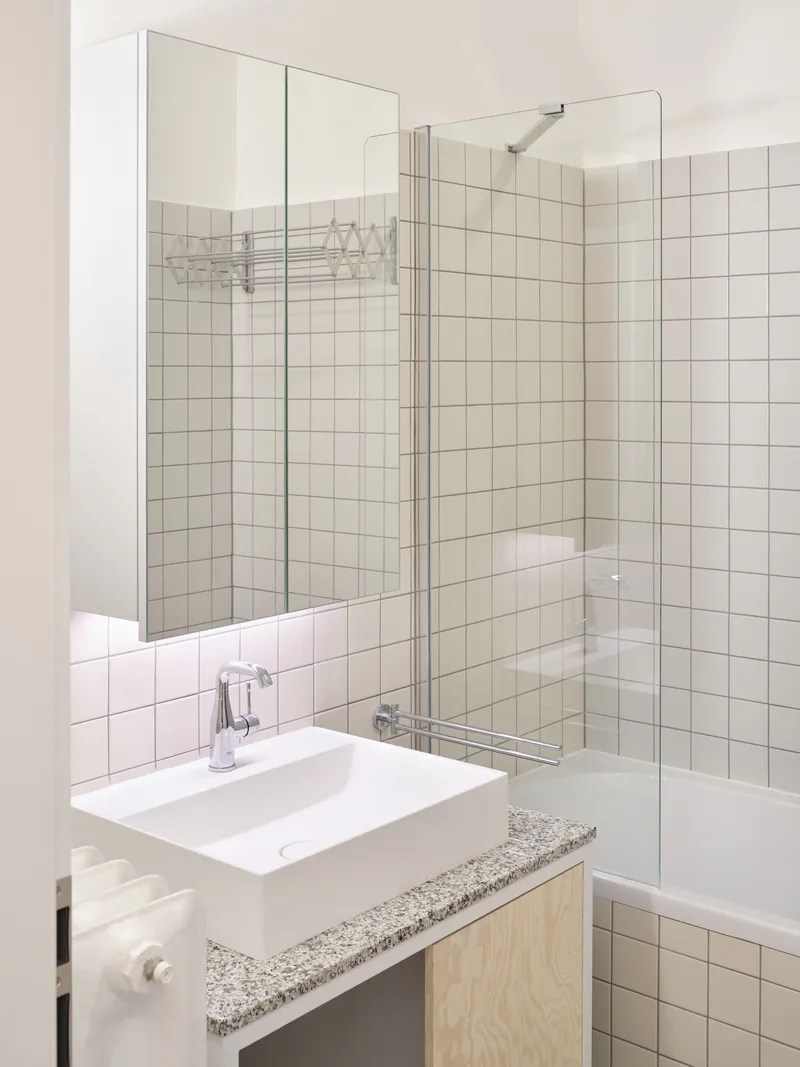

The bathroom continues the project's material honesty with white square tiles, a floating vanity featuring plywood cabinetry, and a terrazzo counter that connects back to the kitchen's backsplash. The glass block partition that screens the shower is visible from both sides, so the bathroom never feels isolated from the spatial sequence of the bedroom. A narrow window above a white radiator ventilates the space and frames a sliver of the city, a reminder that even the most utilitarian rooms in this apartment maintain a relationship with the exterior.
Plans and Drawings


The floor plans reveal the L-shaped configuration of the apartment, with the open living area and kitchen occupying the corner wing and the bedrooms retreating into a separate arm. The removal of the partition between the two original living rooms is clearly legible, as is the relocation of the kitchen from the rear service zone to the main space. What the plans also show is how the built-in storage walls function as spatial dividers, replacing conventional partitions with inhabited thicknesses that do double duty as wardrobes, bicycle storage, and desk nooks.
Why This Project Matters
The Corner Apartment is a small project with outsized lessons. It demonstrates that structural honesty in residential renovation does not require the austerity of a gallery space. Exposed concrete beams and a mirrored column coexist with warm oak, colored cabinetry, and family bicycles without contradiction. Hartl's achievement is in making the 1930s building feel like an active participant in the design rather than a constraint to be overcome.
For anyone working on prewar apartment stock in Central European cities, the project offers a transferable methodology: reveal the structure, let it organize the plan, and build a material palette that speaks to the building's era without imitating it. The result is an apartment that feels both rooted in its history and utterly suited to the way a young family actually lives. That is a harder balance to strike than it looks.
Corner Apartment by Prokop Hartl, Prague, Czechia. 115 m², completed 2026. Photography by Radek Úlehla.
About the Studio
Prokop Hartl
Official website of Prokop Hartl, one of the studios behind this project.
prokophartl.comShare Your Own Work on uni.xyz
If projects like this are the kind of work you want to make, uni.xyz is a place to publish your own, find collaborators, and enter design competitions.


Popular Articles
Popular articles from the community


Faces of the Soviet Avant-Garde: Turning Moscow's Street Names into an Open-Air Museum
A network of sculptural installations across a Moscow residential district transforms forgotten architect names into spatial encounters with cultural memor

Extended Shell: Retrofitting Kolkata's Balconies as Living Urban Thresholds
A modular retrofit system recovers the social and environmental intelligence of Kolkata's historic verandas for contemporary Park Street residents.

Manzana Morphosis: Stretching Barcelona's Grid into a Living Landscape for 2050
A radical reworking of the Eixample manzana turns density into a tool for generous public space, vertical ecology, and environmental performance.
Tsunami Convergenics: Turning Catastrophic Ocean Forces into Underwater Housing Infrastructure
A speculative underwater settlement off the coast of Onagawa, Japan, treats tsunamis and typhoons as energy sources rather than threats.

Similar Reads
You might also enjoy these articles

Bao Huynh Watercolor Atelier: A Serene Art Retreat in Hội An
Bao Huynh Watercolor Atelier in Hội An blends multifunctional art spaces, sustainable design, local materials, and family-friendly living in a serene environment.

Atelier Macri Concept Store Interior Design by CASE-REAL
Atelier Macri store features a "ko" counter, walnut wood details, cork displays, blending retail, gallery, and seamless customer experiences.

Manuel Vargas Izquierdo Stadium and High-Performance Sports Center: Architectural Excellence in Jalpa de Méndez
The Manuel Vargas Izquierdo Stadium blends sustainable design, inclusive sports facilities, and cultural-inspired architecture, revitalizing Jalpa de Méndez’s public spaces.

KAKR Buluh Awar Hall: Revitalizing Community and Ecology Through Bamboo Architecture
Community built bamboo hall revitalizes Buluh Awar village, empowering youth, restoring ecology, celebrating vernacular craftsmanship through sustainable architecture and culture.

Explore Apartment Competitions
Discover active competitions in this discipline

Challenge to design luxury tourism on rails

VR headsets Storefront design competition

Designing a staircase for a client
Comments (0)
Please login or sign up to add comments
No comments yet. Be the first to comment!