

gru.a Builds a 70 m² Timber Shelter That Opens Like a Farm Door in Brazil's Valley of the Vines
In the mountainous region near Rio de Janeiro, a compact retreat uses plywood panels and deep eaves to blur the line between inside and out.


At 70 square meters, the Baixo Shelter by gru.a barely registers as architecture in the conventional sense. It sits on a hillside in the Vale das Videiras, a lush mountainous pocket of Petrópolis near Rio de Janeiro, and reads more like an inhabited piece of furniture: a timber frame, some plywood panels, a concrete slab, a deck, and a roof that stretches well beyond the walls. The project is the second of three planned structures on the site, following the Pavilhão completed in 2016, and it shares with its predecessor a conviction that shelter in this climate can be radically minimal without being rough.
What makes the project genuinely interesting is its panel system. The yellow plywood enclosure opens at two different heights, recalling the split doors of traditional Brazilian farms. This is not decorative nostalgia. It is a practical move that lets the occupant calibrate ventilation, privacy, and sunlight independently. Combined with eaves that extend up to 1.80 meters and a double-layer roof insulation strategy, the result is a building that manages thermal comfort through geometry and material rather than mechanical systems.
A Pavilion on the Slope
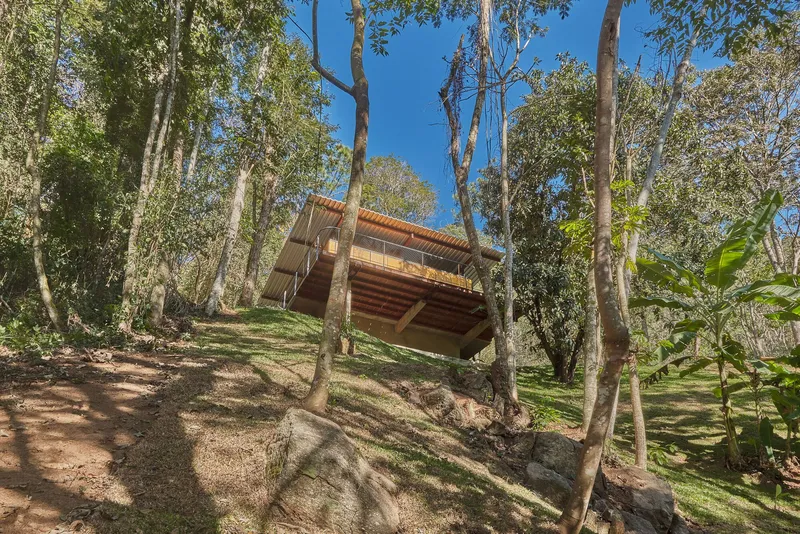
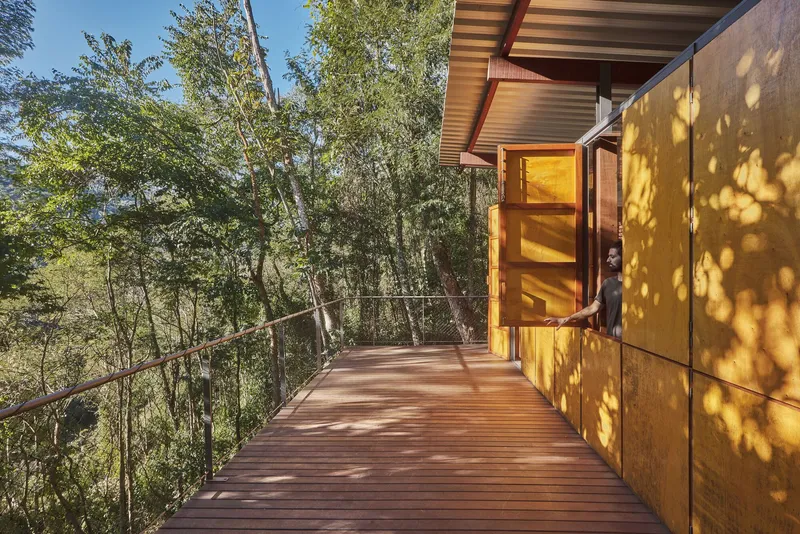
The shelter lifts off the hillside on wooden pillars and ceramic masonry walls, a strategy that keeps the footprint light and lets the terrain fall away beneath the deck. From a distance, the building almost disappears into the eucalyptus grove. Its corrugated metal roof catches flickers of light through the canopy, but the low profile and muted yellow panels blend with the dappled hillside. The raised deck extends the living space outward, its steel cable railing keeping the visual obstruction to a minimum.
This is not a building that announces itself. It occupies its slope the way a hammock occupies a pair of trees: lightly, with the understanding that the landscape was here first and will outlast whatever sits on it.
The Split-Door Facade
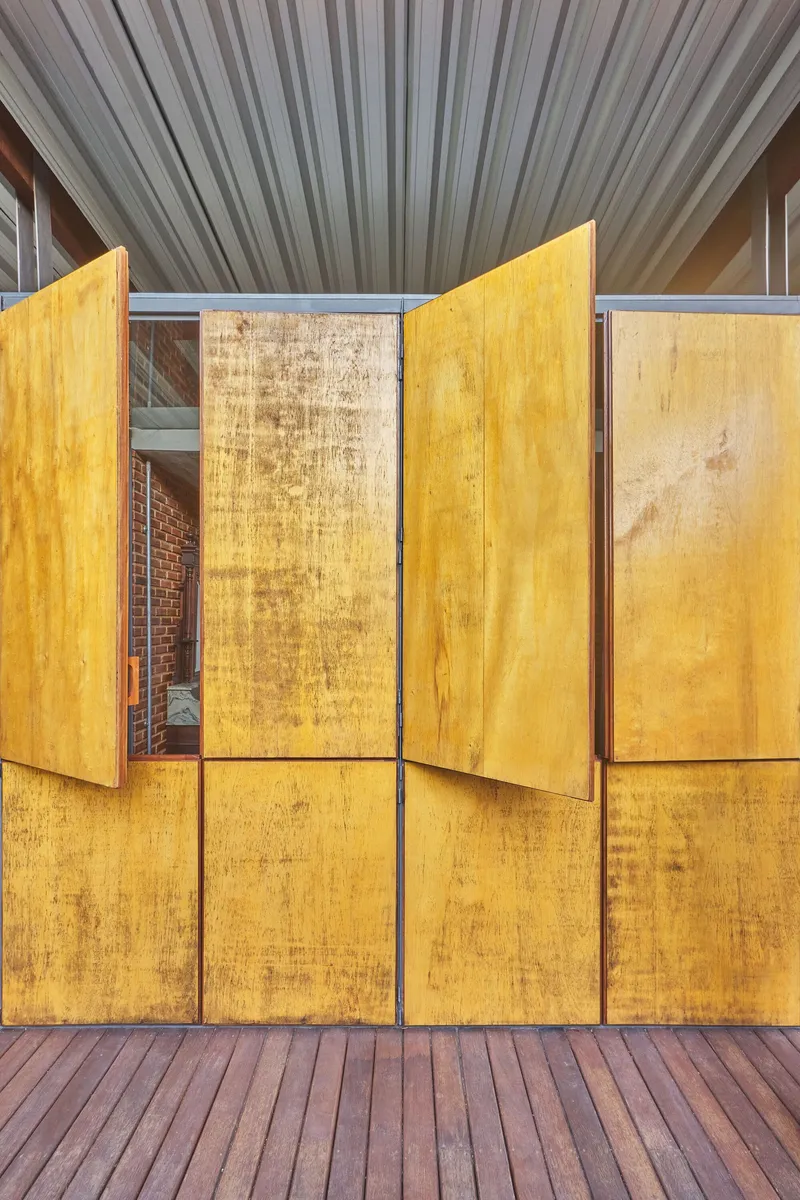
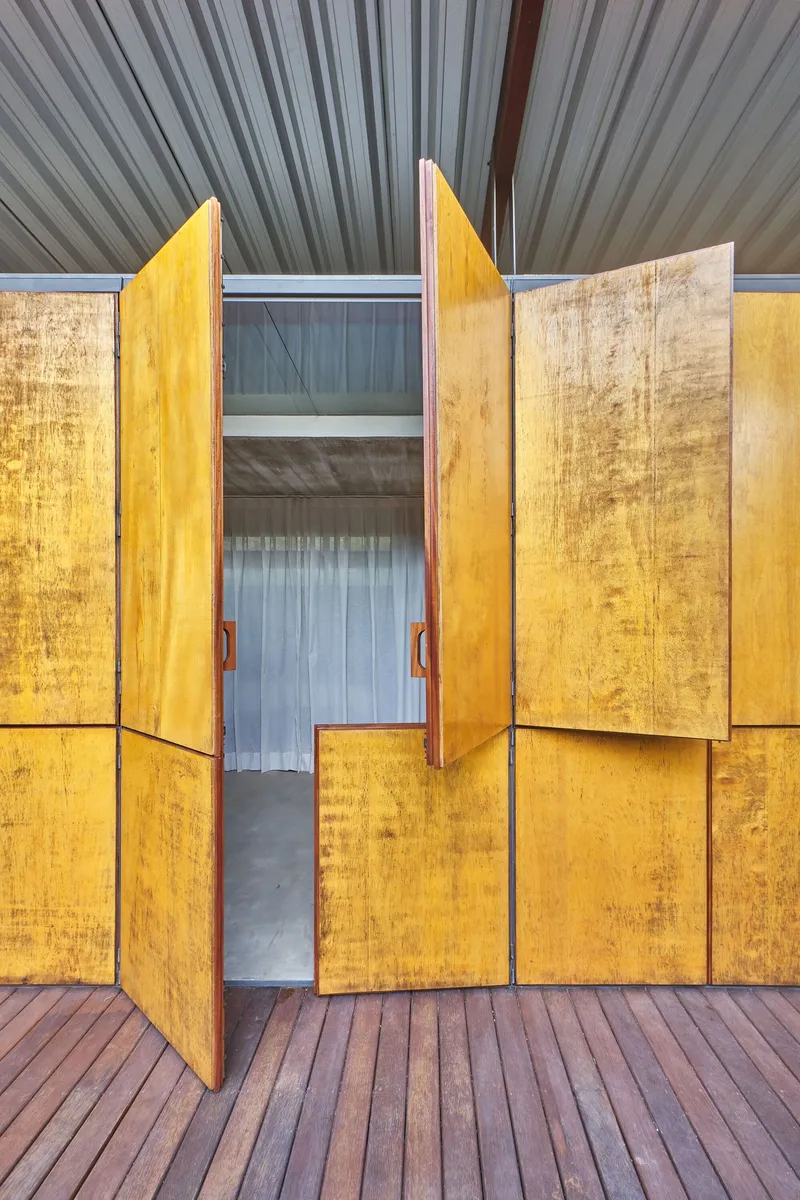
The defining gesture of the Baixo Shelter is its operable plywood facade. The panels swing open at two different heights, a direct reference to the traditional farm doors found across rural Brazil. In those agrarian contexts, the upper half could be opened for ventilation while the lower half stayed shut to keep animals out. Here, the logic is adapted for a weekend retreat: open the top for breeze and light while maintaining a sense of enclosure at seated height, or throw both halves wide to dissolve the wall entirely.
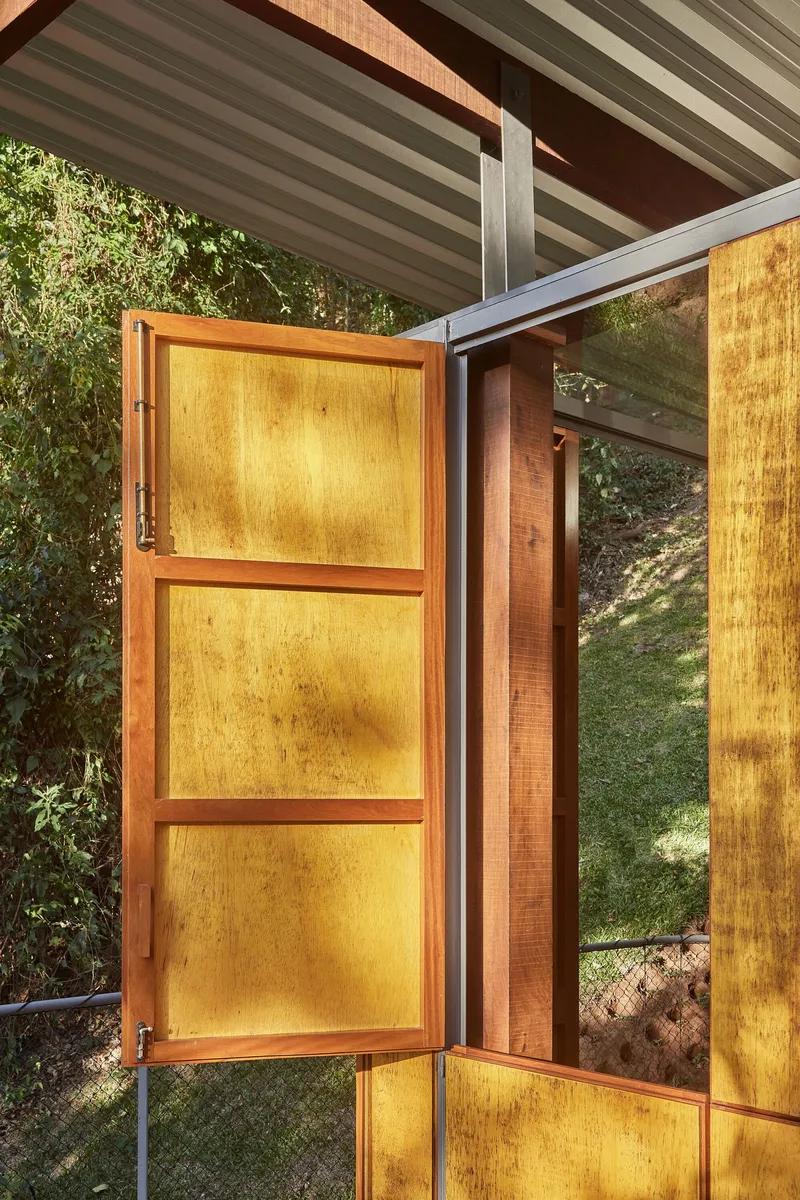
The weathered yellow finish of the plywood is honest about its age, and the panels are detailed with simple metal latches that look like they belong on a workshop rather than a house. This is deliberate. gru.a treats hardware as visible infrastructure, not something to be concealed behind flush detailing. The ribbed metal ceiling overhead reinforces the industrial palette, creating a shelter that feels assembled rather than constructed.
Inside: Concrete, Brick, and Curtain
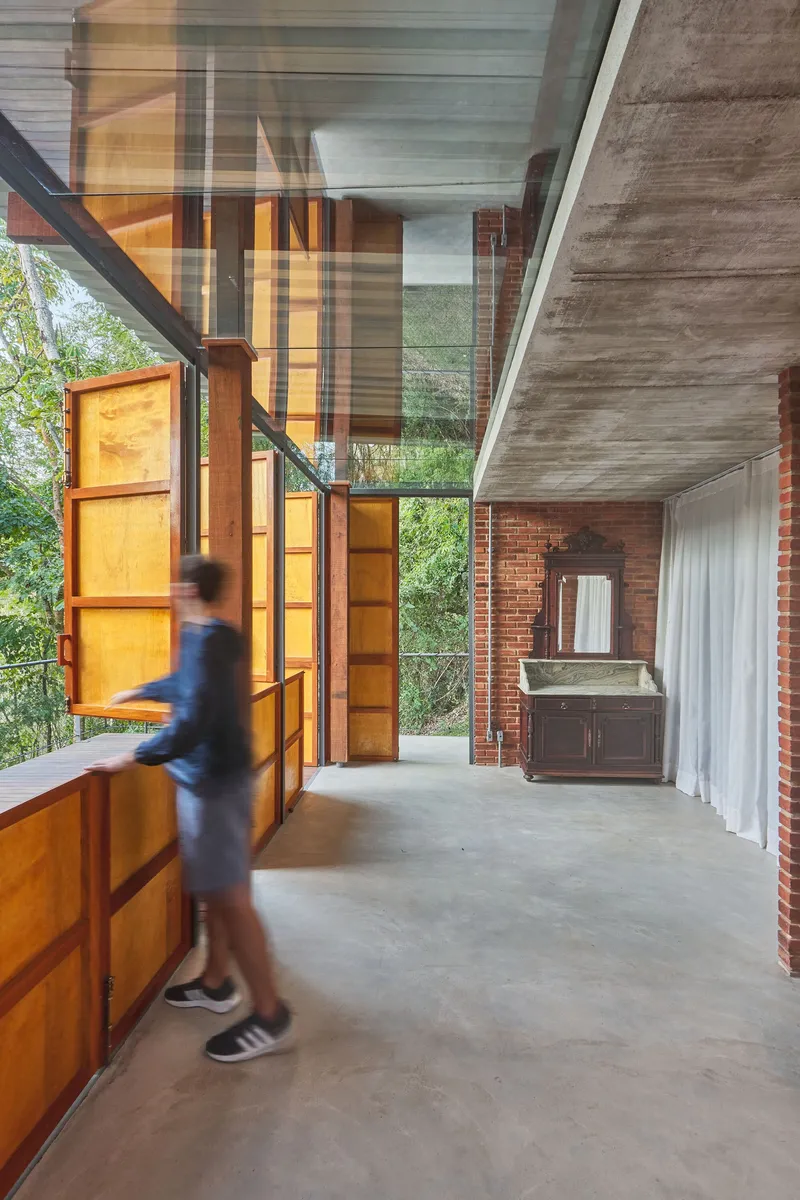
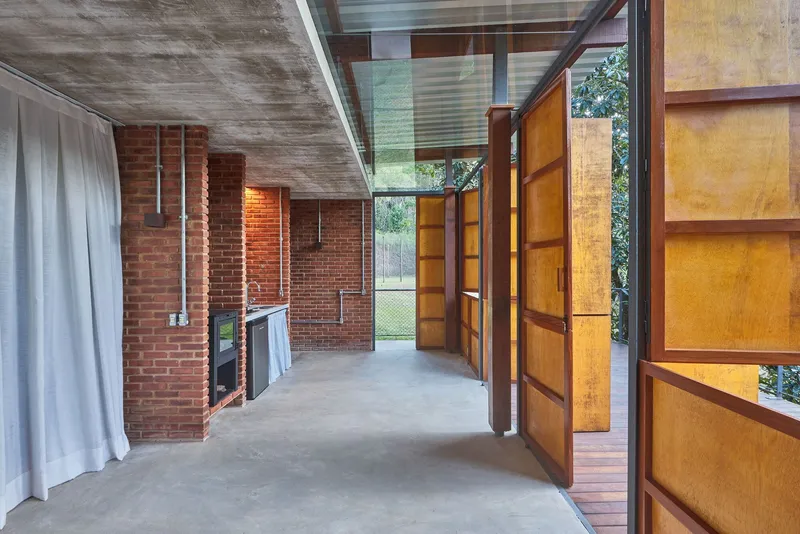
The interior is compact and unapologetic about it. At roughly 30 square meters of enclosed space, the program is compressed to essentials: a sleeping area separated by a light curtain, a small pantry with a wood stove, and a complete bathroom. The polished concrete floor runs continuously from the main room to the threshold of the deck, reinforcing the ambiguity between inside and outside. Brick columns stand exposed, doing double duty as structural supports and spatial dividers.
The sleeping space, enclosed only by fabric rather than a solid wall, is a smart concession to the project's scale. A partition would have created two cramped rooms. The curtain creates one flexible room that can be subdivided on demand. It also allows the cross-ventilation strategy to work across the entire plan, pulling air from the opened facade panels through the sleeping zone and out.
Detail and Hardware
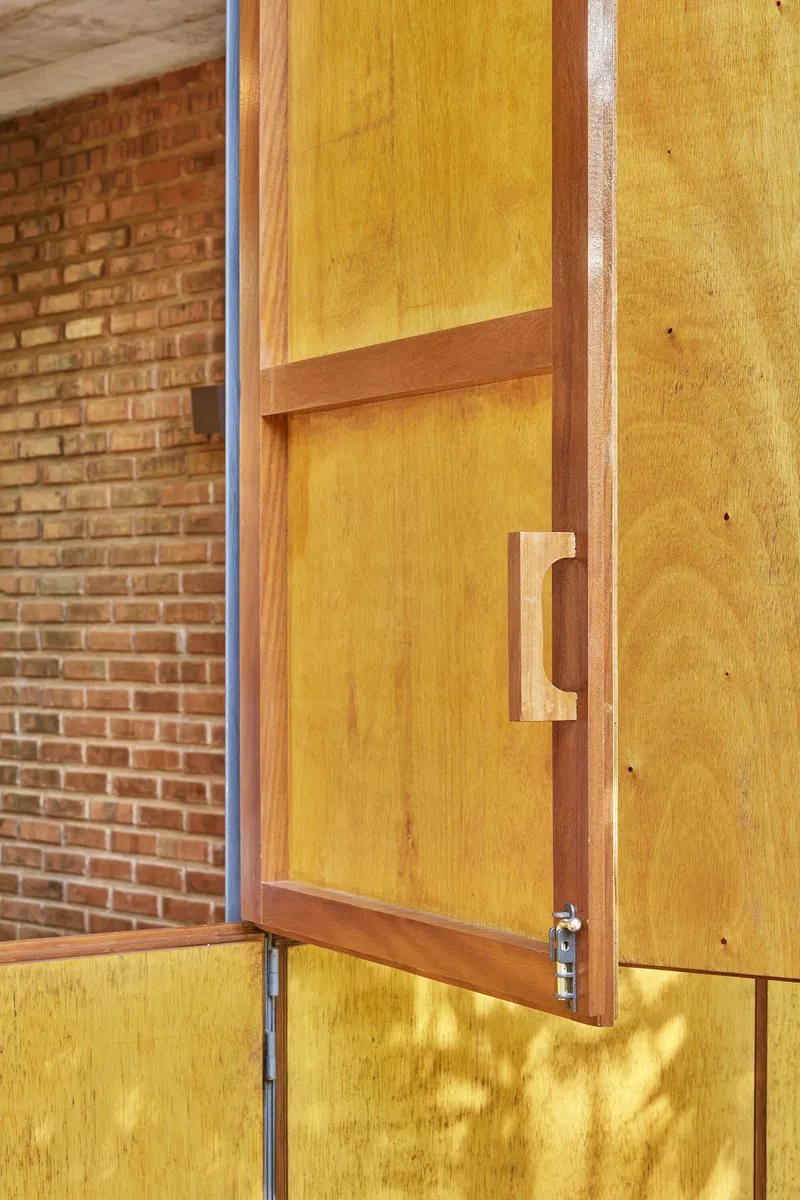
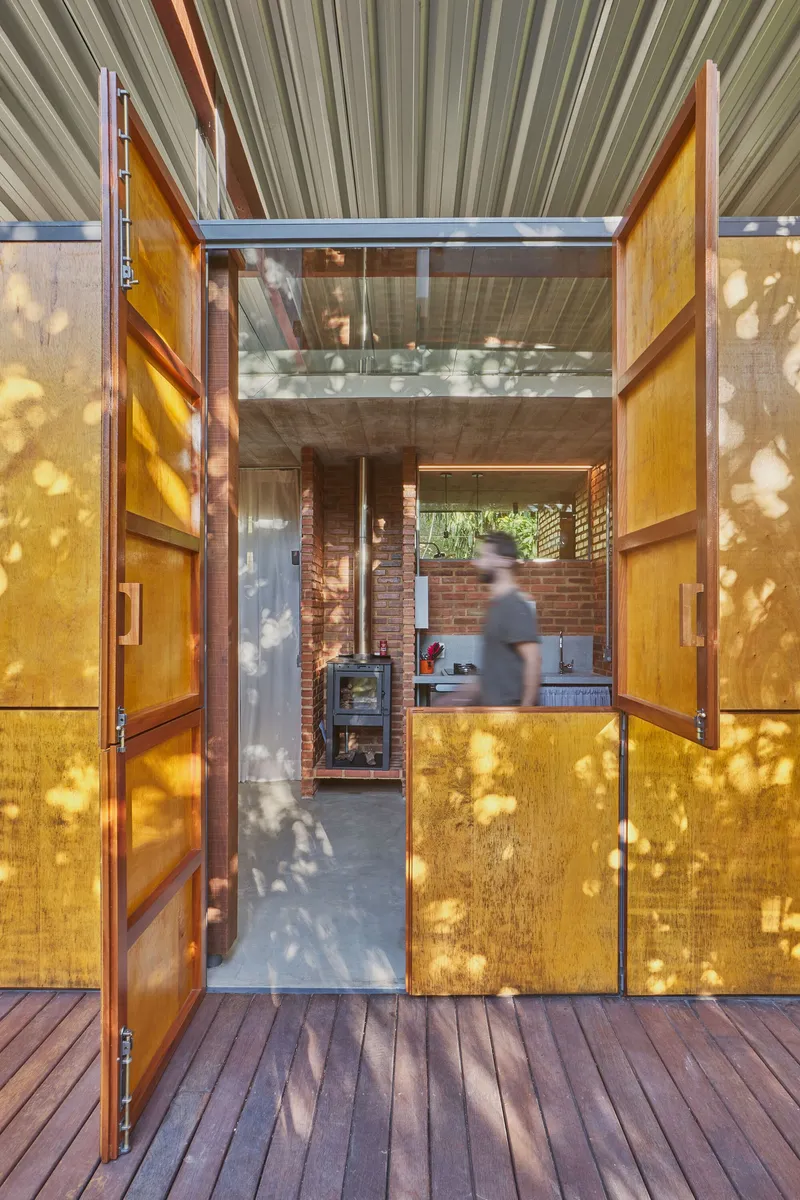
A close look at the door hardware tells you a lot about gru.a's priorities. The timber handle and metal latch are robust, oversized, and visible. There is no attempt to miniaturize or conceal the mechanism. The yellow-painted plywood surface around it has taken on the patina of use and weather, and the architects clearly designed with this aging process in mind. The building is meant to wear its life on its surface.
The wood stove visible through the opened doors is another telling detail. In the mountainous climate of Petrópolis, where temperatures can drop significantly at night, the stove provides warmth while the deep eaves and double-layer roof insulation handle the daytime heat. It is a climate strategy built from specific, low-tech components rather than a general mechanical system.
Plans and Drawings
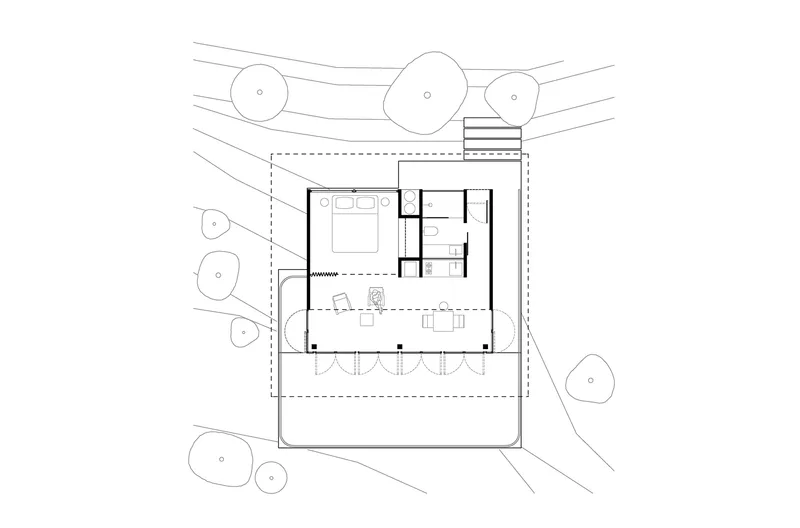
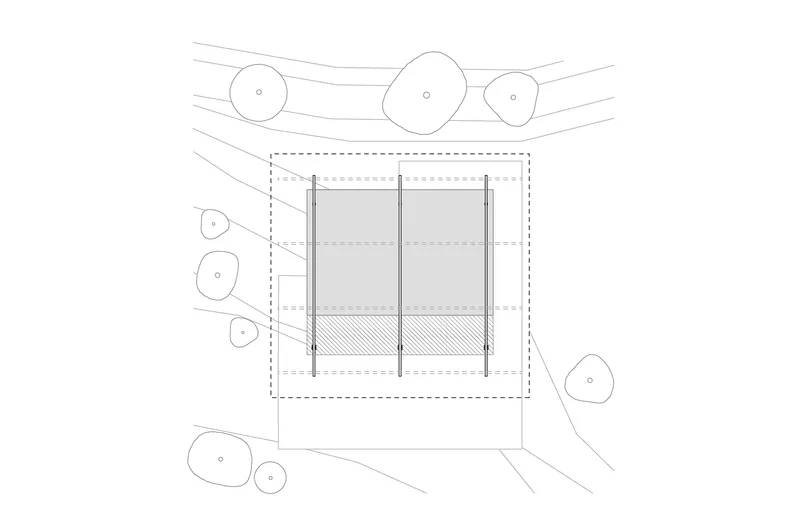
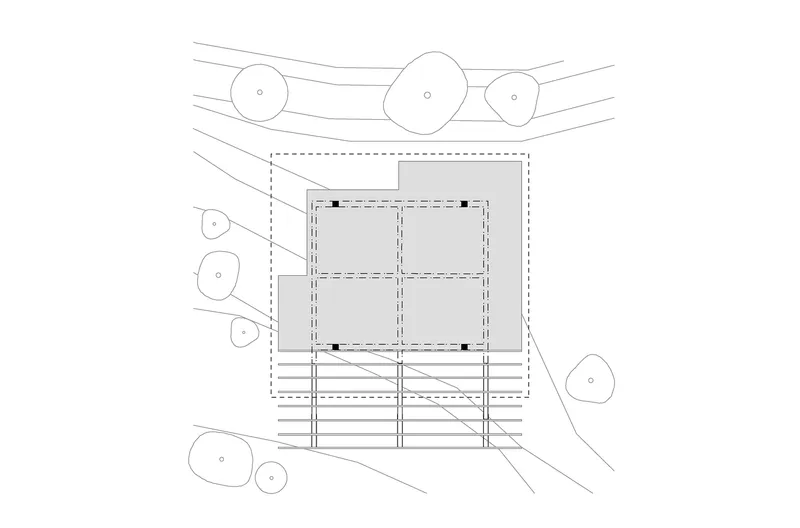
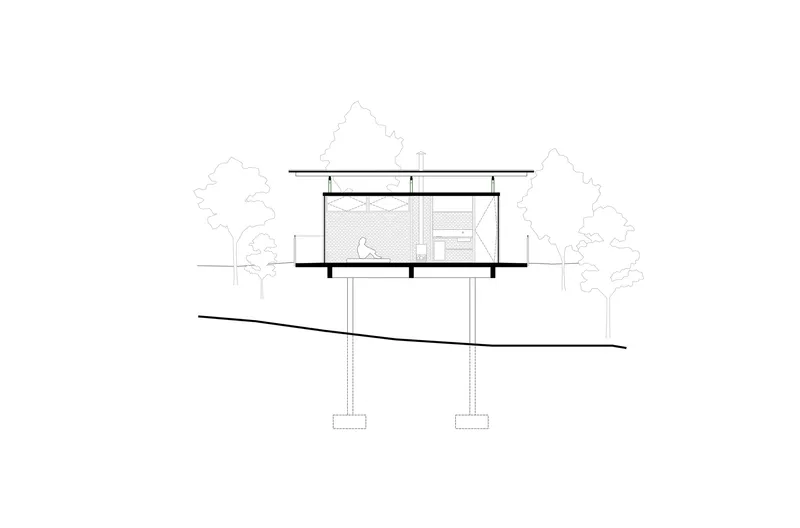
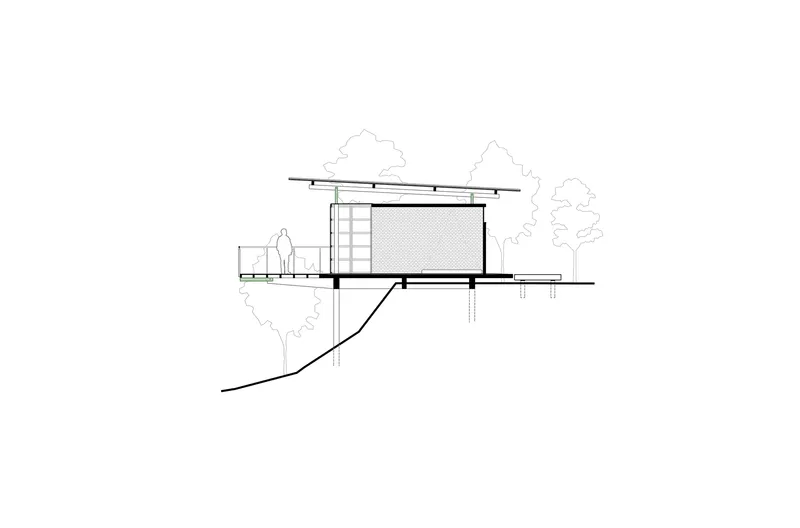
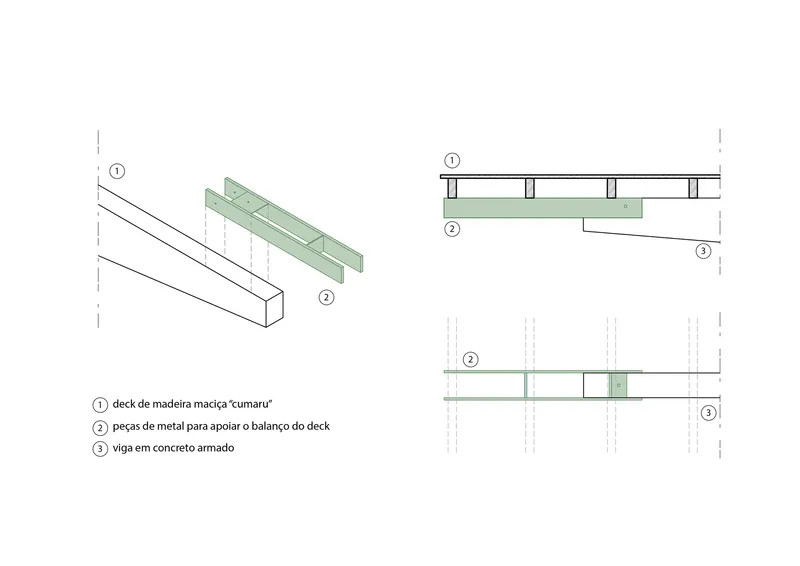
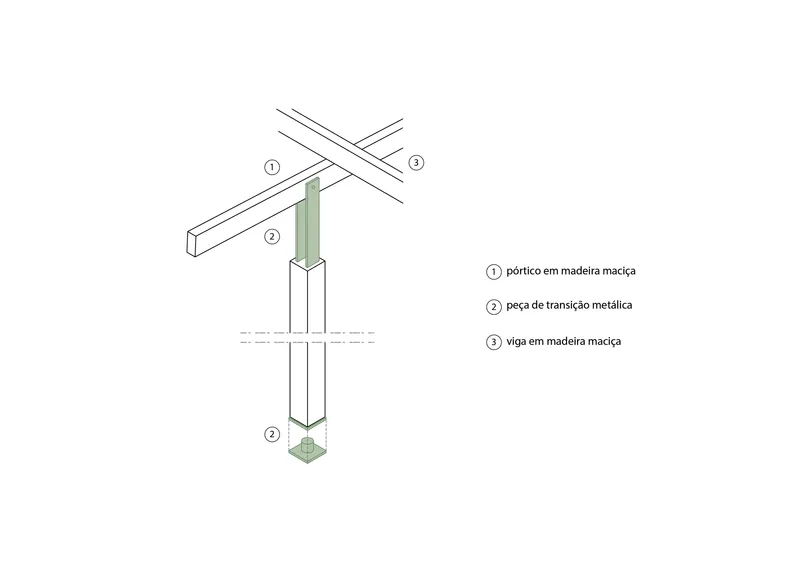
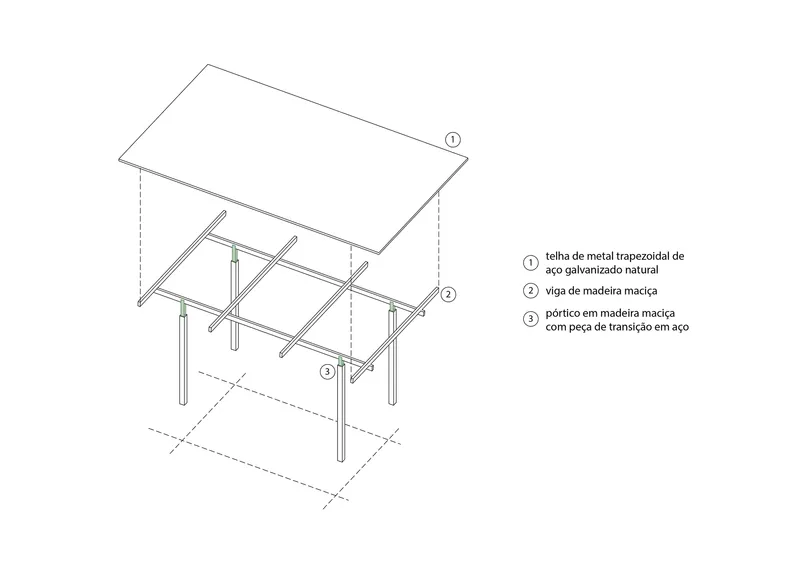
The floor plan reveals just how much of the 70 square meters is deck. The enclosed service core, containing the bathroom and sleeping area, is pushed to one end, leaving the main living space to flow directly onto the surrounding timber platform. The structural logic is clear in the sections: a post-and-beam system with spans of 3 and 5 meters, supported by a combination of wooden pillars and ceramic masonry walls, lifting the entire volume above the sloping grade.
The axonometric details are worth studying. The connection between timber columns, metal bracket plates, and concrete footings shows how the building touches the ground: precisely and with the minimum possible intervention. The roof framing drawing reveals steel trusses sitting on timber posts, a hybrid approach that allows the long overhangs without oversizing the wood members. Every joint in these drawings communicates a decision about how little material can do how much work.
Why This Project Matters
The Baixo Shelter matters because it demonstrates that small architecture can still be rigorous architecture. At 70 square meters, many firms would default to a generic cabin typology, but gru.a has produced a building with a legible structural logic, a considered climate response, and a facade system rooted in vernacular intelligence. The split-door mechanism alone is worth the attention: it takes a piece of agricultural heritage and turns it into a functional device for managing comfort in a subtropical mountain climate.
More broadly, the project offers a quiet counterargument to the idea that sustainability in architecture requires technological complexity. The deep eaves, the double-layer roof, the operable panels, the cross-ventilation enabled by a curtain instead of a wall: all of these are passive strategies that cost almost nothing to operate. As the second of three planned structures on this hillside, the Baixo Shelter also hints at a larger ambition: a small compound in the valley of the vines where each building is a precise, economical response to a specific part of the terrain.
Baixo Shelter (Abrigo Baixo) by gru.a, Petrópolis, Brazil. 70 m². Completed 2022. Photography by Rafael Salim.
About the Studio
Share Your Own Work on uni.xyz
If projects like this are the kind of work you want to make, uni.xyz is a place to publish your own, find collaborators, and enter design competitions.


Popular Articles
Popular articles from the community


The Amber Palace Opera: A Geological Fiction Surfaces on Tallinn's Baltic Waterfront
Pierre Brillard reimagines a Baltic legend as a public landscape, opera house, and waterfront promenade rooted in Tallinn's coastal identity.


Cube Design Draws an Ecological Corridor Between Two Shenzhen Hills with the Nankai Building
Beside Shenzhen's container docks, the Nankai Building pairs stacked balconies with a climbing green screen to connect two hillsides across its height.

graciastudio Turns a Viewless Tijuana Lot Inward Around a Courtyard of Concrete, Timber and Trees
In Tijuana, Jorge Gracia's GA2 House stacks a timber-clad private floor over exposed concrete and replaces a missing view with a planted interior patio.

FCC Arquitectura Expands a Portuguese Granite House with a Board-Marked Concrete Wing
In Portugal, JV House pairs a cleaned-up whitewashed and granite dwelling with a timber-shuttered concrete extension, courtyards and a garden pool.

Similar Reads
You might also enjoy these articles

LAVA Architecten Gives Vocational Education a Sawtooth-Roofed Face on a Mechelen School Campus
In Mechelen, Belgium, a 2,053 m² STEM school on a 6×6 m grid turns workshops and classrooms into rooms that can be rearranged as teaching changes.

KEMA Studio Turns a Derelict Marvila Attic into a 60 m² Lighthouse Apartment Above Lisbon
In Lisbon's Marvila district, a rebuilt roof, four skylights and two plywood volumes turn an unlivable attic into a bright home facing the Tagus.

Pixel Gardens: One Repeated Module Stacked Into a Terraced Social Housing Tower for Famagusta
Salem Bader's shortlisted housing tower builds a vertical neighbourhood from one repeated module, offsetting units to carve terraces, light and air.

Bao Huynh Watercolor Atelier: A Serene Art Retreat in Hội An
Bao Huynh Watercolor Atelier in Hội An blends multifunctional art spaces, sustainable design, local materials, and family-friendly living in a serene environment.

Explore Shelter Competitions
Discover active competitions in this discipline

Challenge to design a portable theatre

Challenge to design a portable music platform

Challenge to design an open learning module for the elderly

Challenge to reimagine the Iron Throne
Comments (0)
Please login or sign up to add comments
No comments yet. Be the first to comment!