
3dor Concepts Wraps a Kerala Home in Mirrored Concrete Arcs Around a Courtyard Tree
In the Western Ghats foothills of Thamarassery, a 270 m² single-story house uses two curved volumes to frame nature as its center.


The name gives it away. Two asymmetric C-shaped concrete volumes, mirrored and interlocked, form the architectural skeleton of this 270 m² house by 3dor Concepts in Thamarassery, Kerala. The site sits in the foothills of the Western Ghats near Wayanad, on land where the client's father farmed and planted trees that still stand today. Rather than clear the plot and impose a plan, lead architects Ahmad Thaneem Abdul Majeed, Muhammed Jiyad, and Muhammed Naseem designed around the existing vegetation, preserving mature palms and anchoring the entire composition to a single tree in the entry courtyard.
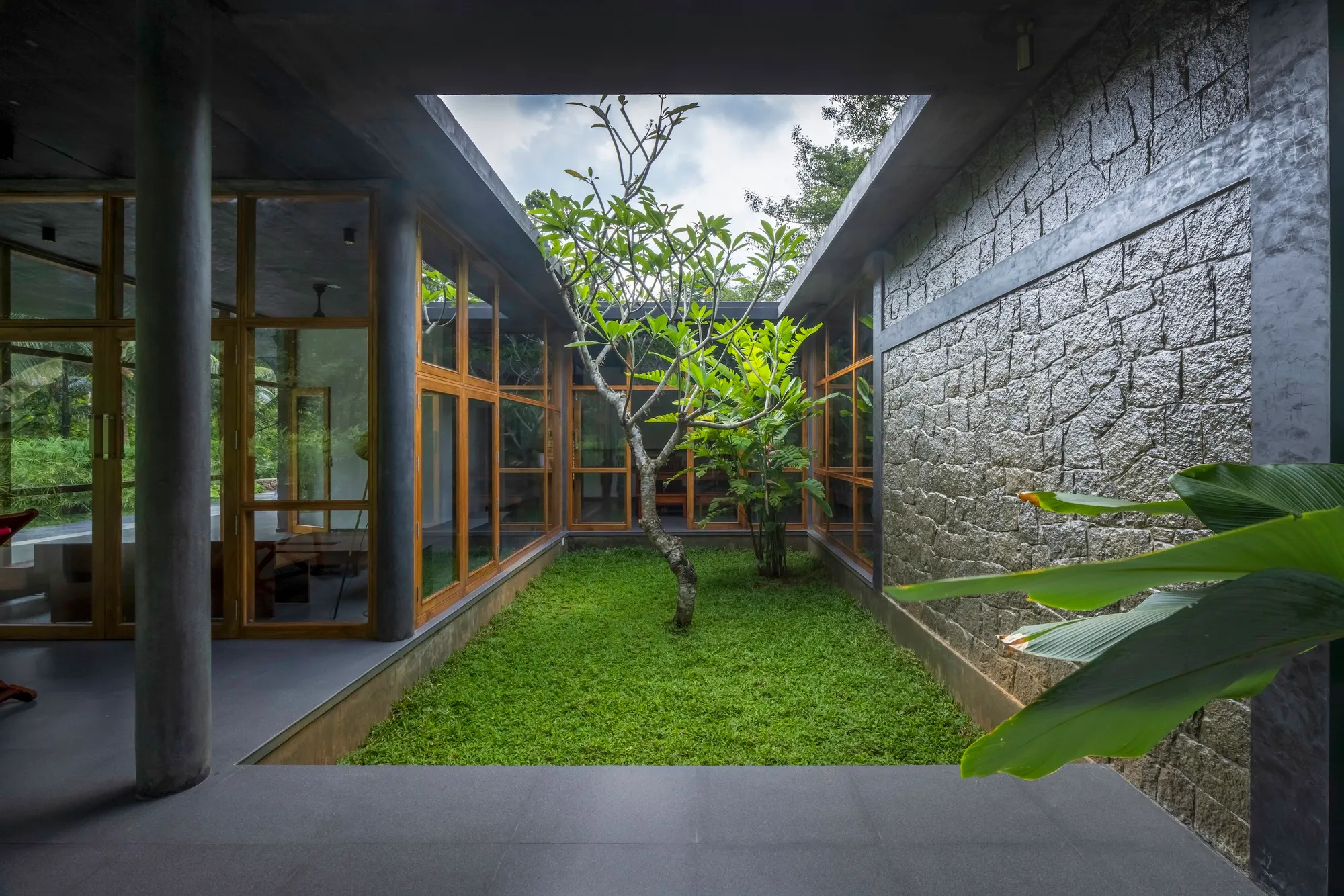
What makes the ↄc House worth studying is not its formal gesture alone, though the mirrored curves are striking, but the way that gesture produces a very specific kind of domestic life. The courtyard is not decorative. It is the gravitational center of a single-story plan that wraps four bedrooms, a transparent living room, and generous eight-foot verandahs around a shared garden. The house does not look at nature through a picture window. It surrounds itself with it, and in doing so borrows climate strategies native to Kerala architecture: wide overhangs, colonnaded thresholds, timber-framed floor-to-ceiling glazing, and dark rubble masonry that absorbs the tonal range of a perpetually green landscape.
Two Cs and a Tree

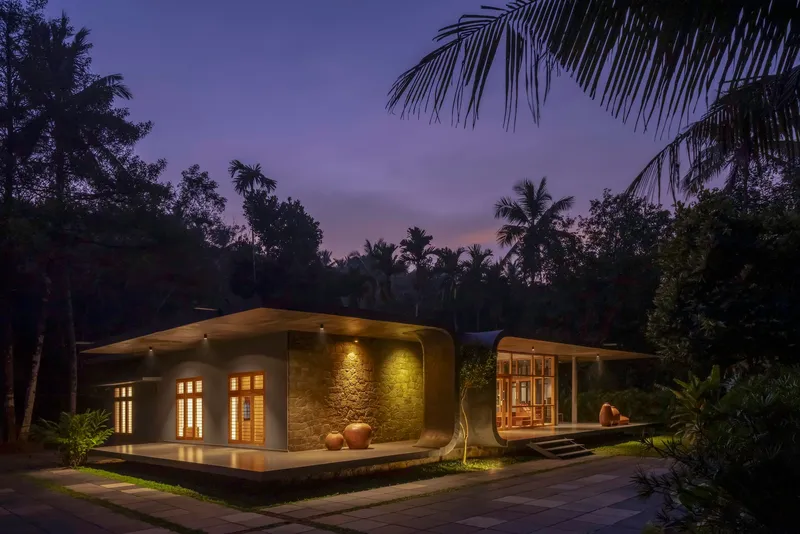

The facade reads as a riddle until you see the plan. Two curved concrete walls part at the entrance to reveal a planted bed and a young tree. The gap between the C-forms is the threshold, and it sets up the logic for the entire house: solid masonry curves on the outside, transparent glazing on the inside, and planted ground in between. At dusk, the illuminated rubble stone walls glow against the palm canopy, making the arced niches legible from the approach path. It is a rare residential facade that manages to be both monolithic and inviting.
Sited in the Canopy
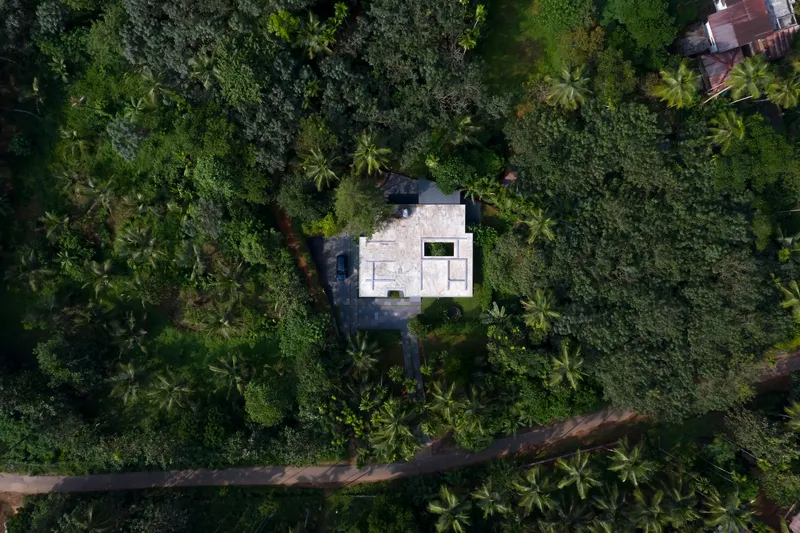
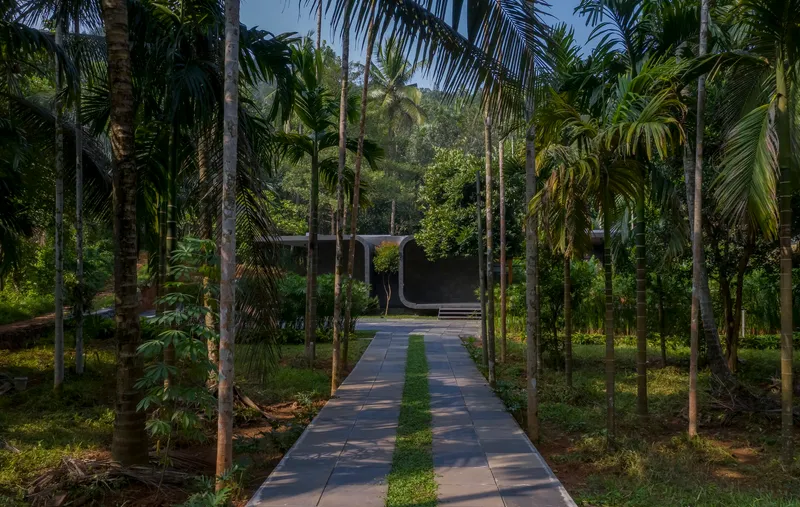
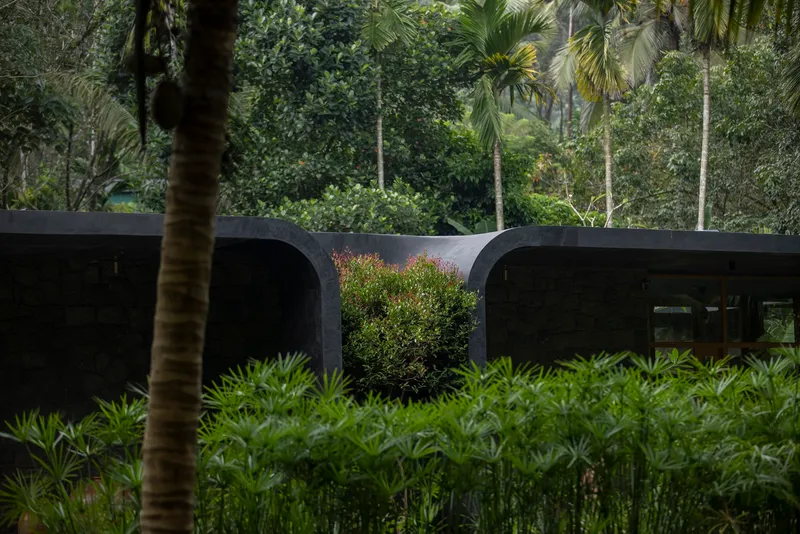
From the air, the house nearly disappears. White roof planes sit beneath a dense coconut palm canopy that predates the building by decades. A stone-paved walkway threaded with grass strips leads through rows of palms to the entrance, reinforcing the sense that you are arriving at something embedded in the terrain rather than placed on top of it. The curved volumes emerge from hillside vegetation like geological outcroppings, their dark surfaces matching the tonality of the surrounding bamboo and banana plants.
This is not a tropical modernist retreat designed to photograph well with a drone. The landscape strategy is rooted in biography: the client grew up on this plot, and the trees are inherited. The architecture simply takes that inheritance seriously.
The Courtyard as Engine


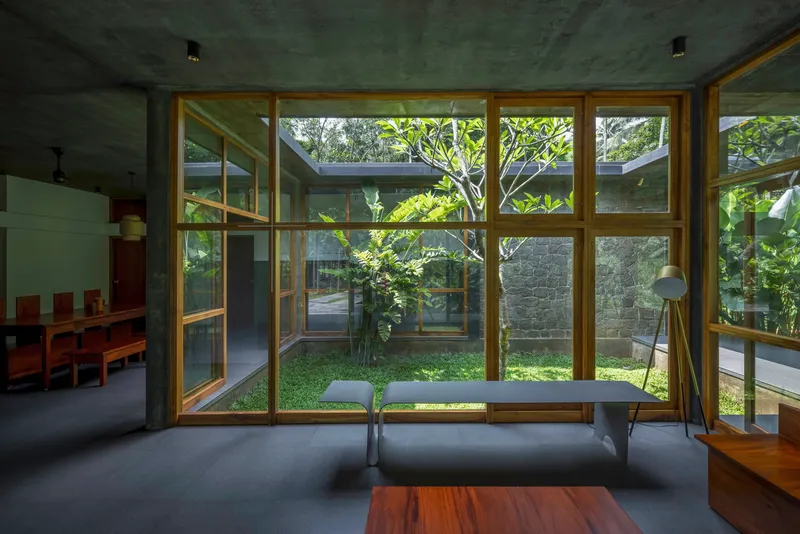
The central courtyard is the organizational engine of the plan. A grass lawn with frangipani trees is enclosed on three sides by full-height glazed walls and rubble stone partitions, creating a room without a roof that every other room orbits. Bedrooms open to it through controlled apertures. The living and dining spaces face it through uninterrupted timber-framed glass. The verandahs that ring three sides of the courtyard act as spatial buffers, eight feet wide, blurring the line between inside and outside.
What the courtyard does thermally is just as important as what it does spatially. It draws cross-ventilation through the plan, provides shaded daylight to deep interior zones, and eliminates the need for artificial cooling during most of the year. In a region with intense monsoons and high humidity, this is not a luxury. It is common sense, executed with precision.
Glass, Timber, and the Living Room Pavilion

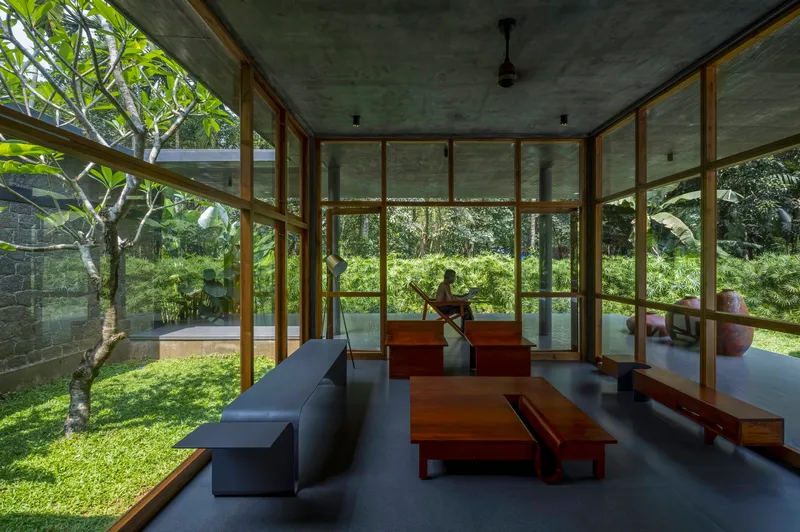

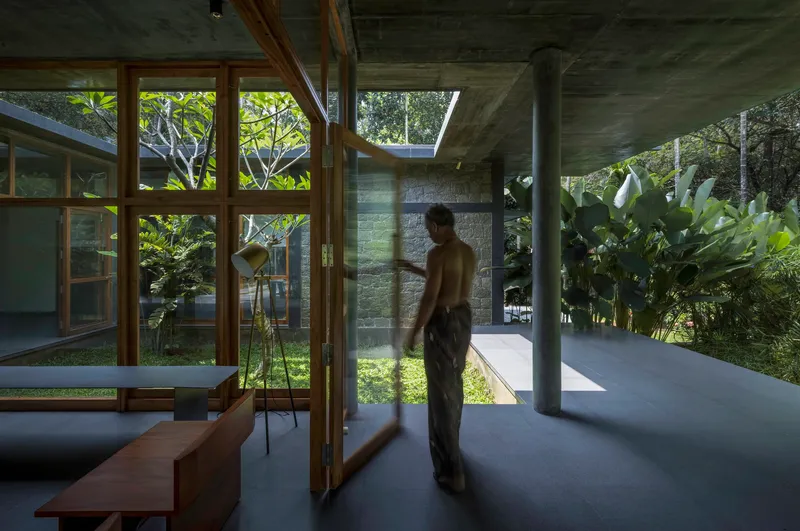
The living room is the most transparent volume in the house, with three glazed walls framed in timber that open onto the lawn. Seen from outside, it reads as a glass pavilion tucked under the curved concrete roof edge, a lightweight insert within a heavy masonry shell. Board-formed concrete columns and the exposed ceiling above give the space texture without decoration. Dappled sunlight filters through the palm canopy and timber mullions, producing a shifting pattern on the gray tile floors that changes with the hour.
The timber framing is a deliberate nod to Kerala's architectural tradition of large wood-framed fenestration. Here it serves a dual purpose: structurally, it supports the expansive glazing panels; visually, it warms the palette against the concrete and stone and provides a domestic scale to what could otherwise feel institutional.
The Verandah as Threshold
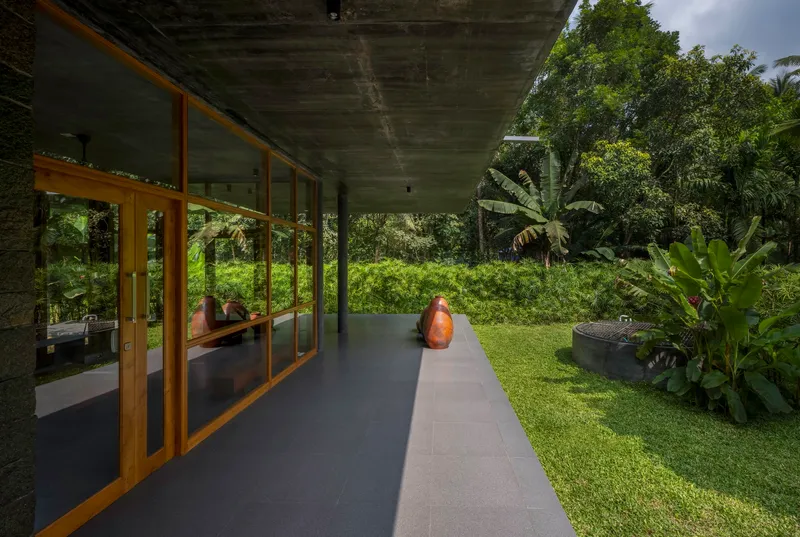


Kerala's verandah is one of the most intelligent spatial inventions in tropical residential architecture, and 3dor Concepts leans into it heavily. The eight-foot-wide covered terraces that wrap the courtyard are not corridors. They are habitable rooms open to the garden, furnished with reading chairs, ceramic vessels, and views of banana plants. Slender cylindrical columns prop up the wide overhangs, keeping the structural expression minimal while maximizing the shaded zone.
These passages do the work that air conditioning cannot. They intercept direct sunlight before it reaches the glazed walls. They provide sheltered outdoor space during the monsoon. And they create a gradient of privacy, from the fully exposed garden to the semi-sheltered verandah to the enclosed bedroom, that lets inhabitants choose their degree of exposure at any moment.
Interior Atmospheres: Stone, Concrete, and Striped Light
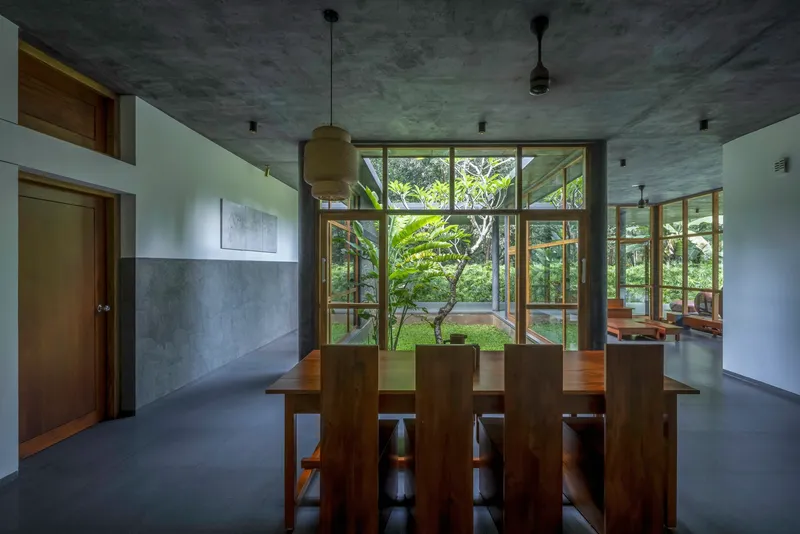

Inside, the palette is restrained: exposed cement-plastered ceilings, board-formed concrete columns, gray stone tile floors, and timber furniture. The dining area sits beneath a raw concrete ceiling with pendant fixtures, its timber table and chairs grounding the space in warmth. The bedrooms take a different approach to light. Horizontal louvered windows cast striped sunlight across platform beds, producing a controlled, contemplative atmosphere that contrasts with the full transparency of the public rooms.
The house understands that privacy and openness are not opposites but positions on a spectrum. Four bedrooms limit their apertures to preserve intimacy. The living room dissolves its walls entirely. The verandah splits the difference. Every room has a calibrated relationship to daylight and view, and the material palette stays consistent enough that moving between zones feels like a change in intensity rather than a change in character.
Details and Objects

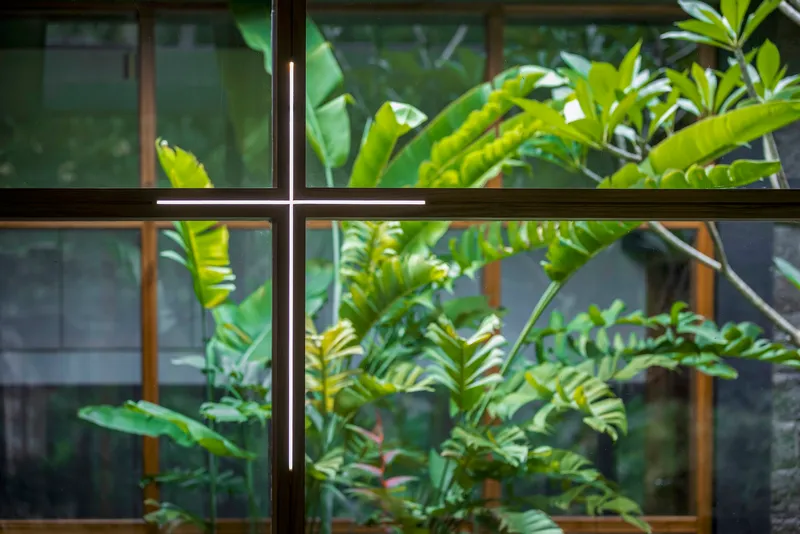

A double-height wall with symmetrical timber doors and suspended bookshelves flanked by two sculptures is the most composed interior moment in the house. It signals that the architects were thinking about inhabitation as a curated experience, not just spatial efficiency. Elsewhere, a close-up of a steel window mullion cross reveals the precision behind the seemingly relaxed timber frames. Ceramic vessels placed in the open pavilion act as markers of domesticity, softening the concrete surfaces and anchoring the space to daily life.
Carport and the Green Roof


The carport, a curved concrete canopy with a planted green roof, is the smallest gesture in the project and one of the most telling. It mirrors the formal language of the main house at a reduced scale, sheltering a single vehicle beneath a living surface. It also signals commitment: the architects were not willing to let even the utilitarian program default to a generic solution. Every element, down to the parking structure, participates in the same material and geometric logic.
Plans and Drawings


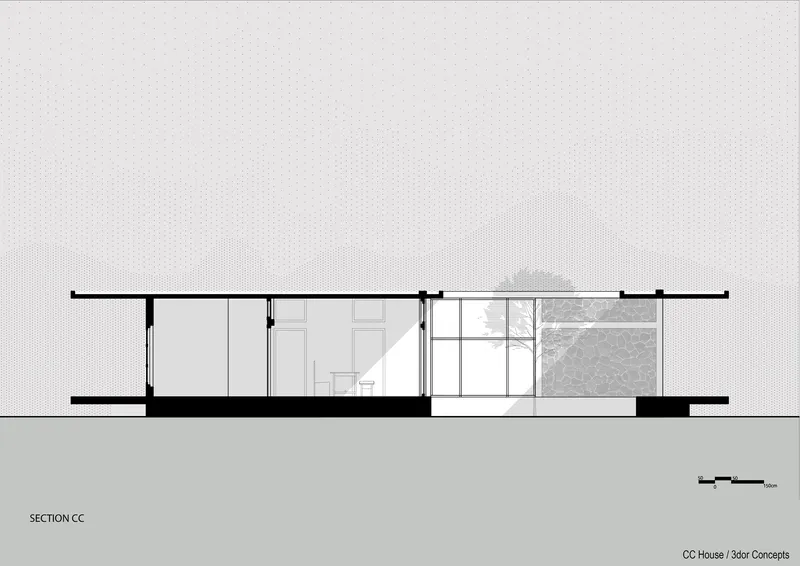
The site plan confirms what the aerial view suggests: the building occupies a modest footprint within an irregular trapezoidal plot, surrounded by scattered trees that dictated the plan's orientation. The floor plan reveals the courtyard's centrality with clarity. Bedroom clusters flank the central garden on two sides, while the living and dining pavilion anchors the third. The front elevation shows the low-slung roof profile and the gap between the two C-forms at the entrance. In section, the continuous roof plane reads as a single horizontal datum that unifies the varied spaces beneath it, while the courtyard tree breaks through, asserting nature's primacy.
Why This Project Matters
The ↄc House is a reminder that formal inventiveness and climatic intelligence are not competing agendas. The mirrored C-volumes give the project a memorable identity, but they also produce the overhangs, shaded thresholds, and courtyard ventilation that make the house livable without mechanical systems for most of the year. In a region where developers routinely flatten sites and stack air-conditioned boxes, this house starts from the opposite premise: the trees were here first, and the architecture must defer to them.
For a practice working in Kerala's foothills, 3dor Concepts demonstrates that local materials, locally sourced rubble stone and timber, can produce architecture that feels contemporary without importing a globalized aesthetic. The house does not quote tradition. It absorbs its lessons: the verandah, the courtyard, the calibrated window. And it builds outward from a site biography that most architects would have overlooked. The client's father planted these trees. The architects let them stay and designed a house that orbits around them. That restraint is the project's most radical move.
ↄc House by 3dor Concepts, Thamarassery, India. 270 m². Completed 2022. Photography by Running Studios.
About the Studio
Share Your Own Work on uni.xyz
If projects like this are the kind of work you want to make, uni.xyz is a place to publish your own, find collaborators, and enter design competitions.




Popular Articles
Popular articles from the community

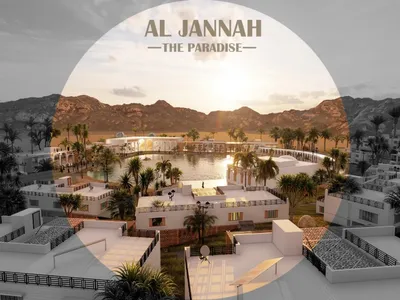
AL-JANNAH: Sustainable Architecture and Permaculture for Afghan Widows
AL-JANNAH uses sustainable architecture and permaculture to create resilient oasis of housing, learning, work and renewal for Afghan widows.

Riyadh For All: Intergenerational Urban Design for Active Aging in Rabat
Riyadh For All reimagines urban design in Rabat with intergenerational co-living, adaptive courtyards, and Moroccan cultural exchange today.

Hill & Cross Opera: Sculptural Opera House Architecture Shaped by Tallinn’s Landscape and Identity
Hill & Cross Opera reimagines opera house architecture in Tallinn through its sculptural hill, civic plaza, glass wave and a luminous cross.

Co-Life: Senior Housing Design That Reconnects Older Adults With the City
Co-Life reimagines senior housing design through healing gardens, shared streets, workshops, and a sustainable community across generations.


Similar Reads
You might also enjoy these articles

Bao Huynh Watercolor Atelier: A Serene Art Retreat in Hội An
Bao Huynh Watercolor Atelier in Hội An blends multifunctional art spaces, sustainable design, local materials, and family-friendly living in a serene environment.

Atelier Macri Concept Store Interior Design by CASE-REAL
Atelier Macri store features a "ko" counter, walnut wood details, cork displays, blending retail, gallery, and seamless customer experiences.

Manuel Vargas Izquierdo Stadium and High-Performance Sports Center: Architectural Excellence in Jalpa de Méndez
The Manuel Vargas Izquierdo Stadium blends sustainable design, inclusive sports facilities, and cultural-inspired architecture, revitalizing Jalpa de Méndez’s public spaces.

KAKR Buluh Awar Hall: Revitalizing Community and Ecology Through Bamboo Architecture
Community built bamboo hall revitalizes Buluh Awar village, empowering youth, restoring ecology, celebrating vernacular craftsmanship through sustainable architecture and culture.


Explore House Competitions
Discover active competitions in this discipline


Challenge to design a portable theatre


Challenge to design a portable music platform

Challenge to design an open learning module for the elderly


Challenge to design mud housing for contemporary communities
Comments (0)
Please login or sign up to add comments
No comments yet. Be the first to comment!