
boq architekti Fits a Gabled Family House onto a Tiny Moravian Hillside Plot with No Room for a Garden
A 115 square meter home in South Moravia trades a garden for a rooftop terrace and a fully glazed facade facing the village below.


A 235 square meter plot that tapers to a point, slopes steeply downhill, and sits shoulder to shoulder with its neighbors in a dense Moravian village is not exactly a developer's dream brief. But for Prague-based boq architekti, led by Miroslav Stach and Jana Stachová, the constraints of this site became the entire argument for the house. There is no garden here, not because the architects forgot one, but because the lot simply cannot accommodate one. What it can offer is elevation, orientation, and a clear sightline over the rooftops of the village below.
House Without a Garden is a 115 square meter family home completed in 2022 that treats limitation as a generative force. The gabled silhouette reads as traditional village architecture from a distance, but up close the building reveals a split-level section, a fully glazed gable end, offset porthole windows, and a rooftop terrace that replaces the missing garden with an elevated outdoor room. It is a compact house that manages to feel both deeply contextual and slightly subversive.
Reading the Village Grain
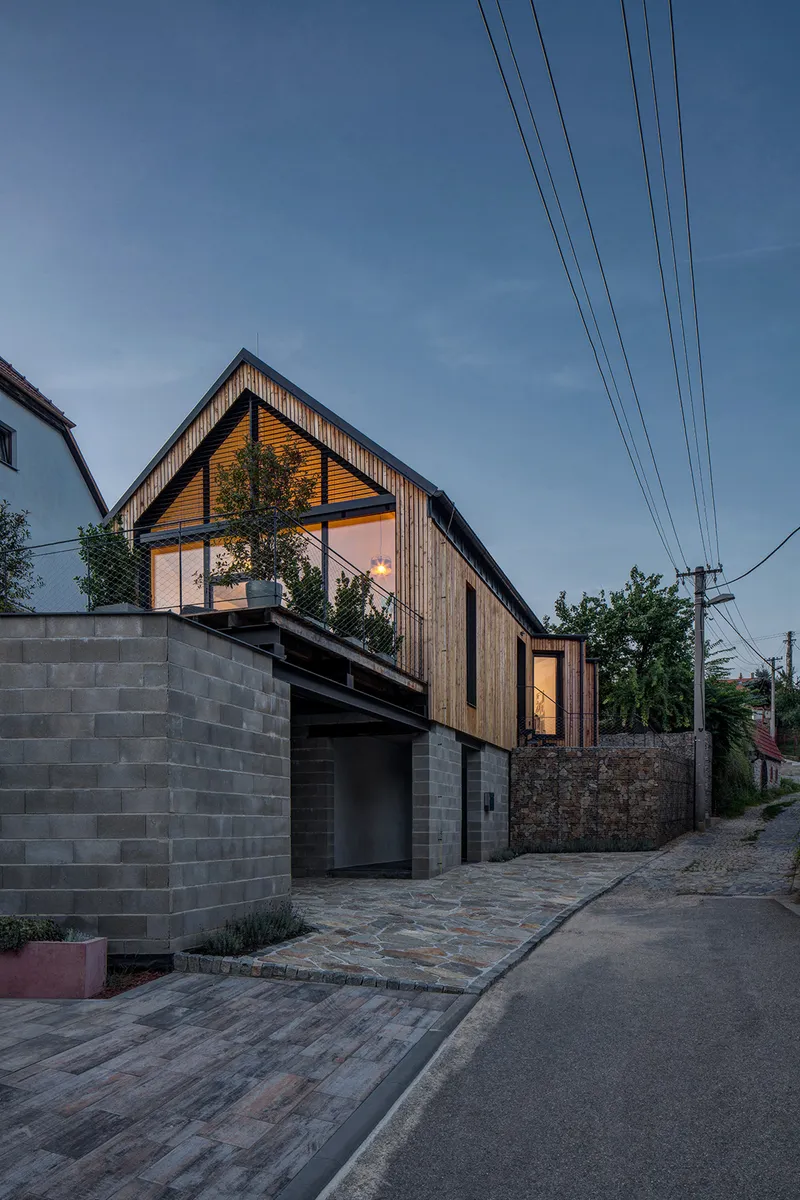
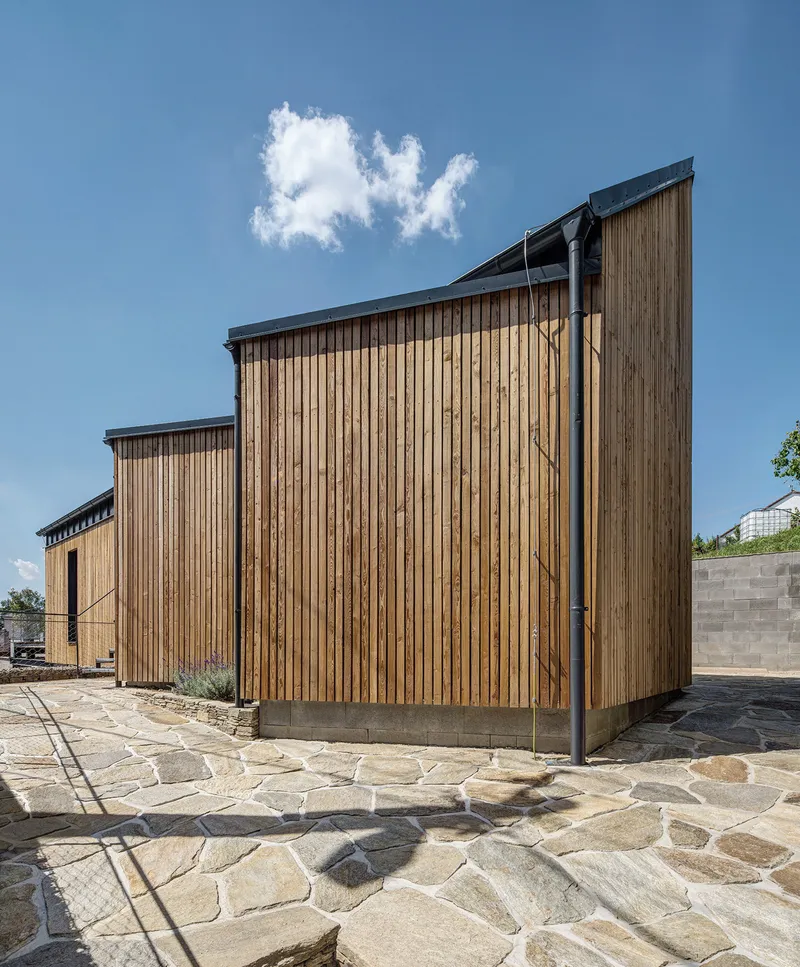
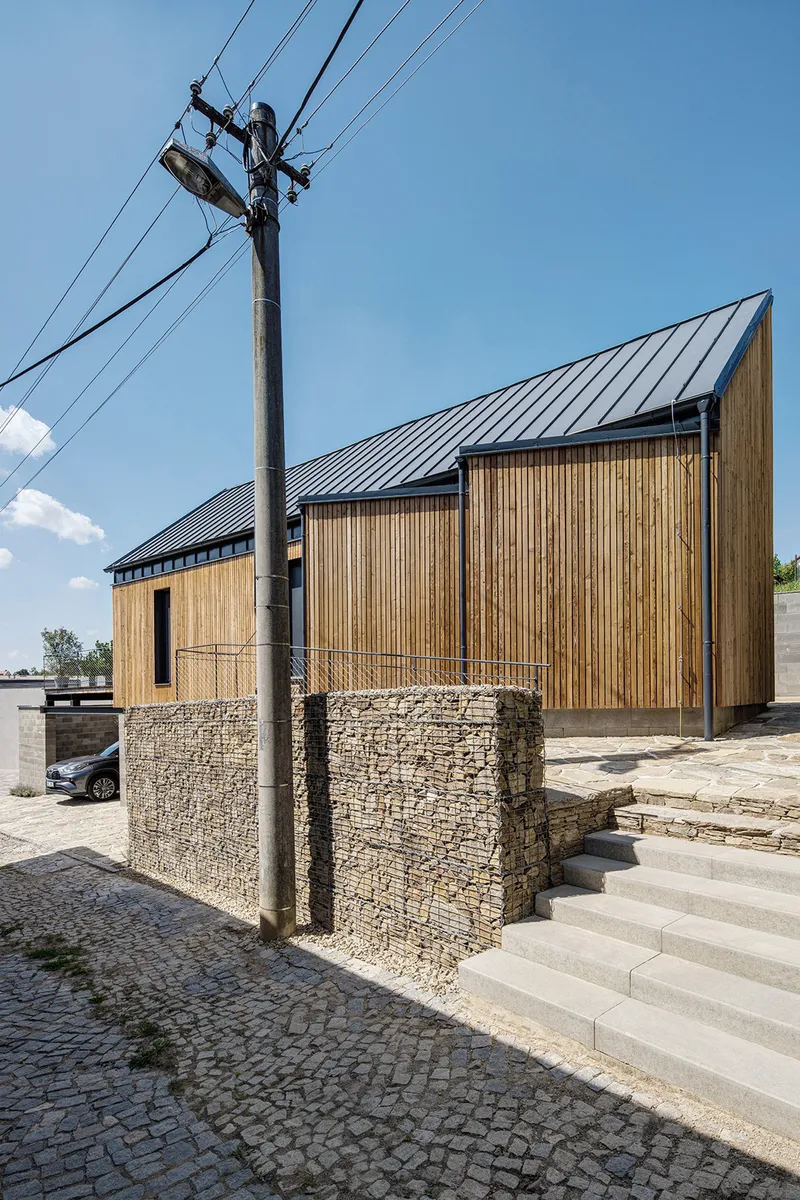
Seen from the street at dusk, the house could pass for a barn that has been quietly upgraded. The gabled volume, clad in vertical timber boards, sits atop a concrete block base that absorbs the slope and anchors the building to the hillside. This two-tone strategy, heavy masonry below and lighter timber above, is a direct translation of the village's own vernacular grammar. The proportions of the roof pitch, the overall massing, and the way the building addresses the narrow lane all defer to the settlement pattern around it.
But deference is not mimicry. The stepping of volumes, the standing seam metal roofing, and the irregular stone paving that wraps the base all introduce a contemporary register. The house participates in the village without pretending to have been there for centuries.
A Facade That Opens and One That Hides
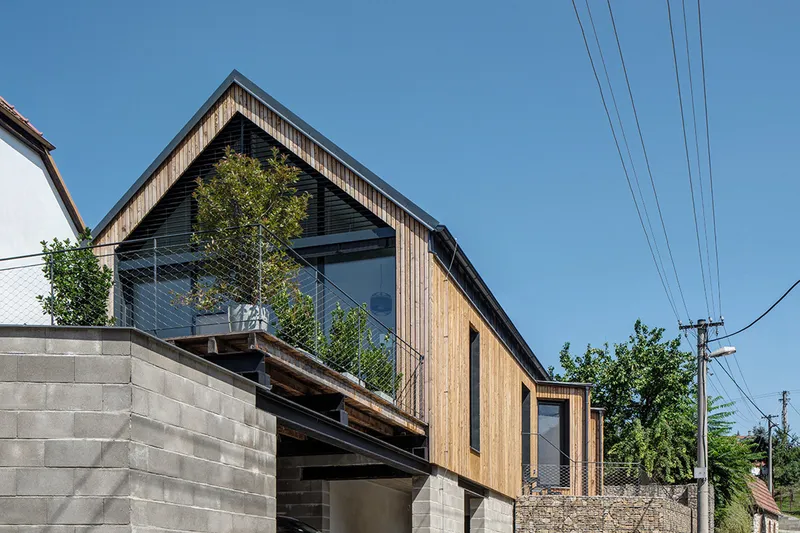
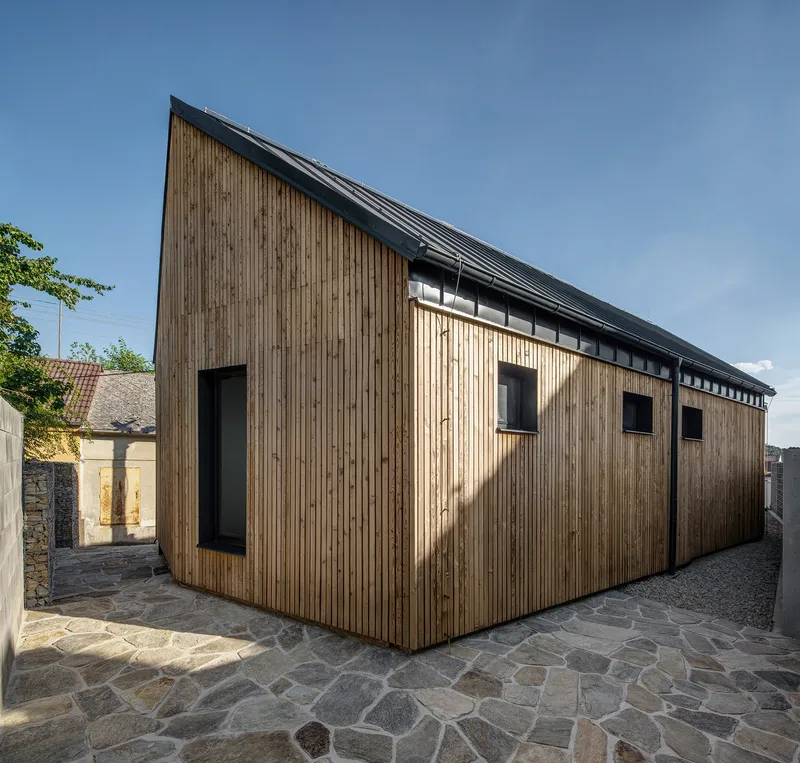
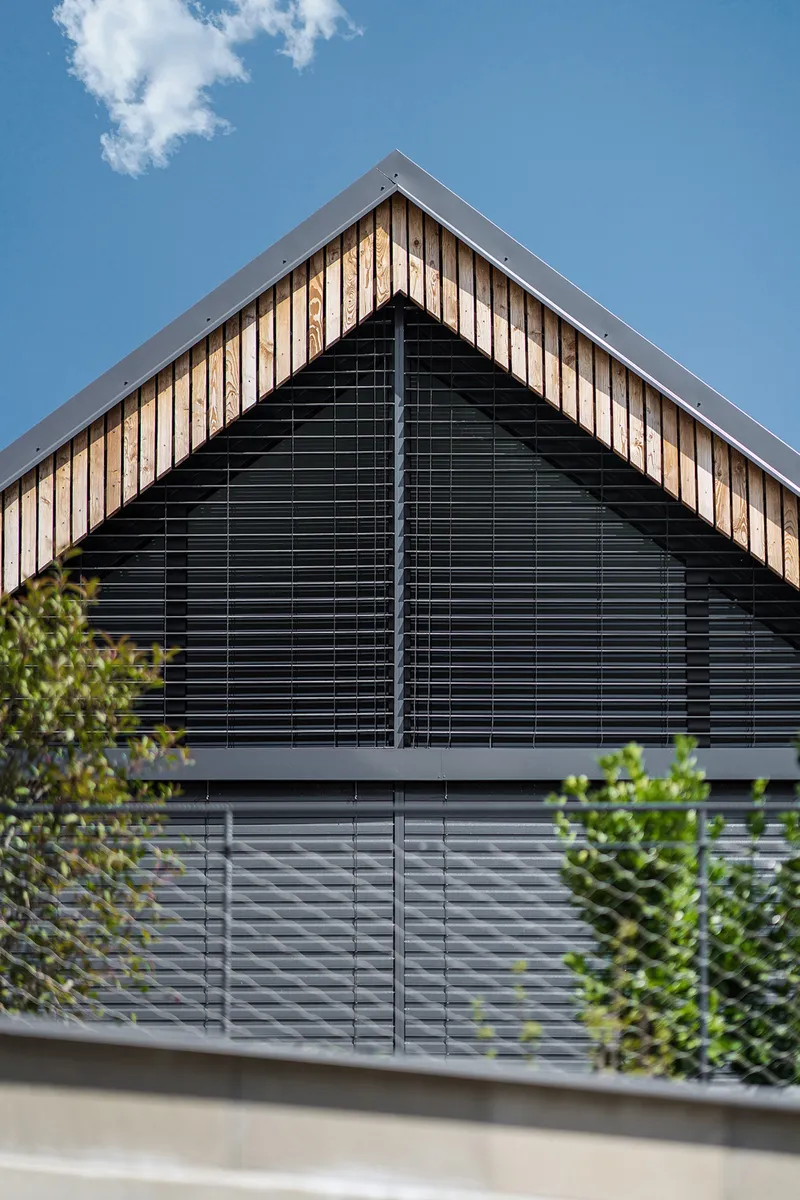
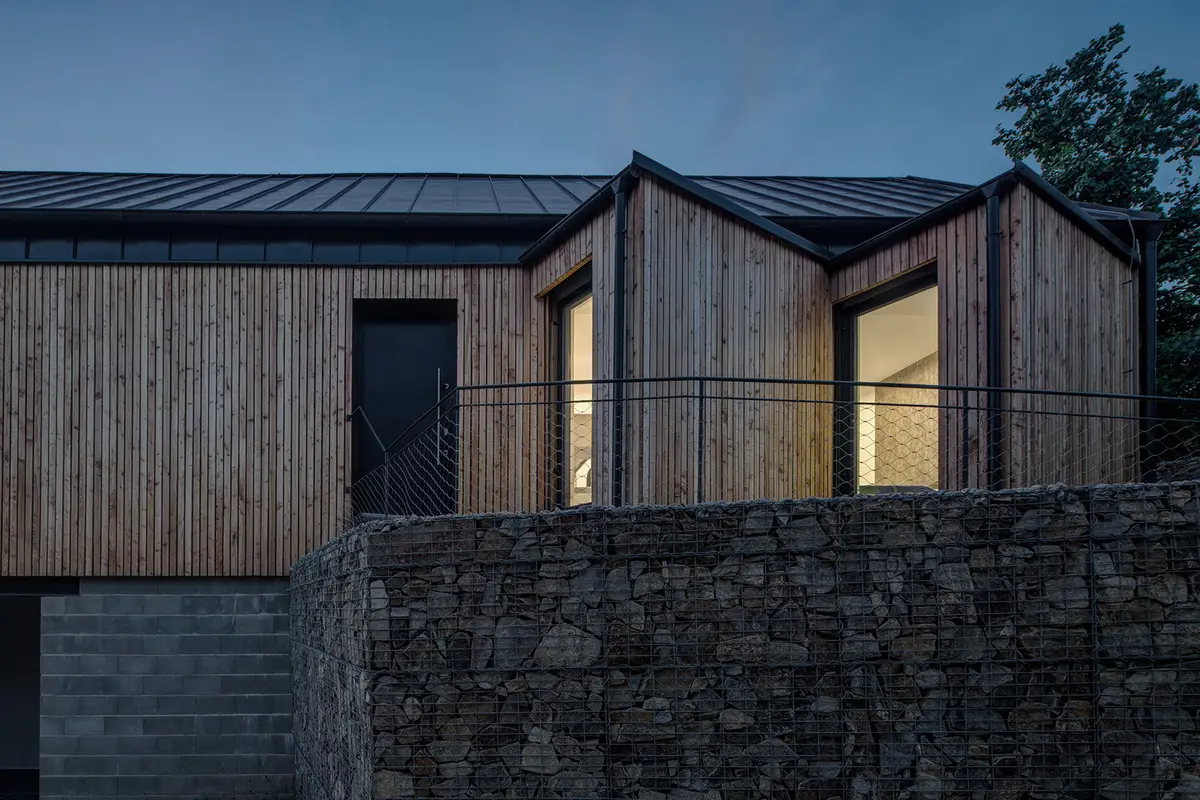
The long elevations tell two different stories. One side presents a rhythmic sequence of square window openings punched into the timber skin, with a clerestory strip running along the top. These are the bedrooms, and the windows are deliberately restrained: small, offset portholes that frame specific views rather than exposing the interior wholesale. The opposite gable end is almost entirely glazed, flooding the elevated living space with light and panoramic views of the village below.
The contrast is sharp and intentional. Privacy on the sides where neighbors are close, full transparency on the axis where the plot opens toward the landscape. Black louvered screens and horizontal timber slats on the secondary facades add a layer of texture and climate control without breaking the overall simplicity of the envelope.
The Courtyard Below, the Terrace Above
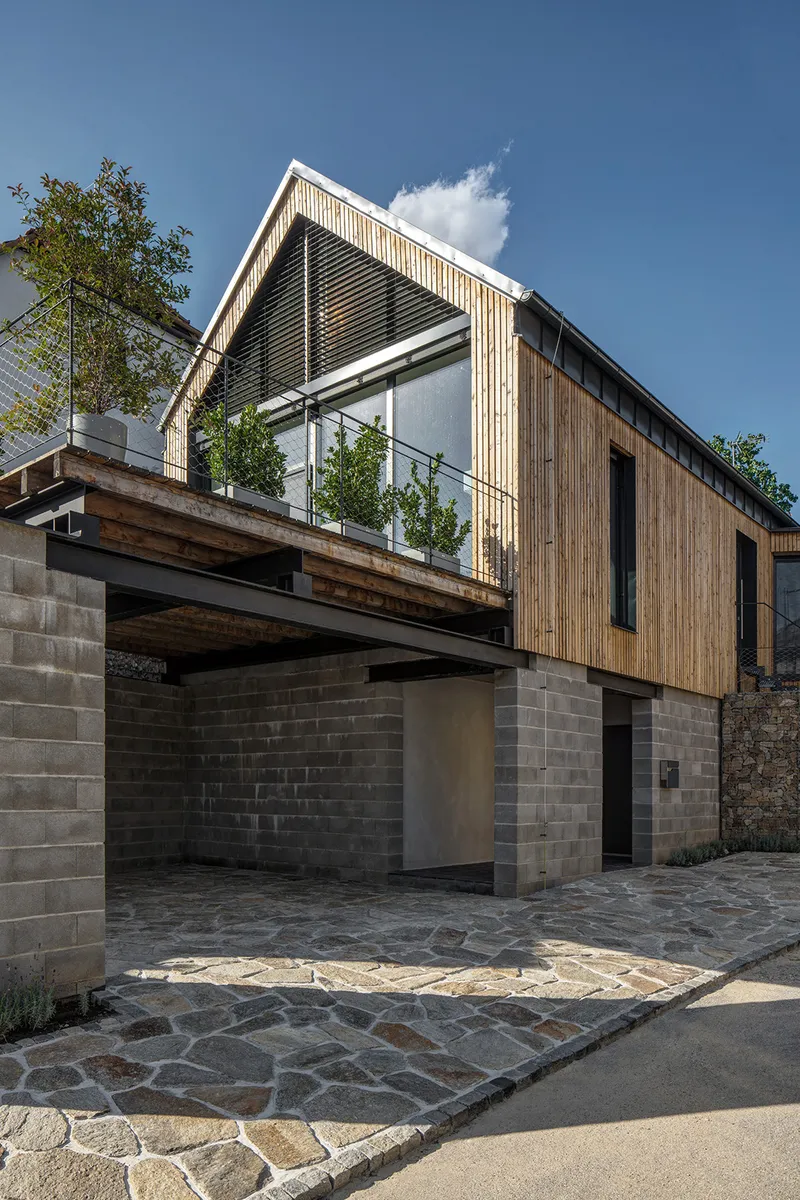
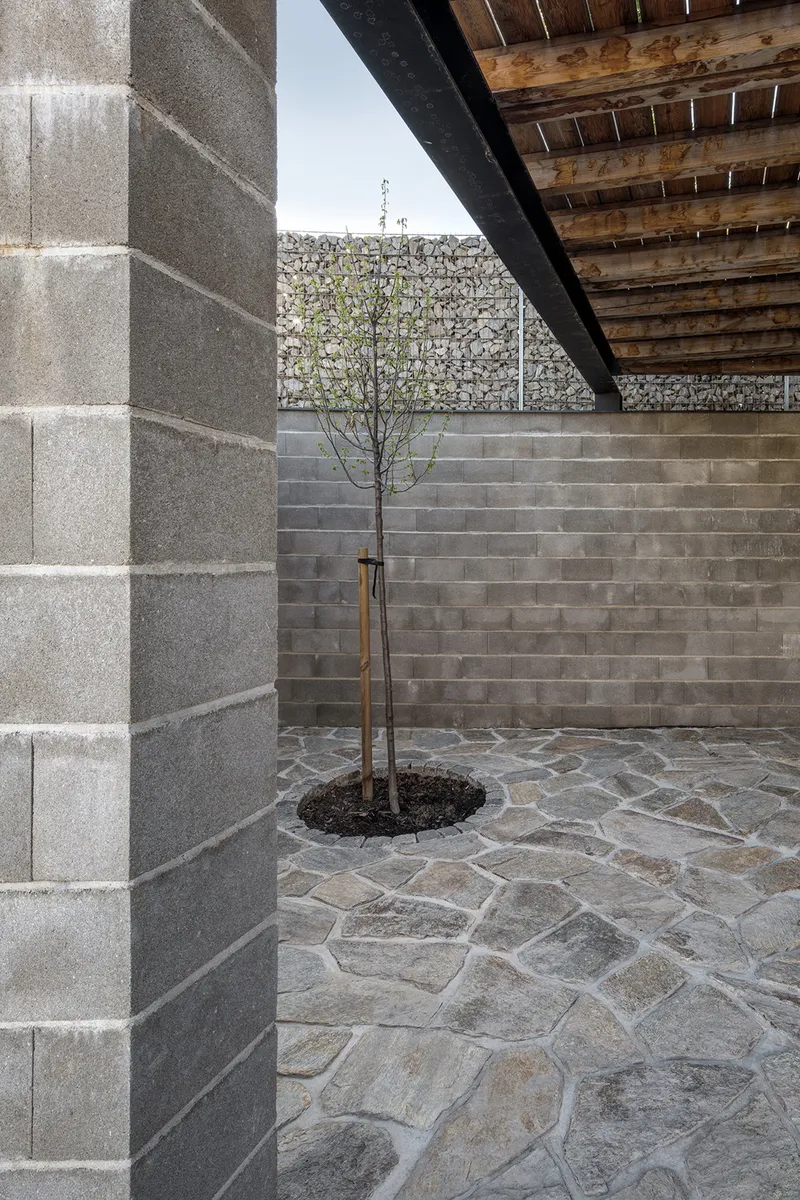
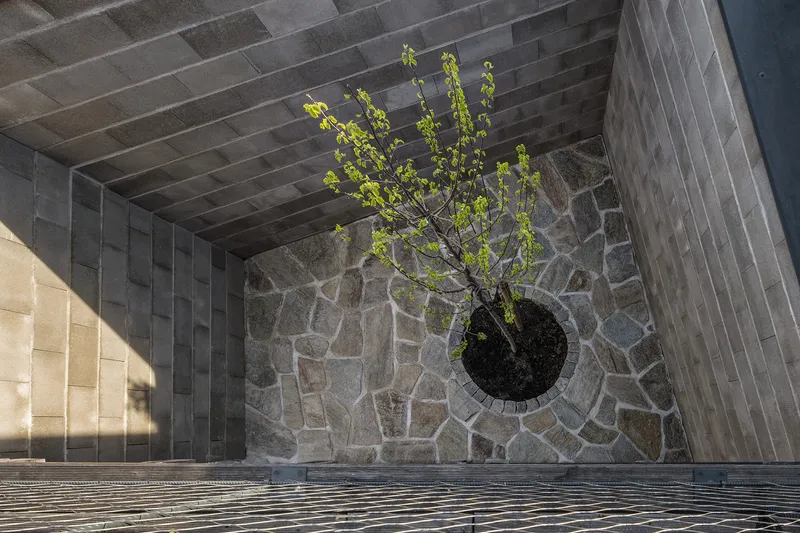
Since there is no room for a garden at grade, the architects carved out two distinct outdoor spaces within the building's footprint. At ground level, a stone-paved entrance courtyard sits beneath the cantilevered upper floor. A single young tree grows from a circular planter cut into the paving, and reclaimed timber beams span overhead to support the deck above. The space is compressed, shaded, and surprisingly generous for a house this small. It functions as an arrival sequence and an outdoor room simultaneously.
The courtyard is not an afterthought. It is the organizational hinge of the plan, connecting the garage at the lower level to the entrance of the living quarters and establishing a threshold between the public street and the private interior.
Replacing the Garden in the Sky
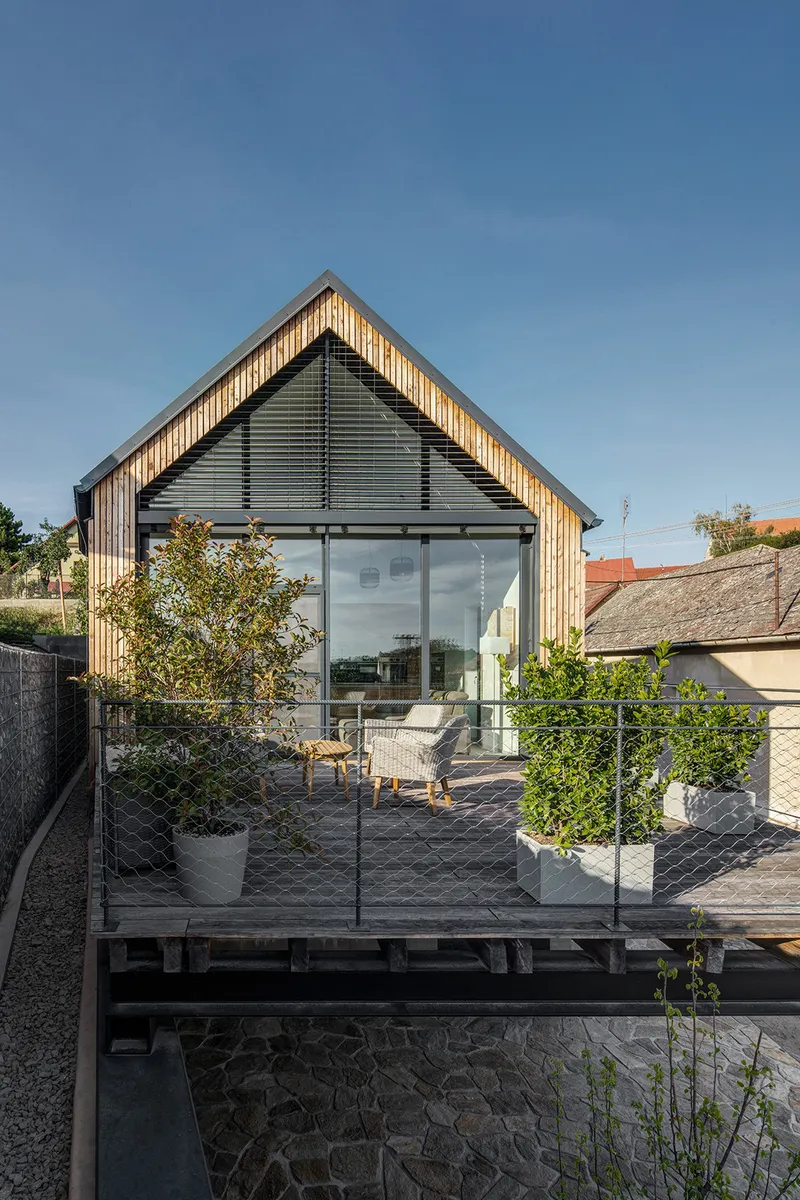
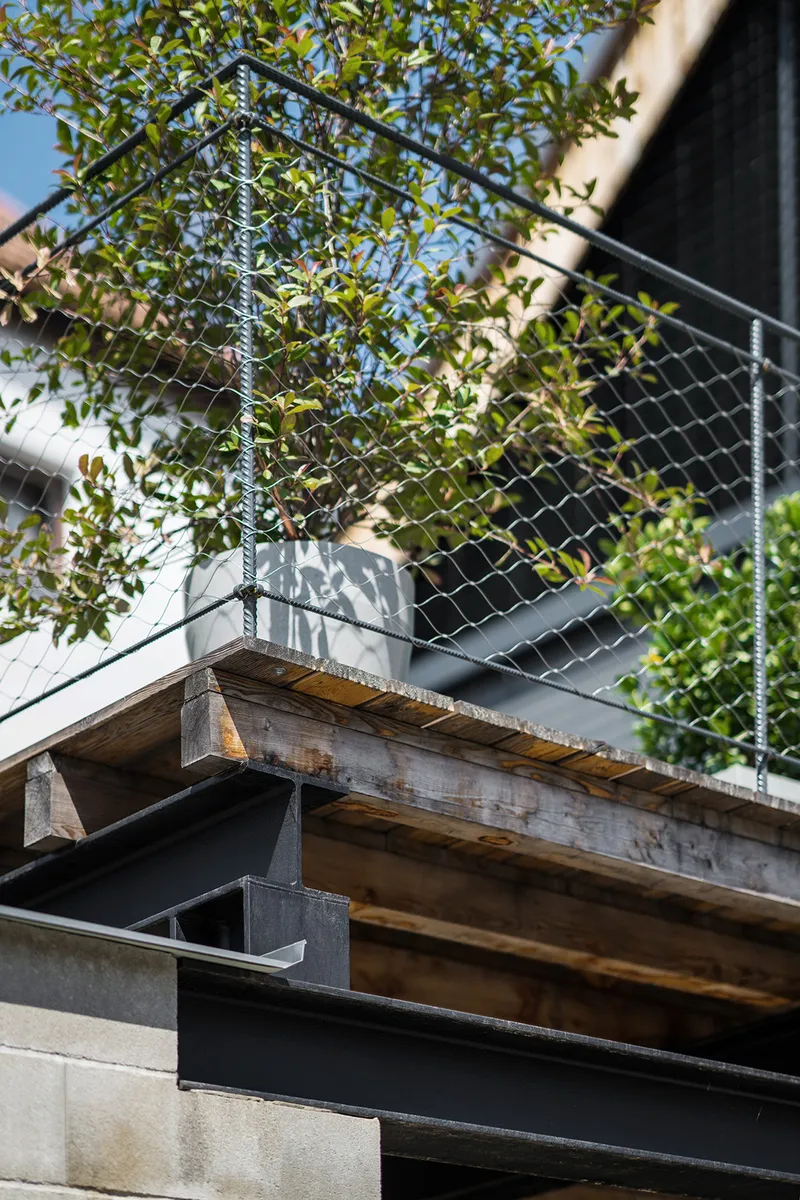
The rooftop terrace is the project's boldest move. Enclosed by chain-link fencing that doubles as a trellis for climbing plants, the terrace sits at the ridge of the gabled roof, directly behind the fully glazed facade. Potted trees line the edges, and the metal deck is supported by the same exposed timber beams visible from the courtyard below. It is an unfinished space in the best sense: the vegetation will thicken over time, the chain-link will disappear under greenery, and what is now a skeletal frame will eventually become a lush rooftop garden.
The detail of the climbing vines on the railing is worth noting. Rather than specifying expensive custom planters or green wall systems, the architects used standard chain-link as infrastructure for natural growth. It is a low-cost, low-maintenance solution that will look better every year.
Material Honesty at the Threshold
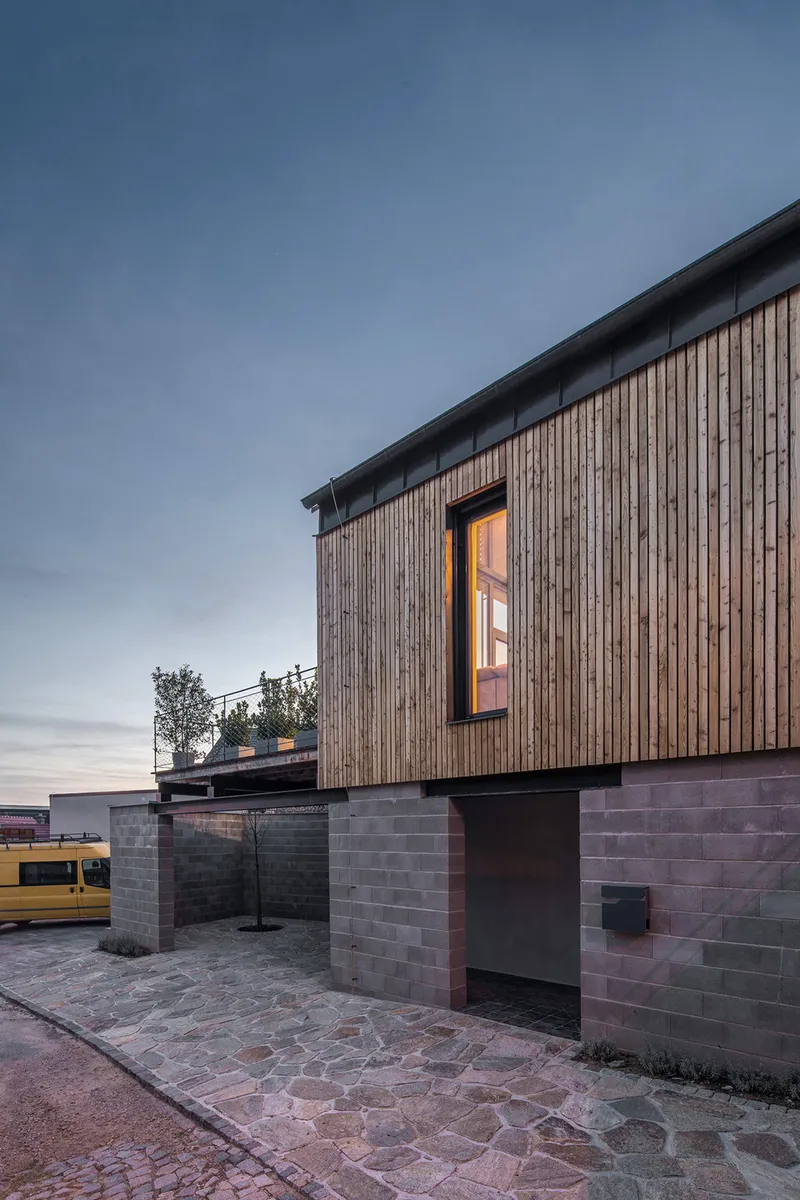
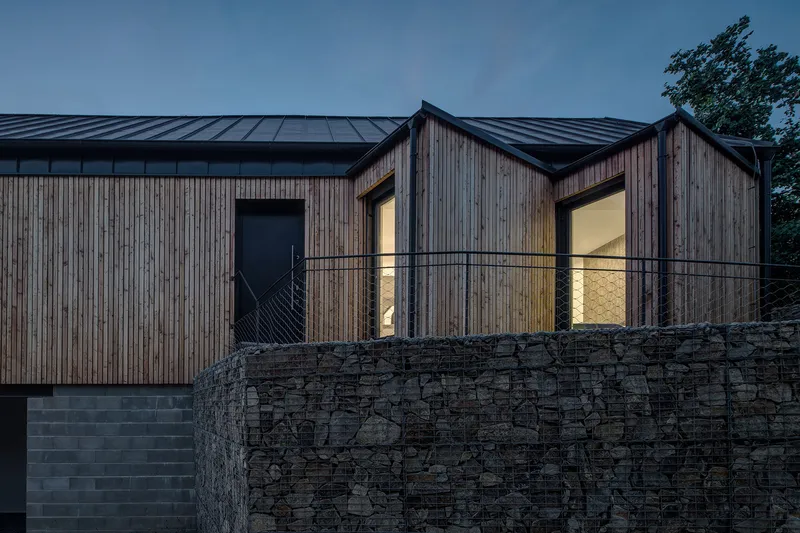
At dusk, when the windows glow from within, the material hierarchy becomes most legible. The concrete block base absorbs the blue twilight, registering as solid, grounded, geological. The timber volume above catches the last warmth of the sky and radiates the yellow light of the interior. The gabion retaining wall, filled with local stone, mediates between the two and ties the building to the cobblestone paving of the lane. Every material decision reinforces the same argument: heavy below, light above, open where the view is, closed where the neighbors are.
Plans and Drawings
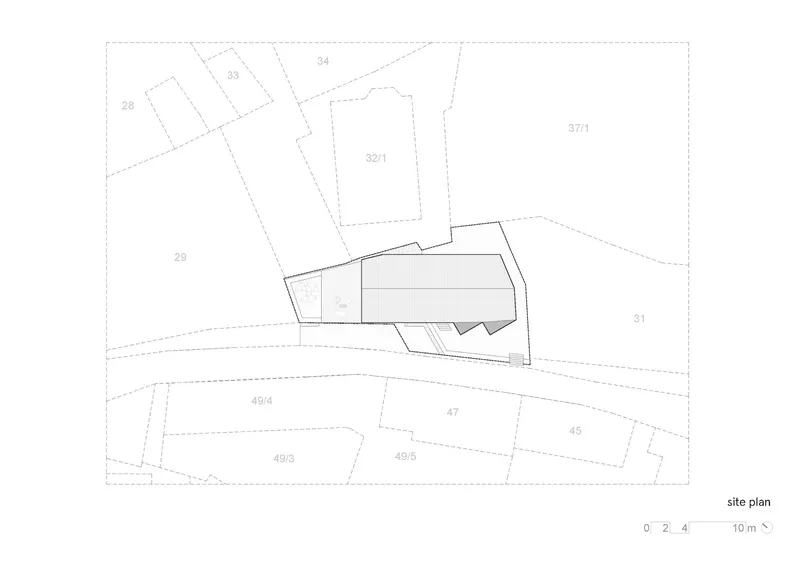
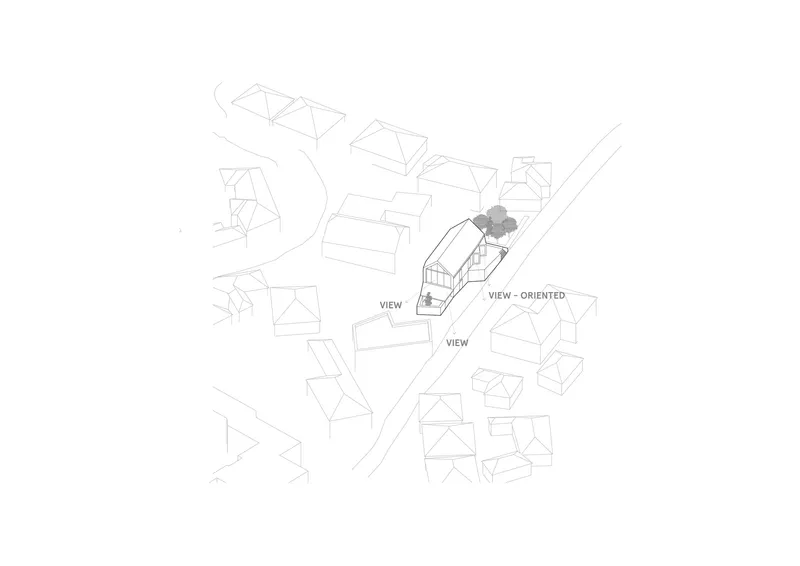
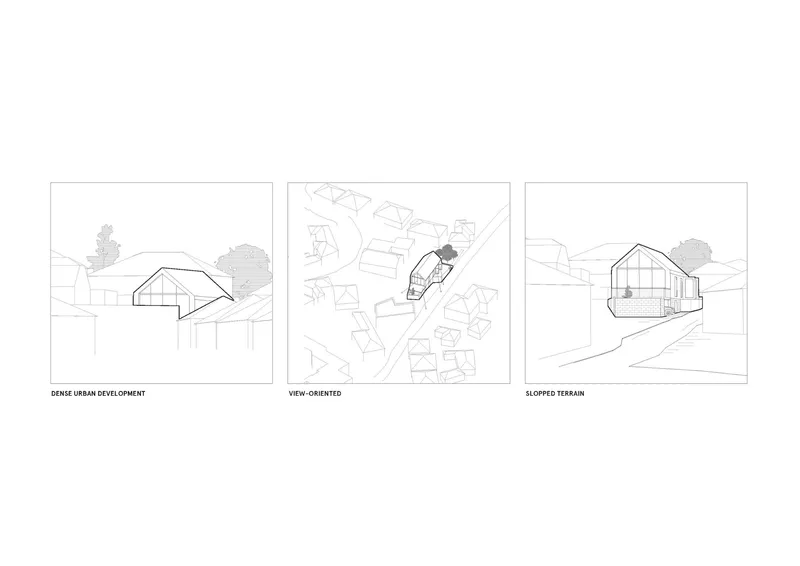
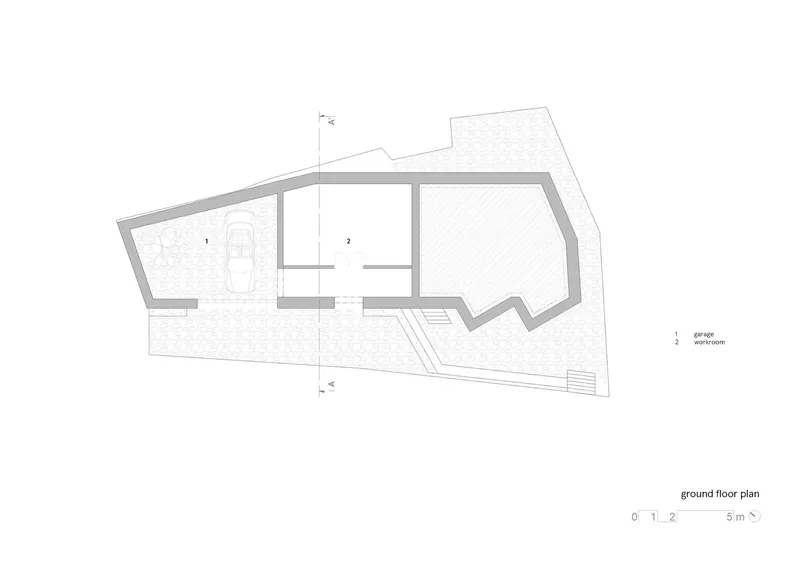
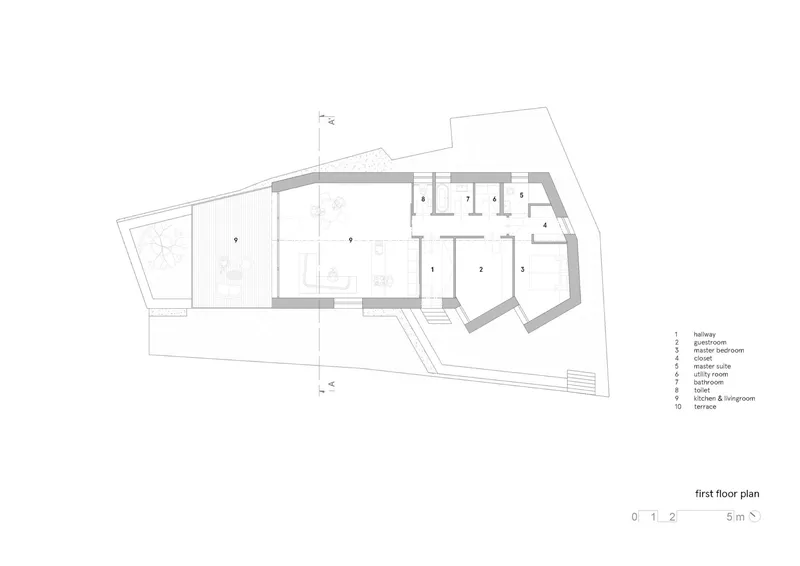
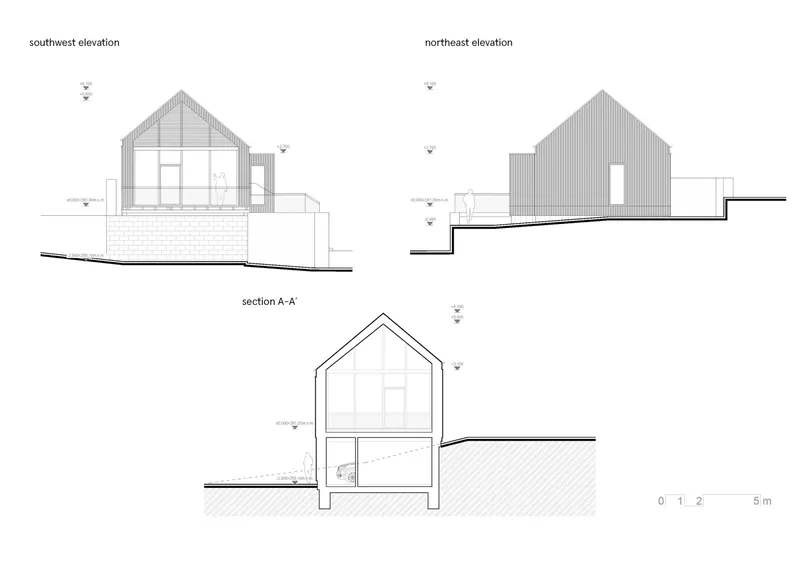
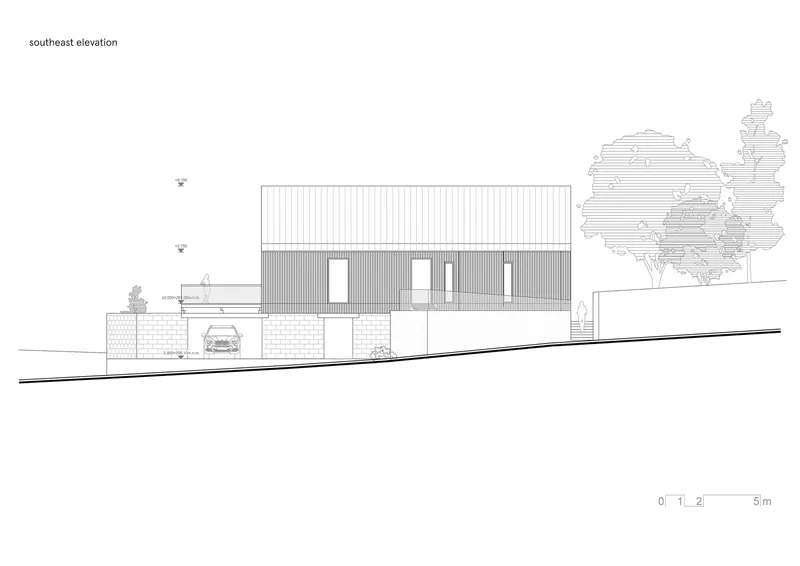
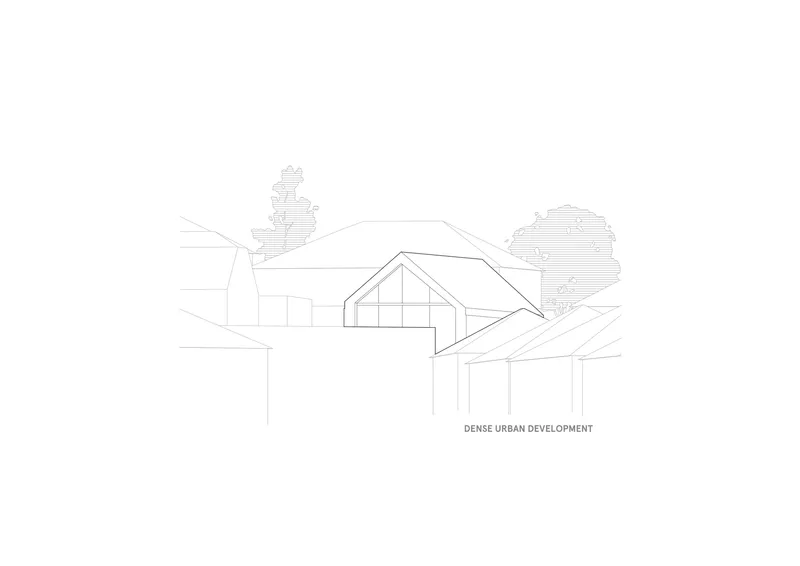
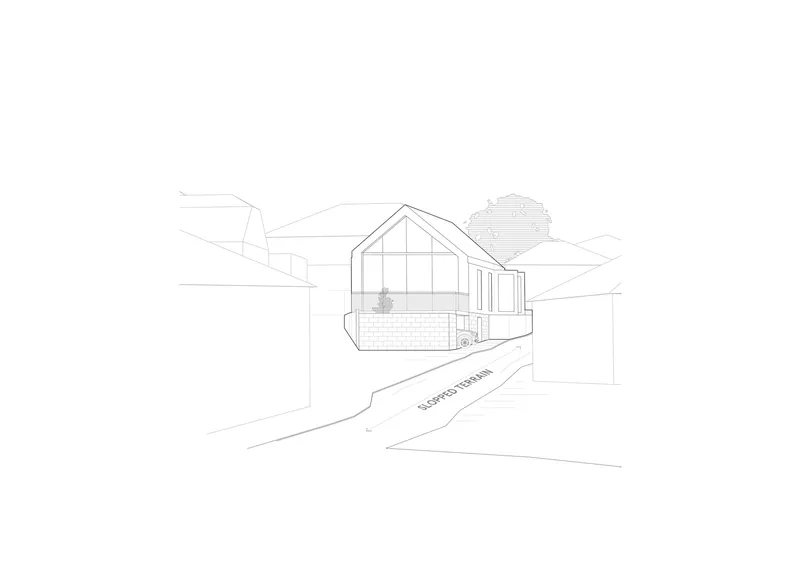
The site plan and axonometric view reveal just how constrained the plot really is. The footprint is wedged between neighboring buildings on a curving street, and the conical taper of the lot toward the view side explains why the bedrooms are slightly rotated in plan. The ground floor accommodates a garage and a single workroom volume, while the first floor opens up to the courtyard and the angled bedroom wings. The section drawings confirm the split-level strategy: the living space is elevated and opens into the full height of the gable, while the bedrooms sit lower, tucked against the slope.
The contextual diagrams are particularly revealing. Three scenarios test how a gabled volume might sit among the existing rooflines and mature trees of the village. The final position is not the most obvious one, but it is the one that maximizes the view corridor while respecting the buildable area of the tapering lot.
Why This Project Matters
House Without a Garden is a useful corrective to the widespread assumption that a family home requires a generous plot. At 235 square meters of site area and 115 square meters of built floor, this is a house that has no business feeling spacious, yet it does. The split section, the borrowed landscape of the village panorama, the courtyard and terrace that create outdoor life without any actual ground to spare: these are not tricks, they are disciplined spatial thinking applied to a genuinely difficult brief.
More broadly, the project demonstrates that contextual architecture does not have to be conservative. boq architekti absorbed the gabled silhouette, the material palette, and the settlement logic of the Moravian village, then used those elements to produce something recognizably contemporary. The house belongs to its place without being trapped by it, and that balance is harder to achieve than it looks.
House Without a Garden, designed by boq architekti (Miroslav Stach, Jana Stachová), South Moravian Region, Czechia. 115 m², completed 2022. Photography by Tomas Dittrich.
About the Studio
Share Your Own Work on uni.xyz
If projects like this are the kind of work you want to make, uni.xyz is a place to publish your own, find collaborators, and enter design competitions.


Popular Articles
Popular articles from the community


Little Red Riding Hood: Architectural Design as a Journey Through Fear, Light, and Storytelling
Little Red Riding Hood reimagines the fairy tale through architectural design shaped by fear, light, scale, memory, uncertainty, and choice.

ALGAL REALM: A Bio-Integrated Lunar Habitat Design for Life Beyond Earth
ALGAL REALM reimagines lunar habitat design with algae-powered life support, 3D-printed regolith, and vertical living for a lunar future.

Co-life: Sustainable Architecture for Age-Friendly Community Living
Co-life reimagines sustainable architecture for seniors through courtyards, rammed earth, shared gardens, and spaces designed for belonging.

Hill & Cross Opera: Sculptural Opera House Architecture Shaped by Tallinn’s Landscape and Identity
Hill & Cross Opera reimagines opera house architecture in Tallinn through its sculptural hill, civic plaza, glass wave and a luminous cross.

Similar Reads
You might also enjoy these articles

Bao Huynh Watercolor Atelier: A Serene Art Retreat in Hội An
Bao Huynh Watercolor Atelier in Hội An blends multifunctional art spaces, sustainable design, local materials, and family-friendly living in a serene environment.

Atelier Macri Concept Store Interior Design by CASE-REAL
Atelier Macri store features a "ko" counter, walnut wood details, cork displays, blending retail, gallery, and seamless customer experiences.

Manuel Vargas Izquierdo Stadium and High-Performance Sports Center: Architectural Excellence in Jalpa de Méndez
The Manuel Vargas Izquierdo Stadium blends sustainable design, inclusive sports facilities, and cultural-inspired architecture, revitalizing Jalpa de Méndez’s public spaces.

KAKR Buluh Awar Hall: Revitalizing Community and Ecology Through Bamboo Architecture
Community built bamboo hall revitalizes Buluh Awar village, empowering youth, restoring ecology, celebrating vernacular craftsmanship through sustainable architecture and culture.


Comments (0)
Please login or sign up to add comments
No comments yet. Be the first to comment!