
HUNI Architectes Wraps a Vietnamese Tech Park Headquarters in Parametric Fiber-Concrete Fins
A gear-inspired administrative hub north of Da Nang City uses energy-simulated sun blades to temper Vietnam's tropical heat.


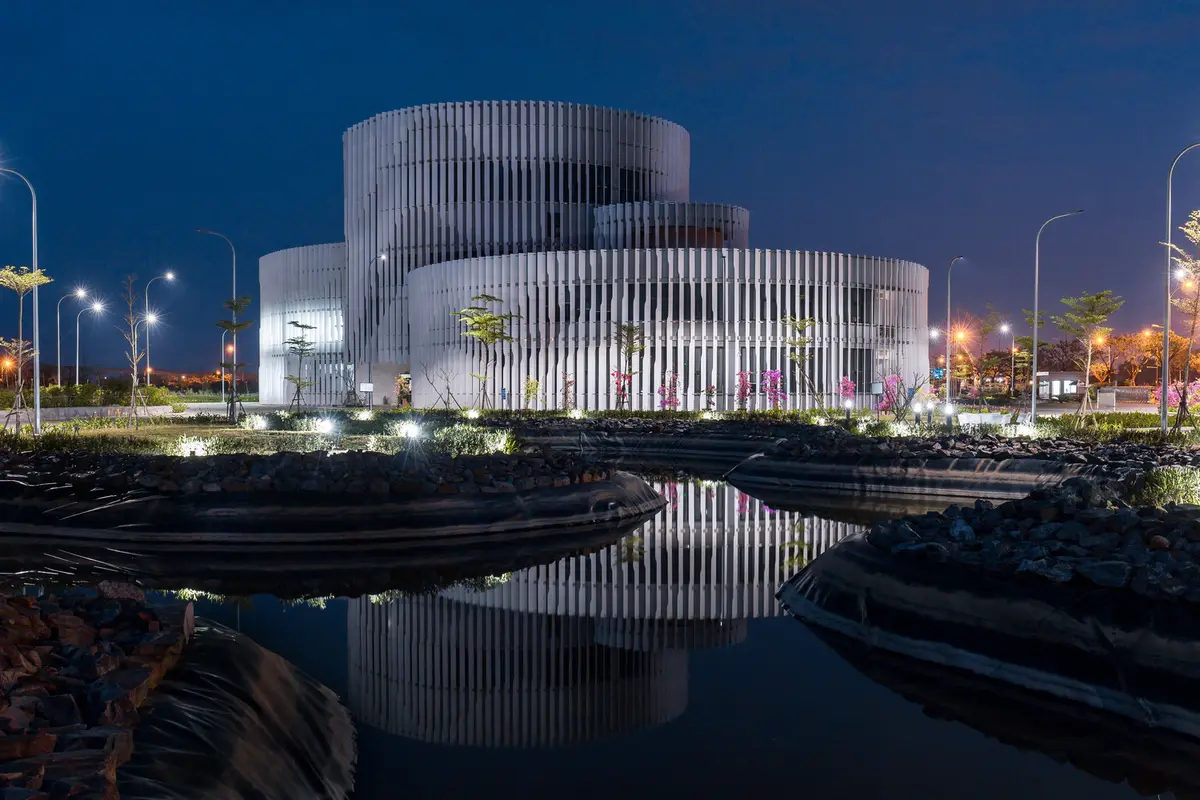
North of Da Nang, Vietnam's third-largest city, a new IT-focused industrial park needed a headquarters that could project ambition without ignoring the realities of a hot, humid climate. HUNI Architectes delivered a four-story, 8,441-square-meter building whose stacked cylindrical volumes read simultaneously as interlocking gears and as an abstract diagram of cloud computing: circular plans overlap, generating shared interstitial spaces that do real thermodynamic work. Designed in 2017 and completed in 2021, the Da Nang Hi-Tech Park Headquarters is one of the more convincing demonstrations in recent Vietnamese architecture that parametric facade design can serve genuine passive performance goals rather than just visual spectacle.
What makes the building worth a close look is the rigor behind its most photogenic feature. Each fiber-concrete fin on the facade was individually angled using energy simulation software, optimized not for pattern but for solar shading at its specific orientation. The result is a skin that shimmers and shifts as you walk around the building, but whose geometry is fundamentally a heat-gain reduction tool. Inside, voids and atriums channel natural ventilation through the plan, and planted beds at their base contribute evaporative cooling and improved air quality. The whole project argues, quietly but firmly, that serious climate strategy and architectural identity can be the same thing.
The Fin Facade as Climate Instrument
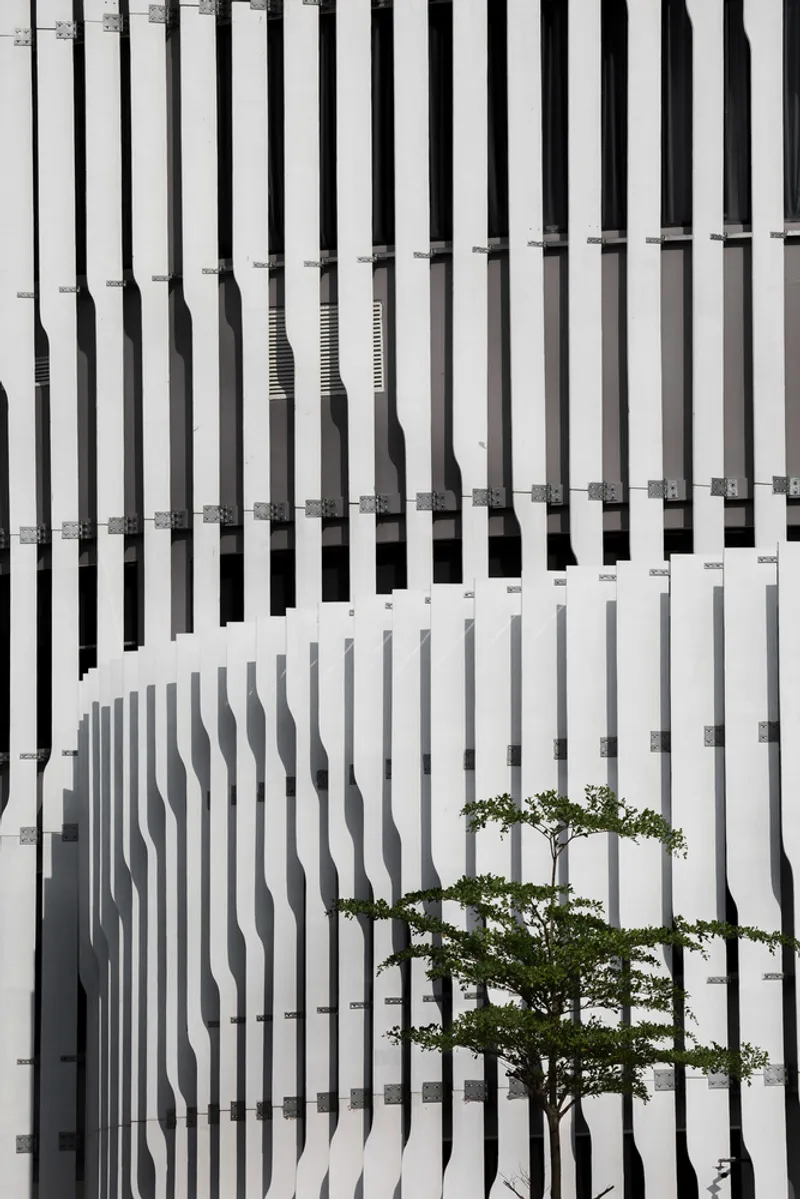
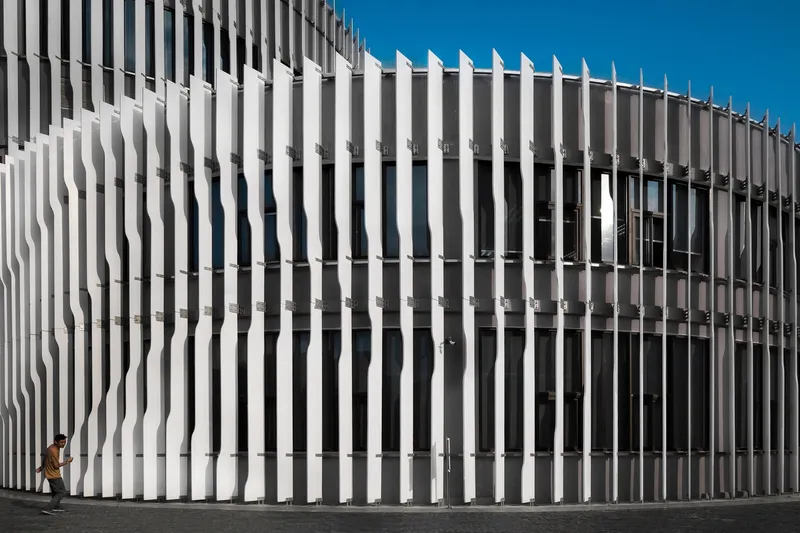
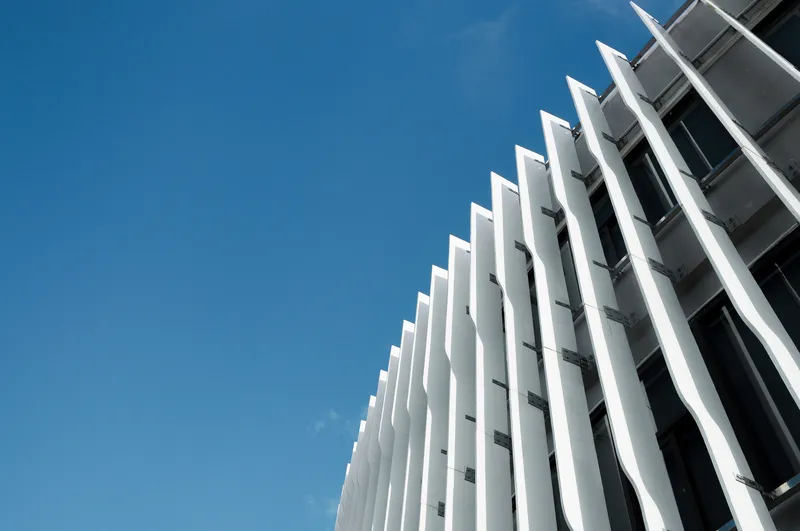
From a distance, the facade reads as a continuous white screen, rhythmic and almost textile in quality. Move closer, and its logic becomes legible: vertical blades of fiber-concrete project at varying angles from the building envelope, each calibrated to its compass orientation and the sun path at Da Nang's latitude (roughly 16°N). The parametric simulation that generated this array was not decorative; it targeted specific reductions in solar heat gain and interior glare while preserving outward views and admitting diffused daylight.
Fiber-concrete is a smart material choice here. It is lighter than precast concrete, more durable than aluminum in a coastal Vietnamese climate, and carries a lower embodied-energy profile than steel. The fins also create a micro-zone of shaded air between themselves and the glazed wall behind, functioning as a ventilated double skin in practice if not in name. The wave-like texture that results is a byproduct of performance, not an imposed pattern, and that distinction matters.
Overlapping Circles and the Logic of Shared Space
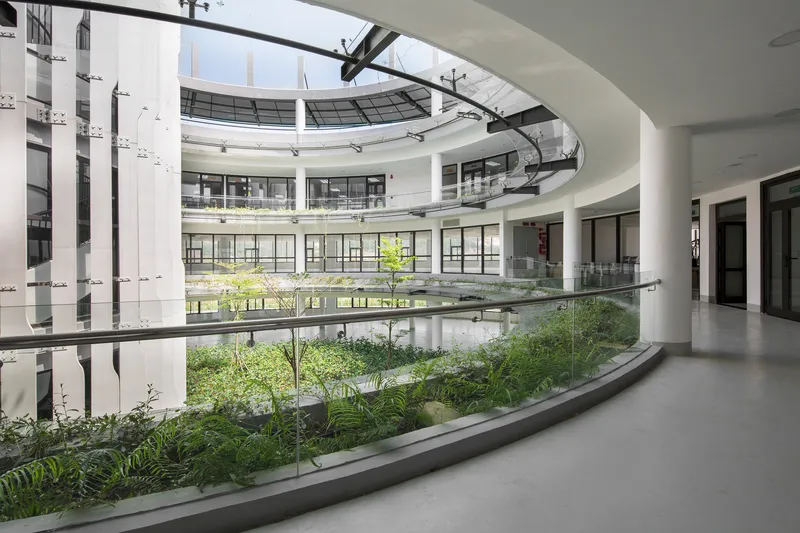
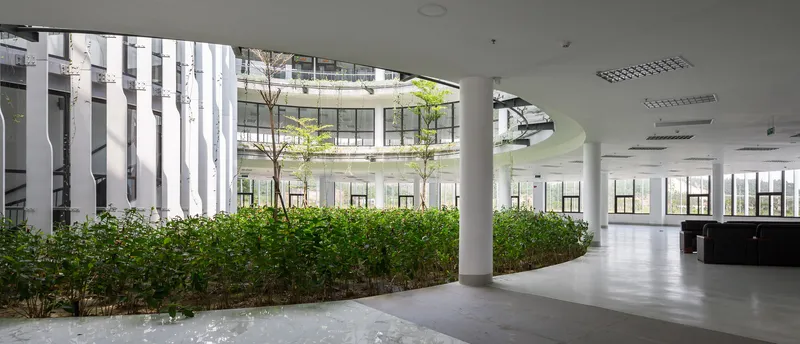
The plan is organized around the overlap of circular volumes, a move HUNI Architectes connects to interlocking gears. In practice, the overlaps produce the most interesting spaces in the building: in-between zones that belong fully to neither adjacent program but serve both. These shared areas host circulation, informal meeting points, and, critically, the vertical voids that drive the building's natural ventilation strategy.
At ground level, sunken planted beds and hedges line the edges of these interstitial zones, softening what could be stark concrete-and-glass territory. The floor-to-ceiling glazing facing the courtyards brings deep daylight into the office floors without the penalty of direct western or eastern sun, because the circular geometry places most of this glass in orientations already self-shaded by the building's own mass. It is a clever piece of formal-environmental alignment.
Atriums as Ventilation Engines
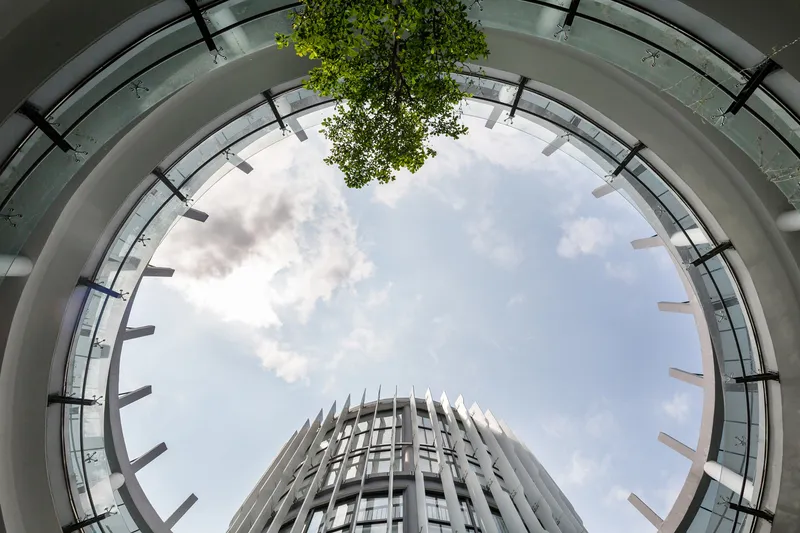
The central atrium is the building's thermodynamic heart. Open to the sky through a circular oculus, it functions as a stack-effect chimney: warm air rises and escapes, drawing cooler air through the lower floors. Ringed balconies on each level look down into this void, and the presence of tree canopy and planted beds at the base contributes evaporative cooling that conditions the air before it moves upward.
Smaller atrium stairwells replicate this principle at a reduced scale throughout the plan. Together, these voids reduce the building's reliance on mechanical air conditioning, a significant energy saving in a climate where cooling loads dominate annual energy consumption. The visual payoff is considerable, too: looking upward through the main atrium, the concentric balcony rings frame the sky like an aperture, lending the space a monumental quality unusual in a building of this modest program.
Twilight Composition and Urban Presence
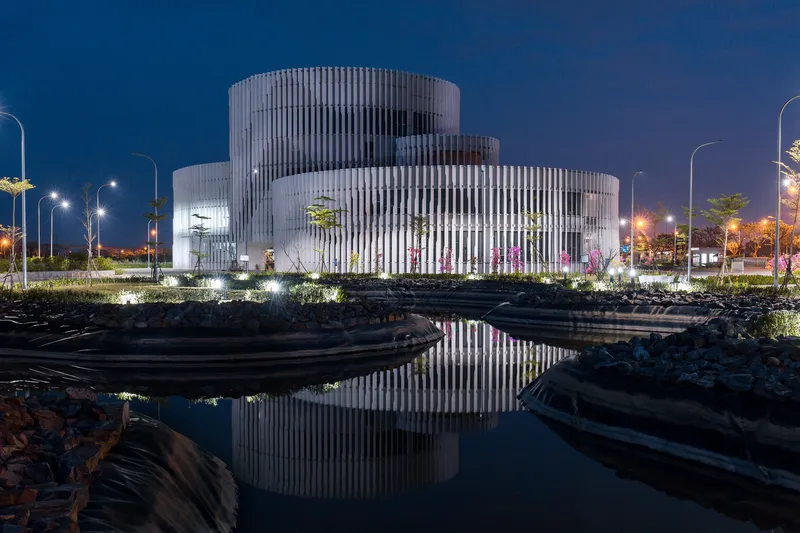
The building's most striking image may be its reflection in the landscape pond at dusk. The stacked cylindrical volumes, wrapped uniformly in white fins, register as a single sculptural object, almost geological in their calm. The still water doubles the composition, and the warm interior glow through the fin screen gives the facade a lantern-like translucency that it lacks in daylight.
For a tech park headquarters, this kind of iconic legibility is essential. The building needs to function as a billboard for the park's aspirations, visible from the access road and identifiable in aerial photographs. HUNI Architectes manages this without resorting to jagged cantilevers or mirrored glass. The form is assertive but composed, and the facade system that makes it visually distinctive is the same system that makes it energy-efficient. That alignment is what separates architecture from branding.
Why This Project Matters
Vietnam's construction boom has produced no shortage of glass-curtain-wall office buildings that rely entirely on mechanical cooling and ignore the local climate. The Da Nang Hi-Tech Park Headquarters pushes back against that default with a passive strategy, parametric facade, and atrium-driven ventilation approach that are calibrated to a specific latitude and weather profile. It demonstrates that climate-responsive design in tropical Southeast Asia does not have to look like vernacular pastiche; it can be thoroughly contemporary and still perform.
The project also makes a case for the mid-scale civic building as a laboratory for facade innovation. At 8,441 square meters and four stories, the headquarters is large enough to justify the engineering investment in a parametric fin system but small enough for the architects to control the detail. The result is a building where concept, material, and climate performance are fully integrated, a standard that larger commercial projects in the region would do well to aim for.
Da Nang Hi-Tech Park Headquarters Building by HUNI Architectes. Da Nang, Vietnam. 8,441 m². Completed 2021. Photography by Hoang Le.
About the Studio
Share Your Own Work on uni.xyz
If projects like this are the kind of work you want to make, uni.xyz is a place to publish your own, find collaborators, and enter design competitions.


Popular Articles
Popular articles from the community


Juan García Correa, John González and Claudia Rueda Sink a Circular Amphitheater into a Manizales Engineering Building
On the La Nubia campus in Manizales, Colombia, the S1 Building folds labs and offices into a hillside of ramped lawns that double as a campus route.

GROUP A Strips a 1969 Rotterdam Harbor Headquarters to Its Frame and Wraps It in Timber Louvers
In Rotterdam's M4H harbor district, Ferro Offices reuses a 1969 frame, adds one timber storey and reaches BREEAM-NL Outstanding.

Architekt Andreas Gruber Scatters 23 Dark Timber Chalets Across a South Tyrolean Forest Edge
In Molini di Tures, Amonti Chalets breaks a resort into a hamlet of gabled timber houses, with parking, storage and services pushed into the slope.

U.GA Architects Wraps an Oval Rooftop Pool in Curved Board-Formed Concrete on Busan's Jeollidan-gil
In Busan's Jeonpo-dong, a 454 m² mixed-use block stacks a neighborhood facility, guest rooms and an oval rooftop pool inside spiraling concrete walls.

Similar Reads
You might also enjoy these articles


Hodi-Mandai Geram
Project Function: Preservation and revitalization of the Intangible heritage and socio-spatial identity of the Hodi by Housing, Cultural Memory Center, Sacred Grove, landscape, local tourism economy


Olio Towers: A Mid-Rise for Performers That Fuses Housing, Rehearsal, and Stage
Located blocks from Houston's Theater District, this modular tower stacks living units around a central performance atrium.

Oasis: Modular Green Housing Carved into Dhaka's Urban Fabric
A shortlisted Plugin Housing entry reclaims unauthorized settlements in Dhaka with stepped concrete volumes, green roofs, and ventilation-driven design.

Black Hole: A Floating Megastructure for the Post-Physical Era
Emiliano Mazzarotto envisions a spherical, self-scaling arena where e-sports, digital hotels, and holographic stadiums replace traditional public space.

Explore Office Building Competitions
Discover active competitions in this discipline

Challenge to reimagine the Iron Throne

Photograph architecture without architects

Illustrate the lost glory of Angkor Wat - Render Challenge

Design challenge to reuse E-waste
Comments (0)
Please login or sign up to add comments
No comments yet. Be the first to comment!