
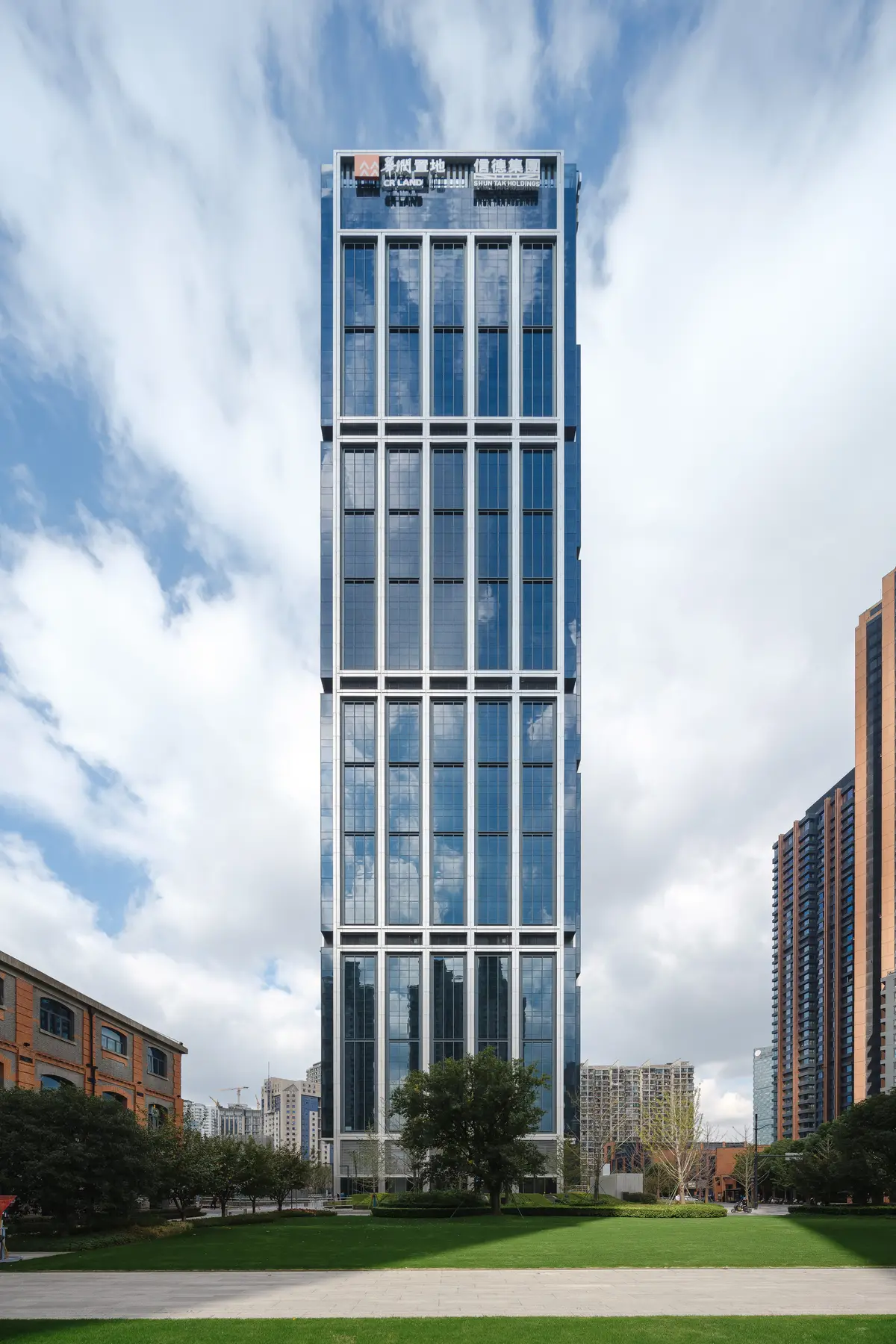
Foster + Partners Wraps a 200-Meter Shanghai Tower in Stainless Steel and Industrial Memory
The Suhe Centre Office Tower anchors a regenerated waterfront district in Shanghai with an all-steel structure that nods to local warehouse heritage.


Shanghai's Suhewan district has spent decades as a quiet residential pocket along the Huangpu River, largely bypassed by the explosive commercial development that reshaped Pudong across the water. The Suhe Centre Office Tower, designed by Foster + Partners with collaborating architect ECADI and structural engineering by Arup, is the first office tower in this newly regenerated quarter, and its 42-story, 200-meter stainless-steel frame is designed to do more than just fill a gap in the skyline. It is meant to kick-start the city's ambition to draw investment east.
What makes the project genuinely interesting is its commitment to legibility. The entire structural system is expressed on the exterior: steel columns, bracing, corner bays, all pulled outward and made visible behind dark glazing. The aesthetic is drawn not from the glossy curtain-wall towers of Lujiazui but from the warehouses and the historic Zhejiang Road Bridge nearby. That is a specific, local reference, not a generic "industrial chic" gesture, and it gives the building a tectonic honesty rare in Chinese commercial high-rises. The result is a tower that earns its presence next to Suhewan Park rather than merely occupying it.
An Expressed Frame Against the Waterfront
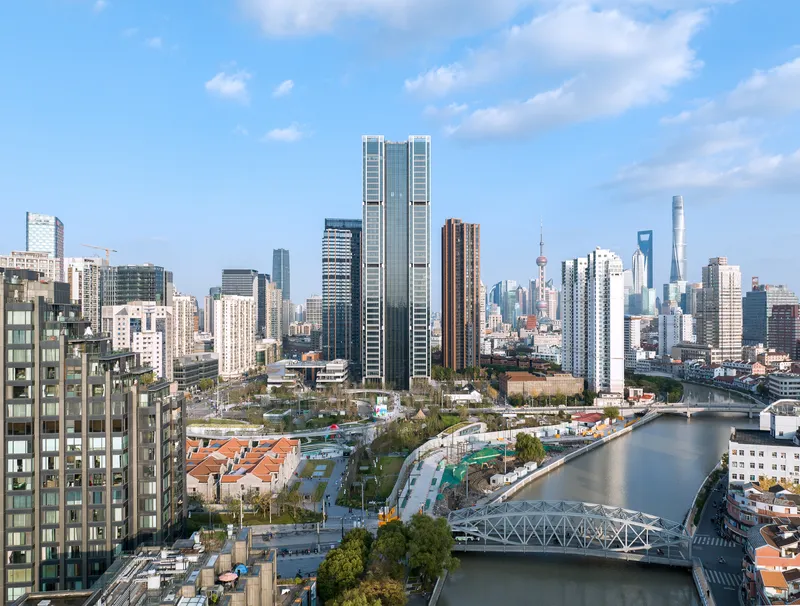
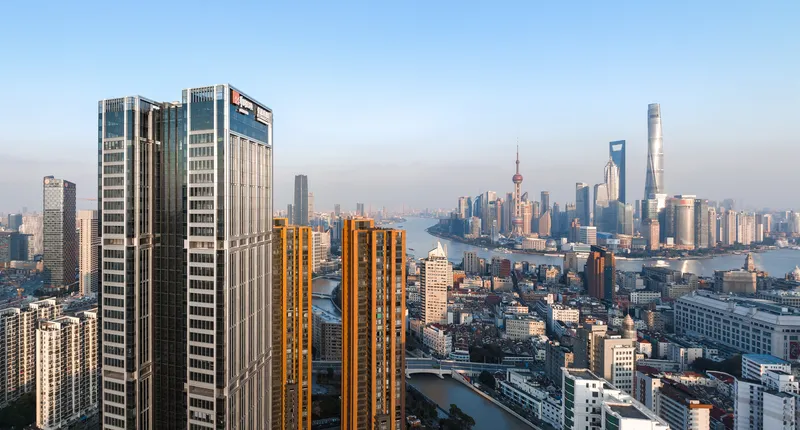
Seen from across the Huangpu, the tower reads as a vertical stack of stainless-steel ribs and dark glass panels. The structural frame is deliberately pulled away from the corners, creating full-height glass volumes at each edge of the floor plate. Those corners are not decorative: they are the prize amenity on every level, offering panoramic views toward Pudong and the river without a single column interrupting the sightline.
The all-steel construction system, applied to both the main vertical and lateral structural elements and the floor spanning systems, is unusual for a tower of this height in China. It gives the facade a rhythmic, almost textile quality when light rakes across the louvered panels, while the dark glazing cuts reflective glare for neighboring buildings and the park below. At dusk, the twin massing of the complex, office tower alongside the adjacent residential volumes, forms a crisp silhouette that anchors the eastern skyline.
Park, Canopy, and Ground Plane
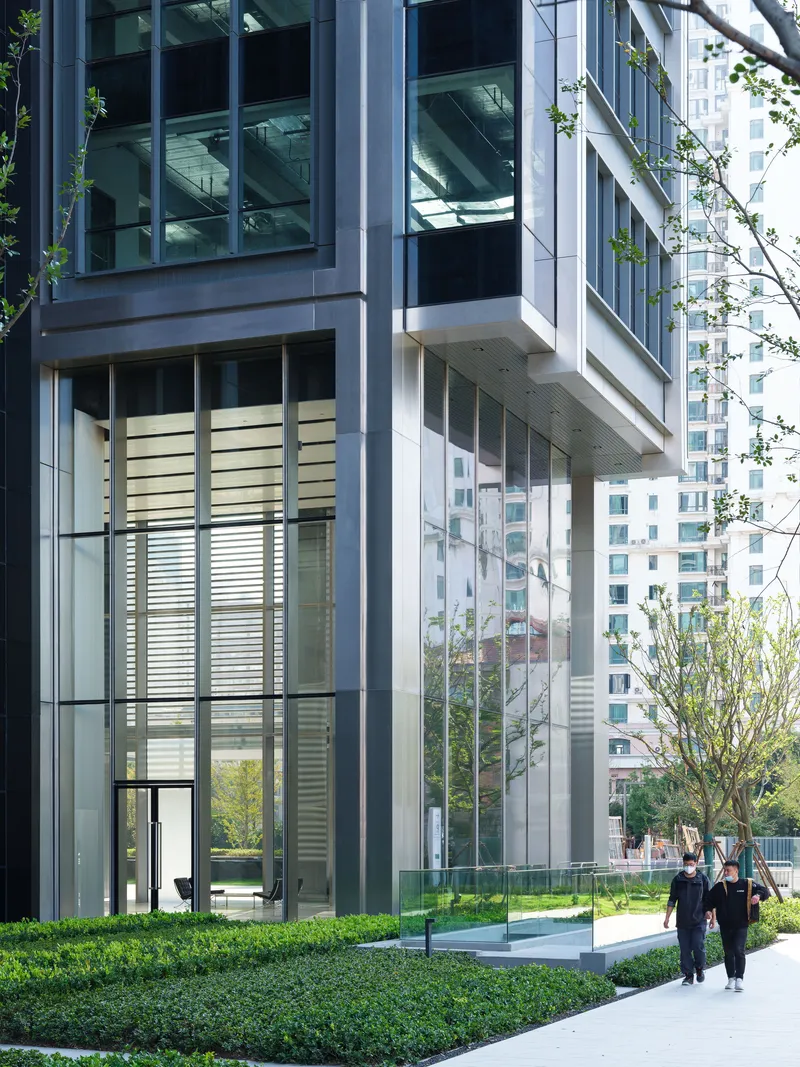
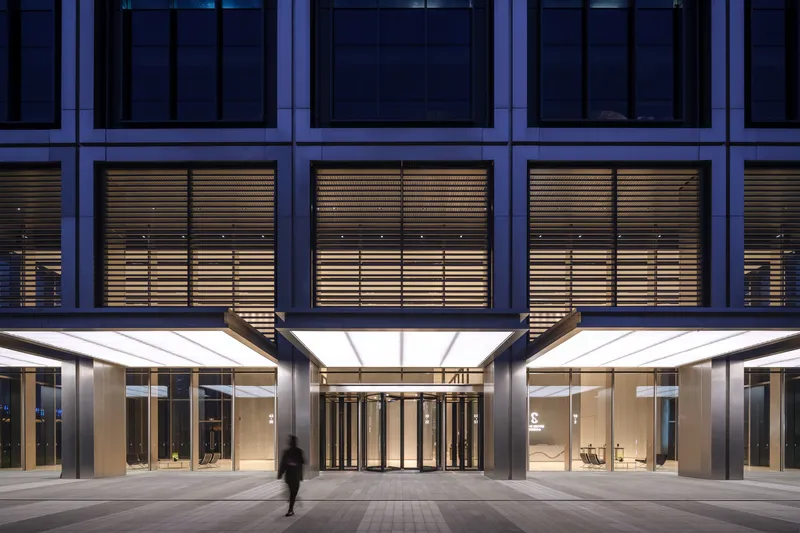
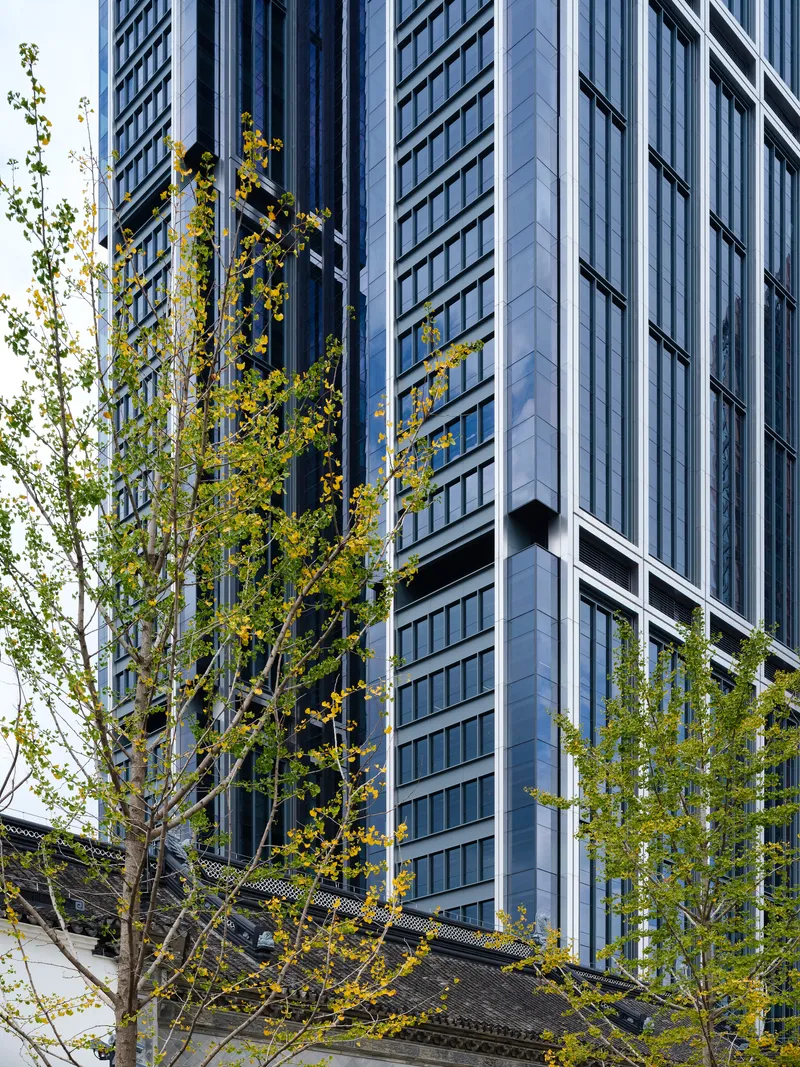
A tower can be structurally brilliant and still fail at the sidewalk. Foster + Partners avoids that trap by treating the ground plane as a threshold between Suhewan Park and the 11-meter-tall lobby. Daylight filters through horizontal louvers above an entrance canopy, casting striped shadows on the paving and softening the scale shift from landscape to interior. Hedged pathways guide pedestrians toward revolving doors set within a fully glazed base, so the park's greenery remains visible even as you step inside.
The western facade is recessed at its middle section, carving a vertical slot that lets natural light flood the office floors while simultaneously creating a recess for a row of scenic lifts. Riding one of these elevators is essentially a slow panoramic tour of the park and the river beyond. It is a simple move, but it means circulation becomes a moment of orientation rather than a windowless chore.
The Lobby as Urban Artifact
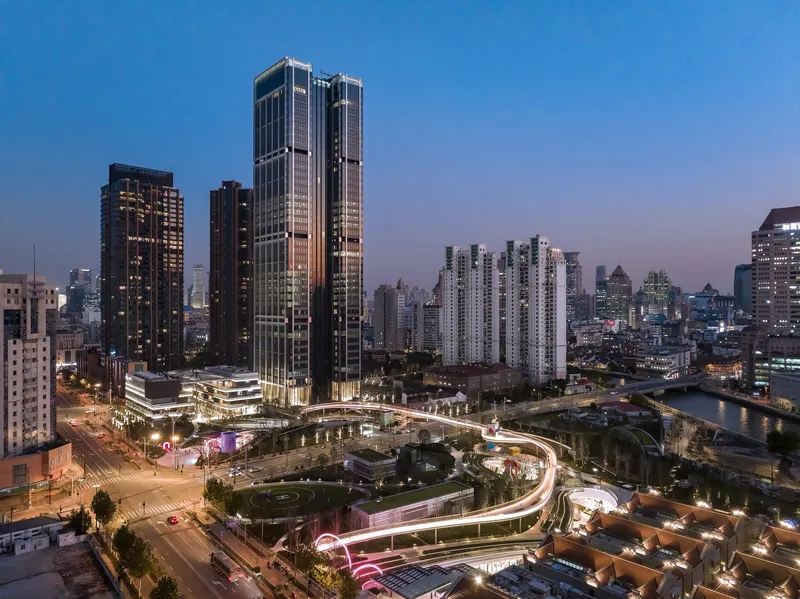
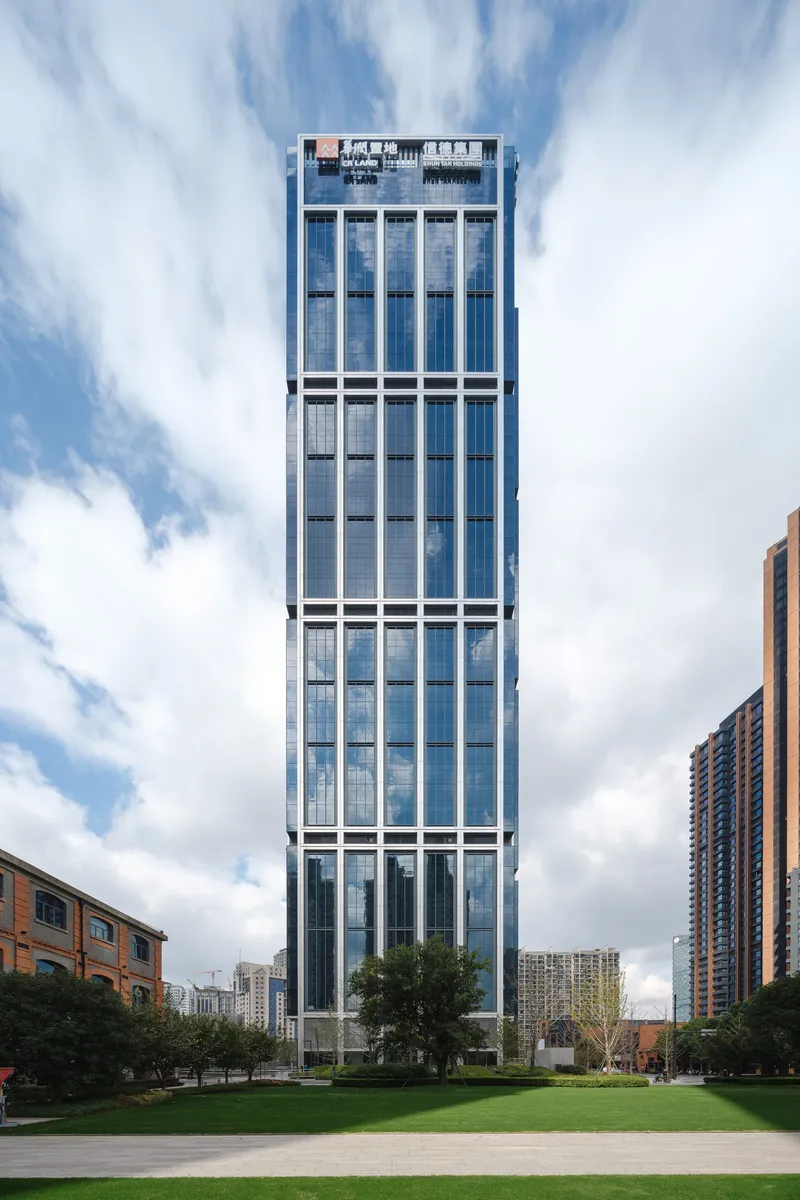
Inside the lobby, undulating wall panels extend the perceived depth of the 11-meter-high space, giving it a sense of motion that contrasts with the gridded rigor of the exterior. The reception desk is imprinted with a historic map of the Suhe River, a detail that could easily slide into sentimentality but instead works as a quiet piece of wayfinding: it tells visitors where they are and why this place matters, all before they reach the elevators.
The tower sits at the heart of the Suhewan East Urban Complex, which introduces offices, retail, and cultural programs into a previously monofunctional residential district. Connections to the Line 10 Tiantong Road metro station make the building a genuine transit-oriented node, not just a prestige address. LEED Platinum certification and a Green Building 2 Star rating back up claims of environmental performance, supported by rainwater recycling, intelligent indoor-environment monitoring, and the passive benefits of that dark glazing.
Flexible Floor Plates and Detachable Slabs


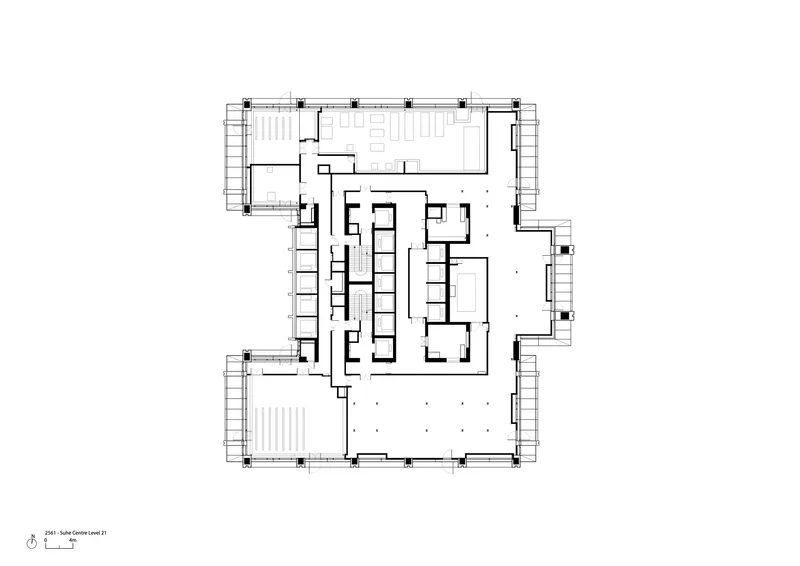
Column-free office floors are the baseline promise of any modern commercial tower, but the Suhe Centre goes a step further. Every level features detachable floor slabs that allow tenants to open double-height or even triple-height connections between levels. That flexibility transforms what could be generic speculative office space into something adaptable: a tech firm wanting an open atrium can get it without structural intervention, while a law practice wanting cellular offices simply leaves the slab in place.
The plans reveal a compact central service core surrounded by open floor area, with perimeter columns and diagonal bracing distributed to the building's edges. Corner projections create alcove zones that can serve as breakout spaces, private offices, or meeting rooms depending on tenant fit-out. The core itself is tight and efficient, grouping vertical circulation, MEP risers, and service rooms to maximize usable floor area on every level.
Context and Urban Ambition
Aerial views make the urban argument clear. The tower rises sharply above a low-rise residential fabric, a deliberate punctuation mark intended to signal the district's transformation. A spiraling pedestrian bridge at the base connects the complex to the park and the surrounding street grid, stitching the tower into a network of public spaces rather than isolating it behind a security perimeter.
Shanghai has no shortage of supertall ambition, but most of it has been concentrated in Pudong and the Bund corridor. Placing a 200-meter office tower in Changning, on the western bank, is a statement about the city's polycentricity. It also puts pressure on the surrounding urban fabric to densify and diversify, which is exactly what the Suhewan East Urban Complex is designed to catalyze. Whether that pressure produces good urbanism or displacement will depend on planning decisions that extend well beyond the building's footprint.
Plans and Drawings
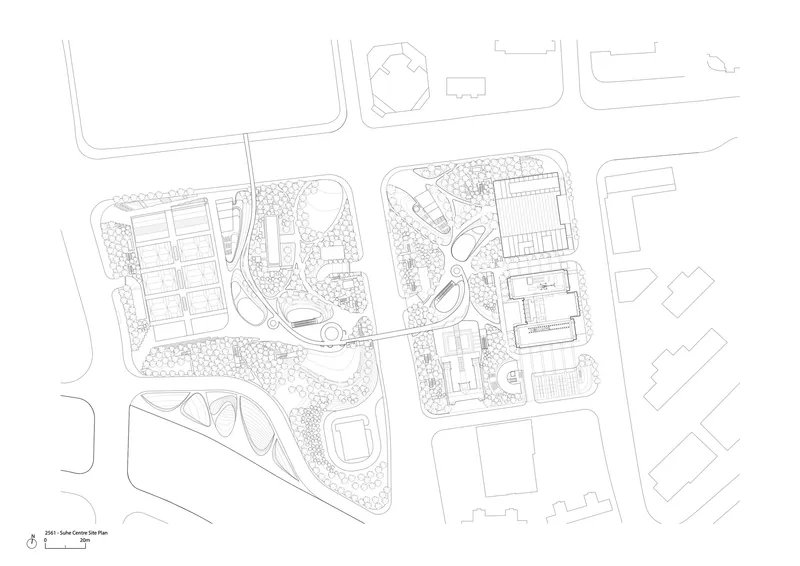


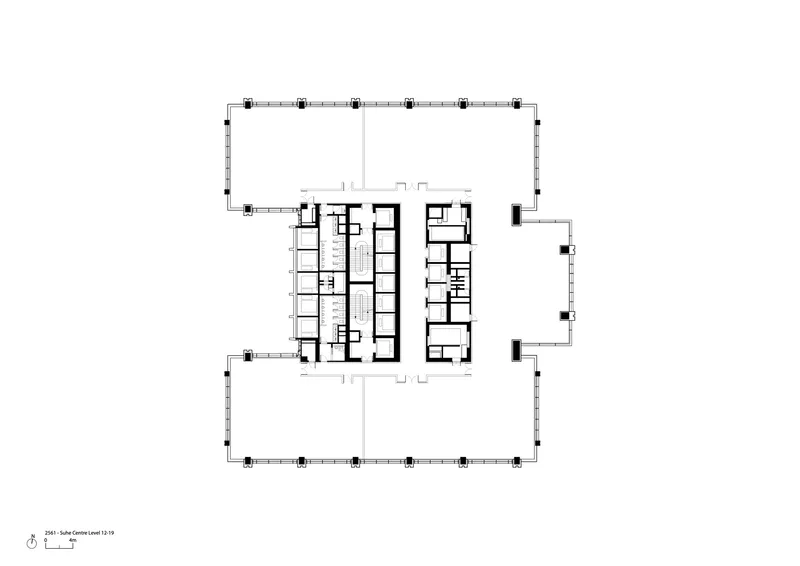
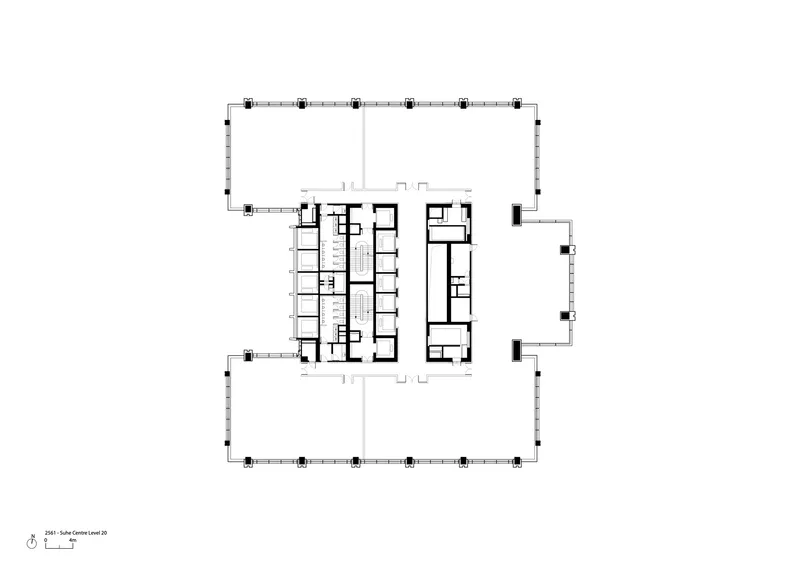


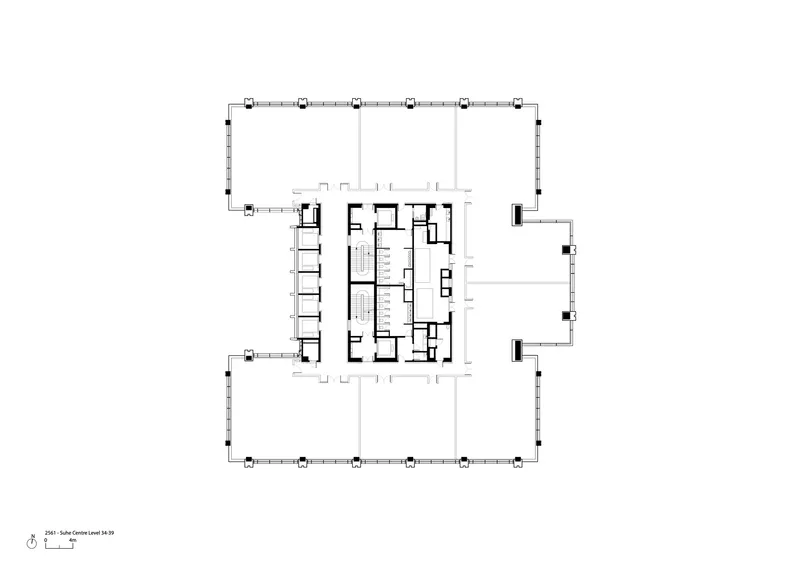
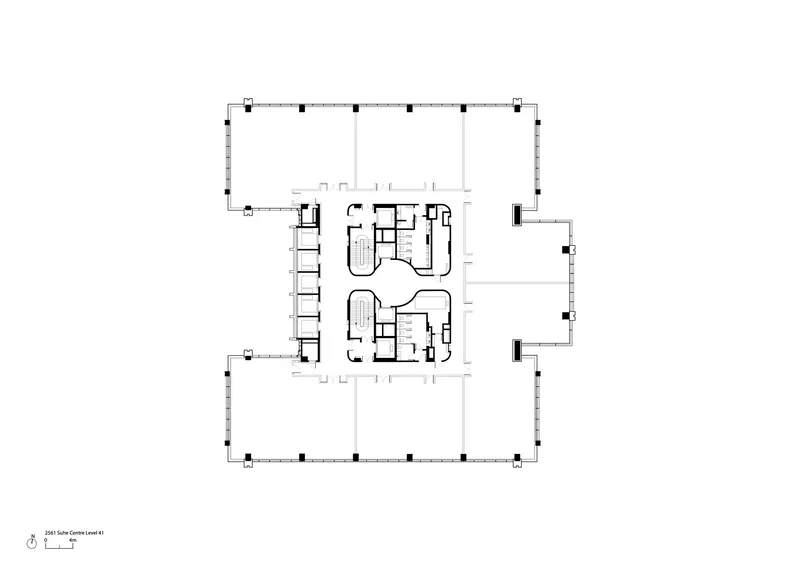


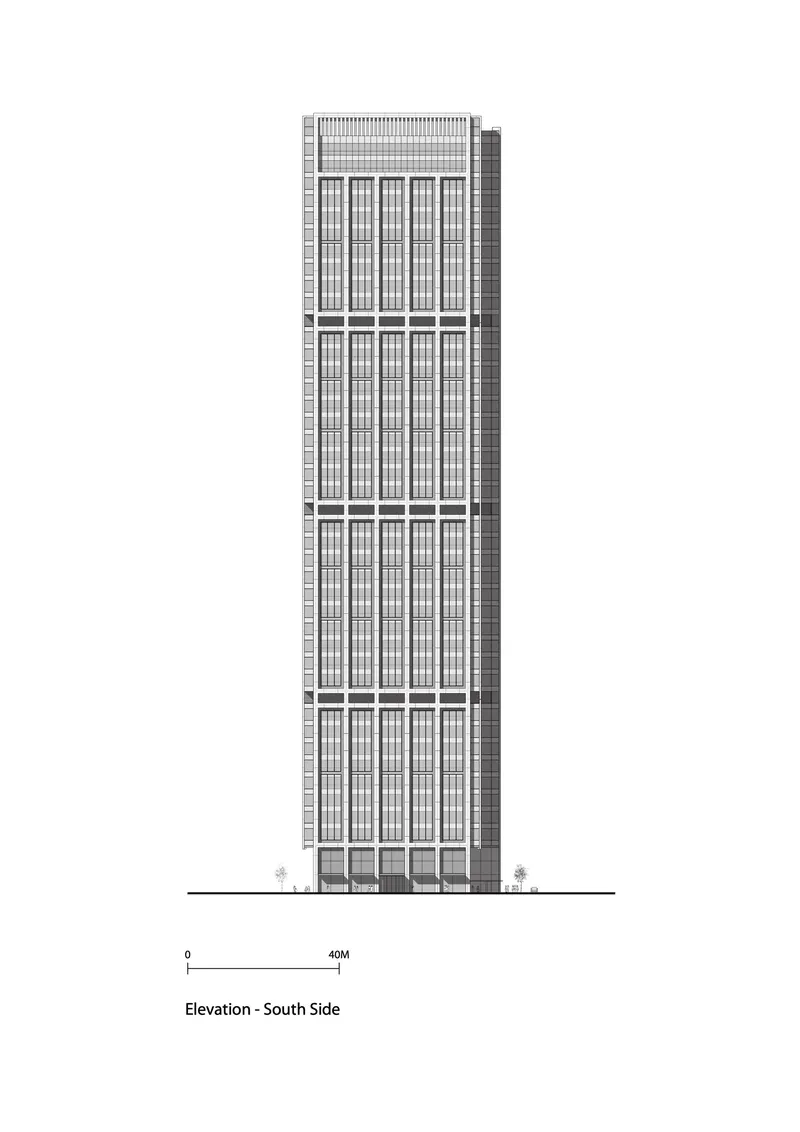
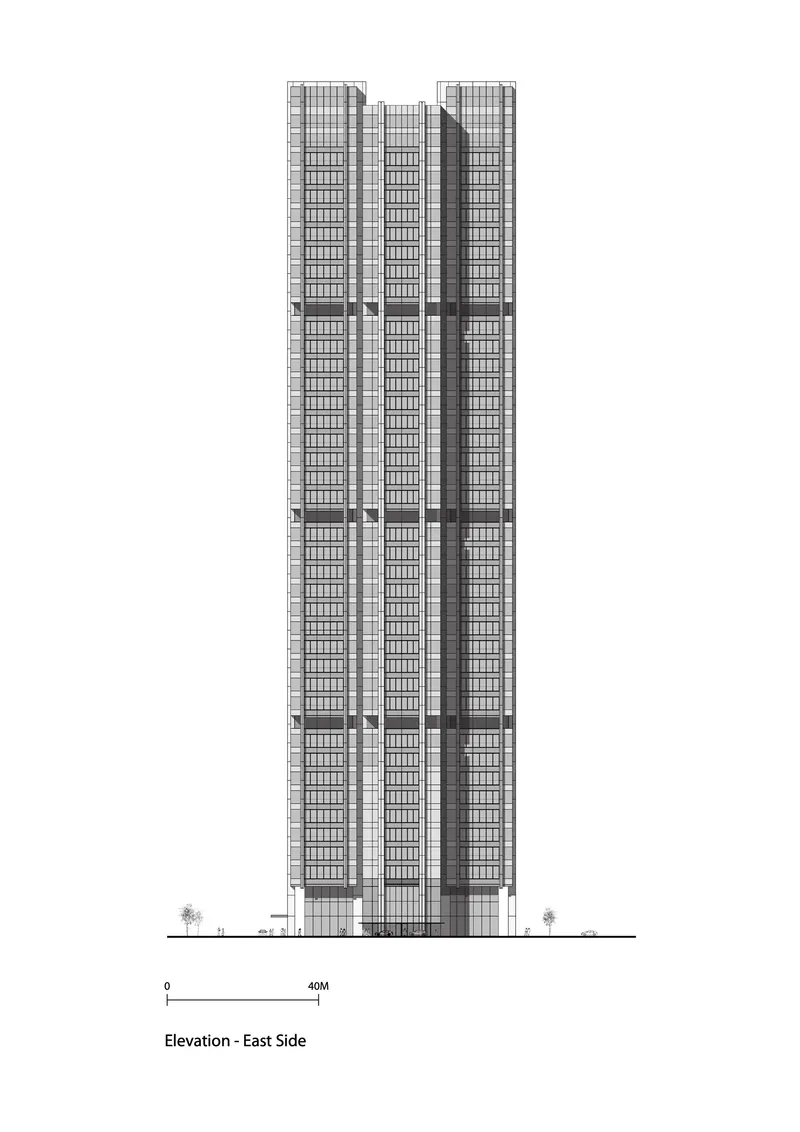
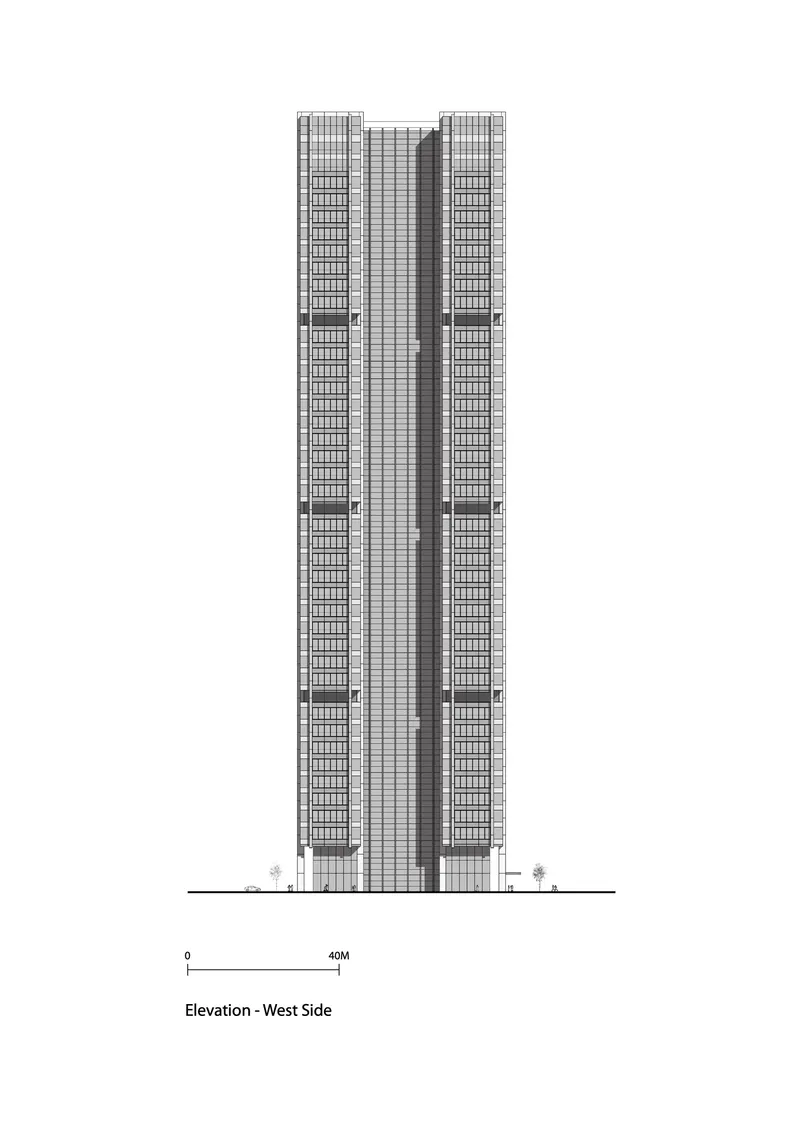
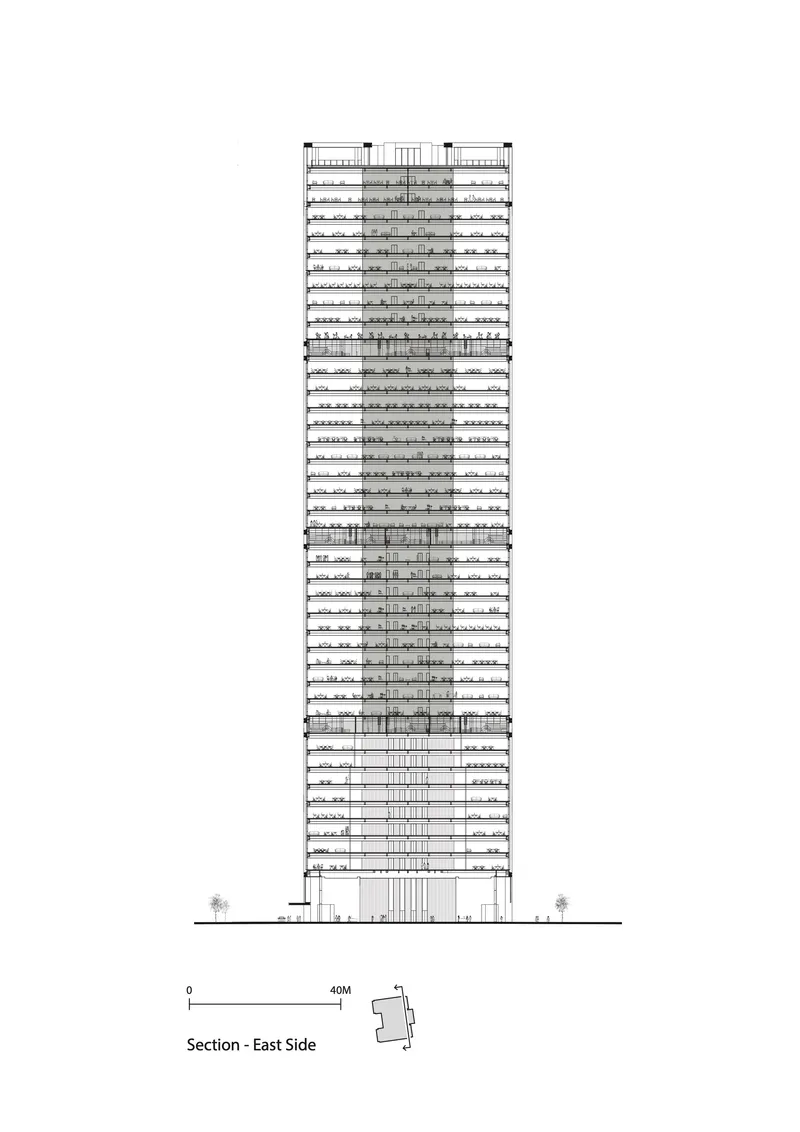
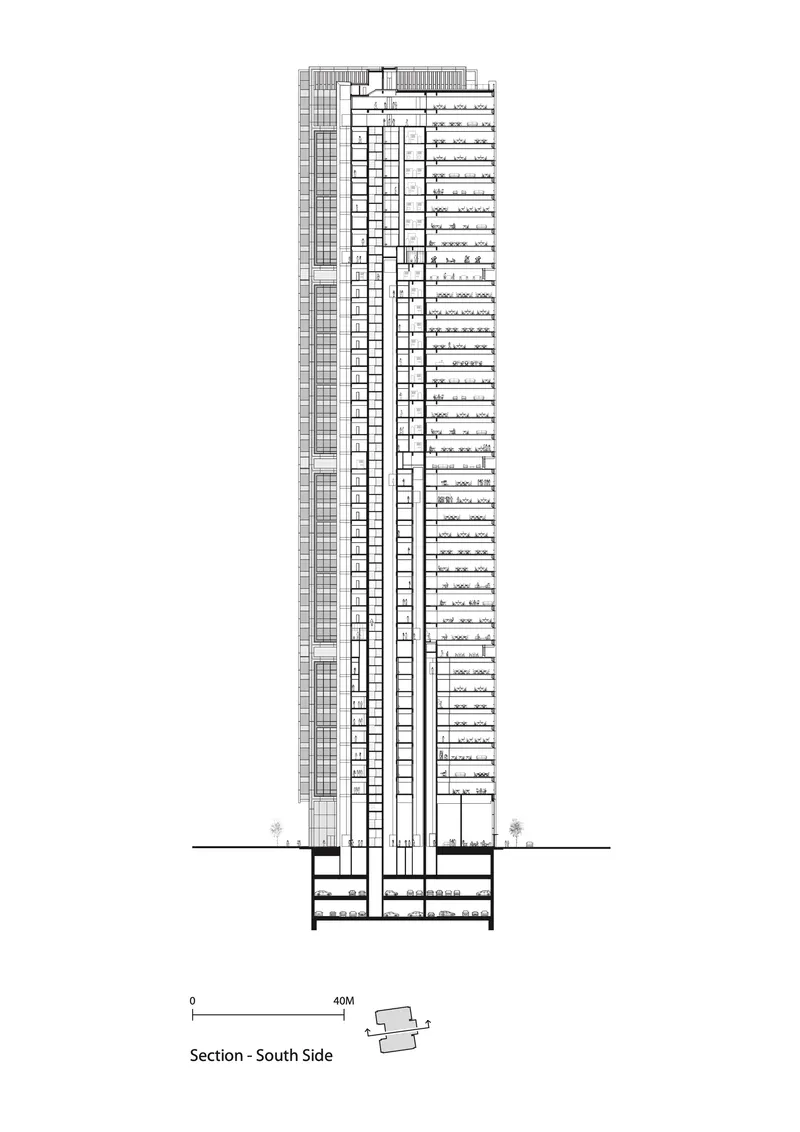
The full drawing set reveals how the floor plates evolve from the broader podium levels, with their curved central cores and extending lateral wings, up through the repetitive office floors with their compact core and perimeter bracing, to the mechanical roof level. Elevations from all four cardinal directions confirm the tower's asymmetric massing: the north and south faces present a tall, slender profile with prominent corner bays, while the east and west elevations expose the recessed glass spine and the scenic lift recess. The section drawings cut through underground parking, the generous lobby, and the stacked floor plates, showing how the detachable slab strategy is accommodated within the structural grid.
Why This Project Matters
The Suhe Centre Office Tower matters because it takes the expressed-structure approach, a hallmark of Foster + Partners' work from the Hongkong and Shanghai Bank onward, and applies it with genuine contextual sensitivity. The stainless-steel frame is not a high-tech flourish for its own sake; it draws from the industrial character of the Suhewan waterfront and makes legible the forces that hold the building up. In a city where commercial towers often default to curtain walls that could be anywhere, that specificity counts.
More broadly, the project is an early test of Shanghai's decentralization strategy. If a LEED Platinum, transit-connected, park-adjacent office tower cannot pull commercial tenants to a regenerating district, then the city's planning ambitions will need recalibrating. Early signs suggest it can. The combination of flexible floor plates, detachable slabs, and corner views gives tenants practical reasons to be here, while the park and metro connection give their employees reasons to stay. The building is a bet on the idea that good architecture, well sited, can do genuine urban work. It is a bet worth watching.
Suhe Centre Office Tower, designed by Foster + Partners with collaborating architect ECADI and structural engineering by Arup. Located in Chang Ning Qu, Shanghai, China. 200 meters, 42 stories. Completed 2023. Photography by Runzi Zhu.
About the Studio
Share Your Own Work on uni.xyz
If projects like this are the kind of work you want to make, uni.xyz is a place to publish your own, find collaborators, and enter design competitions.


Popular Articles
Popular articles from the community


The Amber Palace Opera: A Geological Fiction Surfaces on Tallinn's Baltic Waterfront
Pierre Brillard reimagines a Baltic legend as a public landscape, opera house, and waterfront promenade rooted in Tallinn's coastal identity.


Cube Design Draws an Ecological Corridor Between Two Shenzhen Hills with the Nankai Building
Beside Shenzhen's container docks, the Nankai Building pairs stacked balconies with a climbing green screen to connect two hillsides across its height.

David Ortega Stacks a Two-Story Mexico City Penthouse Around a Steel Stair and a Pergola-Shaded Roof Terrace
In Colonia Roma, a 300 m² penthouse uses oak joinery, a planted steel stair and a slatted roof pergola to make a new-build apartment feel like a house.

FCC Arquitectura Expands a Portuguese Granite House with a Board-Marked Concrete Wing
In Portugal, JV House pairs a cleaned-up whitewashed and granite dwelling with a timber-shuttered concrete extension, courtyards and a garden pool.

Similar Reads
You might also enjoy these articles

LAVA Architecten Gives Vocational Education a Sawtooth-Roofed Face on a Mechelen School Campus
In Mechelen, Belgium, a 2,053 m² STEM school on a 6×6 m grid turns workshops and classrooms into rooms that can be rearranged as teaching changes.

KEMA Studio Turns a Derelict Marvila Attic into a 60 m² Lighthouse Apartment Above Lisbon
In Lisbon's Marvila district, a rebuilt roof, four skylights and two plywood volumes turn an unlivable attic into a bright home facing the Tagus.

Pixel Gardens: One Repeated Module Stacked Into a Terraced Social Housing Tower for Famagusta
Salem Bader's shortlisted housing tower builds a vertical neighbourhood from one repeated module, offsetting units to carve terraces, light and air.

Bao Huynh Watercolor Atelier: A Serene Art Retreat in Hội An
Bao Huynh Watercolor Atelier in Hội An blends multifunctional art spaces, sustainable design, local materials, and family-friendly living in a serene environment.

Comments (0)
Please login or sign up to add comments
No comments yet. Be the first to comment!