

RVMN Models a Seoul Office on Crown Shyness, Where Workers Coexist Without Collision
A 300-square-meter workspace in South Korea translates the forest canopy phenomenon into partitions, light, and spatial rhythm.


Crown shyness is the phenomenon where tree canopies grow close to one another but never quite touch, leaving channels of light between them. It is a fitting metaphor for how a healthy office should work: people in proximity, focused on their own tasks, separated by just enough space to maintain concentration and dignity. RVMN, the Seoul-based studio led by Yonghyun Kwon and Hyoju Kim, takes that metaphor seriously in J Office, a 300-square-meter workspace designed for a company whose culture prizes honesty, practicality, and close collaboration without pretense.
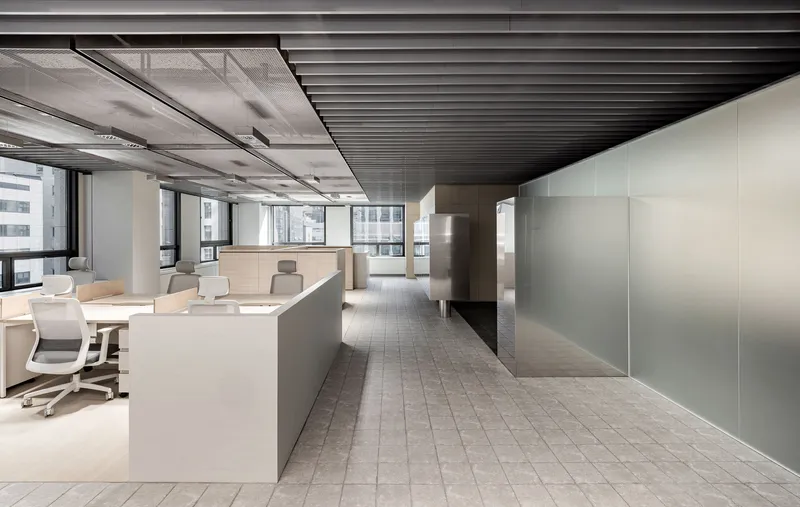
What makes the project compelling is not the metaphor itself but how literally it manifests in the architecture. Frosted glass partitions stop short of the ceiling. A louvered overhead plane filters light the way a canopy filters sun. Zones shift in material warmth and enclosure to signal different modes of work. The result is an office that reads as a single continuous landscape punctuated by clearings, thickets, and paths, all calibrated to a company culture that rejects unnecessary formality but demands respectful boundaries.
The Canopy Overhead
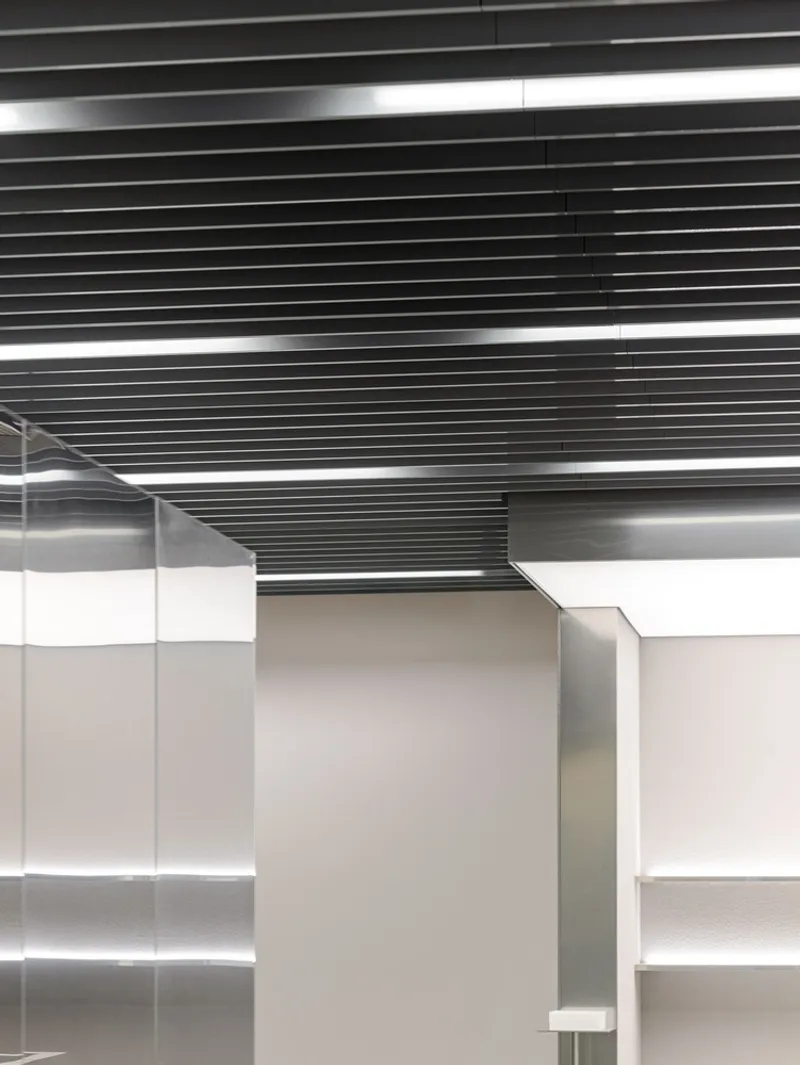
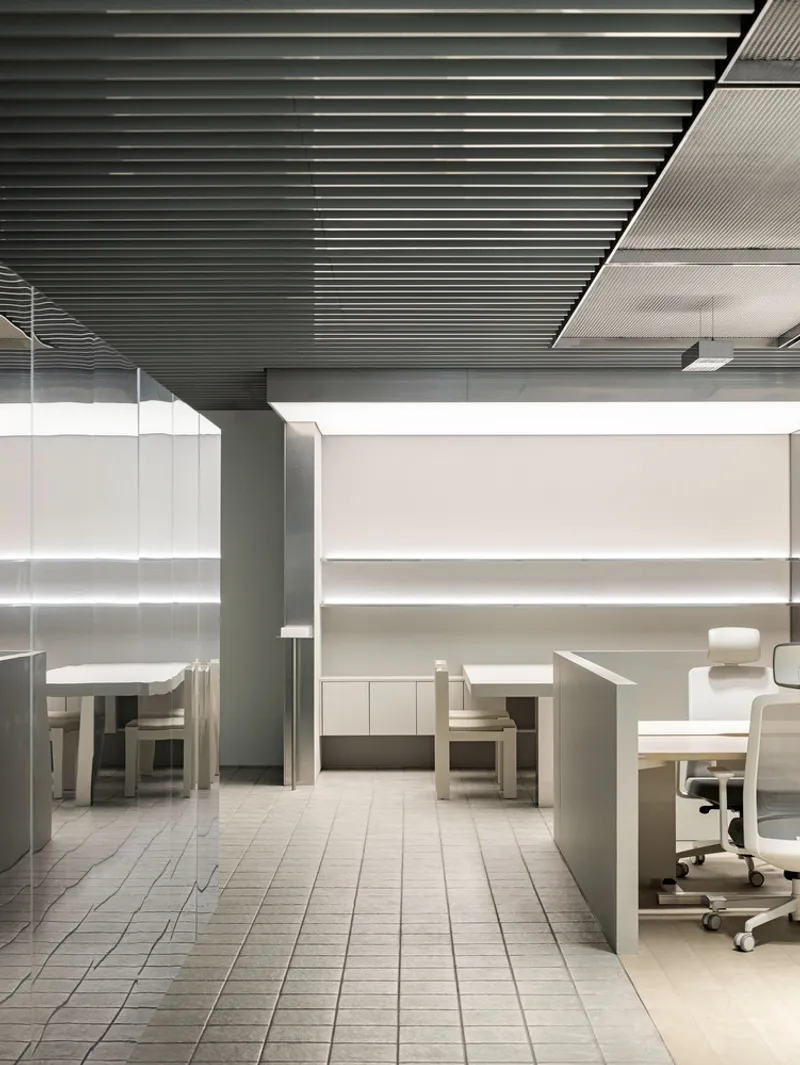

The most immediately legible element in J Office is the black slatted baffle ceiling that runs across the entire floorplate. Rather than dropping in a conventional plasterboard plane, RVMN uses linear timber or metal baffles spaced apart so that services remain partially visible and light seeps through the gaps. The effect is remarkably close to looking up through a lattice of branches. Integrated linear luminaires sit between the baffles, casting even, indirect illumination that avoids the flatness of typical office lighting.
In certain zones, grey acoustic panels are suspended beneath the baffles, creating a second layer that softens sound where concentration matters most. The alternation between exposed baffles and acoustic infill is legible in long views down the office, producing a visual rhythm that signals different territories without walls.
Translucent Boundaries
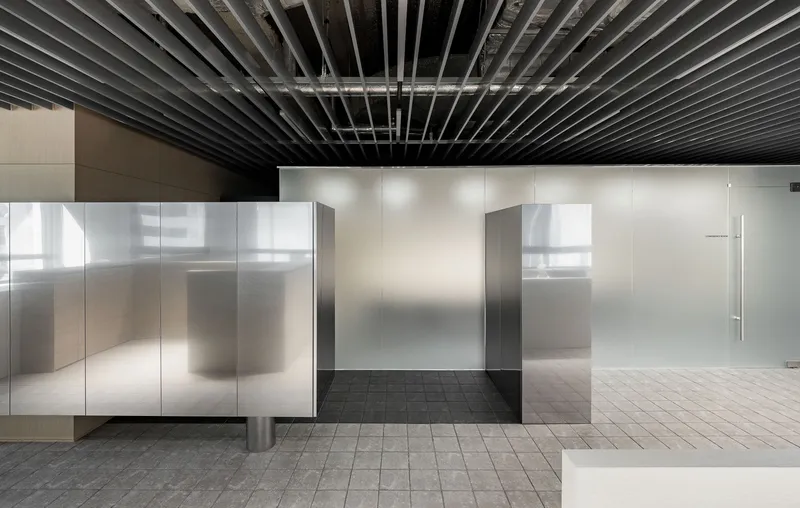
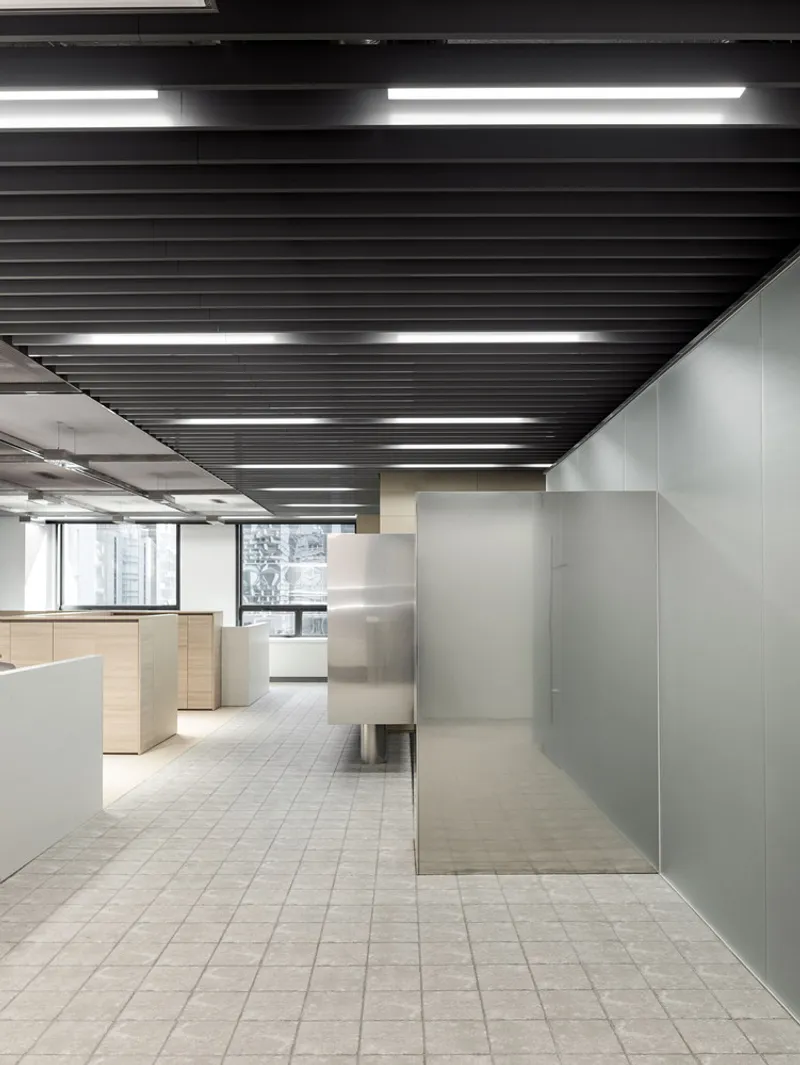
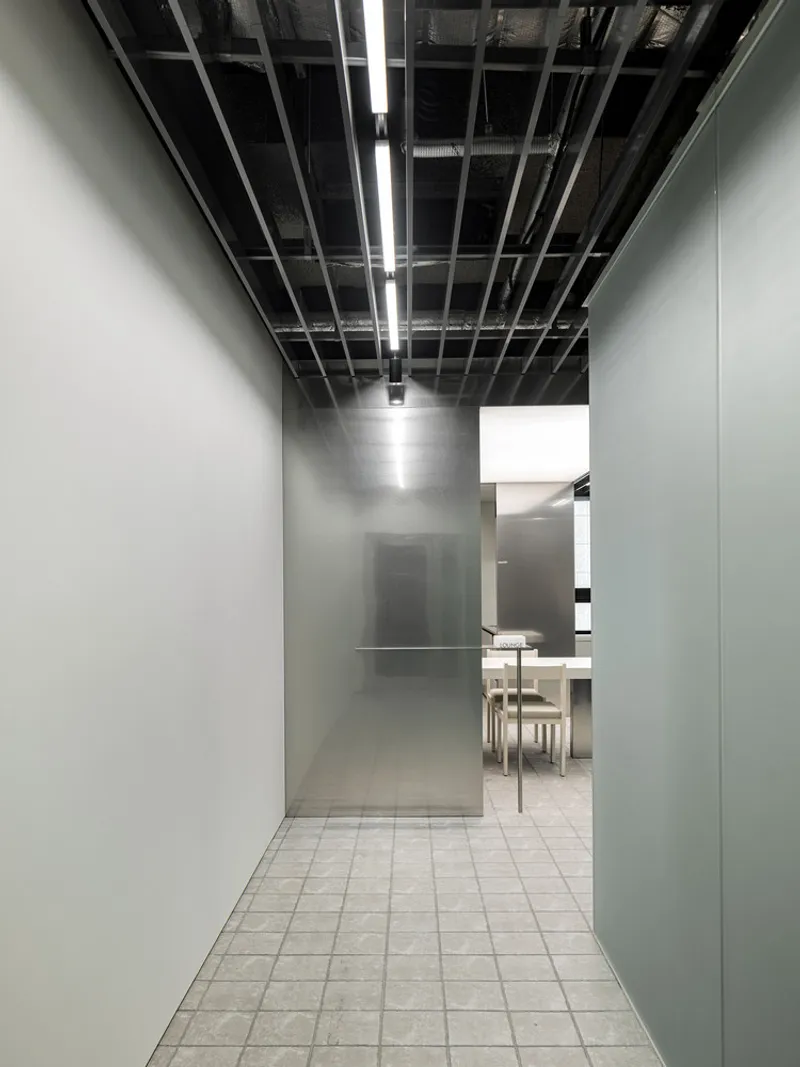
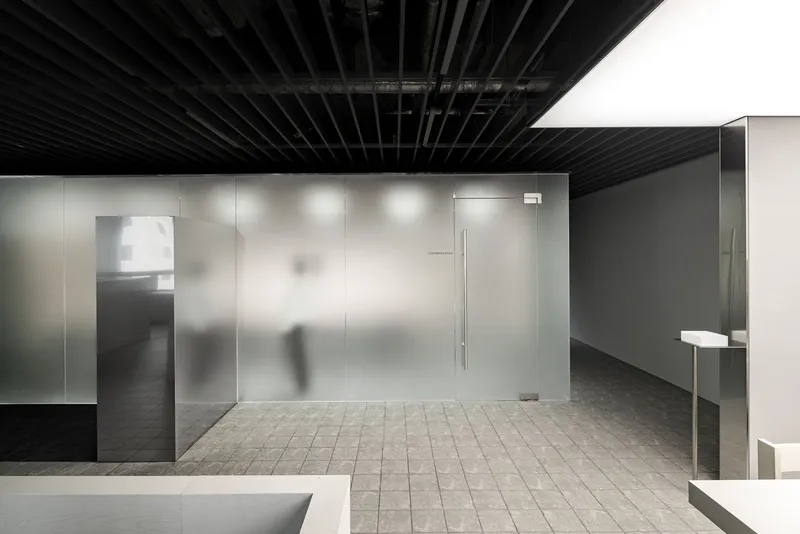
The frosted glass partitions are where the crown shyness analogy becomes spatial rather than decorative. Meeting rooms and the executive office are wrapped in satin glass set in slender steel frames that let silhouettes and light pass through while blocking direct sightlines. The partitions stop before reaching the ceiling baffles above, leaving a deliberate gap that allows air circulation and preserves the sense of a single continuous volume.
Walking the corridors between these glass enclosures produces a particular quality of light: soft, milky, and directionless. It is one of the more successful details in the project. The translucency means that even enclosed rooms borrow ambient light from the perimeter windows, reducing the need for artificial illumination during the day and keeping the office feeling open regardless of where you are standing.
Zoning by Material and Mood

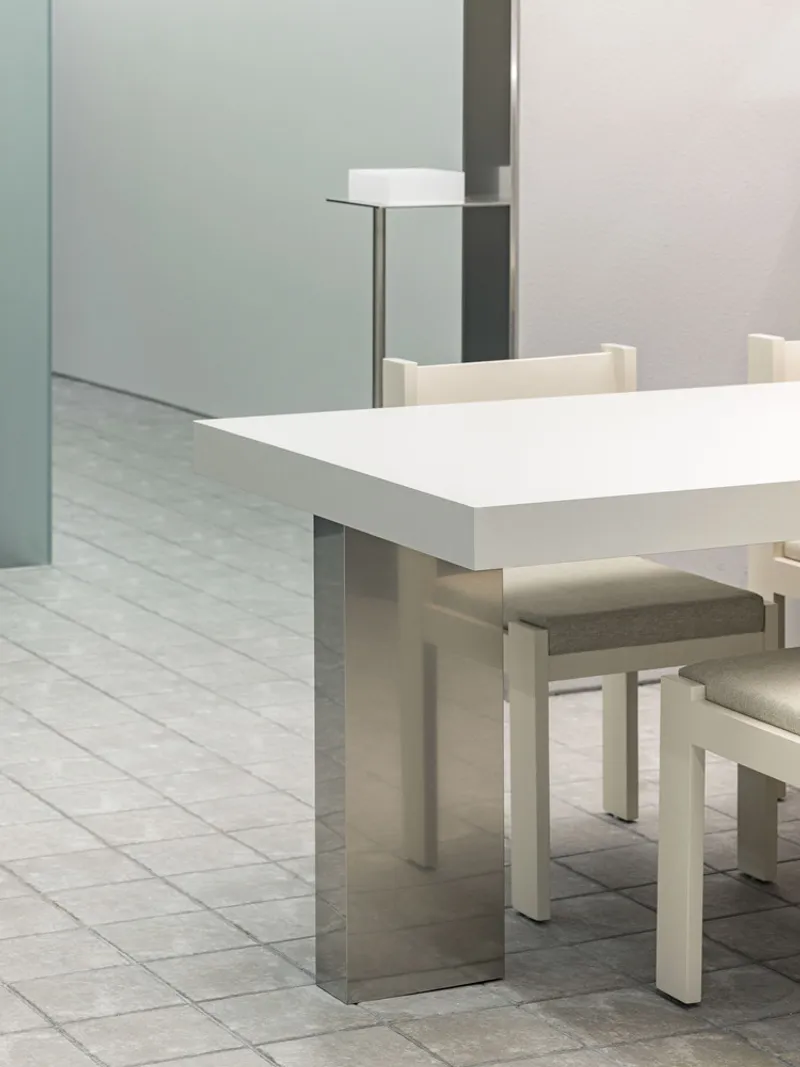
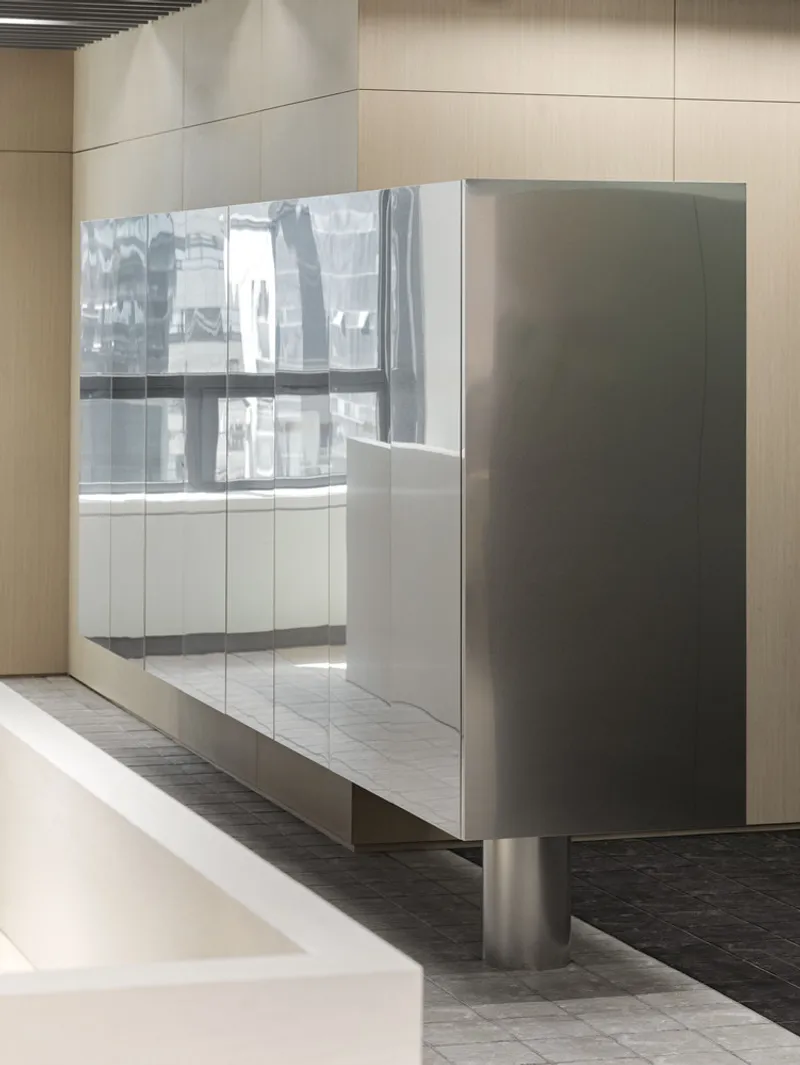
RVMN distinguishes program areas not by dramatic formal gestures but through subtle shifts in material. The open work floor uses pale timber desktops and grey stone-textured tile flooring, keeping the tone neutral and task-oriented. Meeting areas introduce warmer oak tones and upholstered seating. A freestanding storage unit with frosted glass doors and cylindrical steel legs acts as a room divider while doubling as a display piece, its industrial detailing consistent with the office's steel-and-glass vocabulary.
The palette overall is restrained: white, light oak, walnut-toned HPL, terrazzo, and metal. No accent walls, no bold color. The restraint is intentional. RVMN designed to match a company culture that rejects pretense. In an era when office interiors compete for Instagram attention with neon signage and branded wallpaper, J Office's discipline is quietly subversive.
The Open Floor and Its Edges
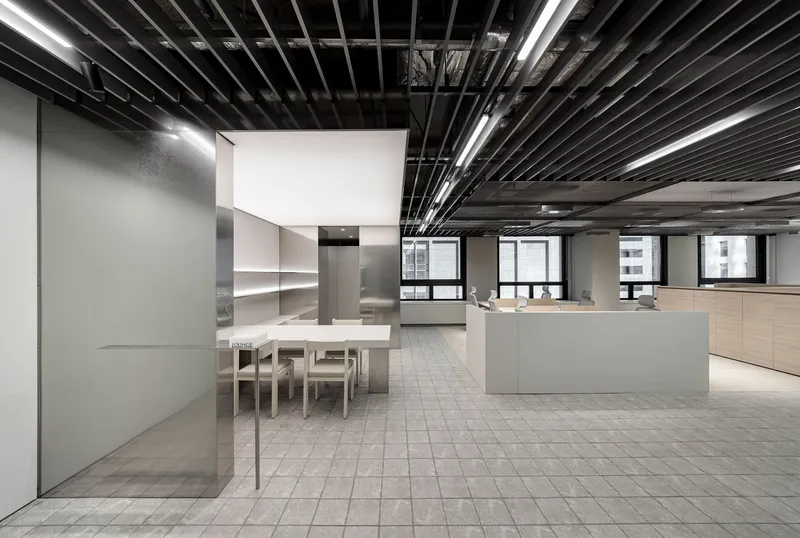
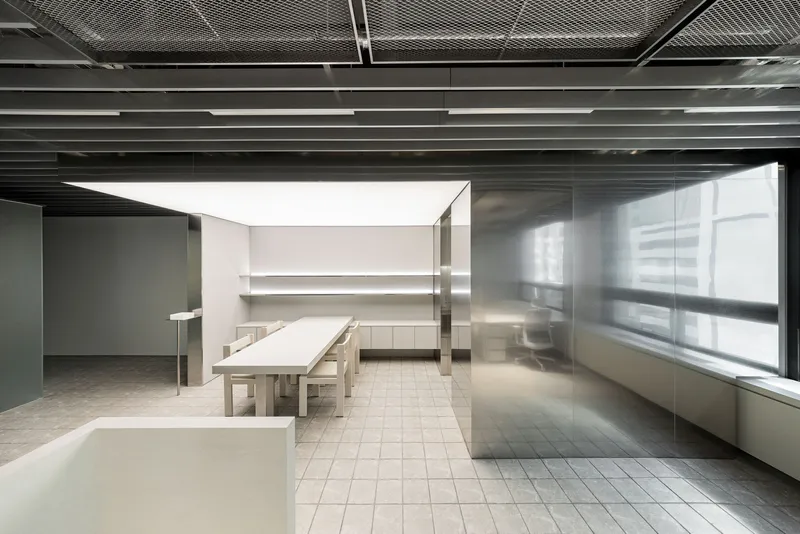
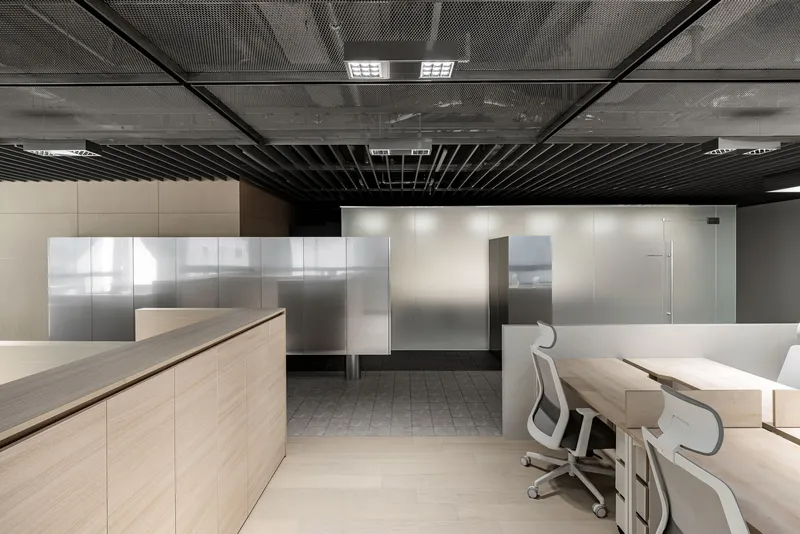
High-use workstations sit along the perimeter, positioned to catch natural light through the building's windows. This is a simple move, but it matters: employees oriented toward daylight stay more attuned to the passage of time, which RVMN cites as a deliberate design response to the J group's work rhythms. Low dividers between desks create soft boundaries rather than hard walls, allowing visual connection across the floor while giving each person a defined territory.
The meeting rooms and executive office, which require more acoustic separation, occupy the interior and windowless sides of the plan. Because they are clad in translucent glass rather than opaque partitions, they borrow ambient daylight from the open floor, avoiding the cave-like quality that enclosed rooms in deep floorplates often suffer from.
The Breakout Zone
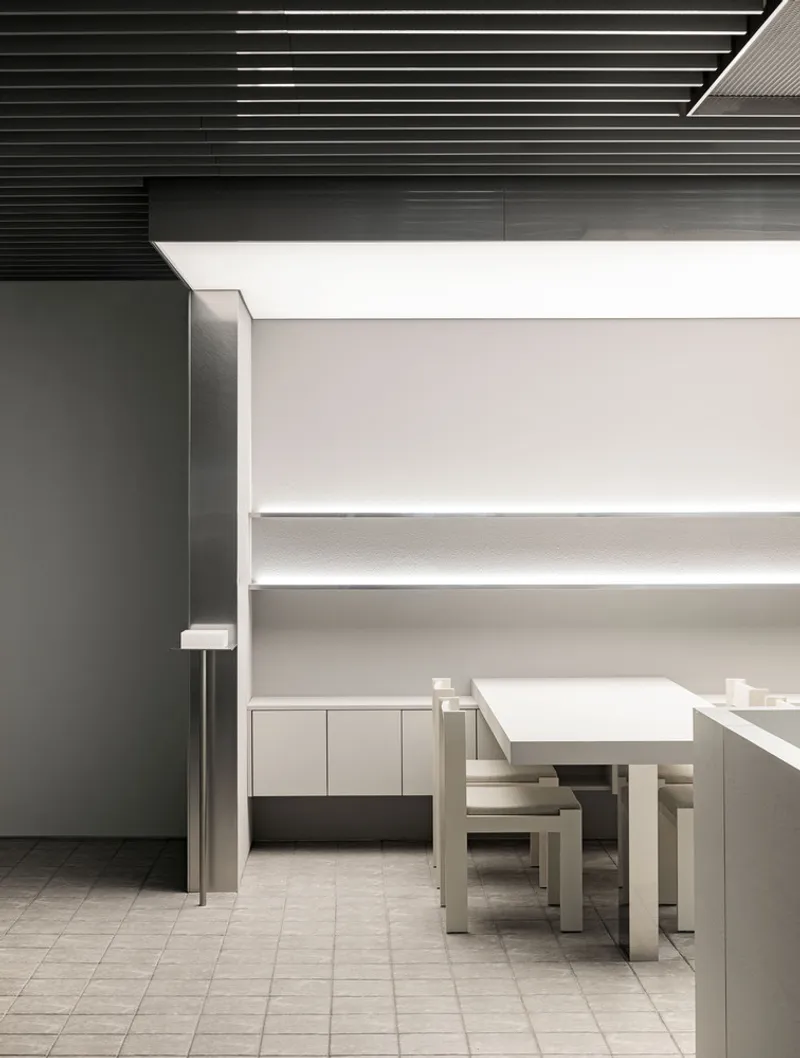
A lounge and pantry area, visible in the plan as a distinct zone off the main circulation spine, provides a counterpoint to the focused work areas. White built-in benches and a communal table sit beneath horizontal light strips that break from the office's dominant baffle pattern, signaling a shift in mode. The space is deliberately lighter, warmer, and more casual, a clearing in the forest where employees can step away from their desks and reset.
The sliding door captured in the corridor view reinforces the office's ethos of gentle separation. Doors are present, but they glide rather than swing, and their translucent panels maintain visual continuity even when closed. Nothing in this office slams shut.
Plans and Drawings

The floor plan reveals a straightforward organizational logic: a conference room, executive office, lounge, and pantry arranged around a central circulation axis. The open work floor occupies the largest share of the 300 square meters, wrapping the building's perimeter. What the plan makes clear is how little the project relies on corridor walls. Circulation happens between freestanding glass volumes, turning movement through the office into a sequence of views rather than a march down a hallway.
Why This Project Matters
J Office matters because it demonstrates that biophilic design does not require living walls, potted ficus trees, or moss panels glued to reception desks. RVMN's interpretation is structural and atmospheric: filtered light, layered transparency, and spatial gaps that echo the behavior of trees. The project draws its coherence from a single natural principle and follows it through ceiling, partition, and plan without resorting to literal botanical decoration.
It also stands as a quiet argument that corporate interiors can reflect company values without branding them onto every surface. The J group's culture of honesty and practicality reads in the material restraint, the absence of performative gestures, and the care taken to balance openness with privacy. In 300 square meters, RVMN has built a workspace that treats its occupants the way crown-shy trees treat their neighbors: with proximity, respect, and just enough distance to let each one reach the light.
J Office, designed by RVMN, South Korea. 300 m². Completed 2025. Photography by Yongjoon Choi.
About the Studio
Share Your Own Work on uni.xyz
If projects like this are the kind of work you want to make, uni.xyz is a place to publish your own, find collaborators, and enter design competitions.


Popular Articles
Popular articles from the community


GROUP A Strips a 1969 Rotterdam Harbor Headquarters to Its Frame and Wraps It in Timber Louvers
In Rotterdam's M4H harbor district, Ferro Offices reuses a 1969 frame, adds one timber storey and reaches BREEAM-NL Outstanding.

David Macias Steps a Doorless Stone and Plaster House Down a Tropical Colombian Hillside
In the humid hills of Colombia, Threshold House replaces the front door with an open void and terraces its 850 m² down the slope instead of fighting it.

Cube Design Draws an Ecological Corridor Between Two Shenzhen Hills with the Nankai Building
Beside Shenzhen's container docks, the Nankai Building pairs stacked balconies with a climbing green screen to connect two hillsides across its height.

U.GA Architects Wraps an Oval Rooftop Pool in Curved Board-Formed Concrete on Busan's Jeollidan-gil
In Busan's Jeonpo-dong, a 454 m² mixed-use block stacks a neighborhood facility, guest rooms and an oval rooftop pool inside spiraling concrete walls.

Similar Reads
You might also enjoy these articles

Bamboo Housing Challenge 2026: Design Affordable, Sustainable Homes Using Bamboo
An international design competition by Bamboo U and IBUKU inviting architects and designers to reimagine affordable housing using bamboo — with the winning design built full-scale in Bali.

Computational Design & Education: Beegraphy Design Awards Introduces 7th Category (Featuring Jiyun's Innovative Approach)
Dive into Beegraphy’s 7th Design Awards category, where computational design meets education to create immersive, interactive learning tools, inspired by Jiyun’s work.

From Parametric Lighting to Urban Furniture: Join the 2nd Workshop in Beegraphy’s Computational Design Series
Dive into Cutting-Edge Design Techniques and Practical Applications with Industry Experts

Last Call: Unleash Your Architectural Genius in SHAK's Kindergarten Design Competition
Urgent call for architects to join SHAK's kindergarten design competition before the looming deadline

Explore Office Building Competitions
Discover active competitions in this discipline

Challenge to reimagine the Iron Throne

Photograph architecture without architects

Illustrate the lost glory of Angkor Wat - Render Challenge

Design challenge to reuse E-waste
Comments (0)
Please login or sign up to add comments
No comments yet. Be the first to comment!