

Range Design & Architecture Wraps a Chicago Furniture Studio in a Porous Brick Veil
A former dentist's office in Logan Square becomes a double-height showroom that channels the city's masonry DNA through a perforated screen.


Chicago has always been a brick city. From the common-brick three-flats lining its side streets to the ornamental face-brick storefronts along its commercial corridors, masonry is less a stylistic choice than a structural reflex. When Range Design & Architecture took on the conversion of a long-vacant dentist's office on West Armitage in Logan Square, the firm didn't reach for a fashionable cladding palette. Instead, it doubled down on the material that made the neighborhood, extending load-bearing common brick walls upward and wrapping the street-facing side in a screen of terra-cotta colored paver bricks that filters light like a slow, deliberate blink.
The result is the headquarters for Nothing Design Co., a 3,500-square-foot furniture studio, showroom, and event space that grew out of a one-story shell into a two-story volume topped with a mezzanine and a rooftop terrace. What makes the project worth studying isn't just its fidelity to Chicago's masonry tradition. It's the way that tradition gets instrumentalized: the brick screen is simultaneously solar shading, privacy barrier, light modulator, and contextual gesture. Every decision traces back to the narrow infill lot and the hard constraints it imposes, especially the prohibition on openings along the east and west party walls. Those limits forced light to arrive only from the north and south, which is precisely what makes the building's sectional strategy so sharp.
The Screen as Environmental Device
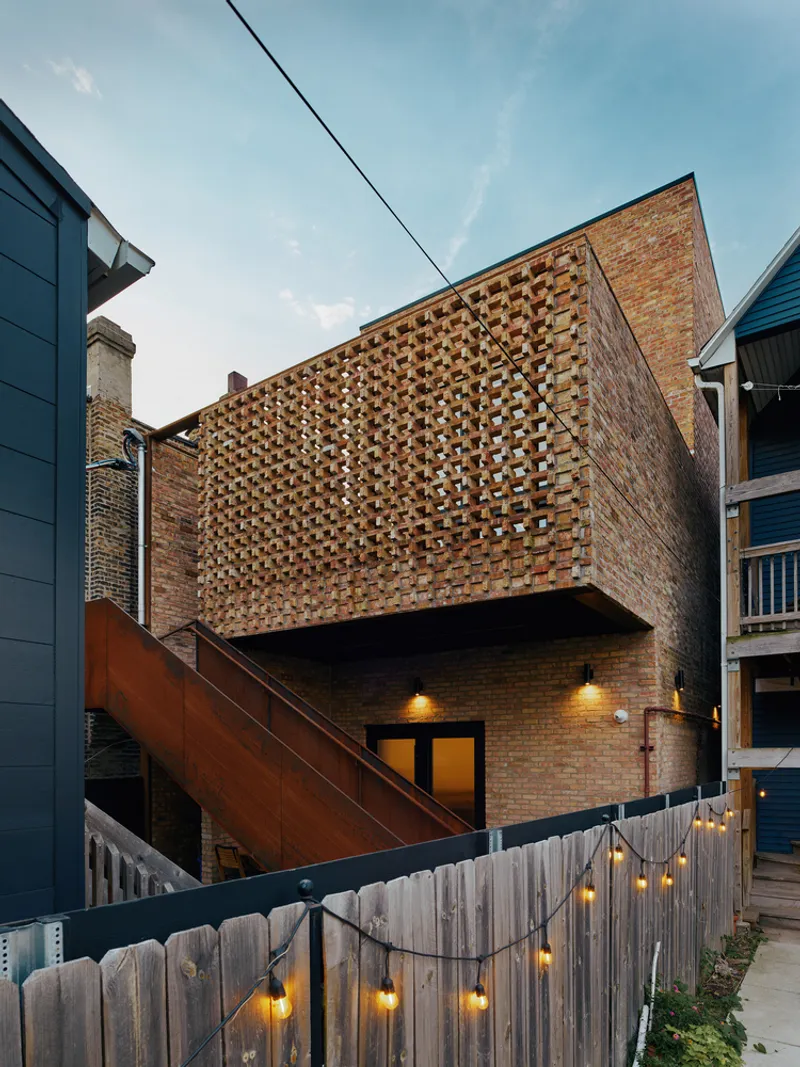
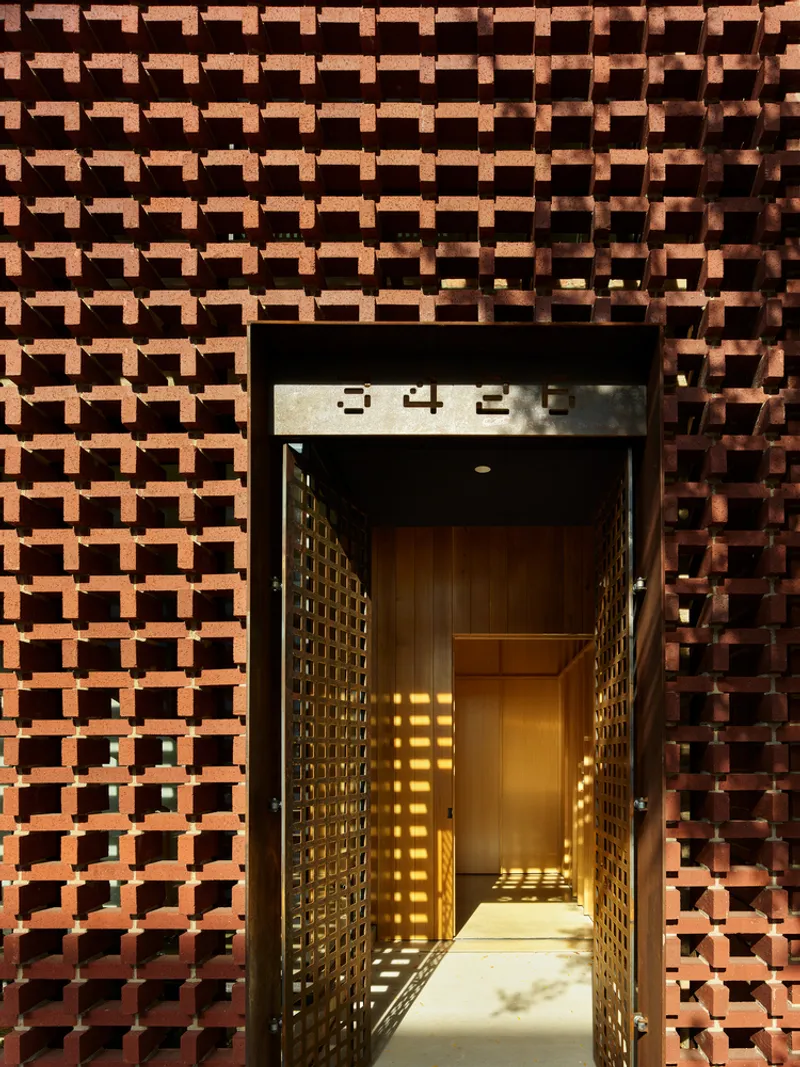
From the street, the south-facing facade reads as a porous wall rather than a conventional storefront. Terra-cotta paver bricks alternate between standard masonry courses and vertically oriented spacers, producing a pattern that is regular enough to feel deliberate and open enough to let daylight pass. The screen's primary job is thermal: south-facing glazing in a narrow urban lot is an invitation for overheating, and the brick veil cuts direct solar gain without eliminating the light itself. Behind it sits a xeriscape planting strip that buffers the glazing and introduces a sliver of habitat into the hardscaped streetscape.
At dusk, the screen inverts. Interior light spills through the gaps, and the building glows like a lantern above the sidewalk. The entry passage, marked by illuminated house numbers, punches through the brick plane cleanly, signaling arrival without grandstanding. It's a restrained move that trusts the material to do the heavy lifting.
Light, Shadow, and the Interior Atmosphere
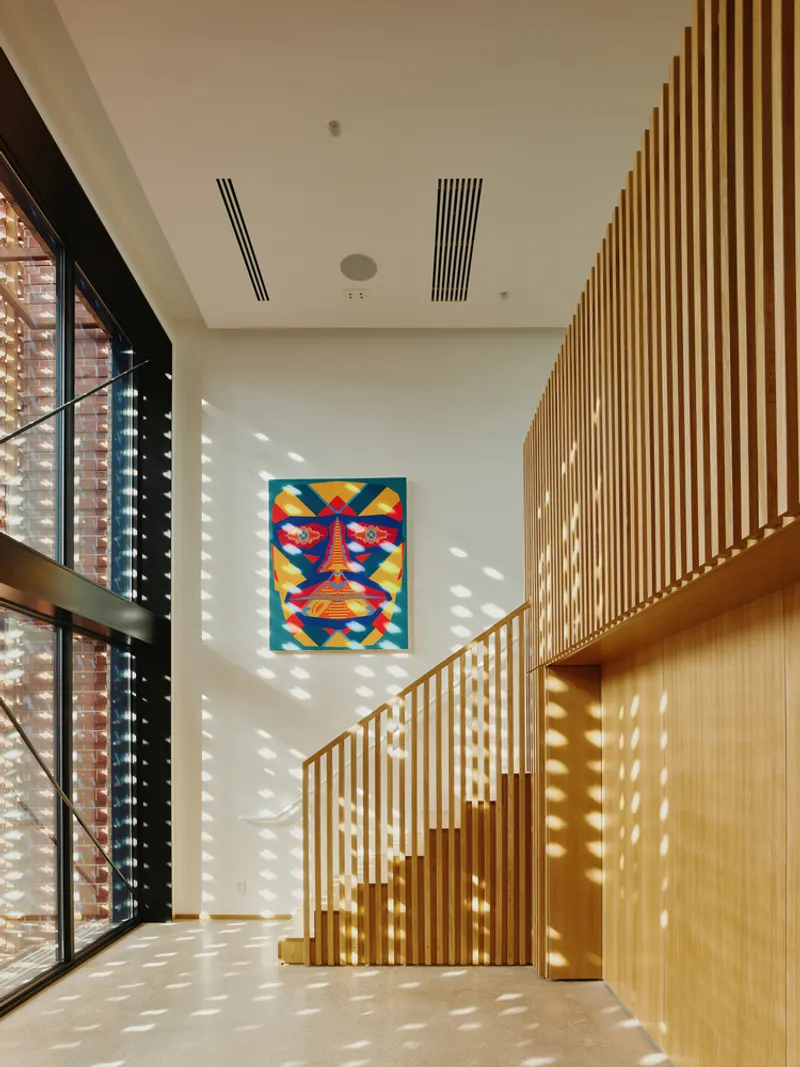
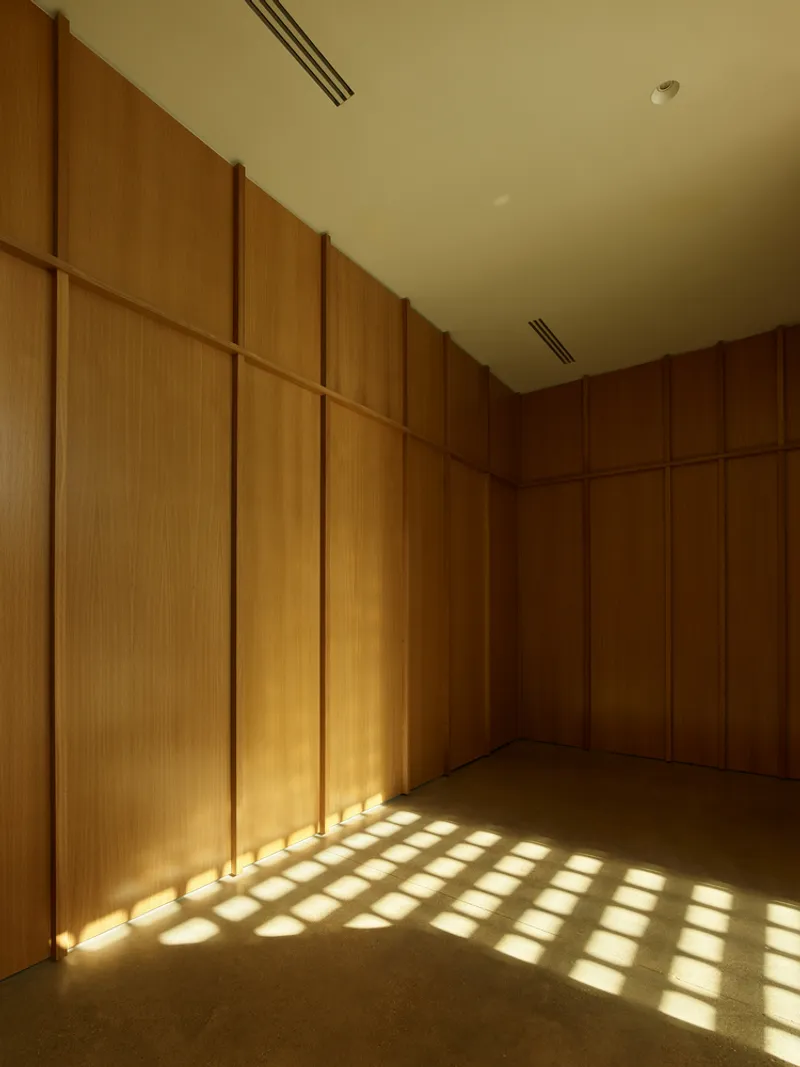
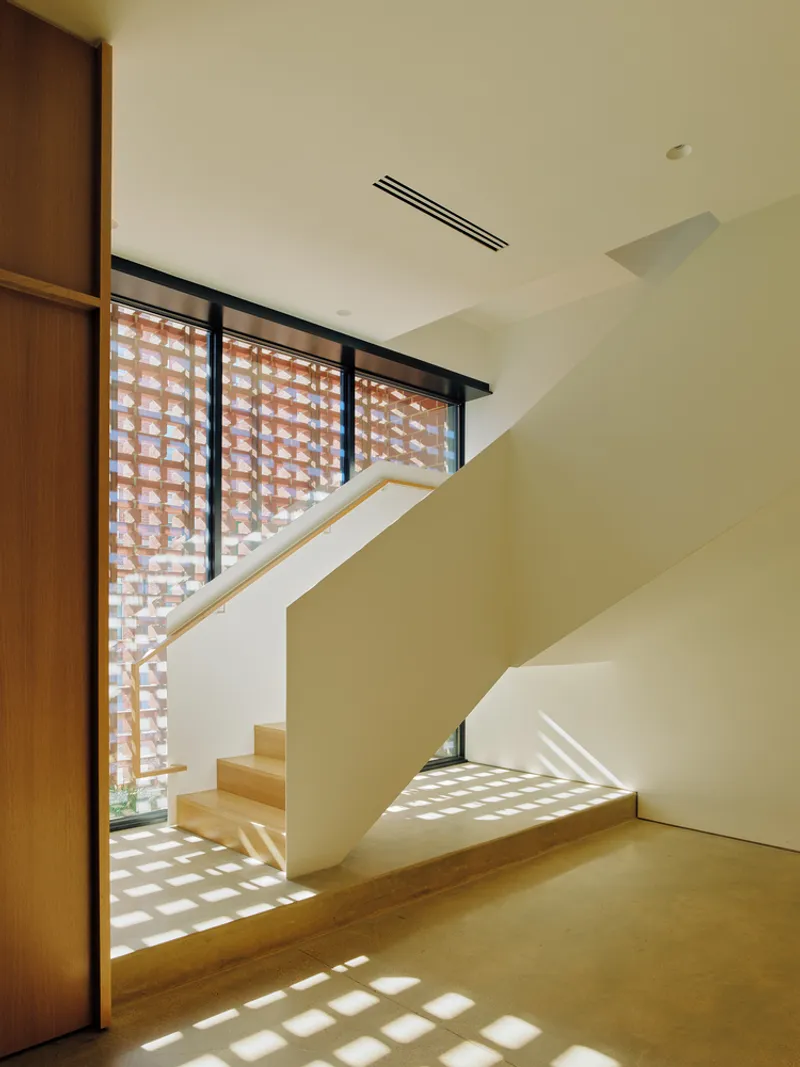
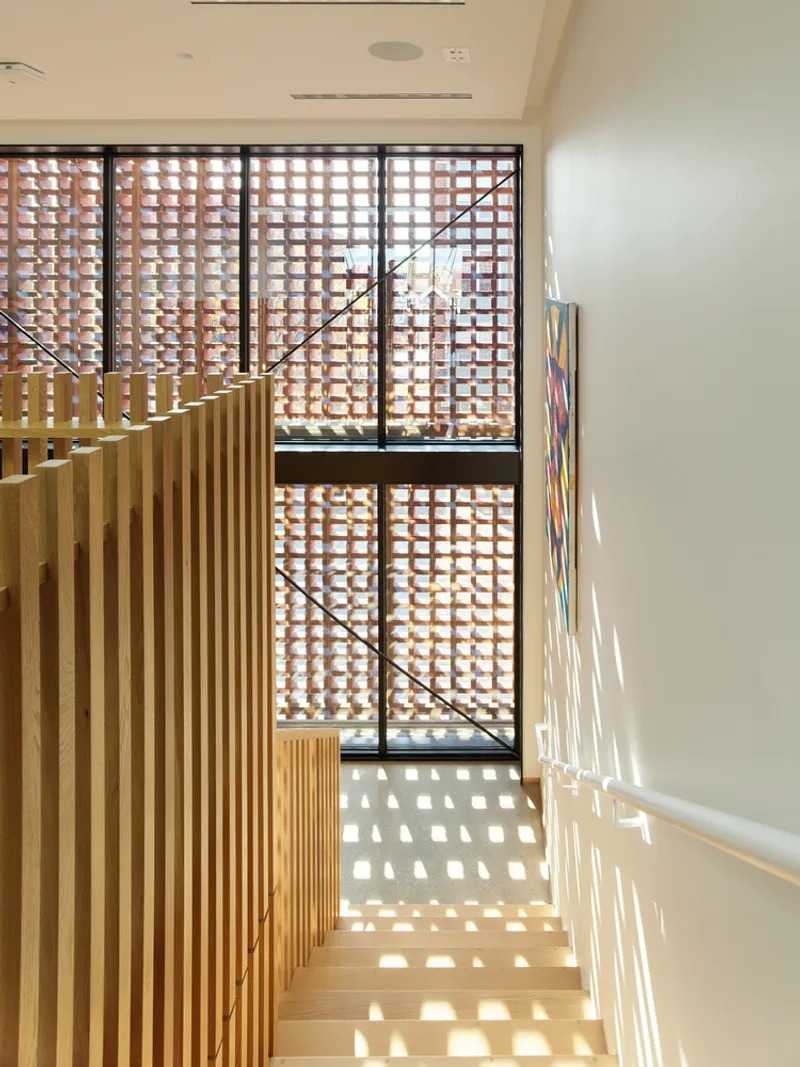
Inside, the perforated brick screen becomes something closer to a projector. As the sun moves, patterned shadows crawl across white oak surfaces and concrete floors, producing the kind of animated interior that architects sketch optimistically and rarely achieve at this resolution. The stairwell is the best demonstration: timber treads and a slat balustrade sit directly behind the screen, so ascending the stairs means walking through shifting bars of light that register the hour as vividly as any clock.
Wood-paneled rooms on the upper level receive this dappled light with warmth, the grain of the oak catching and releasing the pattern in a way that a white plaster wall never could. The choice to clad interior surfaces in natural timber wasn't decorative. It was calibrated to work with the screen's apertures, turning what could be a harsh striping effect into something ambient and textured.
Brick Meets Timber at the Detail Scale
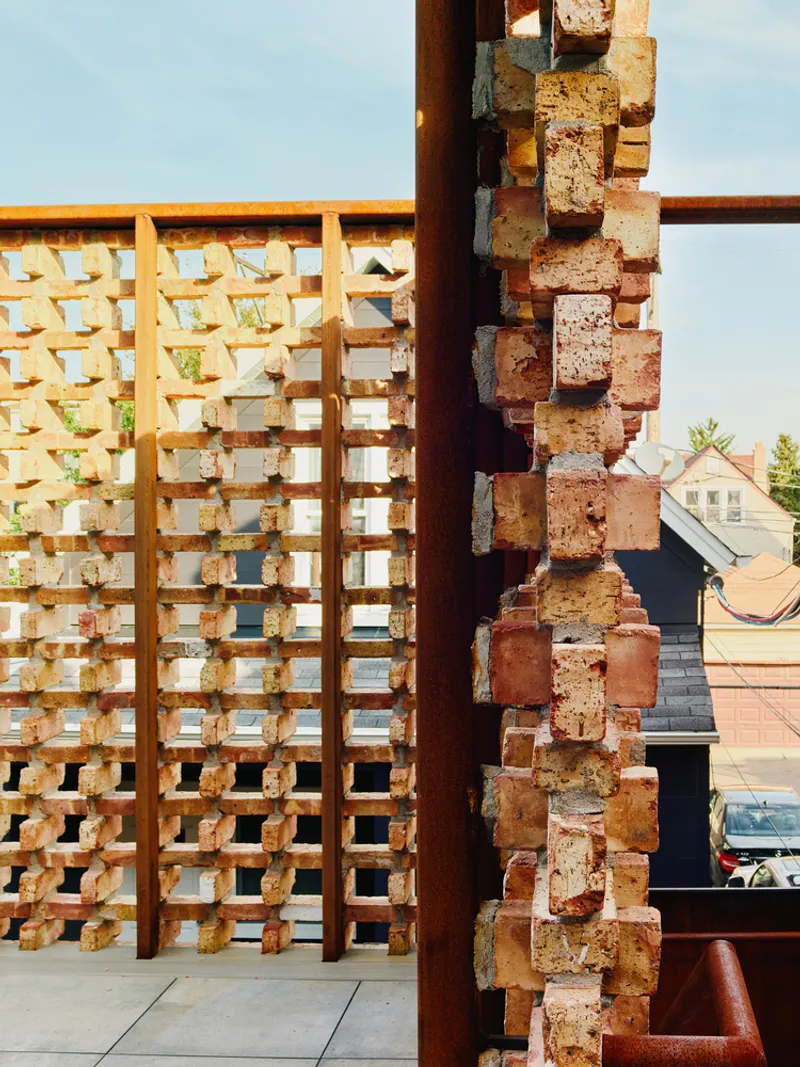
The meeting point between brick and wood is where the project's care shows most clearly. A close-up of the stacked brick column adjoining the timber lattice screen reveals clean, deliberate joints and a tonal warmth that makes the two materials feel like natural companions rather than forced contrasts. Weathering steel appears at connection points and structural frames, adding a third material that will patinate over time and further bind the building to its site.
Range had originally envisioned heavy timber roof framing, but budget reality steered the team toward parallel chord trusses. It's a pragmatic substitution that doesn't register as a compromise in the finished building, largely because the visible material story remains coherent: brick on the perimeter, white oak inside, steel at the transitions.
The Showroom Floor and Mezzanine
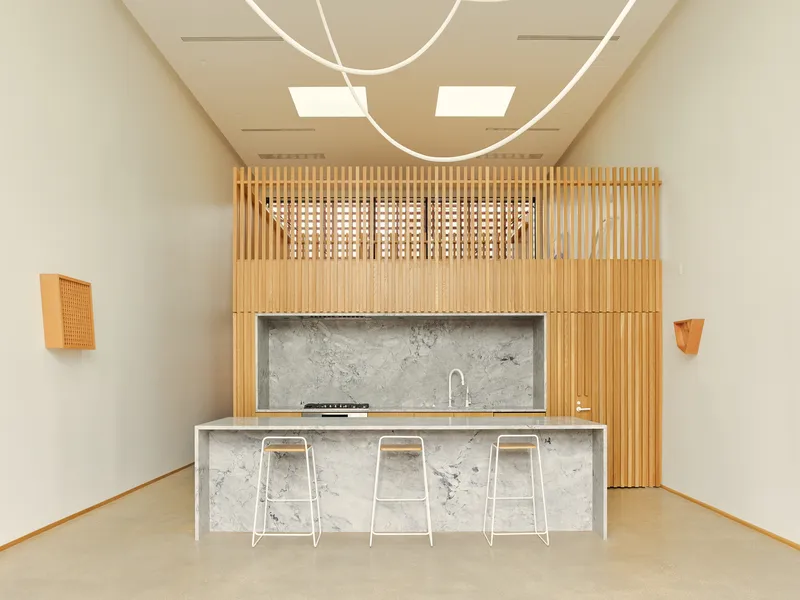
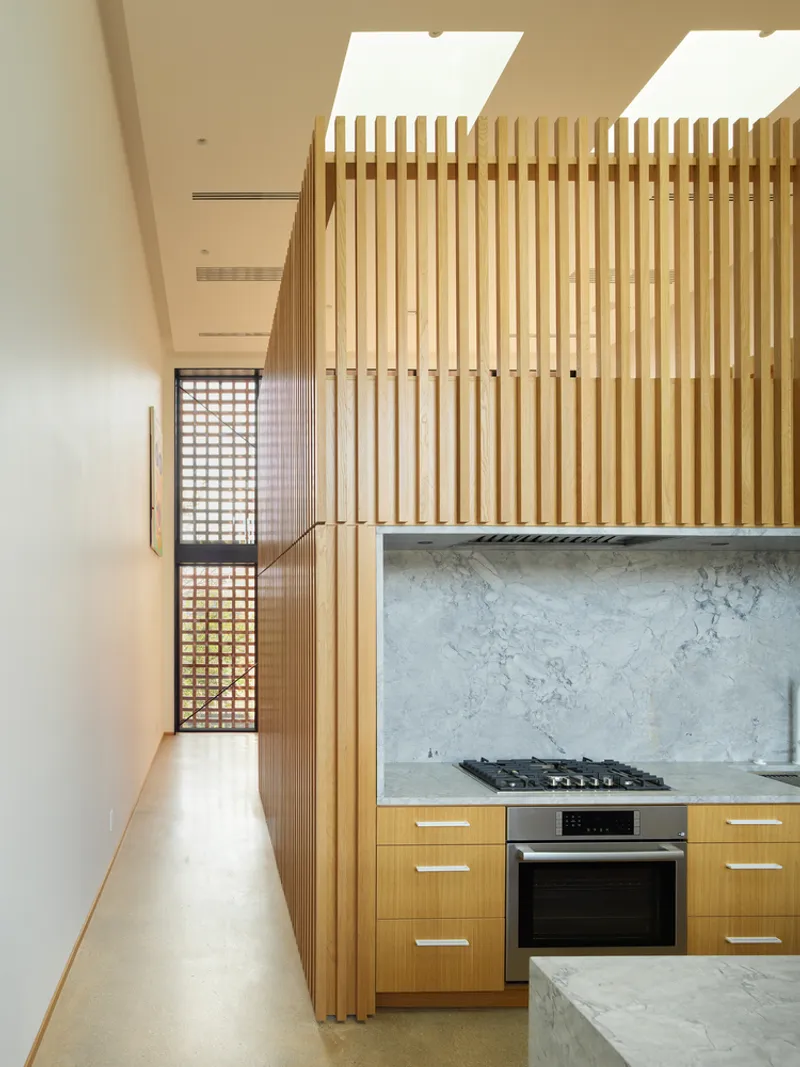
For a furniture company, the showroom has to function as both gallery and workplace, and the double-height main volume handles that duality well. A concrete-topped kitchen island anchored by three stools sits beneath a circular ceiling fixture, offering a grounded domestic register in what is otherwise a lofty, workshop-scaled room. Vertical wood slat screens subdivide without enclosing, and clerestory skylights, which vent passively through solar-powered mechanisms, wash the marble countertop in even, overhead light.
The mezzanine floats above this gathering space, providing elevated vantage points for viewing furniture prototypes and hosting events. The decision to go double-height rather than simply adding a conventional second floor gives the building sectional variety that its modest footprint wouldn't otherwise allow.
Rooftop and Outdoor Rooms
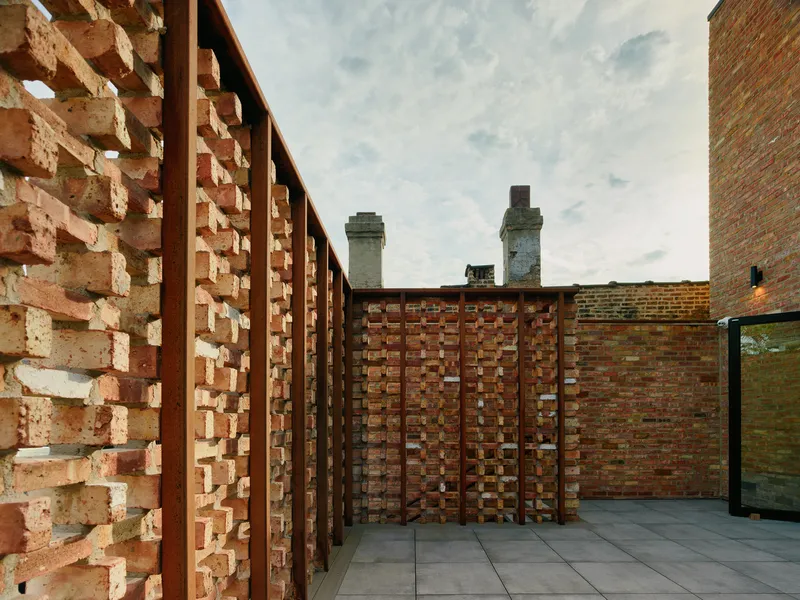
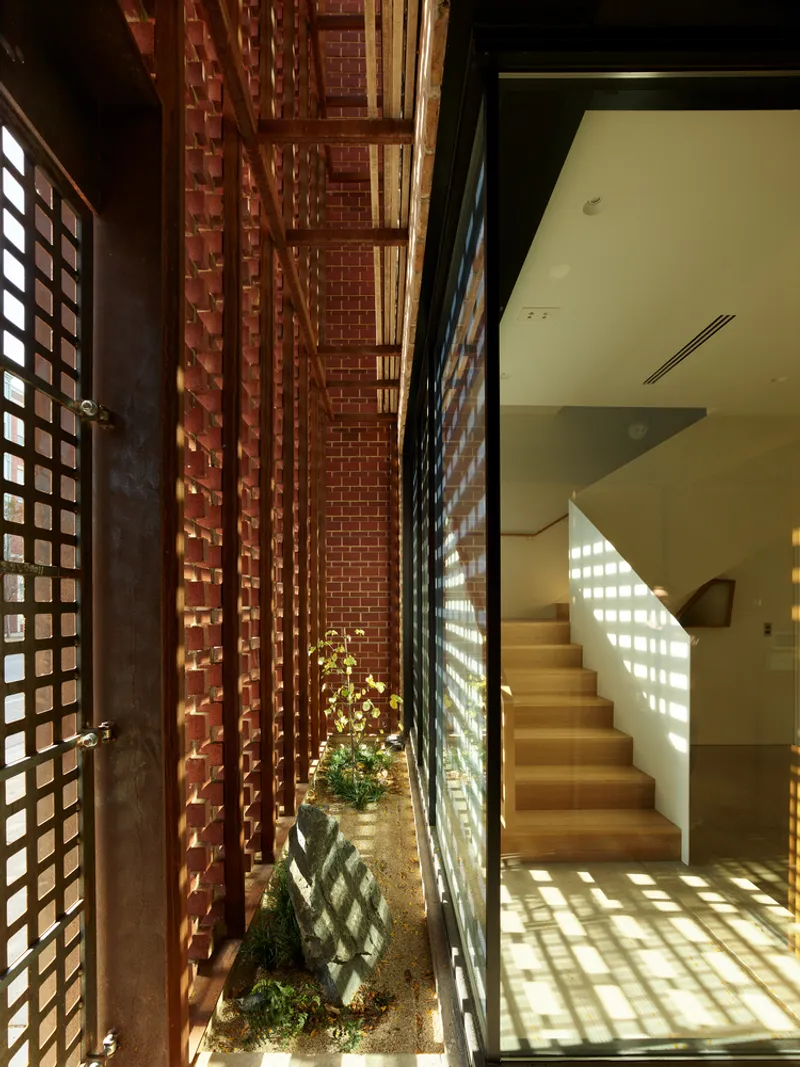
The rooftop terrace extends the brick screen upward as a parapet, framing views of the Logan Square skyline through the same perforated pattern that defines the street facade. Steel frames provide structural armature without closing off the sky, and the effect is that of standing inside the building's own ornament. On the yard-facing side, a second-floor patio opens through bi-folding glazed doors, collapsing the boundary between interior showroom and exterior gathering space.
At ground level, the narrow planting strip between the screen and the staircase captures direct sunlight and channels it into the building's lower zones. It's a tight, almost residual space, but the xeriscape plantings transform it into a miniature garden that softens the hard edges of the infill condition and supports a small pocket of urban habitat close to the adjacent linear park.
Why This Project Matters
Most adaptive-reuse projects in Chicago acknowledge brick by keeping a few exposed walls and calling it context. Range Design & Architecture went further. By using reclaimed common brick structurally, deploying new paver brick as a performative screen, and insulating the envelope to contemporary standards, the firm demonstrated that Chicago's masonry vernacular is not a nostalgic reference but an active, adaptable building system. The constraints of the narrow lot, the party-wall restrictions, and a tight budget didn't limit the design so much as sharpen it.
Nothing Design Co.'s headquarters is proof that a 3,500-square-foot building on a 3,125-square-foot lot can punch well above its weight class. It provides passive ventilation through solar-powered skylights, reduces cooling loads through a south-facing screen, and creates a sequence of interior and exterior rooms that feel generous despite the site's dimensions. For designers working on infill sites in legacy masonry cities, this is the benchmark: not a building that quotes tradition, but one that puts tradition back to work.
Nothing Design Co. Headquarters by Range Design & Architecture. Located at 3426 West Armitage, Logan Square, Chicago, Illinois. 3,500 square feet. Completed in 2024. Structural Engineer: Louis Shell Structures, Inc. Landscape Architect: Nathan Wright Landscape Design. General Contractor: Formed Space. Photography by James John Jetel.
About the Studio
Share Your Own Work on uni.xyz
If projects like this are the kind of work you want to make, uni.xyz is a place to publish your own, find collaborators, and enter design competitions.


Popular Articles
Popular articles from the community


FCC Arquitectura Expands a Portuguese Granite House with a Board-Marked Concrete Wing
In Portugal, JV House pairs a cleaned-up whitewashed and granite dwelling with a timber-shuttered concrete extension, courtyards and a garden pool.

ETEH Reworks the Shared Spaces of São Domingos School in Brazil Around Timber, Color and Hanging Plants
At São Domingos School in Brazil, 436 m² of hall, refectory and library are recast with timber joinery, a yellow and blue code and trailing greenery.

Cube Design Draws an Ecological Corridor Between Two Shenzhen Hills with the Nankai Building
Beside Shenzhen's container docks, the Nankai Building pairs stacked balconies with a climbing green screen to connect two hillsides across its height.


Manzana Morphosis: Stretching Barcelona's Grid into a Living Landscape for 2050
A radical reworking of the Eixample manzana turns density into a tool for generous public space, vertical ecology, and environmental performance.

Similar Reads
You might also enjoy these articles


Hodi-Mandai Geram
Project Function: Preservation and revitalization of the Intangible heritage and socio-spatial identity of the Hodi by Housing, Cultural Memory Center, Sacred Grove, landscape, local tourism economy


Olio Towers: A Mid-Rise for Performers That Fuses Housing, Rehearsal, and Stage
Located blocks from Houston's Theater District, this modular tower stacks living units around a central performance atrium.

Oasis: Modular Green Housing Carved into Dhaka's Urban Fabric
A shortlisted Plugin Housing entry reclaims unauthorized settlements in Dhaka with stepped concrete volumes, green roofs, and ventilation-driven design.

Black Hole: A Floating Megastructure for the Post-Physical Era
Emiliano Mazzarotto envisions a spherical, self-scaling arena where e-sports, digital hotels, and holographic stadiums replace traditional public space.

Explore Exposed Brick Competitions
Discover active competitions in this discipline

Challenge to reimagine the Iron Throne

Photograph architecture without architects

Illustrate the lost glory of Angkor Wat - Render Challenge

Design challenge to reuse E-waste
Comments (0)
Please login or sign up to add comments
No comments yet. Be the first to comment!