

OMCM arquitectos Builds a Summer House in Paraguay from Quarry Waste Blocks and Three Sacred Trees
In the young hillside neighborhood of Altos, a 696-square-meter concrete volume hovers on six pillars around three preserved native Yvyraju trees.


The name tells you what matters most. Yvyraju is the Paraguayan name for Albizia hassleri, a native tree species, and three of them stood at the center of this site in Altos before anything was designed. OMCM arquitectos, led by Matias Ortiz and Maria Paz Chamorro, made the decision not to clear them but to organize the entire house around their trunks. The result is a 696-square-meter summer residence that reads as a single lifted bar, 12 by 24 meters, hovering on six concrete pillars while a courtyard punched through its center lets the trees grow uninterrupted into a rooftop garden.
What makes the project worth studying goes beyond preservation sentimentality. The studio manufactured its own construction blocks on site, using residual stone from local quarries that would otherwise end up as waste. The walls are only five centimeters thick, incorporating air chambers for thermal mass. It is a genuine circular economy experiment dressed up as a family vacation house, and the roughness of the material is not apologized for but treated as the defining aesthetic.
A Lifted Volume on a Sloping Site


From the street, the house presents itself as a horizontal slab of concrete and stone, cantilevered at the edges and supported by pillars clad in the same quarry-waste blocks. The decision to elevate the main volume does two things simultaneously: it handles the site's natural slope without excessive earthwork, and it allows the ground plane to remain open, letting lawn and vegetation flow beneath the structure. The approach recalls a Corbusian pilotis strategy, but the materiality is unmistakably Paraguayan. There is nothing white or sleek about it.
The street-facing facade is deliberately closed, a response to a developing neighborhood where privacy is needed but complete introversion would be oppressive. Timber louvers and deep-set openings punctuate the stone surface, giving the house a defensive posture from the public side while the interior opens aggressively toward the courtyard and garden.
The Courtyard as Cloister


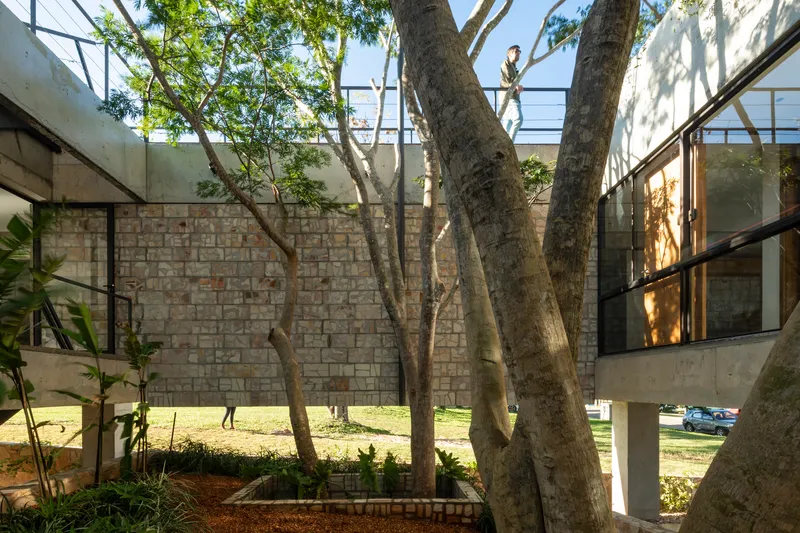
The central void is the spatial engine of the house. Three Yvyraju trees rise from stone-lined beds through the open center, their white bark catching sunlight and reflecting it back into the surrounding glazed corridors. Steel and glass bridges span the gap at the upper level, connecting social spaces on one side to bedrooms on the other. The arrangement borrows from the cloister typology: a covered walk surrounds an open garden, and every room in the house draws its light and air from this single source.
What elevates this beyond a standard courtyard plan is the vertical continuity. The trees don't stop at the roof. They grow up through the rooftop terrace, making the fifth facade as green and inhabited as the ground level. It collapses the hierarchy between roof, garden, and interior in a way that feels both effortless and carefully calculated.
Circulation Through Stone and Light


Moving through the house means moving through changes of material and light intensity. A stone staircase descends through the courtyard under a steel and glass pergola, dappled shadows shifting across the treads as the trees filter direct sun. Inside, an open steel stair rises between stone walls with the courtyard always visible below. The corridors at the upper level are fully glazed on the courtyard side, with concrete soffits overhead and leaf-shadow playing across the floor.
The effect is processional without being grand. There is no monumental entrance or double-height foyer. Instead, the house uses its split levels and the slope of the terrain to create a continuous sequence of compressions and releases. You descend into the garden, ascend past the trees, and arrive on the roof with a view back down through the canopy.
Interiors of Concrete, Stone, and Timber


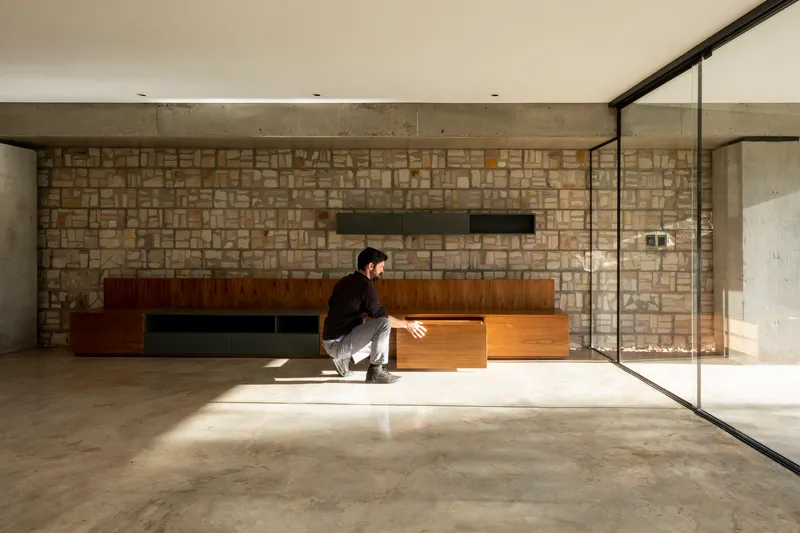
Inside, the palette stays honest: exposed concrete ceilings, quarry-stone block walls, timber door panels, and black steel framing. The kitchen features a stone wall with a small deep-set window and a wooden range hood, a detail that feels more domestic workshop than luxury summer house. The living spaces open fully to the garden through floor-to-ceiling glass, collapsing the boundary between inside and out.
The five-centimeter wall thickness is remarkable for a masonry construction. OMCM arquitectos achieved this by building air chambers into the block assembly, which serve double duty as insulation. The resulting surfaces have an unfinished, almost brutalist quality, but the warmth of the stone color keeps the interiors from feeling cold. Light enters in controlled doses: through the courtyard, through narrow window slots, through glazed bridges overhead.
Pool, Terrace, and the Fifth Facade
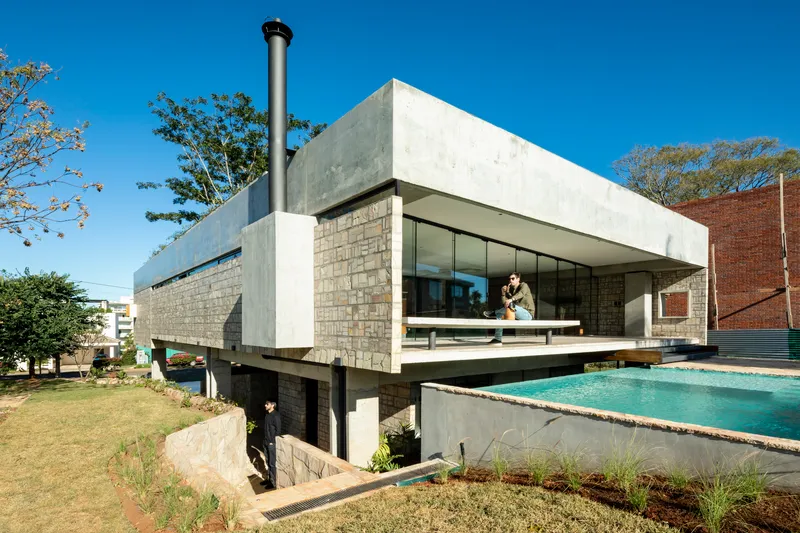


The program is, after all, a summer house, and the outdoor spaces earn their weight. A rectangular pool sits on the garden side, shaded by a white steel pergola and framed by the cantilevered volume above. The covered terrace with limestone pavers provides a generous outdoor living room, its proportions generous enough for the kind of extended family gatherings the brief called for.
From the garden, the house reads as a series of horizontal layers: stone base, concrete slab, timber louvers, planted roof. The flowering shrubs and palms in the foreground soften what is otherwise a very muscular composition. The tension between the heavy materiality and the lightness of the lift is the building's most compelling formal quality.
Rooftop Garden and Solar Infrastructure


The roof is not an afterthought. Timber decking, steel railings, planted beds, and skylight openings around the tree trunks make it a fully inhabited level. The aerial views reveal the extent of the operation: solar panels occupy a substantial grid on one portion of the roof while garden beds and timber terraces fill the rest. The trees that justified the courtyard void now provide canopy shade for the rooftop, completing a cycle that began with refusing to cut them down.
The integration of photovoltaic panels alongside productive garden beds on the same roof is a practical statement about what sustainability looks like in a subtropical Paraguayan context. It is not a showcase technology; it is simply part of the house's metabolic system, alongside the air-chamber walls and the site-manufactured blocks.
Plans and Drawings
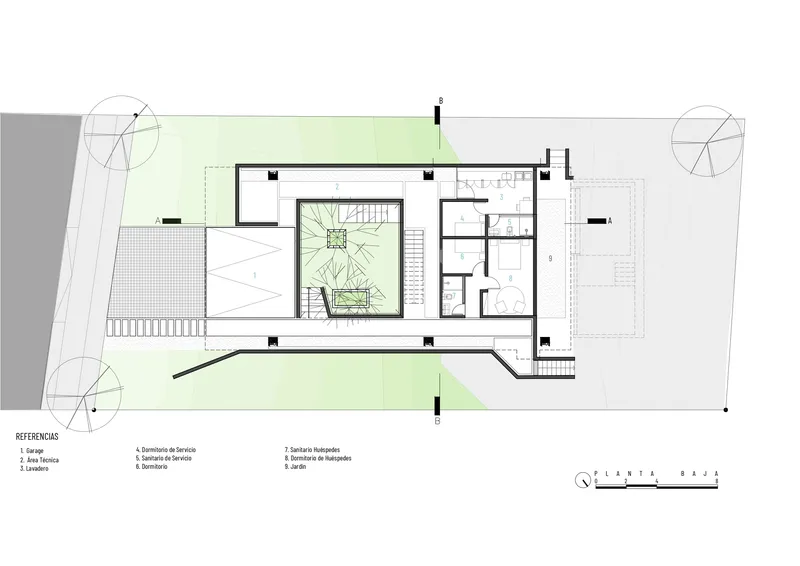


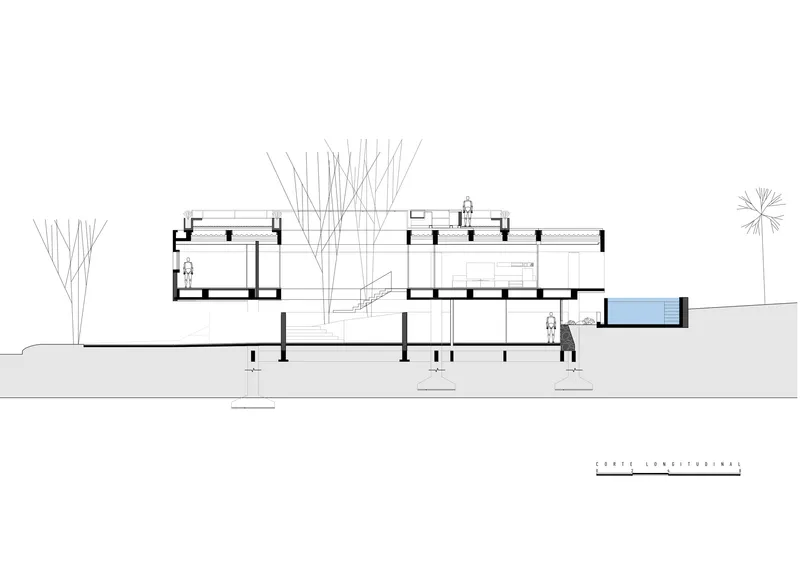



The floor plans confirm the clarity of the parti: a rectangular bar with a courtyard subtracted from its center, social spaces on one side, private rooms on the other, and the pool terrace extending the footprint to the east. The longitudinal section reveals how the split levels negotiate the sloping terrain, with the elevated volume creating a covered ground-floor zone for services and guest quarters. The transverse section shows the two-story volume floating on its columns, the tree canopy rising above the roof line.
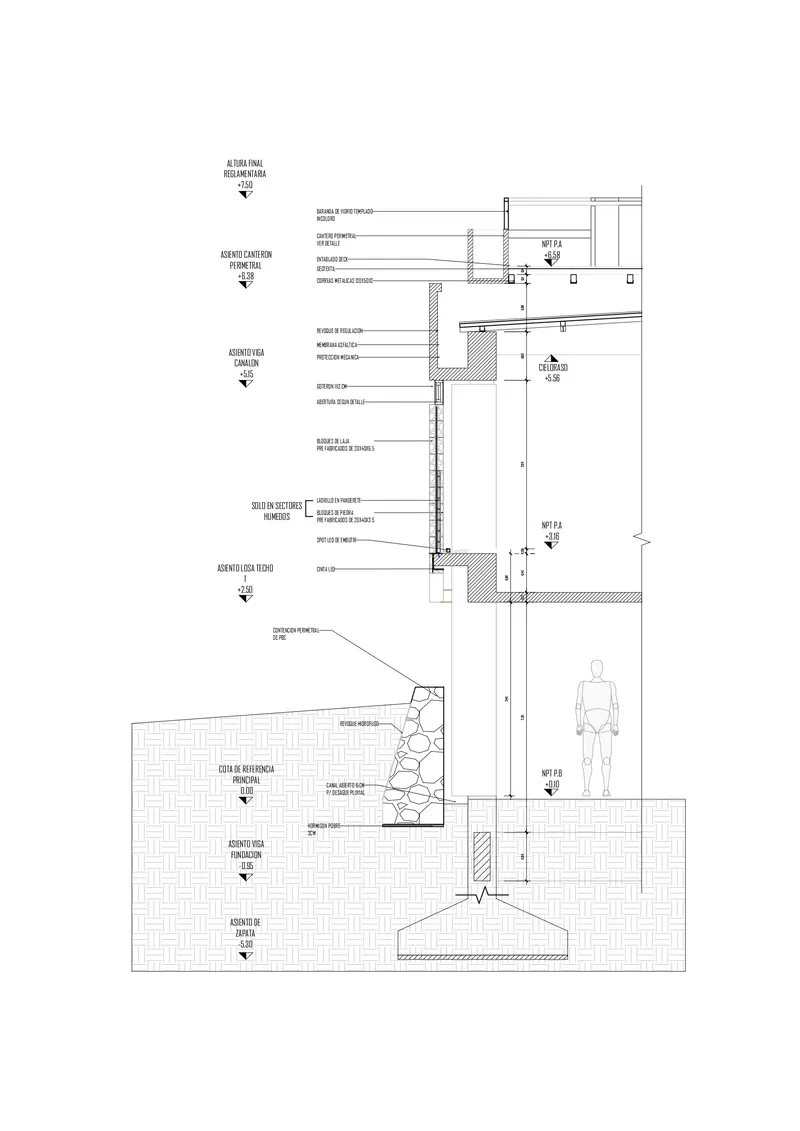
Particularly telling is the construction detail drawing, which lays bare the foundation, column base, floor slab assembly, and paving system. This is where the five-centimeter wall and air-chamber technology become legible, and where the project's ambition as a constructive laboratory is most evident. The physical model, photographed against a black background, strips the house down to its essential proposition: a horizontal volume on pilotis with three trees punching through.
Why This Project Matters
Yvyraju House treats a summer residence as a testing ground for ideas that matter well beyond its program. Manufacturing construction blocks from quarry waste on the building site itself is not a symbolic gesture; it is a replicable technique that competes with conventional market materials on cost. The five-centimeter wall with integrated air chambers challenges assumptions about what masonry can do in a subtropical climate. And the refusal to remove three native trees, turning them instead into the organizational principle of the entire plan, demonstrates a design methodology that starts with what is already there rather than with a blank slate.
OMCM arquitectos have described the house as a laboratory, and the word fits. Laboratories are not pristine; they are places where things are tried, where imperfection is accepted, where results matter more than polish. The rough texture of the blocks, the visible steel bracing, the exposed construction logic: all of this reads as confidence rather than carelessness. In a region where contemporary architecture too often defaults to imported finishes and global aesthetics, this house argues persuasively for a different path, one grounded in local materials, local trees, and local intelligence.
Yvyraju House by OMCM arquitectos (Matias Ortiz and Maria Paz Chamorro). Located in Altos, Cordillera, Paraguay. 696 m². Completed 2022. Photography by Leonardo Méndez.
About the Studio
Share Your Own Work on uni.xyz
If projects like this are the kind of work you want to make, uni.xyz is a place to publish your own, find collaborators, and enter design competitions.


Popular Articles
Popular articles from the community


graciastudio Turns a Viewless Tijuana Lot Inward Around a Courtyard of Concrete, Timber and Trees
In Tijuana, Jorge Gracia's GA2 House stacks a timber-clad private floor over exposed concrete and replaces a missing view with a planted interior patio.


Singing Woman: An Opera House That Performs Before the Curtain Rises
Ovidiu Cristian Pavel's conceptual opera house translates Estonia's choral identity into a sculpted waterfront landmark facing the Baltic Sea.

Manzana Morphosis: Stretching Barcelona's Grid into a Living Landscape for 2050
A radical reworking of the Eixample manzana turns density into a tool for generous public space, vertical ecology, and environmental performance.

David Ortega Stacks a Two-Story Mexico City Penthouse Around a Steel Stair and a Pergola-Shaded Roof Terrace
In Colonia Roma, a 300 m² penthouse uses oak joinery, a planted steel stair and a slatted roof pergola to make a new-build apartment feel like a house.

Similar Reads
You might also enjoy these articles

LAVA Architecten Gives Vocational Education a Sawtooth-Roofed Face on a Mechelen School Campus
In Mechelen, Belgium, a 2,053 m² STEM school on a 6×6 m grid turns workshops and classrooms into rooms that can be rearranged as teaching changes.

KEMA Studio Turns a Derelict Marvila Attic into a 60 m² Lighthouse Apartment Above Lisbon
In Lisbon's Marvila district, a rebuilt roof, four skylights and two plywood volumes turn an unlivable attic into a bright home facing the Tagus.

Pixel Gardens: One Repeated Module Stacked Into a Terraced Social Housing Tower for Famagusta
Salem Bader's shortlisted housing tower builds a vertical neighbourhood from one repeated module, offsetting units to carve terraces, light and air.

Bao Huynh Watercolor Atelier: A Serene Art Retreat in Hội An
Bao Huynh Watercolor Atelier in Hội An blends multifunctional art spaces, sustainable design, local materials, and family-friendly living in a serene environment.

Explore Residential Building Competitions
Discover active competitions in this discipline

Comments (0)
Please login or sign up to add comments
No comments yet. Be the first to comment!