

Pangolin Can Help Mining: Biomimicry Architecture for an Asteroid Mining Habitat
Pangolin Can Help Mining explores biomimicry architecture through a modular 3D-printed habitat designed for asteroid mining and future life.


As humanity looks beyond Earth for resources, research, and long-term settlement, architecture is increasingly being asked to operate in environments far removed from conventional terrestrial conditions. Pangolin Can Help Mining (Leap)explores this emerging territory through biomimicry architecture, proposing a spacecraft and modular habitat system specifically designed to support asteroid mining, mineral extraction, scientific research, and human habitation.
The project, by Misak Terzibasiyan and AMIR FEIZINEZHADGHESHLAGHI, was recognized as a People's Choice Award entry of Leap.
Rather than treating the spacecraft, mining facility, and human habitat as independent components, the proposal combines them into an integrated architectural system. The spacecraft becomes more than transportation. It functions as a space station, an industrial platform, a construction mechanism, and the operational core from which a larger extraterrestrial settlement can gradually develop.
At the heart of the proposal is an unusual biological reference: the pangolin. Through the principles of biomimicry architecture, the project studies the animal's body, movement, protective geometry, and hunting behavior to generate a new architectural language for life and industry in space.

Biomimicry Architecture Inspired by the Pangolin
Biomimicry offers designers a method of translating biological strategies into architectural and technological solutions. Instead of simply reproducing the appearance of an organism, biomimicry architecture investigates how natural systems perform, adapt, protect themselves, move, and respond to environmental pressures.
For Pangolin Can Help Mining, the pangolin becomes both a formal and functional reference.
The designers connect the act of asteroid mining with the animal's behavior when searching for and pulling out its prey. This action is translated into a spacecraft conceived to approach extraterrestrial bodies, extract valuable material, process resources, and support the transfer of those materials.
The visual language of the spacecraft is also derived from the pangolin's body. Its elongated geometry, segmented character, protective surfaces, and transition between curved and more streamlined forms influence the development of the vessel.
The result is not a literal representation of an animal. Instead, the biological reference becomes a generative design tool.
This approach allows biomimicry architecture to establish a conceptual bridge between architecture, aerospace engineering, manufacturing, and future resource extraction.
Bridging Architecture and Space Technology
One of the project's central ambitions is to narrow the perceived gap between architectural design and technology.
In conventional practice, spacecraft design is typically treated as a specialized engineering discipline. Pangolin Can Help Mining proposes a different relationship. The spacecraft is considered an architectural environment capable of supporting living, working, manufacturing, research, and industrial activity.
This shift becomes particularly important when considering long-duration missions.
Future asteroid mining operations would require more than machines capable of collecting minerals. Crews may need accommodation, food production, exercise facilities, research spaces, maintenance areas, communication systems, energy infrastructure, and environments capable of supporting physical and psychological well-being.
The proposal therefore treats space architecture as a complete ecosystem rather than a single enclosed capsule.
Its diagrams reveal an interconnected network in which extraction, processing, habitation, production, research, recreation, agriculture, communication, and power generation operate as components of one expandable system.
A Spacecraft That Becomes a Space Station
A defining feature of Pangolin Can Help Mining is the multifunctional role assigned to the spacecraft.
Instead of arriving at an asteroid and remaining only as a transportation vehicle, the spacecraft becomes part of the permanent infrastructure of the mission. It can operate as the central structure of a future space station while simultaneously supporting asteroid mining.
Minerals and other extracted materials are intended to be tested and transferred through the system. Some resources could eventually contribute to continued development while valuable materials could be transported back toward Earth.
This makes the spacecraft both an operational machine and a spatial framework.
The drawings indicate protected internal zones, storage areas, engines, habitation components, and shielding systems designed to respond to the extreme environmental conditions associated with space travel.
Radiation protection is particularly significant in this context. The spacecraft diagrams show shielding as part of the structural strategy, acknowledging that architecture beyond Earth must respond to environmental threats rarely encountered in terrestrial design.
Modular Space Habitat Architecture
The habitat system extends the project's emphasis on adaptability.
Instead of designing one large, fixed structure, the designers propose interconnected modules capable of changing configuration as the settlement develops. Individual habitat units can operate independently or connect with neighboring modules to create larger networks.
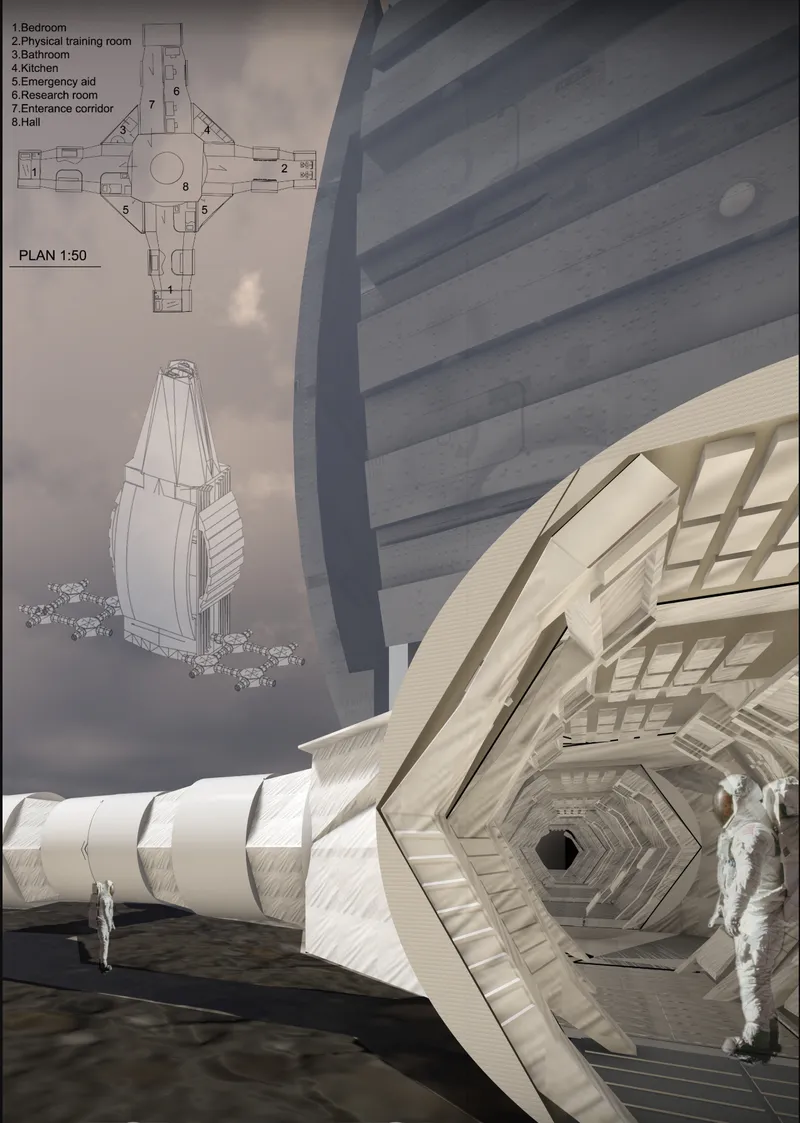
The basic habitat is developed from several cylindrical components organized around a polygonal central volume. The cylinders can expand from smaller units into larger interconnected spatial systems.
This geometry produces a distinctive radial configuration.
From the central core, multiple arms extend outward, creating spaces that can accommodate different programs. As additional modules are introduced, the architecture becomes increasingly networked.
The strategy suggests that extraterrestrial settlements do not necessarily need to arrive fully constructed. A smaller initial habitat could establish essential functions before gradually expanding according to population, mining activity, research requirements, or available resources.
This incremental approach is particularly relevant to space architecture, where transportation volume and payload weight remain critical constraints.
Origami Geometry and Deployable Construction
Alongside its biological inspiration, the habitat is influenced by origami principles.
The project investigates how folded and polygonal geometries can produce structures capable of changing scale and configuration. Cylindrical components are combined with faceted surfaces, allowing the habitat to balance compact transportation requirements with larger usable spaces after deployment.
The diagrams show the transition from basic geometric forms toward a more complex habitat assembly.
Circular and polygonal profiles are combined to establish modular sections that can be transported efficiently and assembled after landing.
This deployable logic is reinforced by the concept of portable and usable modes. Habitat components can be moved across the asteroid surface and repositioned when operational conditions change.
Mobility therefore becomes an architectural characteristic rather than merely a transportation feature.
3D Printing an Extraterrestrial Settlement
A major component of the project's long-term strategy is 3D-printed space architecture.
The initial habitat transported from Earth is envisioned as the foundation for subsequent construction. Once mining and resource extraction operations become established, additional modules could be produced through additive manufacturing technologies.
This approach reduces dependence on continuously transporting complete structures from Earth.
The proposal suggests that future colonization could use extracted materials alongside 3D printing to generate new spaces and infrastructure directly within the extraterrestrial environment.
Such a process would fundamentally change the relationship between architecture and material supply.
Instead of importing every structural component, the settlement could gradually transition toward local production. Asteroid mining would therefore support not only economic resource extraction but also the physical expansion of the habitat itself.
Architecture, mining, and manufacturing become interconnected.
Designing for Mineral Extraction and Processing
Mining remains the operational foundation of the proposal.
The habitat network is organized around mineral extraction and processing areas, allowing industrial activities to remain connected to residential and research functions while maintaining distinct programmatic zones.
The project diagrams present mineral extraction as a central element within a broader infrastructure.
Extracted resources would move through processing systems before being stored, analyzed, used for construction, or transported elsewhere.
This integration demonstrates how architecture for asteroid mining must address logistical systems in addition to human occupation.
Circulation routes, production areas, maintenance spaces, communication infrastructure, and power generation all become essential components of the architectural plan.
Rather than designing a habitat and placing industrial equipment beside it, Pangolin Can Help Mining attempts to design both as parts of the same spatial organism.
Living and Working Inside the Space Habitat
Human habitation is treated as a crucial element of the project.
The accommodation modules include bedrooms, bathrooms, kitchens, physical training spaces, research rooms, emergency facilities, entrance corridors, and communal halls.
These programs transform the project from a temporary expedition vehicle into an environment capable of supporting longer periods of occupation.
Physical exercise is especially important in extraterrestrial habitation because reduced gravity and prolonged confinement create additional physiological challenges for crews.
Research and training environments also indicate that the habitat is intended to function as an active scientific workplace.
The project's internal renderings reinforce this idea. Long polygonal corridors establish a highly technical interior language, while repeated structural ribs create rhythm and define circulation through the cylindrical modules.
The architecture feels simultaneously industrial, modular, and inhabited.
Creating a Self-Sufficient Space Habitat
Long-term extraterrestrial occupation depends on reducing dependence on supplies transported from Earth.
Pangolin Can Help Mining therefore expands its program beyond mining and accommodation to include energy generation and food production.
Aquaponic or aeroponic farming is incorporated into the proposed habitat network, suggesting a future in which plants could become part of the station's life-support and food-production infrastructure.
This introduces another dimension to the architecture.
The settlement is no longer exclusively a machine for extracting minerals. It begins to operate as a self-supporting environment capable of sustaining human life while producing resources, knowledge, energy, and potentially new architectural components.
The designers envision future expansion in which extracted water and minerals contribute to increasingly large-scale development.
Over time, the spacecraft could become the nucleus of a much broader inhabited system.
Communication, Research and Maintenance
An extraterrestrial mining colony would require continuous communication between crews, autonomous systems, orbiting infrastructure, and Earth.
Communication satellites therefore form part of the proposed network.
Research and training spaces allow scientific teams to study materials and environmental conditions while maintenance zones provide areas for repairing equipment and sustaining the operational infrastructure.
These supporting functions are fundamental to the architectural logic of the project.
They reveal that a future asteroid settlement cannot be understood only through spectacular exterior forms. Its viability depends on the careful integration of routine activities such as maintenance, storage, exercise, food production, technical research, and communication.
Pangolin Can Help Mining attempts to bring these systems together within a flexible architectural framework.
Architecture as an Expandable Extraterrestrial Network
Perhaps the most significant characteristic of the proposal is its capacity for growth.
The initial habitat acts as a seed.
Additional components can connect to this starting point, creating progressively larger formations across the asteroid surface. The radial modules can be repeated and linked, allowing specialized functions to emerge as the population and industrial requirements increase.
Such an approach replaces the idea of a single monumental building with that of an evolving network.
This is particularly appropriate for architecture in space, where uncertainty is unavoidable. Crew numbers may change. Mining areas may shift. Resource availability may fluctuate. Technological systems may require replacement or expansion.
A modular system can respond to these changing conditions more effectively than a rigid centralized structure.
The architecture consequently behaves almost like a living system, reinforcing the project's original interest in biomimicry.
Pangolin Can Help Mining and the Future of Biomimicry Architecture
Pangolin Can Help Mining demonstrates how biomimicry architecture can operate beyond the familiar context of sustainable buildings on Earth.
Here, nature becomes a reference for imagining architecture in one of the least natural environments accessible to humans.
The pangolin informs movement, geometry, protection, and extraction. Origami principles support deployability. Modular construction enables expansion. 3D printing introduces the possibility of local fabrication. Mining supplies resources, while farming, research, exercise, communication, maintenance, processing, and accommodation create the foundations for permanent occupation.
Together, these strategies propose an architecture that is not simply transported into space but capable of evolving there.
The spacecraft becomes a station. The station becomes a factory. The factory enables construction. Construction produces new habitats. Those habitats gradually form a settlement.
Through this interconnected vision, Pangolin Can Help Mining positions architecture as an active participant in future asteroid exploration rather than a secondary container for technological systems.
The project by Misak Terzibasiyan and AMIR FEIZINEZHADGHESHLAGHI, a People's Choice Award entry of Leap, ultimately proposes a provocative future for space architecture, one where biological intelligence, advanced fabrication, modularity, resource extraction, and human habitation converge to establish new forms of life beyond Earth.




Popular Articles
Popular articles from the community


The Musturak Paradise: Senior Living Architecture for a Connected Future in Temara, Morocco
The Musturak Paradise reimagines senior living architecture in Temara via private homes, social spaces, culture, community, and shared care.

The Ocean Hive: Sustainable Architecture for a Self-Sufficient Civilization at Sea
The Ocean Hive imagines sustainable architecture at sea, where modular habitats, algae, wave power and ocean waste sustain a growing colony.

The Earth Pod: 3D Printed Homes for Resilient Refugee Communities
The Earth Pod reimagines refugee housing through 3D printed homes made from clay, combining resilience, self-sufficiency, and rapid shelter.
AL-JANNAH: Sustainable Architecture and Permaculture for Afghan Widows
AL-JANNAH uses sustainable architecture and permaculture to create resilient oasis of housing, learning, work and renewal for Afghan widows.

Similar Reads
You might also enjoy these articles

Eco Chapel: A Green Architecture Pavilion Designed in Symbiosis with the Forest
Eco Chapel uses green architecture to weave prayer, learning and reuse into a forest pavilion shaped by modular hexagonal canopies for life.
Kaffeebühnen: Coffee Shop Architecture Designed as a Civic Stage Between Vienna’s City and Park
Kaffeebühnen turns coffee shop architecture into a civic stage, linking Vienna’s park edge, urban life, warm timber yards, and coffee craft.
Healing Façade: Sustainable Architecture for Reforestation, Community, and Sacred Ecology in Ethiopia
Healing Façade reimagines sustainable architecture as a living wall that restores soil, catches water and renews Ethiopia's forest churches.


Urban Forest: A Vertical Ecosystem for 5,000 Workers in Singapore's Changi Business Park
Radially stacked pods and layered green decks turn a 7-acre plot into 47 acres of ecological workspace projected for 2040.

Explore Architecture Competitions
Discover active competitions in this discipline



Challenge to reimagine the Iron Throne


Photograph architecture without architects


Illustrate the lost glory of Angkor Wat - Render Challenge


Design challenge to reuse E-waste
Comments (0)
Please login or sign up to add comments
No comments yet. Be the first to comment!