

Urban Forest: A Vertical Ecosystem for 5,000 Workers in Singapore's Changi Business Park
Radially stacked pods and layered green decks turn a 7-acre plot into 47 acres of ecological workspace projected for 2040.


What if a single office building could multiply its ecological footprint sevenfold? Urban Forest takes a 7-acre site in Singapore's Changi Business Park and, through vertical stacking of green decks, expands its functional landscape to the equivalent of 47 acres of human and ecological space. The result is not an office tower in the conventional sense but a living vertical ecosystem where 5,000 occupants work, sleep, exercise, and collaborate inside radially arranged pods interlocked with parks, amphitheaters, and renewable energy systems.
Designed by Suchi Tanna, Disha Mehta, Kanhai Gandhi, and Santosh Jadhav, Urban Forest received an Honorable Mention in the Breaking Work competition on uni.xyz. The project positions itself within a speculative 2040 timeline, where artificial intelligence, global networking, and personal well-being converge to demand workspaces that are radically more flexible and ecologically responsible than anything the current generation of glass towers can offer.
Work, Sleep, Play, Repeat: Programming for a Full Life Cycle
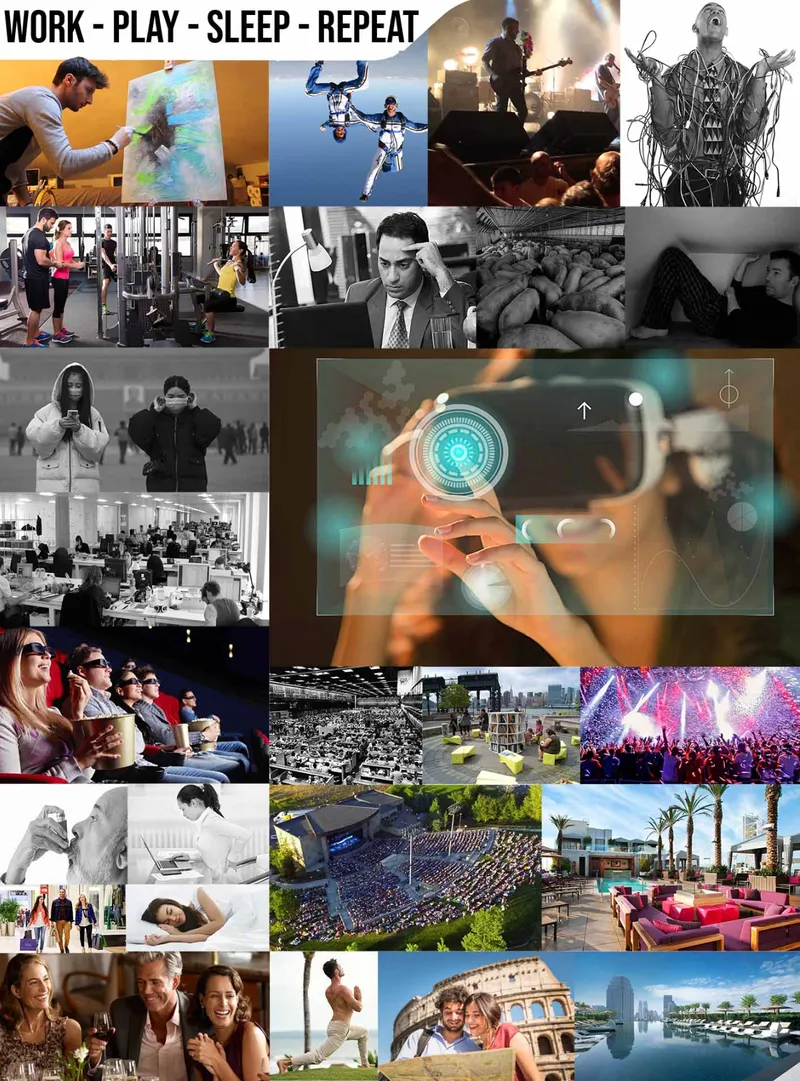
The collage above captures the designers' foundational premise: work is no longer a discrete activity bounded by a 9-to-5 schedule. Urban Forest is programmed around a continuous cycle of work, sleep, play, and social interaction, all housed within the same vertical structure. Each pod, measuring approximately 17.5 square meters, is designed to transform between work mode, sleep mode, and leisure mode, giving individual users agency over how they occupy space throughout the day. The ambition is to eliminate the commute entirely, replacing it with vertical circulation through green decks that double as parks, retail zones, healthcare facilities, and hospitality venues.
Radial Logic: How Pods Become Nests
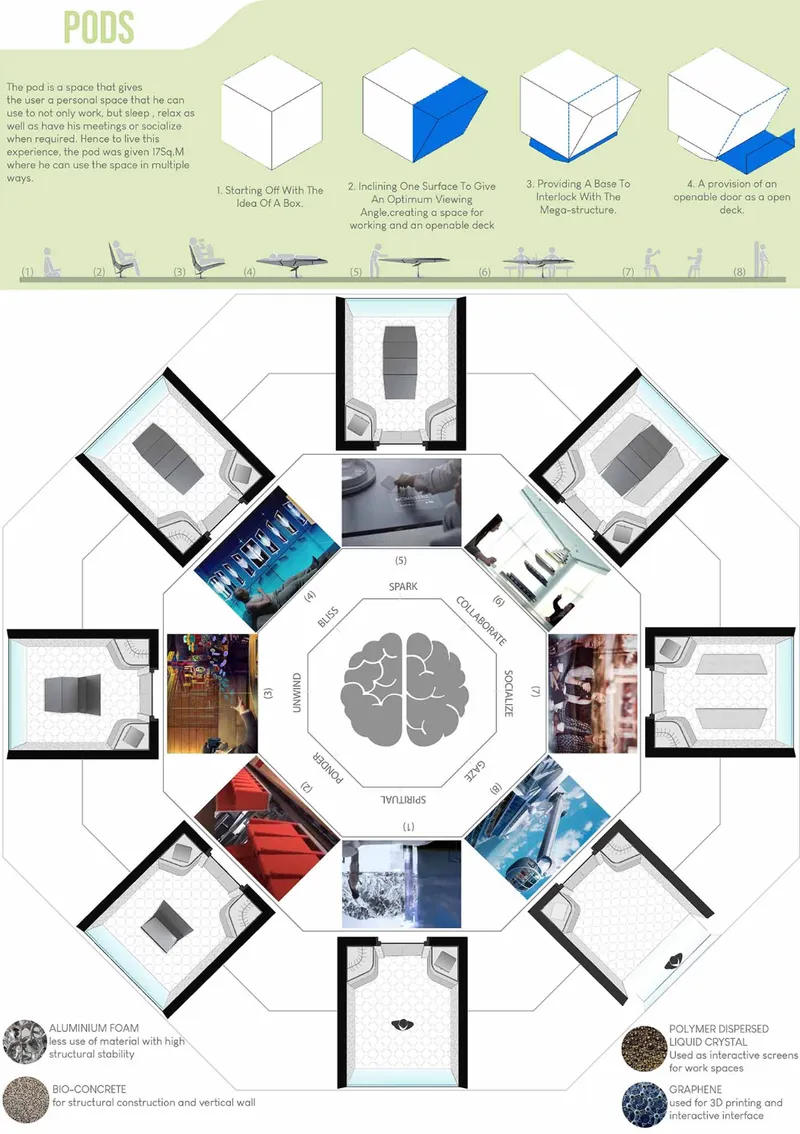
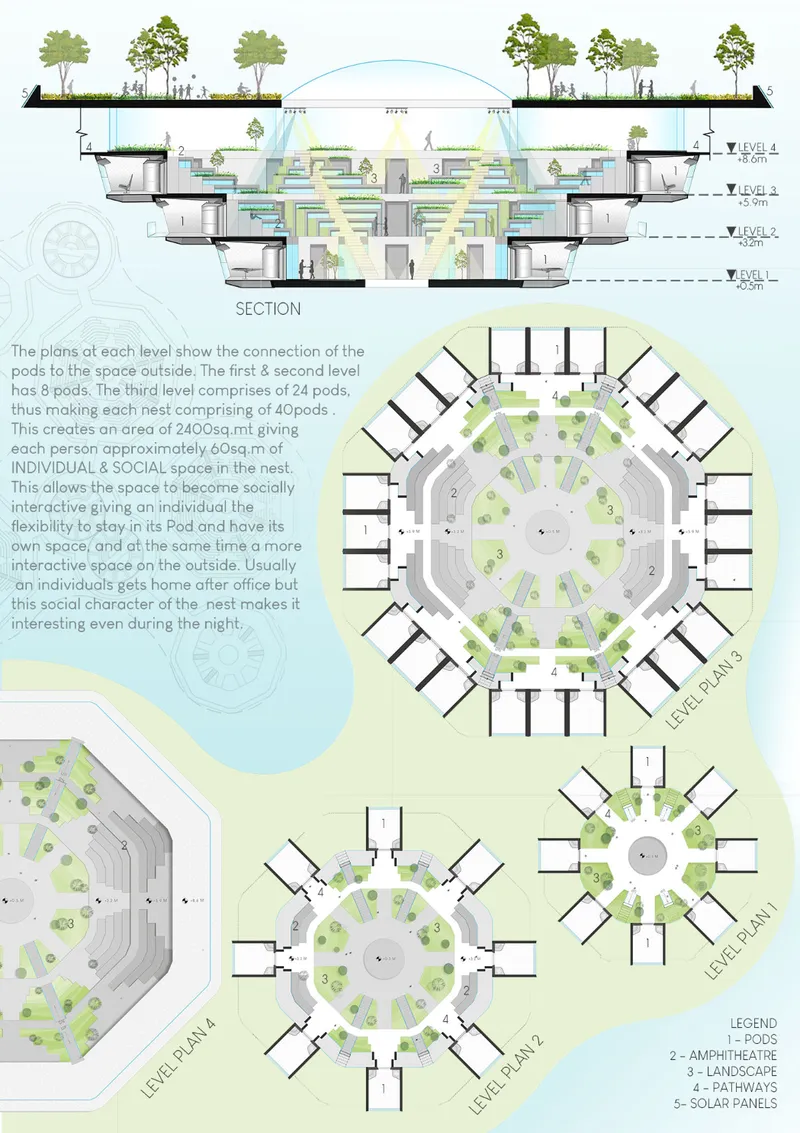
The floor plan reveals the project's organizing principle: a radial arrangement of pods around a central octagonal core. Individual pods interlock to form "nests," which are socially interactive clusters that encourage collaboration without sacrificing personal space. Material callouts on the plan highlight the use of bio-concrete, aluminum foam, and graphene, three materials chosen for their reduced environmental impact and structural performance. Bio-concrete offers self-healing properties, aluminum foam provides lightweight structural infill, and graphene delivers exceptional strength-to-weight ratios for the pod shells.
The section drawing and multi-level plans show how the building extends below grade, with underground spaces organized around a central atrium that pulls daylight deep into the lower levels. Surrounding vegetation is not decorative but structural to the building's environmental strategy, providing natural ventilation, biodiversity support, and micro-climatic cooling that aligns with Singapore's "City in a Garden" ethos.
From 7 Acres to 47: The Green Deck Strategy
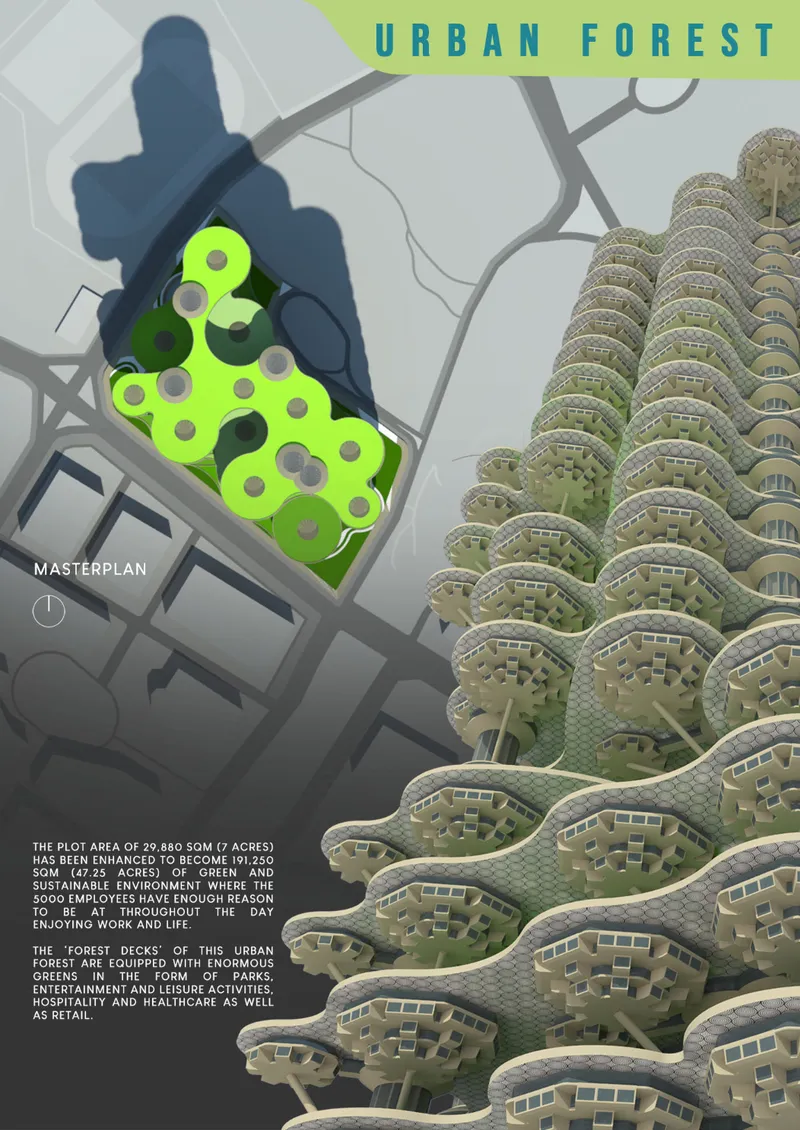
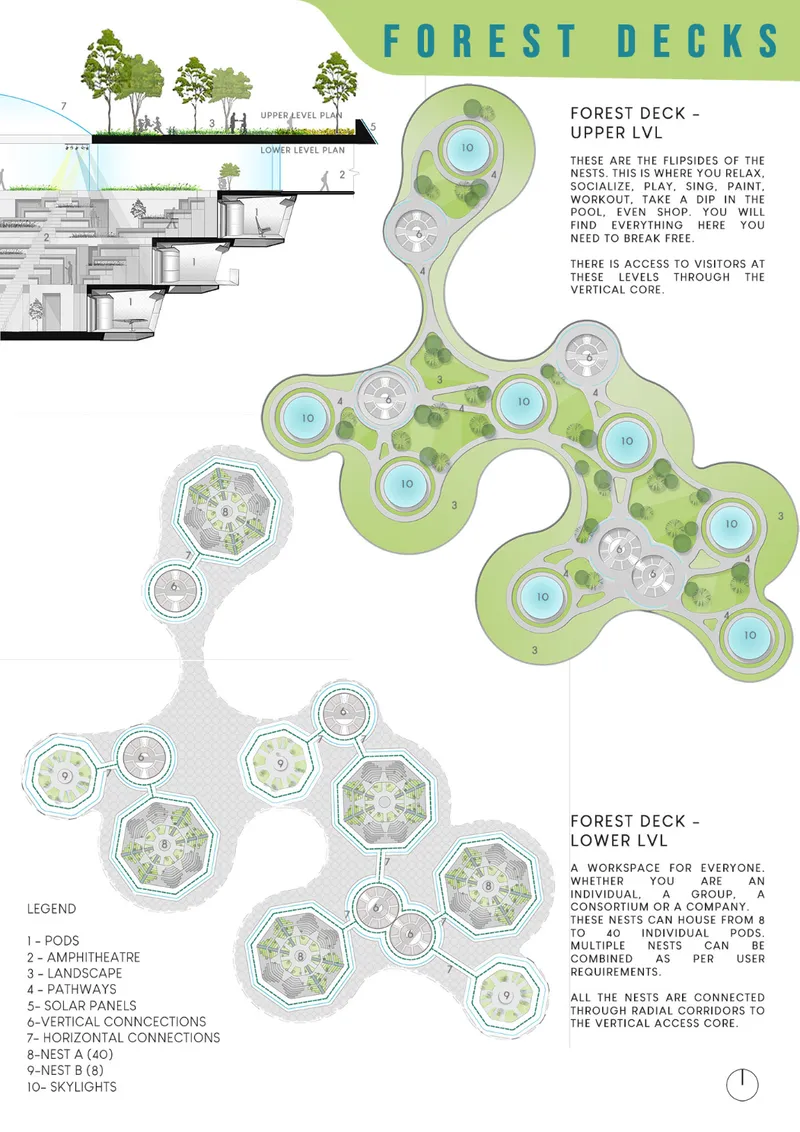
The masterplan rendering shows how the stacked circular units integrate greenery at every level, creating a continuous vertical landscape. The site diagram contextualizes the tower within Changi Business Park, revealing how the project's massing relates to adjacent infrastructure and transport networks. By layering green forest decks across multiple levels, the designers achieve their most striking claim: a 7-acre plot that functions like 47 acres of ecological and human-centric space. Each deck houses a different programmatic mix, from retail and entertainment to healthcare and hospitality, so residents and workers rarely need to leave the building's ecosystem.
The upper and lower forest deck plans detail the spatial organization of these green platforms. Circular pool clusters serve as both water management features and recreational amenities, connected by pathways that promote physical mobility. Solar panels are integrated throughout the deck surfaces, generating renewable energy for the building. Amphitheaters carved into the green decks provide spaces for community gathering and collaborative events, reinforcing the project's commitment to social sustainability alongside its ecological ambitions.
Structural Expression: Bracing Meets Organic Form
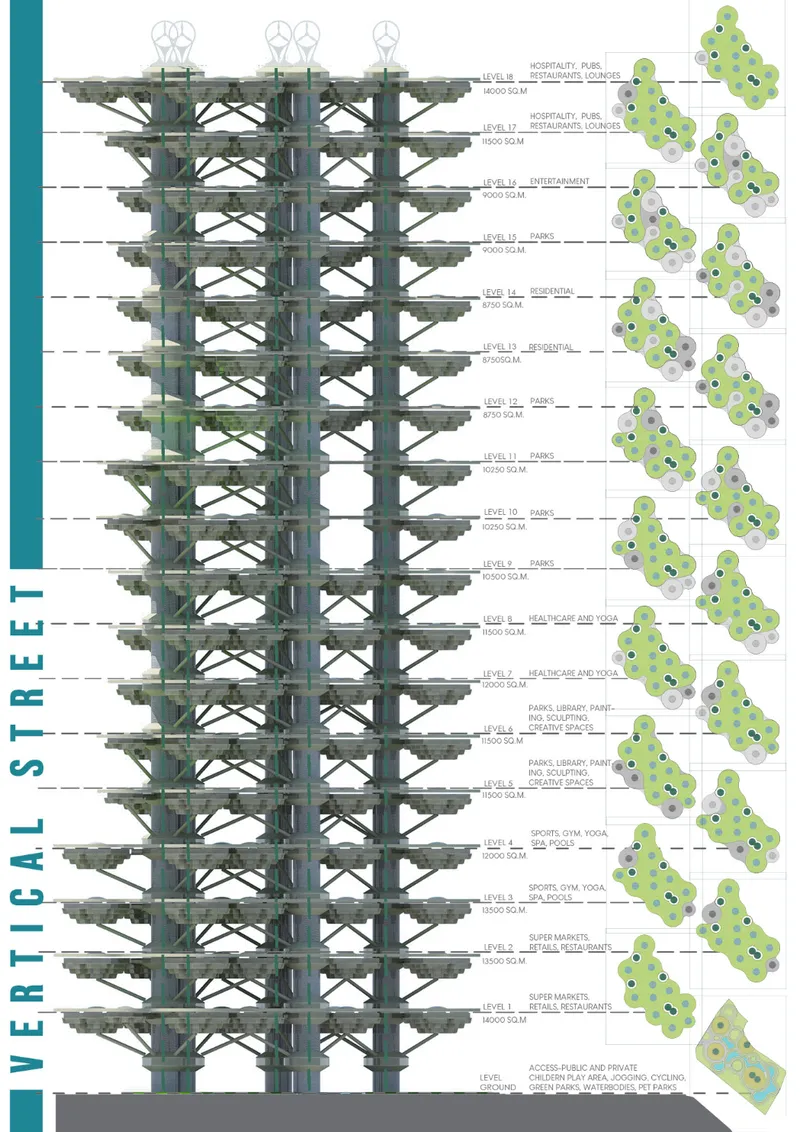
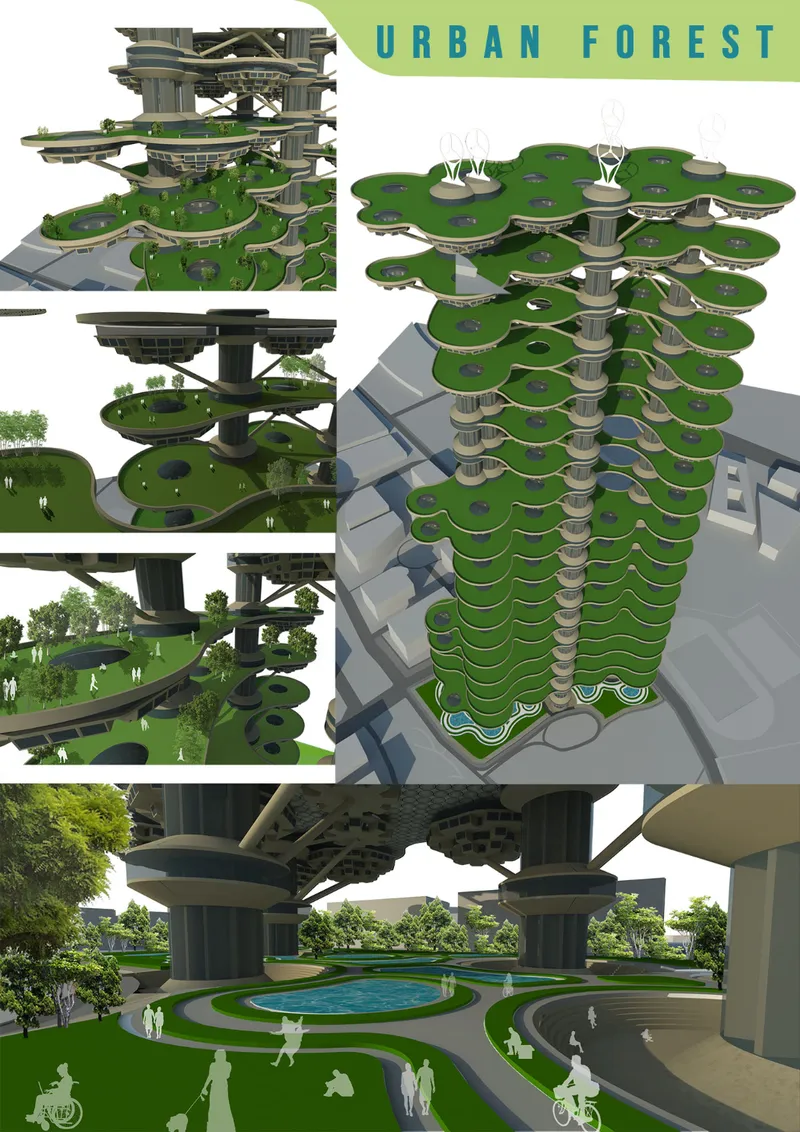
The sectional drawing exposes the structural logic holding this ambitious vision together. Exposed bracing frames the organic pod modules on each level, creating a visual dialogue between engineered precision and biomorphic form. The pods attach to the primary structure like fruit on a branch, a fitting metaphor for a project called Urban Forest. The stacking system maximizes vertical density while maintaining clear sightlines and natural light penetration into every unit.
The final rendering brings the full spatial ambition into focus: a tower where stacked green planted floors spiral around a central concrete core, each level visibly different from the last. The planting is dense and varied, suggesting a genuine attempt at vertical biodiversity rather than the ornamental greenery that characterizes most so-called "green" towers. The rooftops of each nest cluster become community gardens and open-air workspaces, blurring the boundary between built environment and landscape to a degree that few projects at this scale attempt.
Why This Project Matters
Urban Forest operates at the intersection of several urgent conversations: the future of work, the limits of urban density, and the role of architecture in ecological recovery. By projecting forward to 2040, the designers give themselves permission to speculate with advanced materials like graphene and bio-concrete, and to propose a lifestyle model where the boundary between office, home, and park dissolves entirely. The 7-to-47 acre multiplication through vertical green decks is the project's most provocative contribution, suggesting that density and ecology need not be adversaries.
What elevates the work of Tanna, Mehta, Gandhi, and Jadhav beyond a typical competition entry is their insistence on grounding speculation in systems thinking. The radial pod arrangement, the material selections, the energy generation strategy, and the programmatic diversity all connect to a coherent argument about how architecture can restructure daily life. Whether or not the 2040 timeline proves accurate, Urban Forest offers a useful provocation: the workspace of the future may not be a workspace at all, but a complete urban habitat disguised as a single building.
View the Full Project
About the Designers
Designers: Suchi Tanna, Disha Mehta, Kanhai Gandhi, Santosh Jadhav
Enter a Design Competition on uni.xyz
uni.xyz runs architecture and design competitions year-round that reward proposals with spatial conviction and real site intelligence.
Project credits: Urban Forest by Suchi Tanna, Disha Mehta, Kanhai Gandhi, Santosh Jadhav Breaking Work (uni.xyz).


Popular Articles
Popular articles from the community


Cube Design Draws an Ecological Corridor Between Two Shenzhen Hills with the Nankai Building
Beside Shenzhen's container docks, the Nankai Building pairs stacked balconies with a climbing green screen to connect two hillsides across its height.

LT2A and OPEN Architectes Thread a Brick and Glass High School Through a Wooded Belgian Campus
In Braine-l'Alleud, a 3,000 m² wing for Collège Cardinal Mercier pairs pale brick with a glazed colonnade, deferring to a small chapel and a dense wood.

longwave studio Reorganizes a 112 m² Tainan Apartment Around the Daily Routines of a Family and Two Cats
In Tainan, Taiwan, birch plywood, rust-red furniture and a freestanding plaster wall link arrival, storage, work and family life in one apartment.

U.GA Architects Wraps an Oval Rooftop Pool in Curved Board-Formed Concrete on Busan's Jeollidan-gil
In Busan's Jeonpo-dong, a 454 m² mixed-use block stacks a neighborhood facility, guest rooms and an oval rooftop pool inside spiraling concrete walls.

Similar Reads
You might also enjoy these articles


Aquadapt: An Underwater Habitat That Rewrites Its Rooms by the Hour
Curved modules ring the seabed while one shell shifts from breakfast room to cinema, farm and football pitch as residents' needs change.

Play: Fragments of Their World: Remembered Architecture Rebuilt as a Modular Playground for Refugee Camps
Tom Gardner abstracts domes, arches and towers from the homelands of displaced families into a kit of child-scaled play parts for camp settlements.
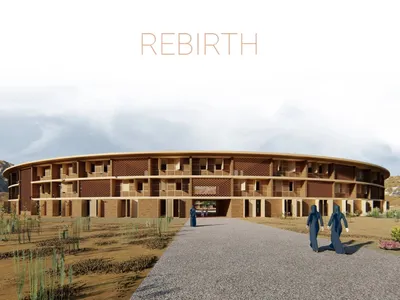
REBIRTH: A Circular Settlement Where Afghan Widows and Their Children Rebuild Life Together
A shortlisted Resile entry turns the circle into a protective ring of timber and brick, gathering homes, classrooms and gardens around a shared landscape.
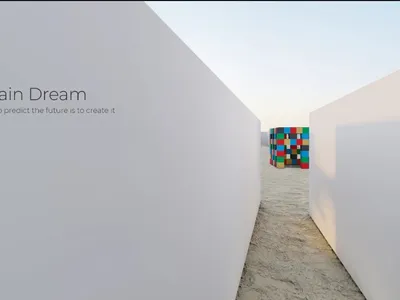
The Main Dream: A Recycled Plastic Kit That Lets Refugee Children Build Their Own Playground
Thirty-centimetre interlocking cubes that connect on three axes turn play into construction, letting children author the spaces they occupy.

Explore Urban Forest Competitions
Discover active competitions in this discipline

Challenge to design a shop stop sunk in the city

Design challenge to equip cities with modern furniture

Competition to design a workstation for architects
Comments (0)
Please login or sign up to add comments
No comments yet. Be the first to comment!