
Three Studios Build 200 Affordable Units for Tulum's Displaced Hospitality Workers
Casa Selva embeds dark concrete housing blocks into Yucatán rainforest, offering dignified shelter to those priced out by the tourism they serve.


Tourism economies have a way of consuming the people who sustain them. In Tulum, a decade of resort development has inflated housing costs to the point where cooks, cleaners, bartenders, and concierges can no longer afford to live near the hotels and restaurants where they work. Casa Selva, completed in 2026, is a rare architectural answer to that crisis: 200 affordable apartments on the edge of town, tucked into the canopy of the Yucatán rainforest. The project is a collaboration between three offices: anonimous, g3arquitectos, and Jesús Vassallo, led by architects Alfonso Jiménez Enciso, Alfonso Garduño, and Jesús Vassallo.
What makes the project genuinely interesting is its refusal to treat affordability as a license for cheapness or placelessness. The 6,503 square meter complex is made of standard concrete block covered in dark plaster, a material palette that is economical and locally sourced yet produces buildings with real presence. The charred gray surfaces deliberately echo the bark of gumbo limbo trees in the surrounding forest, so the architecture reads less as an intrusion than as a geological fact. Four stories is the hard limit, keeping every roofline below the forest canopy. The result is a housing project that takes its site more seriously than many luxury villas in the region do.
A Comb Woven into the Canopy
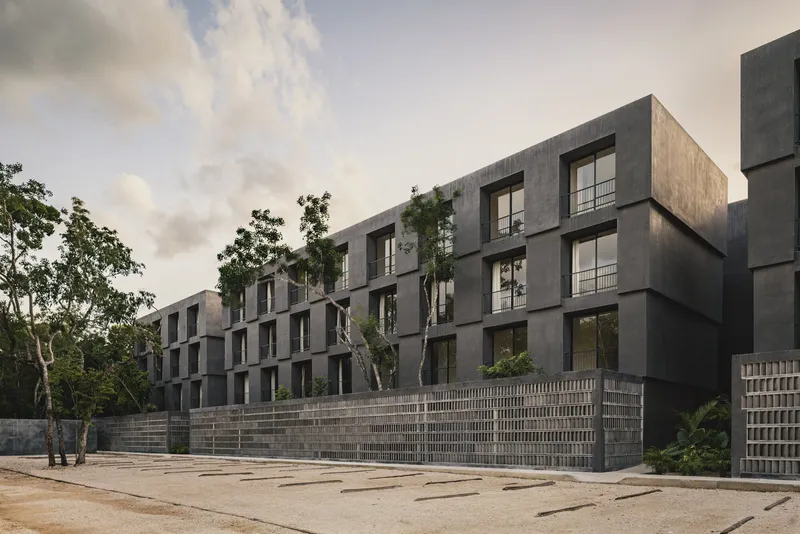

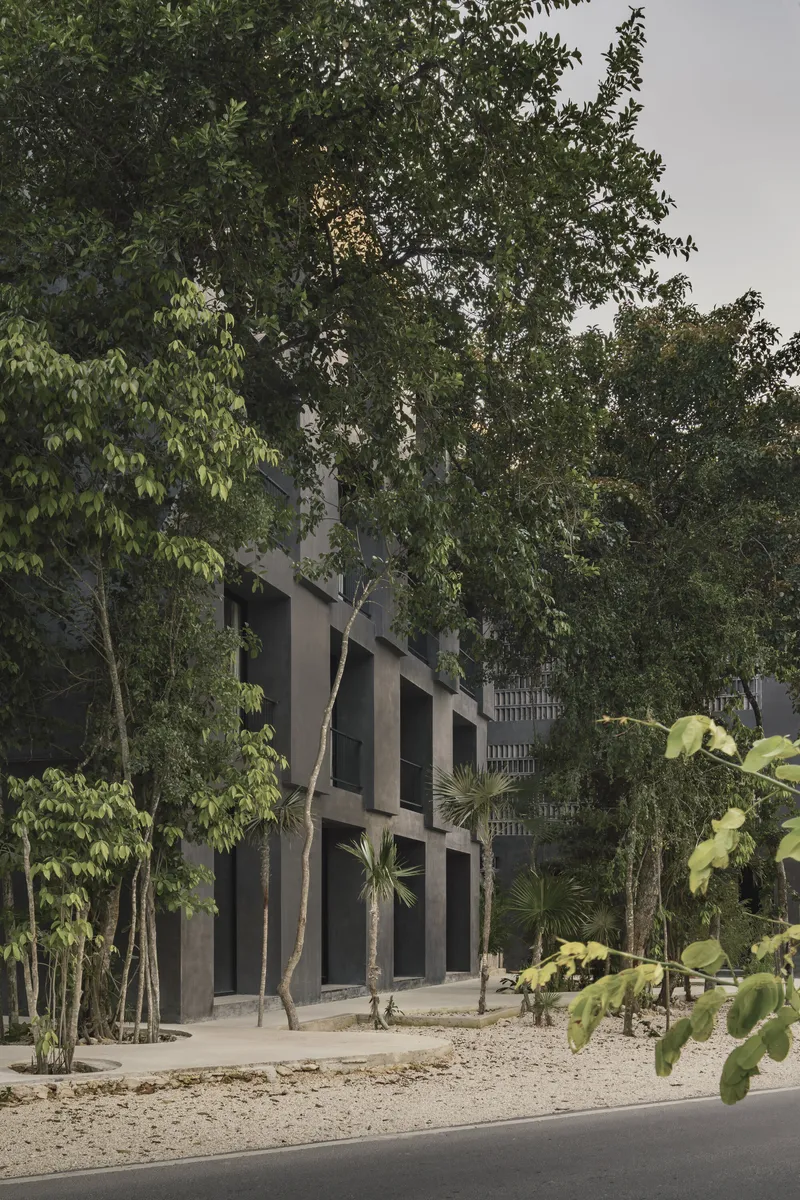
From the street, Casa Selva presents a sequence of dark, staggered volumes separated by mature trees that seem to grow straight through the building's footprint. The massing follows a comb-like configuration: a long, forked bar with three prongs interlocks with three smaller structures nested in the gaps. It is a hybrid of the courtyard block and the linear bar, and it works because the interlocking geometry creates pockets of open space at every turn rather than one monolithic void.
The four-story height limit is not merely a regulation to satisfy. Keeping the buildings below the tree line means residents look out into a wall of green rather than over a clear-cut site. Dappled light filters across the facades in shifting patterns throughout the day, activating the dark plaster surfaces in a way that would be impossible on an exposed, sun-blasted plain. The architecture is designed to be seen through branches.
Courtyards That Were Never Cleared
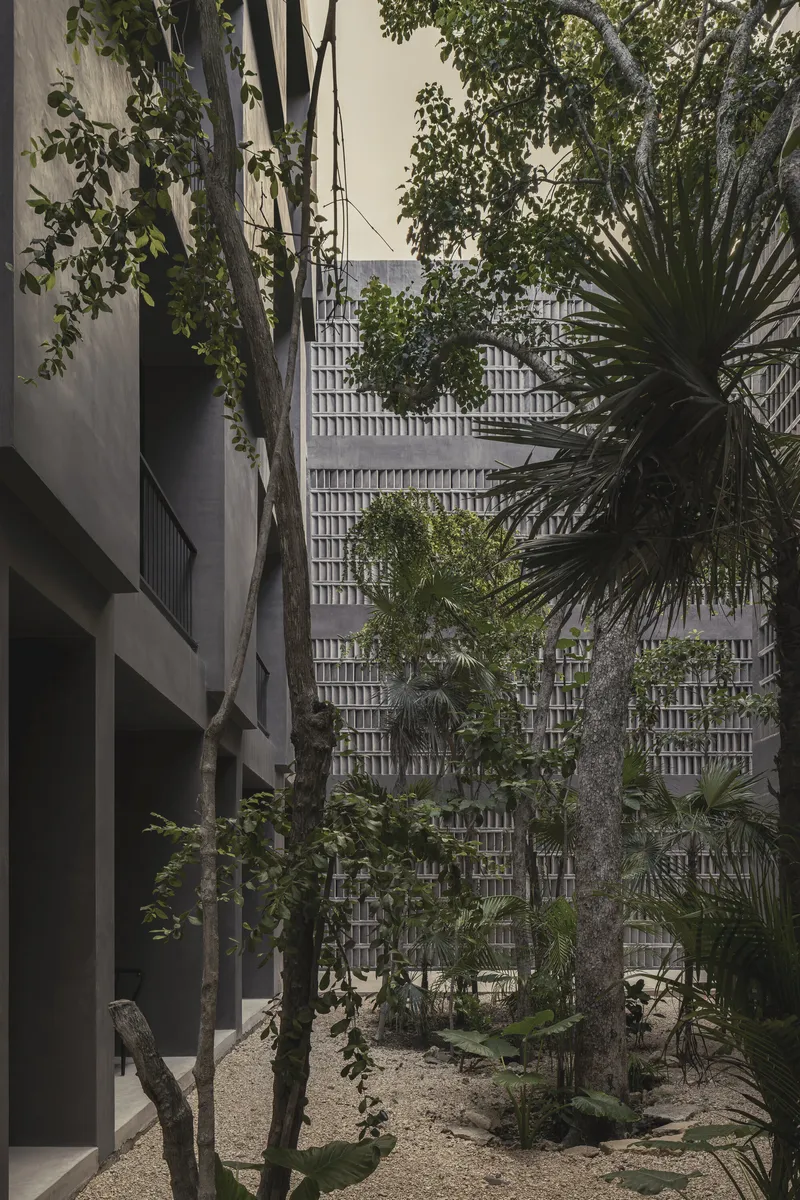
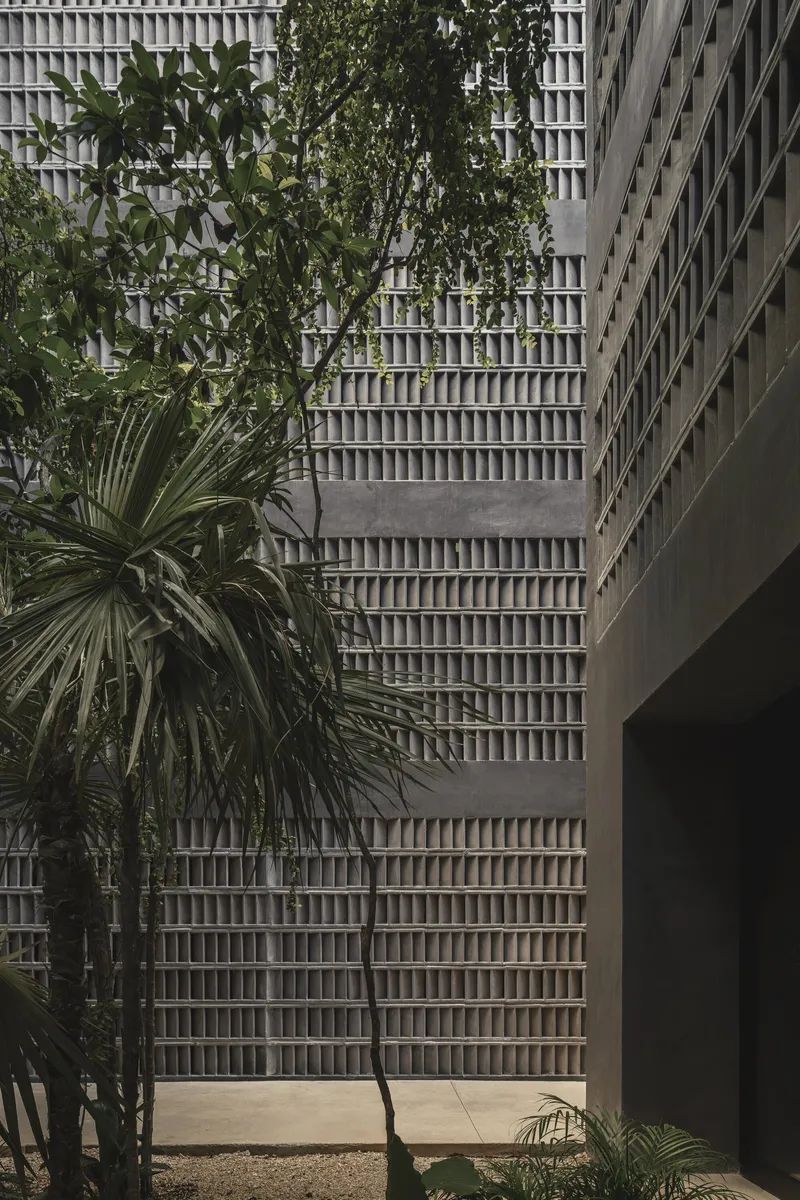
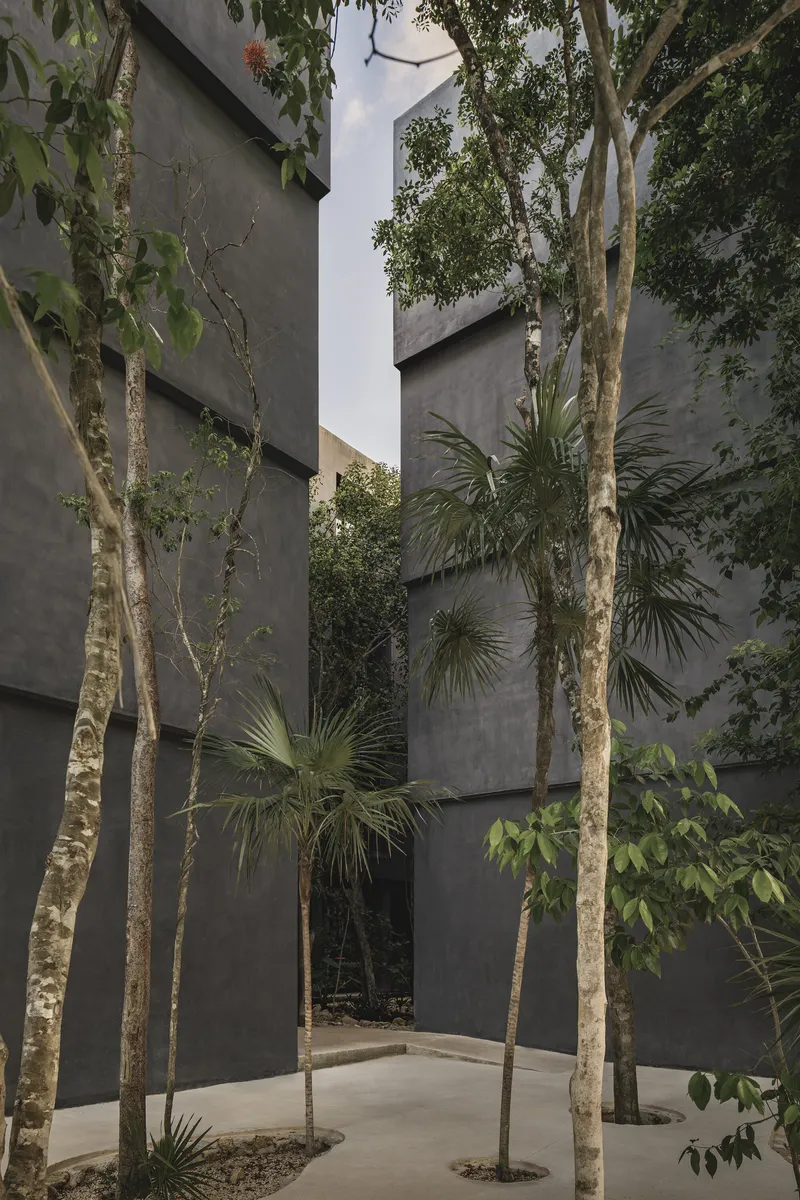
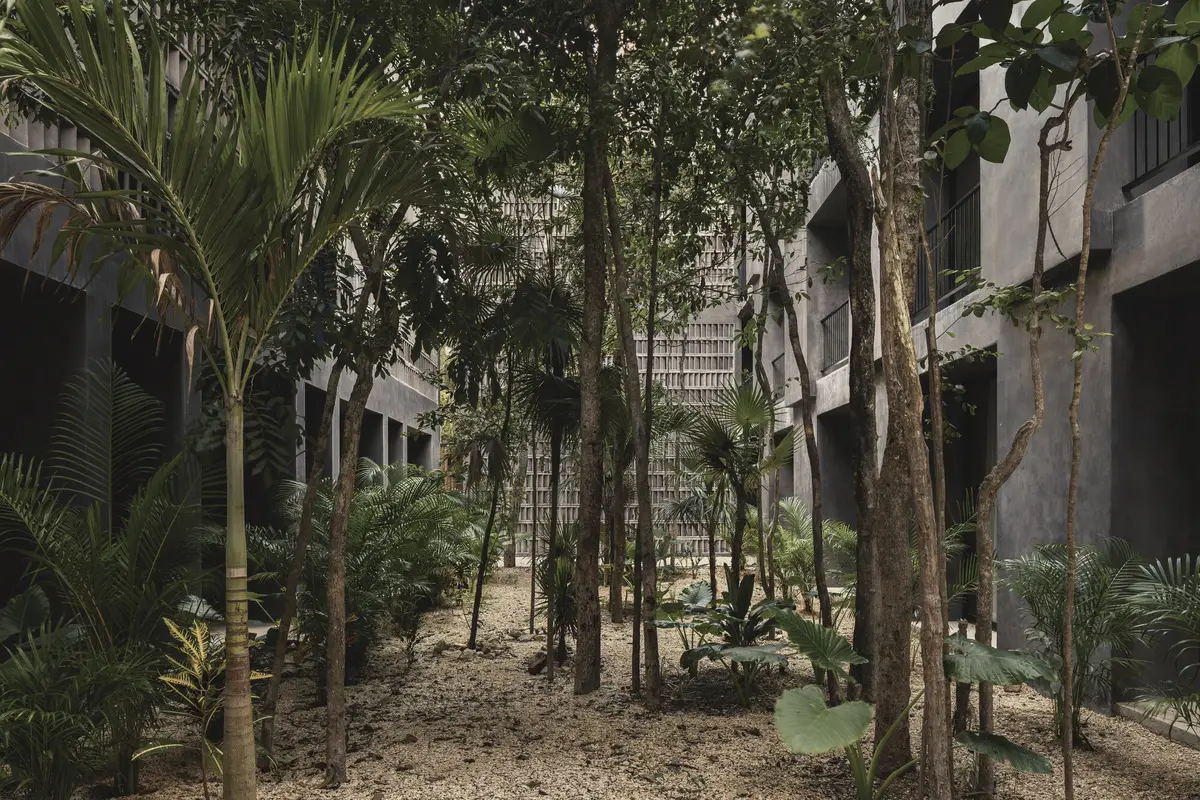
The landscape strategy here deserves close attention because it inverts the usual construction sequence. Typically, a site is cleared, buildings go up, and then someone plants new trees. At Casa Selva, the courtyards and open spaces were cordoned off before construction began, and the building process was staged to preserve existing native trees: gumbo limbo, black poisonwood, and Mexican silver palms. The result is not a manicured garden but an actual piece of forest that the architecture accommodates.
Walking through these in-between spaces, the vegetation is dense enough to buffer units from the road and from one another. Gravel groundcover, tree canopy overhead, and concrete screen walls on the perimeter create a layered threshold between public and private that feels calibrated rather than accidental. The trees are not decoration. They are infrastructure: shade, privacy, and stormwater management delivered by root systems that were already in place.
The Brise-Soleil as Social Membrane
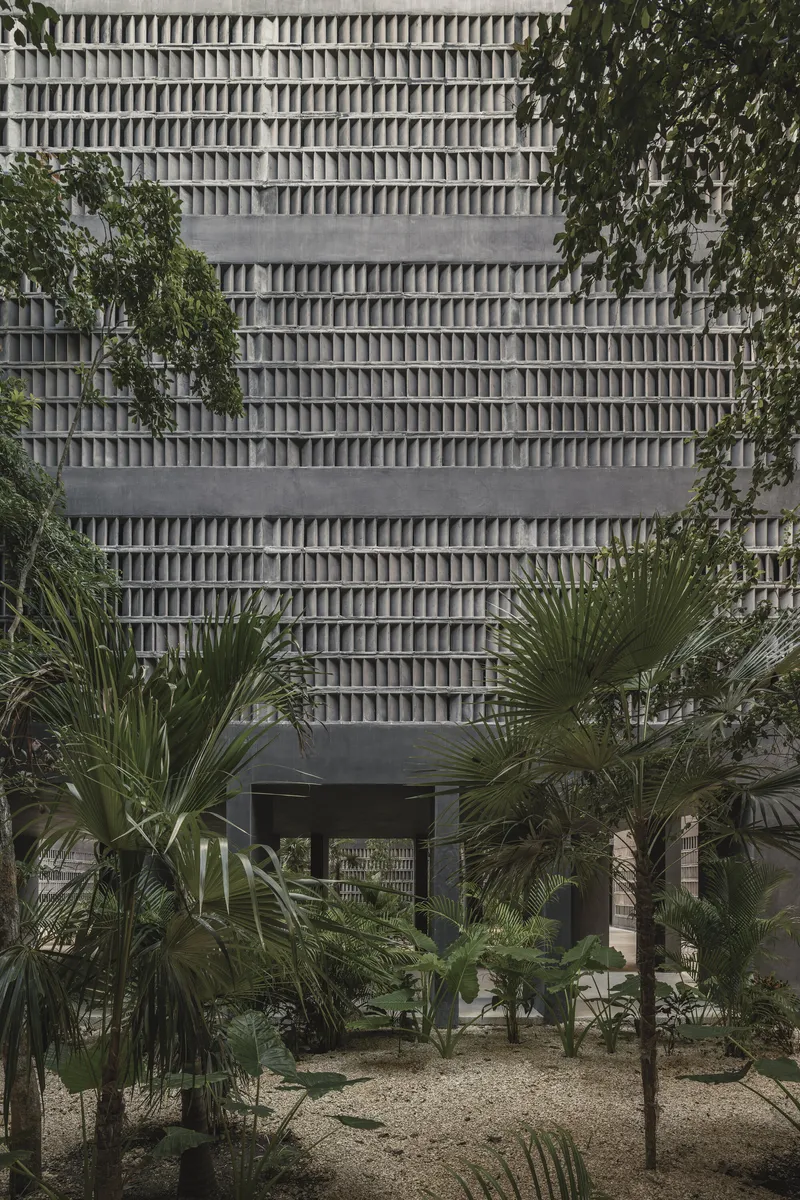
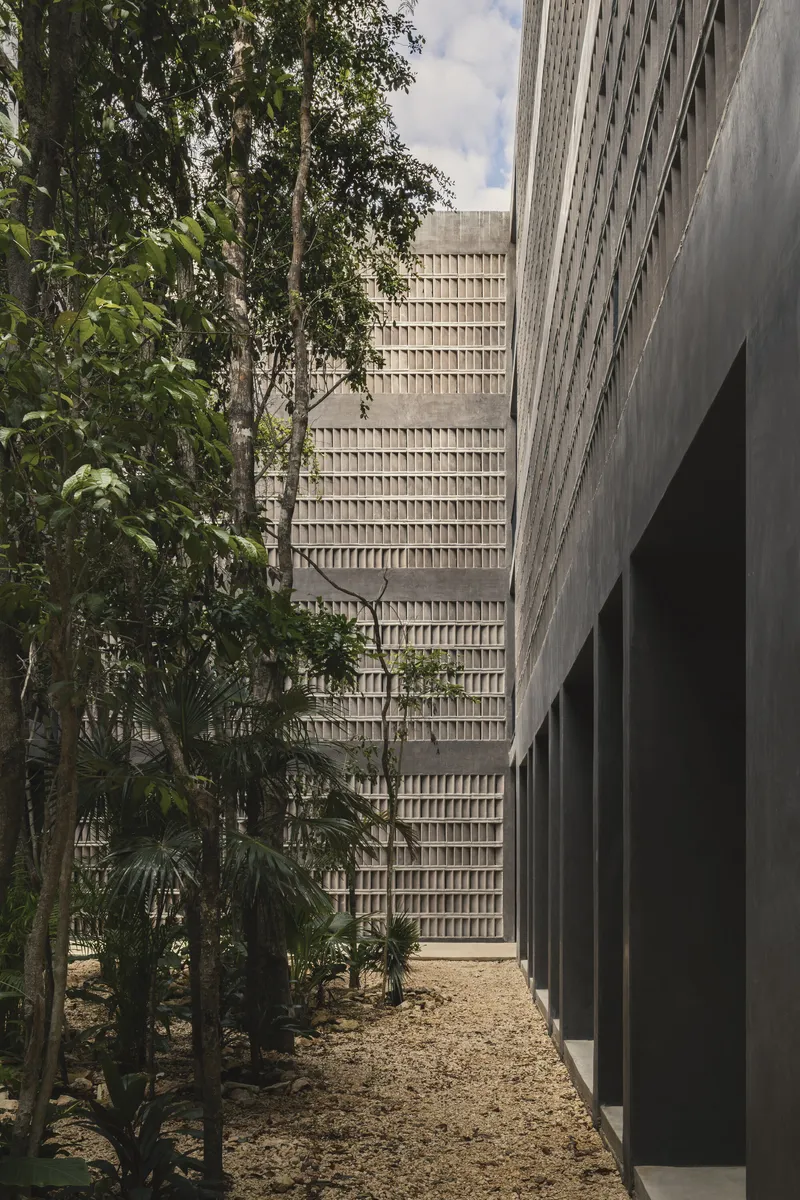
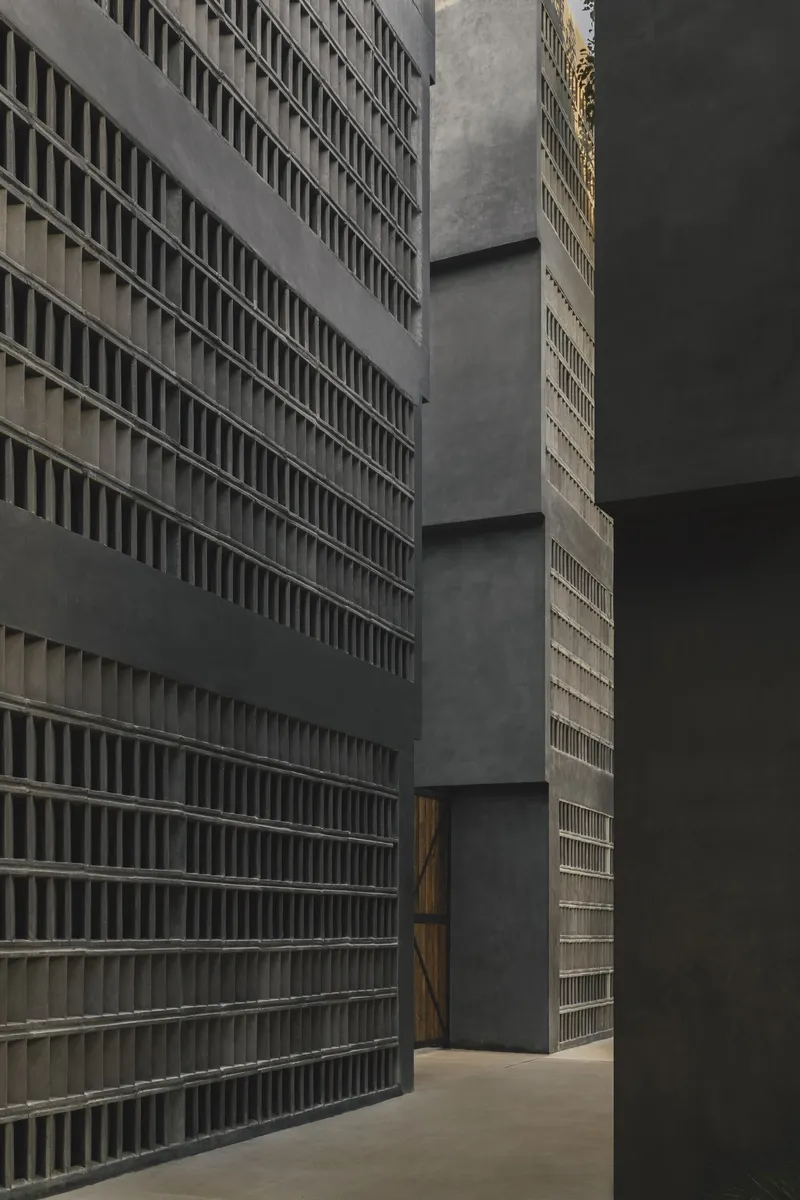
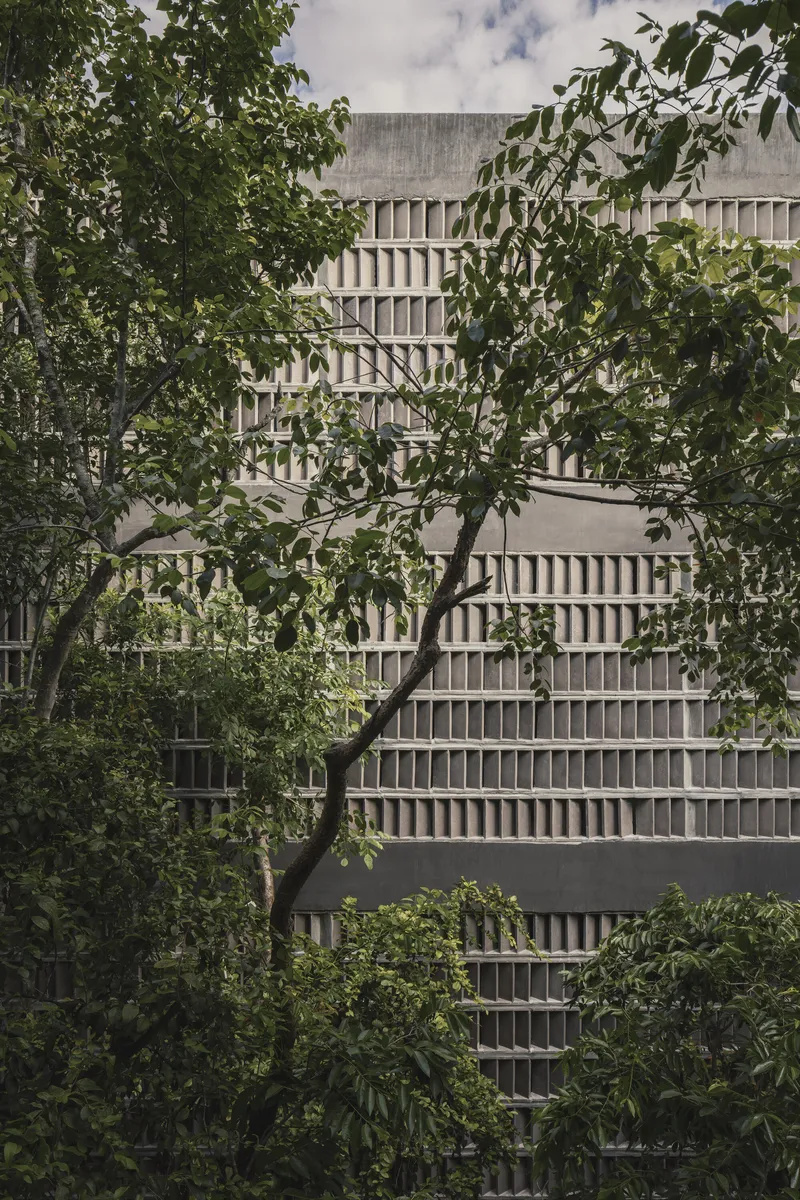
The perforated concrete block screens are the project's signature detail, and they perform several jobs at once. From the outside, they obstruct views into private units. From the inside, they function as latticed apertures that frame the courtyards in fragmented, almost pixelated compositions. They shade interiors from direct sun while allowing cross ventilation, which in the humid Yucatán climate is not optional but essential.
These brise-soleils were fabricated locally, using patterns that are simple enough to produce at scale but varied enough across the complex to avoid monotony. The screens also manage something subtler: they give a degree of visual porosity to what could otherwise feel like a fortress. Affordable housing often ends up either too porous, sacrificing residents' dignity, or too closed, creating a bunker atmosphere. Casa Selva threads the needle. Light enters. Views exit. But nobody is on display.
Stairwells, Passages, and the Space Between
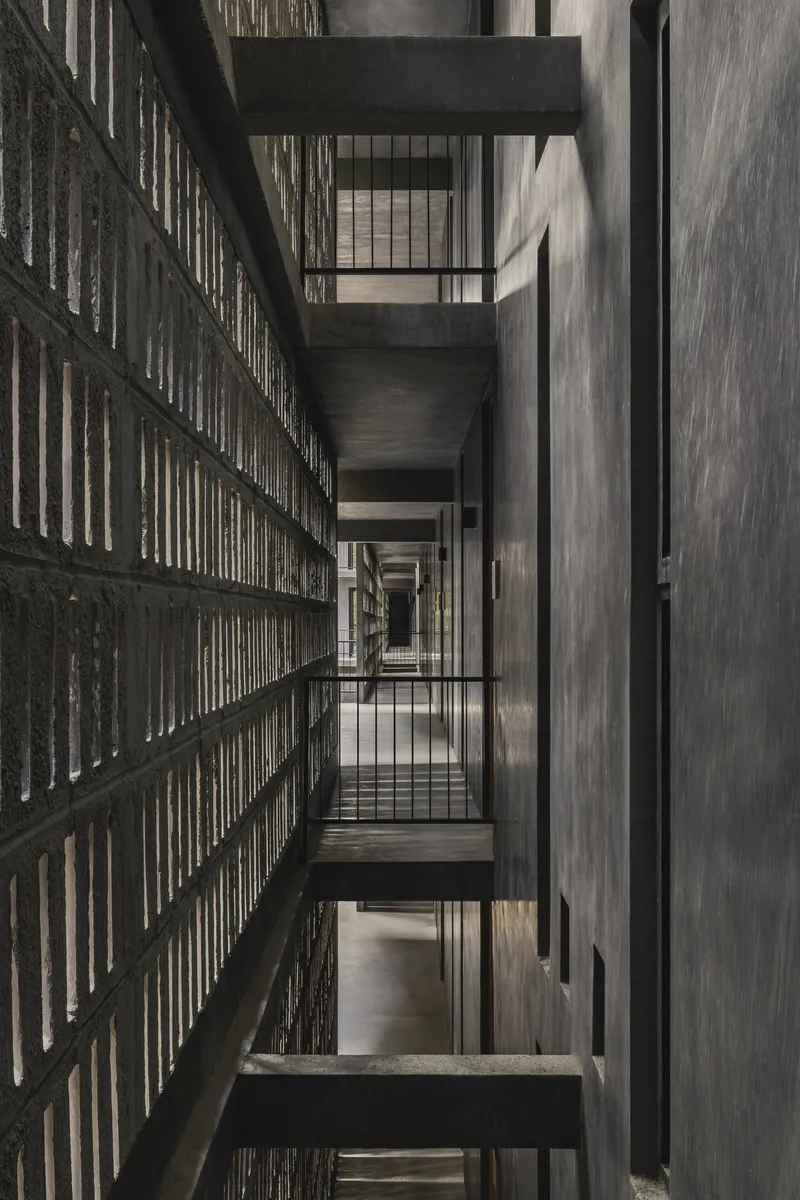
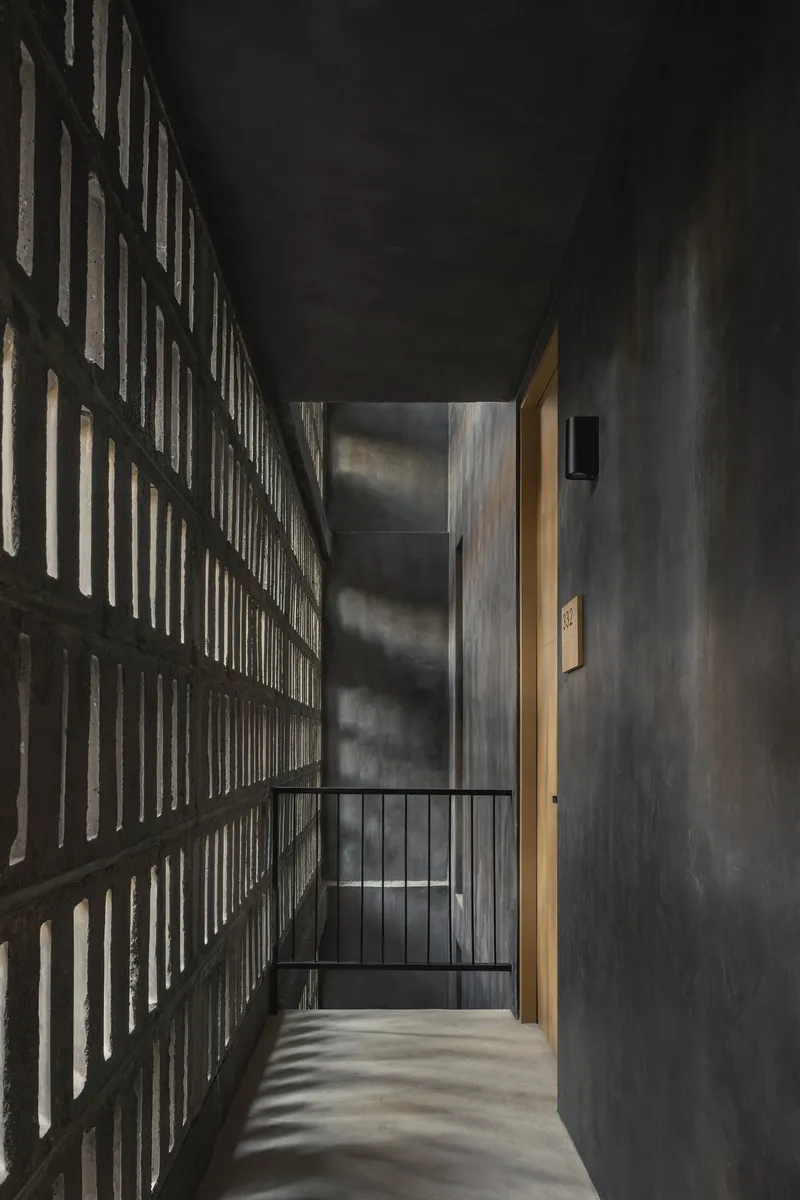

The circulation spaces deserve their own discussion because in affordable housing they are typically the first thing to be squeezed. Here, the stairwells are open and ventilated, with alternating concrete bridges and perforated brick walls that catch dramatic slashes of natural light. These are not fire stairs to be endured. They are moments of architectural intensity that residents encounter daily.
Ground-level passages beneath the buildings are framed by dark concrete columns and open onto planted courtyards. They function as a pedestrian network linking the various wings, and they give the complex a sense of permeability. You move through it rather than around it. For a project housing workers who spend their professional lives navigating other people's luxury spaces, the quality of these communal transitions is a quiet but meaningful form of respect.
Interiors Stripped to Their Essentials

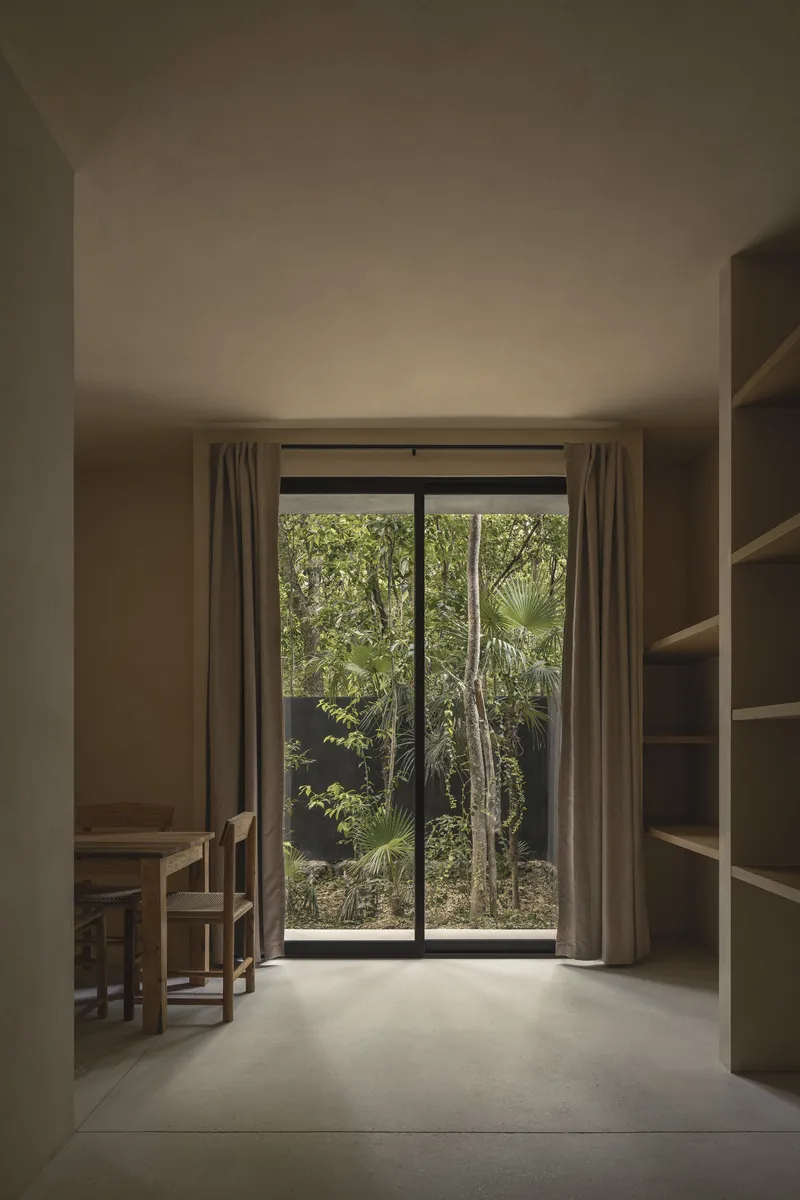
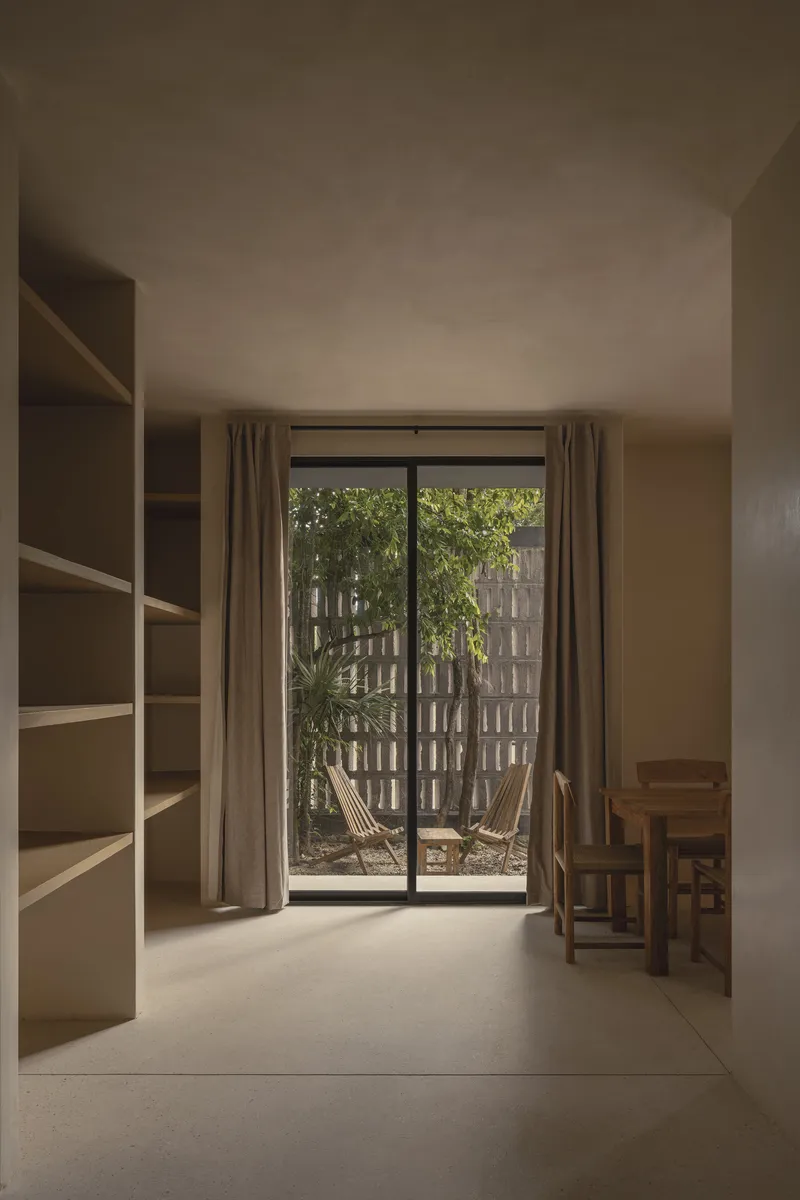
Each dwelling is described by the architects as a simple tube of space: bedroom, bathroom, kitchen, and living room arranged without hallways or interior partitions. Furniture suggests where one function ends and another begins. It is a strategy borrowed from micro-housing experiments in denser cities, applied here not as a lifestyle statement but as a cost-saving measure that genuinely works in a tropical climate where doors can stay open year-round.
What elevates these interiors beyond mere efficiency is the relationship to the outside. Every unit features large glazed openings that frame either dense garden vegetation or the perforated screen courtyards. Ceiling fans replace air conditioning. Built-in timber shelving and simple concrete finishes keep the palette consistent and maintenance low. These are not aspirational spaces dressed up for a magazine shoot. They are livable, cool, and connected to the landscape in a way that many far more expensive Tulum properties fail to achieve.
A Rooftop That Belongs to Everyone
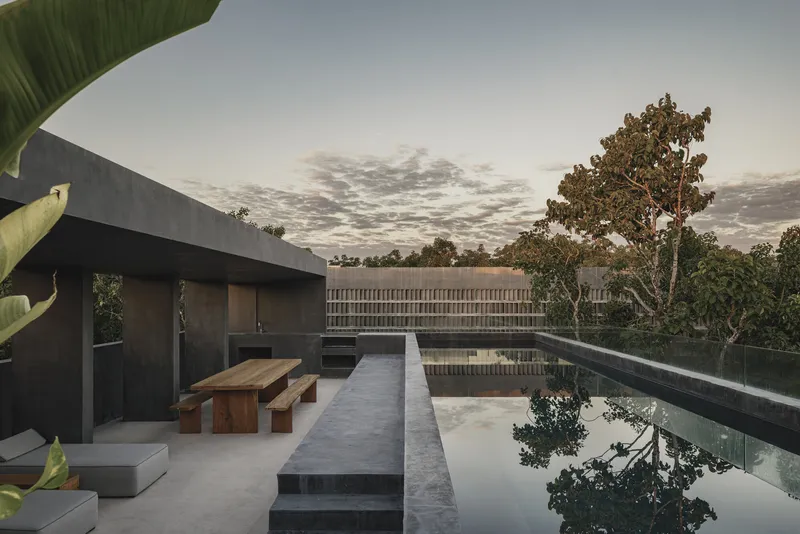


The rooftop amenities are worth flagging because they represent the kind of collective luxury that affordable housing rarely provides. A reflecting pool, stepped concrete seating, barbecue areas, planters, and a roof garden occupy the top level. A co-working space, gym, cafeteria, laundry room, and convenience store fill out the program at other levels. The complex is designed to function as a small neighborhood, not just a dormitory.
This matters because the workers Casa Selva houses are by definition transient in their workplaces. Hotels and restaurants are someone else's domain. Having a rooftop pool that belongs to you, a barbecue area that you share with neighbors who work the same shifts, a co-working space for those building a side business: these are not perks. They are the spatial conditions for community formation in a town that has been structured entirely around visitor experience.
Dark Concrete, Dappled Light
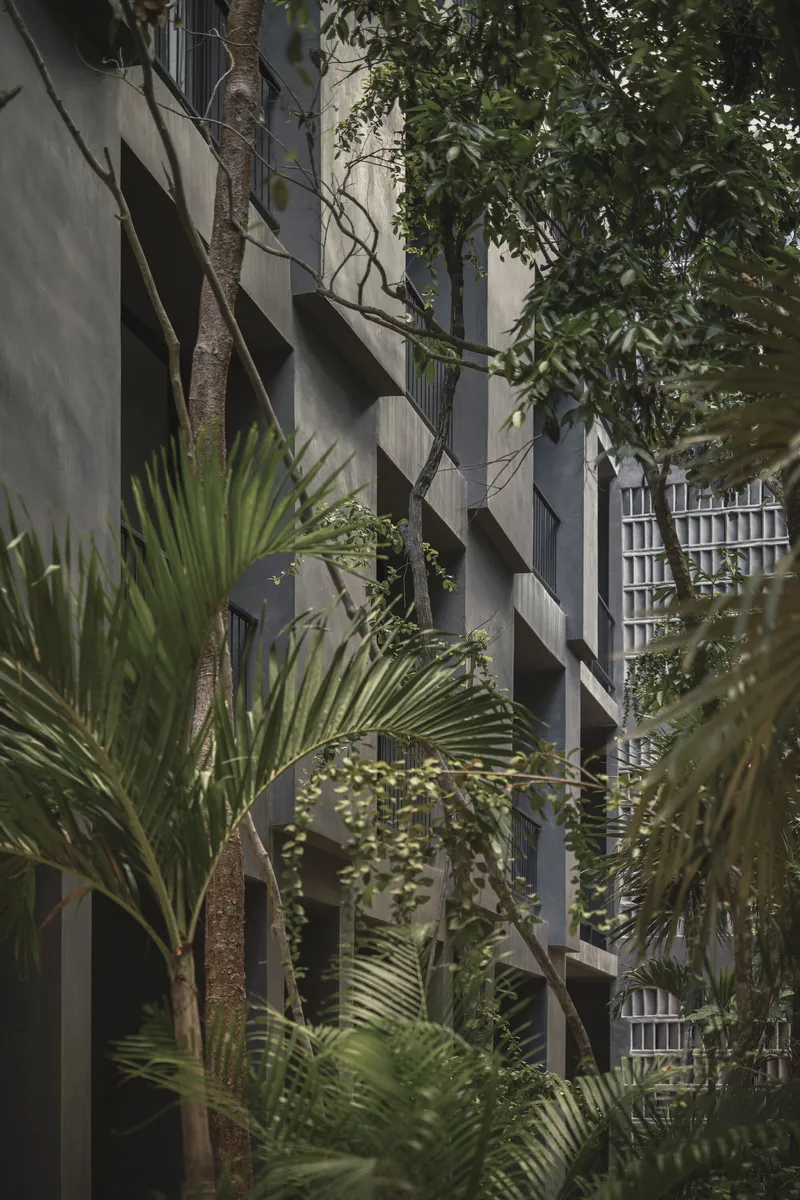
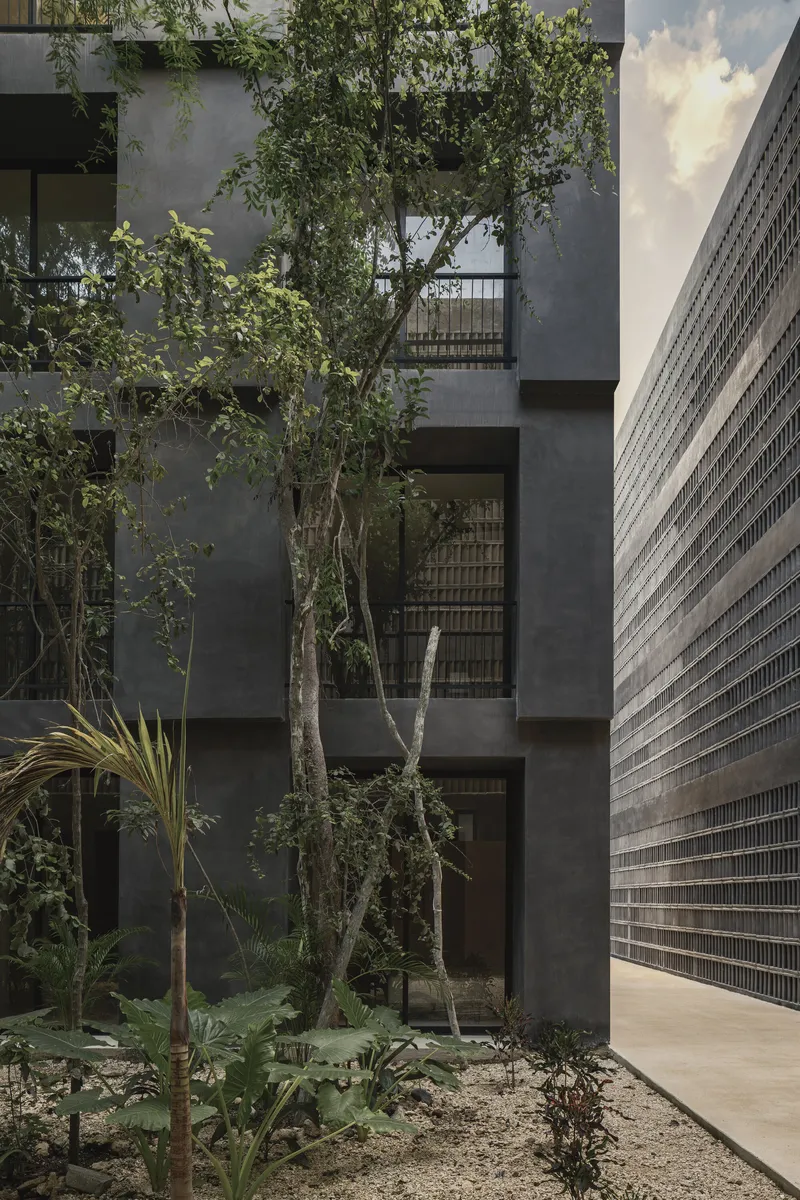
The dark plaster finish deserves comment as a material choice with both practical and atmospheric consequences. In a region where white-washed walls and pale stucco are the default for both resorts and vernacular construction, the charred gray of Casa Selva is a deliberate departure. The color absorbs the dappled light filtering through the canopy rather than reflecting it, which gives the facades a mutable, almost living quality as shadows shift across them throughout the day.
There is also an argument that the color carries a kind of social message. This is not a building trying to look like a resort. It is not mimicking the aesthetic of the tourism industry that employs its residents. It is a housing project that looks like exactly what it is: a serious, composed piece of architecture made from inexpensive materials, positioned in a forest, and unapologetic about its purpose. The echoes of early Brutalism are real but not gratuitous. The austerity here is earned.
Plans and Drawings
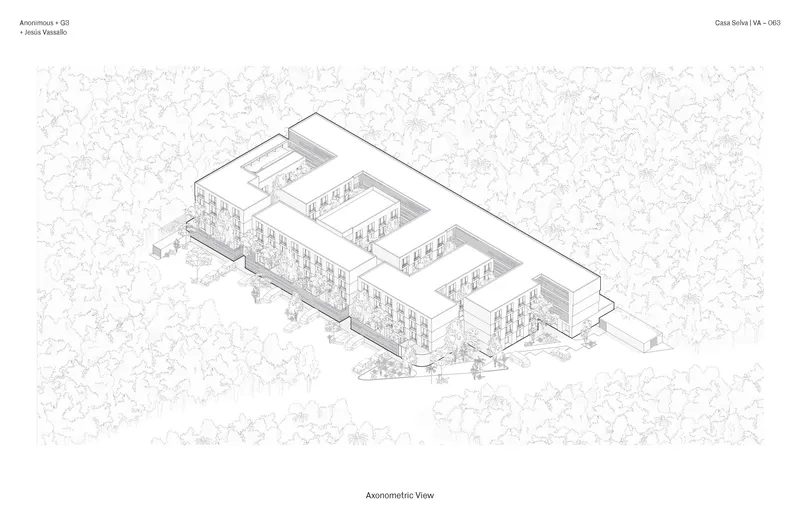
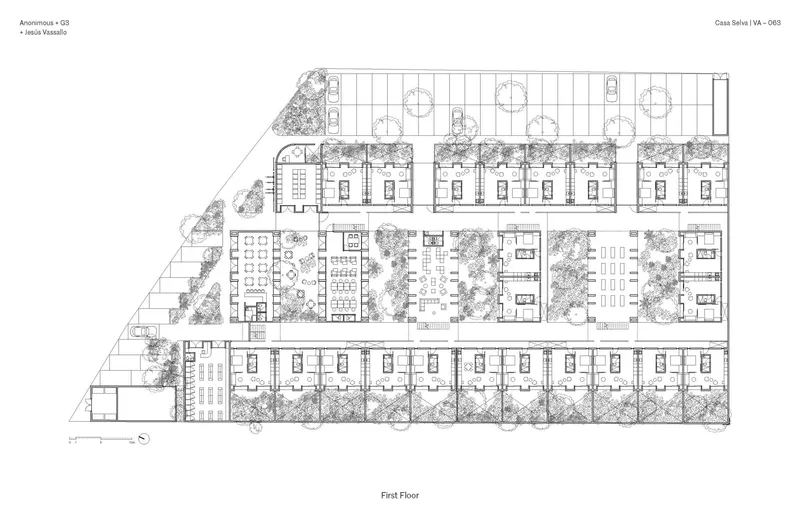

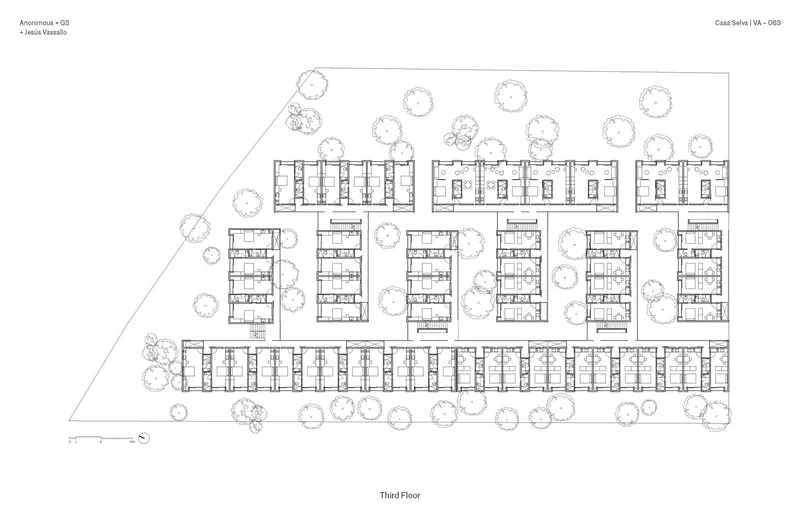
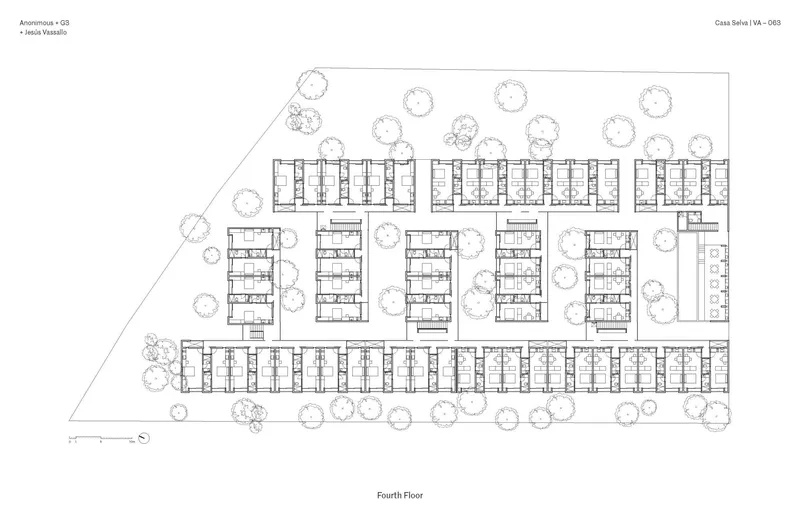
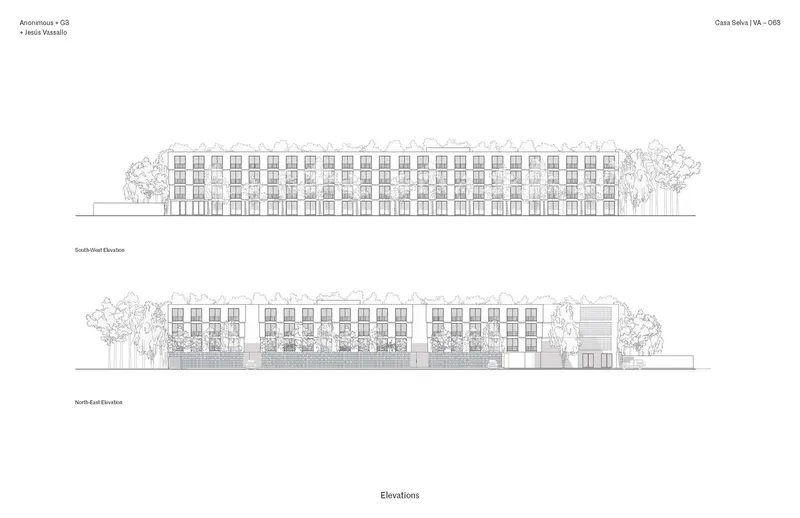
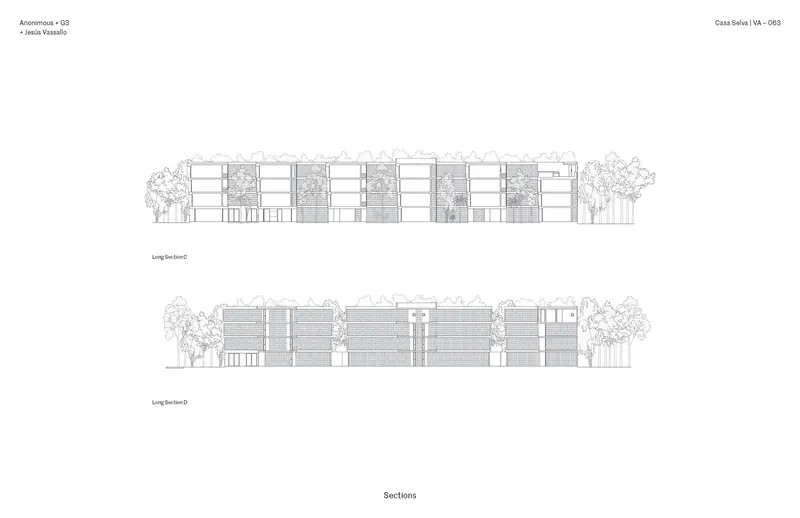
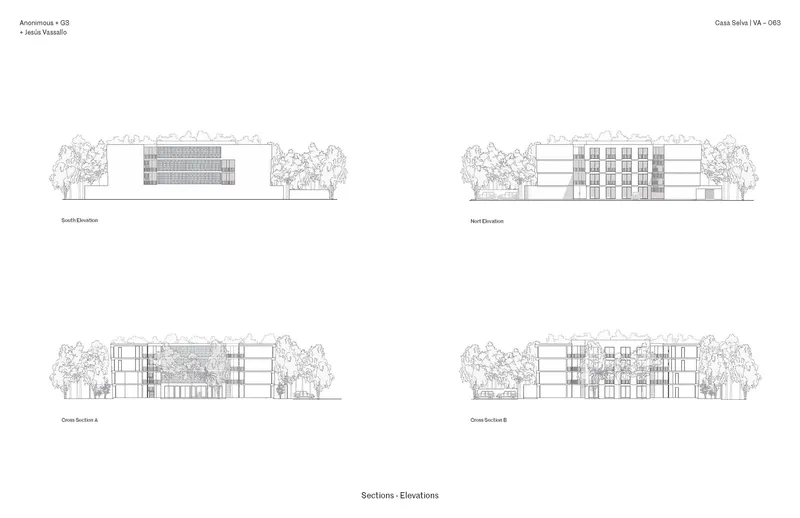
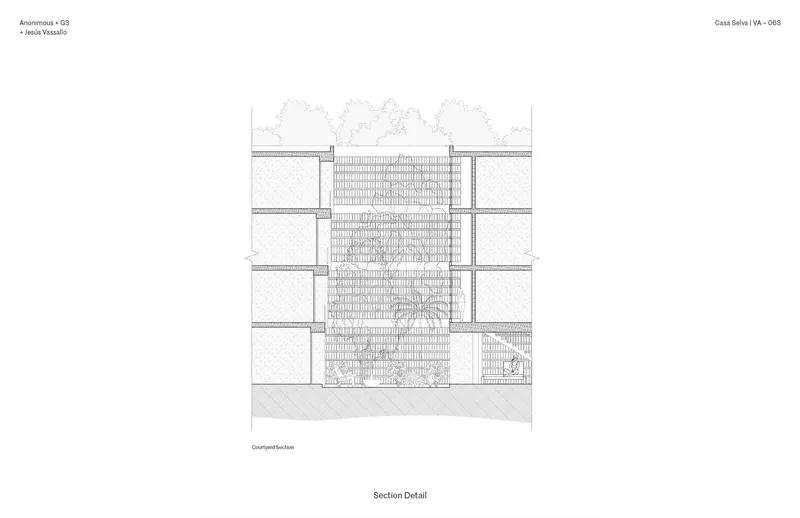
The axonometric drawing reveals the full interlocking logic of the plan: a multi-winged complex where the forked bar and its inserted counterparts create a figure-ground pattern that is more landscape than building. The floor plans, read in sequence from first to fourth level, show how the residential modules repeat with minor variations while the courtyard voids remain consistent, threaded with tree symbols that represent the preserved native vegetation. The sections confirm the four-story datum and illustrate the relationship between the brise-soleil screens, the floor plates, and the climbing vegetation that will increasingly soften the facade over time.
The detail section of the courtyard facade is particularly instructive: it shows the concrete block screening, the floor slab edges, and the planting zones at grade working together as a single integrated assembly. Nothing here is applied. The environmental performance of the building and its architectural expression are the same thing.
Why This Project Matters
Casa Selva matters because it demonstrates that affordable housing in a tourist economy does not have to be a concession, a temporary fix, or an architectural afterthought. Three offices collaborated to produce a complex that takes its site, its climate, and its residents seriously. The preservation of existing vegetation, the passive cooling strategies, the quality of the communal spaces, and the careful calibration of privacy through perforated screens all point to a design team that understood the assignment was not just to provide shelter but to provide a counterweight to the displacement forces reshaping Tulum.
The project also raises questions that extend well beyond Mexico's Caribbean coast. Every tourism-dependent economy produces a version of this problem: the people who make a place function cannot afford to live there. Architecture alone cannot solve that. But architecture can determine whether the housing built for those workers is dignified, well-sited, and capable of fostering the kind of community that makes a place worth staying in. Casa Selva makes a persuasive case that it can.
Casa Selva, Housing for Hospitality Workers, by anonimous, g3arquitectos, and Jesús Vassallo. Tulum, Mexico. 6,503 m². Completed 2026. Photography by Cesar Bejar.
About the Studio
Share Your Own Work on uni.xyz
If projects like this are the kind of work you want to make, uni.xyz is a place to publish your own, find collaborators, and enter design competitions.


Popular Articles
Popular articles from the community


Architekt Andreas Gruber Scatters 23 Dark Timber Chalets Across a South Tyrolean Forest Edge
In Molini di Tures, Amonti Chalets breaks a resort into a hamlet of gabled timber houses, with parking, storage and services pushed into the slope.

David Ortega Stacks a Two-Story Mexico City Penthouse Around a Steel Stair and a Pergola-Shaded Roof Terrace
In Colonia Roma, a 300 m² penthouse uses oak joinery, a planted steel stair and a slatted roof pergola to make a new-build apartment feel like a house.

GROUP A Strips a 1969 Rotterdam Harbor Headquarters to Its Frame and Wraps It in Timber Louvers
In Rotterdam's M4H harbor district, Ferro Offices reuses a 1969 frame, adds one timber storey and reaches BREEAM-NL Outstanding.

longwave studio Reorganizes a 112 m² Tainan Apartment Around the Daily Routines of a Family and Two Cats
In Tainan, Taiwan, birch plywood, rust-red furniture and a freestanding plaster wall link arrival, storage, work and family life in one apartment.

Similar Reads
You might also enjoy these articles


LAVA Architecten Gives Vocational Education a Sawtooth-Roofed Face on a Mechelen School Campus
In Mechelen, Belgium, a 2,053 m² STEM school on a 6×6 m grid turns workshops and classrooms into rooms that can be rearranged as teaching changes.

KEMA Studio Turns a Derelict Marvila Attic into a 60 m² Lighthouse Apartment Above Lisbon
In Lisbon's Marvila district, a rebuilt roof, four skylights and two plywood volumes turn an unlivable attic into a bright home facing the Tagus.

Pixel Gardens: One Repeated Module Stacked Into a Terraced Social Housing Tower for Famagusta
Salem Bader's shortlisted housing tower builds a vertical neighbourhood from one repeated module, offsetting units to carve terraces, light and air.

Bao Huynh Watercolor Atelier: A Serene Art Retreat in Hội An
Bao Huynh Watercolor Atelier in Hội An blends multifunctional art spaces, sustainable design, local materials, and family-friendly living in a serene environment.

Explore Student Housing Competitions
Discover active competitions in this discipline

Challenge to reimagine the Iron Throne

Photograph architecture without architects

Illustrate the lost glory of Angkor Wat - Render Challenge

Design challenge to reuse E-waste
Comments (0)
Please login or sign up to add comments
No comments yet. Be the first to comment!