

KO/OK Architektur Slots Two Translucent Timber Boxes into a 1910 Leipzig Machinery Hall for €80,000
A reversible, radically affordable adaptive reuse of a monument-protected electrical substation in Leipzig's Connewitz district.


There is a certain breed of adaptive reuse project that likes to announce itself: big budgets, signature gestures, the old building reduced to a scenic backdrop for something conspicuously new. The machinery hall renovation by KO/OK Architektur in Leipzig's Connewitz neighborhood is not that project. It is quieter, cheaper, and more disciplined. Two translucent volumes made from pine timber and polycarbonate hollow-chamber panels sit inside a three-nave industrial hall that once housed equipment for the city's DC electrical grid. The total material and labor cost came to €80,000. The entire intervention can be unbolted and removed without leaving a mark on the protected structure.
What makes it genuinely interesting is the refusal to choose between preservation and inhabitation. The hall, part of the former "Unterwerk Süden II" substation designed by Händel & Franke between 1908 and 1910, had been vacant for decades after Leipzig's power grid switched from DC to AC following the Second World War. KO/OK's solution treats the monument as a climatic buffer zone, a shell that mediates between the Saxon winter and two heated workspaces anchored to its floor with just three screws each. The architects work in one volume; the other is sublet. Between them, a shared central zone doubles as kitchen, meeting point, corridor, and event space. It is a scheme governed by common sense, but the specificity of the detailing lifts it well beyond pragmatism.
The Yellow Brick Shell
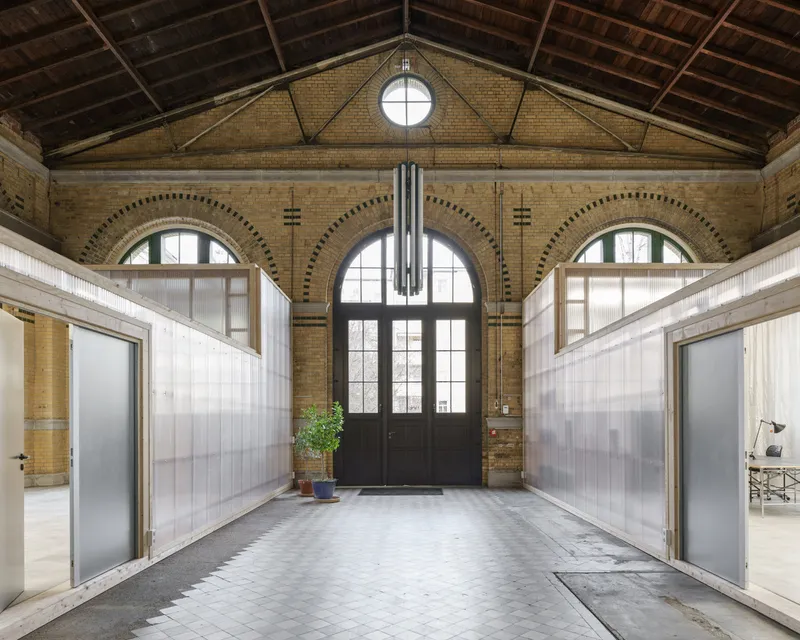
The exterior tells you almost nothing about what has happened inside. The arched brick facade with its trio of tall windows, round oculus, and black steel entrance doors looks much as it did when trams ran on direct current. Selective restoration replaced the original industrial windows with insulated glazing based on historical models, so the thermal envelope improved without altering the composition. When the substation was first built, the architects deliberately broke open the perimeter block and left the street corner free for an orchard, a gesture of urban generosity that persists in the site plan today.
Through the double doors, the transition from masonry solidity to the lightness inside is immediate. The central gate axis organizes the plan: one translucent box to each side, the unheated hall soaring 8.5 meters overhead. It is a threshold that works at every scale, from the urban block to the individual room.
Polycarbonate and Pine: Building a Room Inside a Room
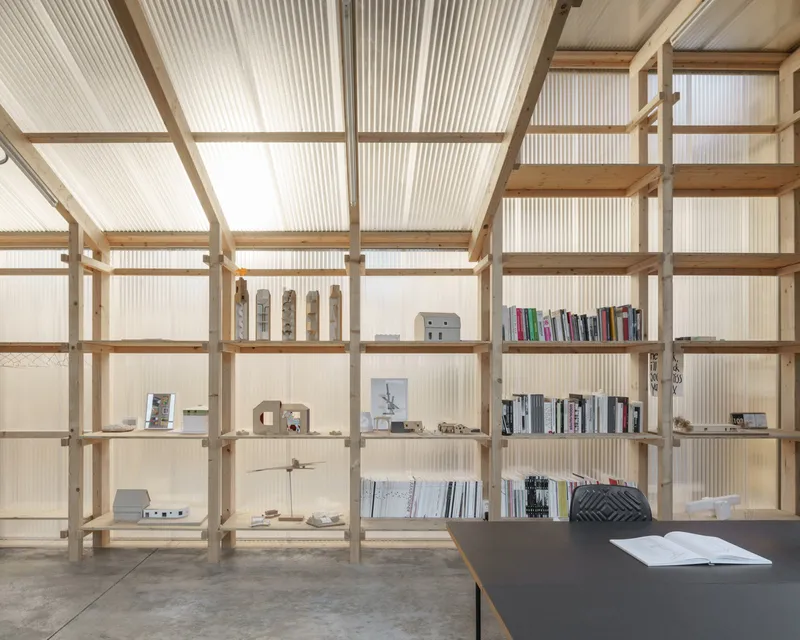
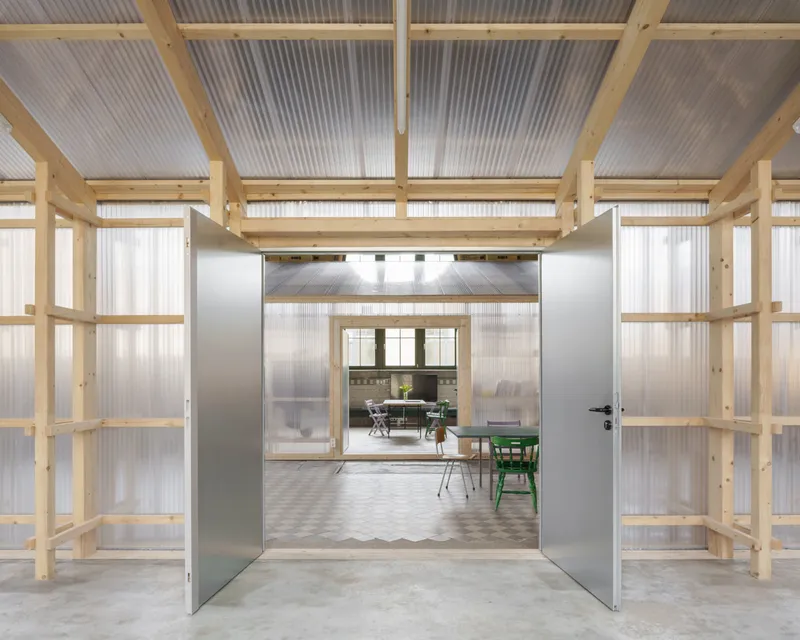
The inserted volumes are constructed entirely from standard commercial products: pine squared timbers and 37mm polycarbonate hollow-chamber panels. Every connection is screwed, not glued, not welded, ensuring the whole assembly can be deconstructed and the materials reused. The inclined roof surfaces rest on wood laths attached at the springing height of the industrial windows, a detail that keeps the new volumes low enough to maintain a respectful distance from the iron roof trusses above. You never lose the sense of being inside a large industrial space, even while sitting at a heated desk.
The polycarbonate panels filter daylight into a soft, even glow that fills the workspaces without direct solar gain. From the corridor side, the walls read as luminous screens. From inside, the silhouettes of the hall's original structure are always faintly visible. It is a material choice that solves thermal, acoustic, and atmospheric problems simultaneously, all while costing a fraction of conventional glazing.
The In-Between: Corridor, Kitchen, and Commons
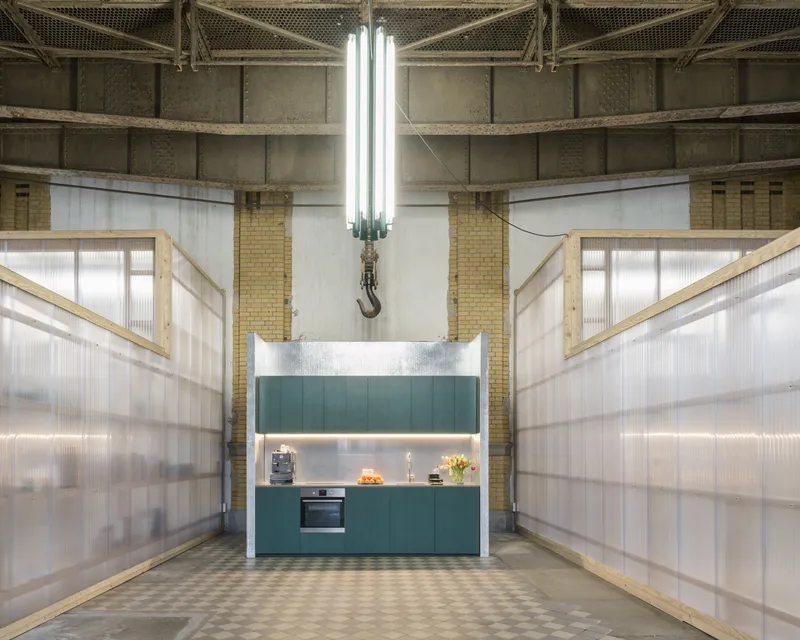
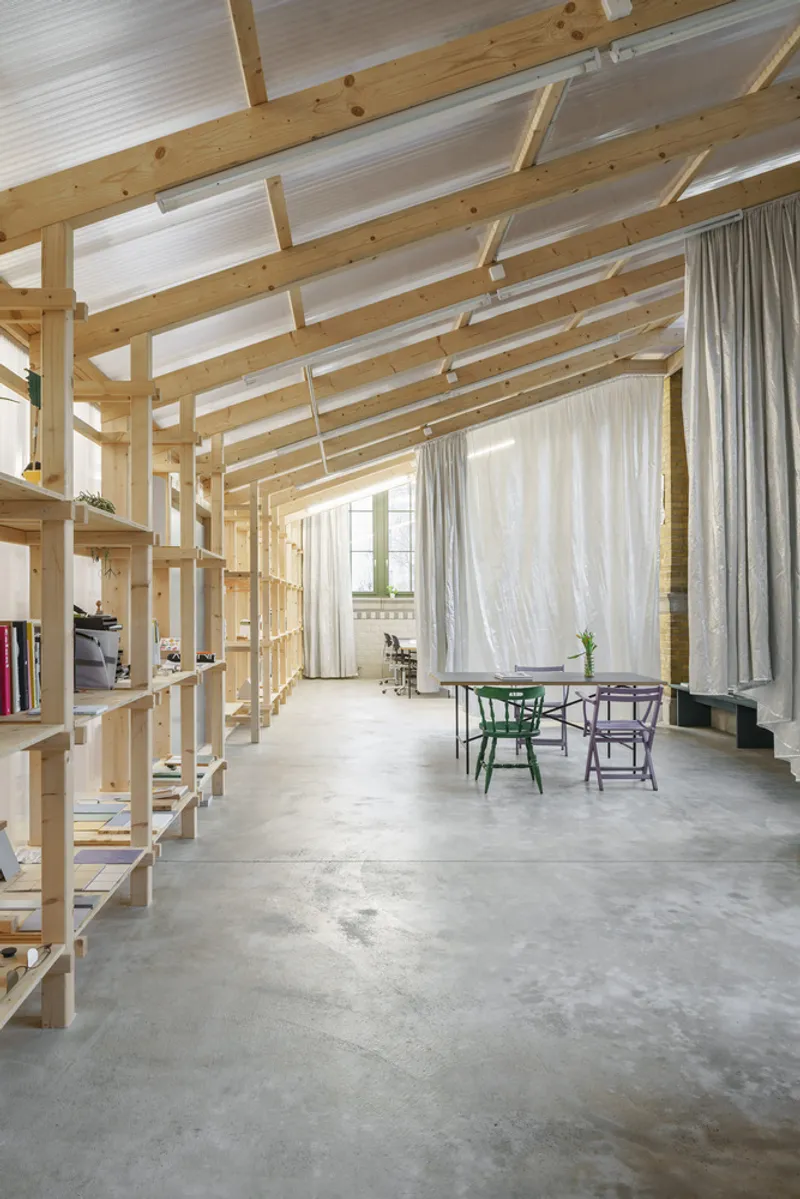
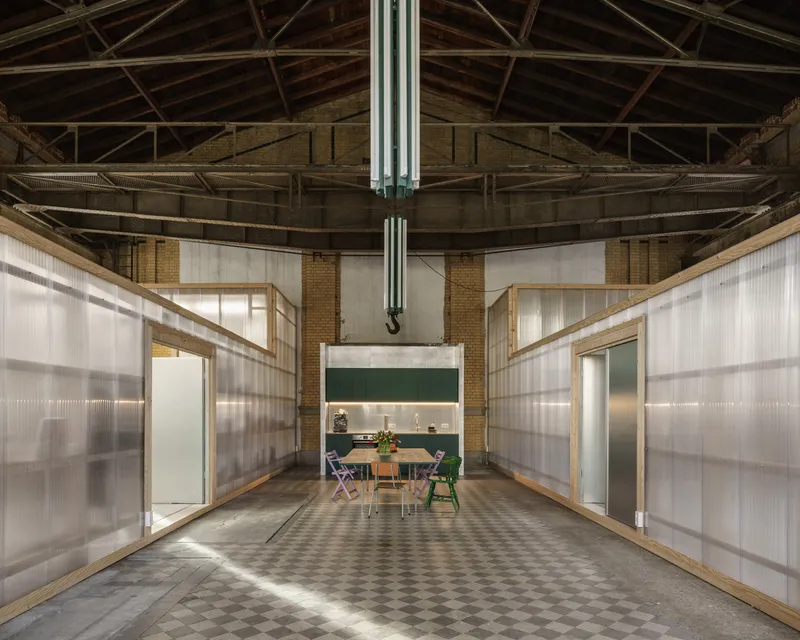
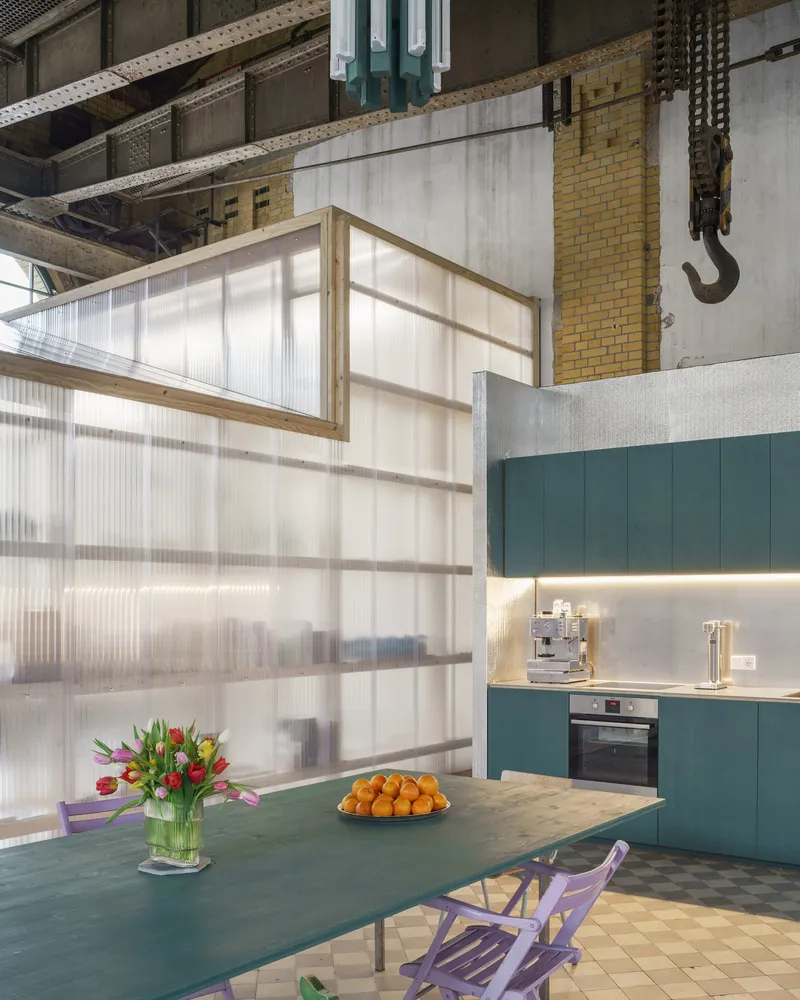
The central zone between the two inserted boxes is the social engine of the project. A teal kitchen unit hangs from the ceiling on an industrial pendant fixture, its hook-and-chain suspension a knowing nod to the hall's former life as a space built for heavy machinery. A dining table sits nearby, framed by the translucent walls on either side. This unheated spine is usable in warmer months and serves year-round as the primary circulation route connecting the office volumes to the accumulator building at the front.
The deliberate refusal to heat the entire hall is the project's most consequential decision. Rather than pouring energy into conditioning 8.5-meter-high ceilings, KO/OK treats the masonry envelope as a passive buffer. The temperature differential between inside and outside is already moderated by the brick mass and new insulated glazing before the polycarbonate walls of the insertions do the rest. It is not a high-tech strategy. It is an old idea executed with precision.
Shelving as Structure, Curtains as Walls
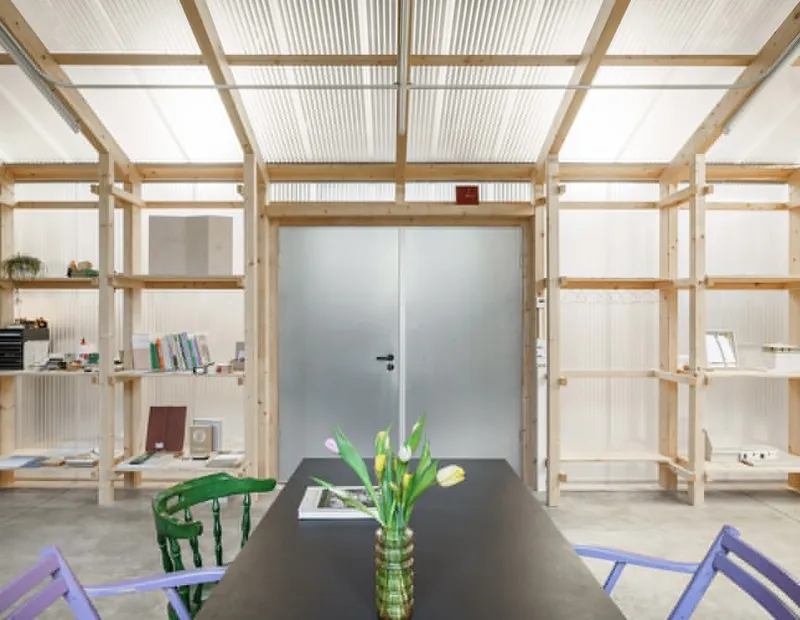
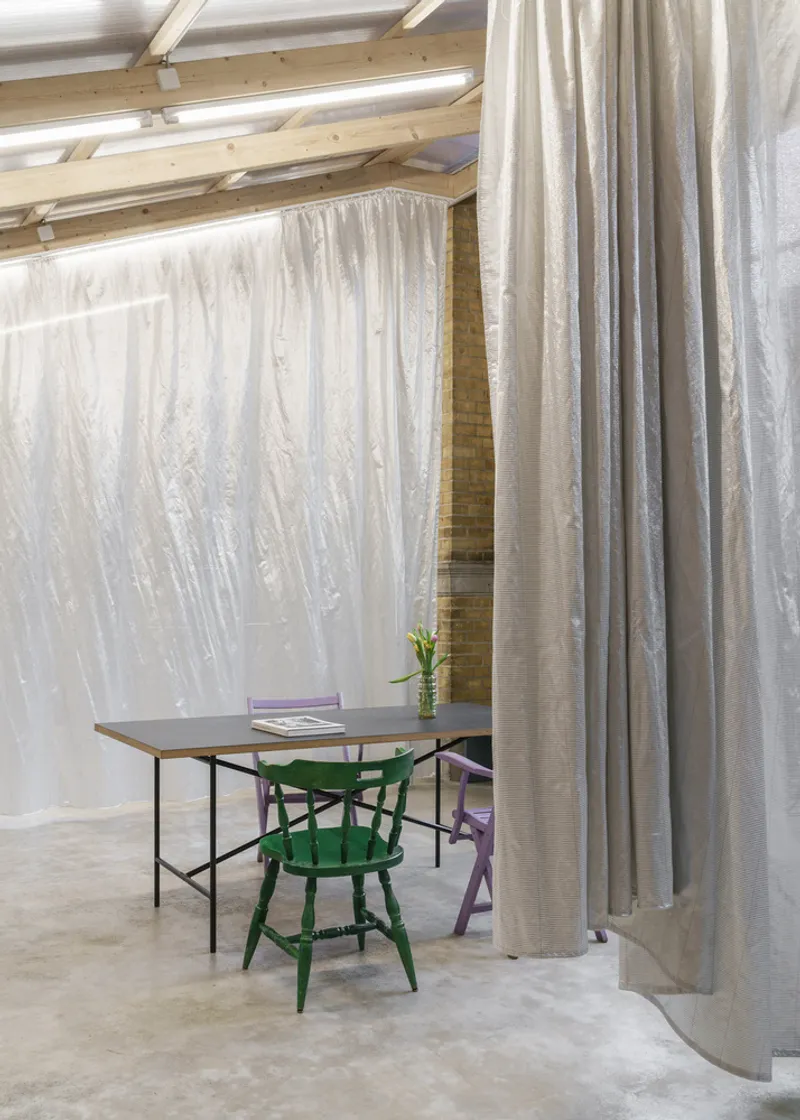
KO/OK's interiors are full of what you might call intelligent cheapness. The inner longitudinal walls of the timber volumes double as open shelving systems, eliminating the need for separate furniture. Commercial greenhouse curtains, the same kind used in agricultural buildings, serve as flexible room dividers within the workspaces. A fabric curtain drawn floor to ceiling can turn a communal desk area into a private meeting room in seconds. These are products designed for durability and economy in contexts far removed from architecture, repurposed here without pretension.
The polished concrete floor, the exposed screw connections, the raw pine framing: none of it is trying to look expensive. But the proportions are careful, the alignments are precise, and the material palette is limited enough to feel coherent rather than haphazard. The construction picks up the rhythm of the hall's large windows, so the new volumes sit in visual dialogue with the original bays rather than ignoring them.
Traces of Use
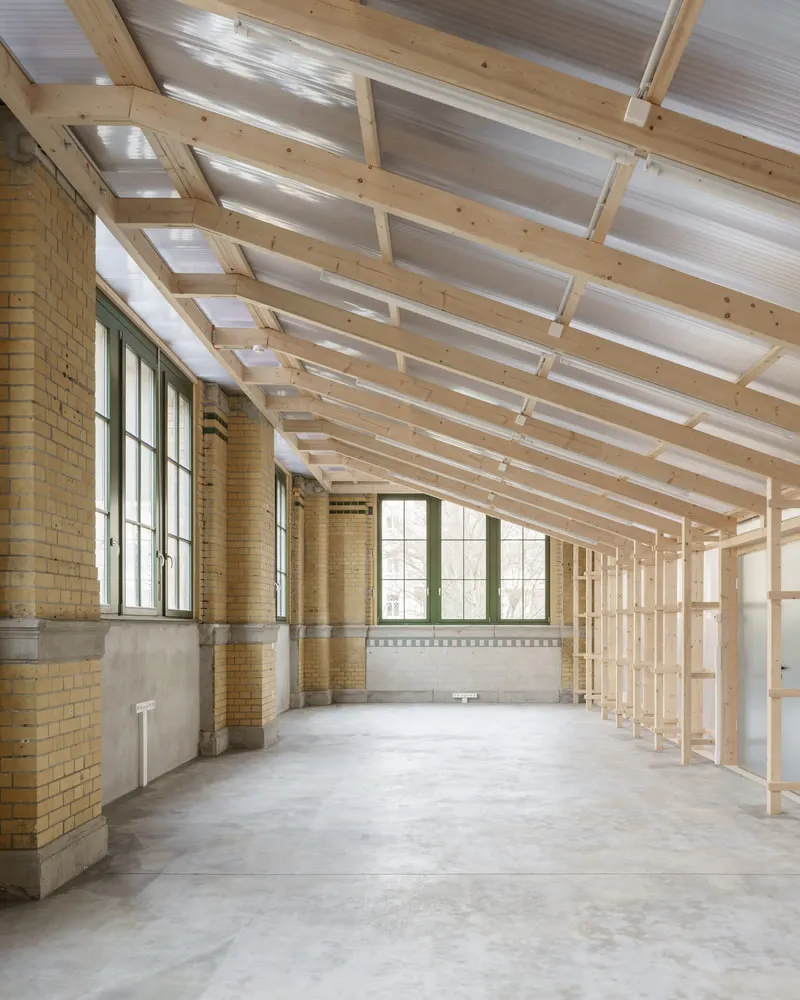
One of the project's strongest qualities is what it chose not to touch. The yellow brick perimeter walls carry decades of patina: paint remnants, electrical conduit scars, the ghosts of removed equipment. The iron roof trusses are original, and their exposed structure gives the hall its verticality. KO/OK made a deliberate decision to preserve these traces of former use, and the result is an interior that feels inhabited by its own history rather than cleaned up for new tenants.
Walking the corridor between the translucent boxes, the yellow brick on one side and the glowing polycarbonate on the other, you get a spatial experience that is genuinely layered: old and new, warm and cool, solid and translucent. It is the kind of juxtaposition that architects talk about constantly but rarely achieve with this degree of economy.
Why This Project Matters
The machinery hall renovation matters because it makes a convincing case that serious adaptive reuse does not require serious money. At €80,000 in material and labor, with the architects performing much of the work themselves, the project strips away the assumption that heritage buildings can only be activated through large-scale investment. The entire intervention is reversible, buildable with standard products, and anchored to the protected floor with three screws per volume. If the use changes or the monument requires restoration, the boxes come out and the hall returns to its 1910 condition. That is not a theoretical claim; it is a constructive fact.
More broadly, the project proposes a climate strategy that architects working with existing buildings should take seriously. Rather than insulating and conditioning an entire industrial volume, KO/OK identified the minimum habitable enclosure and heated only that. The monument does the rest, passively. It is an approach rooted in common sense and executed with genuine craft, and it deserves attention well beyond Leipzig.
Machinery Hall Renovation into Workshop and Office Space by KO/OK Architektur. Leipzig, Germany. 2022–2023. Photography by Sebastian Schels.
About the Studio
Share Your Own Work on uni.xyz
If projects like this are the kind of work you want to make, uni.xyz is a place to publish your own, find collaborators, and enter design competitions.


Popular Articles
Popular articles from the community


The Amber Palace Opera: A Geological Fiction Surfaces on Tallinn's Baltic Waterfront
Pierre Brillard reimagines a Baltic legend as a public landscape, opera house, and waterfront promenade rooted in Tallinn's coastal identity.

Cloaked Colonization: A Mobile Underwater Habitat That Moves Like a Fish
Micah Abaya's shortlisted EHC Pacific entry reimagines ocean settlement as a dispersed network of self-sustaining architectural organisms.

Tsunami Convergenics: Turning Catastrophic Ocean Forces into Underwater Housing Infrastructure
A speculative underwater settlement off the coast of Onagawa, Japan, treats tsunamis and typhoons as energy sources rather than threats.

Temporary Home for Dogs: A Reversed Zoo Rethinks Animal Shelter Architecture
In Bucharest, a sinuous corridor and freed landscape flip the logic of containment, designing a shelter that works to make itself unnecessary.

Similar Reads
You might also enjoy these articles


Hodi-Mandai Geram
Project Function: Preservation and revitalization of the Intangible heritage and socio-spatial identity of the Hodi by Housing, Cultural Memory Center, Sacred Grove, landscape, local tourism economy


Olio Towers: A Mid-Rise for Performers That Fuses Housing, Rehearsal, and Stage
Located blocks from Houston's Theater District, this modular tower stacks living units around a central performance atrium.

Oasis: Modular Green Housing Carved into Dhaka's Urban Fabric
A shortlisted Plugin Housing entry reclaims unauthorized settlements in Dhaka with stepped concrete volumes, green roofs, and ventilation-driven design.

Black Hole: A Floating Megastructure for the Post-Physical Era
Emiliano Mazzarotto envisions a spherical, self-scaling arena where e-sports, digital hotels, and holographic stadiums replace traditional public space.

Explore B19 Architekten Bda – Weimar Competitions
Discover active competitions in this discipline

Challenge to reimagine the Iron Throne

Photograph architecture without architects

Illustrate the lost glory of Angkor Wat - Render Challenge

Design challenge to reuse E-waste
Comments (0)
Please login or sign up to add comments
No comments yet. Be the first to comment!