

Ace Associates Wraps a Gujarat Office in Green Columns and Sweeping Curves
A 3,900-square-foot biophilic workplace unfolds within Asia's largest biogas campus in Anand, India, dissolving walls into landscape.


Most offices that claim to be "biophilic" settle for a potted fern near the elevator. The Whispering Curve Office, completed in 2024 by Ace Associates in Anand, Gujarat, takes the idea seriously enough to dissolve the building envelope almost entirely. Sited within a verdant campus that houses Asia's largest biogas plant, the 3,900-square-foot workplace replaces right angles with sweeping curves and substitutes solid walls with continuous glass, green steel columns, and planted beds that make it genuinely difficult to say where architecture ends and garden begins.
What makes the project worth studying is not the biophilic label but the structural commitment behind it. Led by Ar. Ashish Patel, Ar. Nikhil Patel, Ar. Nilesh Dalsania, and Id. Vasudev Sheta, the design team organized the entire plan around two curved volumes and a central courtyard, then resolved environmental performance through orientation and form rather than mechanical systems. The south-facing façade curves to deflect solar glare, the glass walls invite cross-ventilation, and the colonnade of vivid green tubular columns does double duty as shade structure and spatial marker. It is a small building with large ambitions.
Landscape as Threshold
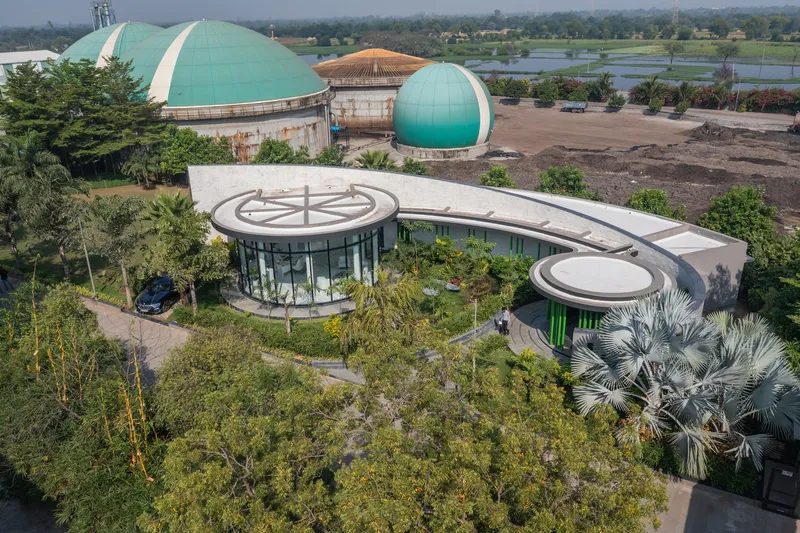
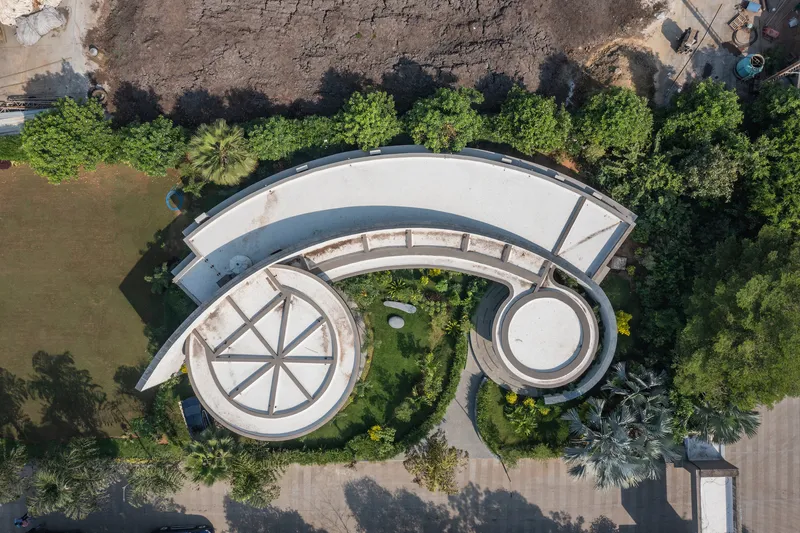
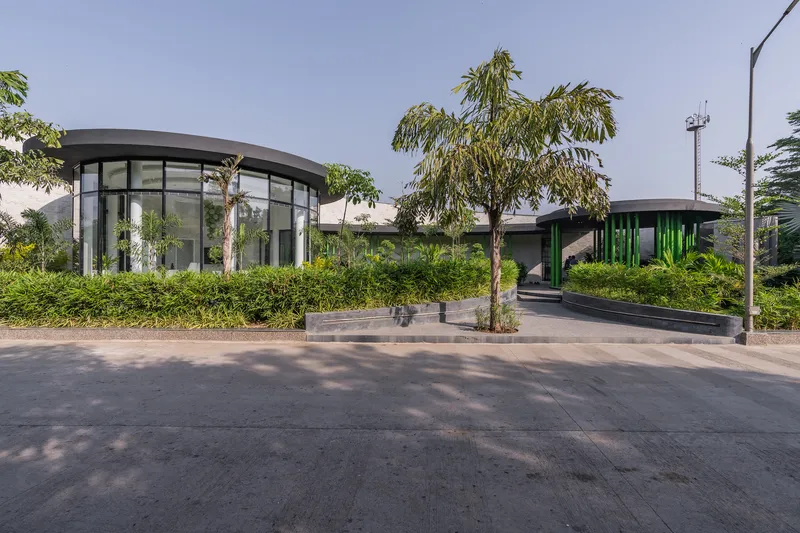
From the air, the building reads less as a freestanding object and more as a clearing in a dense tropical garden. Two curved roof planes, punctuated by circular skylights, sit low among palms, domed structures, and a waterway, hugging the terrain rather than asserting themselves against it. The aerial perspective reveals how deliberately the architects embedded the office within its campus context: the building mediates between manicured lawns and the productive infrastructure of the biogas plant.
At street level, the effect is equally deliberate. Young palms and planted green roofs soften the facade to the point where the architecture almost disappears behind foliage. The reception area was conceived as a transparent threshold, open on all sides, so that visitors experience no hard boundary between the landscaped approach and the interior. For a client already committed to sustainability at an industrial scale, the architectural language reinforces an identity rather than inventing one.
The Green Colonnade
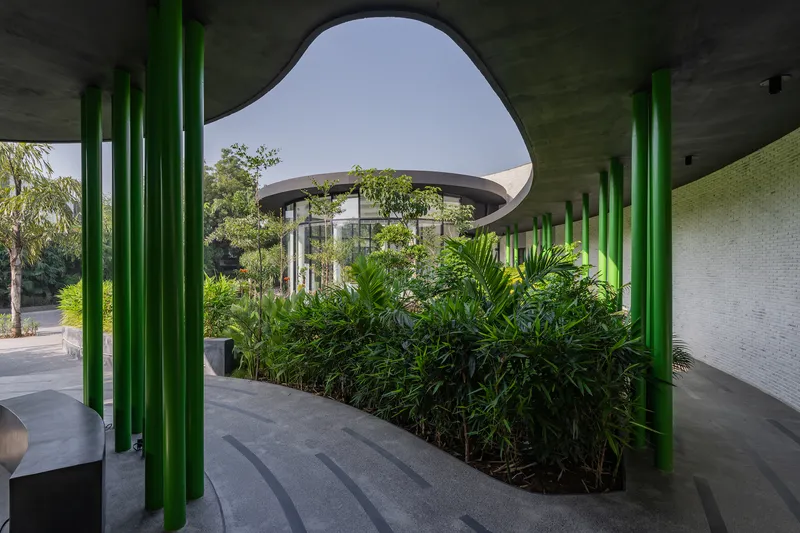
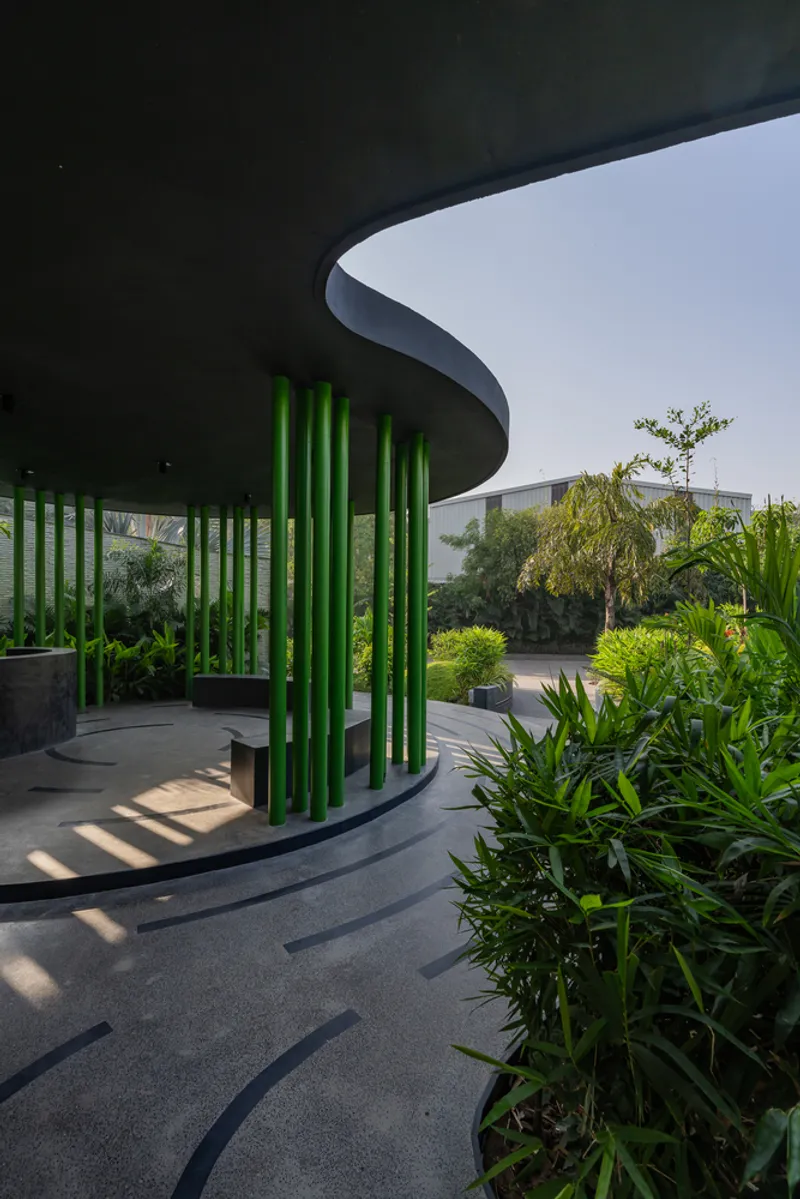
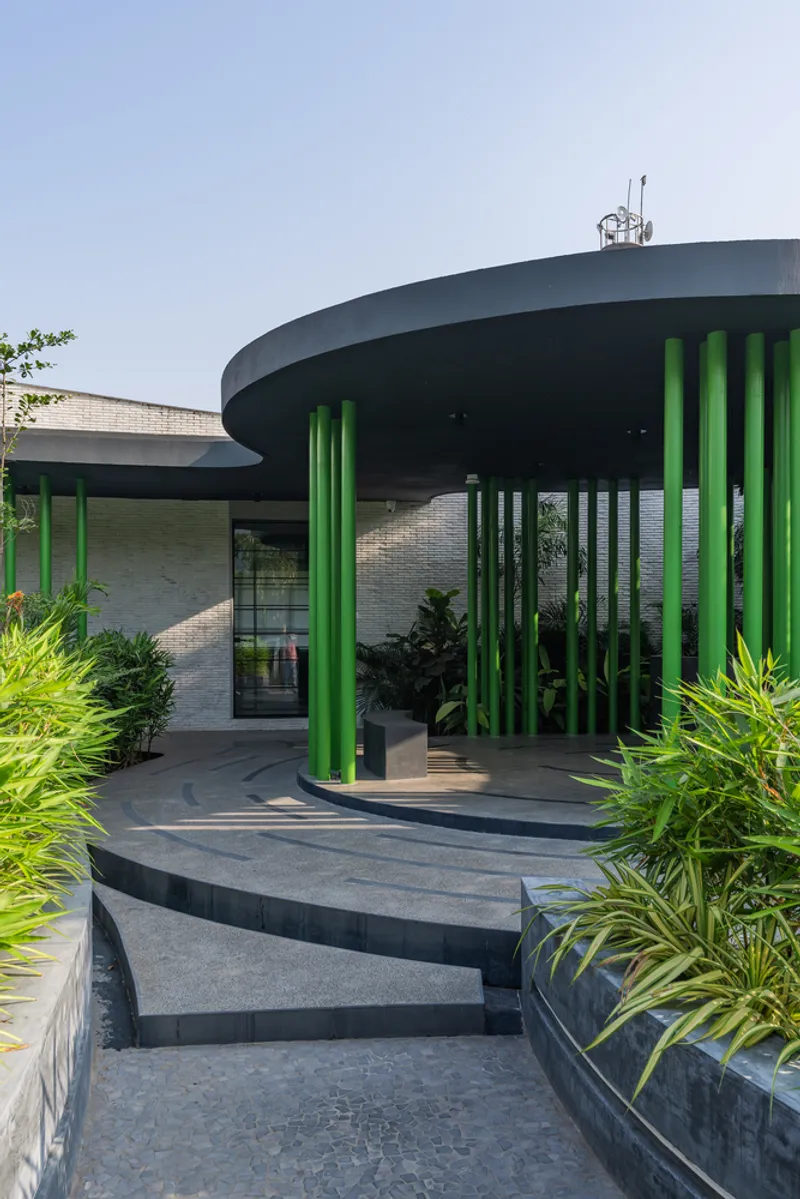
The most instantly recognizable element of the project is its colonnade of bright green tubular steel columns. They march along the curving covered walkways, frame planted beds, and cast striped shadows across stone paving throughout the day. Structurally, they support the dark concrete canopy that shelters circulation zones. Experientially, they transform every corridor into a semi-outdoor room.
Color is doing real work here. The green is saturated enough to read as an extension of the surrounding vegetation, yet artificial enough to register as architecture. It is a simple move, but it anchors the entire material palette: polished marble floors, grey brick accent walls, and glass all defer to those columns as the dominant visual element. The effect is playful without being cartoonish, which is harder to pull off than it looks.
Shadow, Light, and Circulation
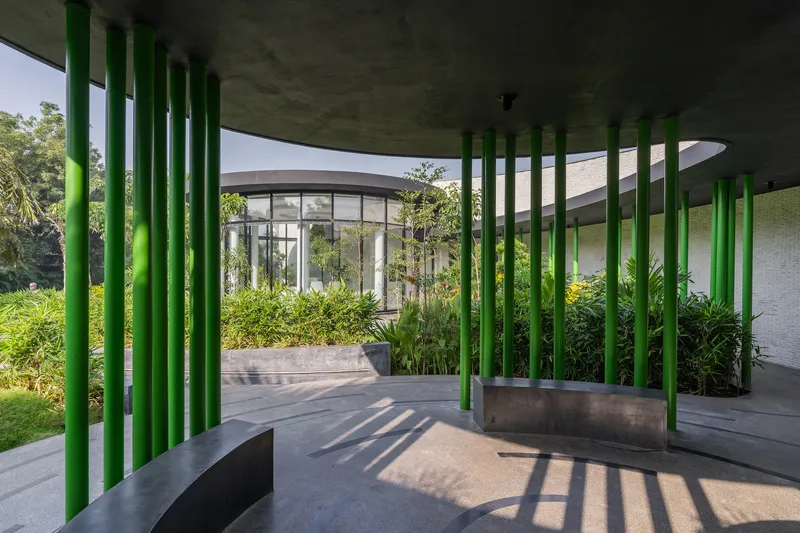

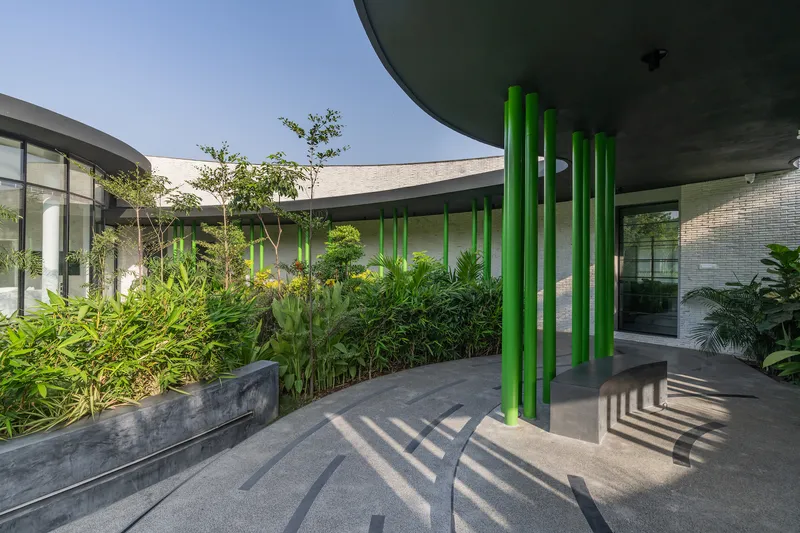
In a hot Indian climate, shade is not decoration; it is infrastructure. The canopy and colonnade generate a constantly shifting pattern of dappled light along the main circulation spine. Afternoon shadows from the tubular columns stripe the terrace floors and concrete benches, creating a visual rhythm that changes by the hour. The covered walkway functions as both connector and climate buffer, shielding occupants from direct sun while keeping them visually engaged with the garden on either side.
The curved pathway through the pavilion reinforces a layered spatial hierarchy. Public areas transition into semi-private administrative zones not through doors and partitions but through subtle shifts in enclosure, light level, and sightline. You are guided through the building by the curve itself, which narrows and widens to signal changes in program.
The Glass Pavilion
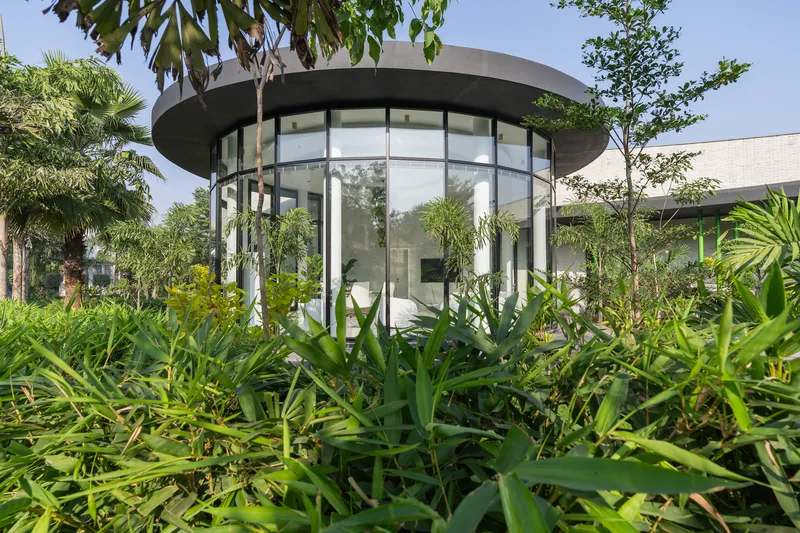
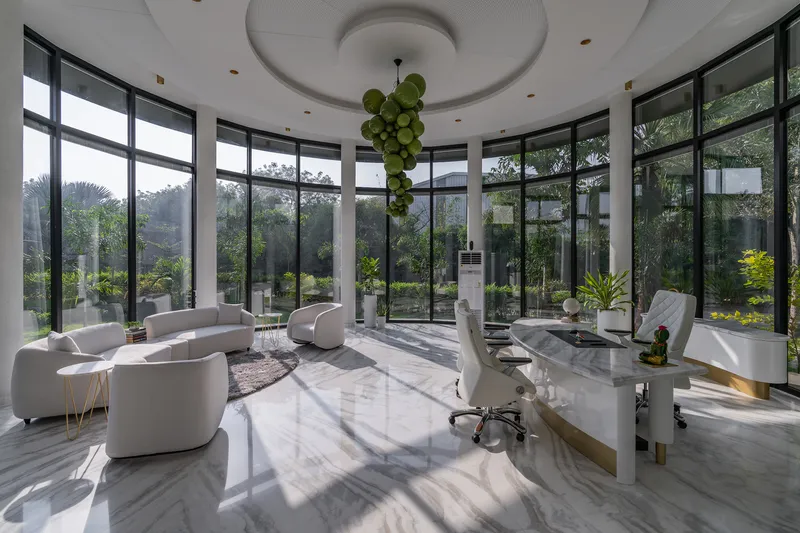
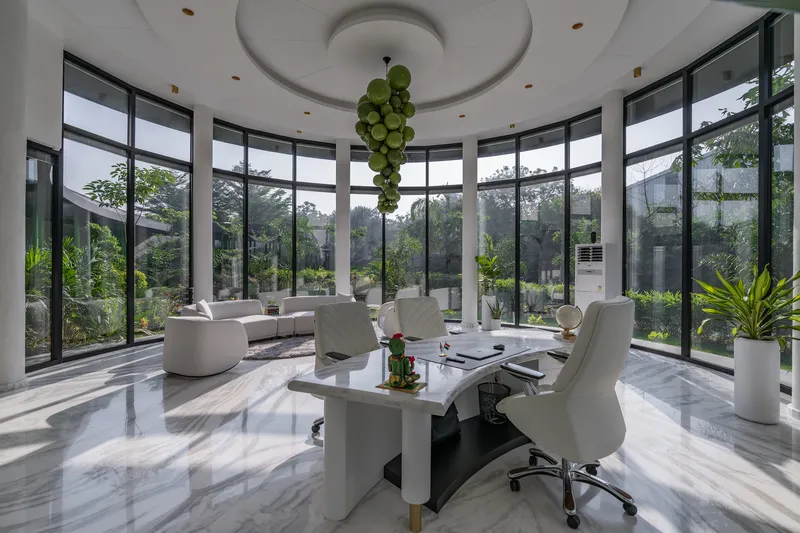
At the heart of the composition sits a cylindrical glass pavilion that houses the primary meeting and administrative spaces. From outside, it appears as a transparent drum wrapped in tropical planting, its concrete canopy hovering above like a parasol. Inside, the effect is striking: polished white marble floors reflect light from all directions, a circular ceiling recess accommodates recessed lighting and a hanging sphere fixture, and the 270-degree glass wall turns every meeting into a panorama of the front yard.
The Managing Director's cabin occupies the most privileged position within this volume, commanding uninterrupted views of the landscape. Conference rooms, the accounts cabin, IT areas, and smaller meeting rooms radiate outward from this core. The continuous glazing ensures that no workspace is more than a glance away from greenery, which is the whole point of the biophilic premise: nature is not a reward for the corner office but a constant condition for everyone.
Courtyard as Lung

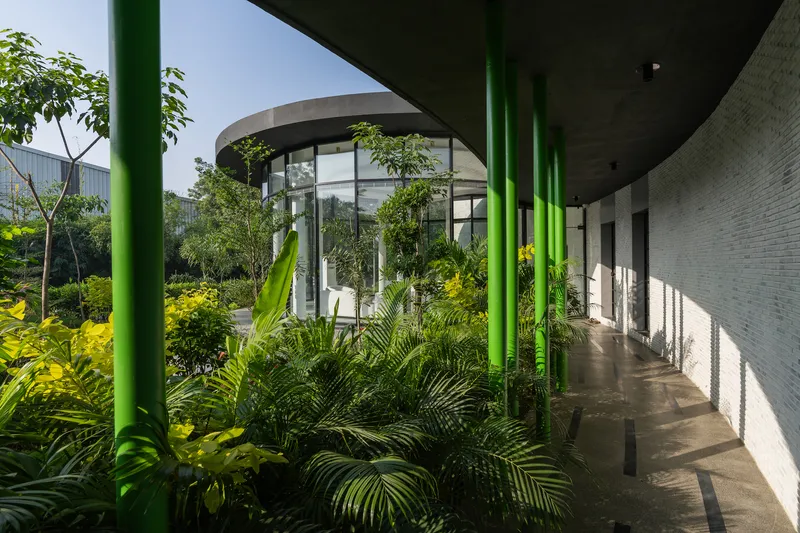
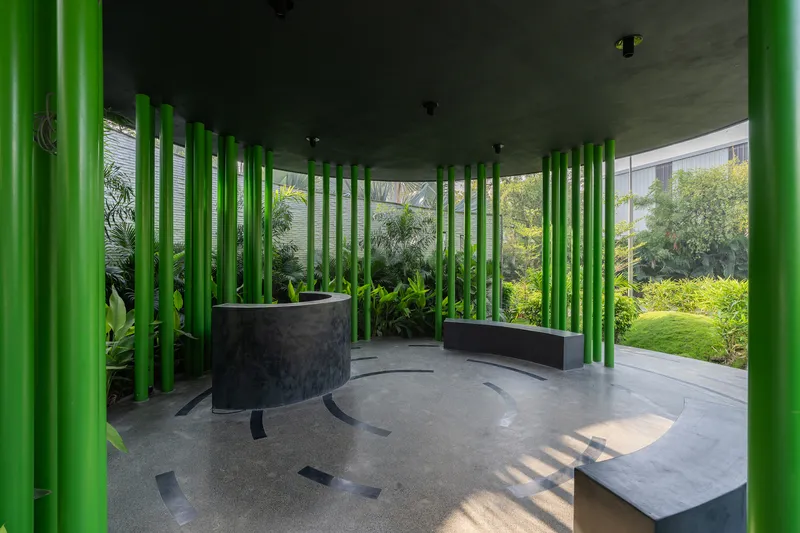
Between the two curved volumes, a central courtyard opens to the sky. Young trees, a lawn, and planted beds fill this void, turning it into a green lung that serves both environmental and social functions. The courtyard draws daylight deep into the plan, supports cross-ventilation through the glass-walled rooms that surround it, and offers an informal gathering space that complements the more structured workstations.
Viewed from the curved corridor, the courtyard becomes a framed composition: green columns in the foreground, planting in the middle ground, and glazed living spaces catching light in the background. The layering gives a building of modest footprint a spatial depth that belies its 3,900-square-foot area.
Material Restraint and Detail
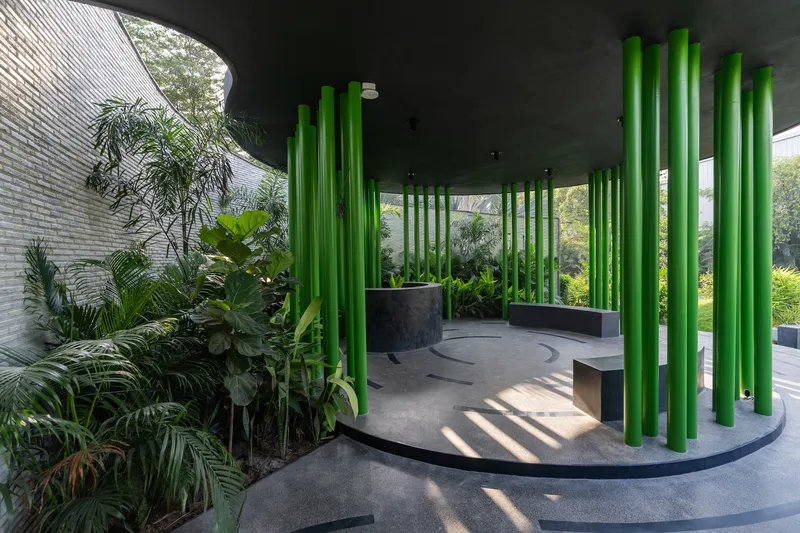
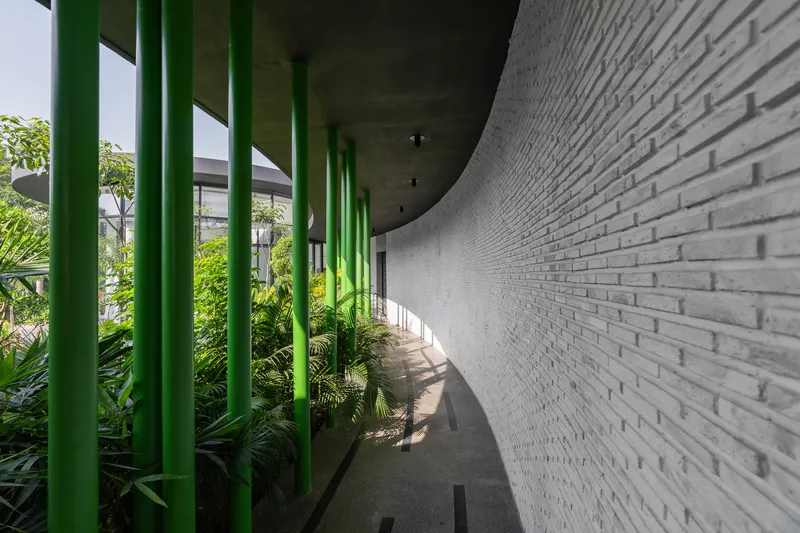
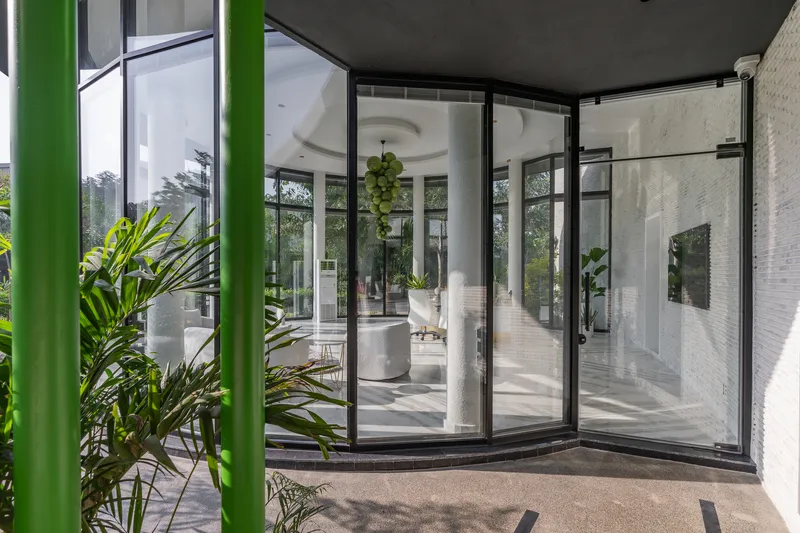
The palette is intentionally limited: grey brick, white marble, concrete, glass, and those green steel tubes. A white brick wall along one walkway provides a textured backdrop for shadow play, while the wood-lined entrance foyer introduces warmth at the point of arrival. The restraint ensures that the landscape remains the dominant visual material. Every surface is either reflective enough to bounce greenery inward or neutral enough to recede behind it.
Glass pivot doors between the covered walkway and interior rooms reinforce the threshold-free experience. When open, the boundary between outside and inside is purely atmospheric: you cross from shade into conditioned air, from birdsong to the hum of Mitsubishi Heavy HVAC units, without ever passing through a conventional door frame. It is a small detail, but it sustains the illusion that the building is a garden with a roof rather than an office with plants.
Plans and Drawings
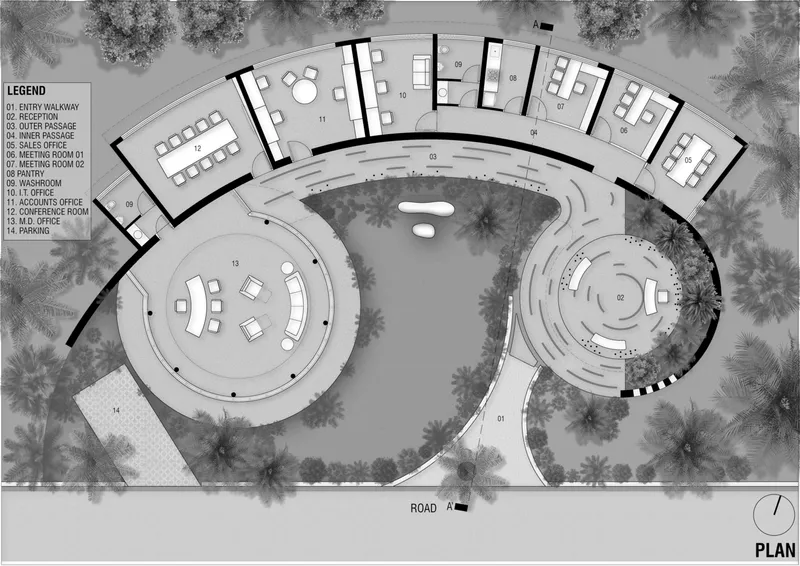

The site plan reveals the organizational logic clearly: two curved volumes embrace a central water feature, with mature trees ringing the perimeter. The geometry is not arbitrary; the arcs respond to the site boundaries and solar orientation, maximizing shaded frontage on the south while opening the courtyard to controlled daylight. The section drawing through the glazed pavilion confirms the low-slung profile and shows how interior ceiling heights remain generous despite the modest overall scale. Human figures and misty tree silhouettes in the section convey an atmosphere that the plan alone cannot: this is a building designed to be experienced at walking pace, with nature always in peripheral vision.
Why This Project Matters
The Whispering Curve Office matters because it demonstrates that biophilic design does not require a massive budget or a sprawling footprint. At 3,900 square feet, it is closer to a large apartment than a corporate headquarters, yet it delivers a convincing argument that workplace architecture can be organized around landscape rather than around a floor plate. The curvilinear form is not a stylistic flourish; it controls solar exposure, structures circulation, and creates a spatial experience that a rectangular box simply cannot replicate.
Ace Associates also shows that context can be a genuine design driver rather than a consultant's afterthought. Placing an office within a biogas campus could have been incidental, but the architects leveraged the existing ecological commitment as a design brief, treating the surrounding greenery as both collaborator and material. The result is a workplace where sustainability is not a certification on the wall but the air you breathe and the view from every desk. For offices that still debate whether to install a living wall, this project suggests they are asking the wrong question.
Whispering Curve Office by Ace Associates (Ar. Ashish Patel, Ar. Nikhil Patel, Ar. Nilesh Dalsania, Id. Vasudev Sheta). Anand, Gujarat, India. 3,900 sq ft. Completed 2024. Photography by Inclined Studio.
About the Studio
Share Your Own Work on uni.xyz
If projects like this are the kind of work you want to make, uni.xyz is a place to publish your own, find collaborators, and enter design competitions.


Popular Articles
Popular articles from the community


Faces of the Soviet Avant-Garde: Turning Moscow's Street Names into an Open-Air Museum
A network of sculptural installations across a Moscow residential district transforms forgotten architect names into spatial encounters with cultural memor

Cloaked Colonization: A Mobile Underwater Habitat That Moves Like a Fish
Micah Abaya's shortlisted EHC Pacific entry reimagines ocean settlement as a dispersed network of self-sustaining architectural organisms.

The Amber Palace Opera: A Geological Fiction Surfaces on Tallinn's Baltic Waterfront
Pierre Brillard reimagines a Baltic legend as a public landscape, opera house, and waterfront promenade rooted in Tallinn's coastal identity.

Opera on the Sea: Driftwood Logic Shapes a Timber Opera House on Estonia's Coast
Trevor Orgill's opera house translates the entangled drift of floating timber into a civic building where wood, water, and music converge.

Similar Reads
You might also enjoy these articles

Bamboo Housing Challenge 2026: Design Affordable, Sustainable Homes Using Bamboo
An international design competition by Bamboo U and IBUKU inviting architects and designers to reimagine affordable housing using bamboo — with the winning design built full-scale in Bali.

Computational Design & Education: Beegraphy Design Awards Introduces 7th Category (Featuring Jiyun's Innovative Approach)
Dive into Beegraphy’s 7th Design Awards category, where computational design meets education to create immersive, interactive learning tools, inspired by Jiyun’s work.

From Parametric Lighting to Urban Furniture: Join the 2nd Workshop in Beegraphy’s Computational Design Series
Dive into Cutting-Edge Design Techniques and Practical Applications with Industry Experts

Last Call: Unleash Your Architectural Genius in SHAK's Kindergarten Design Competition
Urgent call for architects to join SHAK's kindergarten design competition before the looming deadline

Explore Biophilic Competitions
Discover active competitions in this discipline

Challenge to reimagine the Iron Throne

Photograph architecture without architects

Illustrate the lost glory of Angkor Wat - Render Challenge

Design challenge to reuse E-waste
Comments (0)
Please login or sign up to add comments
No comments yet. Be the first to comment!