
Xưởng Xép Turns a Ho Chi Minh City Modernist Apartment into Its Own Studio
A careful renovation in Vietnam layers green MDF, raw steel, and teak over original tile floors and sanded concrete walls.


Architects often talk about designing for other people. Designing for yourself is a different exercise entirely, one where every decision is a declaration of values rather than a negotiation with a brief. When the team at Xưởng Xép found an old modernist apartment in Ho Chi Minh City and decided to convert it into their own studio, the result was less a renovation and more a careful conversation with the building's existing character.
What makes this project worth studying is the discipline of its restraint. The original apartment, maintained with uncommon care by its previous owner, already possessed the spatial generosity and material honesty that many contemporary offices try to fake. Rather than stripping the space back to a blank canvas and starting over, Xưởng Xép chose to amplify what was already there: sanding walls to expose decades of patina, preserving original tile floors, and introducing new materials that read as extensions of the old fabric rather than interruptions. The result is a workspace that feels lived in from the moment it opens its doors.
A Threshold Between Eras
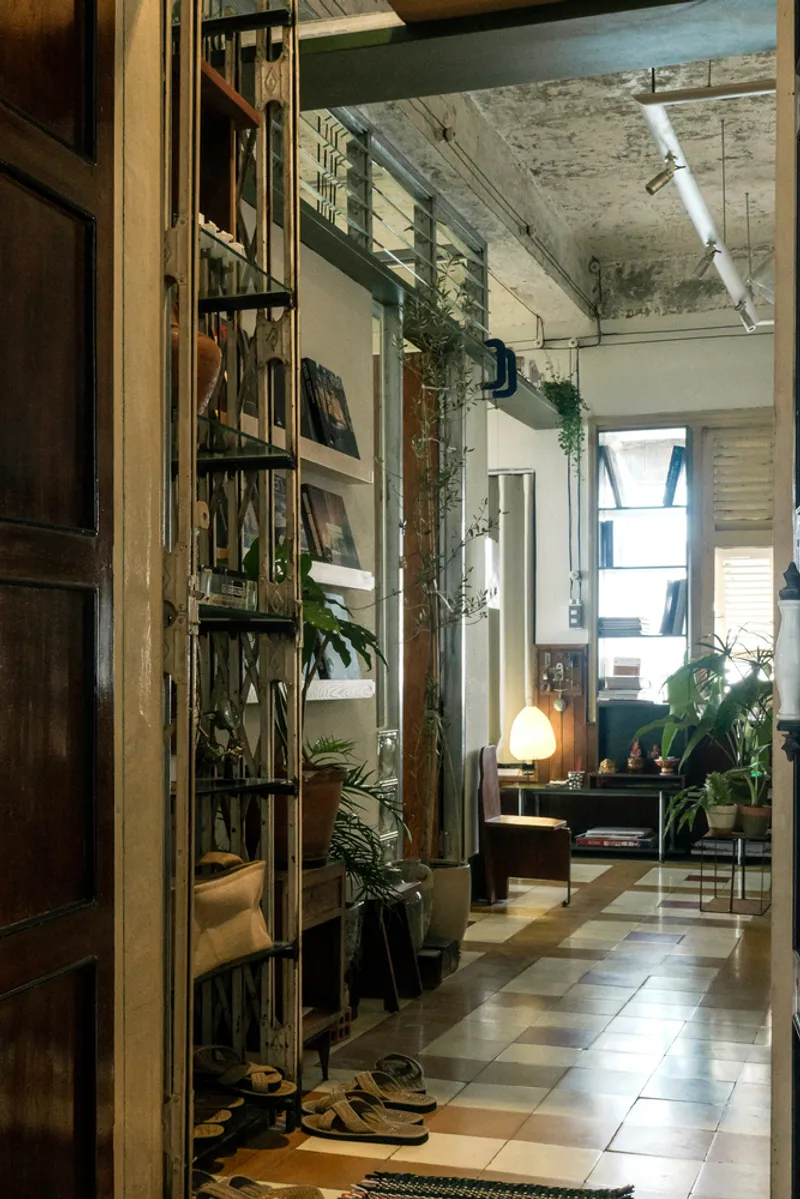
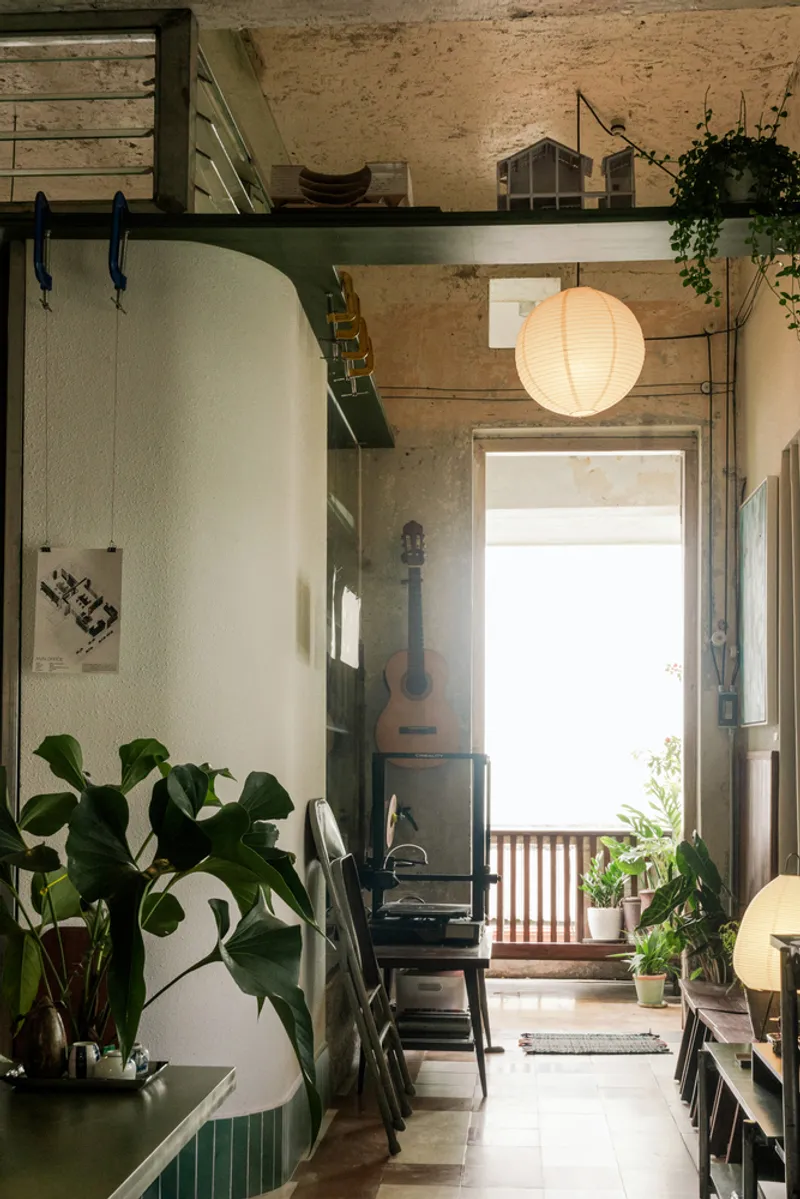
Entry into the Xưởng Xép office is staged through a series of thresholds rather than a single front door. Timber frames, metal shelving, trailing plants, and paper lanterns layer over one another to create a sequence that slows the visitor down, shifting perception from the dense energy of the street to the quieter register of the studio. The effect is almost domestic, which is precisely the point: the building was an apartment, and the conversion respects that lineage.
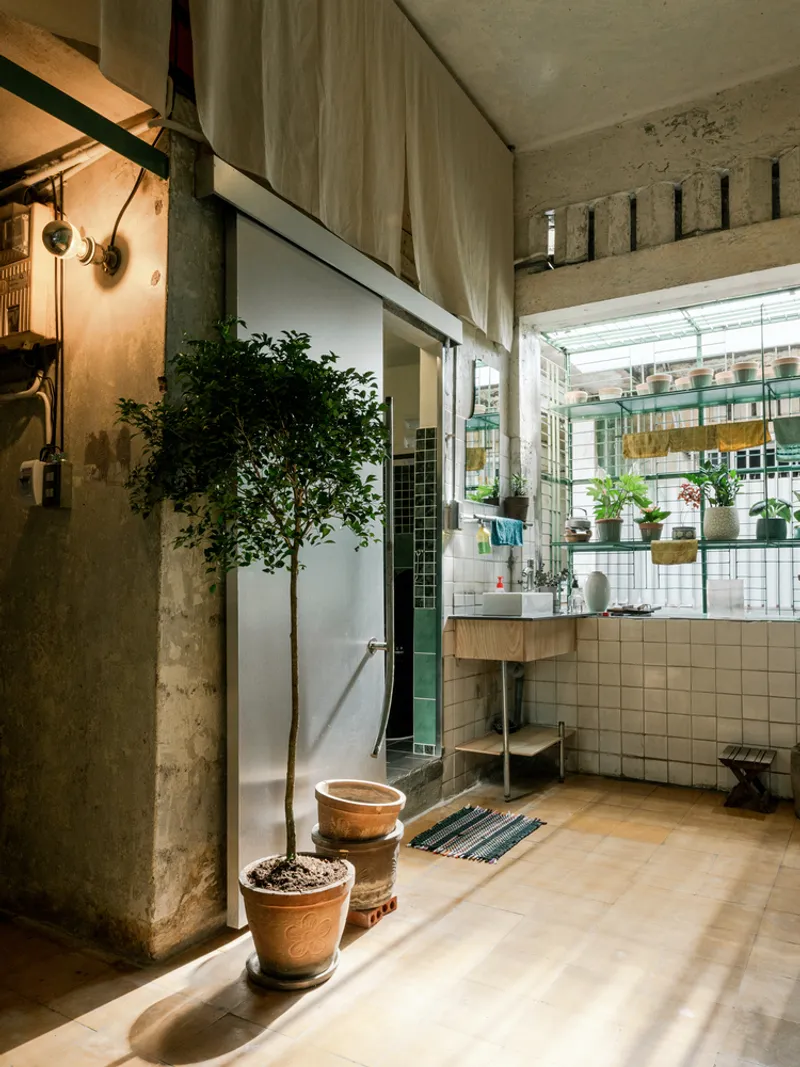
White square tiles on a transition wall reference the apartment's original bathroom finishes, pulled outward and repurposed as a textural motif. A slender potted tree stands where a coat rack might once have been. Nothing here screams "office lobby." The architecture trusts the visitor to understand they have entered a working space by what happens deeper inside, not by signage or reception desks.
Concrete Ceilings as Archaeological Evidence
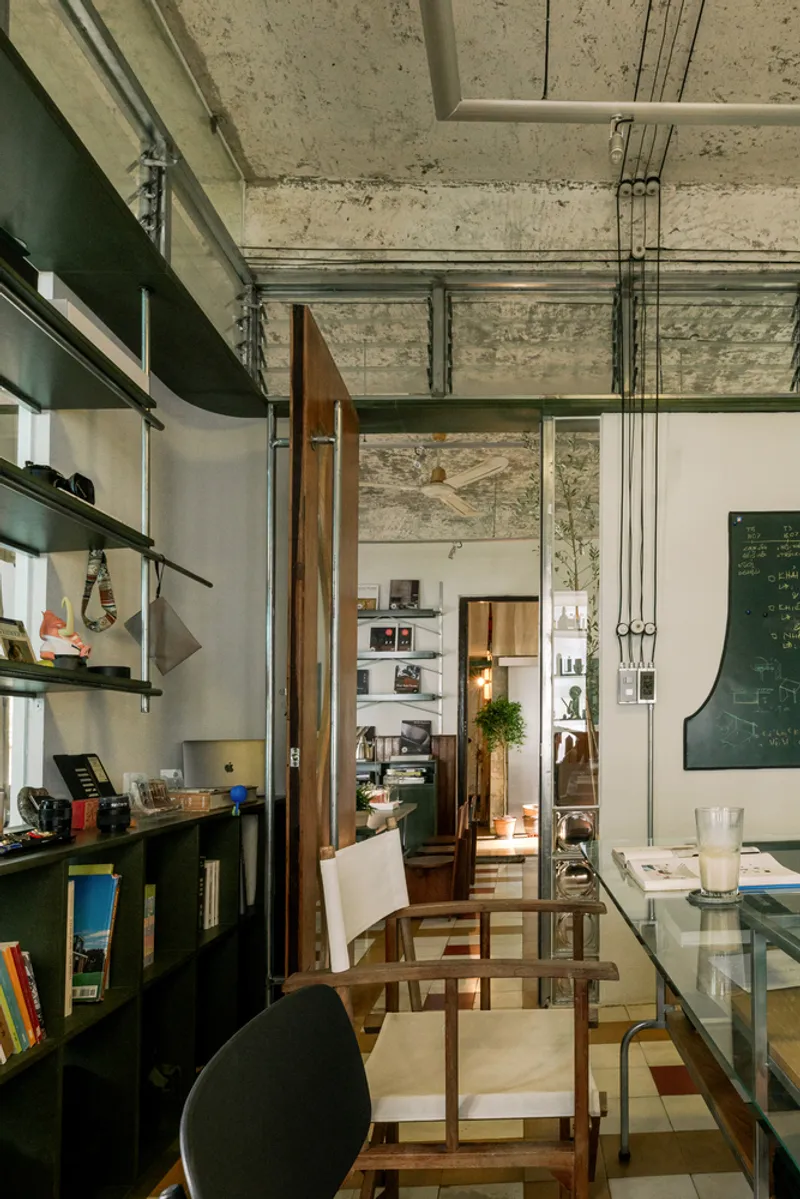
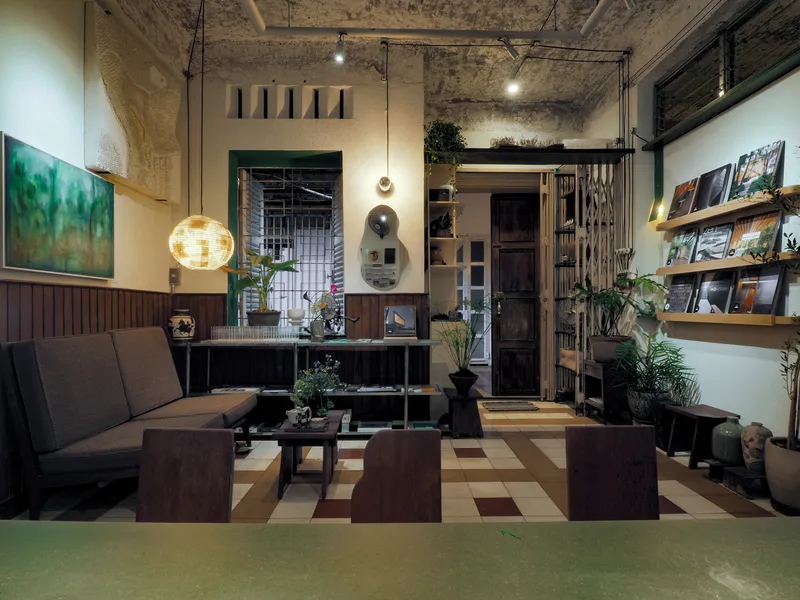
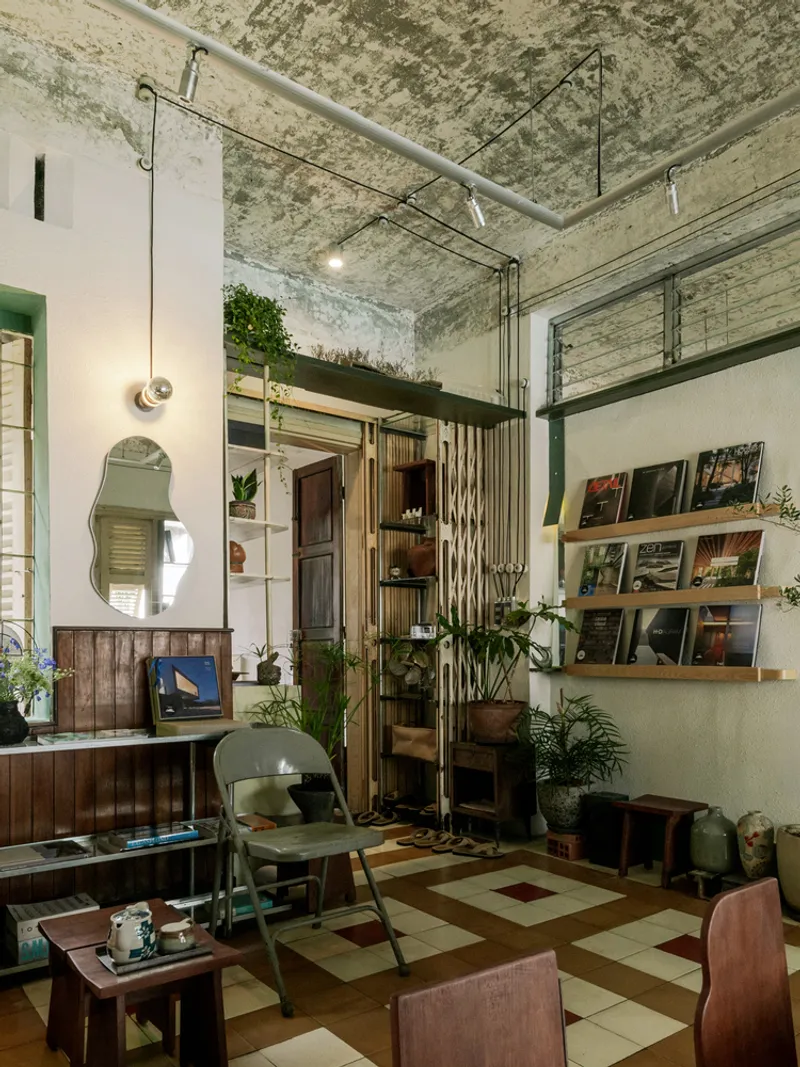
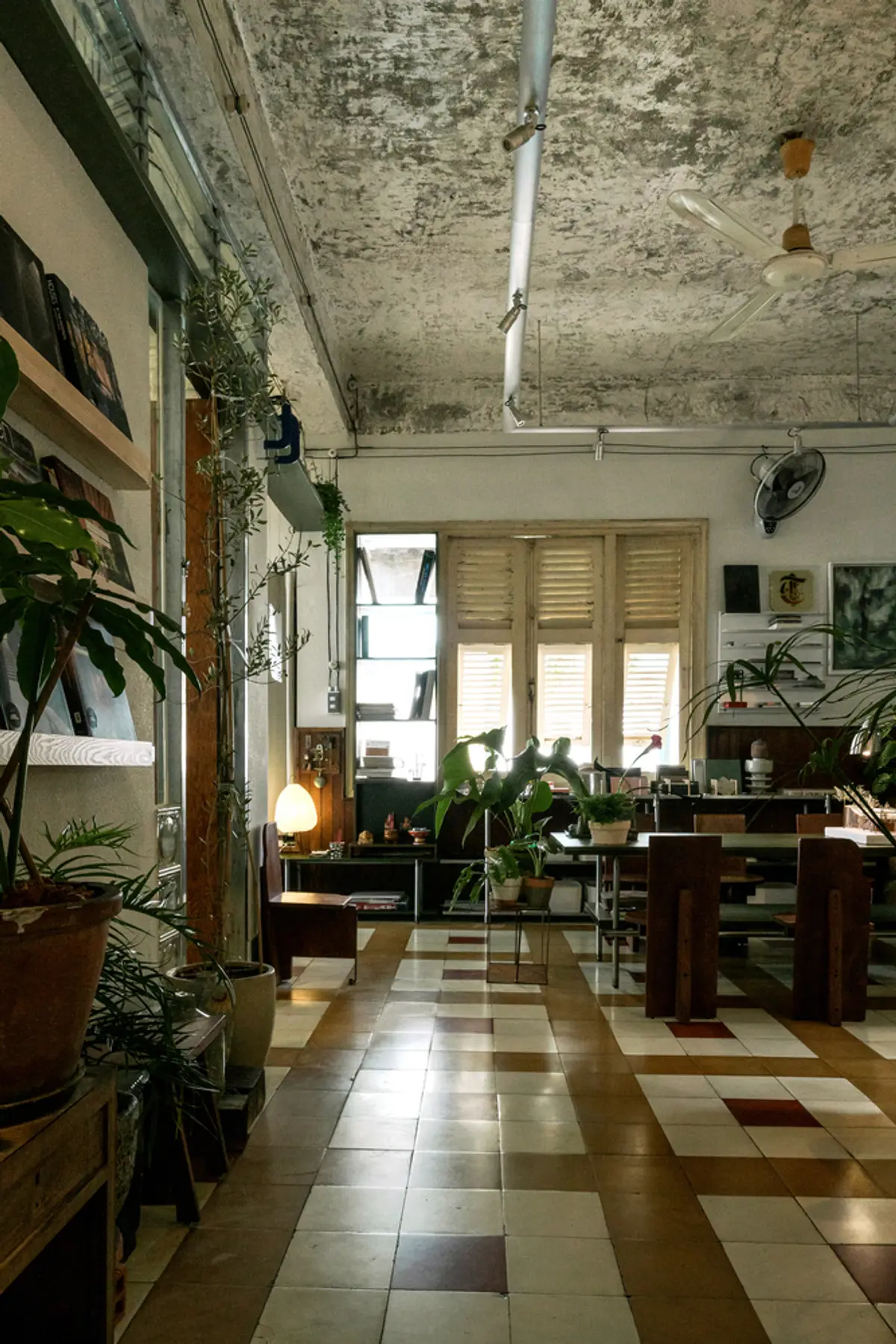
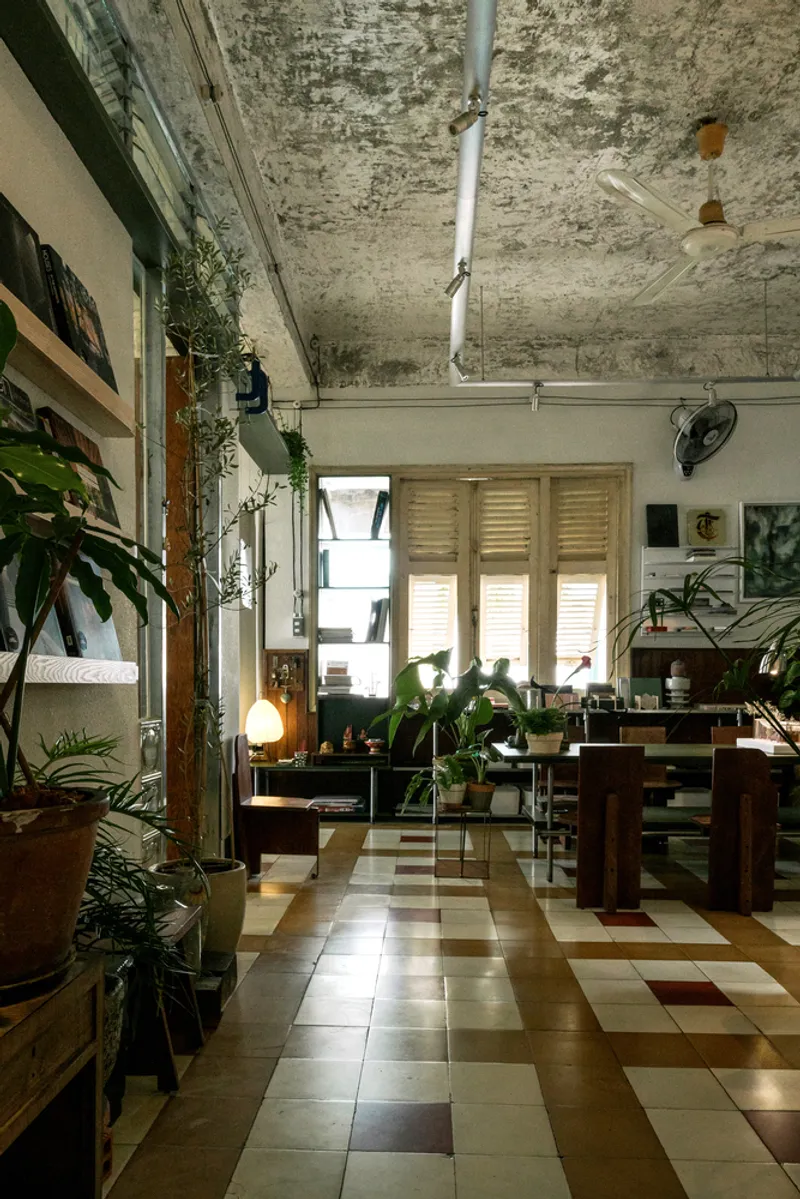
The exposed concrete ceilings are the project's most assertive preservation decision. Left raw, with visible conduits and construction marks, they function as a geological cross-section of the building's history. Every repair, every stain, every imperfection is legible. Against this rough overhead plane, the pendant lights, ceiling fans, and steel mezzanine read as clearly contemporary interventions, their precision forming a productive contrast.
In the double-height volume, this strategy pays off dramatically. The concrete spans uninterrupted above, while below, the chequered floor tiles lock the space into a specific era of Vietnamese domestic architecture. Suspended between these two horizontal surfaces, the life of the studio unfolds. It is a deliberately vertical composition: old below, old above, and everything new occupying the inhabited middle.
The Material Trio: Green MDF, Raw Steel, Teak
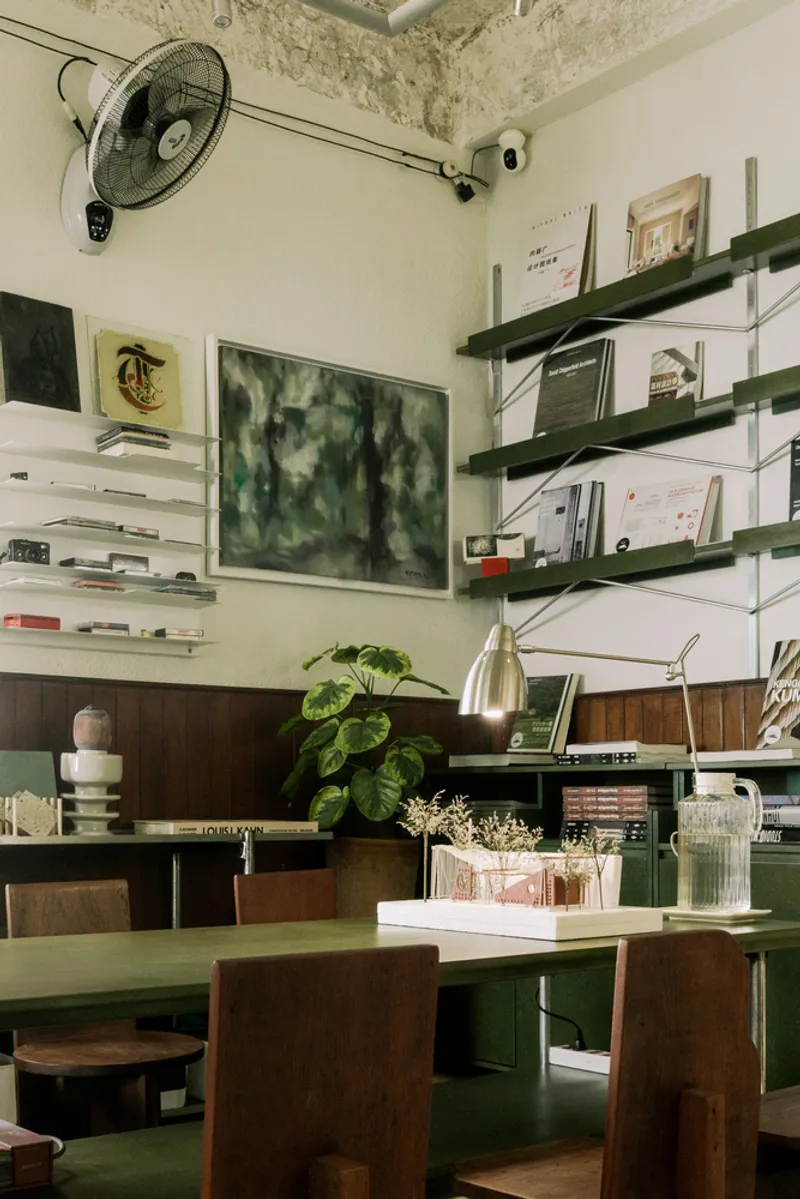
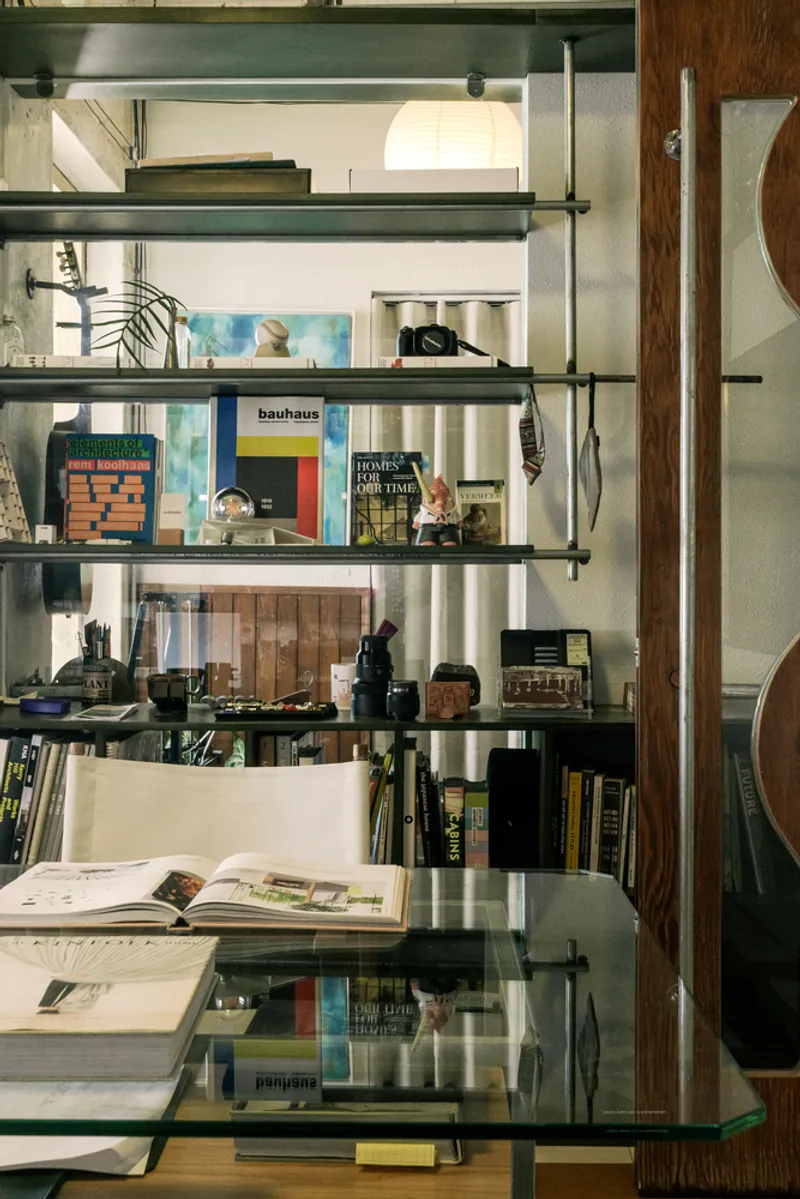
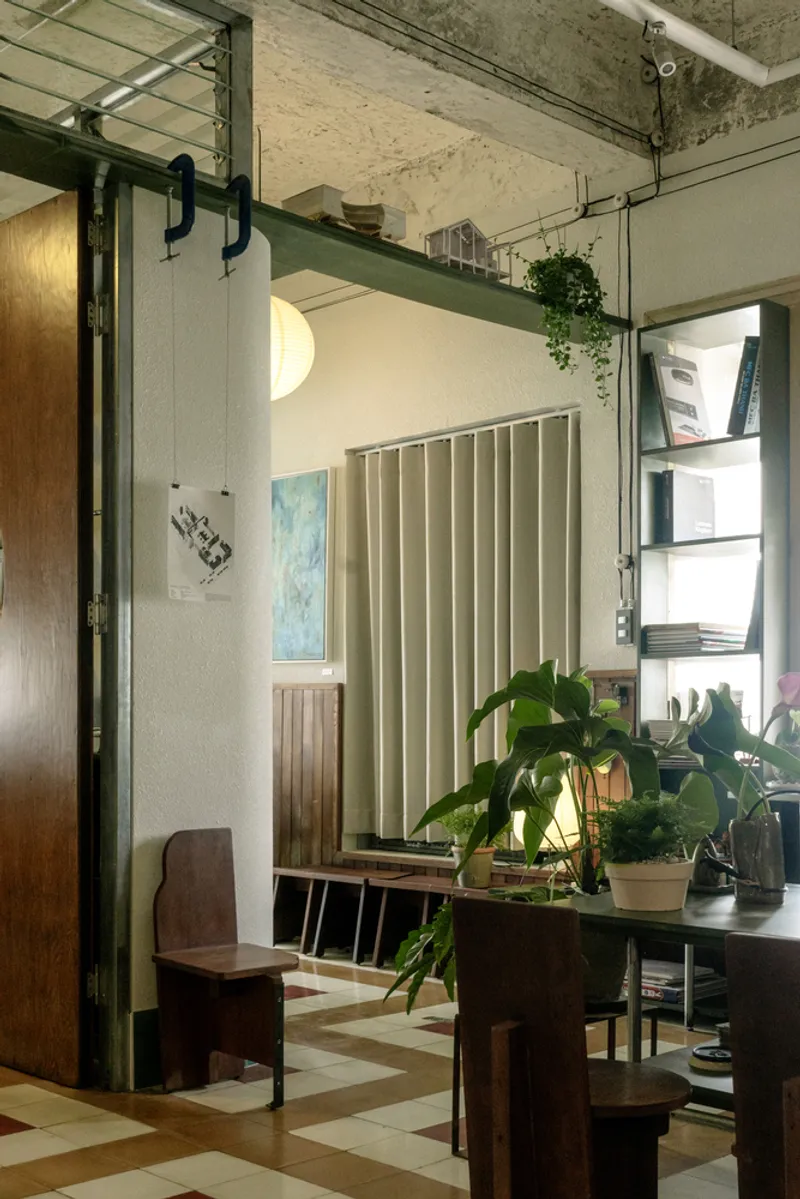
Xưởng Xép's material palette is limited to three new additions: green-core MDF, raw steel, and teak wood. The green MDF appears in shelving systems and structural accents on the mezzanine level, its color subtle enough to read as patina rather than decoration. Raw steel shows up in framing, rod suspensions for glass shelving, and the tracks for sliding doors. Teak provides warmth where the concrete might otherwise make the space feel industrial.
The discipline of this trio prevents the renovation from drifting into eclecticism. Every new element can be traced back to one of these three materials, which means the eye learns the vocabulary quickly and begins to distinguish old from new without conscious effort. The green steel beam on the mezzanine level, for example, reads immediately as an addition, while the concrete column beside it belongs unambiguously to the original structure. No labels needed.
Sliding Doors and Louvered Shutters as Climate Tools
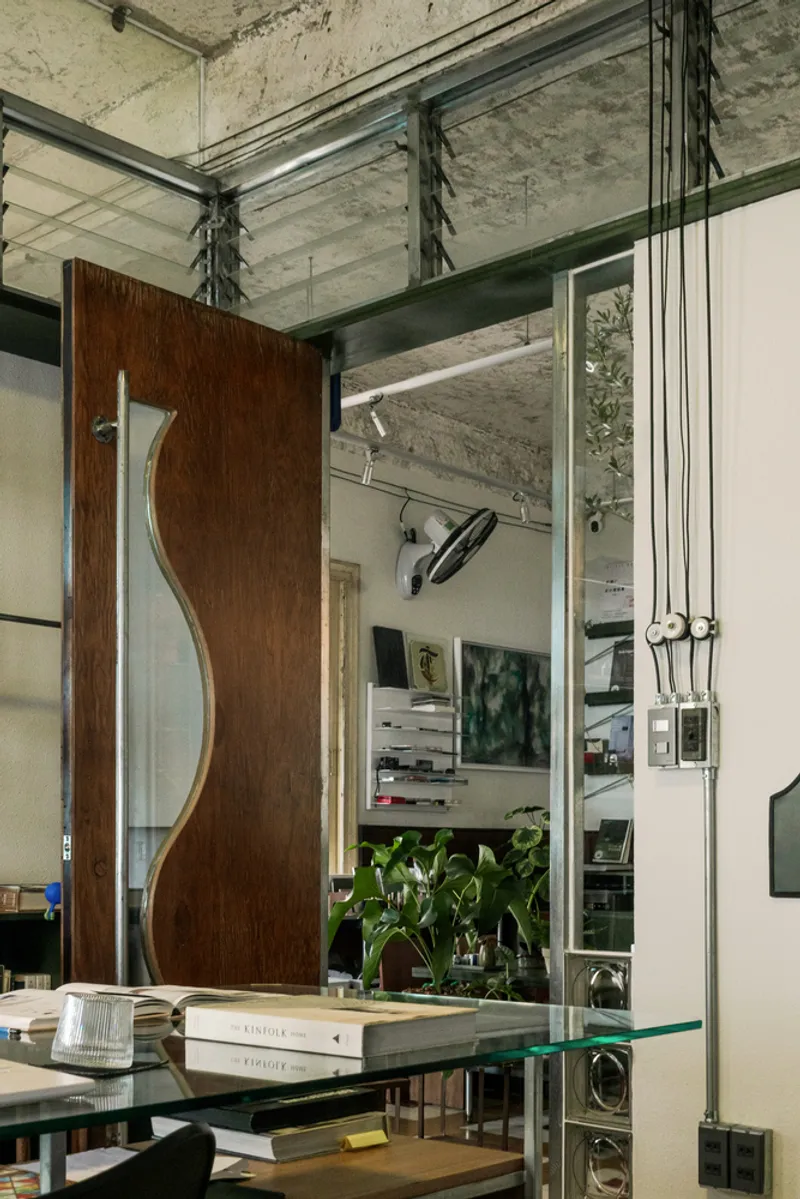
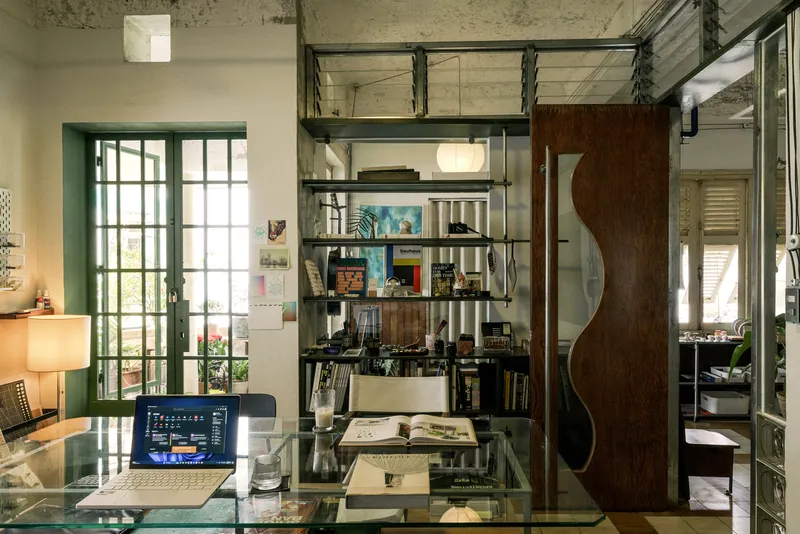
Two operable elements define how the office breathes. The sculptural timber sliding door, suspended from exposed steel tracks, allows the main workspace to be sealed or opened depending on the season, the meeting, or the mood. Its CNC-cut detailing references the apartment's original door but reinterprets it with a specificity that only digital fabrication allows. This is not a replica; it is a translation.
The louvered shutters along the longer axis of the space are drawn from the vocabulary of modernist tropical architecture that once defined Saigon's residential buildings. In their current role they regulate light and airflow through the studio, filtering Ho Chi Minh City's harsh afternoon sun into soft, raking bands. Seen in the long view down the corridor, with potted plants stacked along shelving and concrete weathering overhead, the shutters tie the project back to a regional building tradition that the city's rapid development has otherwise made scarce.
Domestic Details in a Working Context
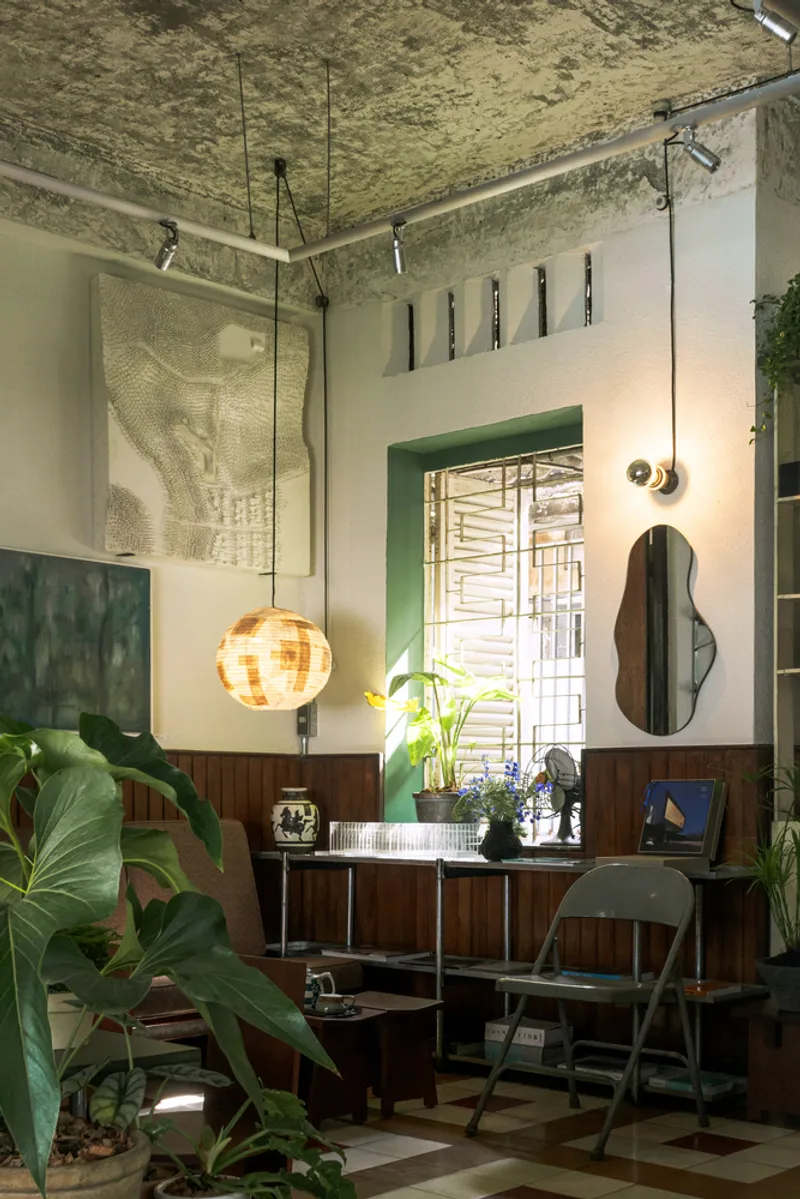
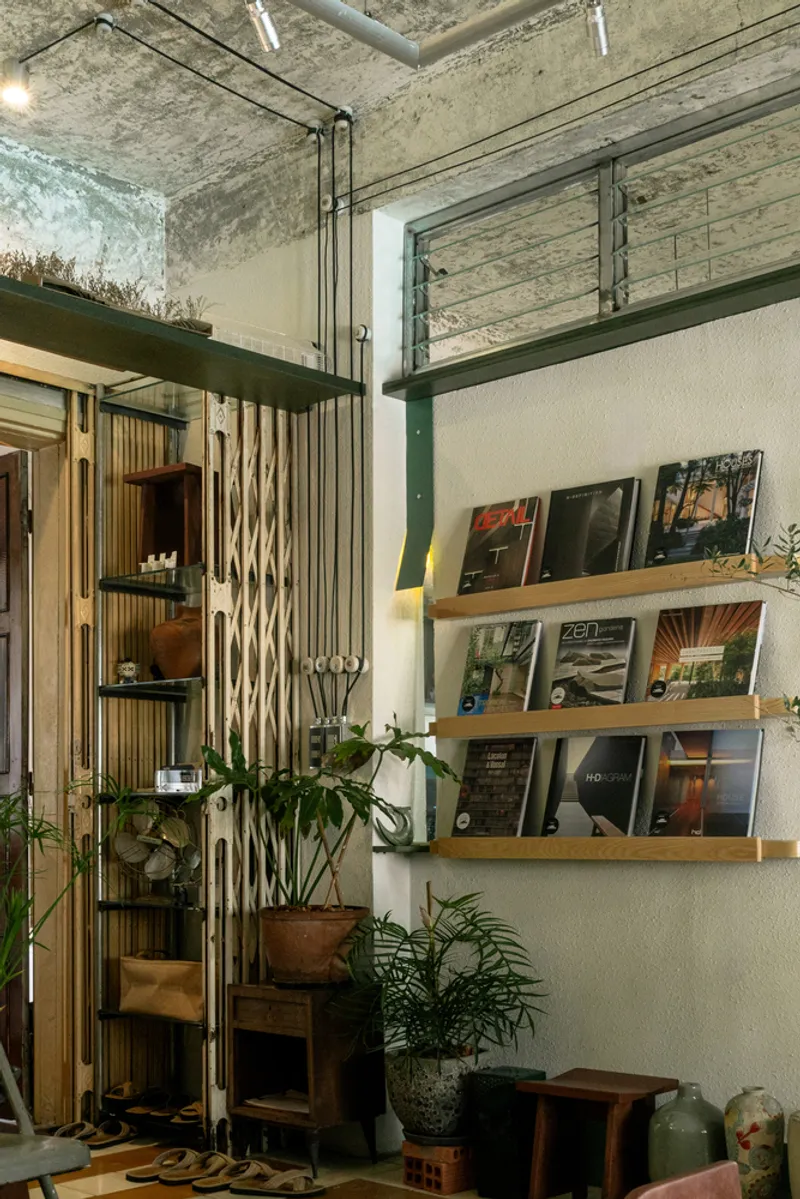
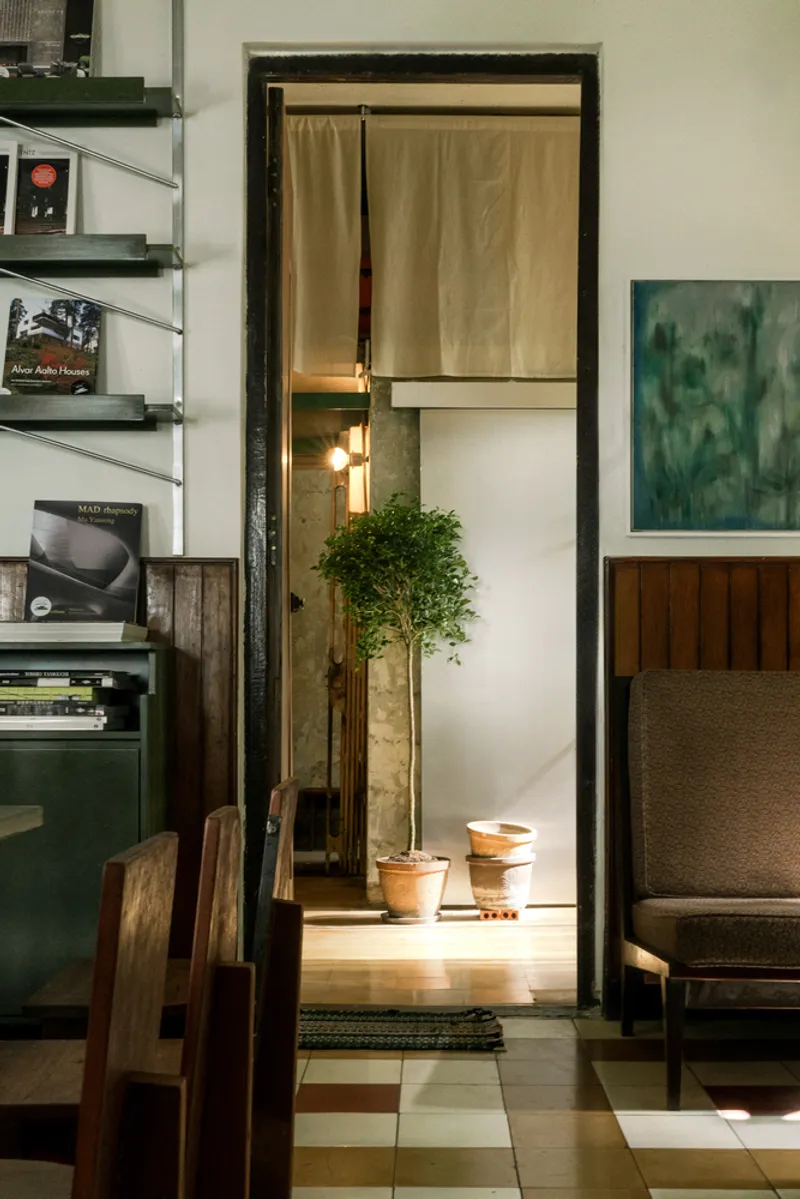
A green door frame and an organic-shaped mirror would look perfectly at home in a well-curated living room. Here they sit inside a design studio, and their presence does something important: they refuse to let the space become sterile. Timber magazine shelves and a bamboo room divider layer with hanging plants to create pockets of intimacy within the open plan. The fabric curtain leading to a smaller room with terracotta pots and green floor tiles could easily belong to a bedroom. These are deliberate gestures, not accidents.
Xưởng Xép has bet that creative work benefits from an environment that feels inhabited rather than optimized. The vintage furniture pieces, some salvaged from the apartment itself and others sourced to match, reinforce the sense that the space accumulated over time. Cabinet legs repurposed as structural details, table bases integrated into new workstations: these small acts of reclamation are where the project's ethos lives most clearly.
Wet Rooms and the Honest Corner
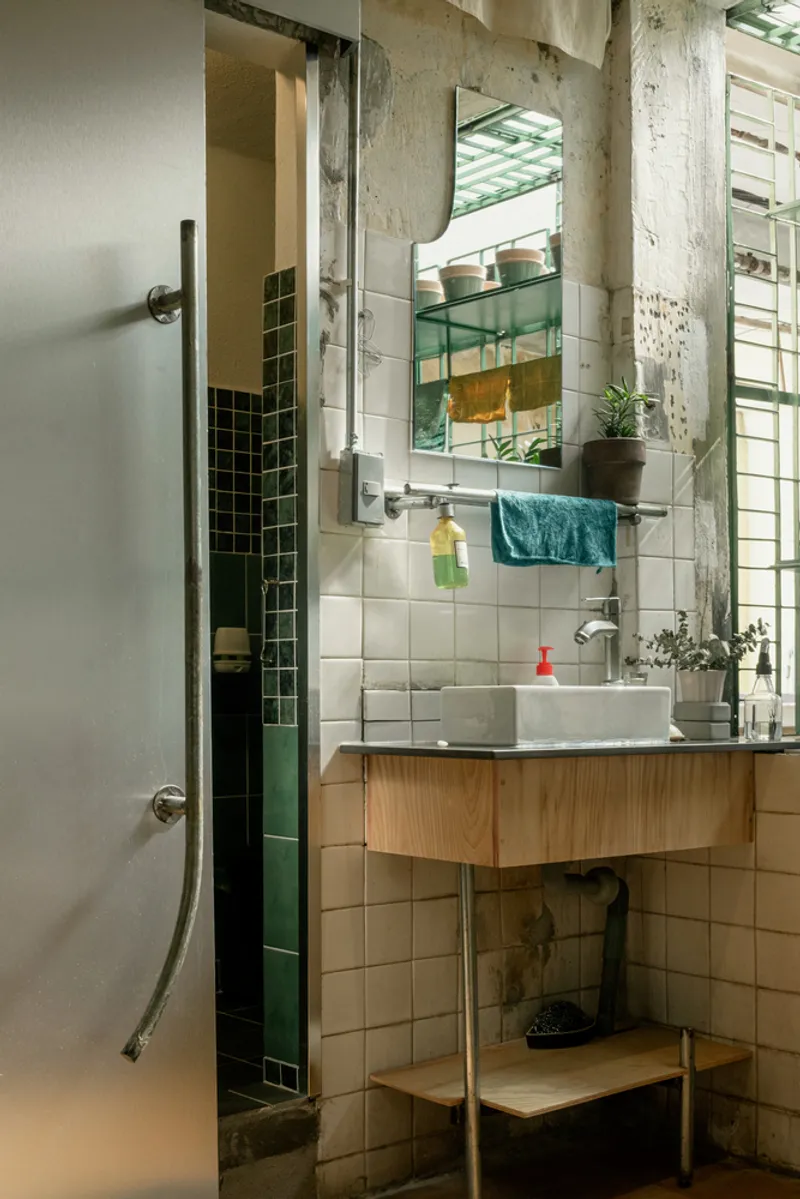
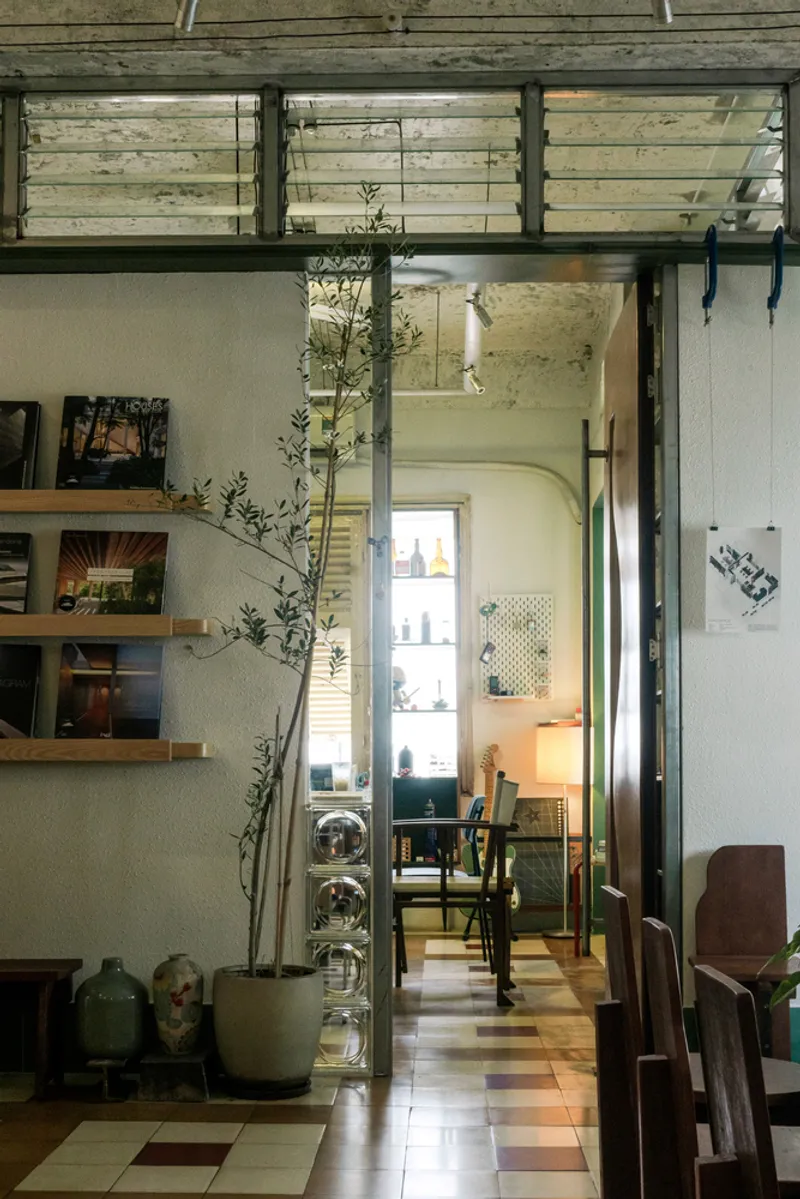
Even the bathroom gets the same treatment. White square tiles, a timber vanity, and a green-tiled shower sit beside an exposed concrete column. It is a small room, but it carries the full material logic of the project in miniature. Nothing is hidden. The column does not get cladded; the plumbing does not disappear behind drywall. If the rest of the office is a thesis on integrating old and new, the bathroom is its proof of concept at the smallest possible scale.
Plans and Drawings
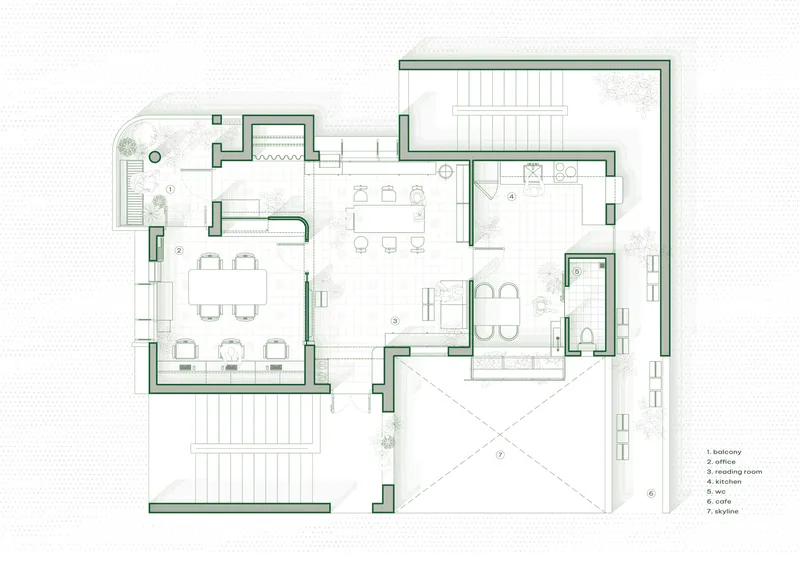
The floor plan reveals the project's spatial logic: a sequence of interconnected rooms organized around a central dining area, with a diagonal skyline void that pulls natural light into the deeper portions of the plan. The apartment's original layout, with its clear room-to-room progression, has been preserved rather than blown open. Walls stay where they were; doors move or transform, but the bones remain.
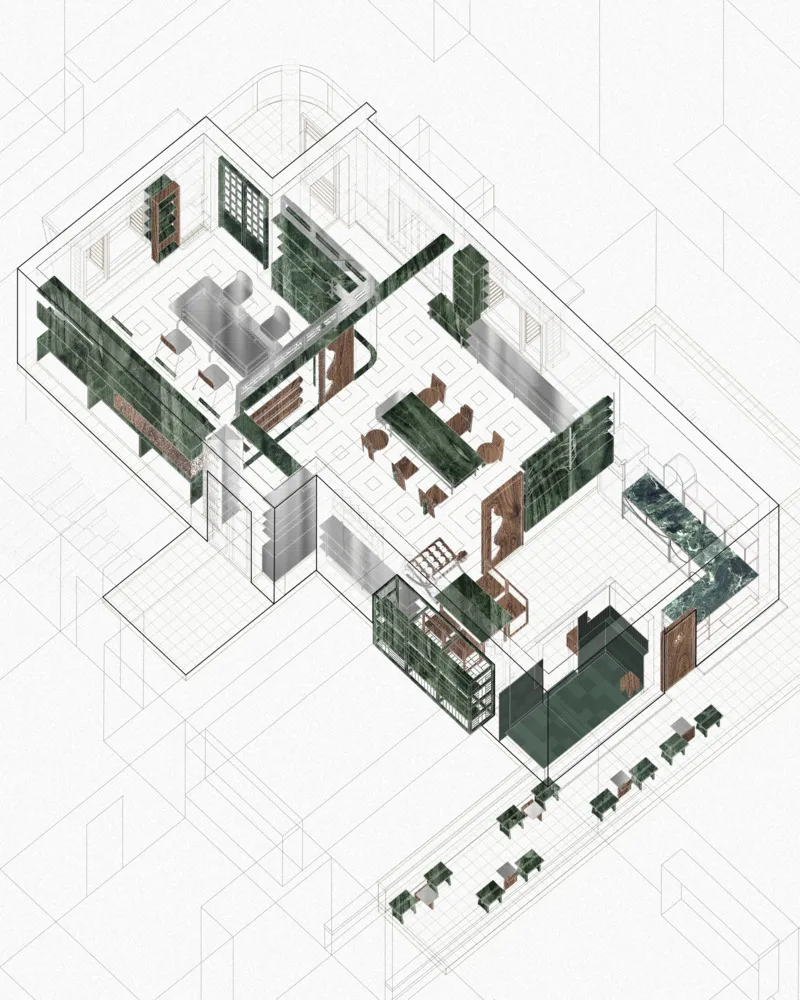
The axonometric drawing is perhaps the most revealing document. It shows the green-tiled walls, timber furniture, and construction grid as a single legible system, making visible the relationship between the mezzanine insertion and the double-height volumes below. You can trace exactly where the new steel structure lands within the old concrete frame. It is a drawing that rewards close reading, which seems appropriate for a studio that clearly values looking carefully at what already exists.
Why This Project Matters
Ho Chi Minh City is losing its modernist residential stock at an alarming pace. Apartments from the mid-twentieth century, the ones with generous ceiling heights, cross-ventilation strategies tuned to the local climate, and tile work that took real craft to install, are being demolished for towers or gutted beyond recognition. The Xưởng Xép office is a quiet counterargument: proof that these buildings can absorb new programs without surrendering their identity.
More broadly, the project offers a model for how small practices can turn limited budgets into strong architectural statements. By restricting the material palette, reusing existing elements, and treating the building's age as an asset rather than a problem, Xưởng Xép has produced a workspace that most firms with ten times the budget would struggle to match in atmosphere. The lesson is not subtle, but it bears repeating: the most sustainable building is the one that already exists, and the most compelling renovation is the one that knows when to stop.
Xưởng Xép Office by Xưởng Xép, Ho Chi Minh City, Vietnam, 2024. Photography by Duy Khiem.
About the Studio
Share Your Own Work on uni.xyz
If projects like this are the kind of work you want to make, uni.xyz is a place to publish your own, find collaborators, and enter design competitions.


Popular Articles
Popular articles from the community


longwave studio Reorganizes a 112 m² Tainan Apartment Around the Daily Routines of a Family and Two Cats
In Tainan, Taiwan, birch plywood, rust-red furniture and a freestanding plaster wall link arrival, storage, work and family life in one apartment.

Architekt Andreas Gruber Scatters 23 Dark Timber Chalets Across a South Tyrolean Forest Edge
In Molini di Tures, Amonti Chalets breaks a resort into a hamlet of gabled timber houses, with parking, storage and services pushed into the slope.

U.GA Architects Wraps an Oval Rooftop Pool in Curved Board-Formed Concrete on Busan's Jeollidan-gil
In Busan's Jeonpo-dong, a 454 m² mixed-use block stacks a neighborhood facility, guest rooms and an oval rooftop pool inside spiraling concrete walls.

GROUP A Strips a 1969 Rotterdam Harbor Headquarters to Its Frame and Wraps It in Timber Louvers
In Rotterdam's M4H harbor district, Ferro Offices reuses a 1969 frame, adds one timber storey and reaches BREEAM-NL Outstanding.

Similar Reads
You might also enjoy these articles

Gil Mello Arquitetura Tilts a Single Roof Toward the Waterfalls on a Plateau Above Aiuruoca, Brazil
In Aiuruoca, Minas Gerais, a 200 m² house of local labor and reclaimed poles pairs a low valley veranda with a tall mountain one.
U.GA Architects Wraps an Oval Rooftop Pool in Curved Board-Formed Concrete on Busan's Jeollidan-gil
In Busan's Jeonpo-dong, a 454 m² mixed-use block stacks a neighborhood facility, guest rooms and an oval rooftop pool inside spiraling concrete walls.

Felipe Hess Arquitetos Turns a Blind Stone Wall to the Street and Opens a Brazilian House onto a Courtyard and Canal
A canal-front house in Brazil hides behind painted stone and planting, then opens to an olive-tree courtyard, a reed-ceilinged porch and a curving pool.

David Macias Steps a Doorless Stone and Plaster House Down a Tropical Colombian Hillside
In the humid hills of Colombia, Threshold House replaces the front door with an open void and terraces its 850 m² down the slope instead of fighting it.

Explore Renovation Competitions
Discover active competitions in this discipline

Challenge to reimagine the Iron Throne

Photograph architecture without architects

Illustrate the lost glory of Angkor Wat - Render Challenge

Design challenge to reuse E-waste
Comments (0)
Please login or sign up to add comments
No comments yet. Be the first to comment!