
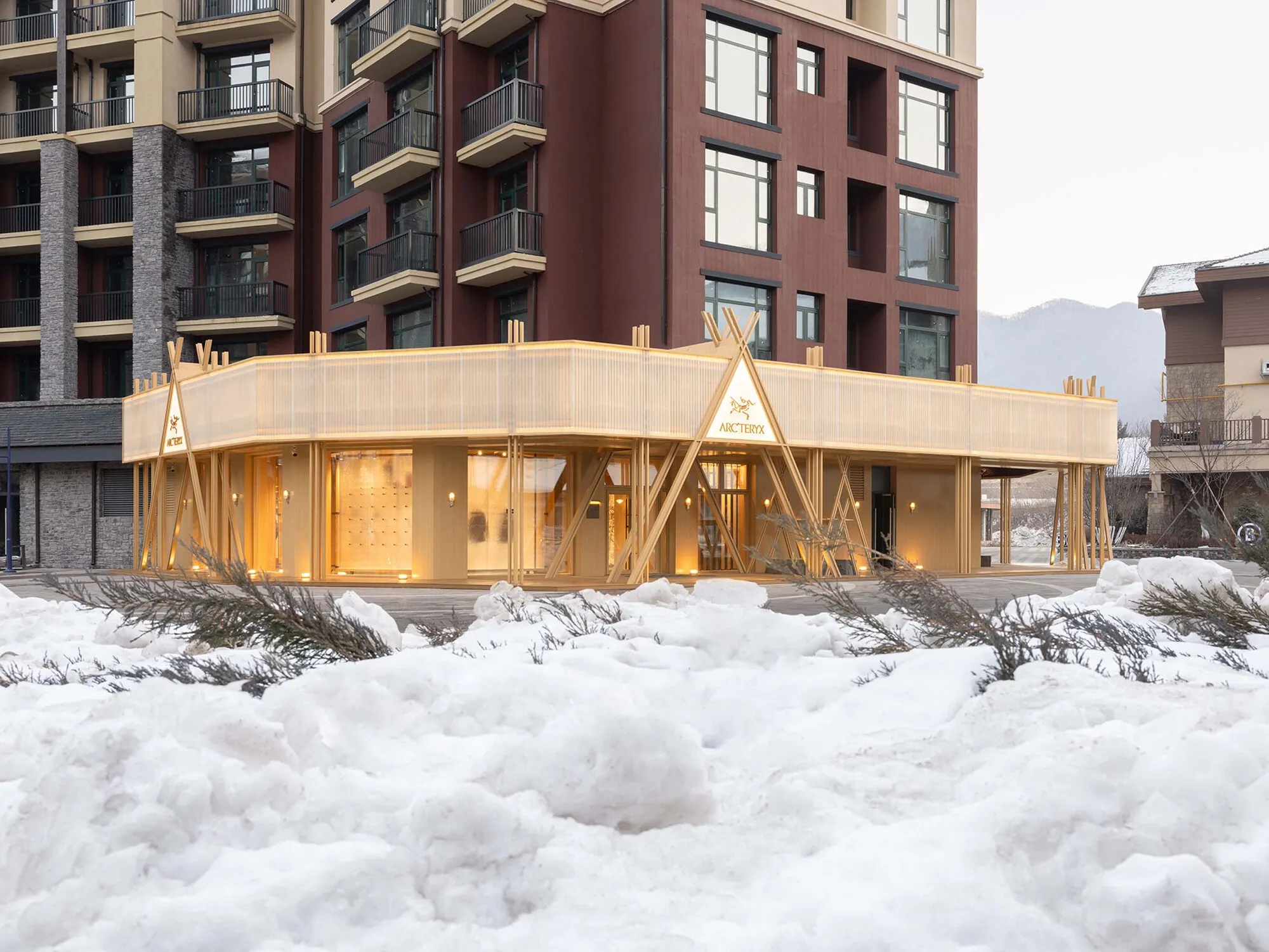
STILL YOUNG Builds a Glowing Campfire in the Snow for ARC'TERYX at a Chinese Ski Resort
A timber-framed pavilion at Beidahu Ski Resort in Jilin wraps warmth and glacier-like resin around outdoor retail.


When a brand rooted in coastal Canadian mountain culture lands at a ski resort in northeastern China, the design brief practically writes itself: make a refuge that feels earned. STILL YOUNG took that brief and compressed it into a compact pavilion at Beidahu Ski Resort in Jilin, treating the 465 square meters (roughly split between interior and outdoor space) as a campfire in the snow. The metaphor is not ornamental. Everything about the store, from its translucent skin to its radiating timber structure, is calibrated to glow against a landscape buried under meters of white.
What makes the project genuinely interesting is the collision between material ambition and logistical constraint. The centerpiece, a sculptural glacier column cast in acrylic resin, was prototyped in carved foam, refined to eliminate bubbles, manufactured at a factory in southern China, and shipped north to a mountain resort accessible for only part of the year. That kind of commitment to a single interior element tells you something about the priorities here: this is retail design that borrows its obsessiveness from architecture, not the other way around.
A Lantern on the Slope
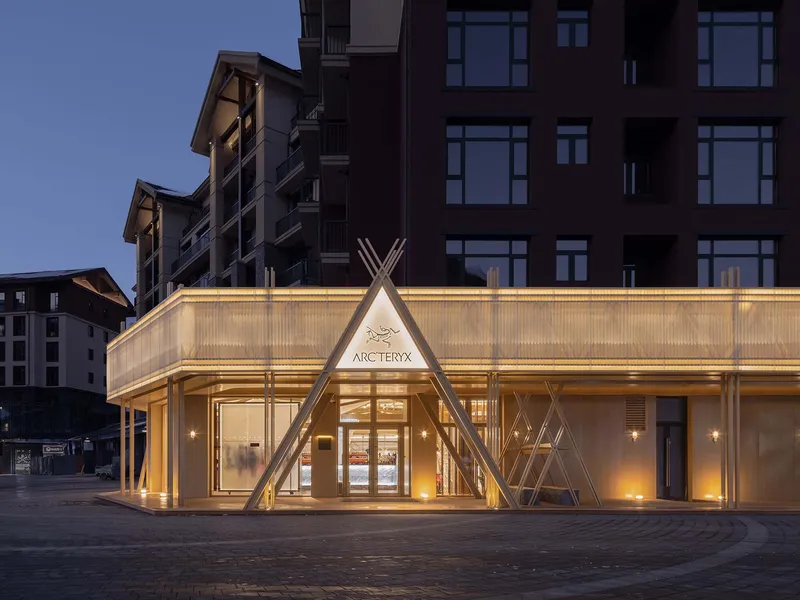
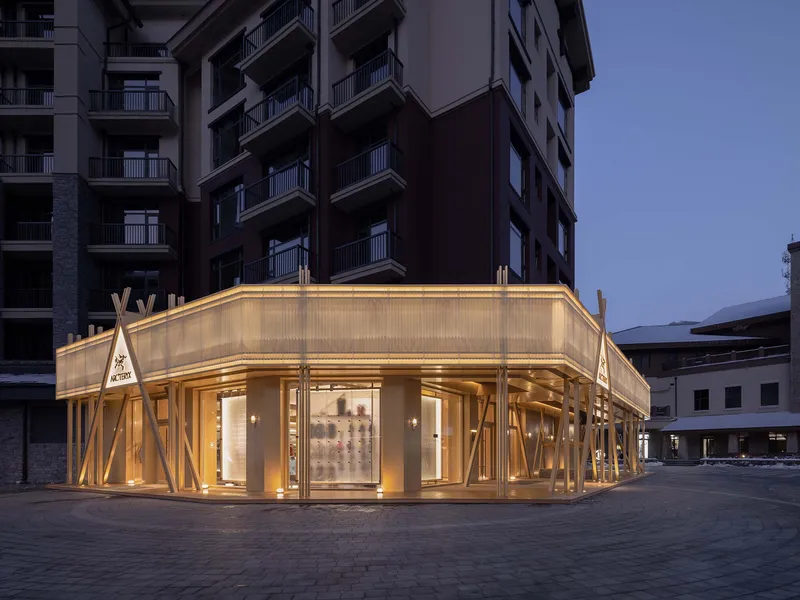
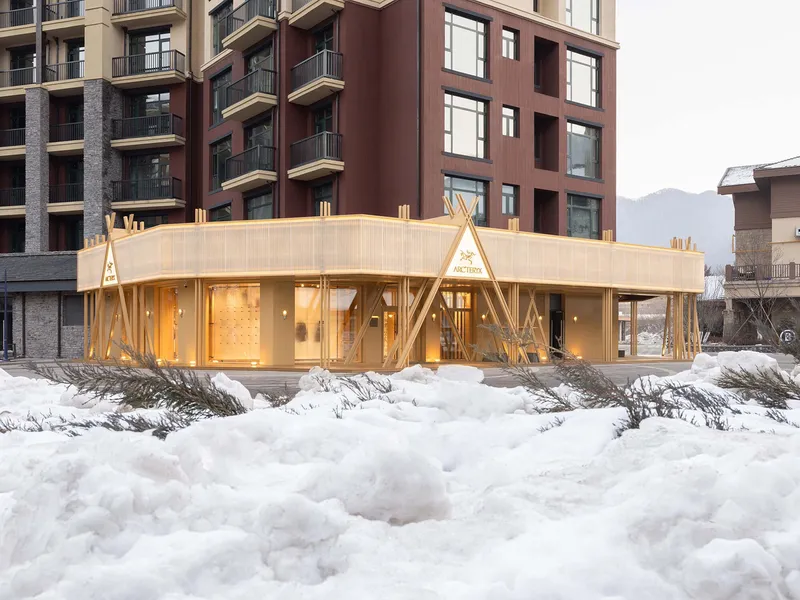
The store occupies a corner on the ground floor of a multi-story building, and STILL YOUNG exploited that position to turn two full facades into translucent light screens. At dusk, the pavilion reads as a triangular-portaled lantern: warm timber framing punches through the glow, and the diagonal columns give the entrance a structural identity that separates it from the generic ski-village architecture around it. Buried in deep snow, the building becomes inseparable from its setting, its warmth made visible rather than merely felt.
The translucent panels do more than create atmosphere. They diffuse daylight into the interior during operating hours and broadcast the store's activity outward after dark, turning commerce into spectacle for skiers returning from the slopes. The triangular timber portal at street level acts as both threshold and logo, a form strong enough to stamp itself on memory even from a chairlift.
Timber as Armature
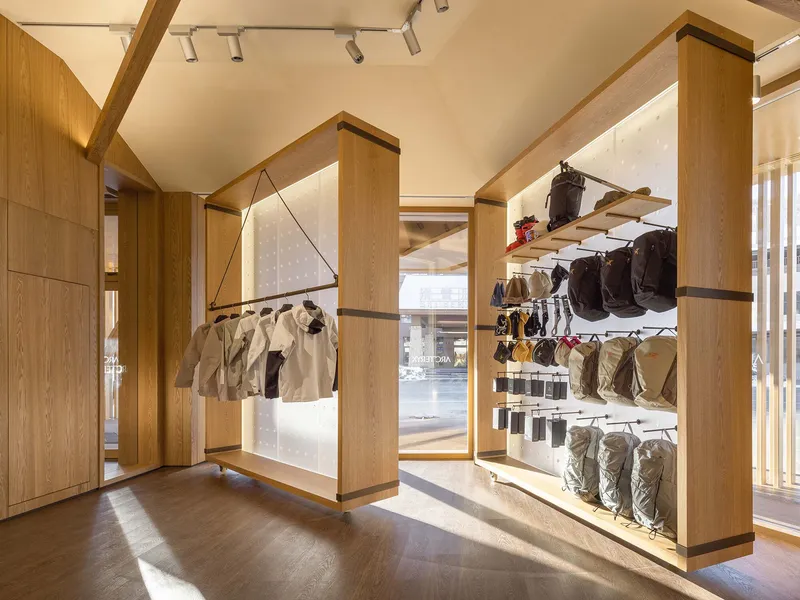

Inside, the timber frame does triple duty: structure, display, and decoration. Exposed beams overhead define the ceiling rhythm, while suspended timber frames become the primary merchandising system. Clothing racks hang within post-and-beam bays, so the architecture and the retail program share the same skeleton. It is an efficient move that avoids the clutter of freestanding fixtures while giving the store a cabin-like warmth.
The covered colonnade with its angled supports extends the timber language outdoors, creating a transitional zone that mediates between the heated interior and the snowfield. Natural wood on the facade reads as honest material in a mountain context. There is no cladding pretending to be something it is not.
The Glacier Column
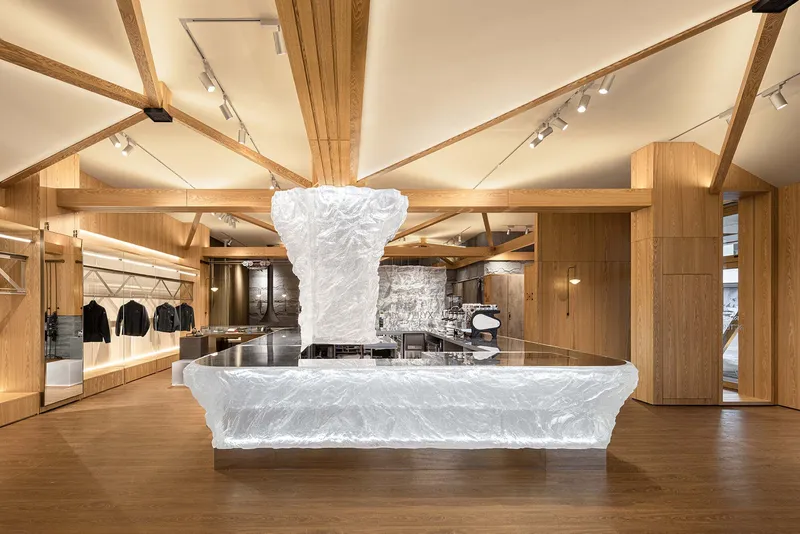


The store's gravitational center is a sculpted white counter wrapped around a faceted column that evokes a glacier or iceberg. It sits beneath radiating timber beams and a vaulted ceiling fitted with track lighting, commanding the plan without blocking sightlines. The column's textured surface catches light unevenly, producing the kind of optical depth you associate with compressed ice rather than retail furniture.
From different vantage points the column changes character. Viewed through the timber-framed doorway alongside a pivoting white panel studded with bronze hardware, it reads as ceremonial. Seen head-on with glass doors and display shelving behind, it becomes a wayfinding device. The piece anchors circulation and gives the relatively modest floor area a sense of occasion.
Prototyping the Ice


STILL YOUNG's process shots reveal how seriously the glacier column was developed. A carved foam mockup, rough and scored with assembly markings, was built at warehouse scale to test proportions and facet geometry before committing to the final acrylic pour. The design team worked through multiple iterations to control the resin's behavior: marbled patterns, air bubbles, and translucency were calibrated rather than left to chance.
The close-up resin samples show swirling, organic striations that mimic geologic time. Getting that effect consistently across a large-format architectural element required a pouring process specifically engineered to minimize voids, followed by overland transport from a southern Chinese factory to a ski resort in Jilin. It is a logistical story that deserves attention because it underscores the gap between concept render and built reality: making something look effortless is, as always, the hardest work.
Details and Atmosphere


Branded signage is handled with restraint. A white textured wall panel carries the ARC'TERYX mark next to a retail display under timber trusses, integrating identity into the material palette rather than bolting it on. The studded panel visible behind the glass storefront at night functions as both privacy screen and graphic element, its bronze rivets catching artificial light in a way that reads as craft rather than branding.
A narrow vertical mirror set against a split-face stone wall introduces a surprising moment of intimacy: seated diners (or resting skiers) are glimpsed in reflection, collapsing the boundary between commerce and hospitality. These small gestures accumulate into an environment that feels curated without feeling precious.
Plans and Drawings


The axonometric drawing of the glacier column clarifies what is difficult to read in photographs: the textured resin form wraps a structural column at the center of the plan, with the retail floor radiating outward. The exploded axonometric reveals the layered ceiling assembly, a folded roof sitting above suspended ceiling planes that define zones of different character within a single open volume.
The floor plan confirms a tight program. Cashier, locker, fitting rooms, and outdoor area are numbered and organized around the perimeter, leaving the central space free for display and the glacier installation. Section drawings show how timber-lined interiors gain height through clerestory windows and triangular steel trusses, pulling daylight deep into the plan. The layered ceiling assemblies visible in the second set of sections demonstrate how STILL YOUNG used overhead geometry to differentiate spatial zones without resorting to partition walls.
Why This Project Matters
Retail architecture at ski resorts tends to default to one of two modes: alpine pastiche or corporate glass box. STILL YOUNG sidesteps both by building an argument grounded in material specificity. The timber frame belongs to the mountain context without quoting chalet clichés, the translucent skin transforms a corner unit into a beacon, and the glacier column injects genuine craft into a program that rarely demands it. The store earns its warmth structurally and materially, not through mood lighting and brand mythology.
At 465 square meters, the project is small enough to be legible and large enough to sustain a real spatial idea. It proves that even a branded retail fitout can function as an architectural proposition if the design team is willing to prototype at full scale, ship materials across a country, and treat a column wrap with the seriousness of a public sculpture. For a brand built on technical performance in extreme environments, that level of commitment is the most fitting endorsement the architecture could offer.
ARC'TERYX Store at Beidahu Ski Resort, designed by STILL YOUNG. Jilin, China. 465 m². Completed in 2022. Photography by SFAP.
About the Studio
Share Your Own Work on uni.xyz
If projects like this are the kind of work you want to make, uni.xyz is a place to publish your own, find collaborators, and enter design competitions.




Popular Articles
Popular articles from the community


Riyadh For All: Intergenerational Urban Design for Active Aging in Rabat
Riyadh For All reimagines urban design in Rabat with intergenerational co-living, adaptive courtyards, and Moroccan cultural exchange today.

Conexión: Biophilic Design Reimagines High-Rise Living in Hong Kong
Conexión reimagines high-rise living in Hong Kong through biophilic design, green facades, shared spaces, daylight, water and nature within.

The Ocean Hive: Sustainable Architecture for a Self-Sufficient Civilization at Sea
The Ocean Hive imagines sustainable architecture at sea, where modular habitats, algae, wave power and ocean waste sustain a growing colony.

Co-life: Sustainable Architecture for Age-Friendly Community Living
Co-life reimagines sustainable architecture for seniors through courtyards, rammed earth, shared gardens, and spaces designed for belonging.

Similar Reads
You might also enjoy these articles

Bao Huynh Watercolor Atelier: A Serene Art Retreat in Hội An
Bao Huynh Watercolor Atelier in Hội An blends multifunctional art spaces, sustainable design, local materials, and family-friendly living in a serene environment.

Atelier Macri Concept Store Interior Design by CASE-REAL
Atelier Macri store features a "ko" counter, walnut wood details, cork displays, blending retail, gallery, and seamless customer experiences.

Manuel Vargas Izquierdo Stadium and High-Performance Sports Center: Architectural Excellence in Jalpa de Méndez
The Manuel Vargas Izquierdo Stadium blends sustainable design, inclusive sports facilities, and cultural-inspired architecture, revitalizing Jalpa de Méndez’s public spaces.

KAKR Buluh Awar Hall: Revitalizing Community and Ecology Through Bamboo Architecture
Community built bamboo hall revitalizes Buluh Awar village, empowering youth, restoring ecology, celebrating vernacular craftsmanship through sustainable architecture and culture.


Explore Commercial Buildings Competitions
Discover active competitions in this discipline


Challenge to design luxury tourism on rails


VR headsets Storefront design competition

Designing a staircase for a client
Comments (0)
Please login or sign up to add comments
No comments yet. Be the first to comment!