
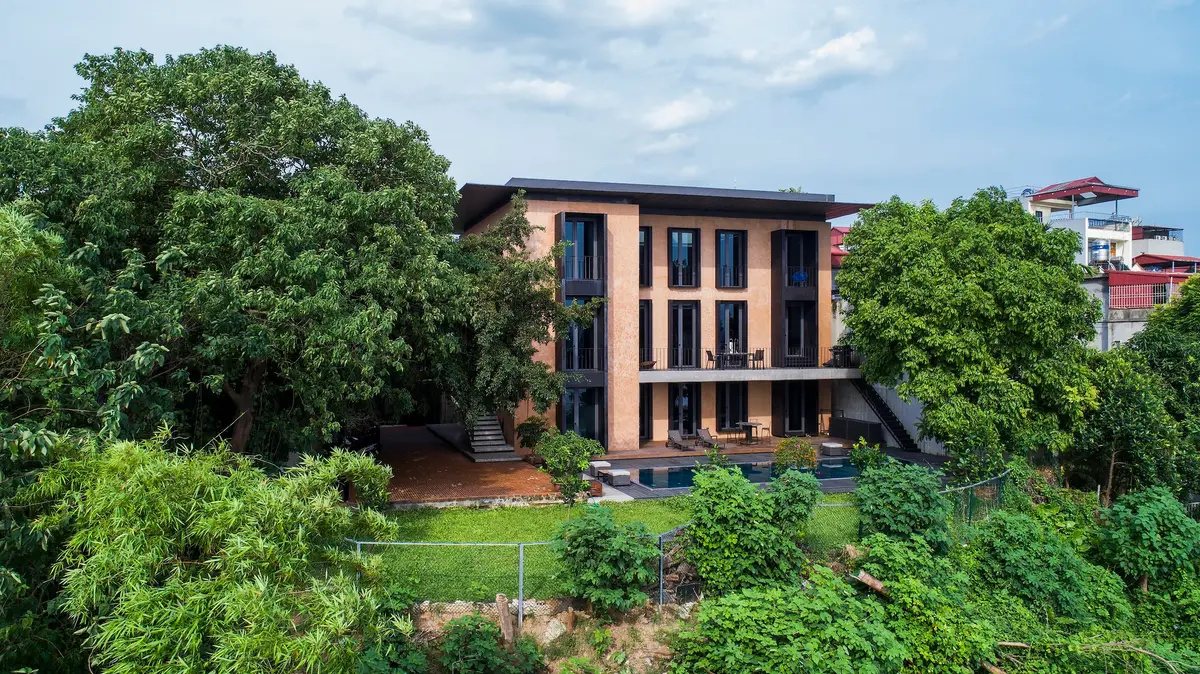
D and P Associates Build a Pi-Shaped House of Rammed Earth Memory on Vietnam's Red River
A 640-square-metre residence in Ngoc Thuy channels the pisé wall traditions of Vietnam's northern highlands into a riverfront family home.


Seen from across the Red River, the Pi House reads as its namesake: a blocky, earth-red silhouette that traces the Greek letter π against the sky. That graphic punch is deliberate but also slightly misleading. The 640-square-metre house designed by D and P Associates for a French client who has lived in Vietnam for nearly three decades is less about geometric symbolism and more about the collision of two building cultures. Lead architects Romain Duval and Tuan Pham grounded the project in the pisé wall tradition of Vietnam's northern highland minorities, the Mong, Ha Nhi, Tay, and Dao Tien, while lacing it with the robust materiality of French colonial construction. The result is a house that looks monolithic from outside yet opens inward to an airy, light-drenched void.
What makes this project genuinely compelling is its refusal to treat Vietnamese vernacular as decoration. Pisé construction, the hand-compressed earth walls found across Ha Giang, Lao Cai, Lai Chau, and Cao Bang provinces, is usually celebrated in museum panels and tourism brochures, not in urban residential architecture. Duval and Pham translated it into a contemporary concrete, brick, and steel frame, then finished the facade with hand-applied colorized plaster that renders the same earth-red tone of traditional rammed earth. That translation, from technique to memory, is the project's real subject.
A Facade Between Two Cultures


The terracotta plaster facade owes its texture to BetonLab colorized paint, hand-troweled to evoke the stratified layers of a genuine pisé wall. Black-framed Xingfa aluminum windows are deeply recessed within the plaster, casting sharp shadow lines that shift across the surface throughout the day. Vertical louvers and metal railings punctuate the composition with a crisp industrial rhythm, a nod to the steel-and-iron vocabulary of French architecture in Hanoi.
The depth of the window reveals is more than aesthetic. It creates a thermal buffer zone, shading interior glass from direct sun while allowing generous openings that pull in views of the Red River and the Long Bien Bridge. These are windows designed for a tropical climate that still wants to feel generous and open, not shuttered.
The Central Void as Organizing Spine
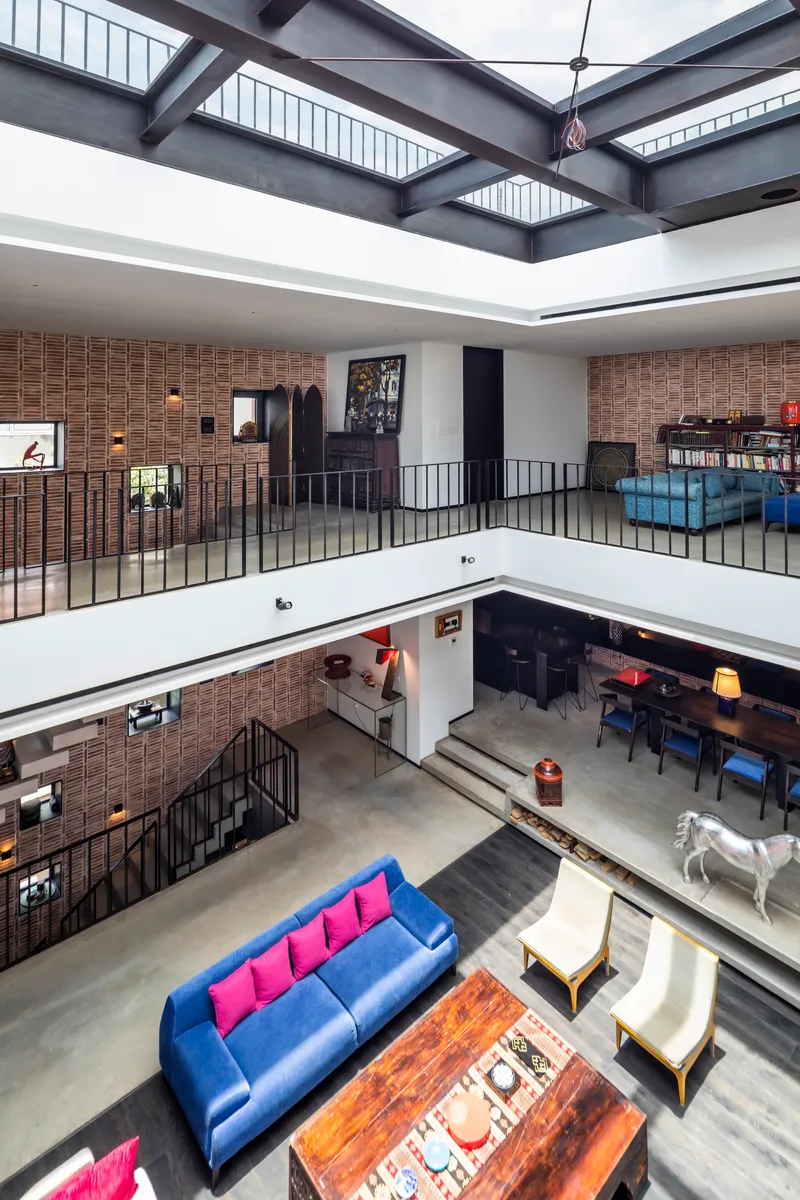


Cut the house in section and you find its real heart: a multi-storey void capped by a continuous steel-framed skylight that floods every level with diffused daylight. Stacked galleries with white balconies and slender steel railings ring this atrium, turning vertical circulation into a social event. You can stand on the third-floor bridge and see all the way down to the polished concrete ground floor.
The skylight does heavy lifting for passive design. In a humid subtropical climate, pulling light deep into the plan reduces dependence on artificial illumination and creates the stack effect that drives natural ventilation upward. It also makes the interior feel substantially larger than 640 square metres. Space flows vertically as much as horizontally, and the family encounters each other across levels rather than behind closed doors.
Brick Walls and Floating Stairs
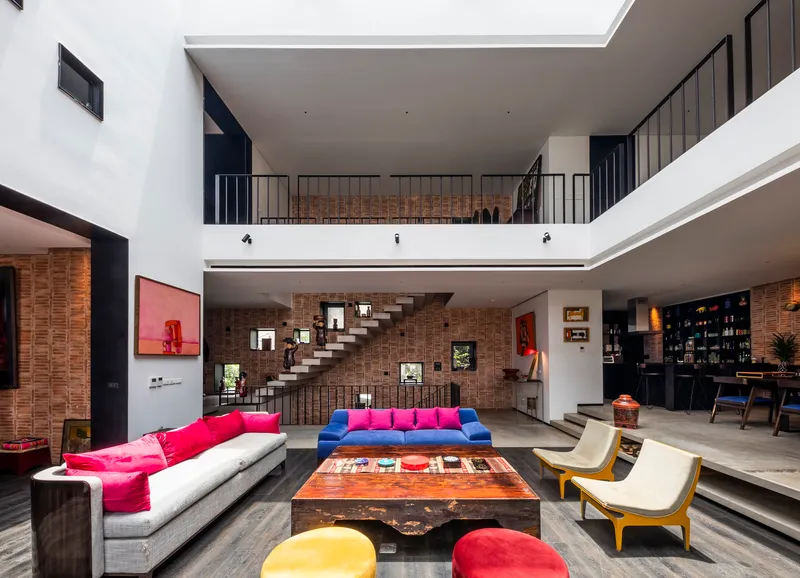


The interior brick walls use a new arrangement pattern of local rustic brick, giving them a woven, almost textile quality that feels handmade without being fussy. Against this rough grain, the floating concrete stair treads read as surgically precise insertions. Each tread is cantilevered from the brick wall, eliminating a visible stringer and turning the staircase into a piece of structural sculpture.
Irregular square windows are punched through the stair wall at seemingly random intervals, tossing small rectangles of light across the treads. The effect is deliberate: as you climb, the light shifts and the views rotate, making vertical movement through the house a sequence of framed moments rather than a chore.
Living Between Ground and Sky


The house stacks its program with a clear social gradient. The ground floor is given over to relaxation: a swimming pool sits directly in front, and floor-to-ceiling glass doors dissolve the boundary between the double-height living room and the surrounding greenery. The first floor hosts joint family activities and guest reception, while the second floor retreats into private bedrooms and a library.
At dusk, the glazed clerestory above the living room glows against the exposed brick, and the house inverts: interior warmth radiates outward. Hiroyuki Oki's photographs capture this transition beautifully, the terracotta walls absorbing the last orange light while the skylight turns blue overhead. The living space becomes a lantern, visible from the river.
Pool Terrace and the Riverbank Edge


The rear elevation is where the house meets the Red River most directly. A deep overhang shelters the pool terrace, and local outdoor wood decking wraps from the pool edge to the facade, softening the transition between landscape and building. Mature trees frame the composition and cast dappled shadows across the terracotta plaster, reinforcing the sense that the house was always here.
The aerial view reveals the cantilevered volume pushing toward the riverbank, a bold structural gesture supported by the concrete and steel frame beneath. Korean zinc roof panels cap the form with a muted silver tone that deliberately contrasts the warm earth of the walls below. It is a practical choice for tropical rain shedding, but it also cleanly separates the roof plane from the mass of the facade, making the Pi silhouette legible even from above.
Interior Details: Kitchen, Bedroom, Bath


The kitchen pairs black cabinetry with a textured terracotta tile wall, uplighting washing the surface at dusk to create a warm, cave-like atmosphere. It is a controlled inversion of the light-filled public spaces downstairs: intimate, moody, and anchored to the earth tones that define the house.
Bedrooms are similarly restrained. A black millwork alcove and brick wall corridor sit beneath an exposed concrete ceiling, keeping the material palette honest. In the bathroom corridor, backlit terracotta tiles glow against a perforated metal door that opens to greenery, a small moment of luxury that proves the architects understand that vernacular inspiration does not require austerity.
The Upper Galleries and Mezzanine


The upper-level bridge that spans the central void is one of the house's most striking spatial elements: a polished concrete ribbon flanked by black steel railings and illuminated from above by the continuous skylight. Timber slat walls filter light along the corridor, casting linear shadows that animate the passage. Exposed steel beam ceilings on the upper floors leave the structure legible, a counterpoint to the hand-plastered warmth of the lower levels.
A pool table beneath pendant lights occupies a mezzanine overlooking the double-height void, where layered timber slat walls create a layered sense of depth. The architects treat leisure spaces with the same spatial ambition as the formal living areas, refusing to relegate recreation to leftover corners.
Plans and Drawings

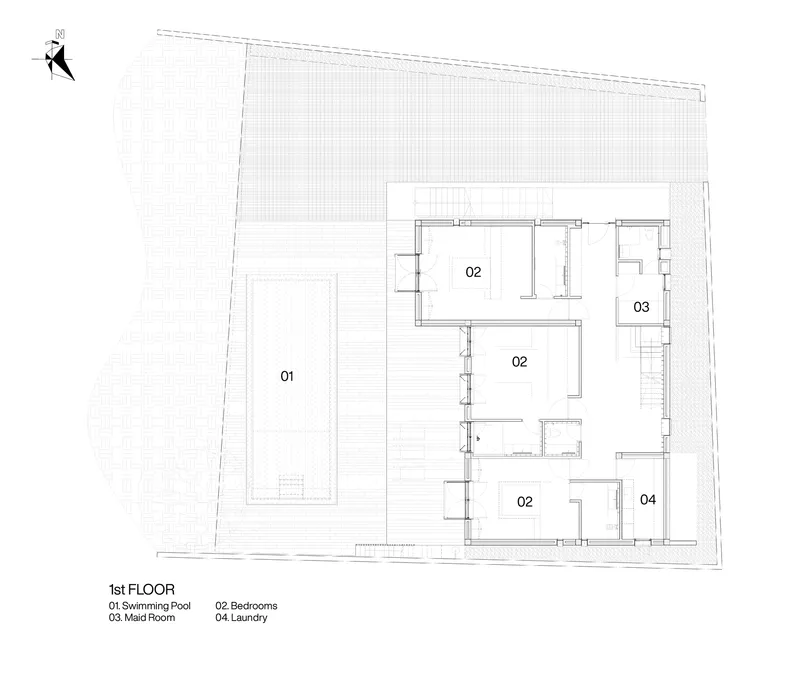

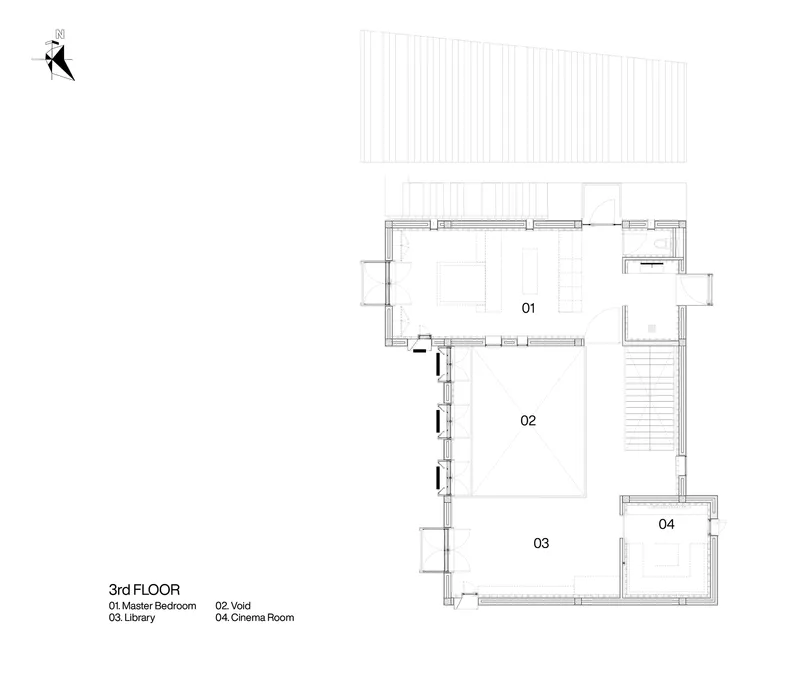
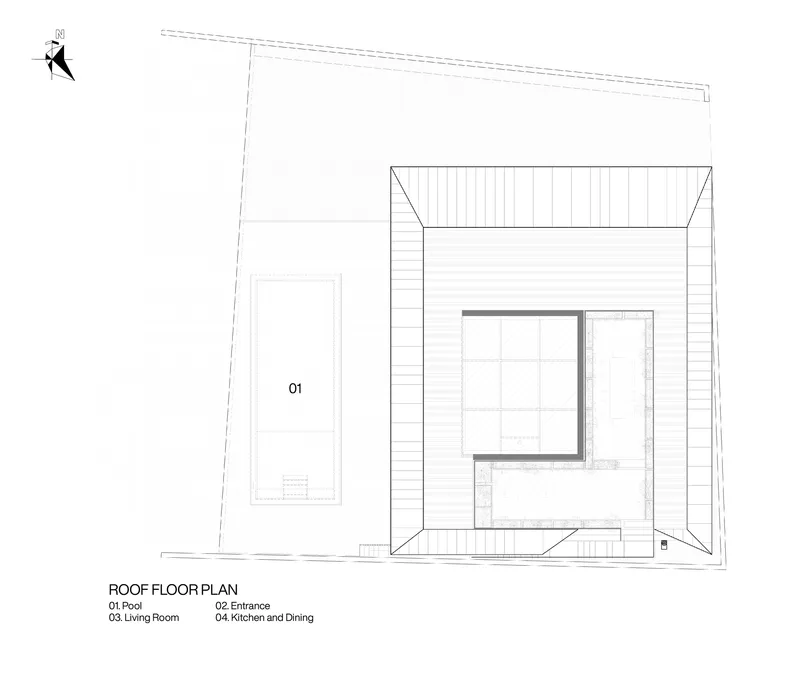
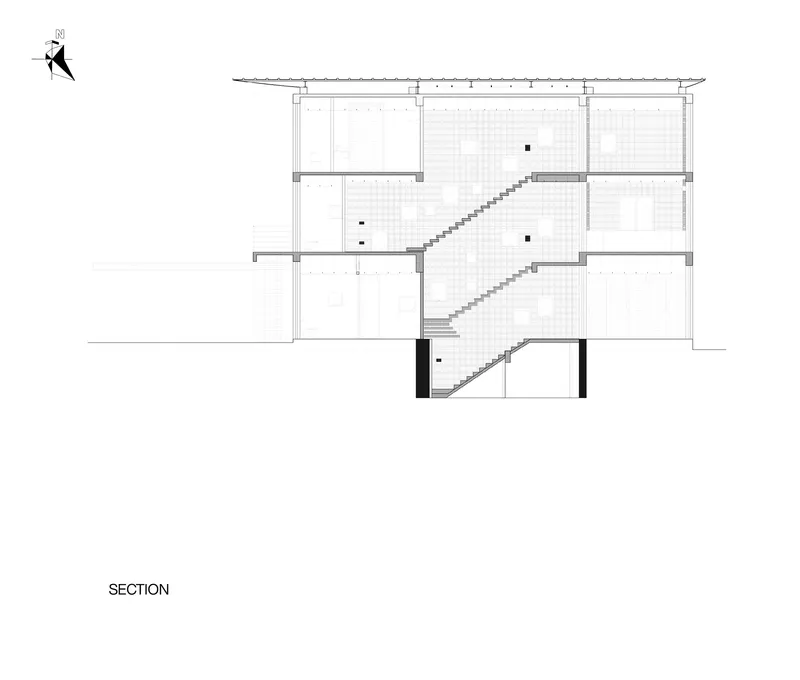
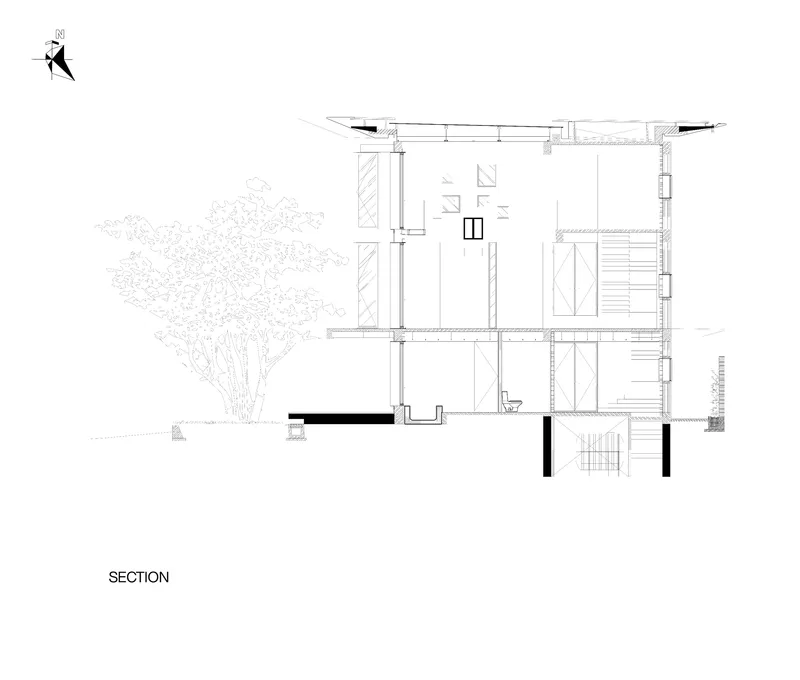
The site plan confirms the building's oblique relationship to the curved waterway, with the entry drive approaching from the southwest and the pool terrace oriented toward the river. Floor plans reveal a compact footprint that the central void makes feel expansive: the ground floor wraps pool and bedrooms around the angled site, the second floor opens living and kitchen spaces onto a louvered terrace, and the third floor tucks a master bedroom, library, and cinema room around the void. The sections are the most revealing drawings. They show how the multi-flight staircase stitches the three levels together beneath a sloped roof, and how the cantilevered volume achieves its dramatic overhang at the rear elevation.
Why This Project Matters
The Pi House matters because it demonstrates that vernacular building traditions can inform contemporary architecture without being reduced to surface decoration. The pisé wall technique of Vietnam's northern highlands is not copied here; it is remembered. Hand-applied plaster, rustic brick, and local timber carry the material DNA of that tradition into a concrete-framed urban house, proving that cultural continuity is a design problem, not a preservation problem.
It also stands as a quiet argument for cross-cultural authorship. A French client, a Vietnamese-French design team, and a construction vocabulary that braids colonial and indigenous building cultures into something neither nostalgic nor neutral. In a city where development often erases context, D and P Associates have built a house that is legible from the river, rooted in its site, and specific to the person who lives in it. That is a lot to ask of architecture, and the Pi House delivers.
Pi House by D and P Associates, lead architects Romain Duval and Tuan Pham. Ngoc Thuy, Vietnam. 640 m². Completed 2021. Photography by Hiroyuki Oki.
About the Studio
Share Your Own Work on uni.xyz
If projects like this are the kind of work you want to make, uni.xyz is a place to publish your own, find collaborators, and enter design competitions.


Popular Articles
Popular articles from the community


LT2A and OPEN Architectes Thread a Brick and Glass High School Through a Wooded Belgian Campus
In Braine-l'Alleud, a 3,000 m² wing for Collège Cardinal Mercier pairs pale brick with a glazed colonnade, deferring to a small chapel and a dense wood.

David Macias Steps a Doorless Stone and Plaster House Down a Tropical Colombian Hillside
In the humid hills of Colombia, Threshold House replaces the front door with an open void and terraces its 850 m² down the slope instead of fighting it.

Juan García Correa, John González and Claudia Rueda Sink a Circular Amphitheater into a Manizales Engineering Building
On the La Nubia campus in Manizales, Colombia, the S1 Building folds labs and offices into a hillside of ramped lawns that double as a campus route.

Architekt Andreas Gruber Scatters 23 Dark Timber Chalets Across a South Tyrolean Forest Edge
In Molini di Tures, Amonti Chalets breaks a resort into a hamlet of gabled timber houses, with parking, storage and services pushed into the slope.

Similar Reads
You might also enjoy these articles


LAVA Architecten Gives Vocational Education a Sawtooth-Roofed Face on a Mechelen School Campus
In Mechelen, Belgium, a 2,053 m² STEM school on a 6×6 m grid turns workshops and classrooms into rooms that can be rearranged as teaching changes.

KEMA Studio Turns a Derelict Marvila Attic into a 60 m² Lighthouse Apartment Above Lisbon
In Lisbon's Marvila district, a rebuilt roof, four skylights and two plywood volumes turn an unlivable attic into a bright home facing the Tagus.

Pixel Gardens: One Repeated Module Stacked Into a Terraced Social Housing Tower for Famagusta
Salem Bader's shortlisted housing tower builds a vertical neighbourhood from one repeated module, offsetting units to carve terraces, light and air.

Bao Huynh Watercolor Atelier: A Serene Art Retreat in Hội An
Bao Huynh Watercolor Atelier in Hội An blends multifunctional art spaces, sustainable design, local materials, and family-friendly living in a serene environment.

Explore Plug-In House Competitions
Discover active competitions in this discipline

Challenge to design a barrier free sports center

Challenge to design an outdoor ice-rink and park

Challenge to design mud housing for contemporary communities
Comments (0)
Please login or sign up to add comments
No comments yet. Be the first to comment!