
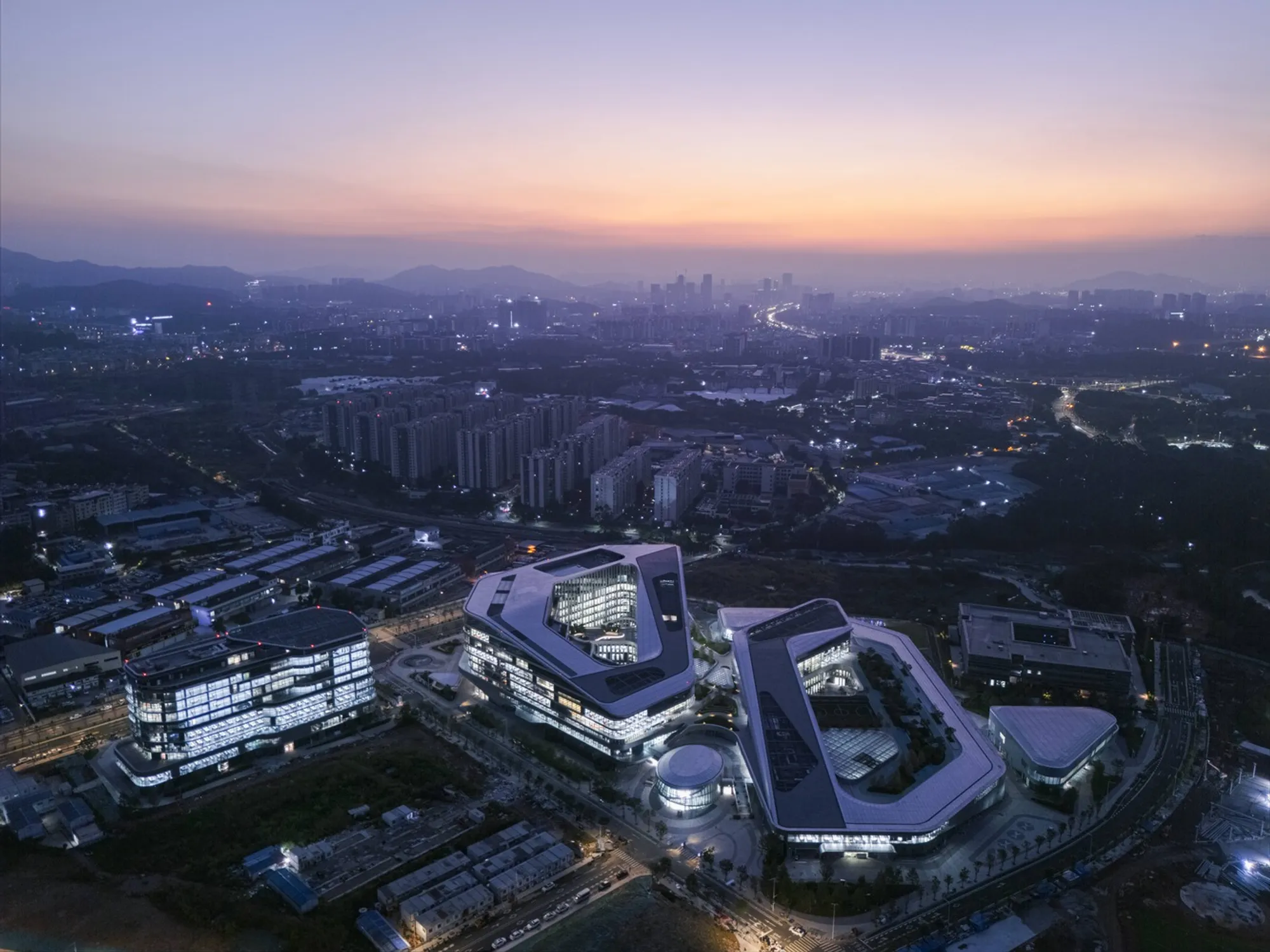
weico Architects Shapes XPENG's Guangzhou Headquarters into an X-Formed Mega Campus for 13,000
A 360,000-square-meter intelligent mobility campus in Tianhe Intelligence City fuses R&D, showrooms, and a flying car launchpad.


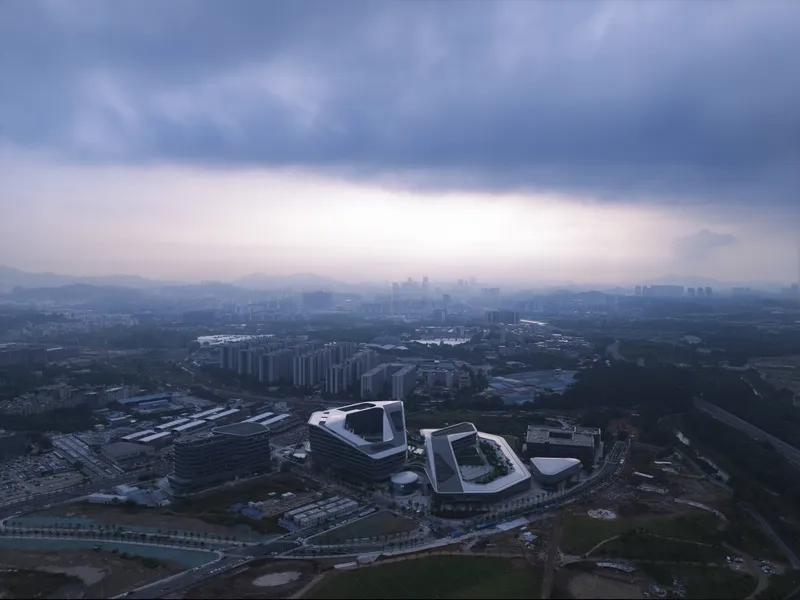
Corporate headquarters for Chinese tech firms have grown into a distinct building type over the past decade, each one trying to outscale and outperform the last. weico Architects, led by Sun Wei, entered that arms race with a clear thesis: the headquarters of an electric vehicle and flying car company should read as continuous motion rather than static mass. The result, completed in Guangzhou's Tianhe Intelligence City district in 2025, is a 360,000-square-meter campus that accommodates roughly 13,000 employees across four programmatic buildings whose rooflines collectively trace the letter X, a direct nod to XPENG's brand identity visible only from the air.
What actually makes the project interesting is not its size, which is formidable, but its insistence on treating a corporate mega-campus as a landscape problem. The massing rises gradually from south to north to frame views of distant mountains, while a height restriction on the southern edge (imposed by a nearby heliport) forces the architecture to stay low where it meets the city and climb where it faces nature. Two large courtyards linked at the center organize everything from autonomous driving research labs to a five-a-side football pitch, and an underground corridor threads the complex directly into Cencun subway station. The campus opened its doors on October 20, 2025, with nearly 11,000 staff from XPENG Motors and XPENG AeroHT already in residence.
An X Written in Rooftop Photovoltaics
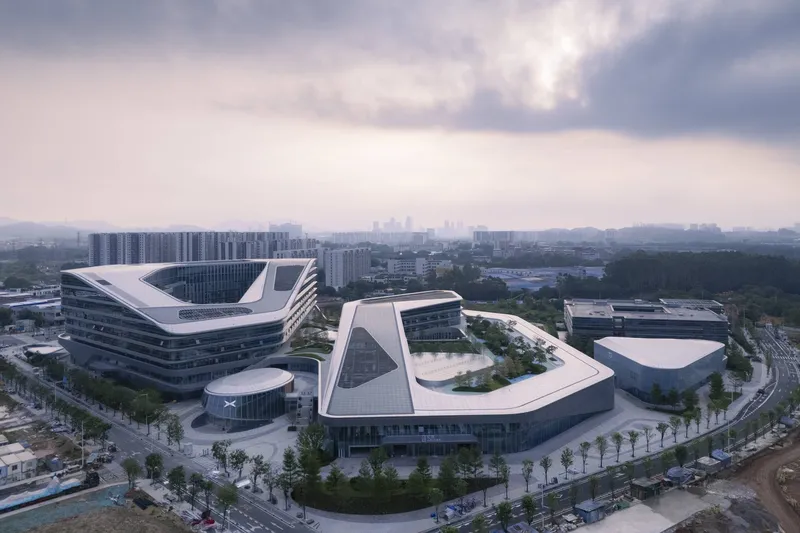
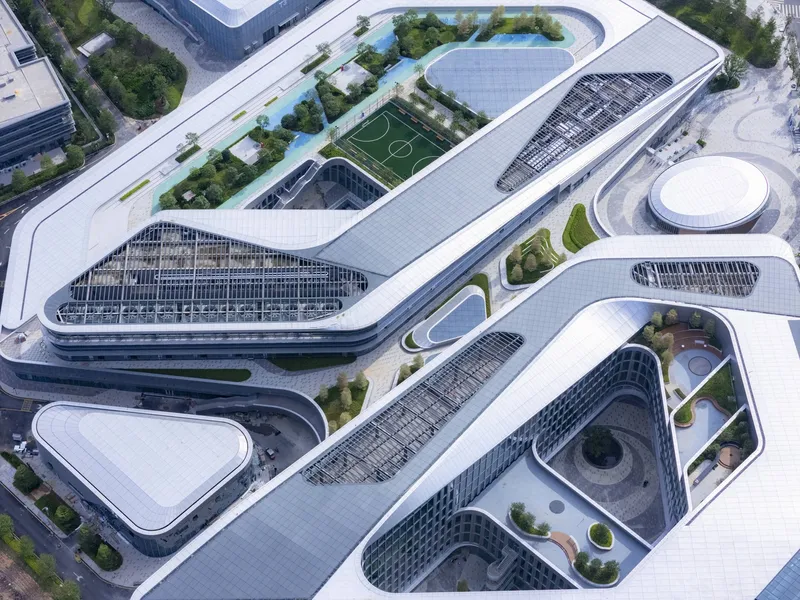
From above, the campus reads as two triangular office volumes whose corners converge to form the X shape. The rooftop photovoltaic arrays reinforce this geometry, turning a branding gesture into an energy strategy. It is a neat trick: the logo is legible in aerial photography and satellite imagery while simultaneously powering portions of the campus through distributed solar generation. The white roof parapets and curved edges give the buildings a softer silhouette than their geometric plan might suggest, avoiding the fortress quality that plagues many tech campuses of comparable scale.
The four functional buildings house distinct programs. One serves as the main office hub shared between XPENG and its aerial vehicle subsidiary HT Aero. A second pairs offices with sales and corporate showrooms. A third is a dedicated conference and event center. The fourth focuses on autonomous driving and large-scale AI model development. By distributing these functions across separate but connected structures, weico avoids the single-monolith approach and creates legible addresses within the campus.
Courtyards That Do the Heavy Lifting
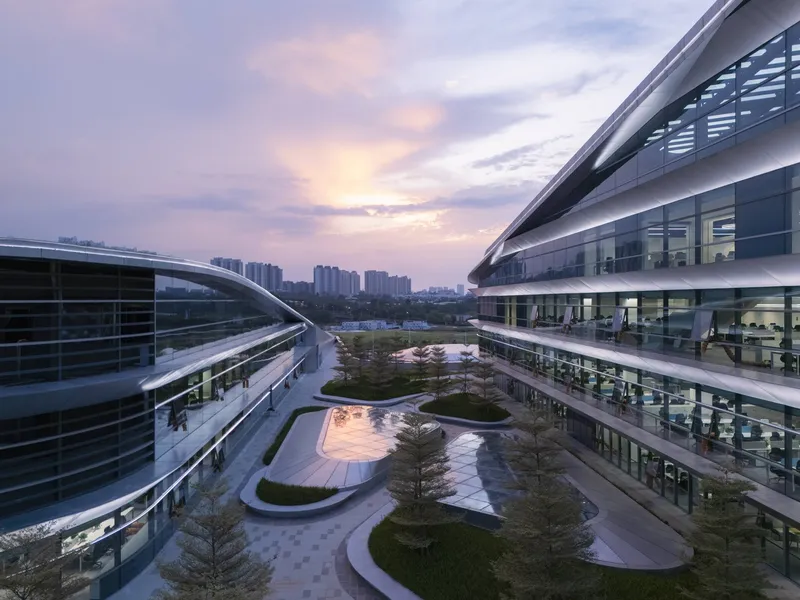
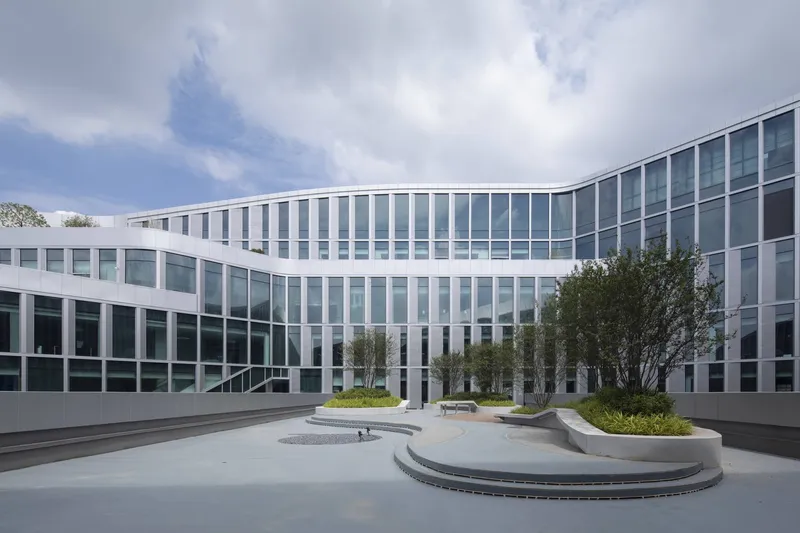
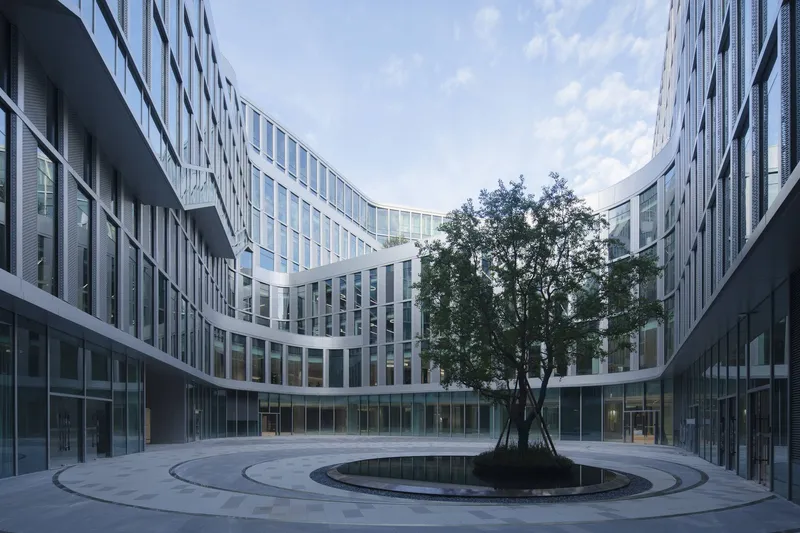
The two primary courtyards are not ornamental voids punched into a floor plate for daylight compliance. They are the organizing logic of the campus. At ground level, circular planters, concentric paving rings, and curved benches create gathering zones that feel more like urban plazas than corporate atriums. The glazed office wings that frame these spaces use arc-shaped glass curtain walls, so the boundary between indoor and outdoor is perceptually thin even if it is thermally robust.
Multiple terraces at varying heights step up through the courtyards, each planted with large trees and fitted with informal seating. These stepped landscapes provide what every open-plan office desperately needs: a reason to leave your desk and have a conversation somewhere other than a meeting room. Generous staircases along the facade double as casual gathering spots, a move borrowed from stadium and campus design that works well here given the sheer number of people circulating daily.
The Glass Envelope After Dark
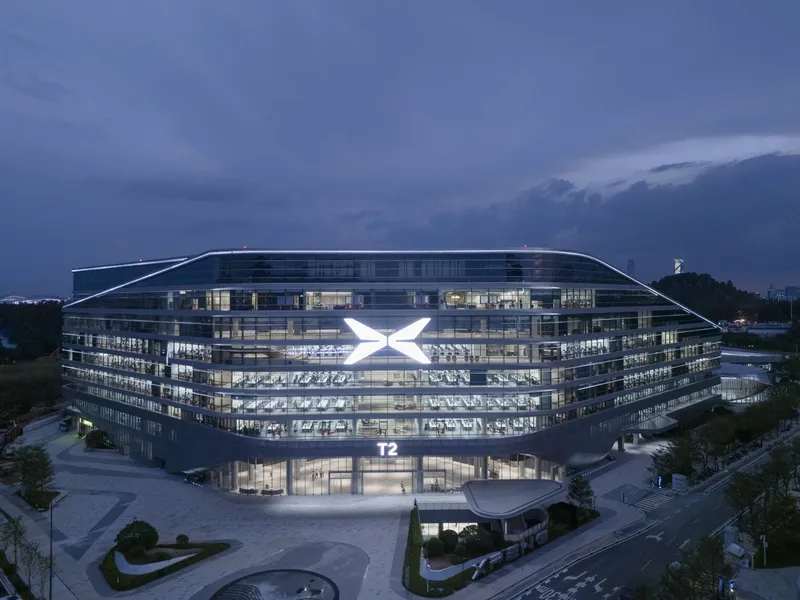
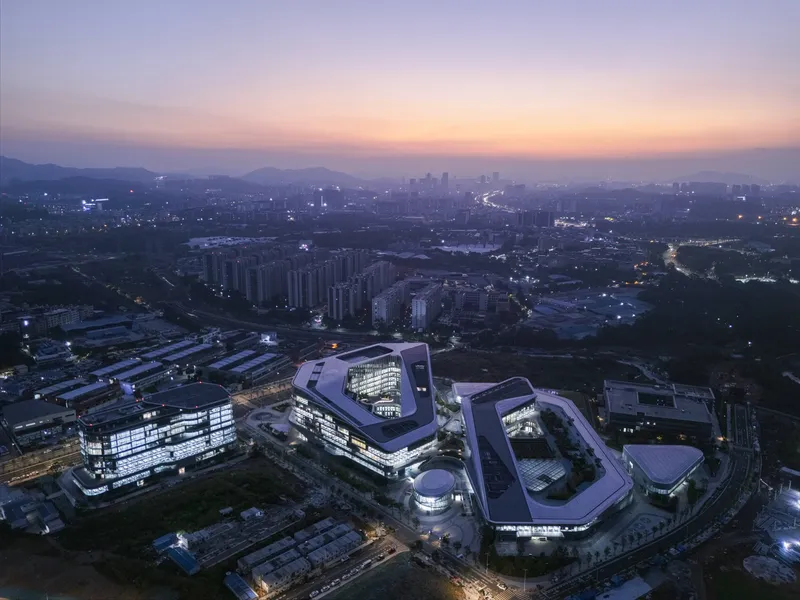
At twilight the campus transforms. Horizontal louvers layered across the glass facade catch interior light and project it outward in warm, stratified bands. The effect is restrained rather than theatrical, giving the buildings a lantern quality without resorting to LED media screens. From a distance, the illuminated campus sits against a mountain horizon, its glow marking Tianhe Intelligence City's presence in the broader Guangzhou skyline. SuP Engineering Consulting served as facade consultant, and the detailing shows: the proportions of glass to louver are carefully calibrated to avoid the generic banded look that plagues many curtain-wall office buildings.
Rooftop Landscapes and Productive Surfaces
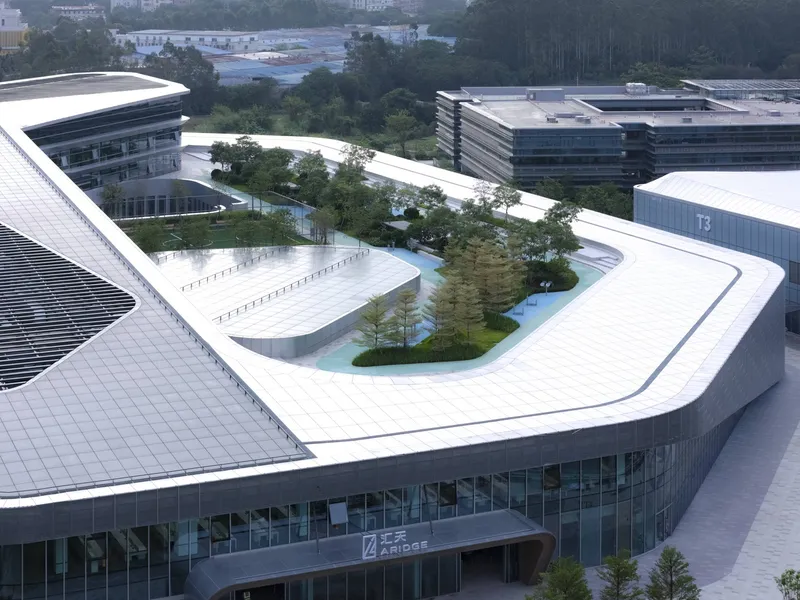
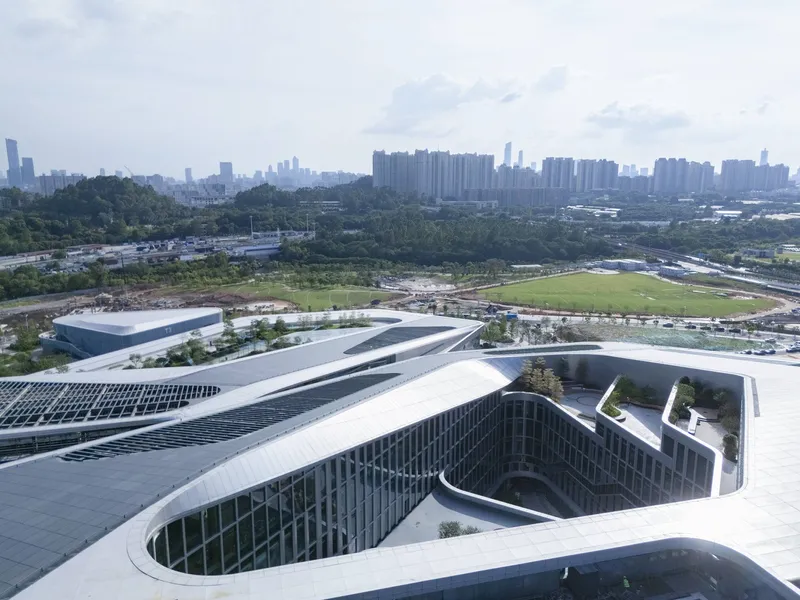
The rooftops are not afterthoughts. Planted beds, trees, and walkways turn the upper surfaces into usable landscapes, extending the 80,000-square-meter park concept vertically. Curved courtyard openings allow views down through planted terraces to the ground level, creating a sectional experience that connects the roof gardens to the courtyards below. Photovoltaic panels share the roof with these green zones, and efficient refrigeration systems are housed discreetly to reduce mechanical clutter. Landscape design by Guangzhou S.P.I Design Co. integrates sports fields, recreational zones, and waterfront edges into a continuous green network across the campus.
Below ground, the infrastructure is equally ambitious. Four underground levels house double-decker parking garages, and nearly 20,000 square meters of dining facilities serve a mega canteen with 5,000 seats. Cafés, supermarkets, a community medical center, barbershops, and gyms fill out the subterranean program, creating a self-sufficient ecosystem that reduces the need for employees to leave the campus during the workday.
Why This Project Matters
The XPENG Headquarters arrives at a moment when Chinese tech companies are building campuses at a pace and scale that rivals anything Silicon Valley produced in the previous decade. What distinguishes this project from the generic glass-and-steel tech park is its willingness to treat landscape, section, and urban connectivity as first-order design problems. The south-to-north massing gradient, the subway link, the courtyard-as-plaza strategy, and the rooftop productive landscapes all suggest a campus that has been thought through at every altitude, from four levels underground to the photovoltaic canopy above.
Whether the X-shaped plan is a stroke of branding genius or an eye-roll-inducing logo building depends on your tolerance for corporate symbolism. But weico Architects earn the gesture by making it functional: the geometry generates the courtyards, the courtyards generate the social life, and the rooftop solar arrays turn the logo into kilowatt-hours. For a company that builds electric cars and flying taxis, having your headquarters literally power itself through its own shape is a credible piece of architecture, not just a billboard.
XPENG Headquarters, designed by weico Architects (concept design lead: Sun Wei), with construction documentation by CAPOL International. Located in Cencun, Tianhe Intelligence City, Guangzhou, China. Site area: 68,000 sqm; total built area: approximately 360,000 sqm. Completed 2025. Landscape design by Guangzhou S.P.I Design Co., Ltd. Facade consultant: SuP Engineering Consulting (Beijing) Co. General contractor: China Construction First Group (Corporation) Ltd.
About the Studio
Share Your Own Work on uni.xyz
If projects like this are the kind of work you want to make, uni.xyz is a place to publish your own, find collaborators, and enter design competitions.



Popular Articles
Popular articles from the community


Co-life: Sustainable Architecture for Age-Friendly Community Living
Co-life reimagines sustainable architecture for seniors through courtyards, rammed earth, shared gardens, and spaces designed for belonging.

The Musturak Paradise: Senior Living Architecture for a Connected Future in Temara, Morocco
The Musturak Paradise reimagines senior living architecture in Temara via private homes, social spaces, culture, community, and shared care.

Play: Fragments of Their World
Familiar architecture becomes modular playground design, creating safe spaces where displaced children can learn, connect, imagine and play.

Co-Life: Senior Housing Design That Reconnects Older Adults With the City
Co-Life reimagines senior housing design through healing gardens, shared streets, workshops, and a sustainable community across generations.
Similar Reads
You might also enjoy these articles


Hodi-Mandai Geram
Project Function: Preservation and revitalization of the Intangible heritage and socio-spatial identity of the Hodi by Housing, Cultural Memory Center, Sacred Grove, landscape, local tourism economy


Olio Towers: A Mid-Rise for Performers That Fuses Housing, Rehearsal, and Stage
Located blocks from Houston's Theater District, this modular tower stacks living units around a central performance atrium.

Oasis: Modular Green Housing Carved into Dhaka's Urban Fabric
A shortlisted Plugin Housing entry reclaims unauthorized settlements in Dhaka with stepped concrete volumes, green roofs, and ventilation-driven design.

Black Hole: A Floating Megastructure for the Post-Physical Era
Emiliano Mazzarotto envisions a spherical, self-scaling arena where e-sports, digital hotels, and holographic stadiums replace traditional public space.
Explore Office Building Competitions
Discover active competitions in this discipline



Challenge to reimagine the Iron Throne


Photograph architecture without architects


Illustrate the lost glory of Angkor Wat - Render Challenge


Design challenge to reuse E-waste
Comments (0)
Please login or sign up to add comments
No comments yet. Be the first to comment!