
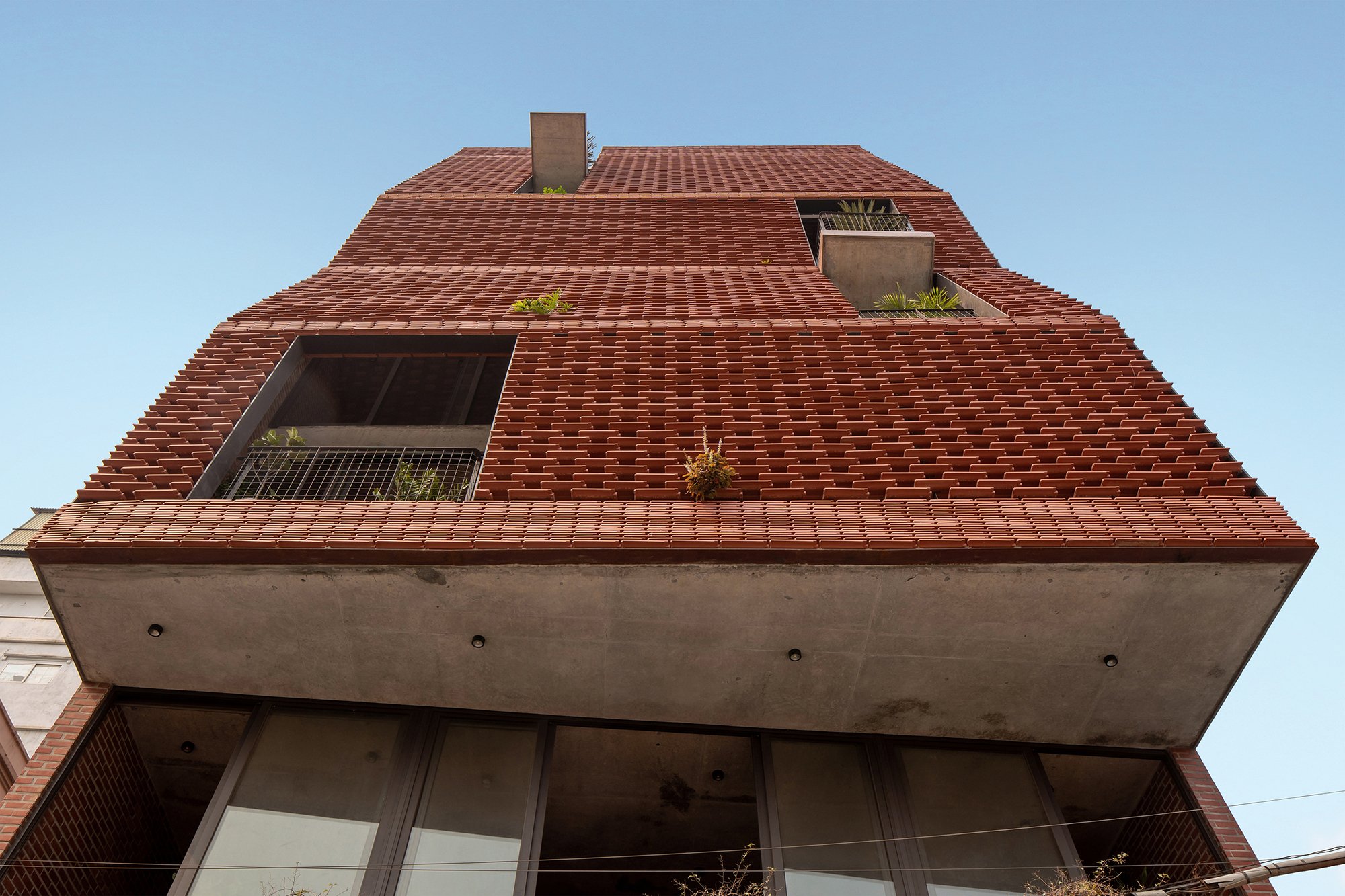
H&P Architects Stack a Vertical River of Brick and Greenery in Hanoi
A perforated terracotta tower in Dong Anh channels water, light, and air through eight staggered levels of domestic life.

Hanoi's suburban communes are dense, narrow-lot territories where houses routinely climb six or seven stories to compensate for footprints barely wider than a parking space. Most of these tube houses treat their vertical dimension as a grudging necessity: stack rooms, cap with a water tank, move on. Tropical Flow, designed by H&P Architects in Vinh Ngoc commune, Dong Anh district, treats that same verticality as a design thesis. The 1,150-square-meter house rises like a faceted brick column above its low-rise neighbors, its silhouette tapering toward the sky while its interior hollows out into a series of planted courtyards that pull daylight and ventilation deep into every floor.
The architects describe the concept as a "House from the Flow," referencing the residential clusters that historically gathered along Vietnam's rivers and waterfalls. It is not a metaphor that demands you squint. The staggered floor plates genuinely cascade, each one offset from the next to create pockets of open air, planted terraces, and visual connections between levels. Phuong Trach lake and Hai Boi lake sit nearby; the Red River is a short distance beyond. Tropical Flow absorbs that riparian logic and rotates it ninety degrees, letting water, plants, and breeze move vertically through the building rather than across a floodplain.
A Facade That Breathes
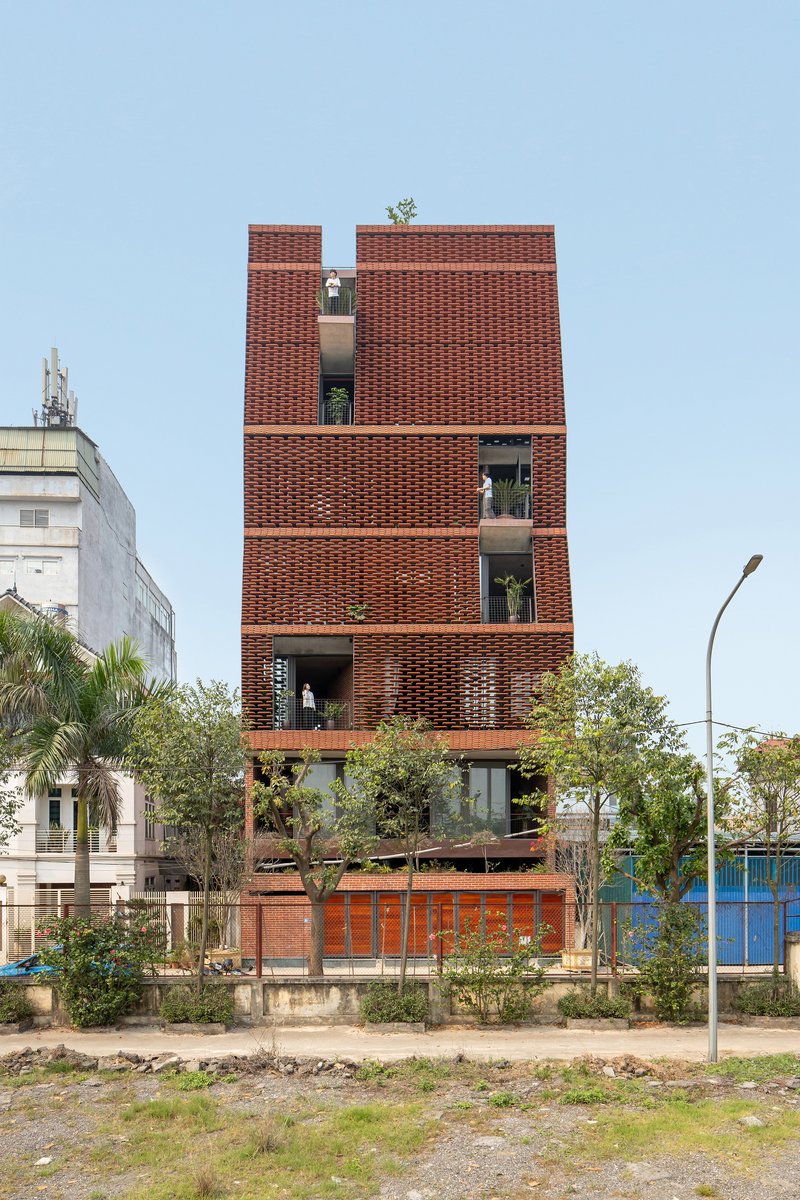
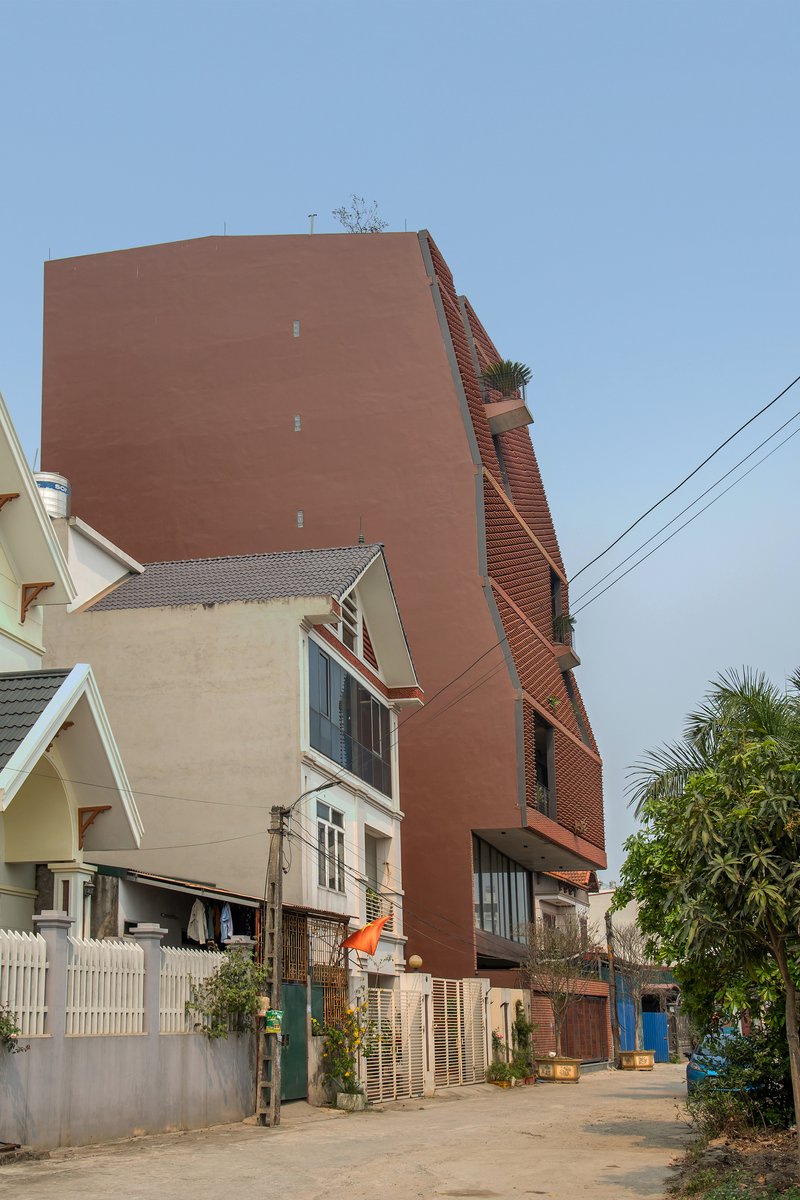
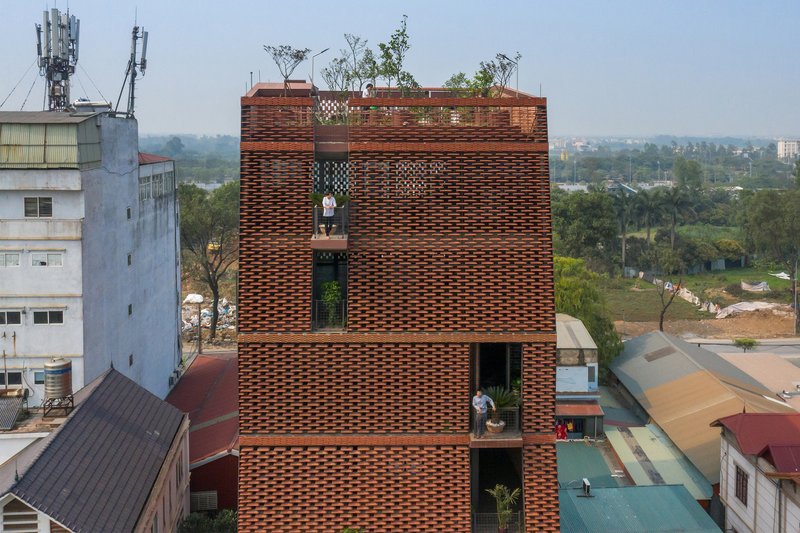
From street level the building reads as a terracotta monolith, its surface patterned in a diagonal herringbone of clay bricks laid at angles that create continuous perforations. The screen does not merely decorate; it regulates. Each opening admits a controlled slice of air and light while shielding the interior from Hanoi's aggressive summer sun. The perforations also blur the boundary between inside and outside, giving the facade a textile quality that shifts in opacity depending on the angle of view and the time of day.
Protruding concrete balconies punch through the brick skin at irregular intervals, their planted edges softening the geometry and providing shade for the openings below. The effect from the street is something between a vertical garden wall and a carved cliff face, an impression reinforced by palm fronds and ferns that grow outward through the gaps. Against the low rooftops and tangled power lines of the commune, the tower registers as unmistakably intentional without being confrontational.
The Central Void as Lung
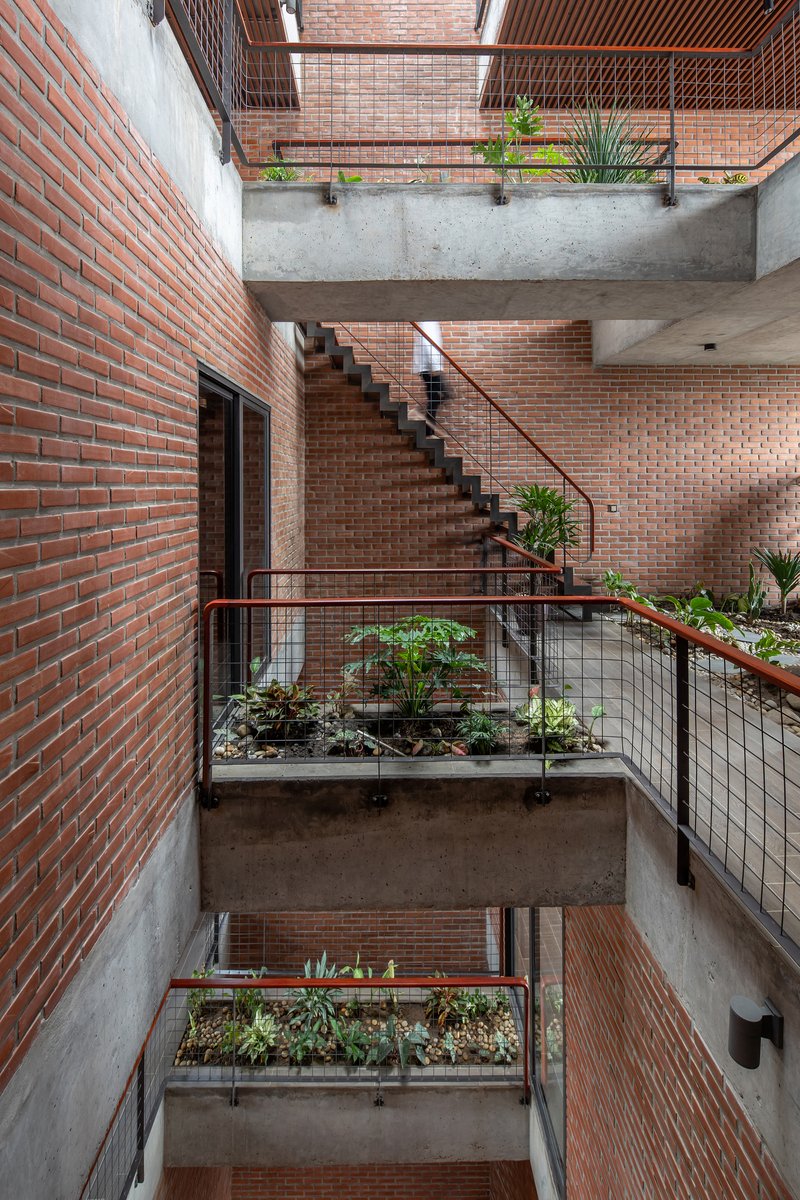
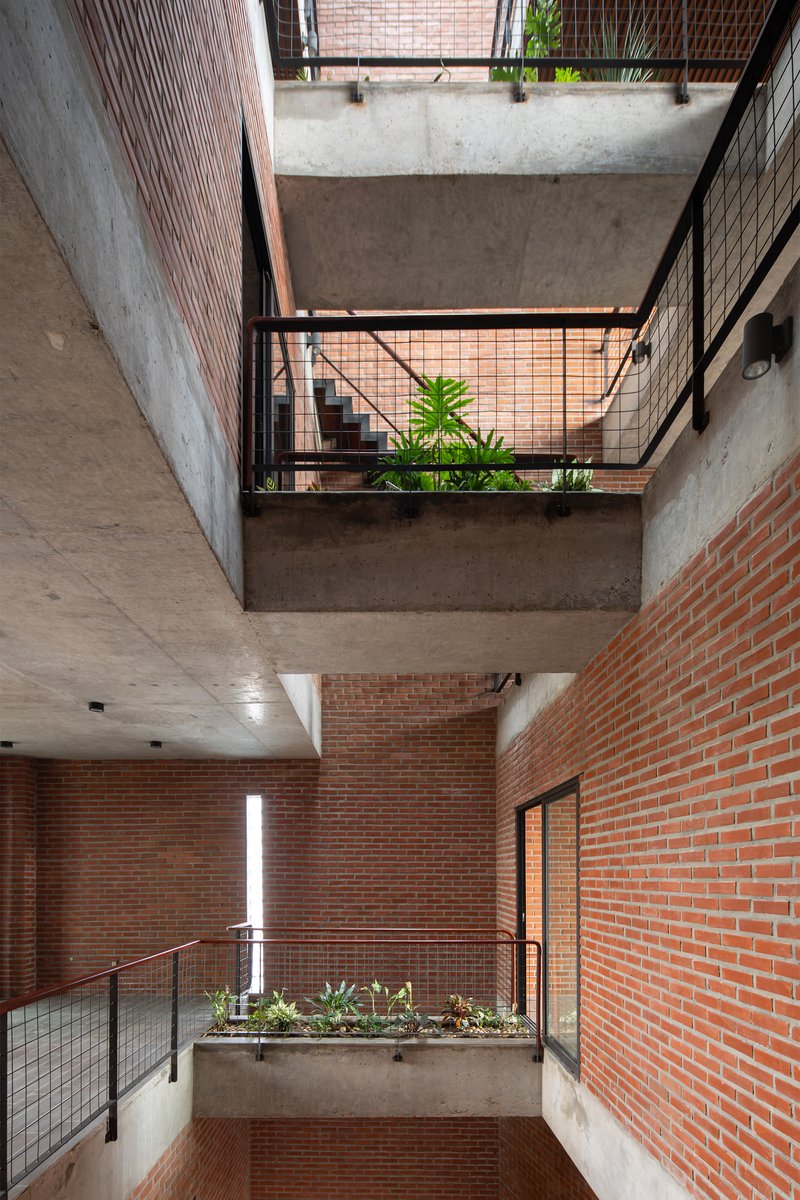
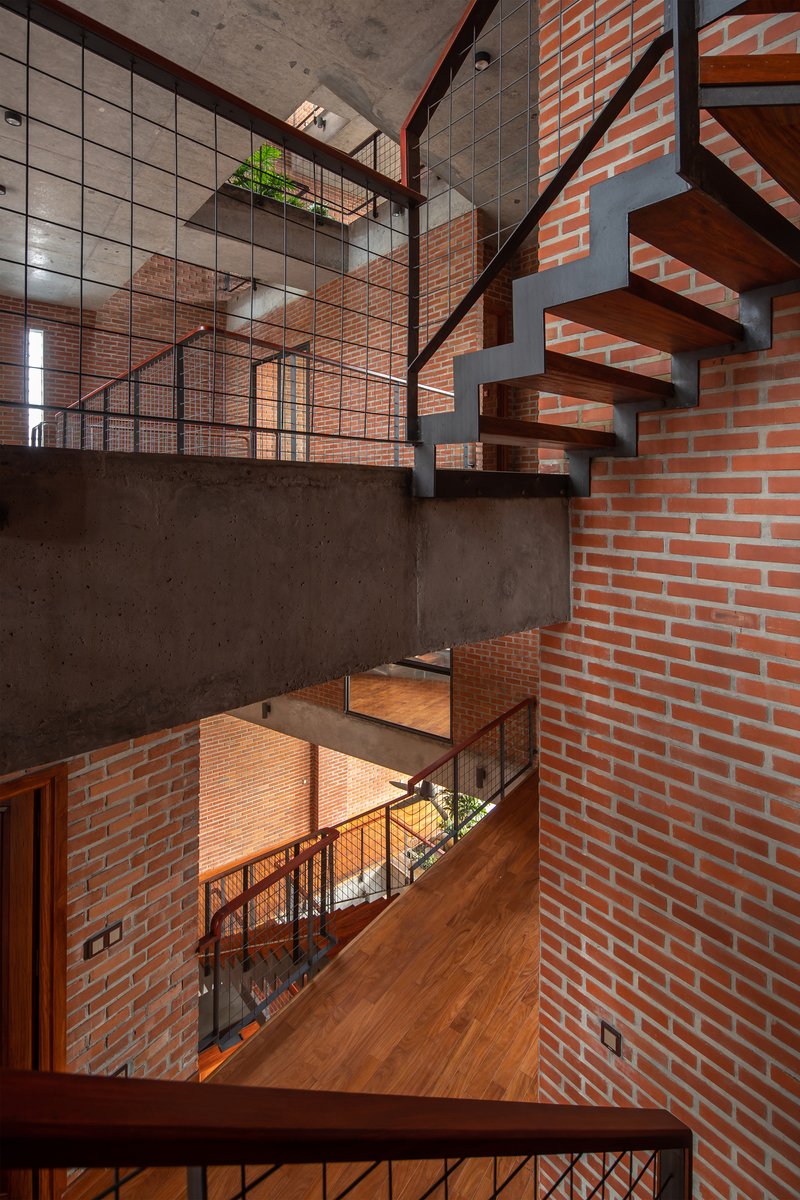
The most consequential move in the plan is the central atrium that runs the full height of the house. Lined with exposed red brick and rimmed by cantilevered concrete landings at each level, this void acts as the building's primary ventilation shaft, pulling hot air upward and out through a generous skylight at the roof. Planted beds at each landing introduce moisture and fragrance into the rising column of air, so the house effectively creates its own microclimate.
Standing at the bottom and looking up, you see a cascading stack of concrete slabs, timber stairs, and greenery receding toward a bright rectangle of sky. It is a genuinely dramatic spatial experience for a private house, closer to what you might find in a mid-rise institutional building. The architects treat circulation not as leftover space but as the primary room, the place where family members encounter one another in motion, and where air, light, and sound mix freely between floors.
Timber, Concrete, and Mesh
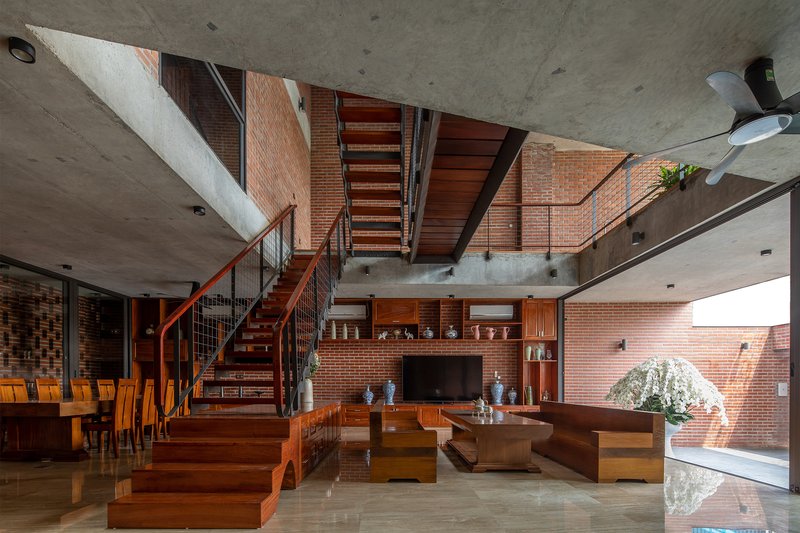
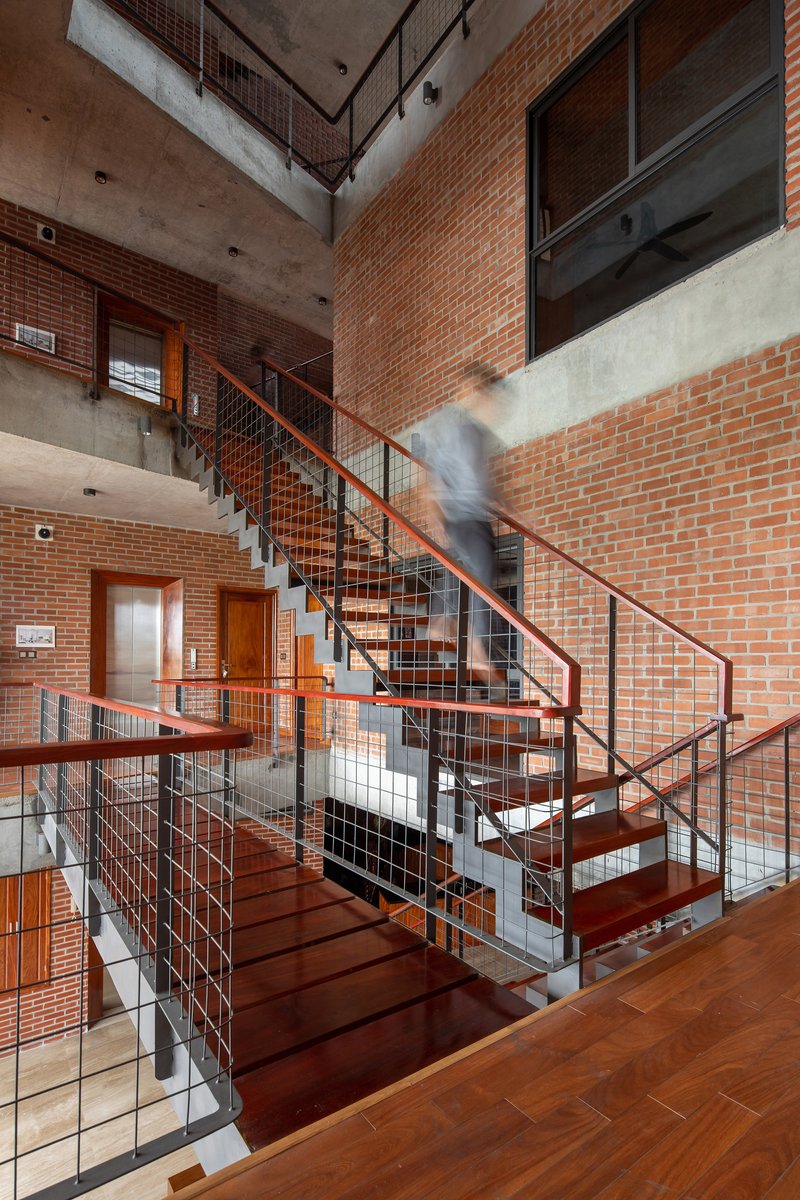
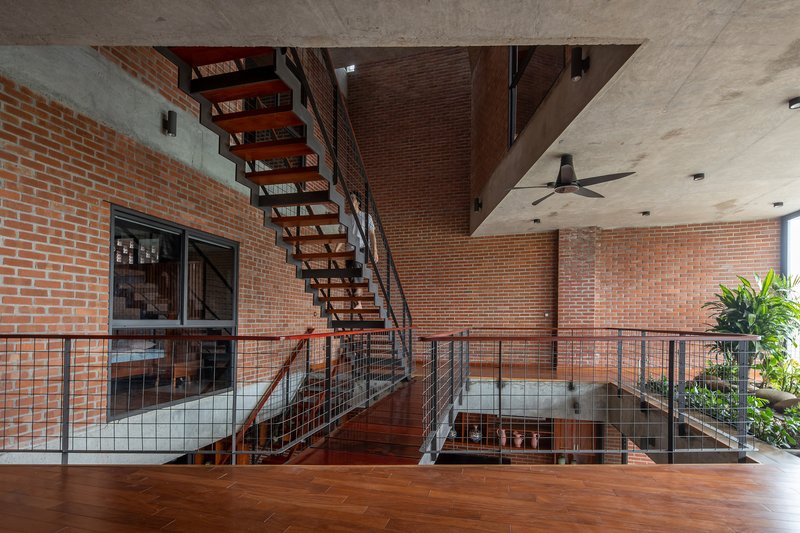
The material palette inside is deliberately industrial: poured concrete ceilings left exposed, steel ducts and columns visible, wire mesh railings replacing solid balustrades. Against this raw backdrop, timber stairs and herringbone wood flooring inject warmth. The contrast is not accidental. Concrete and steel handle the structural loads and thermal mass; timber and brick provide the domestic texture that keeps the house from reading as a warehouse.
The open-tread timber staircases are particularly effective. Because they are visually permeable, they reinforce the sense of spatial continuity that the central void establishes. You can stand at a kitchen counter on one level and see a resident descending stairs two floors above. Privacy exists in the enclosed bedrooms that ring the perimeter, but the shared domestic zones are deliberately transparent, layered, and interconnected.
Filtered Light as Interior Finish
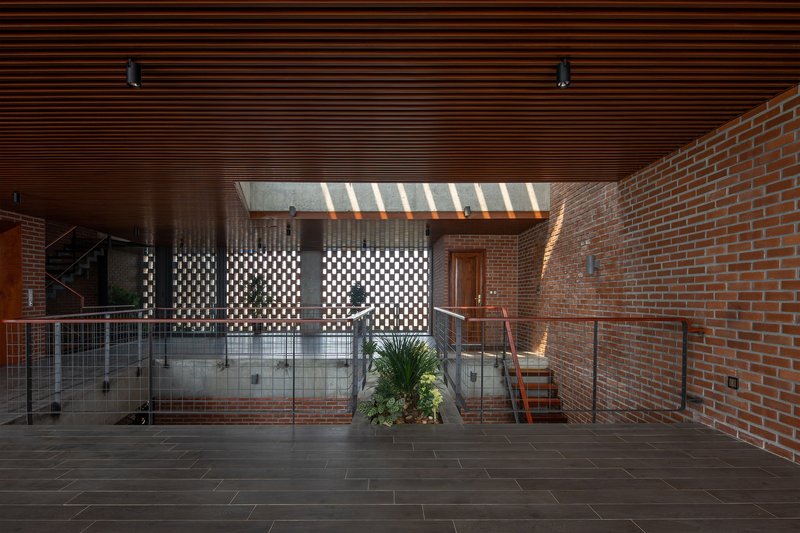
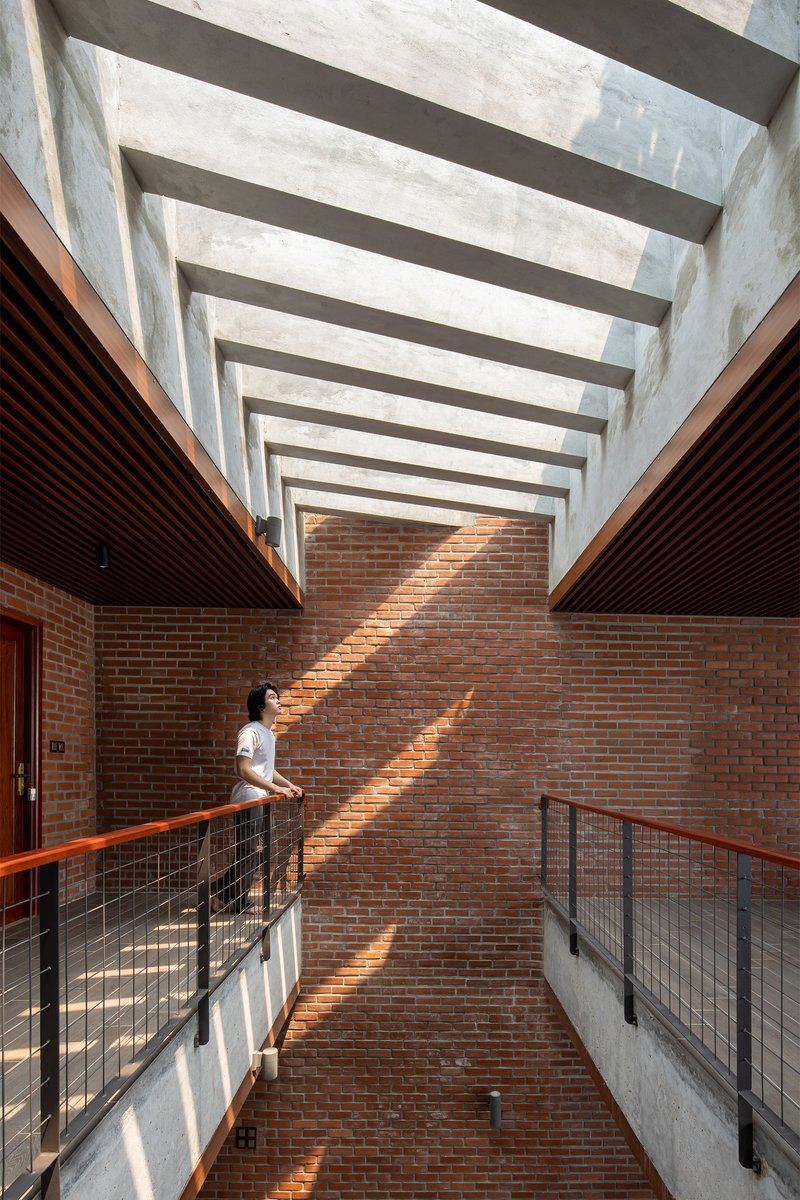
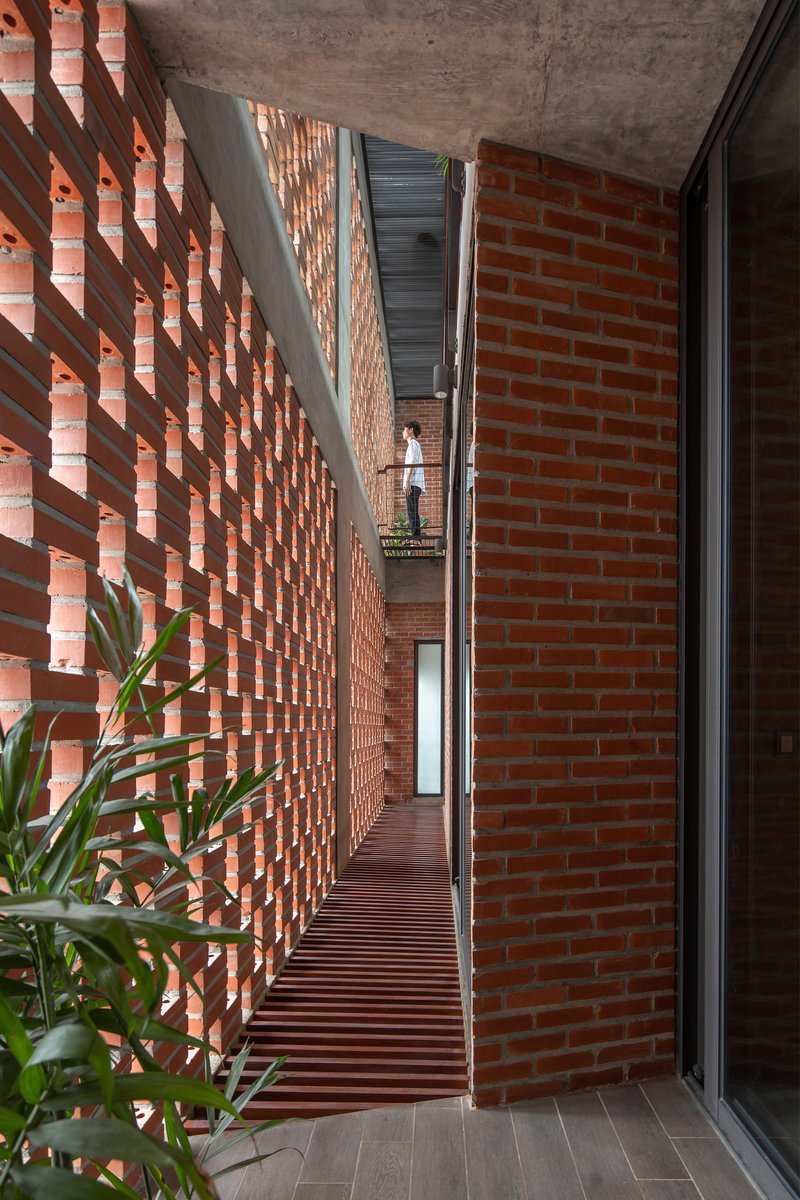
Some of the most striking moments in the house are created not by material but by shadow. The perforated brick screens cast striped and dappled light patterns across dark tile floors, concrete soffits, and corridor walls. These patterns migrate through the day as the sun moves, so the interior never looks the same twice. It is an old tropical technique, but here it is deployed with precision, calibrated so that the deepest rooms still receive enough ambient light to function without artificial illumination during daylight hours.
The skylit courtyard spaces amplify this effect. Where a conventional Hanoi tube house might introduce a single lightwell and call it done, Tropical Flow layers multiple openings, screens, and slat ceilings so that each floor gets a different quality of light. Upper levels are bright and direct; lower levels are cool and diffused. The gradient is deliberate, and it gives the house a vertical rhythm that the section drawings make explicit.
Living with Plants at Every Level
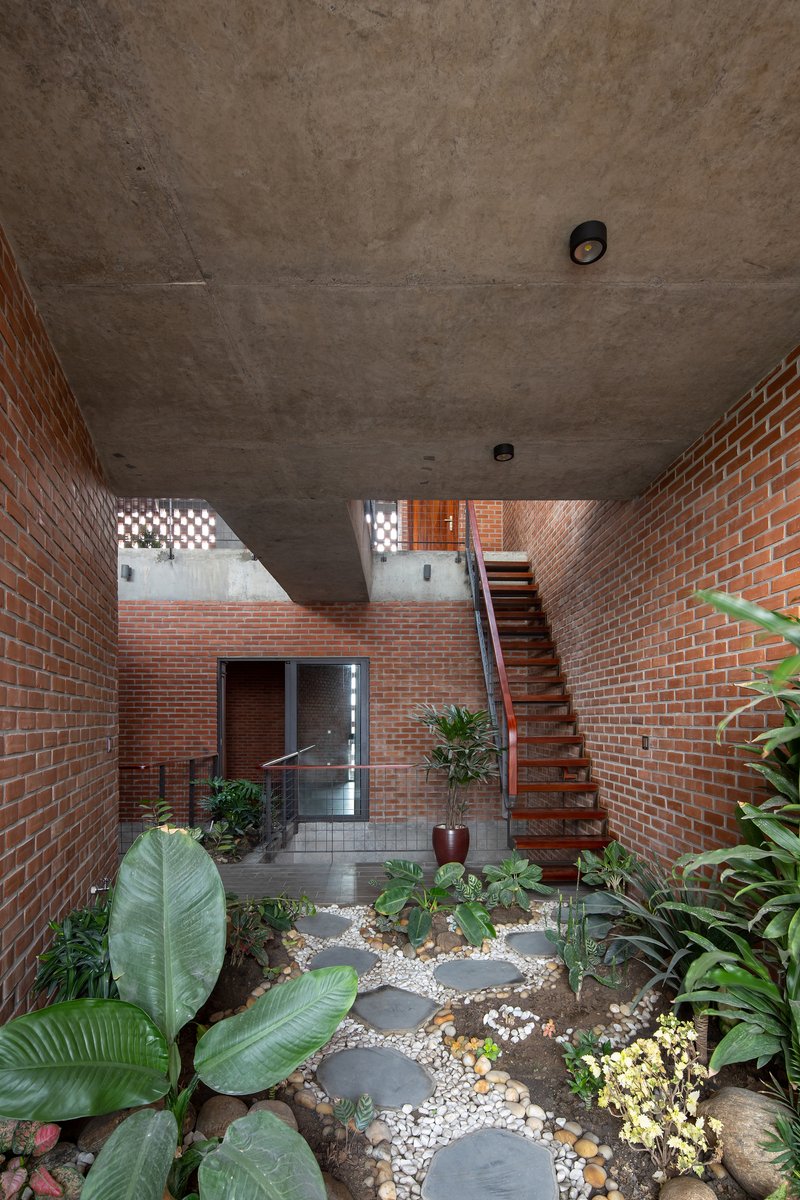
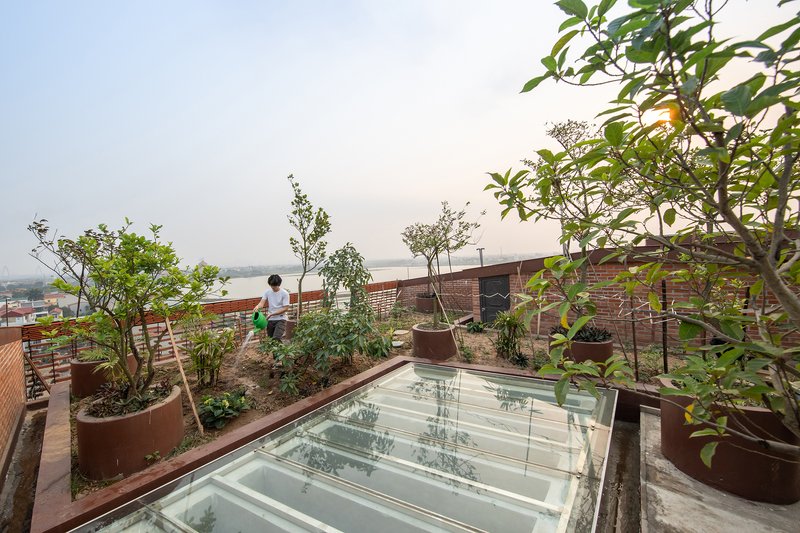
Greenery is not applied as decoration here; it is integrated into the structure. Planted concrete beds appear at every floor, on balconies, along corridors, and inside the central void. Climbing vines colonize the brick screens while ferns and succulents soften the terrace edges. The rooftop garden caps the sequence with potted trees and planting beds surrounding the glass skylight, creating a space that functions as both outdoor living room and thermal buffer for the floors below.
The cumulative effect is that the house produces a measurable amount of shade and evaporative cooling from its own vegetation. In a city where summer temperatures regularly exceed 35 degrees Celsius and mechanical air conditioning dominates residential energy budgets, the strategy is as pragmatic as it is photogenic.
The Brick Screen in Detail
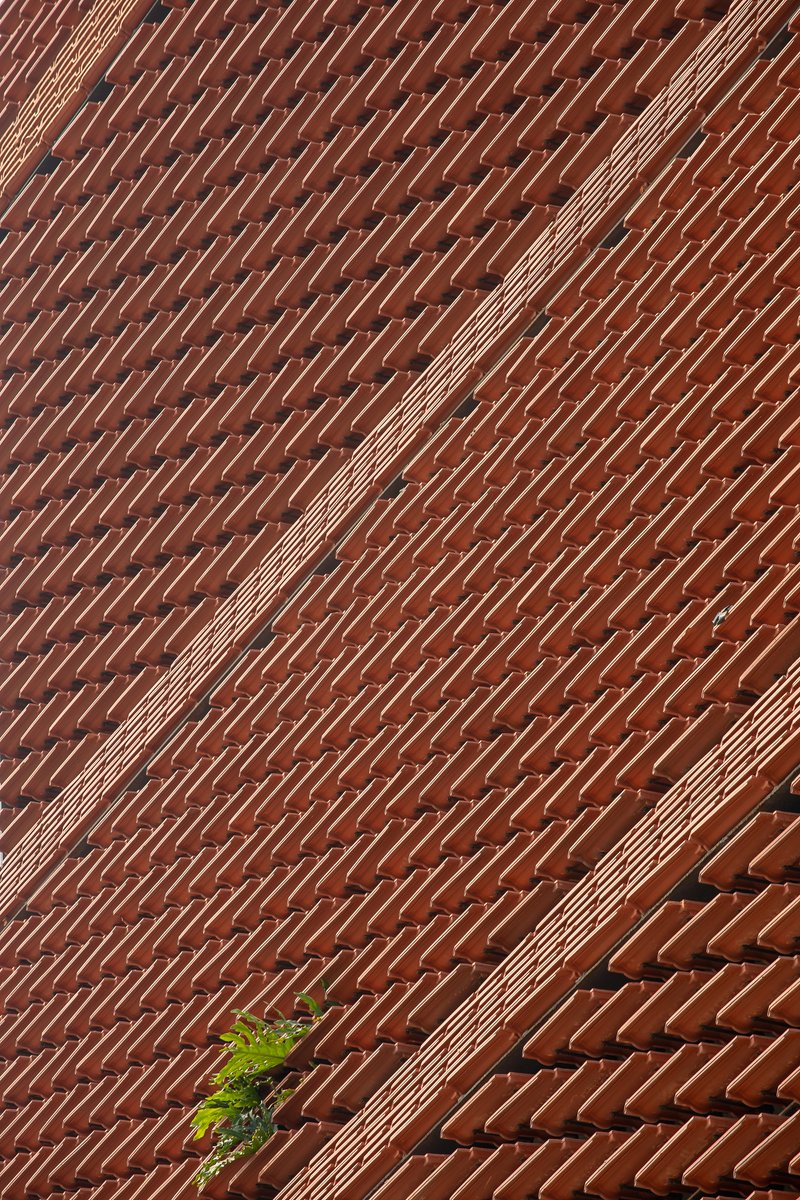
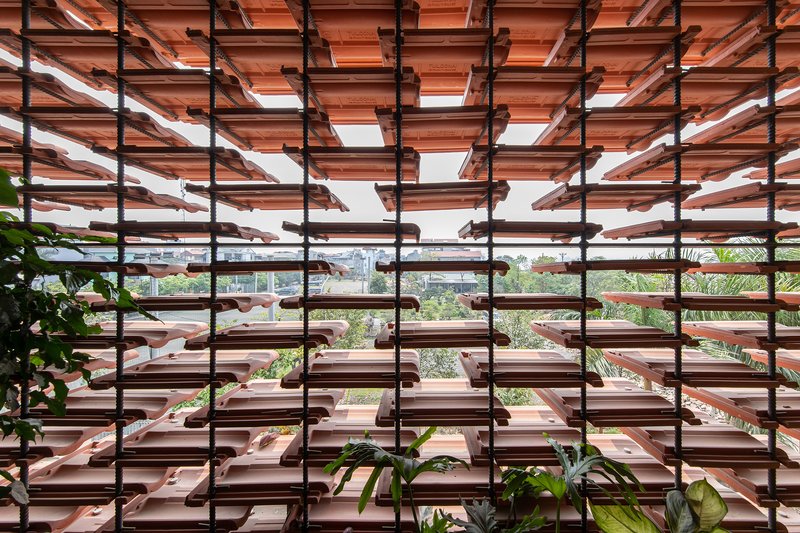
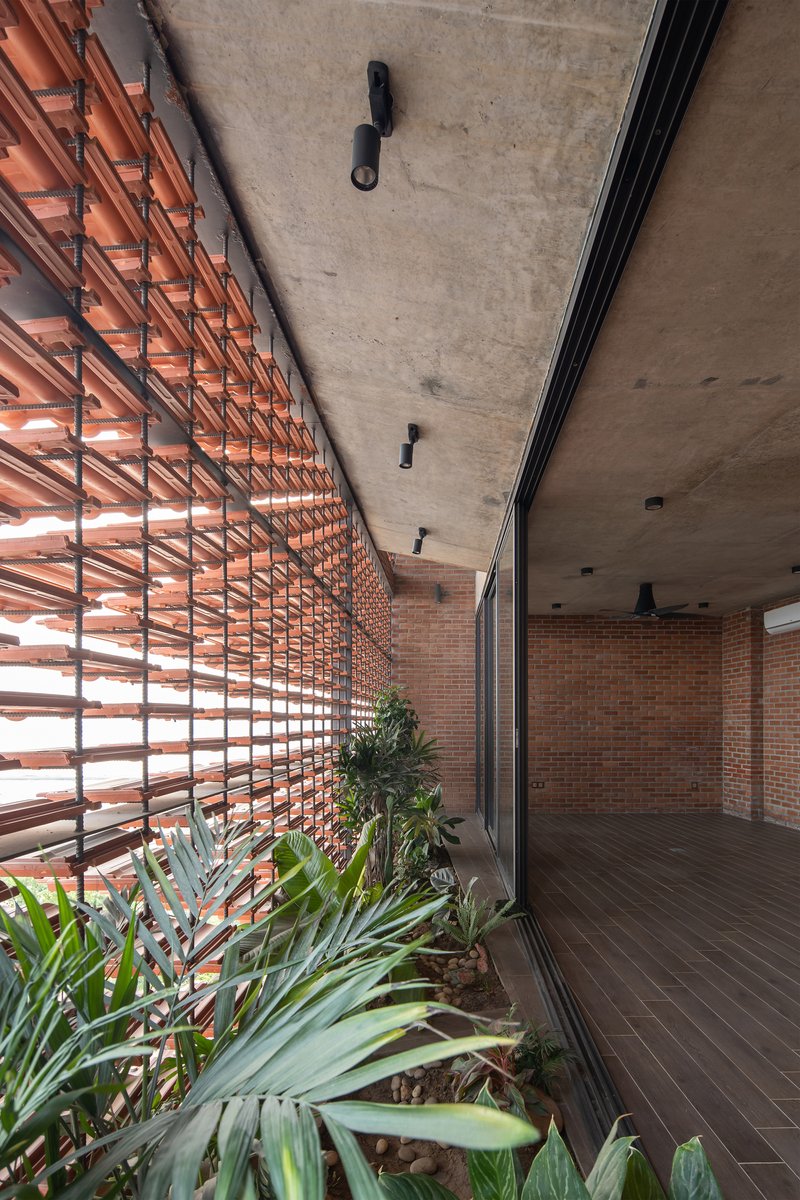
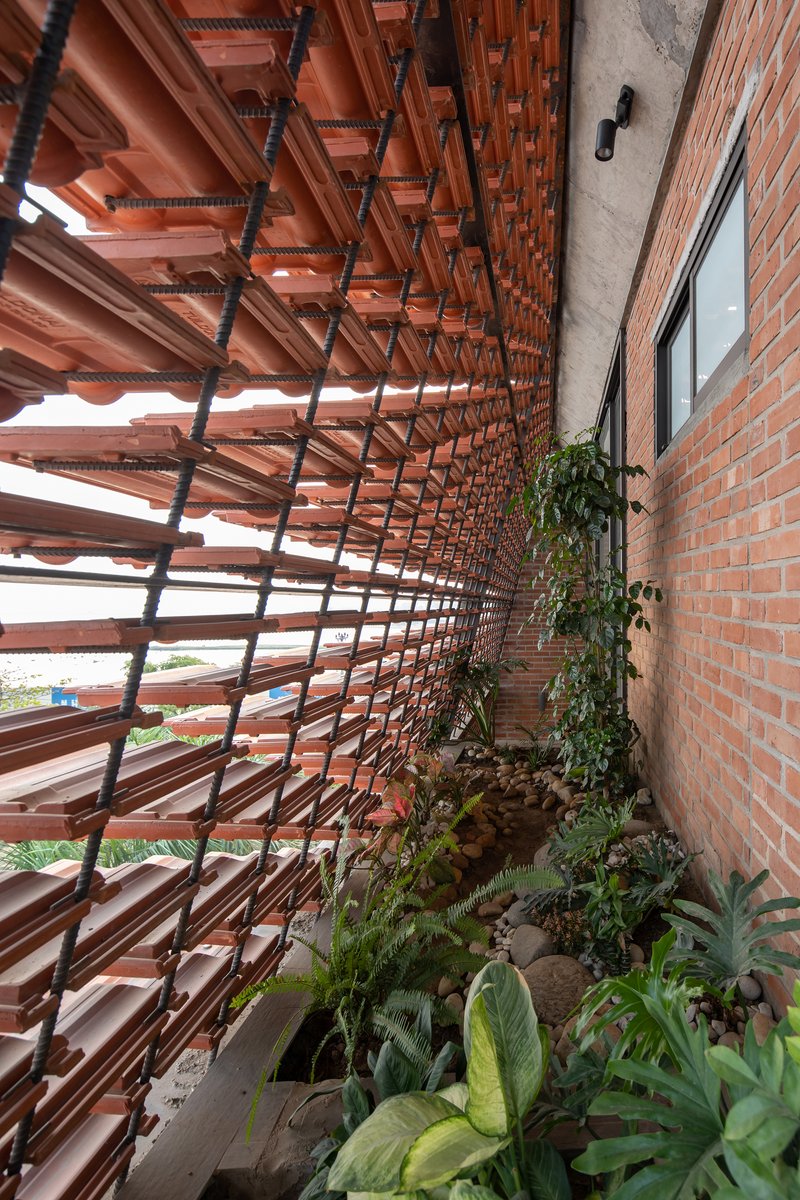
Zooming in on the facade, the construction reveals itself. Terra-cotta tiles and bricks are held in place by steel rod supports, creating a brise-soleil system that can be read as both screen and wall. The diagonal brick pattern produces a moiré effect at distance and resolves into individual bricks up close, each one slightly angled to deflect rain while admitting air. Small planted openings punctuate the lower portions of the screen, further integrating the living facade into the structural one.
The horizontal terra-cotta louvers on certain elevations offer a second register. Where the diagonal brick screen filters light into stripes, the louvers create a more uniform wash, suited to bedrooms and quieter rooms that benefit from even illumination without direct glare. The two screen types work in dialogue, giving the house visual complexity from the outside and functional variety within.
After Dark
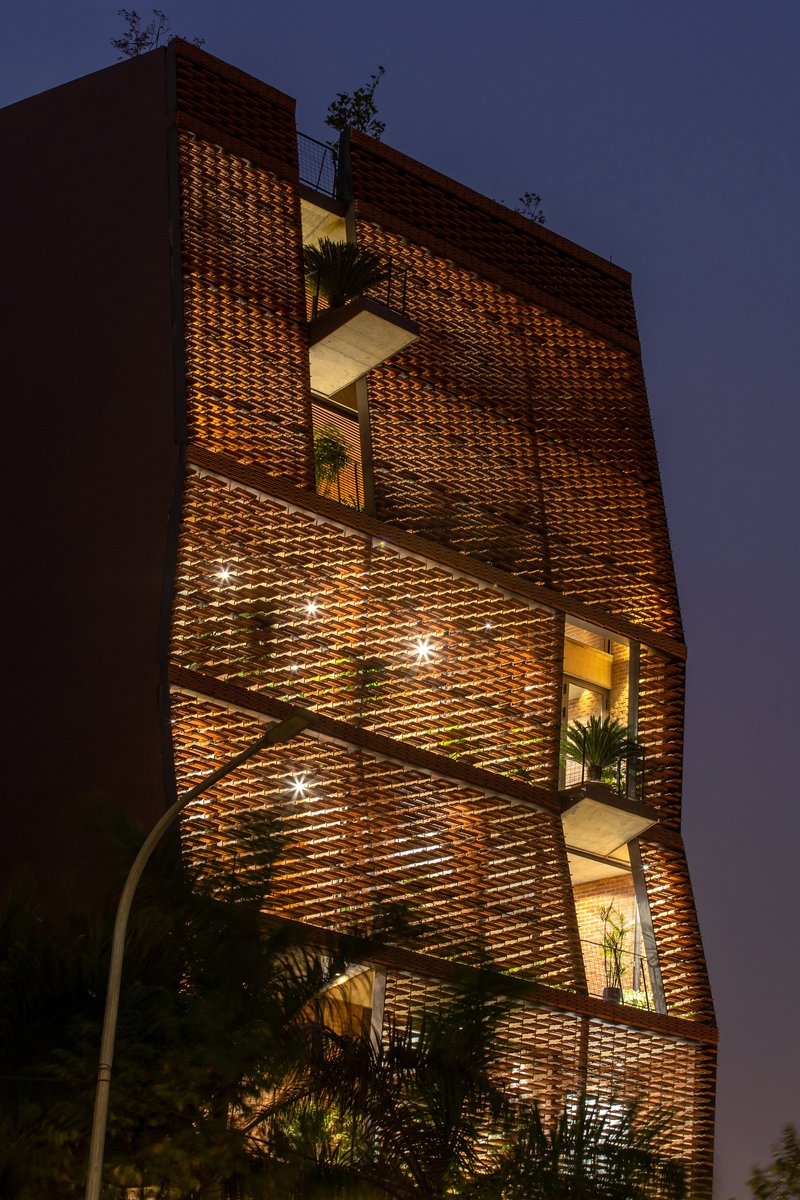
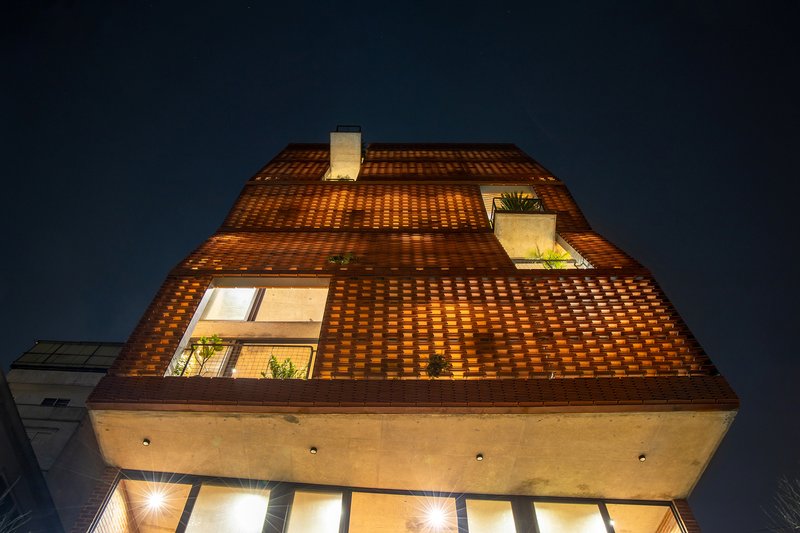
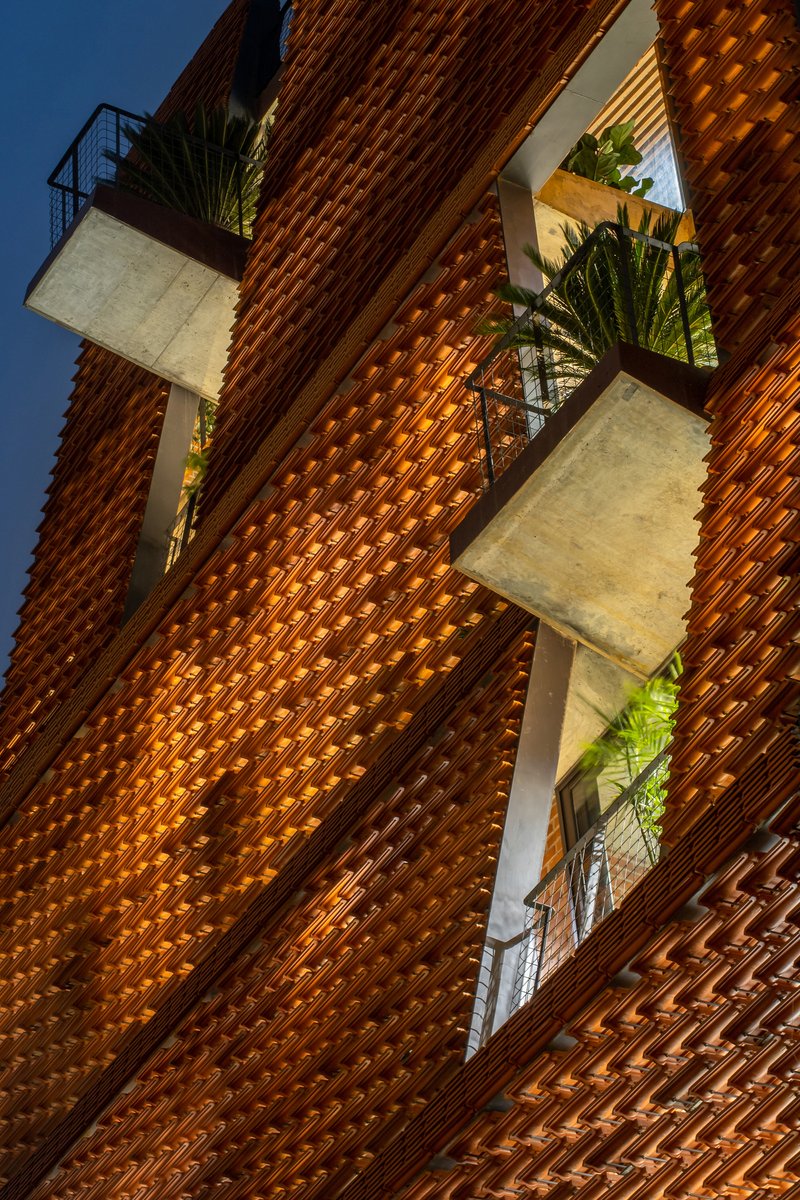
At dusk the logic of the facade inverts. Interior lighting now bleeds outward through the perforations, turning the brick screen into a lantern. The recessed terraces glow behind the lattice, and the staggered balconies read as illuminated shelves set into a dark terracotta cliff. The tapered silhouette against a deep blue sky is the building's most iconic image, the moment when its ambition to be both house and landscape is most legible.
Plans and Drawings
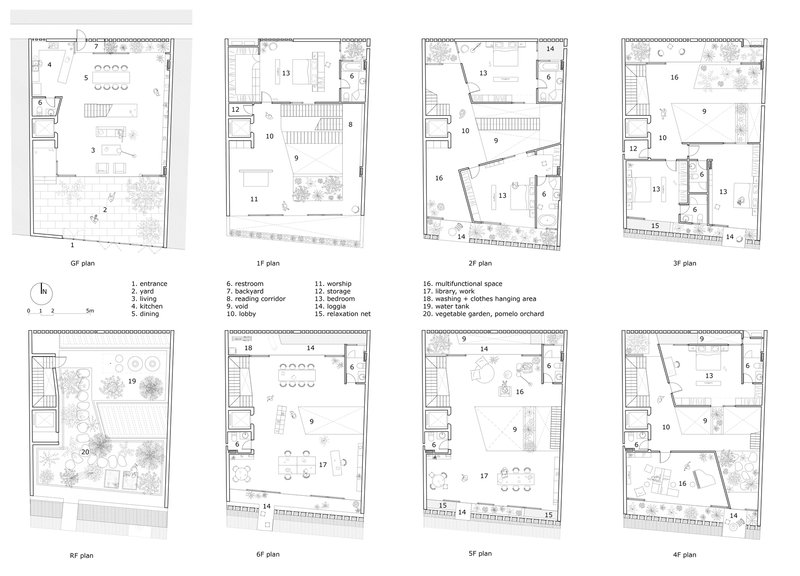
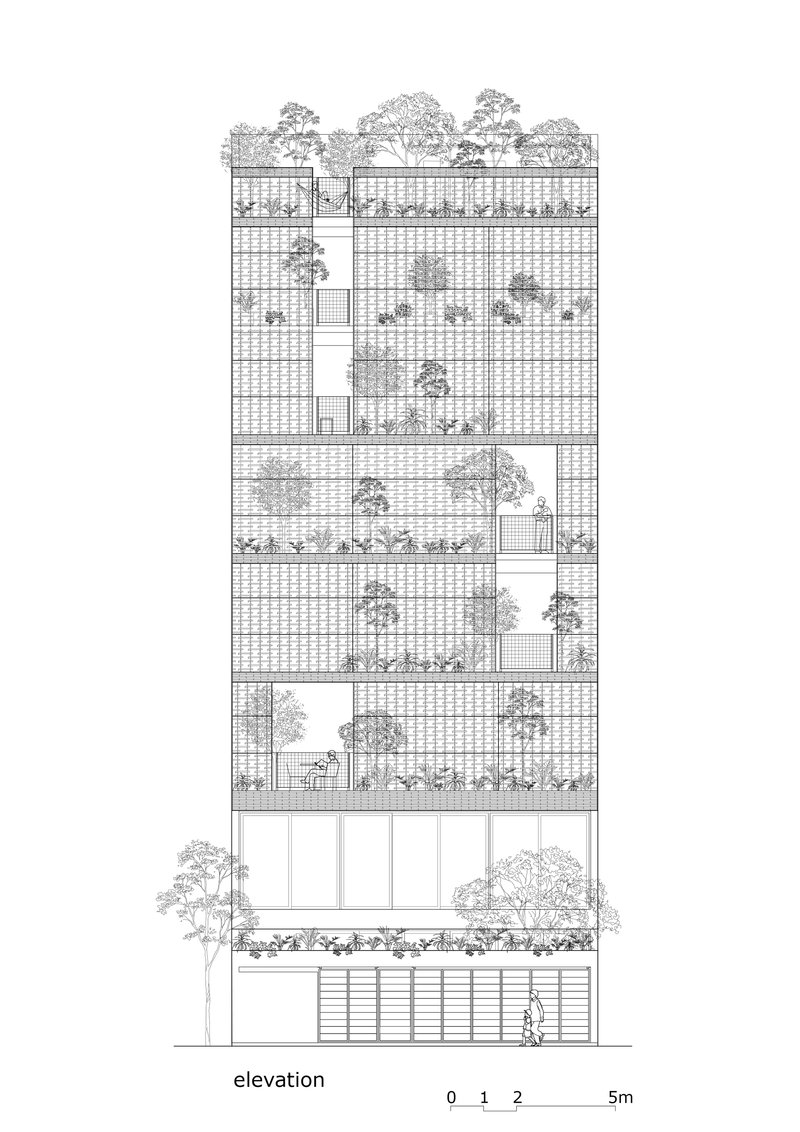
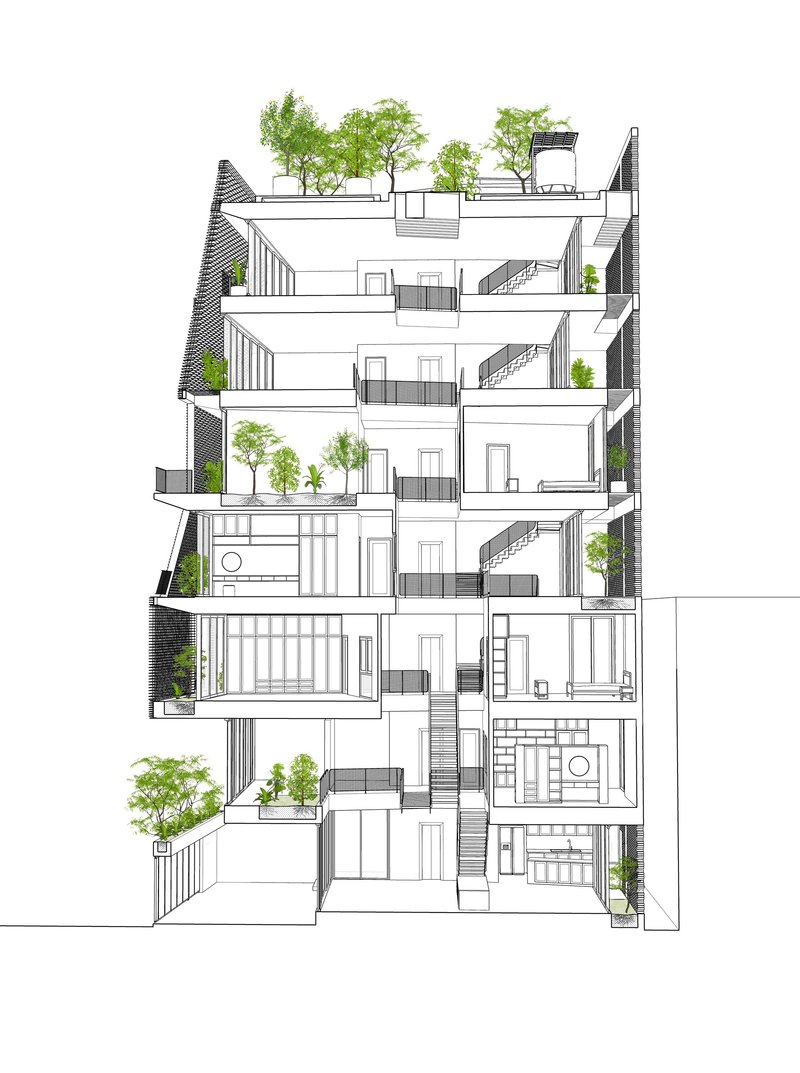
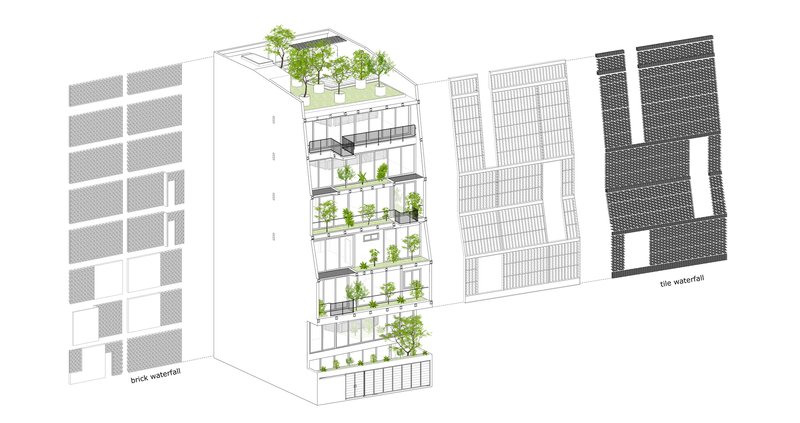
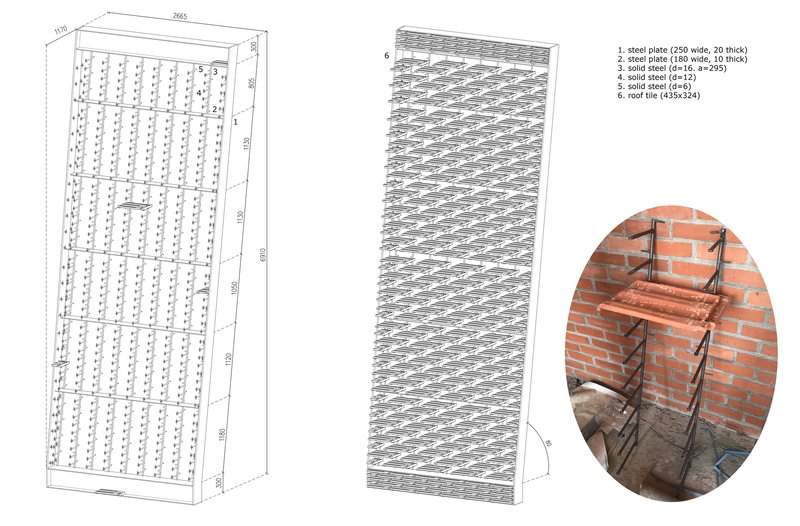
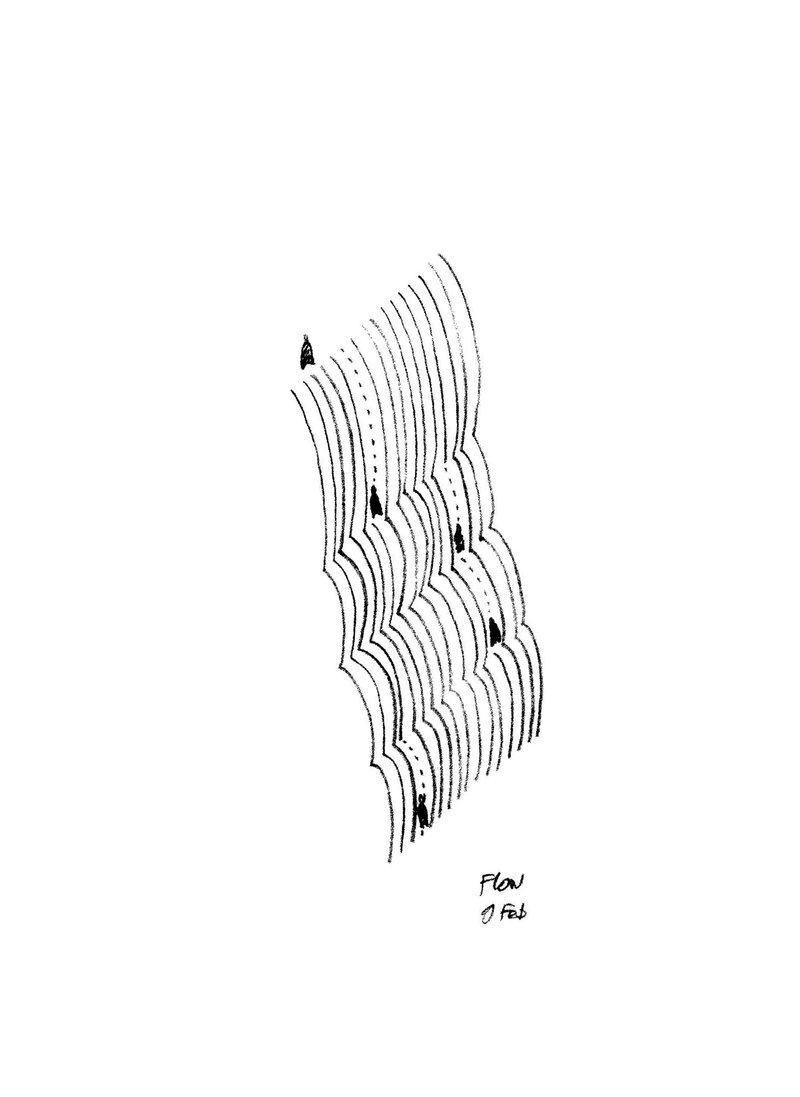
The floor plans reveal eight distinct levels within the narrow footprint, each one slightly offset to produce the cascading section. Internal courtyards and planted terraces appear on every floor, confirming that the greenery visible in photographs is not incidental but rigorously planned. The section drawing is the most revealing: staggered floor plates create a zigzag profile that maximizes air movement and allows each level to borrow light from the one above it.
The axonometric drawings decompose the facade into its constituent layers: the outermost brick screen, the planted balcony zone, the tile cladding, and the structural concrete frame behind. A hand-drawn concept sketch shows the contoured floor plates stacked in an organic composition, making the conceptual connection to flowing water explicit. It is a useful reminder that behind the complex craft of the finished building lies a simple spatial diagram: a vertical stream of air and light, wrapped in perforated earth.
Why This Project Matters
Tropical Flow matters because it demonstrates that the narrow urban lot, the most constrained residential typology in Southeast Asia, can generate genuinely inventive architecture when the vertical dimension is treated as an opportunity rather than an inconvenience. H&P Architects have not invented a new building type; they have radicalized an existing one, pushing the tube house toward a performance standard that most detached villas cannot match. Every decision, from the perforated brick screen to the staggered floor plates to the planted voids, serves both an environmental and a spatial purpose. Nothing is merely ornamental.
The project also offers a counterargument to the glass-and-steel modernism that increasingly dominates Hanoi's new residential construction. Terra-cotta brick is local, affordable, and thermally effective. Wire mesh and exposed concrete are honest about what they do. The house proves that passive climate strategies and rich spatial complexity are not luxuries; they are design choices available at the scale of a single family home, on a narrow lot, in one of Asia's fastest-growing cities.
Tropical Flow, designed by H&P Architects. Located in Vinh Ngoc commune, Dong Anh district, Hanoi, Vietnam. 1,150 m². Completed in 2023. Photography by Le Minh Hoang.
About the Studio
Share Your Own Work on uni.xyz
If projects like this are the kind of work you want to make, uni.xyz is a place to publish your own, find collaborators, and enter design competitions.




Popular Articles
Popular articles from the community

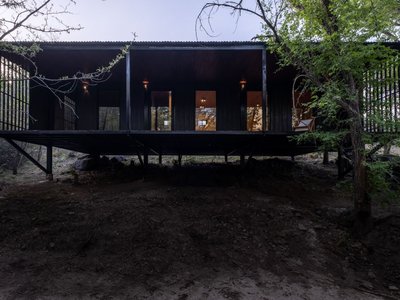
Pablo Senmartin Suspends a Steel-and-Timber Refuge Above a River Forest in Córdoba
An 80-square-meter dwelling on pilotis camouflages itself among the trees of Mayu Sumaj, designed to be dismantled without waste.

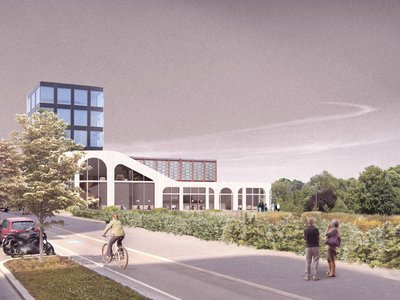
The Flow: Coffee Shop Interior Design Where Time, People, and Process Intertwine
The Flow reimagines Viennese coffee culture through arched forms, warm interiors, music, reading, work, and social gathering.
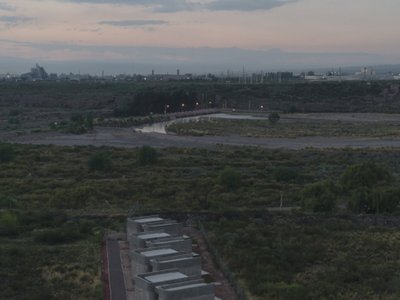
ONA Threads Four Board-Formed Concrete Cabins Along a 260-Meter-Deep Site in Mendoza
At the edge of Argentina's wine country, a set of curved concrete lodges negotiate a razor-thin parcel between city and mountain.
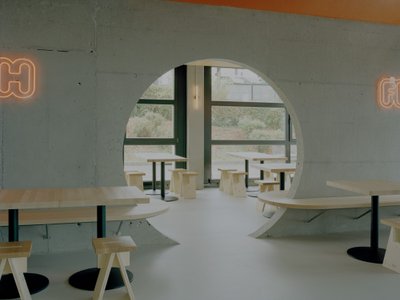
Noue Studio Organizes a Swiss Restaurant Around a Single Concrete Wall
In Granges-Paccot, Switzerland, a 216-square-meter renovation turns raw materials and a central spine into a legible dining experience.


Similar Reads
You might also enjoy these articles
Freebird Residence by Alexis Dornier: A Tropical Modernist Sanctuary in Bali
Floating living pavilion above pool anchors H-shaped tropical villa, blending Japanese minimalism, sustainable strategies, lush landscape, and sculptural interiors.
127af Flips a Tiny Bagnolet Rowhouse Upside Down with a Handcrafted Roof Extension
A 55-square-meter terraced house on the edge of Paris gains a luminous upper living floor through lightweight timber and steel.
1.61 Design Workshop Wraps a 600-Square-Meter Café in Vietnam in Sculptural Burgundy Drama
Reden Café & Bistro pairs a helical staircase, mosaic floors, and deep red interiors to rethink Vietnamese hospitality space.

The Unbound Brain: A School Shaped by Cognitive Architecture
Cylindrical learning pods radiate like neurons from a central cortex, turning the floor plan into a spatial model of human thought.
Explore Urban Design Competitions
Discover active competitions in this discipline




The Global Benchmark for Architecture Dissertation Awards


Challenge to design mud housing for contemporary communities
Comments (0)
Please login or sign up to add comments
No comments yet. Be the first to comment!