

Biophilia Lagos: A Shortlisted Stadium That Heals the Landfill It Stands On
Rachel George reimagines a Lagos landfill as a living stadium, wrapping the bowl in planted lattice screens and reshaping waste into public landforms.


Most stadiums ask the ground to disappear beneath them: level it, cap it, pave it, forget it. Biophilia Lagos does the opposite. It treats a former landfill as the project's raw material and its main client, and proposes a stadium that works as a remediator. The building is cast as an ecological machine that detoxifies, regenerates and reconnects a poisoned piece of city. The spectacle on the pitch becomes secondary to the slow repair happening in the soil and on the walls.
Designed by Rachel George and shortlisted in Commercial '20, the proposal sits on a reclaimed waste site in Lagos. It takes on one of the hardest questions in contemporary urbanism: how to bring toxic land back into civic life without erasing what it was. George's answer keeps the waste on site, sorts and reuses it, and lets the memory of the landfill shape the new topography. The result reads less like a sports venue dropped onto a cleared plot and more like a landscape that happens to contain one.
A Vine-Clad Lattice Rising Out of the Bowl
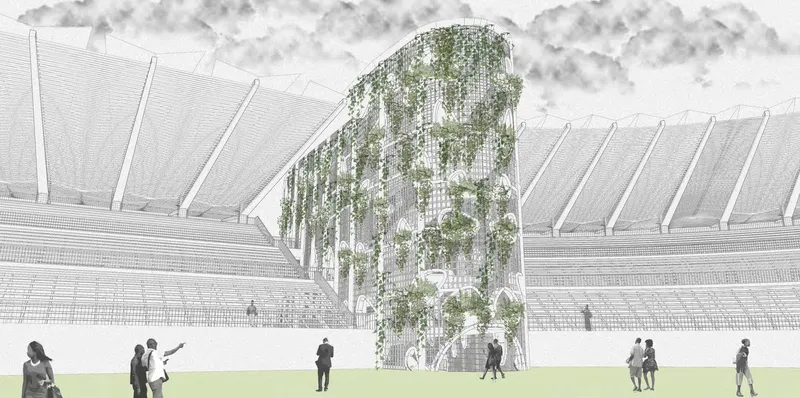
The opening image sets the project's priorities. An empty bowl, a few figures on the pitch, and a lattice tower thick with vines rising above it all. The structure is an example of what George calls biologically activated screens: porous envelopes that wrap the stadium and act as living filters. They hold plant growth, improve air quality and, over time, give themselves up to colonising vegetation. The tower's lack of a solid face is deliberate. Its openness is what allows it to work as a filter.
This is where the project's biophilic claim becomes architectural rather than decorative. Rainwater collection irrigates the planting, and the permeable facade supports passive ventilation. The envelope is meant to change with the climate and with its own ecology, so the stadium George renders is a starting point, one that will look different every season it survives.
Circulation Threaded Through Living Walls


Inside, the conventional stadium concourse, usually a dim ring of concrete and concession stands, is replaced by something closer to a botanical promenade. A wide curved staircase sweeps past lattice walls hung with ivy toward a round balustrade overlooking a lower level. Further up, a slim-railed walkway runs alongside a wall of hanging planters, with visitors pausing beside a white column as if in a garden pavilion.
The brief George sets herself is immersion over spectacle, and these spaces deliver it. Paths are fluid, shaded and layered with greenery, and the boundary between inside and outside is kept intentionally vague. The lattice does double duty as structure and trellis, so movement through the building is always movement past growing things.
Arched Openings That Frame the Pitch Through Ivy

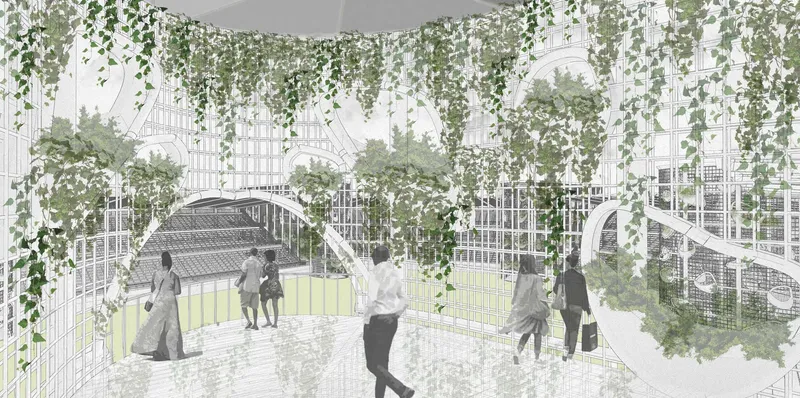
A ramp slides past arched openings cut into the vine-draped facade, the pitch visible beyond. From a balcony inside the planted enclosure, visitors look out through another arch toward the seating, framed by curtains of trailing ivy. The arches are the project's most legible gesture: they give the porous screen a rhythm and turn the act of watching the game into a view filtered through foliage.
These moments matter because they show the screens are inhabited, rather than being a skin wrapped around an ordinary building. Elevated platforms and green corridors give spectators places to linger between the bowl and the city, and they make the envelope a destination in its own right on days when no match is being played.
Landfill Mounds Recast as Skate Terrain
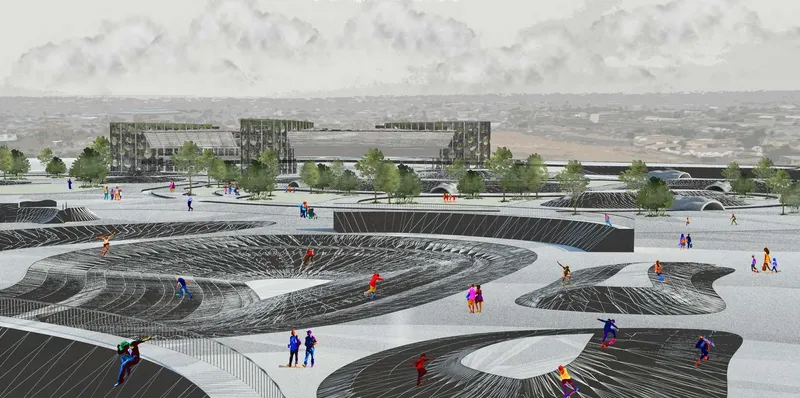
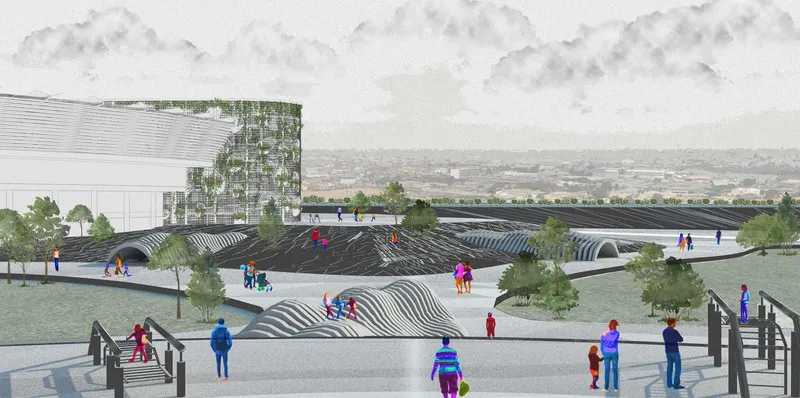
Outside the stadium, the landfill's history is reshaped into public ground rather than hidden. Accumulated waste is reorganised into a series of sculpted landforms that preserve the site's memory while hosting new programme. In the renderings, dark rippled mounds become skate bowls filled with skaters and walkers, and a stepped plaza leads toward the green-clad facade sitting on the horizon. Organic waste is turned into fertile ground through phytoremediation, while non-organic material is sorted, recycled and reconfigured into structural and construction elements.
This closed loop is the project's strongest idea. By refusing to truck waste elsewhere, George folds circular-economy principles into the form of the site itself. The same logic extends to the programme the renderings only hint at: playgrounds, terraced farming on remediated soil, and water streams and retention ponds that manage stormwater while building biodiversity. Infrastructure is designed to be walked through and used, not fenced off.
A Civic Plaza Built on Reclaimed Ground
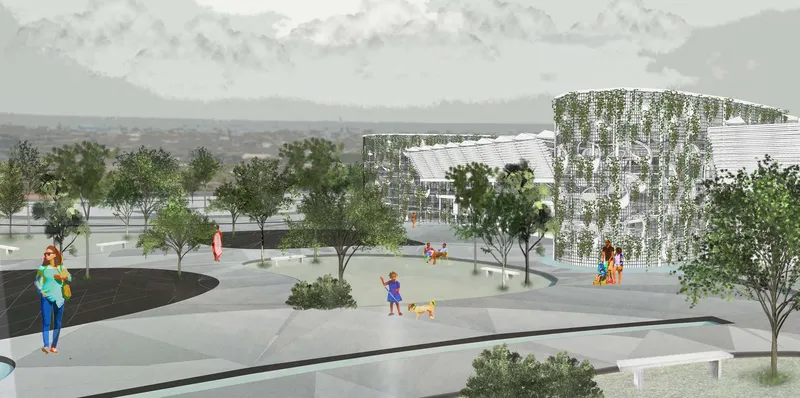
The final rendering is the quietest and perhaps the most persuasive. A paved plaza with scattered trees and benches, a child walking a dog, vine-draped facades behind. Nothing here signals a former dump. That ordinariness is the point. The land has been returned to everyday use, and the stadium recedes into the role of a green backdrop for neighbourhood life.
George ties this public ground to the social life of Lagos as well as its ecology. Waste sorting and recycling are built into the construction phase, opening work to communities already active in the city's informal waste economies. The proposal aligns itself with practices that already exist in Lagos rather than importing a foreign model of remediation, and frames employment and environmental repair as parts of the same process.
Why This Project Matters
Stadiums are among the most resource-hungry buildings a city commissions, and they often sit idle between events. Biophilia Lagos reframes the typology as an active ecological system: a structure whose envelope filters air, whose grounds produce food and manage water, and whose construction process cleans the land it occupies. The decision to keep and reprocess waste on site, rather than displace it, is a sharp and transferable position for any city sitting on its own buried refuse.
The renderings lean heavily on the planted lattice, and the project would benefit from showing more of the farming terraces, ponds and sorting processes that carry its argument. Still, the core proposition is clear and well defended. Rachel George designs a stadium that measures its success by what grows back as well as by the crowds it draws. For a competition themed around commercial architecture, that is a welcome reminder that public buildings can repair cities as well as fill them.
View the Full Project
About the Designers
Designer: Rachel George
Enter a Design Competition on uni.xyz
uni.xyz runs architecture and design competitions year-round that reward proposals with spatial conviction and real site intelligence.
Project credits: Biophilia Lagos by Rachel George Commercial '20 (uni.xyz).


Popular Articles
Popular articles from the community


Cloaked Colonization: A Mobile Underwater Habitat That Moves Like a Fish
Micah Abaya's shortlisted EHC Pacific entry reimagines ocean settlement as a dispersed network of self-sustaining architectural organisms.

Opera on the Sea: Driftwood Logic Shapes a Timber Opera House on Estonia's Coast
Trevor Orgill's opera house translates the entangled drift of floating timber into a civic building where wood, water, and music converge.

Singing Woman: An Opera House That Performs Before the Curtain Rises
Ovidiu Cristian Pavel's conceptual opera house translates Estonia's choral identity into a sculpted waterfront landmark facing the Baltic Sea.

Manzana Morphosis: Stretching Barcelona's Grid into a Living Landscape for 2050
A radical reworking of the Eixample manzana turns density into a tool for generous public space, vertical ecology, and environmental performance.

Similar Reads
You might also enjoy these articles

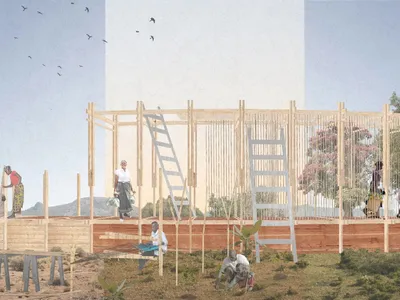
Healing Façade: A Modular Chapel System That Restores Ethiopia's Sacred Forests
Winner of the Eco-Chapel competition, this circular timber façade collects water from air to rebuild soil and reforest degraded Ethiopian landscapes.
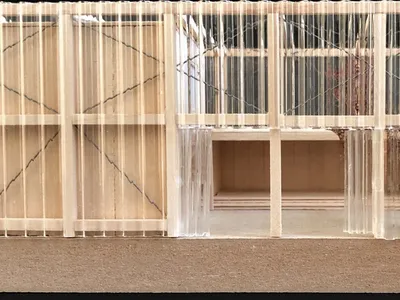
Kaffeebühnen: Where Coffee Shop Architecture Becomes a Civic Stage in Vienna
A linear sequence of timber boxes, transparent shells, and open yards turns the Viennese café tradition into a public performance space.
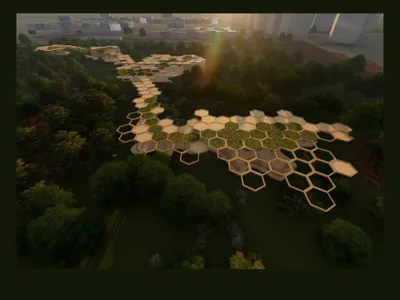
Eco Chapel: A Modular Forest Pavilion That Grows Like the Landscape It Protects
Hexagonal timber modules weave through existing trees, turning a chapel into a living system for prayer, education, and reforestation.


Urban Forest: A Vertical Ecosystem for 5,000 Workers in Singapore's Changi Business Park
Radially stacked pods and layered green decks turn a 7-acre plot into 47 acres of ecological workspace projected for 2040.

Explore Sports Architecture Competitions
Discover active competitions in this discipline

Challenge to design a barrier free sports center

Challenge to design an outdoor ice-rink and park

Challenge to reimagine the Iron Throne

Photograph architecture without architects
Comments (0)
Please login or sign up to add comments
No comments yet. Be the first to comment!