
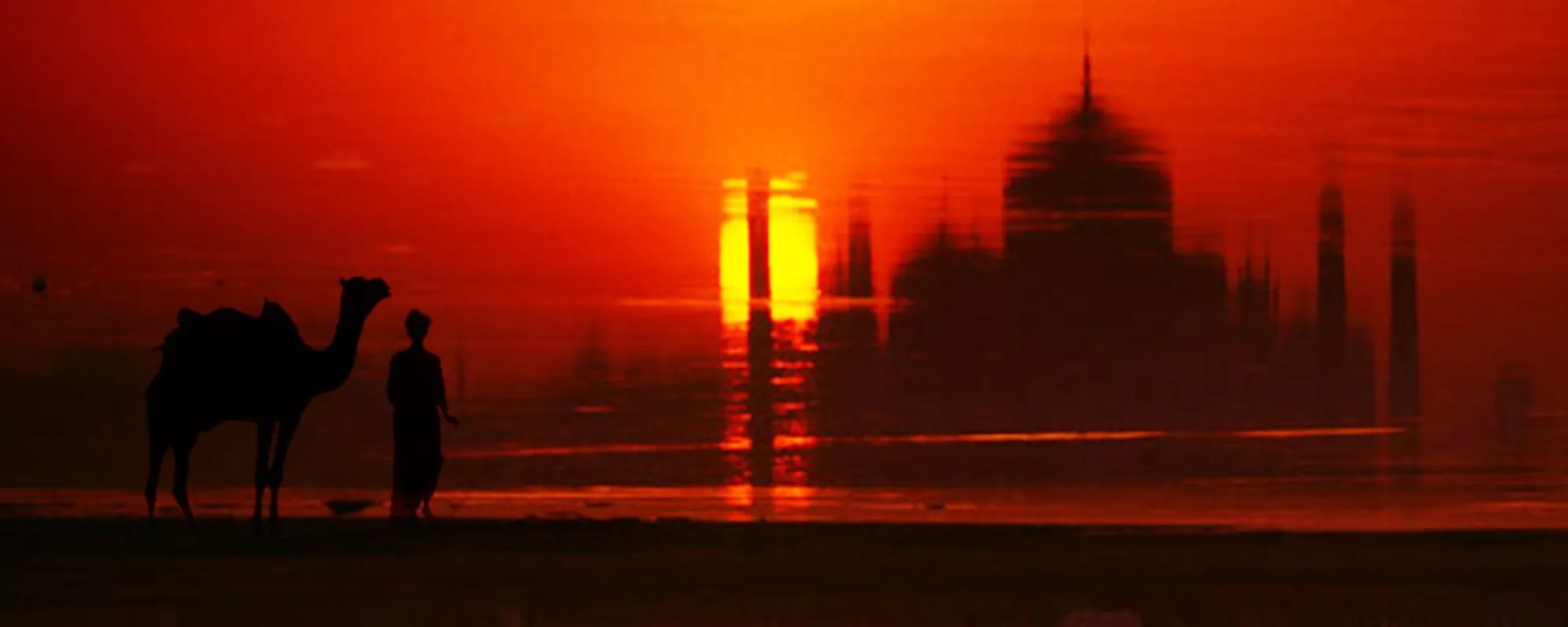
The Black Bagh: A Living Monument Built from Water, Light, and Memory
On the banks of the Yamuna, two designers replace the myth of a marble mausoleum with a regenerative landscape of reflection and ritual.


What if the most powerful monument you could build was one you could never touch? The Black Bagh abandons the idea of the Black Taj as a structure of dark stone and reimagines it as something far more elusive: a reflection on water, a shift in atmosphere at dusk, a collective memory carried by a river. The mythical counterpart to the Taj Mahal becomes not a building but a living landscape, one that heals the polluted Yamuna while staging an architectural performance that changes with each hour of the day.
Designed by Hooman and Amirhossein, the project received an Honorable Mention in The Black Taj competition. Sited on the banks of the Yamuna opposite the Taj Mahal, the proposal reinterprets the Persian Charbagh layout of the historic Mehtab Bagh into a dynamic topography that responds to seasonal water flow, local ritual life, and the urgent ecological crisis of one of India's most sacred rivers.
An Arched Bridge on Still Water
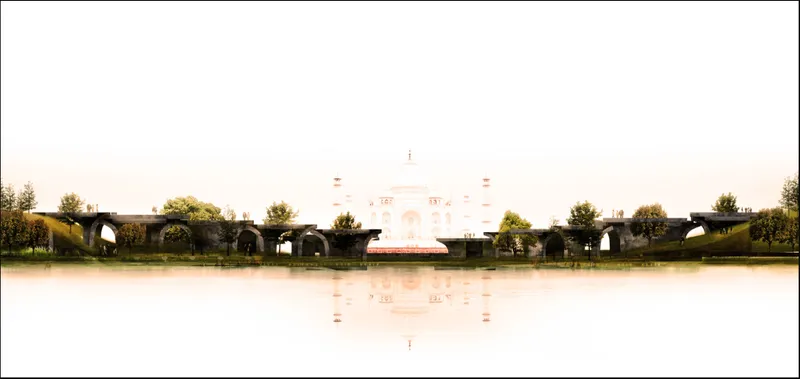
The long elevation reveals the project's defining spatial gesture: a multi-arched bridge stretching across the Yamuna, its form doubled perfectly in the still water below. Beyond it, the dome of the Taj Mahal hovers in the distance. The symmetry is not decorative. It is the project's thesis made visible. The Black Taj exists only in reflection, constructed by the river itself. The bridge operates as a threshold between the tangible city and the imagined monument, framing a view that shifts from crisp solidity in daylight to a dissolving mirage at dusk.
Concrete Courtyards That Channel Water and Light
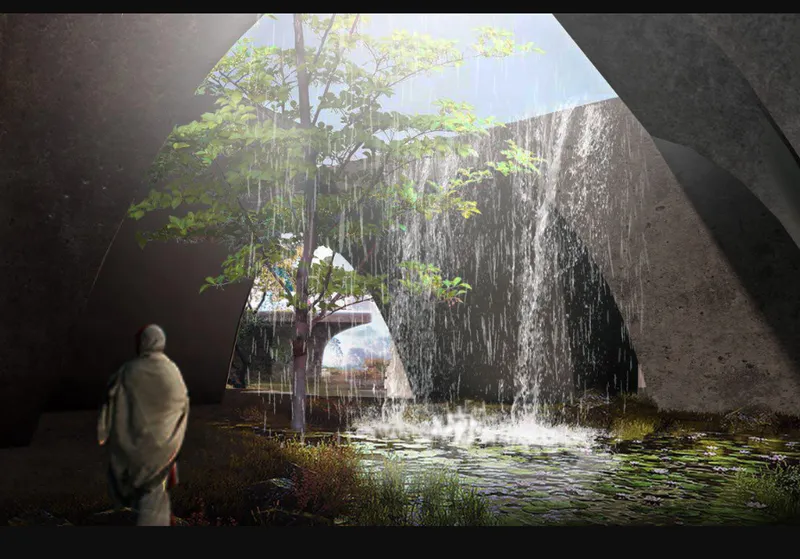
Step inside the interior courtyard and the atmosphere contracts. Angular concrete walls rise to frame a cascading water feature, with a single planted tree anchoring the composition beneath overhead skylights. Water is not an ornamental accent here; it is the structural logic of every space. The cascading feature connects to the larger system of rainwater harvesting and natural filtration that runs through the entire site, turning each courtyard into a functional node in the landscape's self-healing ecosystem.
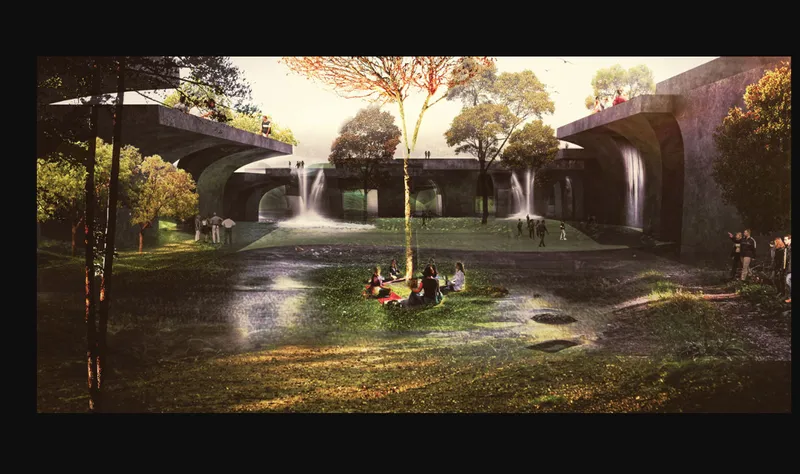
The elevated plaza amplifies this principle at an urban scale. Waterfalls pour from cantilevered concrete platforms while visitors gather on the lawn below, occupying the space between infrastructure and garden. The terraces, bridges, and courtyards dissolve into pools and planted zones designed to purify and replenish the river. Architecture and landscape engineering become indistinguishable.
A Riverside Park Beneath Elevated Platforms
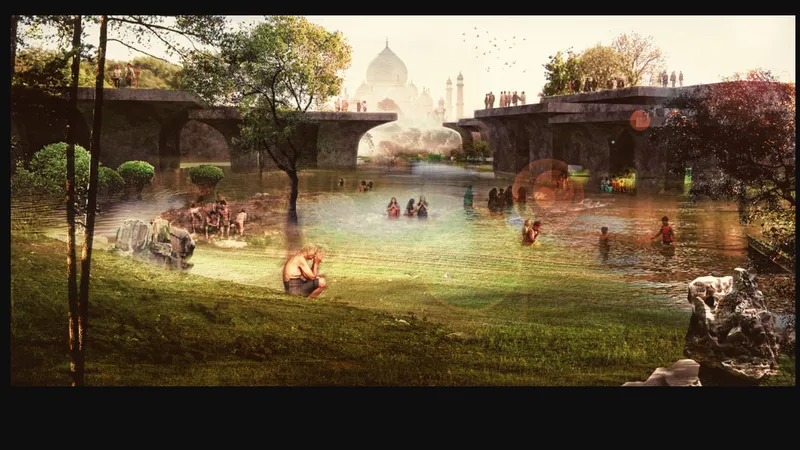
Morning mist softens the boundary between the concrete platforms and the riverbank below, where bathers wade into the Yamuna with the domed monument barely visible across the water. The proposal takes the river's role in local rituals seriously: ablutions, festivals, and community gathering all find space within a landscape graded to accommodate seasonal flooding. The elevated platforms provide shelter and shade without severing the connection between people and water, redefining the Yamuna's edge as a space for healing rather than neglect.
Filtration Zones and Landscape Terraces as System
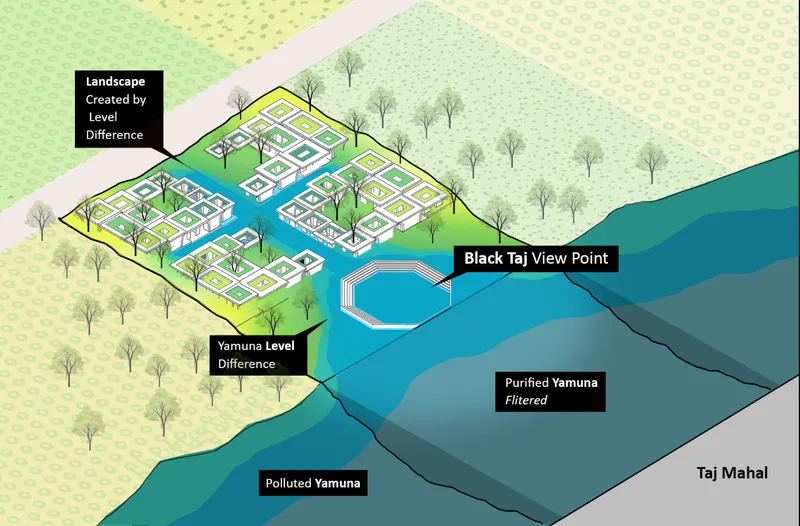
The axonometric diagram strips the project down to its operative logic. Pavilions line the river while water filtration zones and landscape terraces step down toward the bank in a sequence that merges bio-remediation with public program. Filtration ponds, landscape grading, and rainwater collection work together to transform the polluted riverbank into a self-sustaining ecosystem. The Charbagh is no longer a static ornamental garden; it is a machine for ecological recovery, its geometry driven by hydrology rather than symmetry alone.
Floating Candles and the Invisible Monument at Dusk
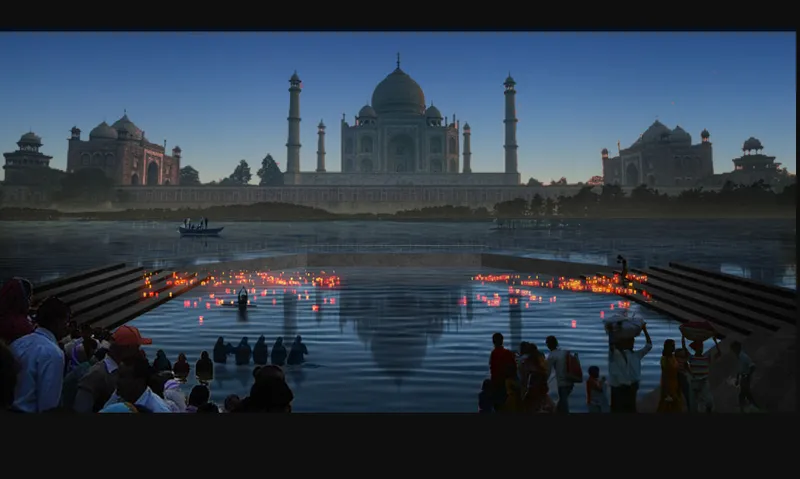
At night, the Black Bagh delivers on its most provocative claim. The ghat steps descend to the water's edge, where floating candles trace the current and the domed monument dissolves into darkness across the river. The built form becomes invisible, existing only through reflections and memory. This is the true Black Taj: not an absence, but a presence that refuses to solidify. The designers describe three temporal layers of experience, from the social activity of daylight to the mirrored peace of dusk and the pure reflection of night. Each phase reframes the same physical space as a different emotional register.
Why This Project Matters
The Black Bagh confronts a deceptively simple question: what does it mean to build a monument to something that never existed? Hooman and Amirhossein answer by refusing to build one at all, at least not in any conventional sense. Instead, they construct a landscape that performs the act of remembering, using water, light, and atmosphere as building materials. The result collapses the distance between heritage conservation and ecological restoration, treating the Yamuna not as a scenic backdrop but as the monument's primary medium.
More importantly, the project reframes regenerative design as a cultural act rather than a purely technical one. By grounding its filtration ponds, bio-remediation zones, and landscape terraces in the rituals and rhythms of life along the Yamuna, The Black Bagh demonstrates that sustainability and spiritual meaning are not competing agendas. They are, in the best cases, the same project. The myth of the Black Taj, long a story of loss and mourning, becomes here a vehicle for renewal.
View the Full Project
About the Designers
Designers: Hooman, Amirhossein
Enter a Design Competition on uni.xyz
uni.xyz runs architecture and design competitions year-round that reward proposals with spatial conviction and real site intelligence.
Project credits: The Black Taj - The Black Bagh - KJVN21 by Hooman, Amirhossein The Black Taj (uni.xyz).



Popular Articles
Popular articles from the community


Play: Fragments of Their World
Familiar architecture becomes modular playground design, creating safe spaces where displaced children can learn, connect, imagine and play.

The Musturak Paradise: Senior Living Architecture for a Connected Future in Temara, Morocco
The Musturak Paradise reimagines senior living architecture in Temara via private homes, social spaces, culture, community, and shared care.

Lunar Spiral: Space Architecture Shaped by the Mathematics of the Universe
Lunar Spiral reimagines space architecture through Fibonacci geometry, lunar regolith, levitating habitats, and self-sustaining Moon living.

Riyadh For All: Intergenerational Urban Design for Active Aging in Rabat
Riyadh For All reimagines urban design in Rabat with intergenerational co-living, adaptive courtyards, and Moroccan cultural exchange today.


Similar Reads
You might also enjoy these articles
Lunar Spiral: Space Architecture Shaped by the Mathematics of the Universe
Lunar Spiral reimagines space architecture through Fibonacci geometry, lunar regolith, levitating habitats, and self-sustaining Moon living.
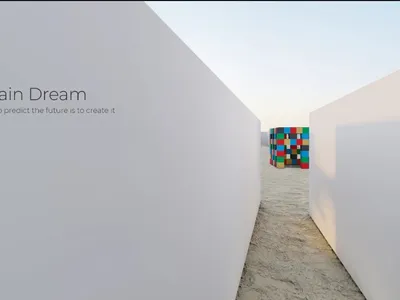
The Main Dream: Modular Architecture for Play, Learning, and Community
A modular playground turns recycled plastic into adaptable spaces where refugee children can play, build, learn, and reconnect.
Play: Fragments of Their World
Familiar architecture becomes modular playground design, creating safe spaces where displaced children can learn, connect, imagine and play.

Wadi Rum Observatory: Desert Architecture Designed for the Night Sky
Wadi Rum Observatory turns desert architecture into a quiet instrument for astronomy, hiding research spaces under Jordan's starlit terrain.




Comments (0)
Please login or sign up to add comments
No comments yet. Be the first to comment!