
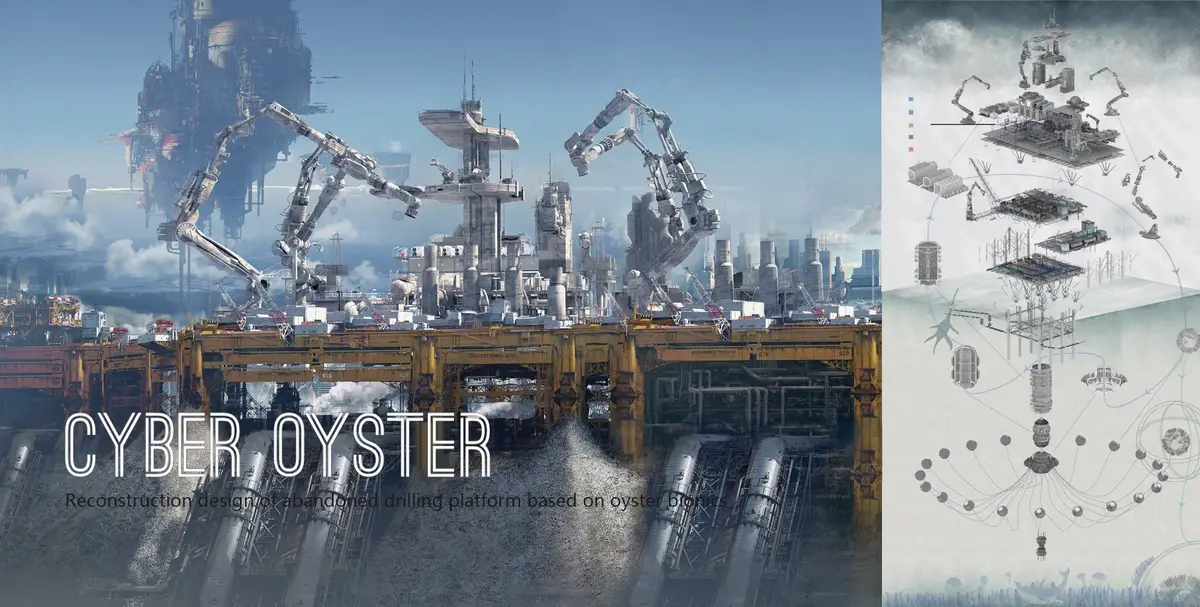
Cyber Oyster: Reprogramming an Abandoned Oil Rig to Filter the Sea It Once Polluted
Zhongzhi Jiang treats a derelict drilling platform as a host shell, growing layered filtration and habitat systems modelled on oyster biomineralization.


An oyster does not ask permission from the water it lives in; it simply filters it, layer by layer, and leaves behind a reef that other creatures can inhabit. Cyber Oyster borrows that quiet persistence and points it at one of the least forgiving building types on earth: the abandoned offshore drilling platform. Instead of dismantling the rig or leaving it to rust, the proposal turns it into a host structure for continuous biological and mechanical growth, a machine that cleans the sea rather than draining it.
Published on uni.xyz by Zhongzhi Jiang, the speculative project sits at the intersection of adaptive reuse, marine ecology and cybernetic urbanism. Its starting point is the oyster's capacity to purify surrounding water while building layered habitat through its shell. Jiang translates that behaviour into an architectural logic of biomineralization, filtration and marine accumulation, imagining a platform where leaked crude oil and industrial waste stop being liabilities and become catalysts for construction.
Inside the Shaft: An Industrial Cathedral With a Biological Purpose
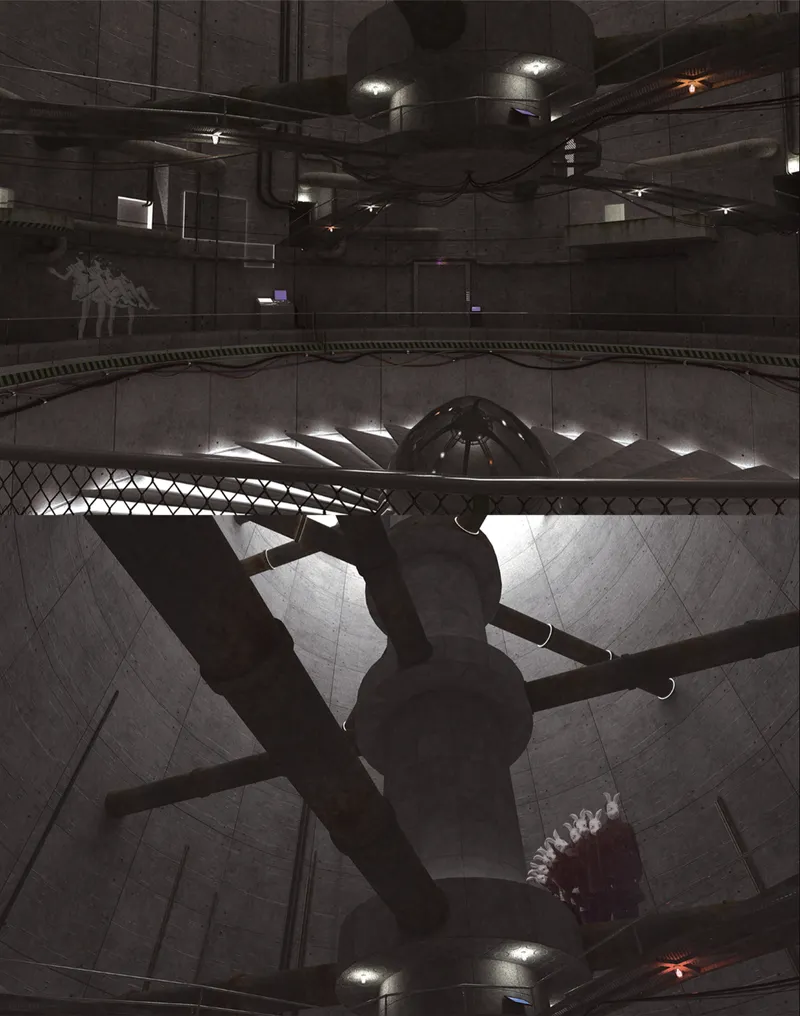
The view up the circular concrete shaft sets the tone for the whole project. A central pipe column rises through the void, a spiral stair winds around it, and a mesh railing catches what little light filters down. Jiang describes these interiors as large cylindrical chambers threaded with exposed pipelines and suspended circulation, and the image delivers exactly that: a vertical, subterranean volume that reads more like a cathedral of infrastructure than a laboratory.
What makes the space interesting is the gap between how it looks and what it does. The atmosphere is dark, dense and unapologetically cyberpunk, yet the chamber is meant to serve a regenerative system aimed at restoring biodiversity and stabilising damaged marine ecosystems. The project refuses the usual visual shorthand of eco-design, trusting the programme rather than the surface to carry its environmental argument.
Phasing the Rig Like a Growing Shell
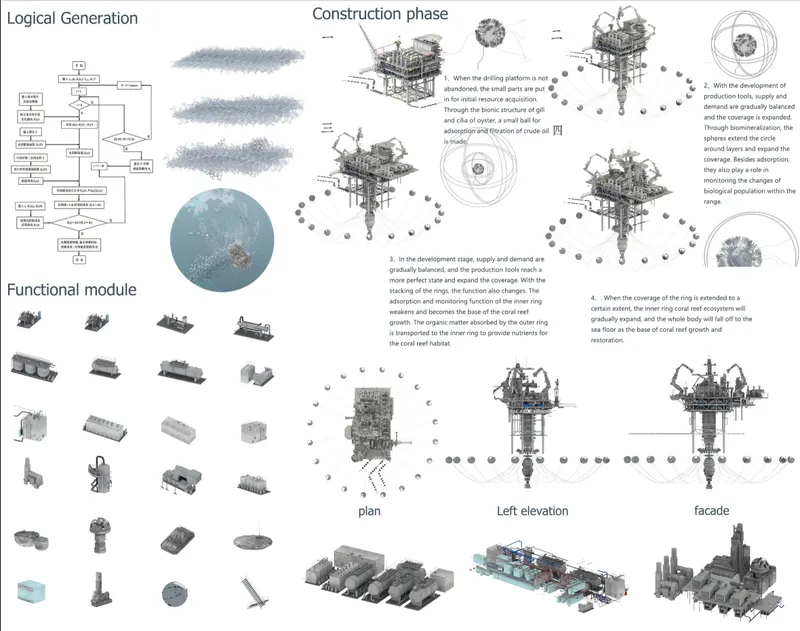
The presentation board is where the oyster analogy becomes a construction method. Phase diagrams, functional module icons, a plan, a left elevation and facade drawings all describe the drilling platform ringed by a cluster of spheres, an arrangement that recalls accretion more than assembly. The original rig stays legible at the centre, while new volumes gather around it the way calcium layers build up on a shell.
This phasing is the project's strongest conceptual move. By staging the transformation over time, Jiang treats infrastructure as something adaptive and biologically integrated rather than finished on completion day. The elevations preserve the memory of extraction, keeping the steel lattice visible, while the incremental additions rewrite its role. Adaptive reuse here is not preservation of an object but the redirection of a process.
Robotic Arms on a Yellow Deck: Extraction Run in Reverse
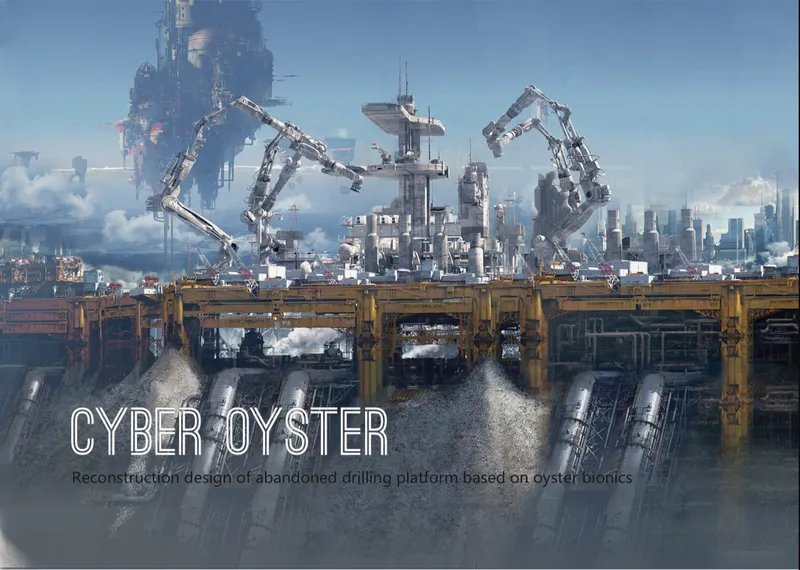
On the platform deck, robotic arms and process towers rise from yellow steel under a hazy sky, with pipes snaking across the surface and gravel piles waiting to be processed. The scene reads as an active worksite, suggesting automated construction that runs continuously over open water. It is a deliberately industrial image, and that honesty matters: the project does not pretend that ecological repair at sea will look soft or pastoral.
The deck is where Jiang's most provocative claim plays out. Through robotic systems, synthetic material generation and ecological layering, pollutants are imagined as feedstock for the structure's own growth. A platform built to pull resources out of the seabed becomes one that contributes material and habitat back, slowly evolving into what the designer calls a self-sustaining marine organism.
Why This Project Matters
Thousands of offshore structures face the same question at the end of their working lives: remove them at great cost or abandon them to the sea. Cyber Oyster offers a third answer, one that treats the rig as a substrate for ongoing environmental work. By grounding its logic in a specific organism and a specific biological process, the proposal avoids the vagueness that often weakens speculative biomimicry and gives its growth strategy a clear rationale.
Its broader contribution is aesthetic as much as technical. Jiang shows that sustainable architecture does not need green facades or symbolic gestures to make its case; it can embrace machinery, darkness and industrial texture while still committing to repair. Whether or not every system proves buildable, the project reframes infrastructure as an active ecological participant, and that is a direction worth pursuing.
View the Full Project
About the Designers
Designer: Zhongzhi Jiang
Enter a Design Competition on uni.xyz
uni.xyz runs architecture and design competitions year-round that reward proposals with spatial conviction and real site intelligence.
Project credits: Cyber Oyster by Zhongzhi Jiang.


Popular Articles
Popular articles from the community


longwave studio Reorganizes a 112 m² Tainan Apartment Around the Daily Routines of a Family and Two Cats
In Tainan, Taiwan, birch plywood, rust-red furniture and a freestanding plaster wall link arrival, storage, work and family life in one apartment.

Jaramillo Van Sluys Arquitectura and Urbanismo Turn a Demolished Registry Lot in Quito into an Orchard Plaza
In Quito's Centro Histórico, a 2,800 m² plaza exposes the San Agustín convent wall and redraws its lost Augustinian orchard in volcanic stone.

Cube Design Draws an Ecological Corridor Between Two Shenzhen Hills with the Nankai Building
Beside Shenzhen's container docks, the Nankai Building pairs stacked balconies with a climbing green screen to connect two hillsides across its height.

Juan García Correa, John González and Claudia Rueda Sink a Circular Amphitheater into a Manizales Engineering Building
On the La Nubia campus in Manizales, Colombia, the S1 Building folds labs and offices into a hillside of ramped lawns that double as a campus route.

Similar Reads
You might also enjoy these articles
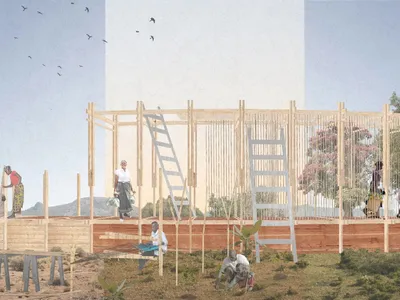
Healing Façade: A Modular Chapel System That Restores Ethiopia's Sacred Forests
Winner of the Eco-Chapel competition, this circular timber façade collects water from air to rebuild soil and reforest degraded Ethiopian landscapes.
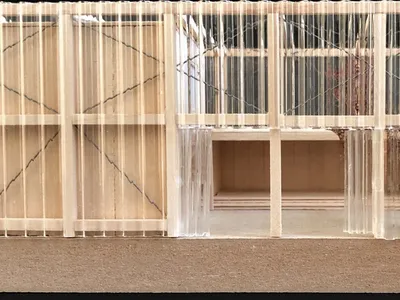
Kaffeebühnen: Where Coffee Shop Architecture Becomes a Civic Stage in Vienna
A linear sequence of timber boxes, transparent shells, and open yards turns the Viennese café tradition into a public performance space.
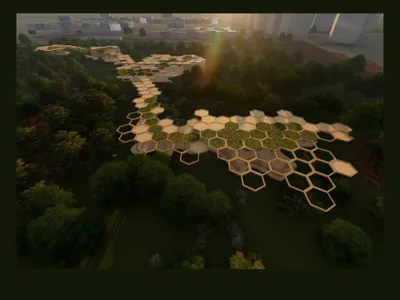
Eco Chapel: A Modular Forest Pavilion That Grows Like the Landscape It Protects
Hexagonal timber modules weave through existing trees, turning a chapel into a living system for prayer, education, and reforestation.


Urban Forest: A Vertical Ecosystem for 5,000 Workers in Singapore's Changi Business Park
Radially stacked pods and layered green decks turn a 7-acre plot into 47 acres of ecological workspace projected for 2040.

Explore Architecture Competitions
Discover active competitions in this discipline

Challenge to reimagine the Iron Throne

Photograph architecture without architects

Illustrate the lost glory of Angkor Wat - Render Challenge

Design challenge to reuse E-waste
Comments (0)
Please login or sign up to add comments
No comments yet. Be the first to comment!