
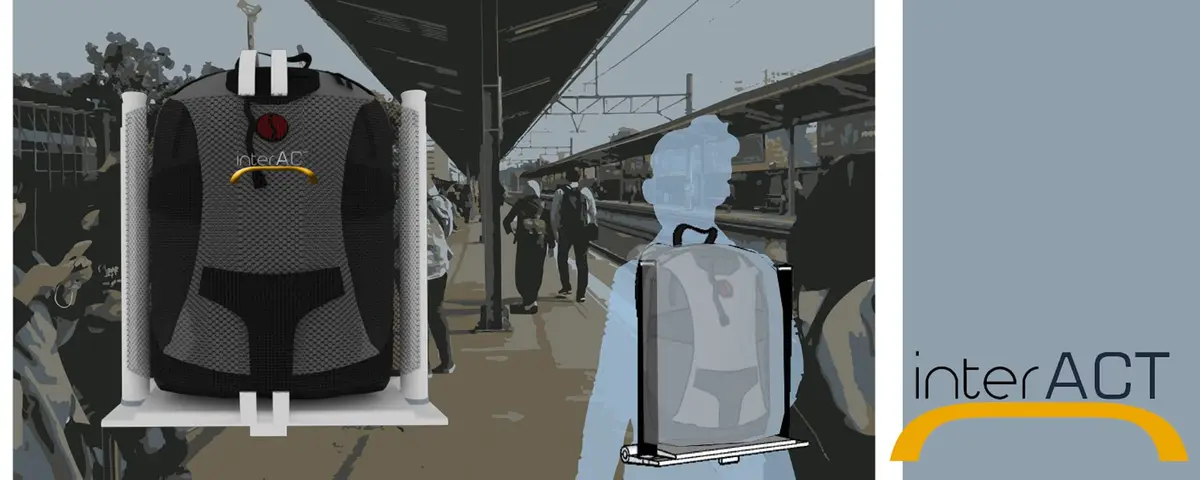
interACT: A Wearable Transit Object That Turns Commuting Into Social Infrastructure
A backpack-mounted foldable device transforms walking, waiting, and riding into moments of shared comfort across Jakarta's transit network.


What if the most antisocial space in a city could become its most socially productive? In the Jabodetabek metro region of Indonesia, millions of commuters endure overcrowded trains, insufficient seating, and the quiet erosion of well-being that comes from traveling alone in a crowd. interACT proposes a compact, wearable transit object that clips onto a backpack and unfolds into a perching seat, a shared handle, and an anti-theft net, turning the daily commute into a sequence of small social encounters rather than a solitary grind.
Designed by Chairunnnisa Luthfya, Danti Dewanti, and Ruth Amelia, interACT received the Organizer's Choice Award in the @ease competition. The brief asked entrants to design portable comfort objects for transit, and this team responded by grounding their proposal in survey data, social architecture theory, and a three-phase analysis of the commuting journey from doorstep to destination.
Survey Data as Design Driver
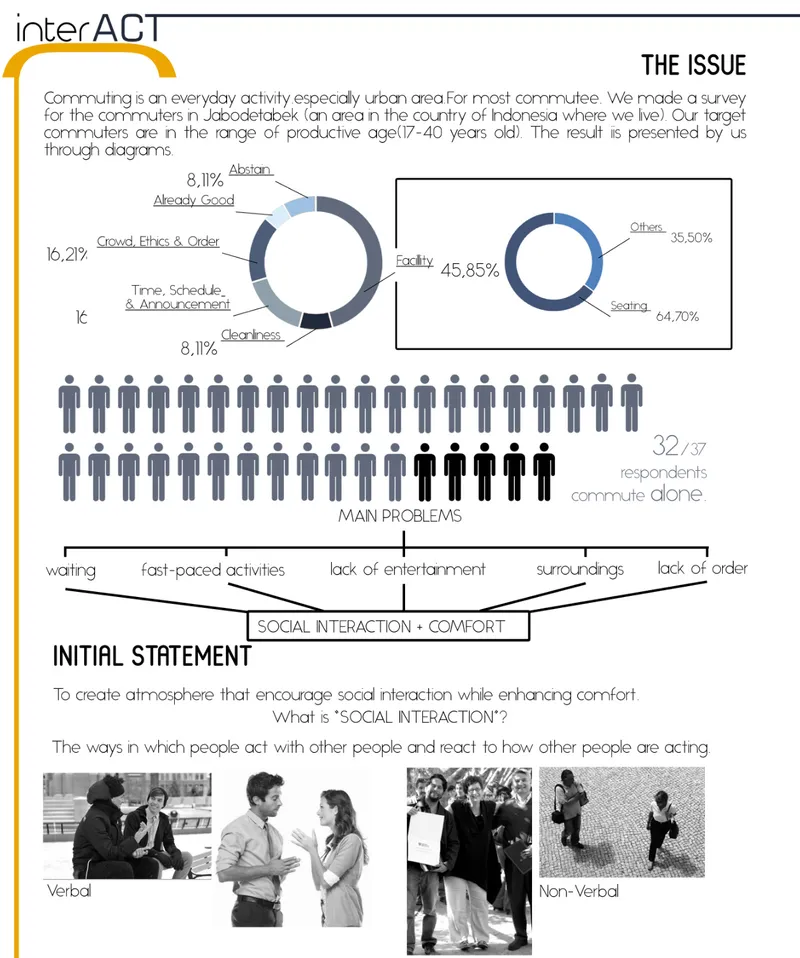
The project begins not with form but with evidence. Surveys conducted among commuters aged 17 to 40 revealed that over 45% cited inadequate facilities as their primary frustration, while 64% specifically pointed to insufficient seating. Most respondents travel alone, compounding feelings of isolation in spaces that are physically packed yet socially empty. The infographic board above maps these findings through donut charts and pictogram figures, establishing a clear problem statement: transit discomfort is not just ergonomic, it is emotional and relational.
From Concept Sketches to a Three-Phase Programme
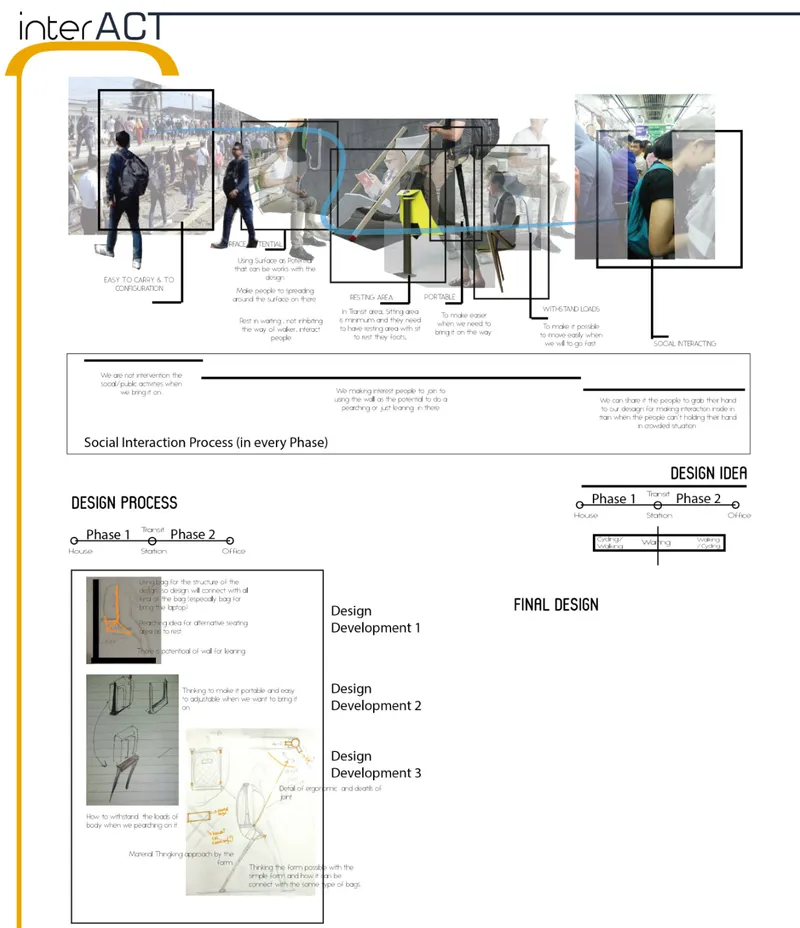
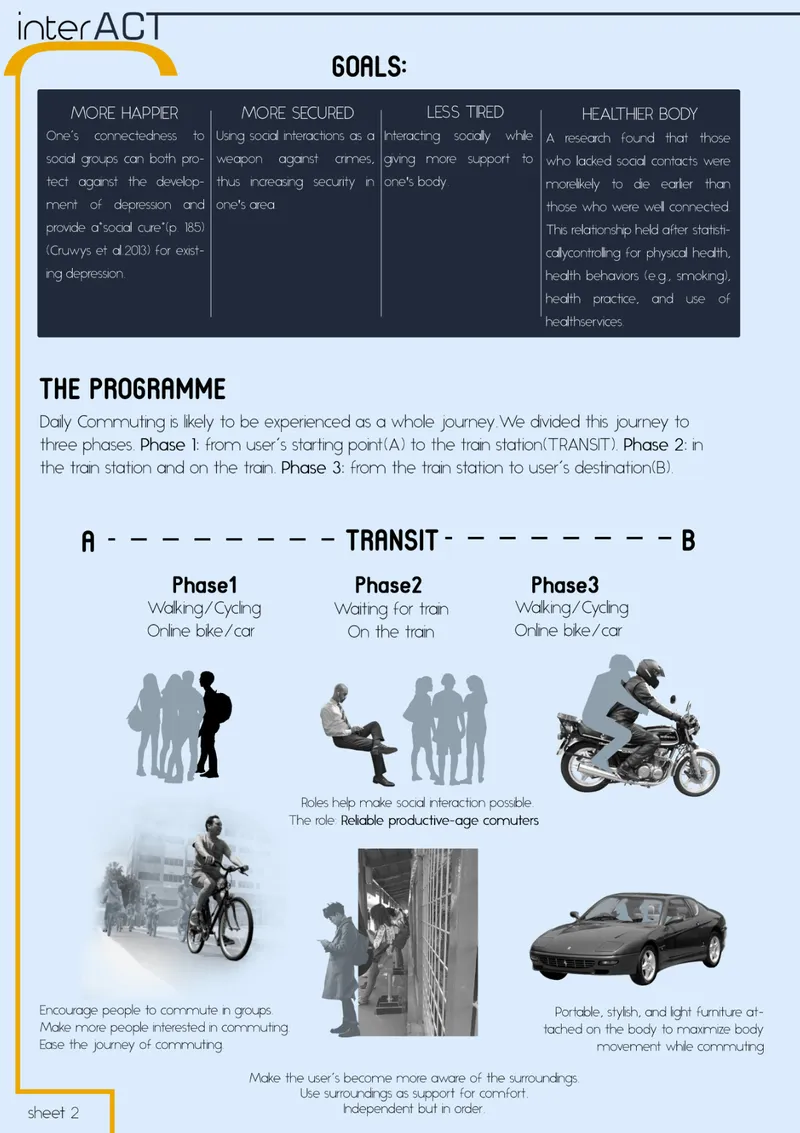
The design team structured the commuting experience into three distinct phases. Phase 1 covers walking or cycling from home to the station. Phase 2 encompasses waiting on the platform and traveling inside the train. Phase 3 addresses the last-mile journey from station to final destination. Each phase presents different bodily postures, social dynamics, and stress points. The process diagram traces how conceptual sketches and circulation annotations evolved into specific design responses for each phase, while the programme board uses silhouettes of cyclists and motorcyclists to illustrate the mobility ecosystem the object must navigate.
This phased approach is what gives interACT its coherence. Rather than designing a single-purpose seat or a single-purpose bag accessory, the team created an object that shapeshifts across the commute: compact and attached to a backpack while walking, unfolded into a perching support while waiting, and extended into a shared handle inside a crowded carriage. Each transformation addresses a specific survey finding.
On the Platform: Perching Among Strangers
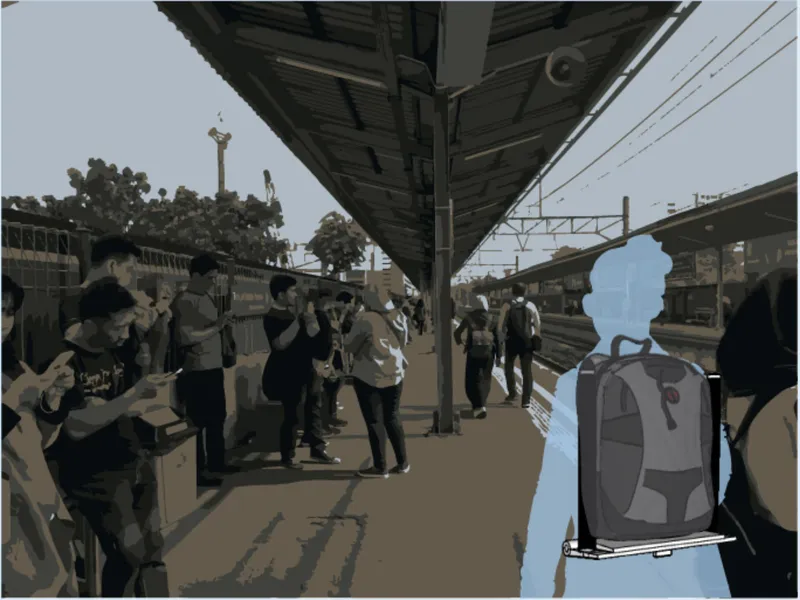
The rendering of a train platform places a highlighted figure wearing the interACT system among a crowd of waiting commuters. In this scenario, the compact foldable structure has converted into a supportive perching seat, allowing the user to rest without occupying a full bench. The gesture is small but significant: perching puts the body in a semi-upright position that signals openness rather than withdrawal, creating what the designers call micro-opportunities for human contact. It is a posture that invites a glance, a comment, a moment of recognition between strangers.
Inside the Carriage: Shared Stability as Social Catalyst
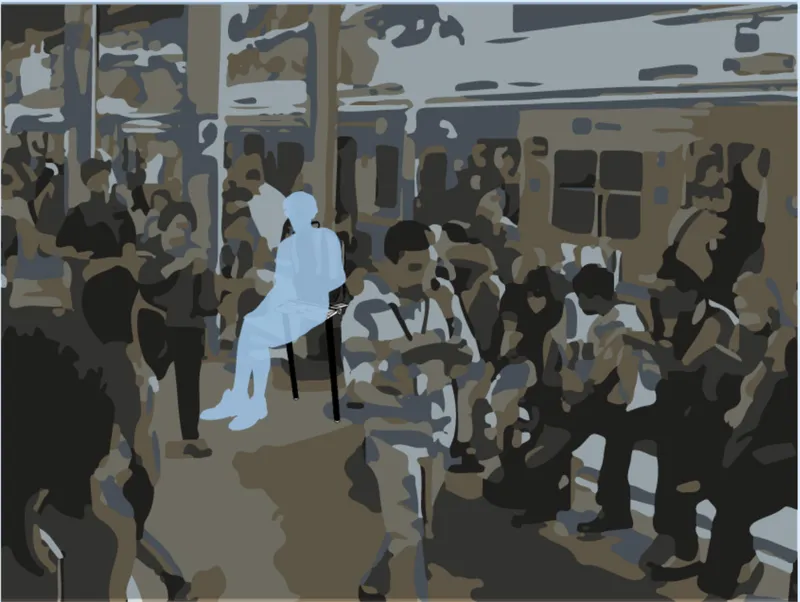
The crowded train interior is where interACT's most socially ambitious feature comes into play. The handle extension allows a neighboring passenger to hold on, transforming a personal object into a shared support device. In a space where bodies are already in close proximity but eye contact is rare, the act of offering a handle to a stranger is a deliberate architectural intervention at the scale of the hand. It reframes the problem of overcrowding: rather than a source of stress, proximity becomes the precondition for a small act of mutual aid. The integrated net, meanwhile, secures belongings against theft, addressing a practical anxiety that the survey data confirmed.
Why This Project Matters
interACT is compelling because it refuses to treat transit comfort as a purely ergonomic question. The four goals the team articulates, happier communities, safer environments, less fatigue, and healthier lifestyles, are ambitious claims for a backpack-mounted device. But the ambition is grounded in a specific reading of how isolation compounds in dense cities: when 64% of commuters cannot sit down and most of them travel alone, the cumulative psychological toll is real. Designing a foldable seat is useful. Designing a foldable seat that creates the conditions for spontaneous social contact is architecture.
Luthfya, Dewanti, and Amelia demonstrate that social architecture does not require a building. It requires a careful understanding of where people are, what their bodies need, and what small spatial adjustments might shift a routine from endurance to engagement. In a region where millions commute daily through the same strained infrastructure, interACT proposes that the most impactful design interventions might be the ones you carry on your back.
View the Full Project
About the Designers
Designers: Chairunnnisa Luthfya, Danti Dewanti, Ruth Amelia
Enter a Design Competition on uni.xyz
uni.xyz runs architecture and design competitions year-round that reward proposals with spatial conviction and real site intelligence.
Project credits: interACT by Chairunnnisa Luthfya, Danti Dewanti, Ruth Amelia @ease (uni.xyz).


Popular Articles
Popular articles from the community


The Ocean Hive: Sustainable Architecture for a Self-Sufficient Civilization at Sea
The Ocean Hive imagines sustainable architecture at sea, where modular habitats, algae, wave power and ocean waste sustain a growing colony.

Little Red Riding Hood: Architectural Design as a Journey Through Fear, Light, and Storytelling
Little Red Riding Hood reimagines the fairy tale through architectural design shaped by fear, light, scale, memory, uncertainty, and choice.

ALGAL REALM: A Bio-Integrated Lunar Habitat Design for Life Beyond Earth
ALGAL REALM reimagines lunar habitat design with algae-powered life support, 3D-printed regolith, and vertical living for a lunar future.

Play: Fragments of Their World
Familiar architecture becomes modular playground design, creating safe spaces where displaced children can learn, connect, imagine and play.

Similar Reads
You might also enjoy these articles
ALGAL REALM: A Bio-Integrated Lunar Habitat Design for Life Beyond Earth
ALGAL REALM reimagines lunar habitat design with algae-powered life support, 3D-printed regolith, and vertical living for a lunar future.

Cinema Futurismo: Futuristic Architecture Reimagining the Future of Cinema
Cinema Futurismo merges futuristic architecture, holographic projection, intimate seating, and landscape into a new social cinema.
Little Red Riding Hood: Architectural Design as a Journey Through Fear, Light, and Storytelling
Little Red Riding Hood reimagines the fairy tale through architectural design shaped by fear, light, scale, memory, uncertainty, and choice.
Playducation: Modular Architecture That Turns Play Into a Space for Learning
Playducation transforms modular architecture into a flexible world of play, learning, and healing for children in refugee settlements.

Explore Urban Mobility Competitions
Discover active competitions in this discipline

Challenge to merge furniture with learning

Competition to design a workstation for architects

Design challenge to reuse E-waste
Comments (0)
Please login or sign up to add comments
No comments yet. Be the first to comment!