
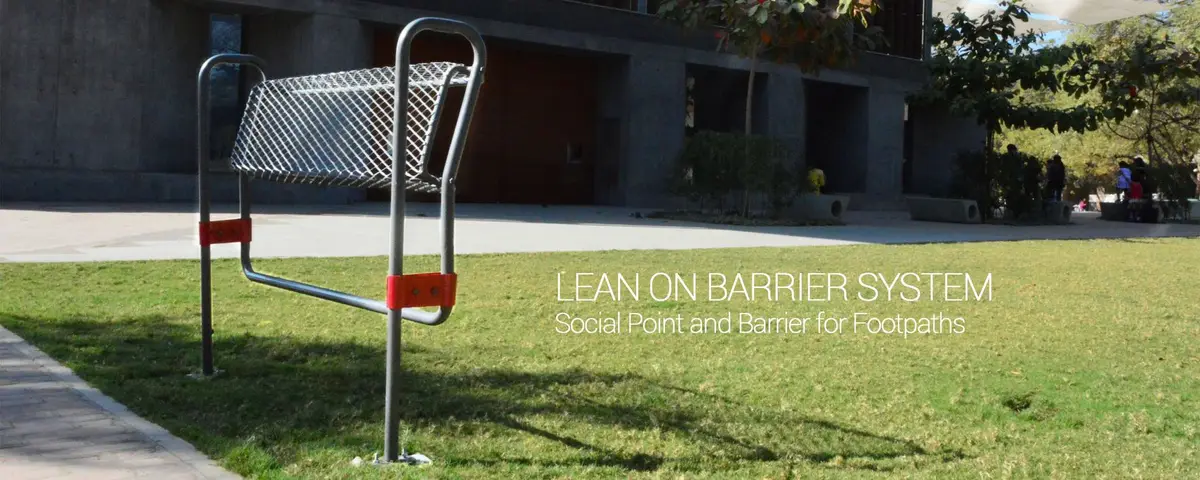
Lean On Barrier System: Where Traffic Safety Meets Chai Culture in Ahmedabad
A modular steel barrier doubles as informal seating and lean-on furniture at one of Ahmedabad's busiest intersections, keeping vendors in place.


At Ahmedabad's Vijay Char-Rasta junction, chai stalls and street food kiosks are not encroachments to be cleared; they are the social infrastructure of the city. The Lean On Barrier System starts from this premise, treating the chaotic overlap of vendors, pedestrians, and vehicles not as a problem to be erased but as a condition to be organized. The result is a modular steel element that works simultaneously as a traffic barrier, pedestrian guide rail, and lean-on surface for the tea drinkers who define the culture of this place.
Designed by Noureen Nazir, the project received an Honorable Mention in Urbanscape 2018. The competition asked entrants to rethink urban public space, and Nazir responded with a tight focus on Ahmedabad's intersections, places where haphazard parking, unsafe pedestrian crossings, and the absence of organized seating collide daily. Rather than proposing a sweeping masterplan, the intervention operates at the scale of a single repeatable unit that can be deployed incrementally across the city's busiest nodes.
Hollow Steel Sections and Anti-Slip Mesh
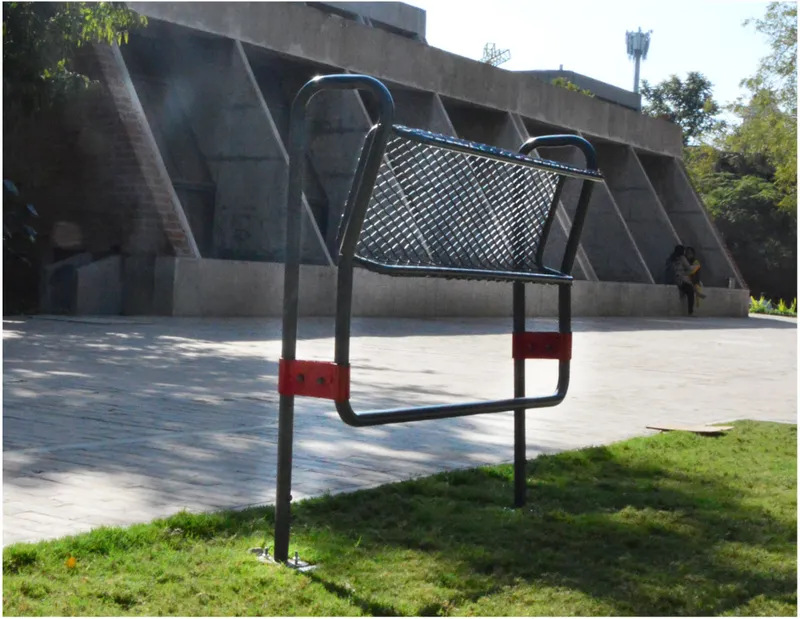

The barrier's material logic is straightforward and deliberate. Modular hollow steel sections form the primary structural frame, allowing rapid on-site assembly and reconfiguration as junction conditions change. The surfaces people touch, lean against, and rest their chai cups on are clad in anti-slip expanded metal sheet, a material that offers grip in Ahmedabad's monsoon humidity while remaining easy to clean. Red brackets punctuate the assembly, marking connection points and giving the system a visual rhythm that distinguishes it from generic street railing.
The steel frame is open enough to maintain visual porosity between the pedestrian zone and the vehicular lane. Nazir avoids the solid wall approach that many barrier designs default to, recognizing that a completely opaque edge would sever the casual eye contact and social signaling that keeps informal commerce alive at these junctions.
Leaning as a Programme

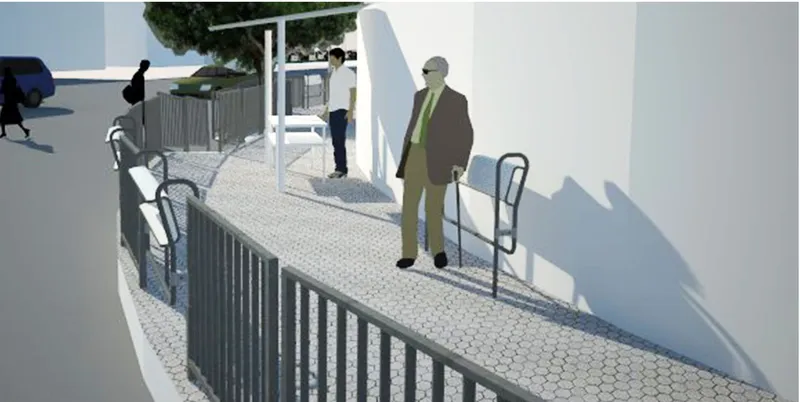
The most compelling move in the project is the insistence that leaning is a legitimate architectural programme. In Indian street culture, the standing lean, body tilted against a railing with one foot propped up and a glass of chai in hand, is a posture as common and as socially loaded as sitting on a bench in a European piazza. The Lean On Barrier System provides surfaces calibrated for exactly this posture: angled rails at hip and elbow height, with enough depth to support a forearm or rest a phone. It does not force anyone to sit or stand; it accommodates the in-between.
By designing for the lean, Nazir creates social points, micro public spaces embedded within the infrastructure of traffic management. These are not plazas or parks that require separate land allocation. They exist within the existing right-of-way, turning the barrier itself into a destination for pause and conversation.
Phased Deployment Along the Walkway

The rendered perspective along a tree-lined pedestrian pathway reveals how the system scales. Barrier modules line the walkway edge, with exercise stations and lean-on points spaced at intervals that correspond to existing vendor locations and pedestrian desire lines. Organized parking lanes run parallel, separated from the walking zone by the barrier itself. The paving shifts material at threshold points, signaling transitions between vehicular, pedestrian, and social zones without requiring signage.
Nazir's scenario development proposes a phased rollout: first mapping existing pedestrian and vehicular conflicts, then introducing barrier segments, followed by organized parking lanes, and finally activating social points as micro gathering spaces. The phasing matters because it allows each junction to adapt the system to its specific mix of vendors, traffic volumes, and pedestrian flows rather than applying a one-size-fits-all template.
Reading the Site Plan

The site plan diagram lays out the full logic: accessible pathways, ramps at grade changes, designated parking zones, and street furniture distributed along a curving route. What stands out is the integration of accessibility. Ramps are not afterthoughts tucked into corners; they are built into the barrier alignment itself, ensuring that wheelchair users and people with limited mobility move through the same social corridor as everyone else. The curving route also functions as a traffic-calming device, breaking sightlines that might otherwise encourage vehicles to speed through the junction.
Why This Project Matters
Most urban safety interventions in Indian cities treat vendors and informal social life as obstacles. Bollards go up, fences appear, chai stalls get relocated to nowhere. Nazir's Lean On Barrier System refuses that logic. It treats safety and socialization as two sides of the same design problem, then solves both with a single modular element. The expanded metal mesh, the hollow steel frame, and the lean-on geometry are all calibrated for a specific cultural condition: the standing tea break at a busy intersection.
The project's real contribution is methodological. It demonstrates that public space design in a city like Ahmedabad does not need grand gestures or large budgets. It needs precise observation of existing social patterns and the discipline to design infrastructure that supports them rather than replacing them. A barrier that you can lean on, rest your chai against, and use as a meeting point is not just street furniture. It is an argument for how public architecture should work in dense, informal, culturally layered cities.
View the Full Project
About the Designers
Designer: Noureen Nazir
Enter a Design Competition on uni.xyz
uni.xyz runs architecture and design competitions year-round that reward proposals with spatial conviction and real site intelligence.
Project credits: Lean On Barrier System by Noureen Nazir Urbanscape 2018 (uni.xyz).


Popular Articles
Popular articles from the community


FCC Arquitectura Expands a Portuguese Granite House with a Board-Marked Concrete Wing
In Portugal, JV House pairs a cleaned-up whitewashed and granite dwelling with a timber-shuttered concrete extension, courtyards and a garden pool.


Singing Woman: An Opera House That Performs Before the Curtain Rises
Ovidiu Cristian Pavel's conceptual opera house translates Estonia's choral identity into a sculpted waterfront landmark facing the Baltic Sea.

Aquadapt: An Underwater Habitat That Rewrites Its Rooms by the Hour
Curved modules ring the seabed while one shell shifts from breakfast room to cinema, farm and football pitch as residents' needs change.

Opera on the Sea: Driftwood Logic Shapes a Timber Opera House on Estonia's Coast
Trevor Orgill's opera house translates the entangled drift of floating timber into a civic building where wood, water, and music converge.

Similar Reads
You might also enjoy these articles
Aquadapt: An Underwater Habitat That Rewrites Its Rooms by the Hour
Curved modules ring the seabed while one shell shifts from breakfast room to cinema, farm and football pitch as residents' needs change.

Play: Fragments of Their World: Remembered Architecture Rebuilt as a Modular Playground for Refugee Camps
Tom Gardner abstracts domes, arches and towers from the homelands of displaced families into a kit of child-scaled play parts for camp settlements.
REBIRTH: A Circular Settlement Where Afghan Widows and Their Children Rebuild Life Together
A shortlisted Resile entry turns the circle into a protective ring of timber and brick, gathering homes, classrooms and gardens around a shared landscape.
The Main Dream: A Recycled Plastic Kit That Lets Refugee Children Build Their Own Playground
Thirty-centimetre interlocking cubes that connect on three axes turn play into construction, letting children author the spaces they occupy.

Explore Urban Bench Competitions
Discover active competitions in this discipline

Design challenge to equip cities with modern furniture

Packaging challenge - Design meets sustainability
Comments (0)
Please login or sign up to add comments
No comments yet. Be the first to comment!