

Edifice Consultants Wraps India's First Net-Positive Energy Office Building in Lutyens-Era Sandstone
A 38,000 square meter government headquarters on Lodhi Road channels Dholpur sandstone and radiant cooling to produce more energy than it consumes.


Net-zero buildings have become a familiar ambition. Net-positive buildings, the ones that generate more energy than they consume across an entire year, remain rare. Rarer still is a net-positive government office building in one of the hottest capital cities on the planet. Atal Akshaya Urja Bhavan, the new headquarters for India's Ministry of New and Renewable Energy on Lodhi Road in New Delhi, is exactly that. Designed by Edifice Consultants Pvt. Ltd and completed in 2022, the 38,150 square meter complex sits on a 2.7-acre site in the Central Government Offices area, surrounded by landmarks like the India Habitat Centre, Lodhi Gardens, and Jawaharlal Nehru Stadium. It is certified under GRIHA and produces roughly 1,100 kWp of electricity from a massive photovoltaic array cantilevered across its roof.
What makes this project genuinely interesting is not the energy numbers alone but the architectural conviction behind them. Edifice did not design a glass-and-steel tech demonstrator. They clad the building in warm beige Dholpur sandstone, studded its facades with GFRC jaali screens, and organized its plan around the same east-west axis and service-core logic that Lutyens deployed a century ago just a few kilometers away. The result is a building that reads as a continuation of New Delhi's institutional tradition rather than a rupture from it, one that derives its performance from orientation, mass, and material rather than from gadgetry bolted on after the fact.
A Sandstone Facade That Works Harder Than It Looks

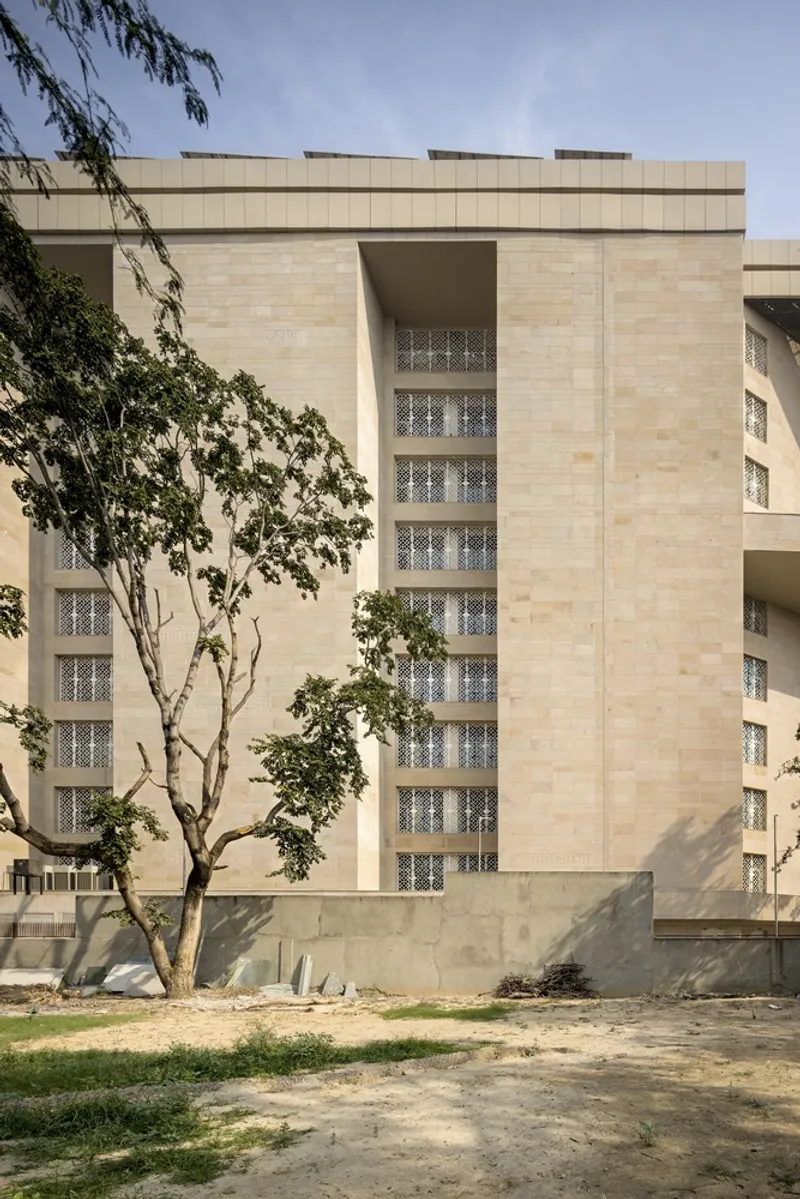

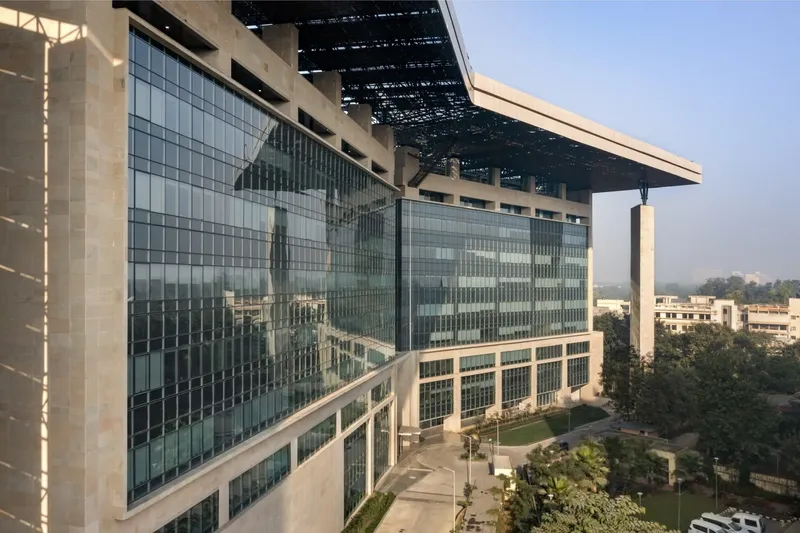
The Dholpur sandstone envelope does double duty. Visually, it anchors the building in the material palette of Lutyens' Delhi, the warm buff tones referencing Rashtrapati Bhavan and the surrounding institutional campus. Thermally, it acts as a massive heat sink. Deep recessed openings, visible in the facade's rhythmic pattern, limit direct solar gain while admitting diffused daylight. The vertical GFRC jaali screens that fill certain bays are not decorative afterthoughts: they permit cross-ventilation on the western face, where New Delhi's harshest summer and winter winds arrive, while also providing armature for climbing plants that will further shade the stone over time.
On the eastern facade, a different strategy applies. Double walls of AAC masonry sandwich 200 mm of glass wool insulation, a construction approach more commonly associated with cold-climate buildings repurposed here to keep Delhi's brutal morning heat at bay. Double-glazed units on the north and east faces maximize daylighting where solar loads are lowest. The carved inscriptions and textures integrated into the stone cladding reinforce the sense that this is civic architecture meant to endure, not a temporary statement.
The Cantilevered Roof and Its Solar Field

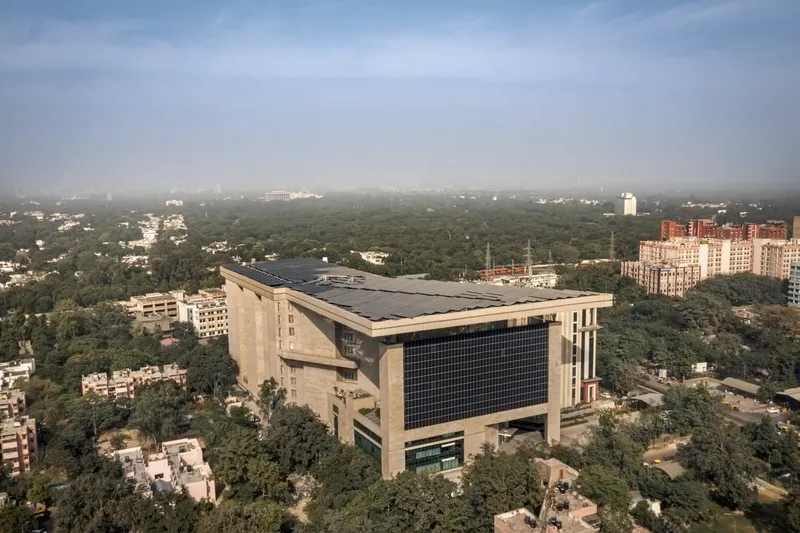
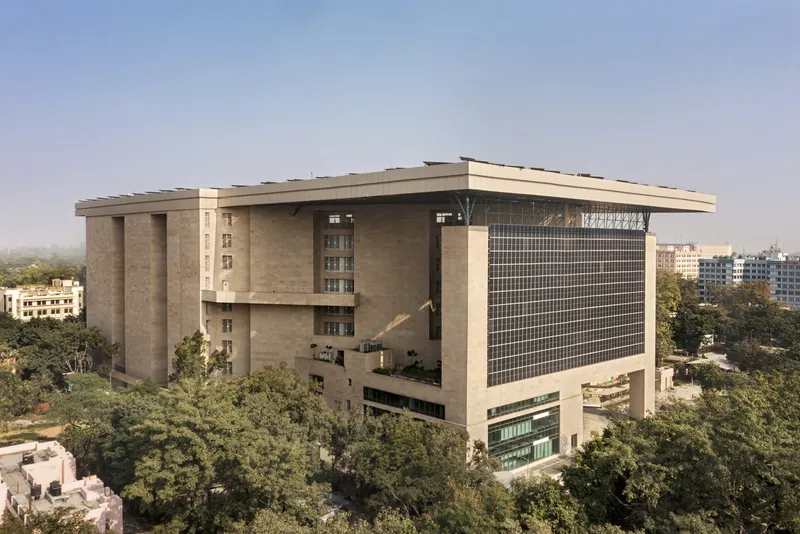
The most immediately striking element is the roof. Cantilevered well beyond the building's footprint, it covers approximately 5,570 square meters with photovoltaic panels angled to capture maximum solar radiation across the year. This is the engine behind the net-positive claim: the panels generate an estimated 19 lakh energy units annually, enough to exceed the building's own consumption. The overhang simultaneously shades the upper-level glass facades, reducing cooling loads before any mechanical system kicks in.
Seen from the air, the solar canopy reads as a coherent architectural gesture rather than a rooftop afterthought. The panels are tilted uniformly, creating a planar geometry that contrasts with the heavy stone volumes below. At dawn, the cantilevered edge floats above the treeline, an effect Edifice clearly choreographed for the approach from Lodhi Road. It is a rare case where a building's energy infrastructure becomes its most expressive architectural feature.
Central Atrium and Public Ground Floor
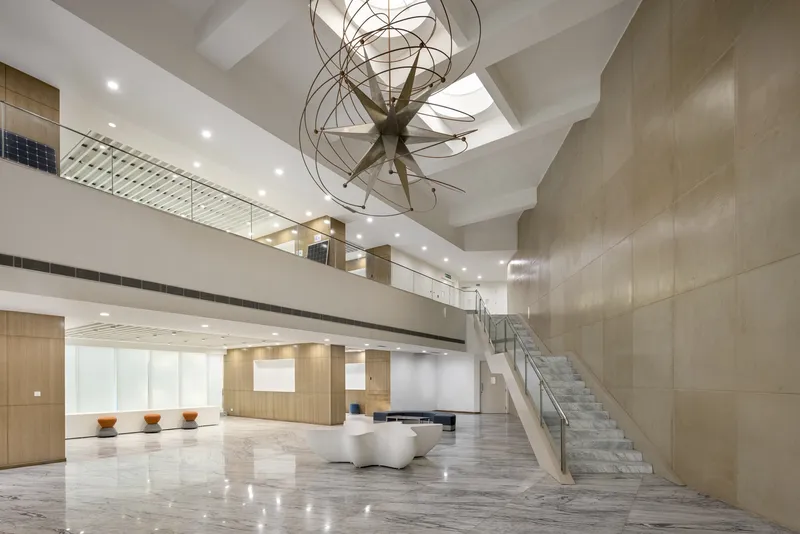

Two rectangular wings, oriented predominantly north-south but set at a slight angle to each other, are stitched together by a central nucleus containing elevators, stairs, and the main entrance. The three-storey atrium at this junction doubles as the primary reception space, its curved skylight flooding the marble-floored lobby with natural light while a suspended chandelier and cantilevered mezzanine create a sense of civic generosity unusual for a government office. The spatial language here is deliberate: this is the Ministry of New and Renewable Energy, and the building is meant to embody its mandate at every turn.
The circular reading room visible in the interiors reveals how the jaali motif migrates inward. Geometric lattice screens wrap the perimeter walls, filtering light and creating layered visual depth. Concentric ceiling rings reinforce the room's centripetal geometry. It is a calm, introspective space nested within a building otherwise organized around transparency and openness. At ground level, the north wing houses a crèche, bank, and retail spaces; the south wing accommodates a 250-seat auditorium, exhibition center, and visitor facilities. These civic programs are accessible without passing through security checkpoints, turning the campus into a semi-public amenity rather than a sealed government compound.
Climate Strategy as Organizing Principle

The plan is not shaped by aesthetics alone. The central corridor splits each floor into two zones: functional office spaces face east toward the morning light, while service cores and circulation corridors line the western edge, acting as a thermal buffer against afternoon heat. The south wing's angular offset is not a formal flourish; it opens the north-facing facades to consistent, glare-free daylighting. Every major decision in the plan can be traced back to Delhi's climate.
Mechanical systems follow the same logic. A hybrid cooling setup pairs a conventional chiller with a radiant chiller, each rated at 215 tons of refrigeration. PEX pipes embedded in ceilings deliver radiant cooling that is roughly 33 percent more efficient than conventional air-based systems. Fresh air is pre-cooled using exhaust from restrooms, then passed through a three-stage evaporative cooler before entering occupied spaces. Rainwater is harvested; wastewater is treated on-site and reused for cooling towers, flushing, and landscape irrigation. The glass curtain wall on the courtyard side, visible in the landscaped forecourt views, is sheltered by the cantilevered roof and exposed concrete columns, allowing transparency where thermal loads are already managed.
Urja Pavilion and the Public Threshold
Positioned across from the JLN metro station, the Urja Pavilion functions as an urban plaza bridging the public street and the government campus. A shaded pedestrian walkway flanked by hedges and indigenous trees guides visitors through a sequence of solar sculptures and installations, each intended to demystify renewable energy concepts. All lighting fixtures along this path are powered by individual solar panels, a small detail that reinforces the building's ethos even at the landscape scale.
The landscaping strategy relies on local and drought-tolerant flora, sidestepping the manicured lawn aesthetic that still dominates Delhi's institutional campuses. It is a pragmatic choice: indigenous plants require less irrigation, which matters when the building's water strategy depends on a closed-loop cycle of harvesting, treating, and reusing every drop. The entry sequence, from metro station through pavilion to forecourt to atrium, is carefully staged to transition visitors from the dense urban fabric of Lodhi Road into the measured calm of the campus interior.
Why This Project Matters
India's government architecture has long oscillated between the monumental and the generic: grand gestures on ceremonial sites, anonymous office blocks everywhere else. Atal Akshaya Urja Bhavan breaks that cycle by proving that a net-positive energy building does not have to sacrifice civic presence for performance. The Dholpur sandstone, the jaali screens, the atrium proportions: these are deliberate choices to situate the building within a recognizable architectural tradition while pushing that tradition toward a radically different energy equation. The fact that this is a ministry building, subject to government procurement timelines and budget constraints, makes the achievement more significant, not less.
The building's real contribution is methodological. Orientation, mass, insulation, and passive ventilation do the heavy lifting before any photovoltaic panel enters the conversation. The solar array tips the balance into net-positive territory, but the gap it needs to close is already narrow because the architecture itself is doing most of the thermal work. That sequence, passive first, active second, is well understood in theory. Edifice Consultants have shown it can be executed at scale, in one of the world's most extreme urban climates, without retreating into the anonymous formal language that so often accompanies sustainable ambition.
Atal Akshaya Urja Bhavan by Edifice Consultants Pvt. Ltd. CGO Complex, Lodhi Road, New Delhi, India. 38,150 m². Completed 2022. Photography by Purnesh Dev and Prashant Bhat.
About the Studio
Share Your Own Work on uni.xyz
If projects like this are the kind of work you want to make, uni.xyz is a place to publish your own, find collaborators, and enter design competitions.


Popular Articles
Popular articles from the community


Tsunami Convergenics: Turning Catastrophic Ocean Forces into Underwater Housing Infrastructure
A speculative underwater settlement off the coast of Onagawa, Japan, treats tsunamis and typhoons as energy sources rather than threats.

Temporary Home for Dogs: A Reversed Zoo Rethinks Animal Shelter Architecture
In Bucharest, a sinuous corridor and freed landscape flip the logic of containment, designing a shelter that works to make itself unnecessary.

Opera on the Sea: Driftwood Logic Shapes a Timber Opera House on Estonia's Coast
Trevor Orgill's opera house translates the entangled drift of floating timber into a civic building where wood, water, and music converge.

Cloaked Colonization: A Mobile Underwater Habitat That Moves Like a Fish
Micah Abaya's shortlisted EHC Pacific entry reimagines ocean settlement as a dispersed network of self-sustaining architectural organisms.

Similar Reads
You might also enjoy these articles


Hodi-Mandai Geram
Project Function: Preservation and revitalization of the Intangible heritage and socio-spatial identity of the Hodi by Housing, Cultural Memory Center, Sacred Grove, landscape, local tourism economy


Olio Towers: A Mid-Rise for Performers That Fuses Housing, Rehearsal, and Stage
Located blocks from Houston's Theater District, this modular tower stacks living units around a central performance atrium.

Oasis: Modular Green Housing Carved into Dhaka's Urban Fabric
A shortlisted Plugin Housing entry reclaims unauthorized settlements in Dhaka with stepped concrete volumes, green roofs, and ventilation-driven design.

Black Hole: A Floating Megastructure for the Post-Physical Era
Emiliano Mazzarotto envisions a spherical, self-scaling arena where e-sports, digital hotels, and holographic stadiums replace traditional public space.

Explore Office Building Competitions
Discover active competitions in this discipline

Challenge to reimagine the Iron Throne

Photograph architecture without architects

Illustrate the lost glory of Angkor Wat - Render Challenge

Design challenge to reuse E-waste
Comments (0)
Please login or sign up to add comments
No comments yet. Be the first to comment!