

Naomi Sato Architects Folds Seven Gabled Roofs into a Beverage Innovation Center at Mt. Haruna
A fireproof timber workplace for Haruna Beverage in Gunma Prefecture channels the rhythm of forest and mountain into a zigzag plan.


Corporate research facilities rarely announce themselves through the landscape. They tend to flatten it, spreading horizontally in generic footprints that ignore topography and context alike. The Haruna Innovation Center, completed in 2024 by Naomi Sato Architects, takes a different approach. Sited at the foot of Mt. Haruna in Gunma Prefecture, the 1,497 square meter building serves as the product planning and development hub for Haruna Beverage, whose head office and factory share the same campus. Seven overlapping gabled roofs stagger across the site, their rhythm deliberately echoing the forested ridge behind them.
What makes this project worth studying is not a single gesture but a sustained argument: that a fireproof wooden structure can satisfy Japanese seismic and fire codes, reduce embodied energy, and still produce interiors warm enough to genuinely change how people work. The zigzag plan is the device that holds everything together, creating alternating zones of collaboration and concentration while pulling natural light deep into the floor plate through the gaps between each gable. It is a building that treats sustainability not as a bolt-on checklist but as a spatial strategy.
Seven Gables and the Mountain Behind Them
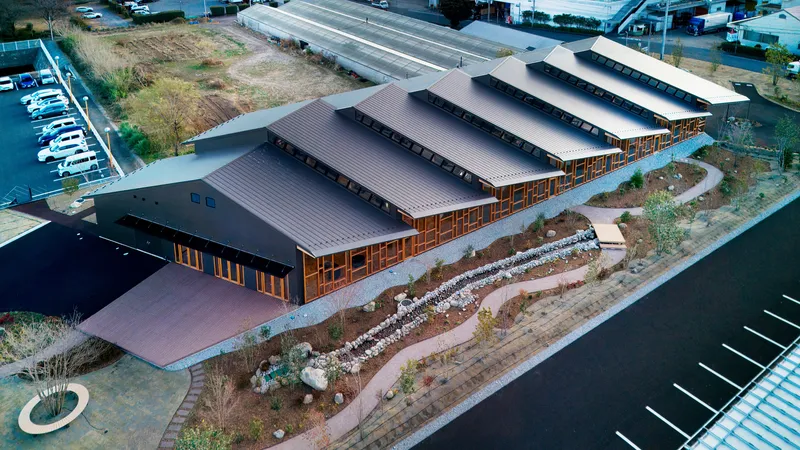
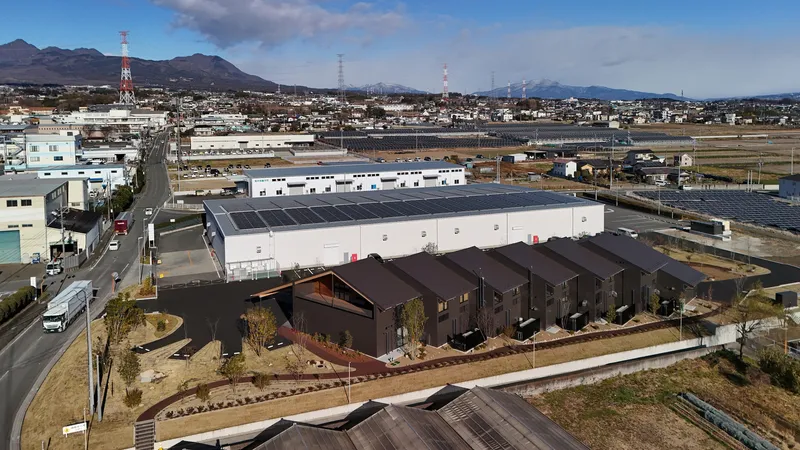
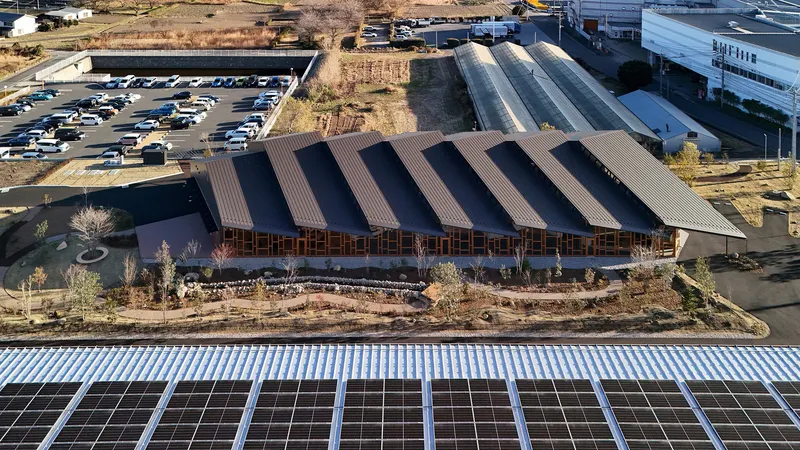
From above, the building reads as a saw-tooth profile in dark corrugated metal, each ridge stepping slightly off axis from the next. The aerial views make the logic legible: these are not decorative pitched roofs applied for regional flavor. They are structural bays, each one housing a distinct programmatic zone, and the angular shifts between them generate the clerestory slots that flood the interiors with daylight. The relationship to the adjacent farmland and solar-paneled warehouse is equally deliberate; the Innovation Center does not compete with the industrial campus but offers a counterpoint in texture and scale.
Naomi Sato has spoken about the gables echoing the natural rhythm of forest and mountain ridge. Seen in winter, with bare birch trees and dormant garden beds surrounding the building, the analogy holds. The roof volumes feel geological, like a series of foothills compressed into architecture.
Arriving Through the Landscape
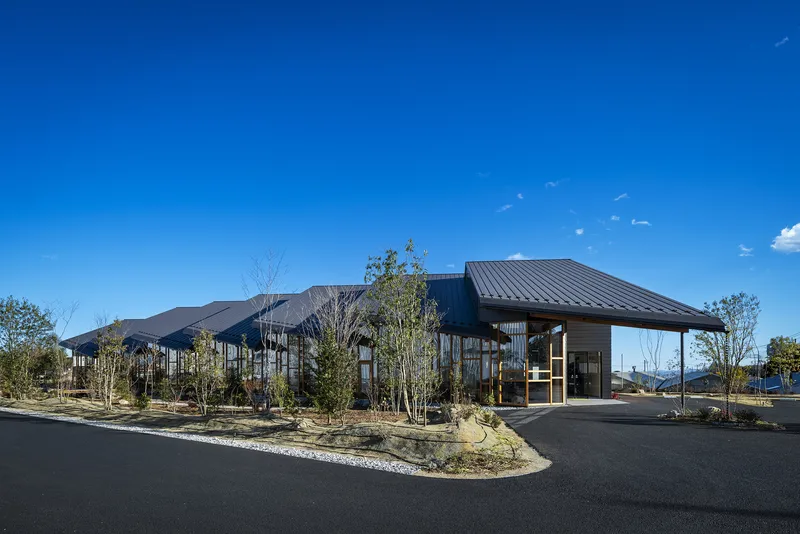
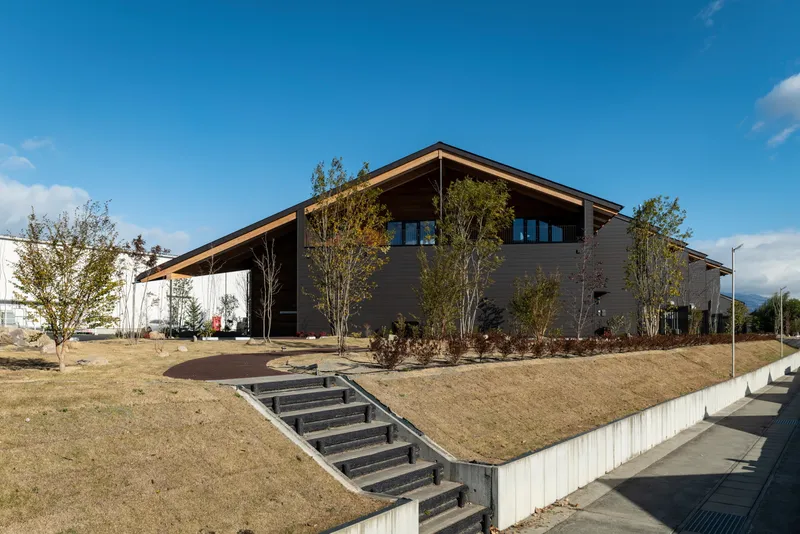

Entry is choreographed rather than imposed. A cantilevered roof overhang supported on timber columns creates a generous threshold between exterior and interior, while young trees planted in gravel beds slow the visitor's pace before crossing the door line. The planted berm with its zigzag concrete pathway on the opposite side reinforces the angular logic of the plan at ground level, making the building's geometry something you walk along before you walk inside.
The facade composition itself is instructive. Charcoal panels and horizontal timber cladding beneath wide sloping roofs avoid any single material dominating. The mix registers differently depending on the angle of approach and the time of day, a quality the dusk and twilight images make particularly clear.
Timber as Structure, Surface, and Atmosphere
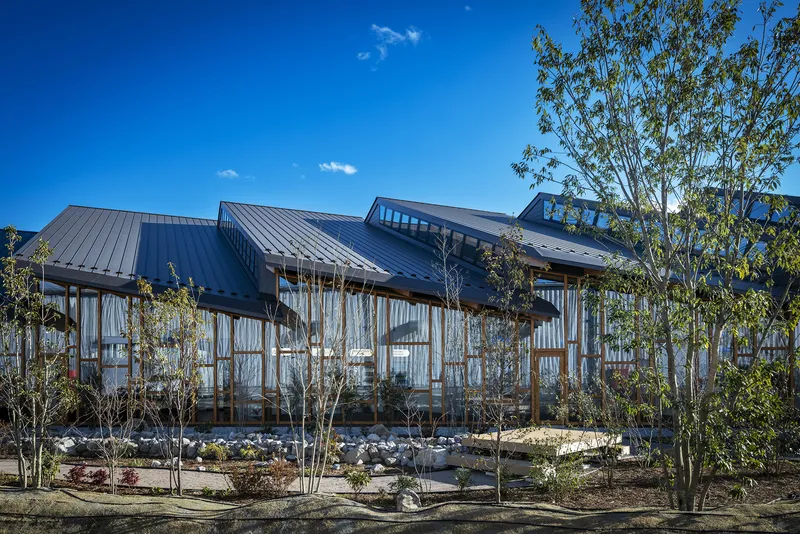


The decision to use a fireproof wooden framework was driven by three goals: fire resistance, seismic stability, and cost efficiency. That the structure is left exposed throughout the building turns a pragmatic choice into an experiential one. Timber columns and beams are visible from every vantage point, from the double-height entrance hall to the upper floor corridors, lending warmth and visual continuity to spaces that vary considerably in scale and function.
The glass curtain wall framed by vertical timber mullions is the building's most photogenic move, and it earns that status. Seen through a grove of birch trees or reflected in a rock-lined water channel at dusk, the facade dissolves the boundary between workspace and garden in a way that feels effortless rather than theatrical. Natural light is not supplementary here. It is the primary light source during working hours, and the high-insulation envelope ensures that all that glass does not become an energy liability.
The Gallery and Innovation Floors
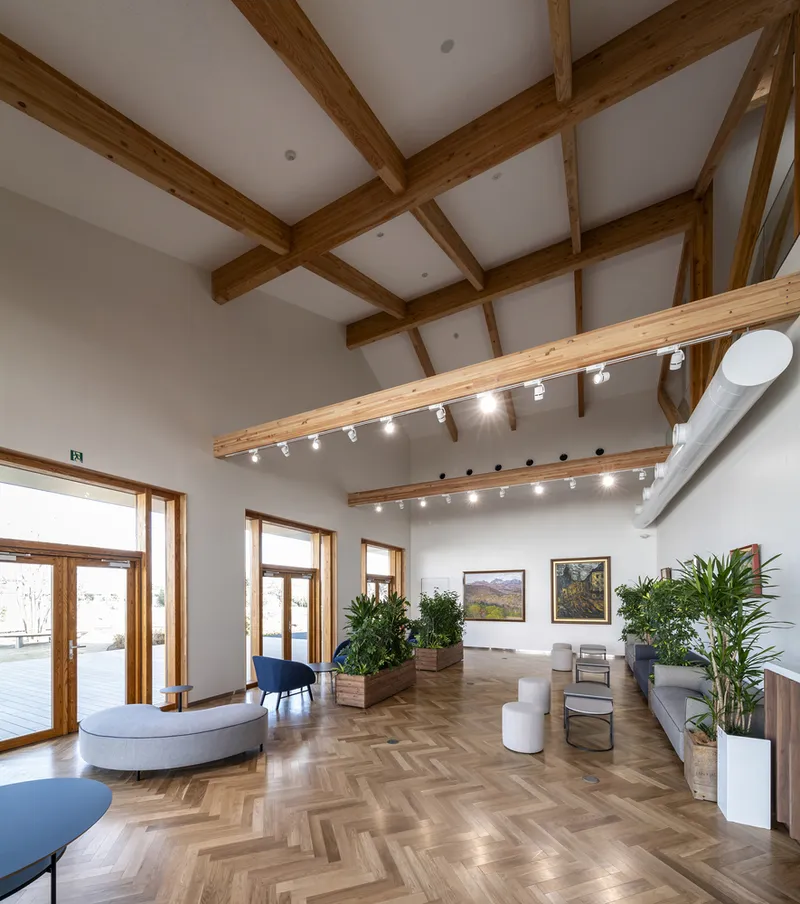
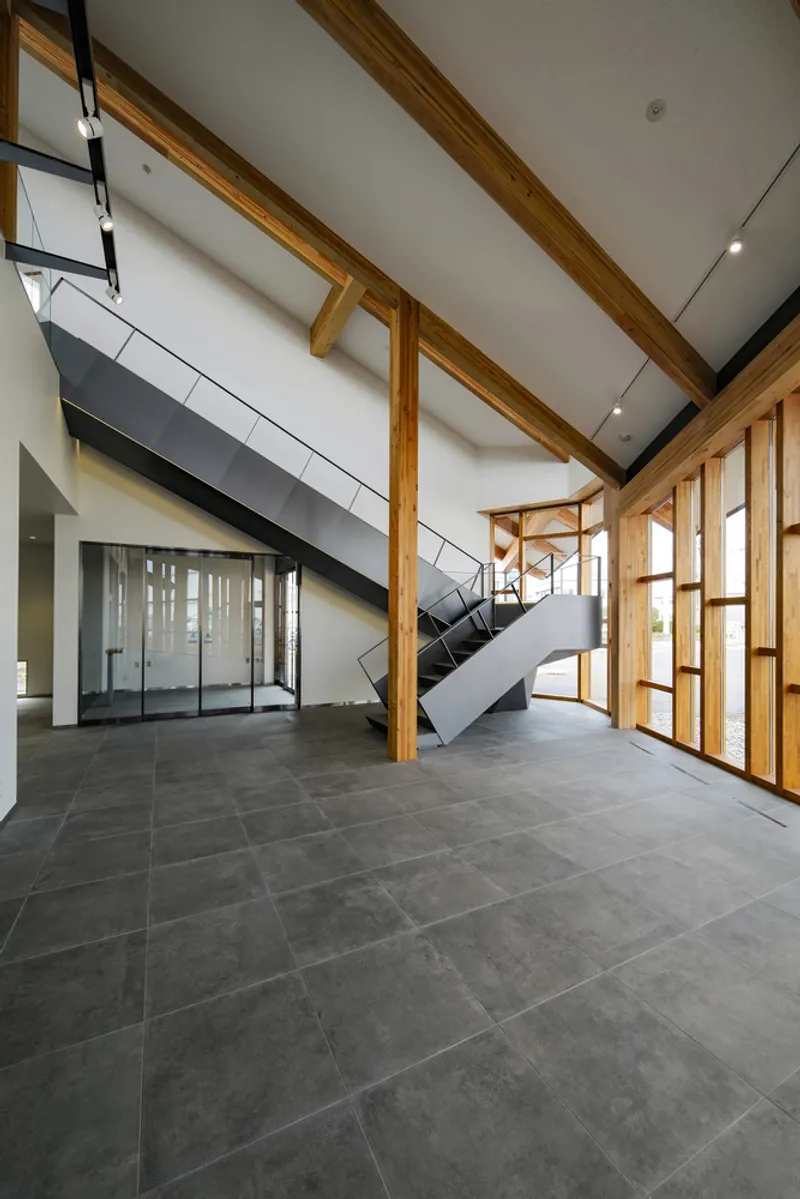
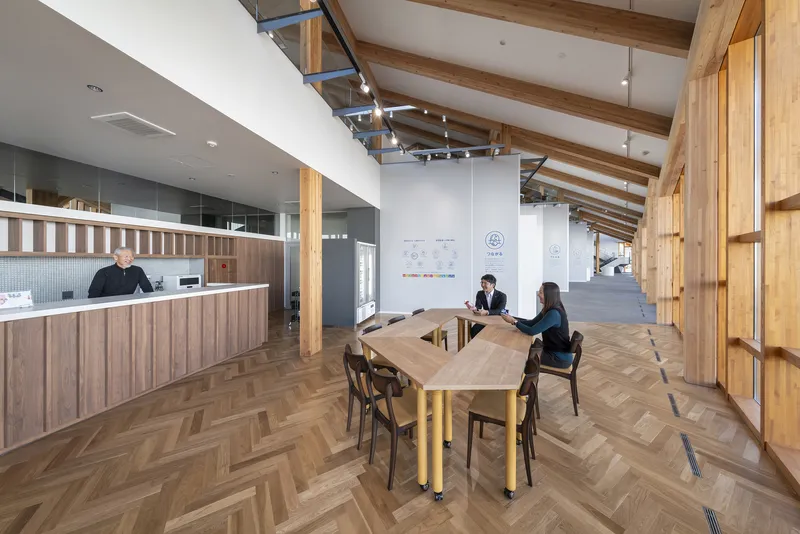
The ground level houses the Gallery Area, a space where visitors learn about Haruna Beverage's products and processes while touring the full building. Herringbone wood flooring, exposed timber beams, and track lighting create an atmosphere closer to a design museum than a corporate showroom. The folded steel stair sculpture that rises through the lobby volume announces the vertical circulation with real conviction, its angular geometry picking up the zigzag theme without mimicking the roof forms literally.
Adjacent to the gallery, a dining area with the same herringbone floor and exposed rafters doubles as an informal meeting zone. The Innovation Area, conceived for scientists to work creatively using all five senses, occupies a quieter wing where controlled daylight and acoustic separation support concentrated research.
The Open Office Under the Rafters
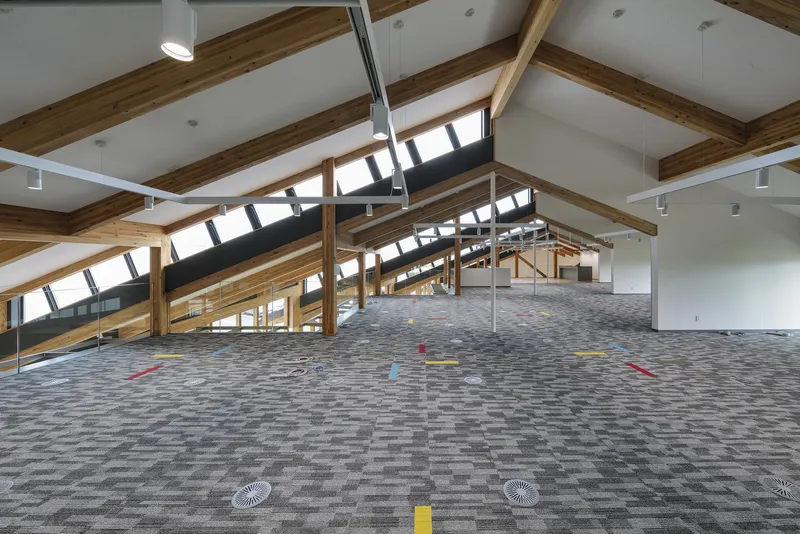
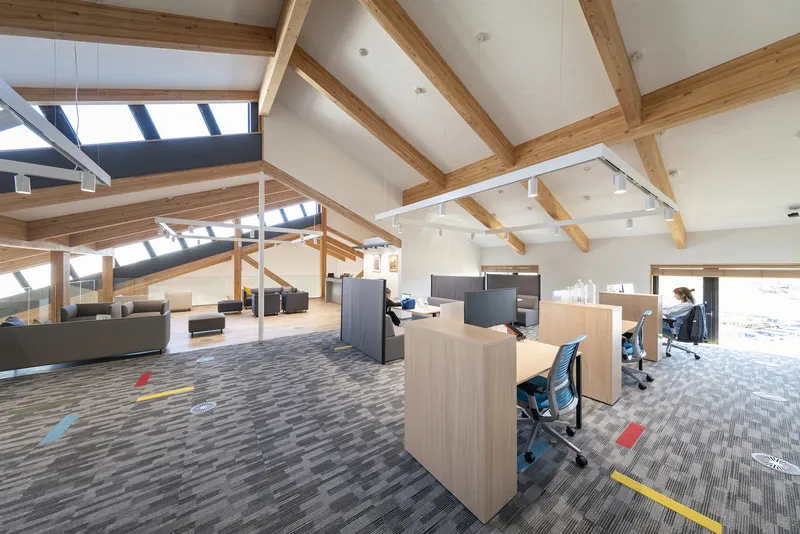
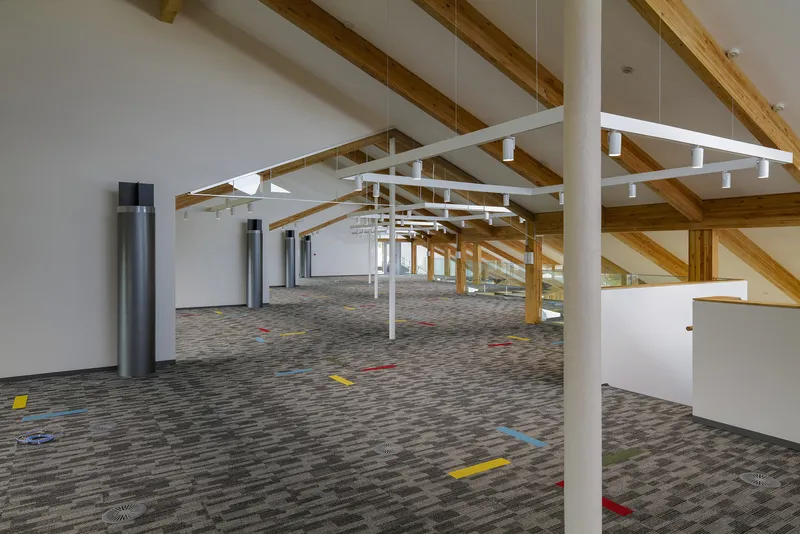
The upper floor office operates as a free-address workspace, a deliberate choice to promote communication and co-creation. The pitched ceiling with exposed timber rafters and clerestory windows along the ridge generates a quality of light that is hard to achieve in conventional suspended-ceiling offices. Workstations sit beneath the trusses in generous pools of daylight, and the section drawing confirms that the roof geometry is calibrated to maximize north-facing clerestory openings while shading the south.
The floor-supply air conditioning system is worth noting. By delivering conditioned air at floor level rather than ceiling level, the system reduces energy consumption and improves comfort in the zone where people actually sit. Combined with the high-insulation walls and roof, it allows the building to maintain stable interior temperatures year-round without the oversized mechanical plants that compromise so many open-plan offices.
Details and In-Between Spaces

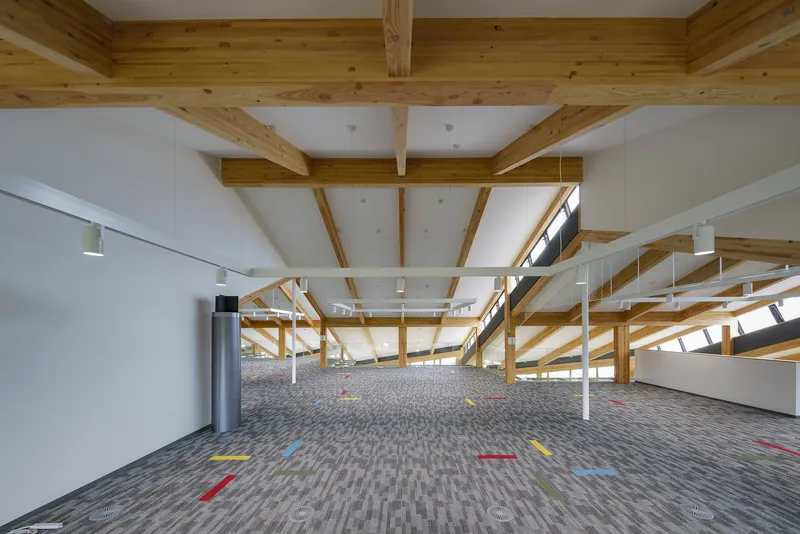

The corridors are not afterthoughts. Timber-louvered walls, exposed rafters, and glazed meeting room partitions line circulation routes that double as informal work zones. On the upper floor, grey carpet tiles marked with colored tape suggest flexible zoning rather than permanent division, an honest admission that workplaces need to adapt faster than construction permits allow.


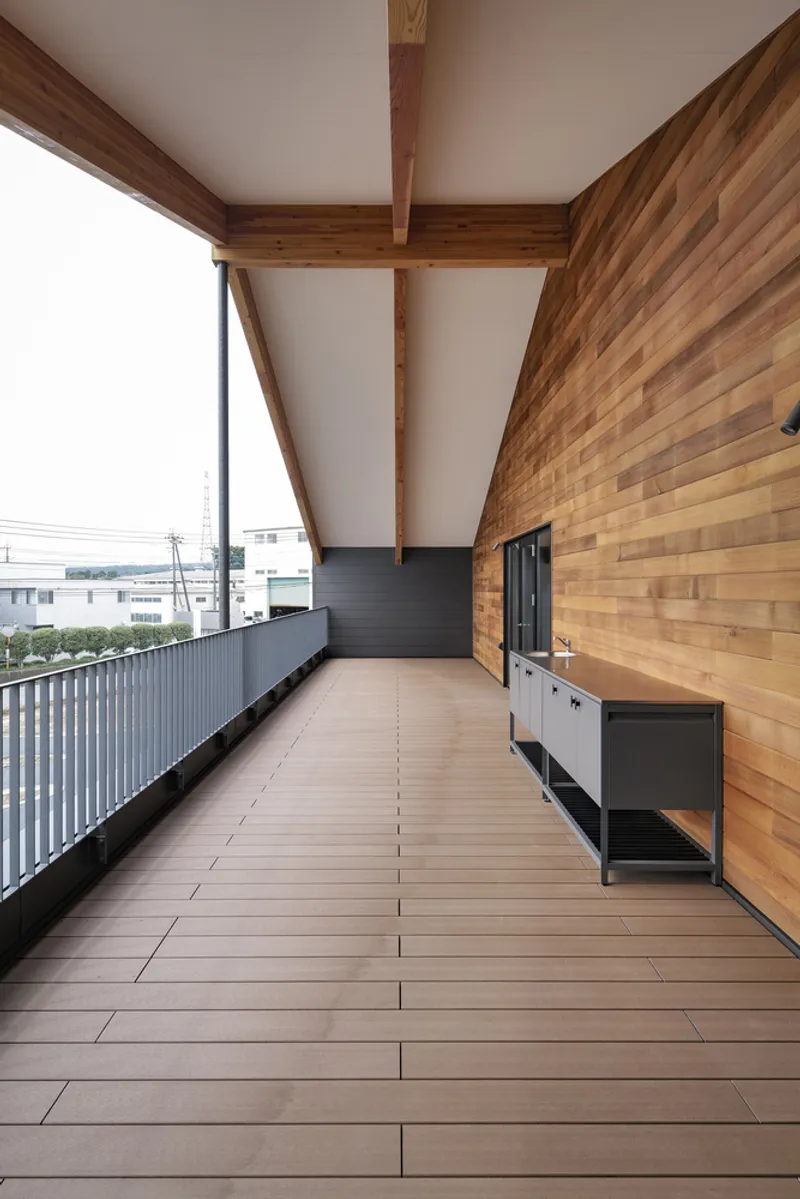
The diagonal exterior staircase in black steel, the folded stair in the foyer, and the covered terrace with its timber plank wall and diagonal bracing all share a taut material language. Steel is deployed for moments of structural drama or weather exposure; wood handles everything else. The terrace in particular offers a useful lesson: outdoor space adjacent to an office does not need to be a manicured roof garden. A sheltered deck with a view of the neighboring buildings is enough to break the rhythm of the workday.
Gallery Interiors and Visitor Experience
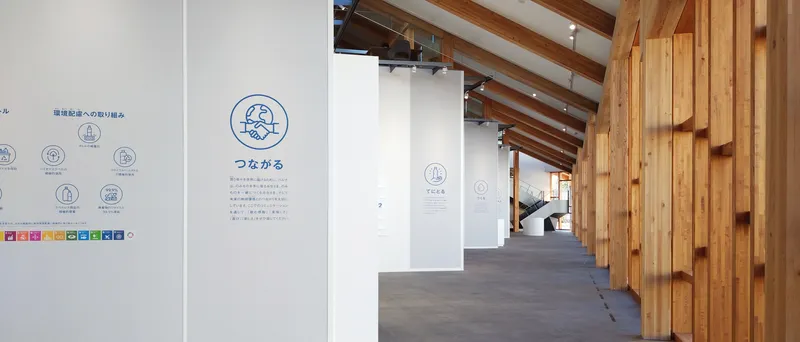


The visitor circuit threads through spaces that shift in character without losing coherence. Informational wall graphics alongside timber cladding narrate the company's story, while a meeting room with folding chairs on blue carpet beneath a white ceiling demonstrates that not every space needs exposed beams to succeed. The white interior room with exposed timber columns and recessed air conditioning units shows the palette at its most restrained, a deliberate pause in the material sequence.

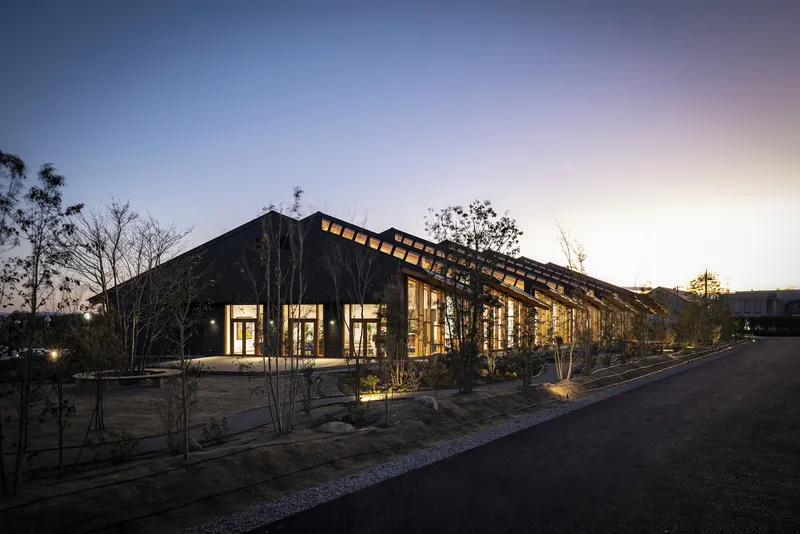
The top-down view of the entrance hall captures the spatial layering at its most condensed: glazed balustrade, tiled floor, stairwell, and sloped beams all visible in a single frame. At twilight, the illuminated timber frame glows through the curtain wall, and the planted courtyard becomes a foreground that softens the building's angular profile into something approachable.
Plans and Drawings


The site plan reveals how the angled building volumes negotiate their relationship with the distribution center and surrounding landscape. Each gable bay sits on a slightly different axis, producing the zigzag footprint that is the plan's organizing idea. The ground floor drawing shows rooms arranged along the diagonal perimeter with a central gathering space that acts as the social heart of the building, while the upper floor plan confirms the open office strategy: large, unpartitioned areas separated by parallel wood-decked zones that serve as breakout or transition spaces.
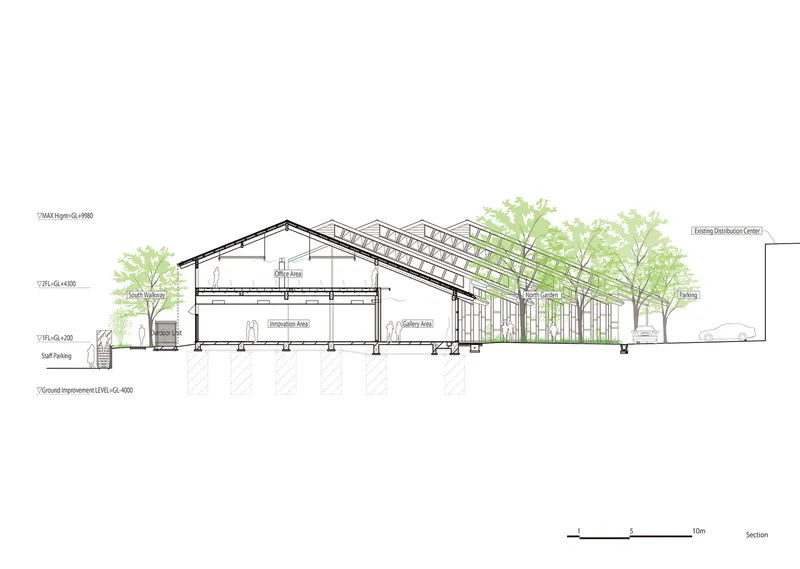

The sections are where the roof strategy becomes fully legible. The gabled structure with exposed trusses spans gallery and innovation areas in generous single volumes, while the detail section shows how steel trusses and sloped roof planes combine to create two-story interior spaces with carefully proportioned clerestory openings. Human figures in the drawing underscore the scale: these are tall, light-filled rooms, not compressed office floors with dropped ceilings.
Why This Project Matters
The Haruna Innovation Center matters because it refuses to separate sustainability from spatial quality. Too many green-certified buildings treat environmental performance as an engineering overlay applied to conventional plans. Here, the zigzag layout, the clerestory gaps, the exposed timber frame, and the floor-supply conditioning are all part of a single integrated design idea. You cannot remove the passive strategies without dismantling the architecture itself, which is exactly the point.
It also offers a credible model for corporate campuses that want to foster innovation without resorting to the open-plan clichés of tech headquarters. The three-zone program, office, innovation lab, and gallery, gives the building a public dimension that most R&D facilities lack, and the material warmth of the timber frame turns what could have been a sterile workplace into a space with genuine character. For a beverage company at the foot of a mountain, that connection to place and craft is not ornamental. It is operational.
Haruna Innovation Center by Naomi Sato Architects. Ashikadomachi, Takasaki, Gunma Prefecture, Japan. 1,497 m². Completed 2024.
About the Studio
Share Your Own Work on uni.xyz
If projects like this are the kind of work you want to make, uni.xyz is a place to publish your own, find collaborators, and enter design competitions.


Popular Articles
Popular articles from the community


Singing Woman: An Opera House That Performs Before the Curtain Rises
Ovidiu Cristian Pavel's conceptual opera house translates Estonia's choral identity into a sculpted waterfront landmark facing the Baltic Sea.


David Ortega Stacks a Two-Story Mexico City Penthouse Around a Steel Stair and a Pergola-Shaded Roof Terrace
In Colonia Roma, a 300 m² penthouse uses oak joinery, a planted steel stair and a slatted roof pergola to make a new-build apartment feel like a house.

FCC Arquitectura Expands a Portuguese Granite House with a Board-Marked Concrete Wing
In Portugal, JV House pairs a cleaned-up whitewashed and granite dwelling with a timber-shuttered concrete extension, courtyards and a garden pool.

Opera on the Sea: Driftwood Logic Shapes a Timber Opera House on Estonia's Coast
Trevor Orgill's opera house translates the entangled drift of floating timber into a civic building where wood, water, and music converge.

Similar Reads
You might also enjoy these articles

Cube Design Draws an Ecological Corridor Between Two Shenzhen Hills with the Nankai Building
Beside Shenzhen's container docks, the Nankai Building pairs stacked balconies with a climbing green screen to connect two hillsides across its height.

Praksis A and Studio Sted Bend a Red Timber Cabin Across the Granite of Norway's Southern Coast
On the southern Norwegian coast, a 105 m² cabin follows the rock on slender posts, pairing red cladding outside with pine, brick and plywood within.
David Ortega Stacks a Two-Story Mexico City Penthouse Around a Steel Stair and a Pergola-Shaded Roof Terrace
In Colonia Roma, a 300 m² penthouse uses oak joinery, a planted steel stair and a slatted roof pergola to make a new-build apartment feel like a house.

PARALELA and LB2 Thread a Public Walkway Through the Base of a Las Condes Residential Tower
In Las Condes, Santiago, the Hamlet Building gives its fenceless ground floor to a 70-metre wooded passage linking two streets and the metro.

Explore Office Building Competitions
Discover active competitions in this discipline

Challenge to reimagine the Iron Throne

Photograph architecture without architects

Illustrate the lost glory of Angkor Wat - Render Challenge

Design challenge to reuse E-waste
Comments (0)
Please login or sign up to add comments
No comments yet. Be the first to comment!