

Carlana Mezzalira Pentimalli Builds an Office That Refuses to Stay Still in Carbonera
A four-storey headquarters near Treviso treats every wall, desk, and rooftop as something its occupants can rearrange at will.


The flatlands north of Treviso are not typically associated with architectural ambition. Vascon di Carbonera sits in a landscape of dense industrial sheds and logistics yards, the kind of territory where a new headquarters could easily default to the same utilitarian box. Carlana Mezzalira Pentimalli took the commission for four companies, Itagency, Faba, Maikii, and Exclama, and turned it into a thesis on what an office building should actually do in an era when half the staff might be working from home on any given Tuesday.
The result, completed in 2025 after a 2020 invited competition, is a 3,070 square metre building on a 13,255 square metre lot that treats permanence as a design liability. Movable walls, folding partitions, modular furniture, and a ground floor that swings between showroom, cafeteria, and exhibition hall make the building less a fixed container and more an infrastructure of possibilities. The most provocative move may be the rooftop, conceived not as a mechanical penthouse but as a communal plaza with art by Lorenzo Mason Studio. In a region where flat roofs collect dust, this one collects people.
Blue Steel and Layered Facades
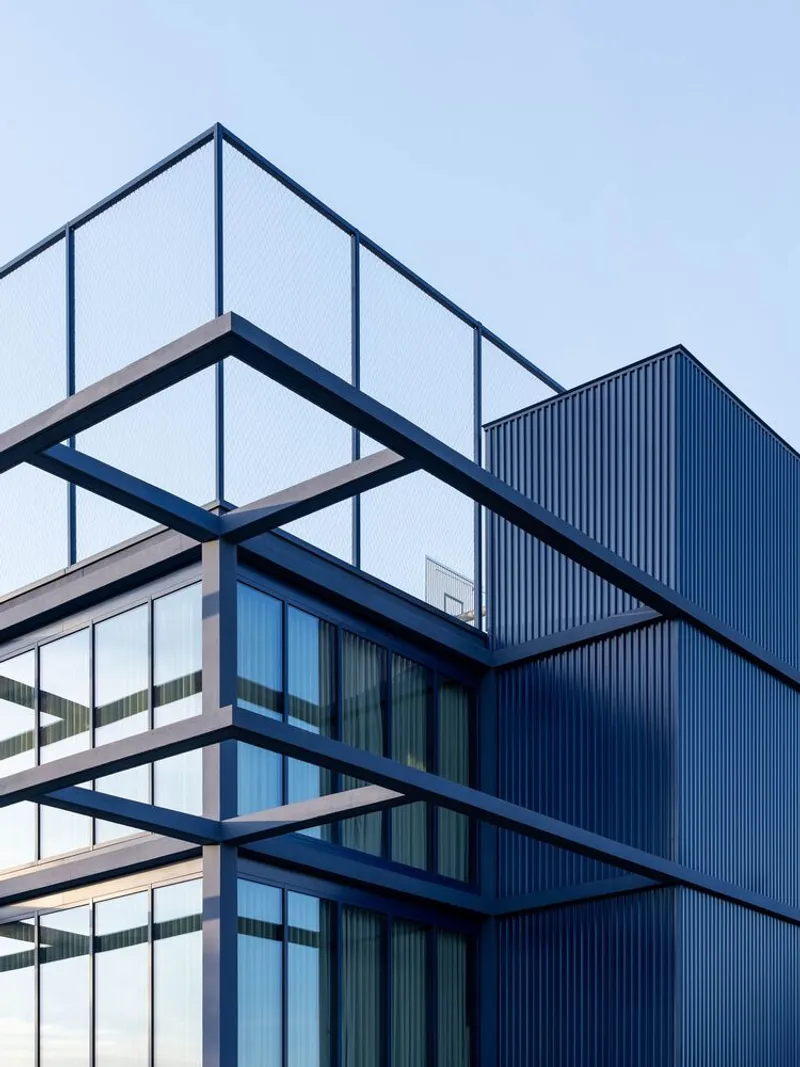
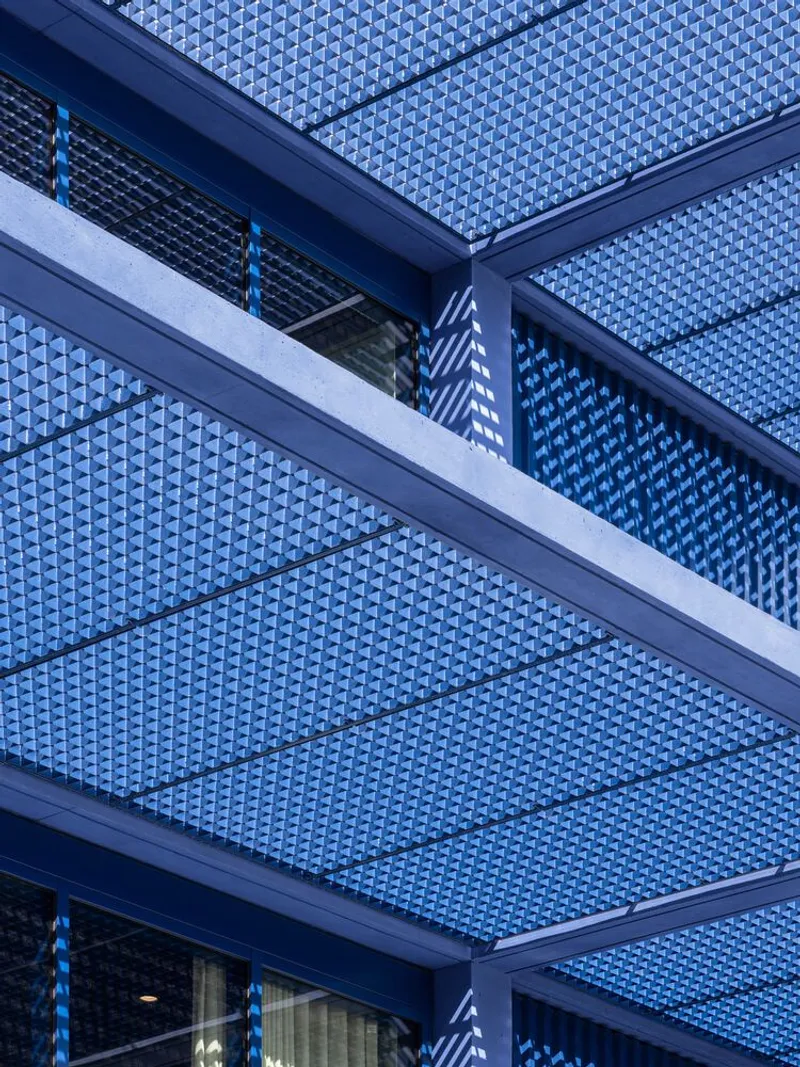
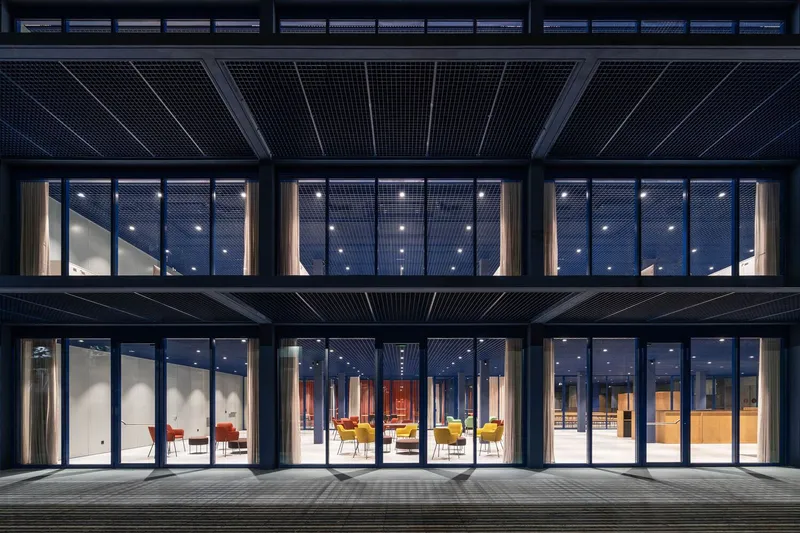
The exterior reads as a stack of horizontal trays held apart by a muscular steel frame. Corrugated blue cladding wraps the volumes with a textured, almost textile quality, while the exposed structural beams lend the building an honest, industrial character that does not pretend to be somewhere other than the Veneto's warehouse belt. At the corner, cantilevered balconies project outward, giving each floor its own outdoor register and breaking up what could have been a monotonous box into a series of inhabited ledges.
At night the building inverts itself. The blue panels recede into shadow and the glass curtain wall takes over, turning each floor into an illuminated vitrine. The dark grid ceiling, visible from outside, gives the interior a continuous datum line that unifies every level. It is a simple trick, but it works: the building looks heavier and more grounded by day, lighter and more open after dark.
Ground Floor as Public Infrastructure
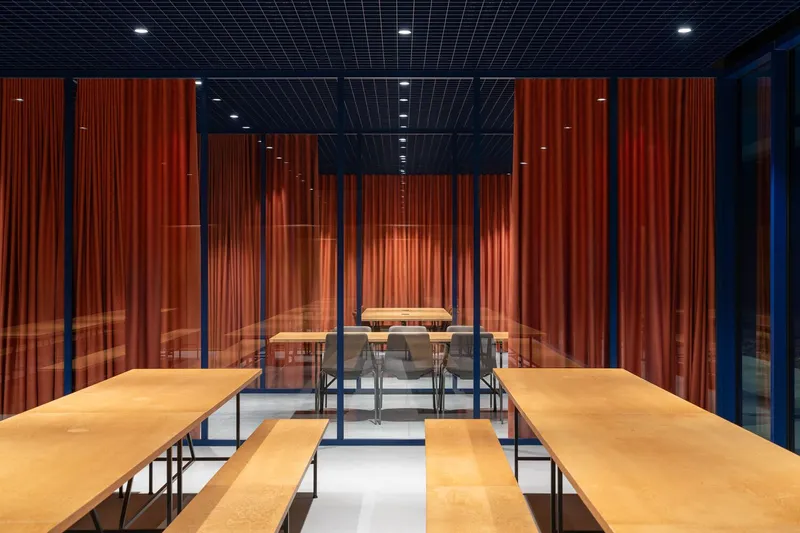
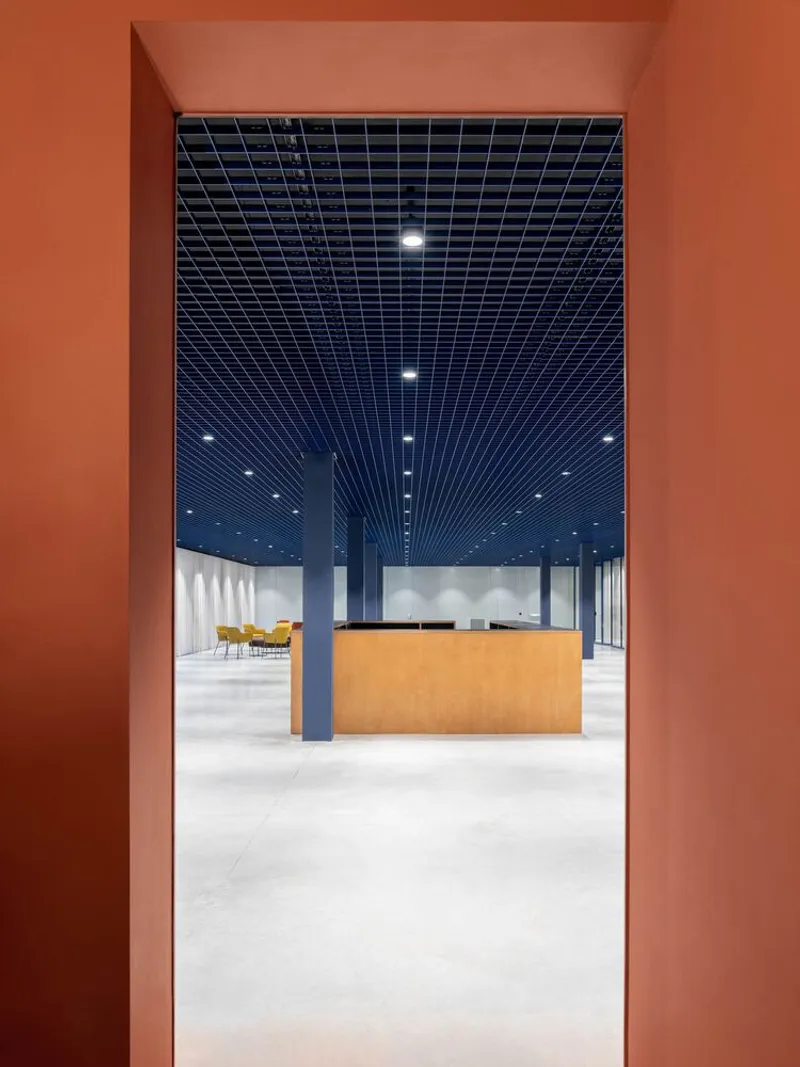
The ground level operates as the building's social engine. A dining hall lined with timber benches and glazed partitions draped in orange curtains serves lunch on weekdays and exhibitions on weekends. The architects clearly studied how corporate ground floors tend to die outside business hours and pushed back, programming the space for meetings, community events, and product showcases in equal measure. The cafeteria does not feel like an afterthought tucked behind the lobby; it feels like the reason you walk in.
Stepping through an orange-painted doorway into the reception area, you encounter plywood surfaces and a warm timber desk framed by the same black grid ceiling overhead. The color accents, orange fabric, blue steel, timber grain, are not arbitrary. They establish a navigational palette that helps occupants orient themselves across the building's modular, reconfigurable plans without relying on conventional wayfinding signage.
Corridors That Do More Than Connect
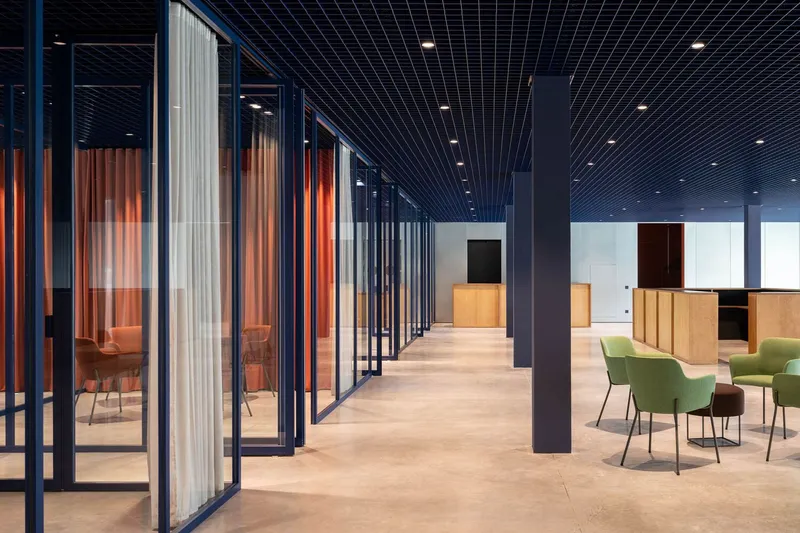
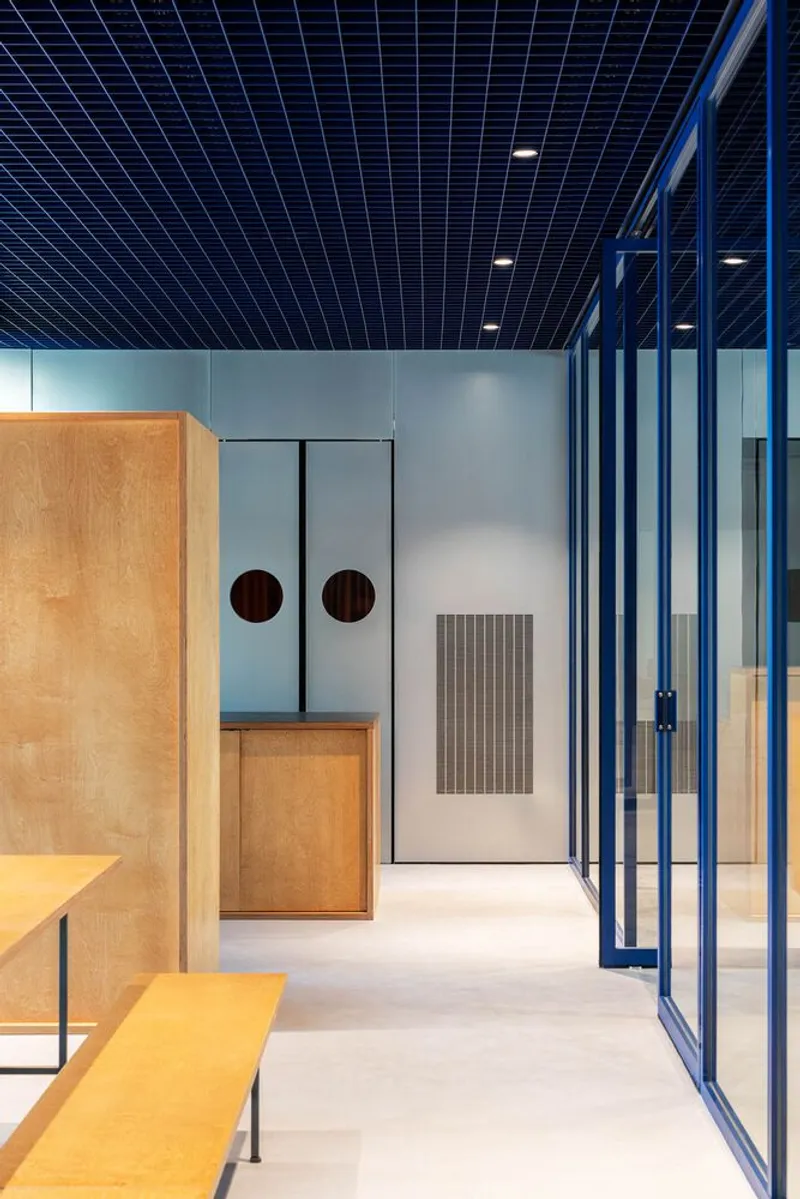
In most office buildings, corridors are dead space, a tax on the floor plate. Here, they become exhibition galleries, informal meeting zones, and acoustic buffers. One corridor runs past glazed meeting rooms backed by curtains and green lounge chairs, setting up a layered transparency where you can see activity without hearing it. Another passage is lined with plywood casework, grey metal doors punched with circular portholes, and blue steel partitions that echo the exterior cladding. The portholes are a small delight: they let you glimpse who is inside a room before you knock, reducing the social friction of shared space.
The acoustic strategy, developed with Niraconsulting of Bressanone, relies on glass and fabric partitions rather than solid drywall. The result is a building where sound can be tuned rather than simply blocked. Pull a curtain closed for a phone call; fold a wall open for a team brainstorm. The corridor becomes the seam where those two modes overlap.
The Meeting Room as Soft Machine
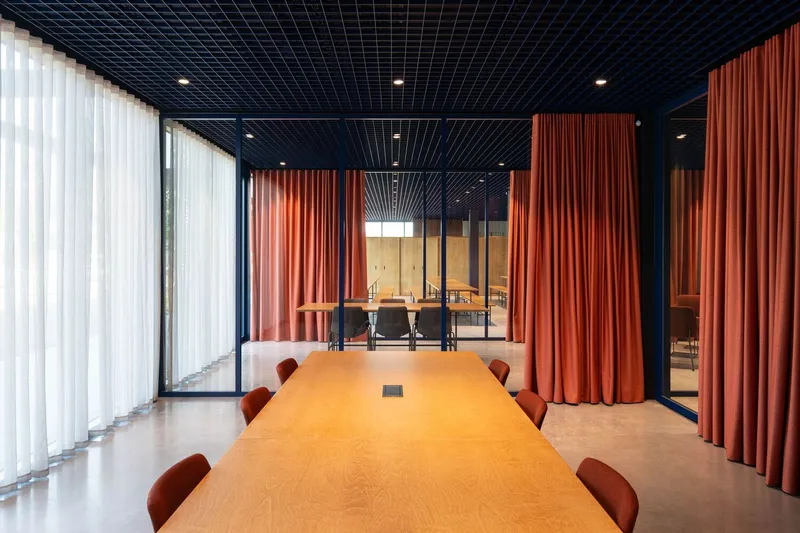
A meeting room with a long timber table and orange fabric dividers beneath a dark slatted ceiling reveals the building's core proposition: nothing is fixed. The fabric screens can be repositioned to shrink or expand the room. The modular desk and shelving system, visible in several configurations across the upper floors, lets occupants calibrate the degree of privacy from fully open collaboration to near-isolation. Carlana Mezzalira Pentimalli designed these spaces not for a single tenant profile but for the reality that four different companies with four different cultures share the building.
The dark slatted ceiling is worth noting on its own. It conceals the mechanical systems behind a uniform datum while absorbing sound and reducing glare from overhead lighting designed by Stingers Srl. It is a move borrowed from theatre design, where the fly loft hides all the rigging and lets the stage below change constantly. The analogy is apt: these meeting rooms are stages whose sets rearrange between acts.
Ground Plane and Site Logic
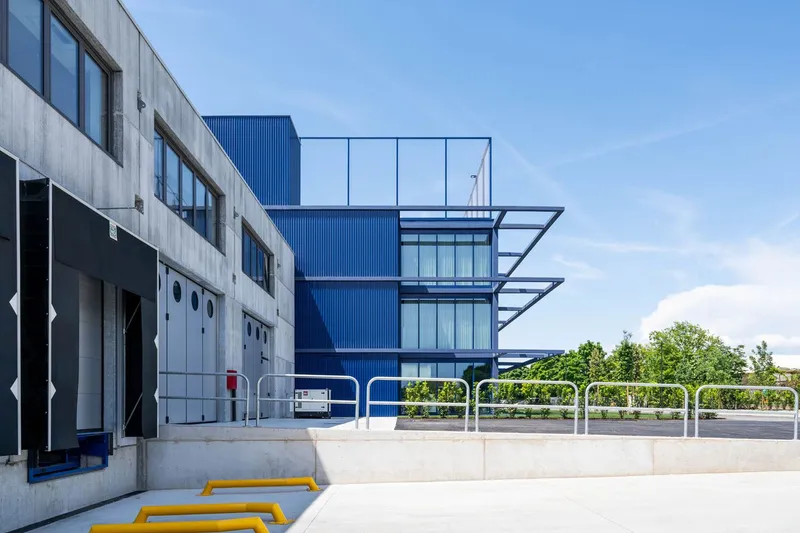
The site strategy is quietly radical. Rather than demolishing the existing offices to make way for the new building, the architects converted them into additional warehouse space and extended the logistics yard northward with a new cargo area. The new office building therefore sits on a site that has been reorganized holistically: production, storage, and administration each have their own zone, connected but not entangled. Yellow bike racks and white bollards in the courtyard signal a commitment to non-automotive arrival that is rare in an industrial zone where the car is king.
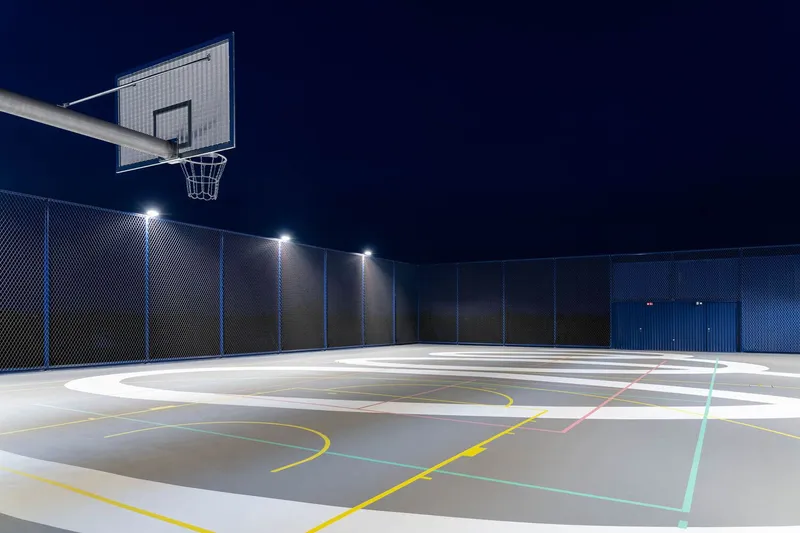
Then there is the basketball court. Illuminated at night with crisp painted lines, it occupies the perimeter of the lot like a civic amenity that wandered in from a public park. It is an unambiguous statement: this is not a fortress campus where employees swipe in and disappear. The boundary between workplace and community is deliberately porous, and a half-court three-pointer at 7 p.m. is as valid a use of the site as a board meeting at 10 a.m.
Why This Project Matters
The post-pandemic office debate has often polarized into two camps: the tech-utopian hot-desking pod and the nostalgic return to the corner office. Carlana Mezzalira Pentimalli sidesteps both by designing a structural frame that makes almost no spatial commitments. Walls fold, curtains slide, desks rearrange, and even the rooftop refuses to be just a roof. In a small industrial town where architectural ambition is scarce, this building demonstrates that flexibility is not the same as cheapness or vagueness. It requires more thought, not less.
What elevates the project beyond a competent workplace fit-out is its insistence on cultural content. The collaboration with Lorenzo Mason Studio embeds art into the architecture rather than hanging it on the walls afterward. The basketball court, the communal rooftop plaza, and the multi-use ground floor extend the building's audience beyond its four tenant companies. If the future of the office is a place people choose to go rather than a place they are required to attend, Carbonera offers a credible prototype.
New Office Building Carbonera by Carlana Mezzalira Pentimalli. Vascon di Carbonera, Italy. 3,070 m² (office building), 13,255 m² (lot). 2025. Photography by Marco Cappelletti.
About the Studio
Share Your Own Work on uni.xyz
If projects like this are the kind of work you want to make, uni.xyz is a place to publish your own, find collaborators, and enter design competitions.


Popular Articles
Popular articles from the community


Aquadapt: An Underwater Habitat That Rewrites Its Rooms by the Hour
Curved modules ring the seabed while one shell shifts from breakfast room to cinema, farm and football pitch as residents' needs change.


graciastudio Turns a Viewless Tijuana Lot Inward Around a Courtyard of Concrete, Timber and Trees
In Tijuana, Jorge Gracia's GA2 House stacks a timber-clad private floor over exposed concrete and replaces a missing view with a planted interior patio.

Manzana Morphosis: Stretching Barcelona's Grid into a Living Landscape for 2050
A radical reworking of the Eixample manzana turns density into a tool for generous public space, vertical ecology, and environmental performance.

FCC Arquitectura Expands a Portuguese Granite House with a Board-Marked Concrete Wing
In Portugal, JV House pairs a cleaned-up whitewashed and granite dwelling with a timber-shuttered concrete extension, courtyards and a garden pool.

Similar Reads
You might also enjoy these articles


Hodi-Mandai Geram
Project Function: Preservation and revitalization of the Intangible heritage and socio-spatial identity of the Hodi by Housing, Cultural Memory Center, Sacred Grove, landscape, local tourism economy


Olio Towers: A Mid-Rise for Performers That Fuses Housing, Rehearsal, and Stage
Located blocks from Houston's Theater District, this modular tower stacks living units around a central performance atrium.

Oasis: Modular Green Housing Carved into Dhaka's Urban Fabric
A shortlisted Plugin Housing entry reclaims unauthorized settlements in Dhaka with stepped concrete volumes, green roofs, and ventilation-driven design.

Black Hole: A Floating Megastructure for the Post-Physical Era
Emiliano Mazzarotto envisions a spherical, self-scaling arena where e-sports, digital hotels, and holographic stadiums replace traditional public space.

Explore Office Building Competitions
Discover active competitions in this discipline

Challenge to reimagine the Iron Throne

Photograph architecture without architects

Illustrate the lost glory of Angkor Wat - Render Challenge

Design challenge to reuse E-waste
Comments (0)
Please login or sign up to add comments
No comments yet. Be the first to comment!