

LYM SPACE by PAK Architects
A poetic office-commercial building in Hanoi shaped like a blooming flower, merging concrete strength with terrace greenery and spiritual softness.


Amid the intensely dense urban layers of Hanoi, where concrete rises rapidly and buildings increasingly push against one another for space, visibility, and commercial advantage, LYM SPACE arrives not as a typical office block but as an exception. It does not shout its presence. It grows. It blooms. It stands quietly yet symbolically, like a flower rooted in a field of rigid construction, offering softness where the city often feels unyielding.

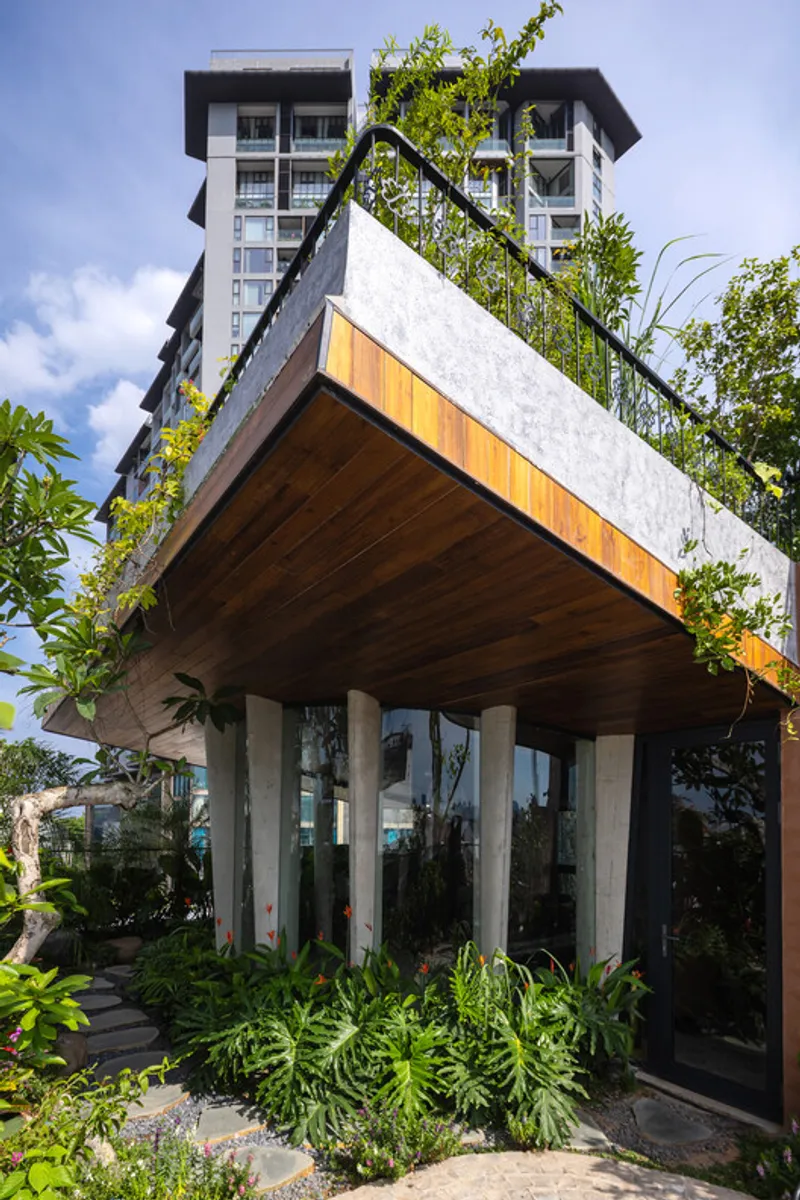
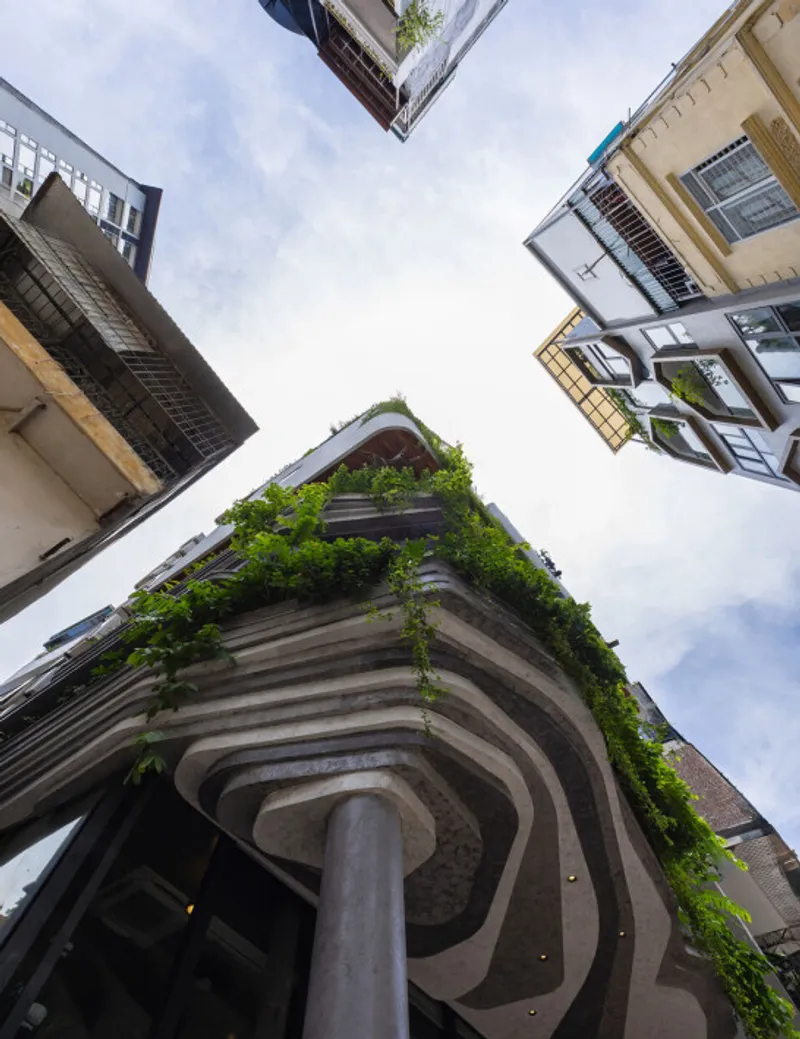
At first encounter, the architecture appears simple in its material language, raw concrete, clean verticalities, and stepped terraces. But beneath this clarity lies a conceptual foundation tied intimately to the form and growth of a flower. PAK Architects proposed a structure where a single central column acts as the stem, carrying the weight of a concrete mass that unfolds above like petals. The design is not merely formal metaphor; it is structural defiance, urban critique, and poetic statement.
In the metaphor of the flower, the architects find both fragility and resilience. A flower is delicate, open, and vulnerable to the world, yet its stem holds everything firmly. This duality becomes the core of the project. It becomes the essence of LYM SPACE.

Architecture as Feminine Strength
The architects express the project as an allegory for women, particularly Vietnamese women, though by extension all women whose lives are often defined by balance between softness and formidable endurance. A flower is admired for beauty but survives through strength unseen. Likewise, women carry families, careers, generations, and burdens with tenacity often overlooked.

LYM SPACE becomes architectural embodiment of that paradox:
Grace above. Strength below.Openness in form. Stability in structure.
A slender column rises like a stem, uncompromising, load-bearing, powerful. Above it, the mass steps back like petals layered in bloom, each terrace opening into light and landscape. Instead of sharp edges and maximized envelopes common to commercial structures, the architecture chooses curve, texture, recess, and pause. It chooses beauty in stillness, in air, in organic form.
Here, metaphor becomes structure. Structure becomes message.

Choosing Less in a City That Always Wants More
Hanoi’s development climate is intensely pragmatic. High land value demands density, efficiency, and total built area. In most cases, plots are filled to the limits, air rights are used fully, street edges built tight, and light only enters where required by code. Under such conditions, sacrificing leasable interior area is unconventional.

Yet LYM SPACE does exactly that.
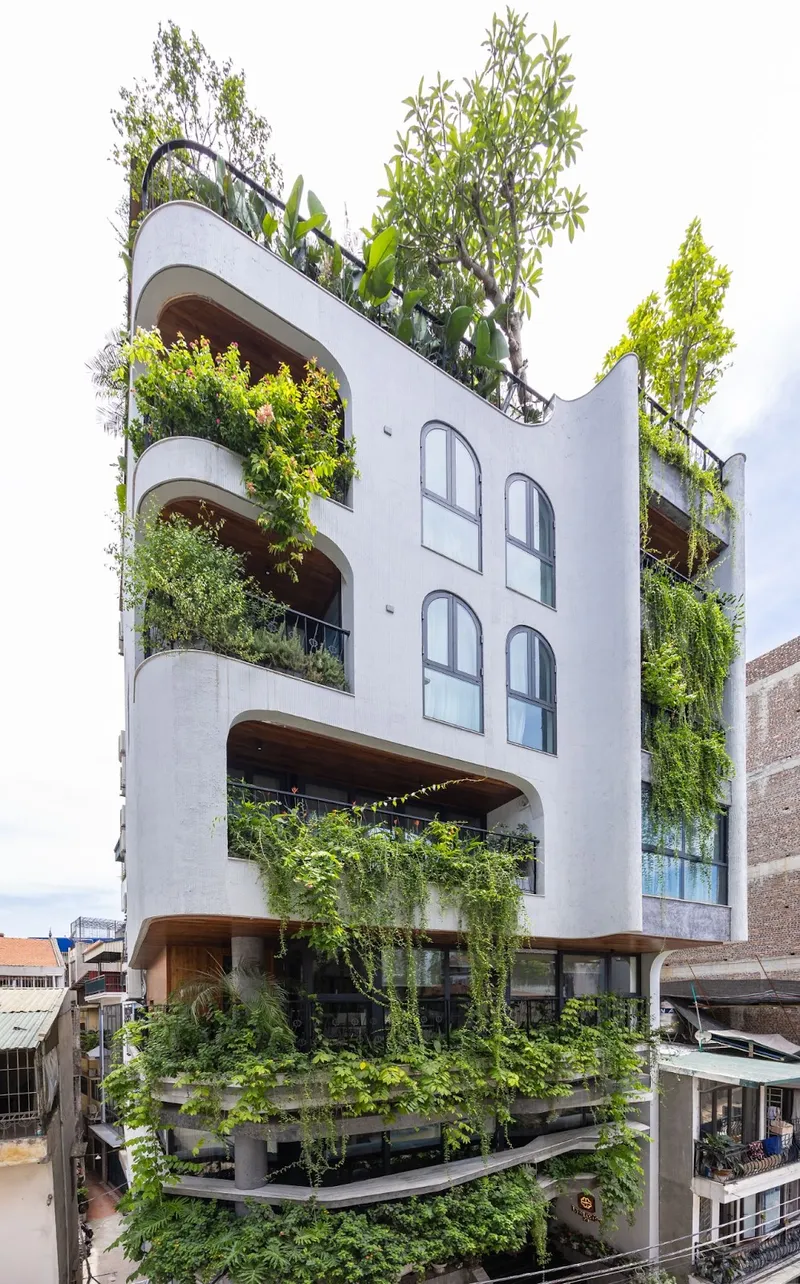
PAK Architects persuaded the client to leave space unbuilt, not as emptiness but as possibility. The mass steps back from the boundary, and two-thirds of what could have been rentable interior becomes instead a layered system of outdoor terraces. Another section of interior volume is surrendered to create a central atrium, bringing openness where floor could have existed.
This is not absence. It is intentional restraint.
It is rare, especially in commercial architecture, to gain value by building less. But by allowing nature to enter, air to move, sunlight to fall freely, and vegetation to root into terraces, the project transcends conventional office typology. It becomes breathable architecture. It becomes a workplace where comfort is not mechanical but environmental.
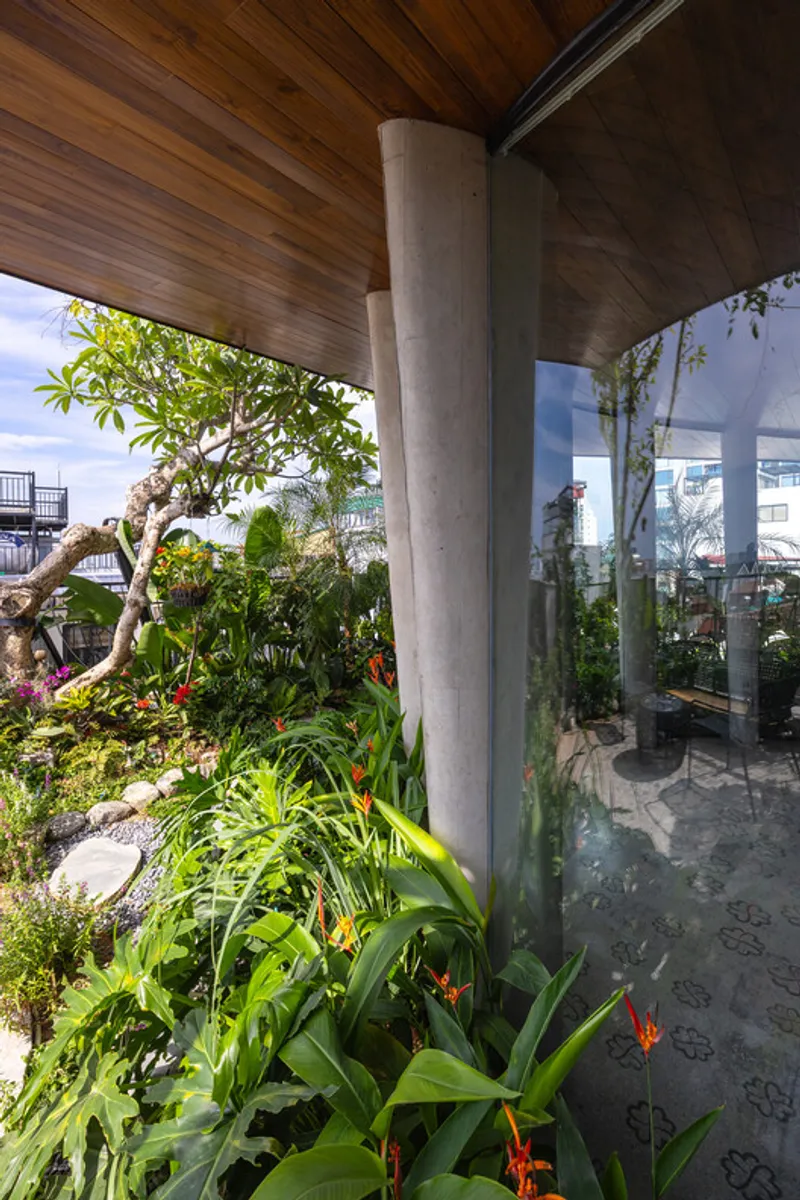
The building rejects maximum area in favor of maximum experience, proving that profitability can coexist with generosity when spatial quality attracts long-term tenants rather than merely filling square meters.
The Calyx and the Garden: A Vertical Green Envelope
The stepped terraces are described as a calyx, the botanical shield that nestles a flower bud before it blooms. In LYM SPACE, this idea becomes literal and spatial. Every recess is planted. Every notch becomes soil for growth. Terraces ripple upward, each one expanding the lushness of the architecture as height increases.
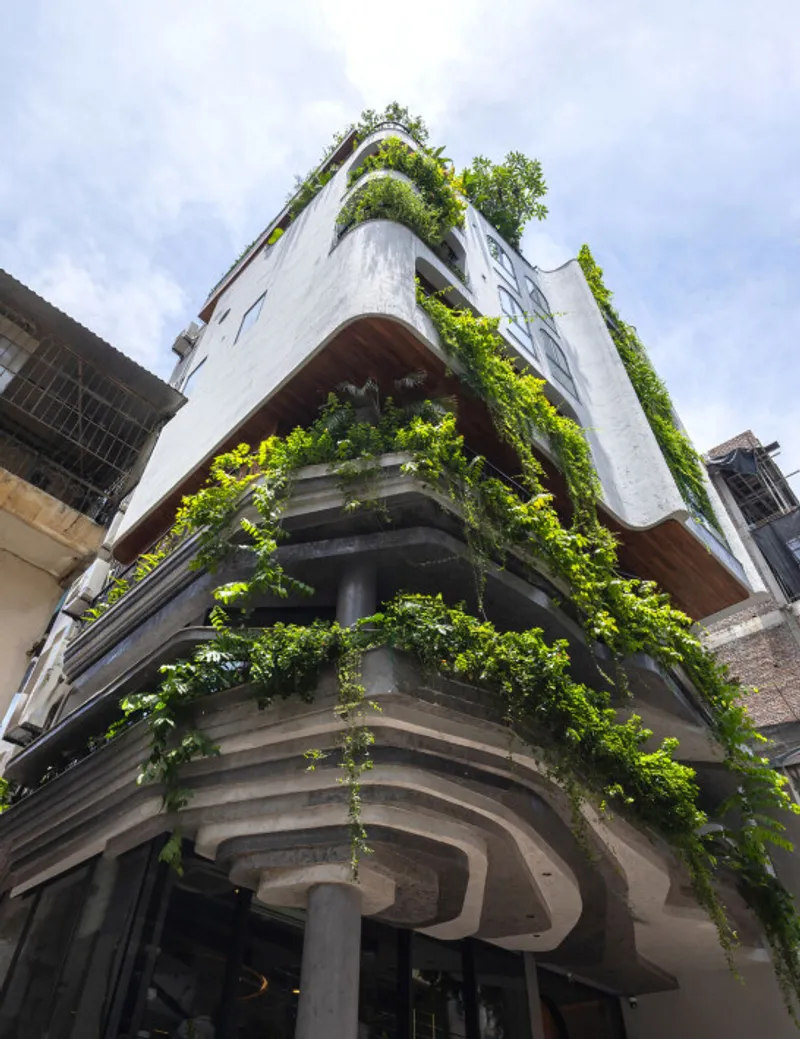
Where Hanoi’s architecture often meets the street with hard façade, LYM SPACE meets it with green volume, a soft boundary that breathes instead of blocking. Trees cascade downward, herbs and shrubs root in concrete pockets, and vines thread across beams like nerves reaching toward sun.
This garden is not applied, it is integrated into structure, part of the building’s ecology. Plants moderate heat, shade the interior, filter light, and renew air. Architecture is no longer envelope alone; it becomes photosynthetic skin.
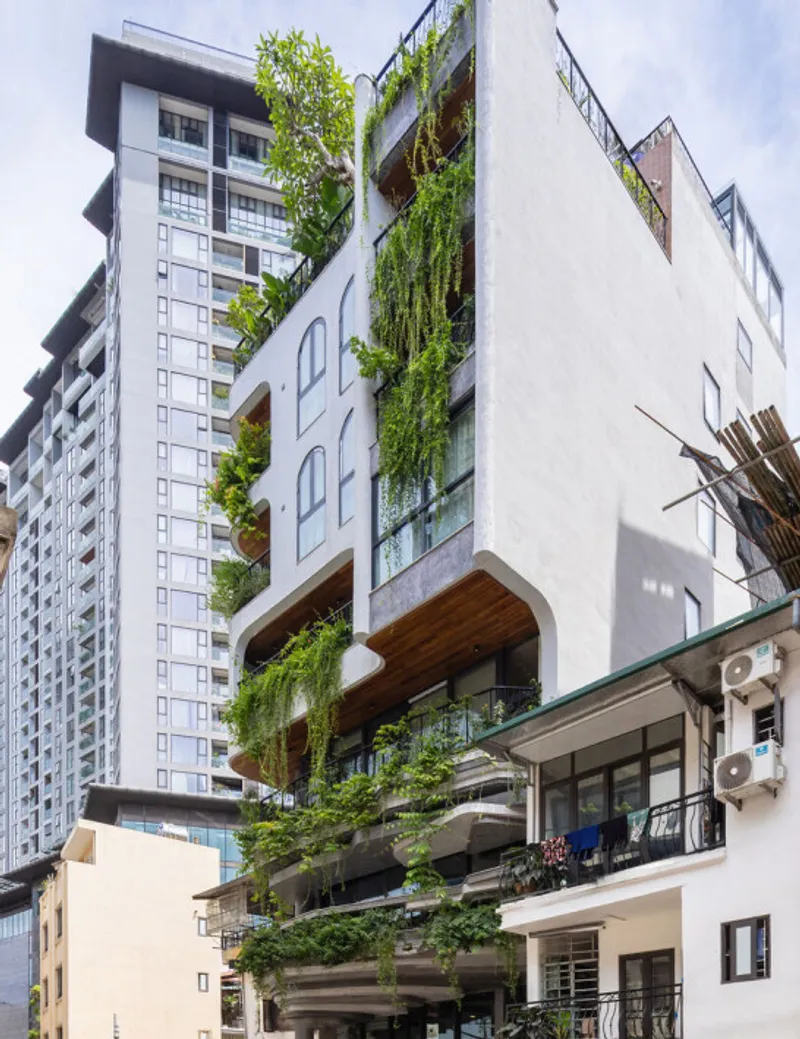
The result is a façade in motion:
Swaying leaves respond to wind.Dappled light paints the walls.Seasons alter the building’s expression.
It is an architecture that lives.

Concrete, Stone, Wood: Material Honesty and Urban Warmth
The project embraces monolithic cast-in-place concrete, not polished into slick perfection, but left textured, grainy, and subtly warm. Concrete becomes earth rather than industry. Its surface absorbs shadow softly, aging with time instead of resisting it.
Stone grounds the lower levels with weight and timelessness. Wood introduces tactile softness in human-scaled interior zones, where hands rest, where bodies move, where sound must feel comfortable. This triad of materials, concrete, stone, timber, reflects nature rather than mimicry. They become the garden’s companions.
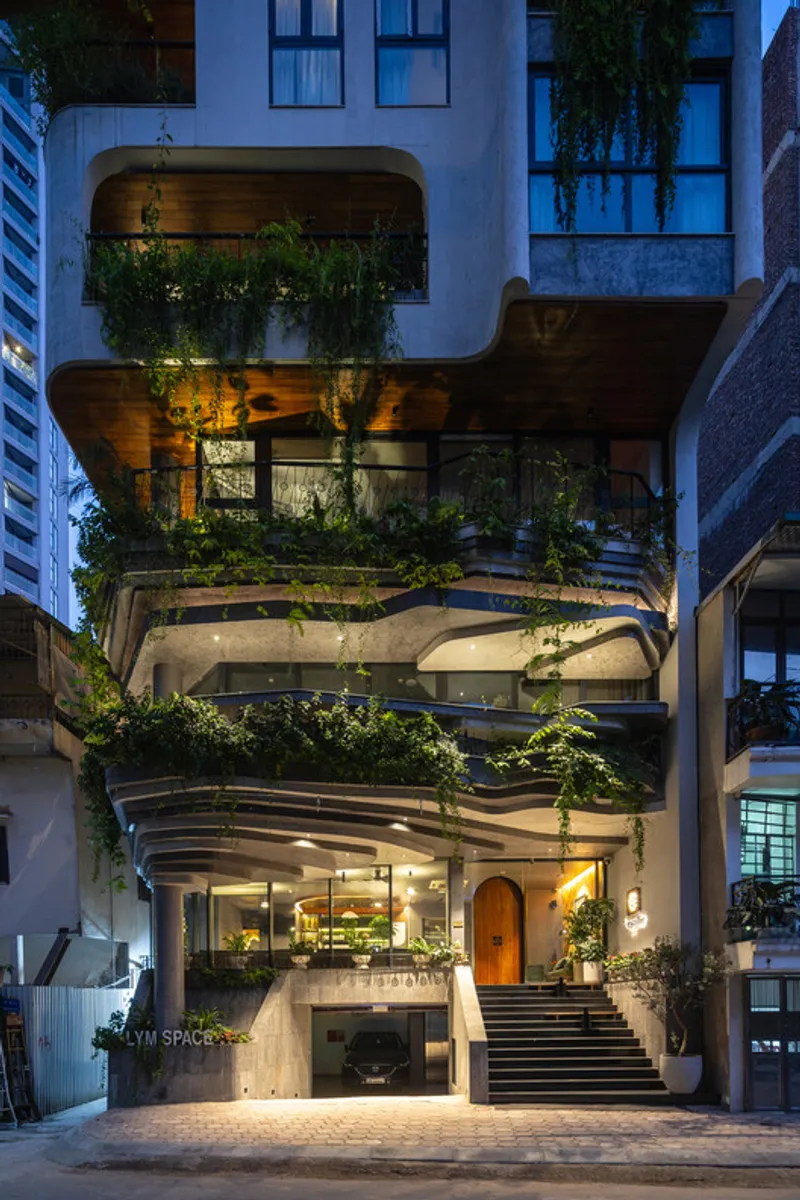
In urban environments where glass and aluminum increasingly dominate, LYM SPACE stands differently. It is not a sealed climate-controlled object, but a building that feels built with climate, oriented to air flow, sun angle, seasonal humidity. Even indoors, there is continuity with exterior environment. You do not feel removed from Hanoi, you feel situated within it, yet protected.
This balance is what elevates the project beyond aesthetic metaphor. It is not only a flower in form, it behaves like one.


Light, Air, and Vertical Circulation
At the heart of the plan, the atrium becomes vertical lung. Light enters from above like nutrients. Air circulates naturally, temperature moderated through openings and porous terraces. The interior closer resembles courtyard architecture than sealed office block.

Stairways stitch the building together like a spiraling vine, encouraging movement, avoiding rigid separation by floor. Circulation becomes experiential journey instead of functional connector. Employees step between zones with awareness of greenery, texture, air, shadow. Productivity becomes atmospheric rather than fluorescent.
The building is not walked through, it is felt through.
A New Image for Urban Commercial Space
In increasingly compact Asian cities, architecture must now negotiate responsibility beyond enclosure and rentable units. LYM SPACE proposes a possible future format: one that absorbs environmental stress, offers public aesthetic, and prioritizes mental comfort.


It acknowledges:
That people work better in daylight than in LED glow.That greenery is not decoration but necessity.That cities demand buildings that heal, not heat.
LYM SPACE is small in scale but symbolic in value. It demonstrates that design decisions rooted in restraint can be model for next-generation commercial development in Vietnam and beyond.
A building can earn money without losing soul.A workplace can breathe like a garden.Urban density can still be gentle.

All the Photographs are works of Triệu Chiến


Popular Articles
Popular articles from the community


GROUP A Strips a 1969 Rotterdam Harbor Headquarters to Its Frame and Wraps It in Timber Louvers
In Rotterdam's M4H harbor district, Ferro Offices reuses a 1969 frame, adds one timber storey and reaches BREEAM-NL Outstanding.

longwave studio Reorganizes a 112 m² Tainan Apartment Around the Daily Routines of a Family and Two Cats
In Tainan, Taiwan, birch plywood, rust-red furniture and a freestanding plaster wall link arrival, storage, work and family life in one apartment.

Juan García Correa, John González and Claudia Rueda Sink a Circular Amphitheater into a Manizales Engineering Building
On the La Nubia campus in Manizales, Colombia, the S1 Building folds labs and offices into a hillside of ramped lawns that double as a campus route.

Jaramillo Van Sluys Arquitectura and Urbanismo Turn a Demolished Registry Lot in Quito into an Orchard Plaza
In Quito's Centro Histórico, a 2,800 m² plaza exposes the San Agustín convent wall and redraws its lost Augustinian orchard in volcanic stone.

Similar Reads
You might also enjoy these articles


Hodi-Mandai Geram
Project Function: Preservation and revitalization of the Intangible heritage and socio-spatial identity of the Hodi by Housing, Cultural Memory Center, Sacred Grove, landscape, local tourism economy


Olio Towers: A Mid-Rise for Performers That Fuses Housing, Rehearsal, and Stage
Located blocks from Houston's Theater District, this modular tower stacks living units around a central performance atrium.

Oasis: Modular Green Housing Carved into Dhaka's Urban Fabric
A shortlisted Plugin Housing entry reclaims unauthorized settlements in Dhaka with stepped concrete volumes, green roofs, and ventilation-driven design.

Black Hole: A Floating Megastructure for the Post-Physical Era
Emiliano Mazzarotto envisions a spherical, self-scaling arena where e-sports, digital hotels, and holographic stadiums replace traditional public space.

Explore Commercial Buildings Competitions
Discover active competitions in this discipline

Challenge to reimagine the Iron Throne

Photograph architecture without architects

Illustrate the lost glory of Angkor Wat - Render Challenge

Design challenge to reuse E-waste
Comments (0)
Please login or sign up to add comments
No comments yet. Be the first to comment!