

Harmonia: A River-Shaped Community That Grows Over Decades in Boa Vista
Curved pathways and modular grid structures along the Branco River create a phased settlement designed to evolve from 2030 to 2050.


A bright orange pedestrian ribbon cuts through the Brazilian landscape like a tributary of the Branco River it parallels, connecting scattered volumes that step down a sloped terrain. Harmonia does not read as a building so much as a settlement in formation: a grid-frame architecture that is designed to be incomplete, planned to grow and reconfigure itself over a twenty-year timeline stretching from 2030 to 2050. The ambition here is not a fixed masterplan but a living framework, one that absorbs new residents, new programs, and new ecological conditions as they arrive.
Designed by İlayda Sargsyan and Doruk Ecemis, Harmonia is a shortlisted entry in the Live Green competition. Sited in Boa Vista, Brazil, the project takes the organic course of the Branco River as its formal generator, producing a curved spatial layout that organizes users by their purpose and duration of stay. The result is a community architecture that treats cultural exchange, permaculture, ecotourism, and collective learning not as programmatic additions but as the structural logic of the settlement itself.
A River's Curve Becomes a Site Strategy
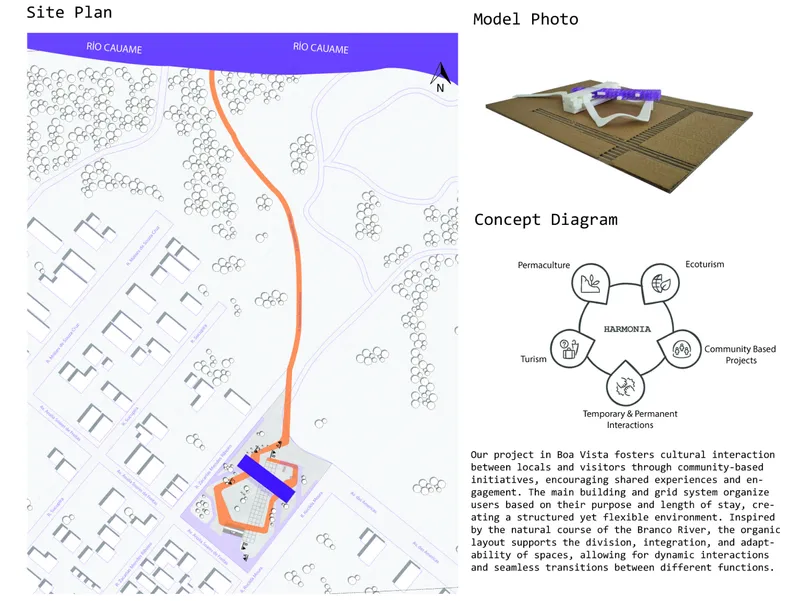
The site plan reveals the project's core organizational move. The sculptural orange pathway flows across the terrain like a ribbon, linking scattered building clusters to the river edge and the existing village context. This is not merely decorative circulation; it functions as the primary connective infrastructure, guiding users through landscape zones and bridging built and natural elements. The organic curvature mirrors the Branco River's course, and the buildings are positioned along this spine according to a logic of temporary versus permanent inhabitation. Visitors cycle through on shorter stays while residents anchor longer-term programs, and the pathway mediates between these two rhythms.
What makes this plan compelling is its refusal to treat architecture and landscape as separate systems. The buildings appear scattered but are in fact organized by the pathway's geometry, creating a gradient of density that loosens as it approaches the river. The concept positions architecture as a catalyst for permaculture initiatives, sustainable tourism, and collective learning, with the spatial layout itself encouraging the overlap between these activities.
Layered Plans and a Twenty-Year Phasing Logic
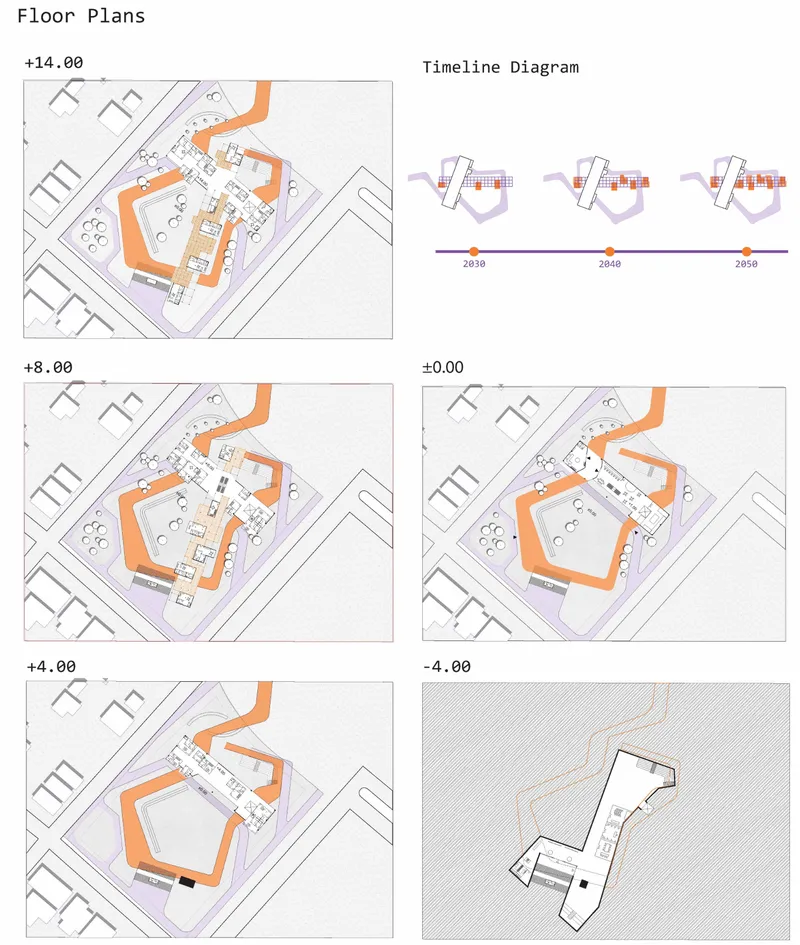
The multi-level floor plans expose a thoughtful vertical hierarchy. At the basement level (-4.00), service and storage areas are integrated into the topography, disappearing into the slope rather than occupying buildable ground. The ground level (±0.00) opens up into public gathering zones, open plazas, and interactive courtyards, while intermediate levels from +4.00 to +14.00 contain residential and communal spaces organized along the project's curved pathways. Central courtyards punctuate the plan, providing daylight, ventilation, and a visual connection between floors.
The phasing diagrams visible alongside these plans are critical. Harmonia is conceived not as a completed object but as a framework that fills in over time, with the 2030 to 2050 timeline allowing the settlement to absorb new social needs, technologies, and ecological shifts. Each phase adds volume without breaking the existing spatial logic, which is a genuinely difficult design problem to solve. The gradient from collective to personal space, from public plaza to private dwelling, remains consistent across phases.
Grid-Frame Volumes Stepping Down a Tropical Slope
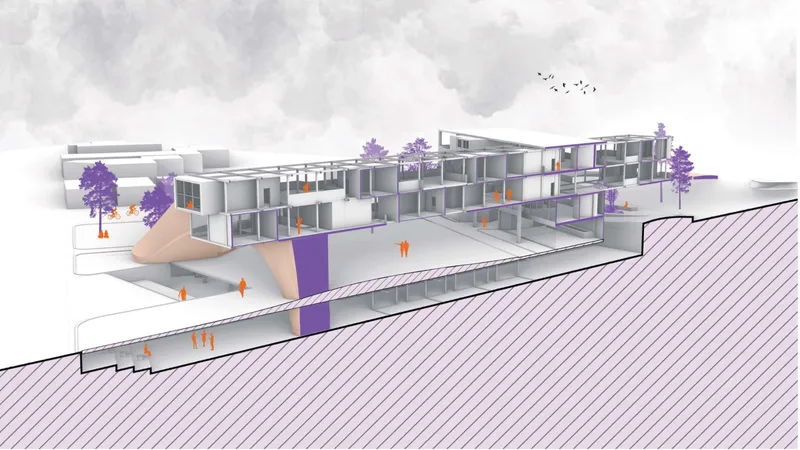
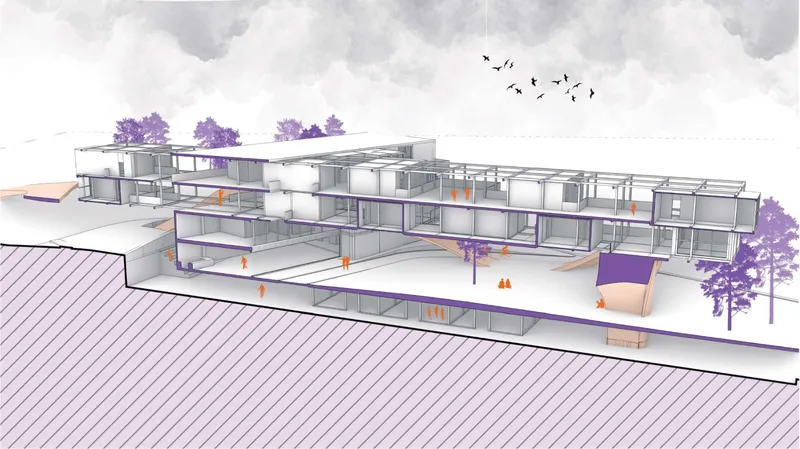
The section drawings reveal the project's structural character most clearly. Residential volumes are organized as open grid-frame structures that step down the sloped terrain, their modular bays stacked and offset to create shaded voids and pedestrian passages beneath. Purple trees punctuate the sections, reinforcing the project's commitment to integrating vegetation not as ornament but as a functional component of climate response. Human figures populate the drawings at every level, suggesting a settlement that is porous and walkable rather than sealed off.
The material palette becomes legible here: lightweight modular systems sit within reinforced concrete frames, achieving both flexibility and durability. The grid allows individual units to be added, removed, or reconfigured without compromising the overall structure. Where the buildings bridge over pedestrian passages on the sloping terrain, the sections show generous clearances that encourage airflow, a passive cooling strategy suited to Boa Vista's tropical climate. The building orientation, informed by a sun diagram study, optimizes daylight penetration while shading outdoor gathering spaces.
Ramped Pathways and the Architecture of Movement
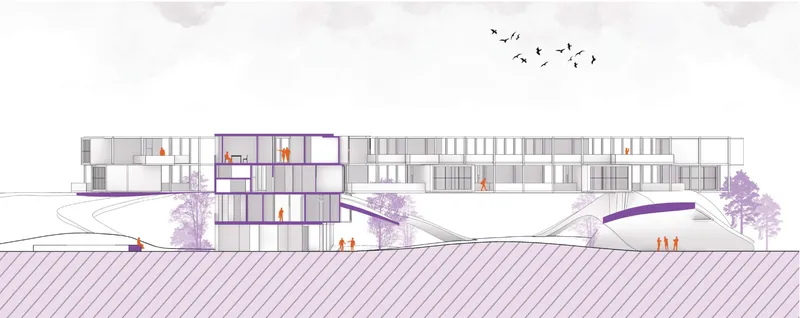
The elevation drawing captures Harmonia as a continuous landscape of movement. Ramped pathways connect interconnected volumes at different levels, and human figures are shown mid-stride, walking between residential clusters, communal terraces, and open ground. The cloudy sky backdrop is a small but effective atmospheric choice, grounding the project in the real weather of northern Brazil rather than the generic blue skies of most competition renderings.
What this elevation communicates is that the architecture works as a three-dimensional circulation network. The ramps are not afterthoughts to satisfy accessibility requirements; they are the primary spatial experience, the means by which residents and visitors navigate the settlement's gradient from public to private. The interconnected volumes read as a hillside village rather than a singular building, which is precisely the point. Harmonia is designed to feel grown, not placed.
Why This Project Matters
Harmonia's strongest contribution is its insistence that sustainable architecture is a temporal problem, not just a material one. The twenty-year phasing strategy forces the designers to think beyond formal composition and into questions of adaptability, governance, and social change. A building that cannot accommodate new programs or new people in 2040 is not truly sustainable, no matter how many solar panels it carries. Sargsyan and Ecemis take this seriously, proposing a grid-frame system that is structurally open to futures they cannot fully predict.
The project also demonstrates a mature understanding of site. Rather than parachuting a geometric form onto the Boa Vista landscape, the designers let the Branco River's curvature, the terrain's slope, and the region's climate shape the architecture from the ground up. The result is a settlement that weaves landscape, culture, and community into a single spatial system. It is the kind of work that treats ecological sensitivity and cultural exchange not as separate agendas but as the same design problem, and proposes a coherent architectural answer.
View the Full Project
About the Designers
Designers: İlayda Sargsyan, Doruk Ecemis
Enter a Design Competition on uni.xyz
uni.xyz runs architecture and design competitions year-round that reward proposals with spatial conviction and real site intelligence.
Project credits: Harmonia by İlayda Sargsyan, Doruk Ecemis Live Green (uni.xyz).


Popular Articles
Popular articles from the community


Juan García Correa, John González and Claudia Rueda Sink a Circular Amphitheater into a Manizales Engineering Building
On the La Nubia campus in Manizales, Colombia, the S1 Building folds labs and offices into a hillside of ramped lawns that double as a campus route.

Jaramillo Van Sluys Arquitectura and Urbanismo Turn a Demolished Registry Lot in Quito into an Orchard Plaza
In Quito's Centro Histórico, a 2,800 m² plaza exposes the San Agustín convent wall and redraws its lost Augustinian orchard in volcanic stone.

Architekt Andreas Gruber Scatters 23 Dark Timber Chalets Across a South Tyrolean Forest Edge
In Molini di Tures, Amonti Chalets breaks a resort into a hamlet of gabled timber houses, with parking, storage and services pushed into the slope.

U.GA Architects Wraps an Oval Rooftop Pool in Curved Board-Formed Concrete on Busan's Jeollidan-gil
In Busan's Jeonpo-dong, a 454 m² mixed-use block stacks a neighborhood facility, guest rooms and an oval rooftop pool inside spiraling concrete walls.

Similar Reads
You might also enjoy these articles

Yenisei Monitoring Center: A Sun-and-Moon Sphere Anchors a Research Campus on Siberia's Great River
In Krasnoyarsk, shifting square blocks, a glazed central sphere and descending window rhythms turn river science into a public spectacle on the Yenisei.
Andretta Artist's Village: A Node-Based Masterplan That Lets the Hills Write the Plan
A cultural landscape strategy for Palampur's artist colony threads studios, residences and stages along a porous spine shaped by the Dhauladhar terrain.
Street Children Rehabilitation Center: A Brick Campus That Eases Children From Street to Safety
A low-rise courtyard campus where learning streets, uthans and shaded verandahs stage a gradual passage from street into protective, family-scale life.
The NEON Culture: A Field of Pavilions Built for the 24-Hour City
Smaran Alva spreads galleries, stages, clubs and markets across a varied site, treating light, sound and ramped movement as the real building materials.


Comments (0)
Please login or sign up to add comments
No comments yet. Be the first to comment!