
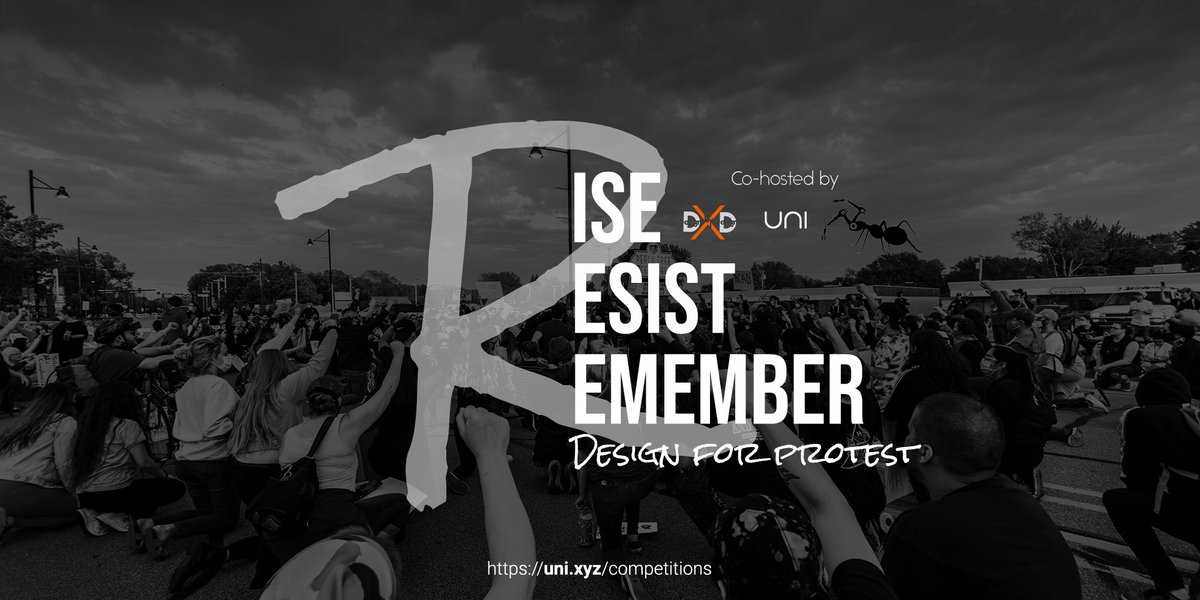
RISE, RESIST, REMEMBER
Design for protest
About
NOTICE: The deadlines for this competition have been extended. Please visit the revised schedule as updated in the Schedule section. Thank you!
Premise
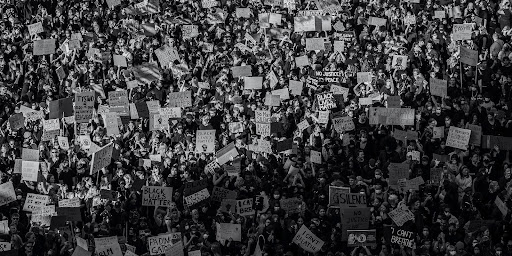 Fig: 1 - Revolutions are the catalyst of human society
‘I protest, therefore I am.’
A protest is a public expression of objection, disapproval, or dissent towards an idea or action, typically a political one. Protests can also be thought of as acts of cooperation in which numerous people cooperate by attending and sharing the potential costs and risks of doing so. History is the witness to the achievements of protests against power by common people.
‘Silence becomes cowardice when occasion demands speaking out the whole truth and acting accordingly.’
The history of protest is as old as the history of human civilization. It is the protests against social, economic, political, religious, and cultural power structures that shaped the idea of freedom and human progress towards the 21st century. The idea of human freedom from bondages of slavery, feudalism, colonialism, capitalism are products of protests.
The ideals of democracy, liberty, equality, and fraternity are the products of different struggles in history. French revolution, October Revolution, anti-colonial struggles, women's movement, and environmental movements in Asia, Africa, The Americas, and Europe revealed that protest power is human progress. The organized and unorganized protest puts pressure and pursues people to accept, accommodate and advance change. In this sense, protest is a powerful instrument of change that shapes our present and assures a better future.
‘Protest beyond the law is not a departure from democracy. It is absolutely essential to it.’
All the ideals of human progress are at crossroads today. The uncertainties of today and questions of a better future confront everyone. The time has come again to celebrate the idea of protest and sketch its significance in the history of human progress. Protests are individual and group expressions of dissent, both in non-violent and violent forms. Some of the common forms of protest are:
-
Conventional: Press conferences, lawsuits, lobbying, etc.
-
Written Demonstration: Petitions, letters, signature campaigns on and offline.
-
Symbolic: Building of temporary/permanent installations before, during, or after a protest.
-
Culture Jamming: Creative displays using street theatre/dance, music/chanting, design/graphic art
-
Solemn and Sacred: Vigils, prayer, candlelight rallies, coffin bearing, etc.
-
Movement in Space: Processional activities such as marches, parades from one spatio-temporal location to another with beginning and ending places sometimes chosen for symbolic reasons.
-
Civil Disobedience: Sit-ins/blockades, bannering, occupation/camping, boycott, etc.
-
Collective Violence and Threats: Pushing, shoving, hitting, punching, verbal threats, looting, throwing objects, damaging property, self-immolation, etc.
-
Internet and Social Networking: Registering grievances through blogging, social networking, viral networking, etc.
Out of the above list, this competition involves three chosen forms of protest (iii., vi., and vii), as outlined in the following section.
The Challenge
The challenge invites designers of all age groups, nationalities, and interests, to unleash their endless imagination and creative abilities, merging it with evolving scientific, technological advances of the present times in order to project a utopia for ‘Design for Protest.’
Within this theme, the competition offers its participants the opportunity to choose from three challenges. You can exercise the choice of working on any one, two, or all three levels of predetermined forms of protest, that correspond to different scales of design interventions:
|
|
|
Scale |
Form of Protest |
Challenge |
|
I |
City-level |
vi. Movement in Space |
Protest March Route Design |
|
|
II |
Neighborhood-level |
vii. Civil Disobedience |
Temporary Settlement Design for Occupation |
|
|
III |
Location-level |
iii. Symbolic |
Memorial/Installation Design |
‘You may never know what results come of your actions, but if you do nothing, there will be no results.’
Seize this opportunity to empathize, understand, resolve and express the lofty phenomenon of protest. The competition serves as a chance to engage with the notion through humane, socially relevant, innovative design ideas. You have the liberty to adopt an imaginary present, past, or future protest in the city you live in or any other existing city of your choice across the globe.
Similar Competitions
Discover competitions you might be interested in



Design challenge to reuse E-waste



Imagining parliament for an unified world.


Design challenge fostering public involvement in wildlife research


Design an urban fitness centre

