
The Black Taj
An incomplete memory of the Mughal Empire
Overview
Winner of the competition
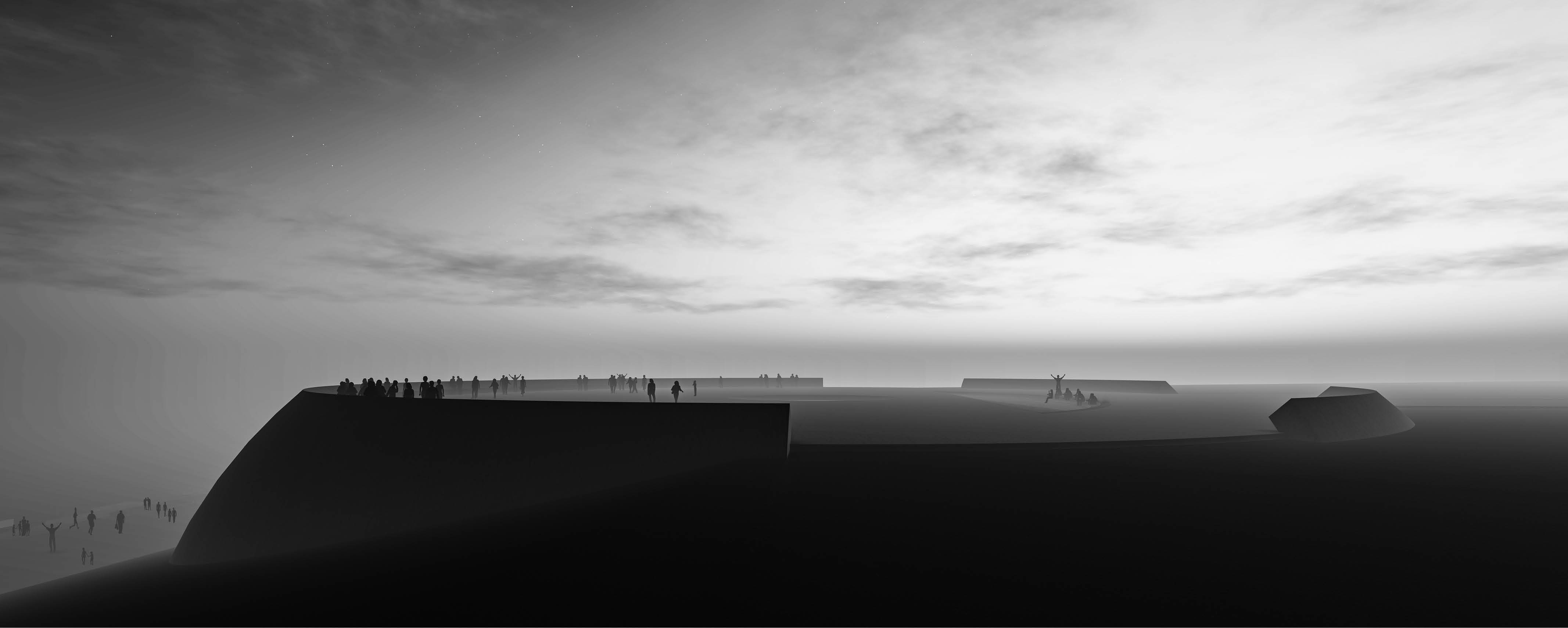
The Black Taj - Presence in Absence - GPPB50
The intervention attempts to celebrate the Taj Mahal as an epitome of architectural poetry and the physical manifestation of a soulful proposition of the mighty builder Shah Jahan. The obsessive insistence in refining the space that is bold yet calm, as a force that is able to penetrate and reveal the mystery of the human condition.
Runner Ups
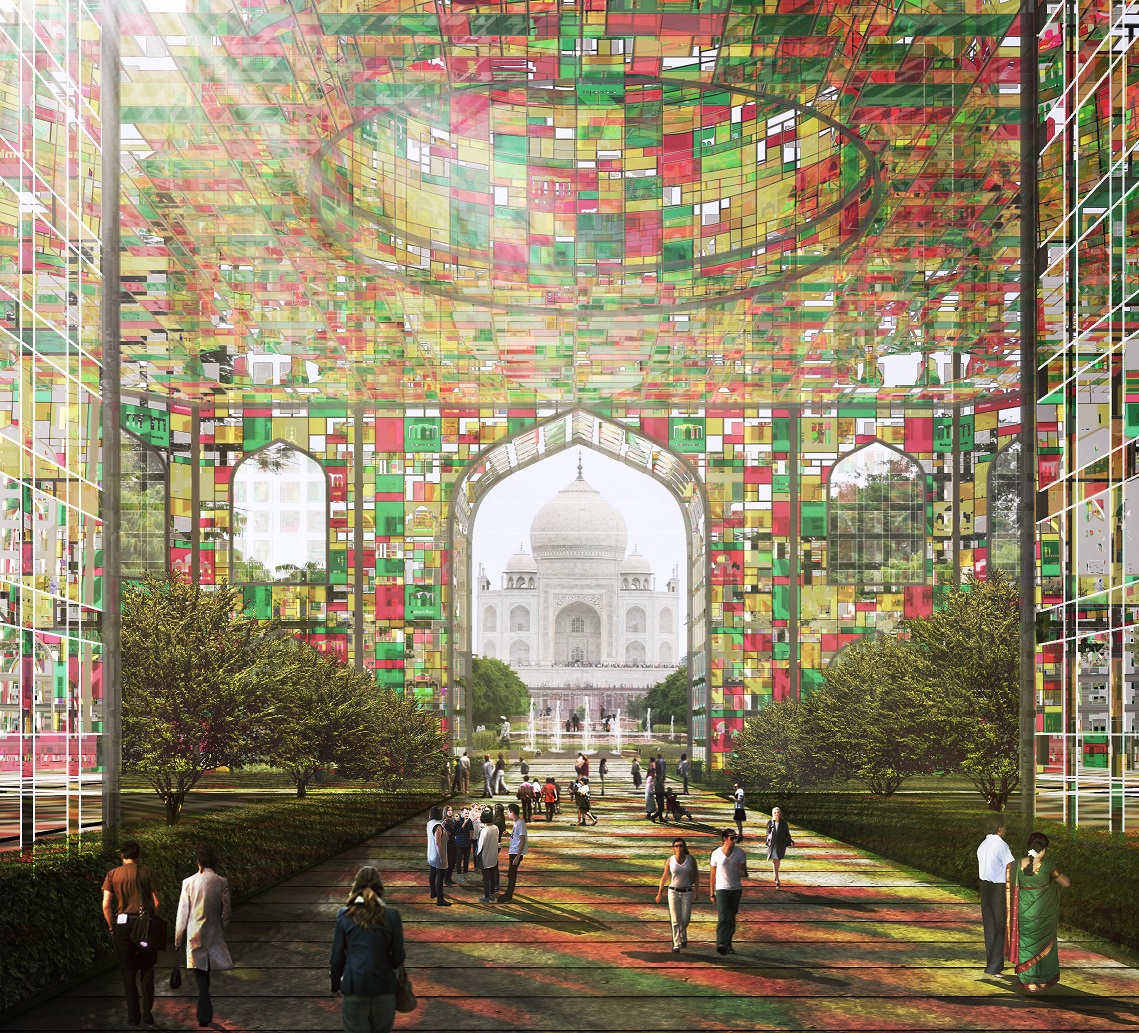
1. Time Capsule
If Tajmahal represents the past then the complementary mass contained between the 4 minarets represent the present, which is the form of the proposed pavilion "Time Capsule". Both the Taj Mahal & the complementary mass form a solid box representing history & Time. The outer shell a pixilated box made of glass as if it's sending a future image of Tajmahal.

2. The Black Taj - The exemplar of Mughal architecture - GACB87
By responding to the Taj, we intend to enhance its beauty of it. This metaphoric approach is envisaged to make people think repeatedly, eventually unfolding different layers of history each time; which will give this built space its timeless quality.
3. The Black Taj - XBST88
The Taj Mahal rises above the banks of the river like a solitary tear suspended on the cheek of time. - Rabindranath Thakur Architecture should speak of its time and place but yearn for timelessness. - Frank Gehry

Because of time’s many particularities, there are a plethora of possibilities on how to explore it. One can say that with respect to our past, everything from our societal, moral and even aesthetical values have also changed. The development in science and technology has changed our outlook and would definitely change the future as well. What was relevant back then is maybe not relevant right now… or even if it is relevant our perceptions have changed. There are plenty of questions forming in our minds. Maybe being able to bring elements from our present to the pastor from the future to the present may help us understand this ever-changing relationship with regards to time.
If so, then what if you get a chance to travel back or forward in time and shape things the way it will suit the timeline? What if you have the chance to infuse those ideas that we have today or travel in the future to comprehend our present better? In the bi-annual theme of UNFUSE, an opportunity is being provided to all the participants to ponder upon all these questions and bring the change that you think is, would have been and will be best for society.
An opportunity to visit back in time or leap into the future to create a new continuum. A multidisciplinary approach to change and influence all that exists in this world irrespective of time. We are devising three platforms to ponder upon this thought.
The wonder of the world
One of the seven wonders of the world ‘The Taj Mahal’ is a monument situated in Agra on the banks of river Yamuna. Considered the most beautiful tomb in the world, the Taj Mahal is a living example of the glory of the Mughal Empire and illustrates the love story of Shah Jahan and Mumtaj Mahal. However, there is a legend behind this story.
A European traveller by the name of Jean Baptiste Tavernier who visited Agra in 1665 first mentioned the idea of The Black Taj in his writings. Tavernier mentioned that Shah Jahan began to build his own tomb on the other side of the river but could not complete it as he was deposed by his own son Aurangzeb.
Taj Mahal, the building has been the source of an admiration transcending culture and geography, and so personal and emotional responses have consistently eclipsed scholastic appraisals of the monument. — Jean-Baptiste Tavernier, one of the first European visitors to the Taj Mahal.
The Black Taj
The Black Taj Mahal (Persian/Urdu: ہایس جات لحم” Black Taj”, also “the 2nd Taj”) was supposed to be a legendary black marble mausoleum that was planned to be built across the Yamuna River directly opposite the Taj Mahal. Mughal emperor Shah Jahan is widely believed to have desired a mausoleum for himself similar to the one he had built-in memory of his deceased wife, Mumtaz Mahal.
There has always been a debate in the archaeological and historian circles regarding the authenticity of the plan for the Black Taj. However in 2009, when the pool of Mehtab Bagh (a garden complex that lies north of the Taj across the river) was recreated for historical studies it showed the Black Taj in reflection clearly.
Does this imply that Shah Jahan already pinned the location himself when he was planning the original Taj?
Legends say that on the completion of the Taj, the Mughal treasury was almost bankrupted. Later after a gruelling battle for the throne, Aurangzeb (the third son of Shah Jahan) seized the reins of the Mughal empire by force, from the eldest son Dara who was the willful choice of Shahjahan. These beautiful Mughal tombs are generally built by the subsequent generation of the Mughal rulers as a token of respect for their fathers.
But due to bitter relationships in the family and almost expended Mughal reserves, the supposed will of Shah Jahan to have his final resting place built on the opposite side of the river connecting by a bridge to Mumtaz, never saw the light of the day. A few historical facts have been mentioned below that can be used for their own interpretations.
Fig. 1: Emperors and their tombs in chronological order.
Born as Prince Shihab-ud-din Muhammad Khurram in the Lahore of 1592, Shah Jahan was the son of Emperor Jahangir. His name Khurram, which means “joyful” in Persian, was given to him by his grandfather Akbar the Great. He displayed great military skills at an early age against numerous enemies including Mewar, the Lodi in the Deccan, and Kangra. This impressed his father so much that Shah Jahan received the title “Shah Jahan Bahadur” from him. He wasn’t just a sharp military leader, but also had an exceptional talent for building and proved it by re-designing buildings within the Agra fort. Among the many titles he had earned, “The Builder of the Marvels” was one that proved the most deserving in the time to come.
The emperor’s love for the finest architecture with impeccable symmetry is very much evident, in almost every single detail which was planned. Be it the Taj, the gardens, or the inspirations where the components of the Taj came from to the execution in reality.
An emperor who never compromised on anything and was the ruler of one of the largest empires that ever existed, did not find a resting place for himself? The apparent section through the river, showing Taj at one end and Mehtab bagh at the other. One end with a built mausoleum and the other with a landscaped garden.

Fig. 2: Schematic section of the river

Fig. 3: Presence of Color white and imbalance.
Colour distribution across the landscape of Taj Complex, with shades of red and brown as a base, with White of Taj as a focal point, within the context.
Brief of the competition
Let us assume the possibility that it was supposed to exist. Now, we vest this opportunity upon YOU, how would you build the Black Taj?
If we TWIST time and build a project that was supposed to be made in the past, however, is being released TODAY, how will YOU as a designer capitalize on this opportunity? By this, we are not conceiving the tomb as the problem, but something much more extensive than that. What we are really looking at is an idea that can exhibit the Mughal contribution in the country right next to ‘the place which frames its summit’. This line of thought can have immense possibilities, challenges & solutions. Here we are eyeing that one single idea, that can complete this tale, to re-gather all these crumbling fragments again and can create an experiential storyline for the people.
A-frame with the sky, the river, the backdrop of the fort behind the Taj Mahal and the world waiting eagerly for your next massive design opportunity.

Fig. 4: A view of the riverfront from the Bukhari Masjid. (Credits: Timestance)
A Memorial, A Relic, An Interpretation, any idea is not too vague if you are able to complete this storyline - or here ‘the missing link’ The stage here is framed by the skies of Agra, the 7th Wonder of the World and the global creative community eagerly waiting for your next massive design opportunity.
Issue/Need
1. Educate: To educate tourists and enthusiasts, about the immense wealth of knowledge of Mughal history. To make this information lucid as well as use architecture to support this function of reaching out to more people.
2. Address: To address the fact that these historic structures and built forms have an expiry. Also, at the same time, the knowledge resources are not only getting diluted but most of it does not reach people which is a major issue.
3. Develop: We are not at all looking at a structure that would be competing with the Taj, or outdo it in any manner. We are looking for outputs that make the whole experience better. In other words, it helps in extending what is there now and adds value to it.
4. Celebrate: Mughal history is an inseparable facet of the subcontinent and its contribution to the world is extraordinary. A building that celebrates this unparalleled legacy is an unspoken necessity of today.
Mughal history in India is restricted to these monuments and in books that are fairly inaccessible to the general public. There are museums, public libraries, art centres, galleries etc. that hold fragments of this reminiscent past but are rarely made to work as a whole. Dissemination of this waning shell of knowledge is a need of the hour. Means to convey this information can also be a part of the design, in addition to architectural aspects of the idea.
Design objectives
The problem has been briefly outlined to see the results in terms of an architectural outcome. Approaches can be varied but are not at all restricted to only the ideas in the design brief.
- Function: Fit and possible.
- Heritage: Respects but not replicates.
- Landmarks: Addresses city and its context.
- Views: Consider the views and settings as a whole.
- Helps Agra: In all possible ways.
- Time: Considering from today to the coming millennia.
Monument/Conservation
- Intersection: Of cultures, dynasties, hierarchy, empire, values, contribution.
- Shall not overpower: The design is in no way a competition to beat Taj.
- Adds value: Brings more value to the table and moreover solves the issue.
- The missing link: Sets in that idea of culmination.
Interpretation
We are looking for radical ideas that satisfy these criteria with one unified outcome. Design decisions that are brave, yet informed. Unconventional, but which makes sense. A string that weaves through all the tiny pieces. Traditional outcomes are accepted but the design is expected as a rejuvenator to the Taj as well as Mughal history and carries it further through the coming centuries.
Site of the competition
The site designated is an equivalent patch of land allocated at the Mehtab Bagh, opposite the Taj Mahal on the banks of the River Yamuna River. The build is supposed to be contained within this site patch only. The pool or landscape of the existing Mehtab Bagh can be levelled or retained as per the design solution proposed. The site boundaries can be taken from the attached DWG file.
Excavation as well as level additions are permitted but shall be backed by feasibility, practicality and strong design justifications. The process of arriving at the final design is quintessential through the product as well as the process. The material pallet, construction technique and landscape elements are kept unrestricted, to allow more experimentation. A literal interpretation of BLACK TAJ is not recommended.
The site area is around 3 Acres (13543sq.m.). Participants are free to use the entire site area. The height shall not be more than the Taj Mahal (73m). Here the rationale will be your ideas for function + program, based on the design approach. The river can be intervened in the highlighted zone by unbuilt means or propositions that deal with it in features like landscape. Bridges connecting Taj are not permitted.
Explore related competition:
Eligibility
- The competition/events/exhibitions/project/publication/presentation is open to anyone (Student & Professionals) who is at least 18-year-old till the last date of registration.
- Anyone who is less than 18 years old may still participate in the competition but must be a part of a team whose leader/at least one member is 18 years or older.
- Employees of UNFUSE/UNIEGIS NETWORK PRIVATE LIMITED/Jury member/Curator/ organizing panel or anyone who is in direct/close relation to them are barred from receiving any prize money, however, they can enter into the competition to project and compete with other designs. Such entries if found are worthy then will be displayed on a separate panel but no award will be given to such entries.
- The competition is open to people of all nationalities and professions (including students)
Similar Competitions
Discover competitions you might be interested in


Design challenge to reuse E-waste

Bring back Drive In's

Illustrate the lost glory of Angkor Wat - Render Challenge

Photograph architecture without architects
